REVIEW 4 major objections 5 minor 42 references
Unsupervised Deep Feature Transfer for Low Resolution Image Classification
T0 review · 4 major / 5 minor · reviewed 2026-08-14 · deepseek-v4-flash
Pith's one-line read The paper claims that a two-layer feature transfer network, supervised only by pseudo-labels from clustering high-resolution features, lifts low-resolution image classification on VOC2007 by about 2 mAP points over plain feature extraction.
desk verdict The idea is simple and honest, but the 2% mAP claim is not established because the model was tuned on the test set; with a proper validation protocol it could be a solid short paper. read the letter →
The pith
A machine-rendered reading of the paper's core claim, the machinery that carries it, and where it could break.
The reading
What carries the argument
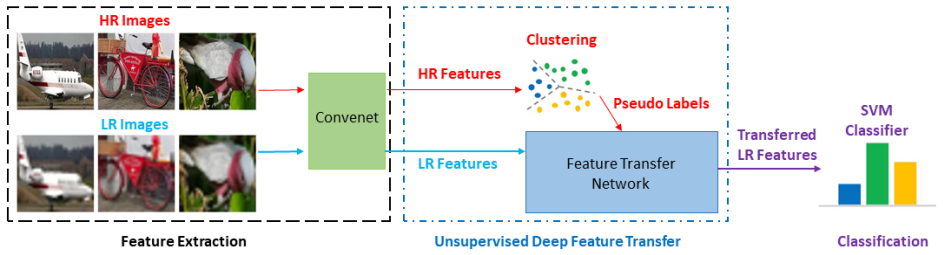
The load-bearing object is the two-layer feature transfer network trained with k-means pseudo-labels. It takes 2048-dimensional pool5 features from a pre-trained ResNet-101, projects them through two fully connected layers (best configuration found by grid search: 4096 neurons then 100 neurons, matching the number of clusters), and is supervised by cluster assignments derived from high-resolution features of the same images. The mechanism works by using the well-separated geometry of high-resolution features as a target structure, then training the transfer network to impose that same geometry on low-resolution features; classification is done afterward with a linear SVM.
What would settle it
Take a low-resolution benchmark with realistic degradations (compression, sensor noise, motion blur) and train the same transfer network on bicubic downsamplings: if the transferred features fail to beat the raw-feature SVM baseline, the reported gain is an artifact of the synthetic protocol. Alternatively, permuting the k-means cluster assignments or changing the number of clusters should destroy the 2-point gain if the pseudo-label geometry is the active ingredient.
Extended reading notes
Core claim
The central claim is that the cluster structure present in high-resolution deep features can be transferred to low-resolution features without using any ground-truth labels for the low-resolution images. K-means clustering of the high-resolution features produces pseudo-labels, and those pseudo-labels supervise a two-layer fully connected network that maps 2048-dimensional low-resolution features into a 100-dimensional space. An SVM trained on the transferred features outperforms an SVM trained on the raw low-resolution features, raising VOC2007 mAP from 78.1% to 80.0%, with gains in 18 of the 20 object classes. The paper interprets this as evidence that the transfer preserves the discriminative data structure of the high-resolution feature space while reorganizing the low-resolution feature space.
Load-bearing premise
The load-bearing premise is that downsampling an image to $32\times32$ pixels and upsampling it back to $224\times224$ produces images that represent the real low-resolution domain; if real low-resolution images contain noise, compression, or blur, the transfer may not generalize.
Editorial extensions
If this is right
- A fixed pre-trained convolutional network can be reused for low-resolution inputs by adding a small transfer network, with no fine-tuning of convolutional filters.
- The performance gap between high- and low-resolution features narrows: on VOC2007 the gap to the high-resolution upper bound falls from 11.0 to 9.1 mAP points.
- The transfer network can serve as a plug-in feature enhancement module for existing deep networks.
- Because the low-resolution images need no labels during training, the method can be applied to unlabeled target domains.
- Per-class gains appear in 18 of the 20 VOC2007 classes, with only bottle and sheep showing small drops.
Reading between the lines
- A natural extension is to test the same pseudo-label transfer on real low-resolution images with compression, sensor noise, or motion blur; the reported gain is demonstrated only on synthetic bicubic downsampling.
- If the number of object categories is unknown in a new target domain, the method requires a rule for choosing the number of k-means clusters, which points toward category discovery rather than fixed-class classification.
- The same two-layer transfer recipe could be applied to other feature-space shifts, such as blurred versus sharp images or synthetic versus real domains, whenever one side forms well-separated clusters.
- Because the transfer network is trained on fixed pre-extracted features, it may be a cheap preprocessing alternative to fine-tuning the whole network when training labels are scarce.
Signed reviews
Editorial analysis
A structured set of objections, weighed in public.
Referee Report
Summary. The paper proposes an unsupervised feature-transfer method for low-resolution image classification. Given a fixed pre-trained convnet, the method extracts high-resolution (HR) and low-resolution (LR) features from the same image collection, clusters the HR features with k-means, and uses the cluster assignments as pseudo-labels to train a two-layer fully connected network that maps LR features to those pseudo-labels. At test time, LR features are passed through this network and classified by an SVM trained on ground-truth labels. On PASCAL VOC2007, with LR images produced by bicubic downsampling to 32x32 and upsampling to 224x224, the method reports 80.0 mAP versus 78.1 for Baseline-LR, a gain of about 1.9 mAP, attributed to better separated transferred features.
Significance. If the reported gain is reliable, the approach is attractive because it is simple, requires no convnet fine-tuning, and can be inserted as a plug-in feature-enhancement module. The manuscript is transparent about its protocol: it provides a full grid-search table, per-class AP values, and tSNE visualizations, which makes the evaluation easy to inspect. However, the central empirical claim is not currently established: the architecture and cluster count are selected by maximizing mAP on the test set, the comparison is against an untuned baseline, there is only one dataset and no error bars, and the low-resolution protocol is entirely synthetic. The strengths are the clarity of the method and the explicit disclosure of the experimental choices; the weaknesses are in the evaluation protocol rather than in the derivation.
major comments (4)
- [Sec 4.3, Table 2] The two architecture hyperparameters N1 and N2 (the latter also fixing the k-means cluster count k) are selected by maximizing mAP on the VOC2007 test set, and the reported result N1=4096, N2=100 is the best entry in the grid. Because Table 2 spans 0.704 to 0.800, the headline 80.0 is a selected maximum and is therefore optimistically biased as an estimate of the method's performance; selection bias alone could account for a substantial part of the 1.9-point gain over Baseline-LR. Please re-run the evaluation with a validation split or nested cross-validation for architecture/cluster selection, and report test performance of the selected configuration, together with the same selection procedure applied to the baseline (e.g., SVM hyperparameters).
- [Sec 4.2] The training schedule is internally inconsistent: with batch size 1,000 and 1,000 epochs on the 5,011-image VOC2007 trainval set, the expected number of iterations is roughly 5,000, not 31,561. As written, the paper does not specify what data the feature transfer network actually saw or whether 'epoch' means something else, so the experiment cannot be reproduced. Please clarify the schedule or correct the numbers.
- [Sec 4.4, Table 1] The evaluation uses a single dataset and a single run with no error bars or significance testing. The reported improvement over Baseline-LR is 1.9 mAP, which is small relative to the spread across the grid in Table 2, so without repeated runs or paired tests across trainval/test splits it is not possible to conclude that the gain is reliable. At minimum, report mean and standard deviation over multiple random initializations and consider additional datasets (e.g., Caltech-101, STL-10) to support the general claim.
- [Sec 4.1] Low-resolution images are generated only by bicubic downsampling to 32x32 and upsampling to 224x224. The introduction motivates the method by real-world privacy/surveillance applications, where low-resolution images typically contain additional degradations such as sensor noise, compression artifacts, or motion blur. The current experiments do not show that the learned transfer generalizes to such inputs; either test on real low-resolution data or explicitly limit the claim to the synthetic bicubic protocol.
minor comments (5)
- [Throughout] The word 'convenet' should be 'convnet' (e.g., abstract, Section 1, Section 2, Section 3.1, Section 4.2).
- [Sec 3.1] 'Multinominal logistic loss' should be 'multinomial logistic loss.'
- [Sec 4.1] The generation of low-resolution images is attributed to [23] (Lin et al., Microsoft COCO), but that reference does not appear to describe this protocol; please cite the correct source or describe the procedure directly.
- [Table 2] Please mark the selected configuration (N1=4096, N2=100) explicitly and note that mAP values are on the test set, as this is the source of the selection-bias concern.
- [Figure 3] The tSNE plots are qualitative; consider adding a quantitative cluster-quality measure (e.g., adjusted Rand index against ground-truth labels) on the transferred features.
Circularity Check
The reported 2% mAP improvement is an optimistic maximum selected on the VOC2007 test set, not a fair unbiased estimate.
-
fitted input called prediction
[Section 4.3 (Table 2) and Section 4.4 (Table 1)]
"We conduct grid search to find the optimal combination for N1 and N2, as shown in Table 2. The number N2 is determined by the number of clusters k for the pseudo labels in k-means. ... We use grid search to find the optimal combination of N1 and N2 for the two-layer feature transfer network by calculating the mean average precision (mAP) on VOC2007 test set. ... We observe that the hyperparameters with N2 = 100 and N1 = 4096 for the neurons give us the best performance. We use the same values in our experiment."
The headline number, Ours 80.0 mAP in Table 1, is the test-set mAP of the single architecture selected in Table 2 because it gave the best performance. The selection criterion is exactly the VOC2007 test mAP, so the reported result is by construction the maximum over the 30 grid configurations, not a fresh unbiased evaluation. The claimed 'boost by about 2%' over Baseline-LR is therefore partly a product of test-set selection of architecture size N1, N2 and implicitly cluster count k=N2, while Baseline-LR is a single untuned 2048-D SVM.
full rationale
No equation in the paper reduces the method's output to its input: pseudo-labels come from k-means on HR features, the two-layer network is trained with those pseudo-labels, and the final SVM uses ground-truth labels. That pipeline is not self-definitional, and there are no load-bearing self-citations or imported uniqueness theorems. The substantive circularity is in the evaluation: Section 4.3 explicitly grid-searches N1 and N2 by maximizing mAP on the VOC2007 test set, then Section 4.4 reports the selected configuration's test mAP as the method's performance. The 80.0 mAP and the 2% gain over Baseline-LR is a selected maximum, so the empirical claim is not established as stated; a fair evaluation would require a validation split or nested cross-validation and error bars. There is also an arithmetic inconsistency in the training schedule (batch size 1,000, epoch 1,000, total iterations 31,561 cannot describe the ~5,000-image trainval set), but that is a reproducibility issue rather than a circularity. The underlying method has independent content, so the circularity is partial rather than total.
Assumptions & free parameters
free parameters (2)
- N1 (first FC layer neurons) =
4096
- N2 (second FC layer neurons, equal to k-means cluster count k) =
100
assumptions (3)
- domain assumption Pre-trained ResNet-101 features on high-resolution images are well separated by class and provide a useful source domain.
- ad hoc to paper K-means cluster assignments on HR features are a valid proxy for class labels for training the transfer network.
- domain assumption The VOC2007 dataset and synthetic downsampling/upsampling protocol adequately represent low-resolution image classification.
Cite this review
Pith. "Pith review of Unsupervised Deep Feature Transfer for Low Resolution Image Classification." pith.science (2026). https://pith.science/paper/PDFQ6COB
@misc{pith2026190810012,
  author       = {Pith},
  title        = {Pith review of: Unsupervised Deep Feature Transfer for Low Resolution Image Classification},
  year         = {2026},
  howpublished = {\url{https://pith.science/paper/PDFQ6COB}},
  note         = {Machine review of arXiv:1908.10012}
}
read the original abstract
In this paper, we propose a simple while effective unsupervised deep feature transfer algorithm for low resolution image classification. No fine-tuning on convenet filters is required in our method. We use pre-trained convenet to extract features for both high- and low-resolution images, and then feed them into a two-layer feature transfer network for knowledge transfer. A SVM classifier is learned directly using these transferred low resolution features. Our network can be embedded into the state-of-the-art deep neural networks as a plug-in feature enhancement module. It preserves data structures in feature space for high resolution images, and transfers the distinguishing features from a well-structured source domain (high resolution features space) to a not well-organized target domain (low resolution features space). Extensive experiments on VOC2007 test set show that the proposed method achieves significant improvements over the baseline of using feature extraction.
Figures


Reference graph
Works this paper leans on
-
[1]
H. Azizpour, A. S. Razavian, J. Sullivan, A. Maki, and S. Carlsson. Factors of transferability for a generic convnet representation. IEEE TPAMI, 38(9):1790–1802, 2016. 2
work page 2016
-
[2]
S. P. Bharati, S. Nandi, Y . Wu, Y . Sui, and G. Wang. Fast and robust object tracking with adaptive detection. In 2016 IEEE ICTAI, pages 706–713. IEEE, 2016. 1
work page 2016
-
[3]
S. P. Bharati, Y . Wu, Y . Sui, C. Padgett, and G. Wang. Real- time obstacle detection and tracking for sense-and-avoid mechanism in uavs. IEEE Transactions on Intelligent Ve- hicles, 3(2):185–197, 2018. 1
work page 2018
- [4]
- [5]
- [6]
-
[7]
C.-C. Chang and C.-J. Lin. Libsvm: a library for support vector machines. TIST, 2(3):27, 2011. 4
work page 2011
-
[8]
T. Chen, I. Goodfellow, and J. Shlens. Net2net: Accel- erating learning via knowledge transfer. arXiv preprint arXiv:1511.05641, 2015. 2
arXiv 2015
Show all 42 references
-
[9]
J. Deng, W. Dong, R. Socher, L.-J. Li, K. Li, and L. Fei-Fei. Imagenet: A large-scale hierarchical image database. In IEEE CVPR, pages 248–255. Ieee, 2009. 1
2009
-
[10]
Everingham, S
M. Everingham, S. M. A. Eslami, L. Van Gool, C. K. I. Williams, J. Winn, and A. Zisserman. The pascal visual object classes challenge: A retrospective. IJCV, 111(1):98–136, Jan
-
[11]
Girshick, J
R. Girshick, J. Donahue, T. Darrell, and J. Malik. Rich feature hierarchies for accurate object detection and semantic segmentation. In IEEE CVPR, pages 580–587, 2014. 1
2014
-
[12]
Goyal, P
P. Goyal, P. Doll´ar, R. Girshick, P. Noordhuis, L. Wesolowski, A. Kyrola, A. Tulloch, Y . Jia, and K. He. Accurate, large minibatch sgd: Training imagenet in 1 hour. arXiv preprint arXiv:1706.02677, 2017. 1
2017 arXiv
-
[13]
Y . Guo, H. Shi, A. Kumar, K. Grauman, T. Rosing, and R. Feris. Spottune: transfer learning through adaptive fine- tuning. In IEEE CVPR, pages 4805–4814, 2019. 2
2019
-
[14]
K. He, G. Gkioxari, P. Doll´ar, and R. Girshick. Mask r-cnn. In IEEE ICCV, pages 2961–2969, 2017. 1
2017
-
[15]
K. He, X. Zhang, S. Ren, and J. Sun. Delving deep into rectifiers: Surpassing human-level performance on imagenet classification. In IEEE ICCV, pages 1026–1034, 2015. 3
2015
-
[16]
K. He, X. Zhang, S. Ren, and J. Sun. Deep residual learning for image recognition. In IEEE CVPR, pages 770–778, 2016. 1, 3
2016
-
[17]
L. He, G. Wang, and Z. Hu. Learning depth from single images with deep neural network embedding focal length. IEEE Transactions on Image Processing, 27(9):4676–4689,
-
[18]
L. He, M. Yu, and G. Wang. Spindle-net: Cnns for monocular depth inference with dilation kernel method. In 2018 24th In- ternational Conference on Pattern Recognition (ICPR), pages 2504–2509. IEEE, 2018. 1
2018
-
[19]
Isola, J.-Y
P. Isola, J.-Y . Zhu, T. Zhou, and A. A. Efros. Image-to-image translation with conditional adversarial networks. In CVPR, pages 1125–1134, 2017. 1
2017
-
[20]
X. Ji, J. F. Henriques, and A. Vedaldi. Invariant informa- tion distillation for unsupervised image segmentation and clustering. arXiv preprint arXiv:1807.06653, 2018. 2
2018 arXiv
-
[21]
Y . Jia, E. Shelhamer, J. Donahue, S. Karayev, J. Long, R. Gir- shick, S. Guadarrama, and T. Darrell. Caffe: Convolutional architecture for fast feature embedding. In ACM Multimedia, pages 675–678. ACM, 2014. 3
2014
-
[22]
Krizhevsky, I
A. Krizhevsky, I. Sutskever, and G. E. Hinton. Imagenet classification with deep convolutional neural networks. In NeurIPS, pages 1097–1105, 2012. 1, 3
2012
-
[23]
T.-Y . Lin, M. Maire, S. Belongie, J. Hays, P. Perona, D. Ra- manan, P. Doll´ar, and C. L. Zitnick. Microsoft coco: Common objects in context. In ECCV, pages 740–755. Springer, 2014. 3
2014
-
[24]
M. Long, Y . Cao, J. Wang, and M. I. Jordan. Learning trans- ferable features with deep adaptation networks. In ICML, pages 97–105, 2015. 2
2015
-
[25]
W. Ma, Y . Wu, Z. Wang, and G. Wang. Mdcn: Multi-scale, deep inception convolutional neural networks for efficient object detection. In ICPR, pages 2510–2515. IEEE, 2018. 1
2018
-
[26]
L. v. d. Maaten and G. Hinton. Visualizing data using t-sne. JMLR, 9(Nov):2579–2605, 2008. 1
2008
-
[27]
S. J. Pan and Q. Yang. A survey on transfer learning. IEEE Transactions on knowledge and data engineering , 22(10):1345–1359, 2010. 2
2010
-
[28]
P. O. Pinheiro, R. Collobert, and P. Dollar. Learning to seg- ment object candidates. In NeurIPS, pages 1990–1998, 2015. 1
1990
-
[29]
S. Ren, K. He, R. Girshick, and J. Sun. Faster r-cnn: Towards real-time object detection with region proposal networks. In NeurIPS, pages 91–99, 2015. 1
2015
-
[30]
Russakovsky, J
O. Russakovsky, J. Deng, H. Su, J. Krause, S. Satheesh, S. Ma, Z. Huang, A. Karpathy, A. Khosla, M. Bernstein, et al. Imagenet large scale visual recognition challenge. IJCV, 115(3):211–252, 2015. 3
2015
-
[31]
Saenko, B
K. Saenko, B. Kulis, M. Fritz, and T. Darrell. Adapting visual category models to new domains. ECCV, pages 213–226,
-
[32]
Tzeng, J
E. Tzeng, J. Hoffman, T. Darrell, and K. Saenko. Simultane- ous deep transfer across domains and tasks. In IEEE ICCV, pages 4068–4076, 2015. 2
2015
-
[33]
Y . Wu, Y . Sui, and G. Wang. Vision-based real-time aerial object localization and tracking for uav sensing system. IEEE Access, 5:23969–23978, 2017. 1
2017
-
[34]
W. Xu, S. Keshmiri, and G. Wang. Stacked wasserstein autoencoder. Neurocomputing, 363:195–204, 2019. 1
2019
-
[35]
W. Xu, S. Keshmiri, and G. R. Wang. Adversarially approx- imated autoencoder for image generation and manipulation. IEEE Transactions on Multimedia, 2019. 1
2019
-
[36]
W. Xu, K. Shawn, and G. Wang. Toward learning a unified many-to-many mapping for diverse image translation.Pattern Recognition, 93:570–580, 2019. 1
2019
-
[37]
W. Xu, Y . Wu, W. Ma, and G. Wang. Adaptively denoising proposal collection for weakly supervised object localization. Neural Processing Letters, pages 1–14, 2019. 1
2019
-
[38]
J. Yang, D. Parikh, and D. Batra. Joint unsupervised learning of deep representations and image clusters. In IEEE CVPR, pages 5147–5156, 2016. 2
2016
-
[39]
Yosinski, J
J. Yosinski, J. Clune, Y . Bengio, and H. Lipson. How transfer- able are features in deep neural networks? In NeurIPS, pages 3320–3328, 2014. 2
2014
-
[40]
Zhang, Y
Z. Zhang, Y . Wu, and G. Wang. Bpgrad: Towards global optimality in deep learning via branch and pruning. In IEEE CVPR, June 2018. 1
2018
-
[41]
P. Zhu, L. Wen, D. Du, X. Bian, H. Ling, Q. Hu, Q. Nie, H. Cheng, C. Liu, X. Liu, et al. Visdrone-det2018: The vision meets drone object detection in image challenge results. In ECCV, pages 0–0, 2018. 1
2018
-
[42]
W. W. Zou and P. C. Yuen. Very low resolution face recogni- tion problem. IEEE TIP, 21(1):327–340, 2011. 1
2011
Reviewed August 14, 2026 · model on record in the stance chip above.
Discussion (0). Continue with ORCID to comment.