REVIEW 3 major objections 6 minor 42 references
Cosmological evolutions in Tsujikawa model of $f(R)$ Gravity
T0 review · 3 major / 6 minor · reviewed 2026-08-14 · deepseek-v4-flash
Pith's one-line read The Tsujikawa model of f(R) gravity fits current cosmological data about as well as ΛCDM while allowing a roughly 20% larger neutrino-mass bound and enhanced matter clustering.
desk verdict A legitimate, incremental fit of the Tsujikawa tanh f(R) model with MGCAMB/MGCosmoMC, undermined by an abstract that contradicts its own body on the direction of the clustering effect; the physics is plausible, the numbers are conditional, and the paper deserves a referee with specific demands. read the letter →
The pith
A machine-rendered reading of the paper's core claim, the machinery that carries it, and where it could break.
The reading
What carries the argument
The engine of the analysis is the scalaron, the massive scalar degree of freedom of f(R) gravity, together with the quasi-static subhorizon form of the modified Poisson equation. For the model $f(R)=R-\lambda R_{\mathrm{ch}}\tanh(R/R_{\mathrm{ch}})$, with $f_R=df/dR$ and $f_{RR}=d^2f/dR^2$, the effective gravitational coupling and gravitational slip are $\mu(k,a)=f_R^{-1}(1+4k^2f_{RR}/(a^2f_R))/(1+3k^2f_{RR}/(a^2f_R))$ and $\gamma(k,a)=\Phi/\Psi=(1+2k^2f_{RR}/(a^2f_R))/(1+4k^2f_{RR}/(a^2f_R))$. Viability requires $f_R>0$ and $f_{RR}>0$; because $f_R<1$ and $f_{RR}>0$, $\mu$ exceeds unity and grows with wavenumber, producing the scale-dependent enhancement of structure. The same functions enter the growth equation and the CMB integrated-Sachs-Wolfe contribution, so they carry both the increased clustering and the relaxed neutrino-mass bound.
What would settle it
Compute the exact linear scalar perturbations for the Tsujikawa model at k=0.2 h/Mpc without the quasi-static approximation and compare the resulting matter transfer function with the μ(k,a)-based growth of Eq. (16); a difference comparable to the claimed 3.9% enhancement would indicate that the effect is an artifact of that approximation.
Extended reading notes
Core claim
The paper's central claim is that the Tsujikawa model $f(R)=R-\lambda R_{\mathrm{ch}}\tanh(R/R_{\mathrm{ch}})$ is observationally competitive with $\Lambda$CDM. In the best fit, the baryon and CDM densities are virtually unchanged, $H_0$ moves from 67.71 to 67.63 km/s/Mpc, and the matter power spectrum is enhanced with scale, reaching 3.9% at $k=0.2\,h/\mathrm{Mpc}$. The neutrino-mass-sum upper limit grows from about 0.20 eV to 0.23 eV, a ~20% relaxation, while $\sigma_8$ rises from 0.811 to 0.859. The paper attributes these shifts to the scalaron-mediated modification of the Poisson equation, encoded in the scale- and time-dependent functions $\mu(k,a)$ and $\gamma(k,a)$, and notes that the model approaches $\Lambda$CDM at large curvature while its dark-energy equation of state crosses the phantom divide at low redshift.
Load-bearing premise
The result assumes that the simplified quasi-static subhorizon formulas for the modified gravitational coupling are accurate at all scales and redshifts used in the fit, in particular at k=0.2 h/Mpc; if the massive scalaron is not in its quasi-static regime there, the predicted power spectrum and the neutrino-mass bound would both shift.
Editorial extensions
If this is right
- The expansion history of the Tsujikawa model is almost indistinguishable from ΛCDM, so future measurements of H(z) or the deceleration parameter alone will not discriminate between them; scale-dependent clustering or low-multipole CMB measurements are needed.
- The roughly 20% wider neutrino-mass ceiling means that cosmological neutrino-mass constraints are model-dependent: in f(R)-type gravity, the bound weakens unless the clustering enhancement is independently calibrated.
- A 3.9% enhancement in the linear matter power spectrum at k≈0.2 h/Mpc translates into percent-level differences in predicted weak-lensing shear and galaxy-cluster counts, offering a testable signature for ongoing surveys.
- The earlier deceleration-to-acceleration transition (z=0.688 versus 0.649) implies a slightly longer dark-energy-dominated phase, which could be probed by supernova distances at z<1, though current data leave this unconstrained.
- The scalaron mass at the current background density sets a low-frequency cutoff for the scalar gravitational-wave mode around 10^-17 Hz, a signature that could be accessible to future stochastic gravitational-wave searches.
Reading between the lines
- The abstract says that matter-density fluctuation is 'suppressed' while the body and conclusions consistently report a scale-dependent enhancement, so readers should rely on the quantitative statements, which give a +3.9% amplitude at k=0.2 h/Mpc.
- The fit barely constrains the model parameter λ^{-1} (best fit 0.665 with a 1σ range extending from below 0.12 to above 1.0), suggesting that current data cannot pin down the functional form of f(R); this is an editorial inference from Table II.
- Because the relaxation of the neutrino bound is driven by the scale-dependent μ(k,a), a measurement of the matter power spectrum at high k with percent-level accuracy could separate the two degenerate effects, a test the paper does not itself propose.
- The same quasi-static machinery applies to other viable f(R) forms; comparing several models on identical data would reveal which functional choices current data actually prefer, a comparison the paper only gestures at.
Signed reviews
Editorial analysis
A structured set of objections, weighed in public.
Referee Report
Summary. The paper studies the Tsujikawa f(R) gravity model, f(R)=R−λR_ch tanh(R/R_ch), using the MGCosmoMC/MGCAMB pipelines with a dynamically evolving background (as opposed to fixing the background to ΛCDM). The authors fit cosmological parameters and the model parameter λ^{-1} to current cosmological data, then present the resulting background evolutions (Hubble parameter, deceleration parameter, dark-energy equation of state, scalaron mass) and linear perturbations (matter power spectrum, CMB spectrum) compared with ΛCDM. Their main reported findings are that the TM is very close to ΛCDM in the background, that the matter clustering amplitude is larger in the TM than in ΛCDM at k>0.001 (3.9% larger at k=0.2), and that the constraint on the sum of neutrino masses is relaxed by about 20%. They also note a higher deceleration-to-acceleration transition redshift and phantom crossing of the dark-energy equation of state.
Significance. If the results hold, the paper provides a useful application of the dynamical-background MGCosmoMC framework to a less-studied viable f(R) model, quantifying how the Tsujikawa model shifts the matter power spectrum and the neutrino-mass constraint relative to ΛCDM. The use of an existing, publicly available Monte Carlo pipeline is a strength, and the explicit comparison of background quantities (H, q, w_DE) with ΛCDM is clearly presented. However, the significance is currently limited by a direct internal contradiction between the abstract and the body regarding whether matter fluctuations are suppressed or enhanced, and by the absence of a validation of the quasi-static approximation on which the headline numerical claims rest. The paper's quantitative conclusions are therefore not yet fully supported.
major comments (3)
- [Abstract; Section III (Fig. 6); Section V] The abstract states that 'the matter density fluctuation is suppressed' in the TM, but the body of the paper reports the opposite: Section III states that matter density fluctuations are enhanced because μ(k,a)>1, Fig. 6 shows Δδm>0 for all k>0.001, and Section V quotes a 3.9% larger amplitude at k=0.2. Table II also gives σ8(TM)=0.85866 versus σ8(ΛCDM)=0.81101, consistent with enhancement. This is a direct internal contradiction in a central claim. The abstract must be corrected; the body of the paper appears to be the correct result.
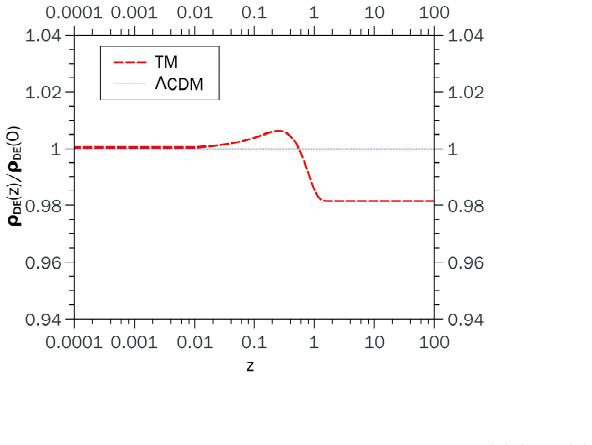
- [Section III, Eqs. (14)-(15) and Fig. 6] The headline quantitative results—the 3.9% enhancement at k=0.2 and the 20% relaxed neutrino-mass bound—are computed with MGCAMB's quasi-static subhorizon μ(k,a) and γ(k,a), which assume k^2/a^2 ≫ H^2 and neglect time derivatives of the perturbed scalaron. The paper shows in Fig. 5 that the scalaron mass grows and oscillates at high z, and in Fig. 3 that ρDE evolves non-monotonically at z<1, but it never verifies that the quasi-static approximation is accurate at k=0.2 h/Mpc over the redshifts that contribute to the power-spectrum normalization. No cross-check against a full linear Boltzmann solver (e.g., hi_class or MGCLASS) or against the exact k=0 equation (17) is provided. Because the claimed differences are at the few-percent level, an uncontrolled approximation error could dominate the signal. Please add a validity test or quantify the error.
- [Section IV, Table II] The observational data sets used in the MGCosmoMC analysis are not identified; the text only says 'the latest data from the cosmological observations.' The constraints in Table II, including the 20% neutrino-mass statement, depend critically on the likelihood combination (e.g., Planck TTTEEE+lowl+lowE, BAO, JLA, H0). Without specifying the exact data sets and versions, the results are not reproducible and cannot be assessed. Please list all likelihoods used.
minor comments (6)
- [Section II, Eq. (9)] The equation of state is defined as wDE = ρDE/PDE, which is inverted; it should be wDE = PDE/ρDE. As written, Eq. (12) using (1+3wDE) would give an incorrect deceleration parameter.
- [Section IV, Table I/II] The best-fit λ^{-1}=0.6646 has an upper error bar of +0.33544, which is truncated at the prior boundary of 1.0. The posterior for λ^{-1} is very broad, spanning most of the prior; the statement in Section V that the TM model parameter is 'more sensitive' than the exponential model should be reconsidered, since a broad posterior does not by itself imply sensitivity.
- [Section III, Fig. 6 caption] The caption defines Δδm = (δ_TM − δ_LCDM)/δ_LCDM, but the text refers to the 'matter power perturbation'. Please clarify whether δm is the matter density contrast or the power spectrum amplitude, and specify the redshift and k units.
- [Section III] The statement 'the singularity problem is not avoidable because of the generic property of the viable f(R) models' is presented without a proof or reference; for the TM, the high-z oscillation is visible in Fig. 5, but 'not avoidable' is stronger and should be justified.
- [Section V and throughout] There are typos: 'strenghen' should be 'strengthened', 'Possion' should be 'Poisson', and 'the behaves of the deceleration parameter' should be 'the behavior'. The email address in the abstract appears to be a LaTeX leftover and should be removed.
- [Reference [12]] Reference [12] is cited as 'Tsujikawa, Phys. Rev. D 77, 023507 (2008)' while the text says 'first proposed by Tsujikawa in 2007'; please verify the original publication year.
Circularity Check
No significant circularity: the TM background and perturbation equations are derived from the f(R) action, and the reported 3.9% amplitude and 20% neutrino-mass statements are Monte Carlo posterior comparisons, not predictions built from their own targets.
full rationale
The derivation chain is self-contained. The action (1) is the input; the modified Friedmann equations (5)-(6), dark-energy density and pressure (7)-(8), and the y_H equation (10) follow by variation and algebraic definition. The modified Poisson and slip parameters μ(k,a) and γ(k,a) in Eqs. (14)-(15) are the standard quasi-static subhorizon reduction of the f(R) field equations, quoted explicitly in terms of f_R and f_RR; they are not obtained by fitting the 3.9% matter-power enhancement or the relaxed Σmν bound reported in Sec. V. The 3.9% and roughly 20% statements are comparisons of MGCosmoMC posterior fits (Tables I-II) using external cosmological data; the fitted λ^{-1} and cosmological parameters are inputs to the evolution, and the reported constraints are outputs, but neither side is defined in terms of the other. The paper does cite prior works by overlapping authors (e.g., [17], [23], [24], [37]) for the numerical method and for the phantom-crossing behavior, but these citations supply a peer-reviewed implementation and standard formulas that are also written out in the text; the central quantitative claims do not reduce to a self-citation chain or to a renamed input. The quasi-static approximation in Eqs. (14)-(15) is not validated against a full Boltzmann solver at k=0.2 h/Mpc, but that is a robustness and correctness concern, not a circularity: an unvalidated approximation is not the same as assuming the target result. No step equates a claimed prediction with its own input by construction.
Assumptions & free parameters
free parameters (3)
- Model parameter λ^{-1} =
0.6646 with 68% CL [-0.5436, +0.3354]
- Sum of neutrino masses Σmν =
0.1039 eV with 68% CL upper 0.2268 eV
- Standard cosmological parameters (Ω_b h^2, Ω_c h^2, n_s, ln(10^10 A_s), τ, 100θMC, H0) =
See Table II
assumptions (5)
- standard math FLRW metric and modified Einstein field equations (Eqs. (3)-(6)) describe the background universe.
- domain assumption The viability conditions f_R>0, f_RR>0, and the existence of a late-time de Sitter solution (Section II) are imposed.
- domain assumption The quasi-static subhorizon approximation for linear perturbations (Section III, Eqs. (14)-(16)) is valid for all scales used in the fit.
- ad hoc to paper The background evolution is solved by integrating Eq. (10) in decreasing redshift with initial conditions from the MCMC; the numerical scheme is stable.
- domain assumption MGCAMB and MGCosmoMC correctly implement the modified gravity equations with the dynamical background.
Cite this review
Pith. "Pith review of Cosmological evolutions in Tsujikawa model of $f(R)$ Gravity." pith.science (2026). https://pith.science/paper/BXA3EJF5
@misc{pith2026190810061,
  author       = {Pith},
  title        = {Pith review of: Cosmological evolutions in Tsujikawa model of $f(R)$ Gravity},
  year         = {2026},
  howpublished = {\url{https://pith.science/paper/BXA3EJF5}},
  note         = {Machine review of arXiv:1908.10061}
}
abstract
We concentrate on the cosmological properties in the Tsujikawa model (TM) of viable $f(R)$ gravity with the dynamical background evolution and linear perturbation theory by using the CosmoMC package. We study the constraints of the cosmological variables along with the model parameter from the current observational data. In particular, we show that the matter density fluctuation is suppressed and the constraint of the neutrino mass sum is relaxed in the TM, which are similar to other viable $f(R)$ models. In addition, we discuss the parameters of the deceleration and equation of state for dark energy in the TM and compare them with those in the $\Lambda$CDM model.
Figures


Figures from the paper (5 more)


Reference graph
Works this paper leans on
- [17]
-
[1]
L. Amendola and S. Tsujikawa, Dark Energy : Theory and Observations, (Cambridge Univer- sity Press, 2015)
work page 2015
-
[2]
Weinberg, Rev
S. Weinberg, Rev. Mod. Phys. 61, 1 (1989)
1989
-
[3]
Weinberg, Gravitation and Cosmology , (Wiley and Sons, New York, 1972)
S. Weinberg, Gravitation and Cosmology , (Wiley and Sons, New York, 1972)
work page 1972
-
[4]
J. P. Ostriker and P. J. Steinhardt, astro-ph/9505066
-
[5]
N. Arkani-Hamed, L. J. Hall, C. F. Kolda and H. Murayama, P hys. Rev. Lett. 85, 4434 (2000)
work page 2000
-
[6]
P. J. E. Peebles and B. Ratra, Rev. Mod. Phys. 75, 559 (2003)
2003
-
[7]
E. J. Copeland, M. Sami and S. Tsujikawa, Int. J. Mod. Phys . D 15, 1753 (2006)
work page 2006
Show all 42 references
-
[8]
M. Li, X. D. Li, S. Wang and Y. Wang, Commun. Theor. Phys. 56, 525 (2011)
2011
-
[9]
De Felice and S
A. De Felice and S. Tsujikawa Living Rev. Rel. 13, 3 (2010)
2010
-
[10]
Hu and I
W. Hu and I. Sawicki, Phys. Rev. D 76, 064004 (2007)
2007
-
[11]
A. A. Starobinsky, JETP Lett. 86, 157 (2007)
2007
-
[12]
Tsujikawa, Phys
S. Tsujikawa, Phys. Rev. D 77, 023507 (2008)
2008
-
[13]
Zhang, Phys
P. Zhang, Phys. Rev. D 73, 123504 (2006); B. Li and M. C. Chu, ibid. 74, 104010 (2006); R. Bean, D. Bernat, L. Pogosian, A. Silvestri and M. Trodden, ibid. 75, 064020 (2007); P. J. Zhang, ibid. 76, 024007 (2007); P. Zhang, M. Liguori, R. Bean and S. Dodelson , Phys. Rev. Lett....
2006
-
[14]
Cognola, E
G. Cognola, E. Elizalde, S. Nojiri, S. D. Odintsov, L. Se bastiani and S. Zerbini, Phys. Rev. D 77, 046009 (2008)
2008
-
[15]
E. V. Linder, Phys. Rev. D 80, 123528 (2009)
2009
-
[16]
Bamba, C
K. Bamba, C. Q. Geng and C. C. Lee, JCAP 1008, 021 (2010)
2010
-
[18]
A. Ali, R. Gannouji, M. Sami and A. A. Sen, Phys. Rev. D 81, 104029 (2010)
2010
-
[19]
L. Yang, C. C. Lee, L. W. Luo and C. Q. Geng, Phys. Rev. D 82, 103515 (2010). 14
2010
-
[20]
B. Hu, M. Raveri, N. Frusciante and A. Silvestri, Phys. R ev. D 89, 103530 (2014)
2014
-
[21]
Raveri, B
M. Raveri, B. Hu, N. Frusciante and A. Silvestri, Phys. R ev. D 90, 043513 (2014)
2014
-
[22]
de Martino, M
I. de Martino, M. De Laurentis and S. Capozziello, Unive rse 1, 123 (2015)
2015
-
[23]
C. Q. Geng, C. C. Lee and J. L. Shen, Phys. Lett. B 740, 285 (2015)
2015
-
[24]
C. Q. Geng, C. C. Lee and S. Lin, Astrophys. Space Sci. 360, 21 (2015)
2015
-
[25]
B. Li, G. B. Zhao, R. Teyssier and K. Koyama, JCAP 1201, 051 (2012)
2012
-
[26]
Puchwein, M
E. Puchwein, M. Baldi and V. Springel, Mon. Not. Roy. Ast ron. Soc. 436, 348 (2013)
2013
-
[27]
Lombriser, B
L. Lombriser, B. Li, K. Koyama and G. B. Zhao, Phys. Rev. D 87, no. 12, 123511 (2013)
2013
-
[28]
Llinares, D
C. Llinares, D. F. Mota and H. A. Winther, Astron. Astrop hys. 562, A78 (2014)
2014
-
[29]
B. P. Abbott et al. [LIGO Scientific and Virgo Collaborations], Phys. Rev. Lett . 116, 061102 (2016)
2016
-
[30]
Liu et al
T. Liu et al. , Phys. Rev. D 98, 083023 (2018)
2018
-
[31]
Jana and S
S. Jana and S. Mohanty, Phys. Rev. D 99, 044056 (2019)
2019
-
[32]
Kase and S
R. Kase and S. Tsujikawa, Int. J. Mod. Phys. D 28, 1942005 (2019)
2019
-
[33]
Hojjati, L
A. Hojjati, L. Pogosian and G. B. Zhao, JCAP 1108, 005 (2011)
2011
-
[34]
Lewis, A
A. Lewis, A. Challinor and A. Lasenby, Astrophys. J. 538, 473 (2000)
2000
-
[35]
Lewis and S
A. Lewis and S. Bridle, Phys. Rev. D 66, 103511 (2002)
2002
-
[36]
G. B. Zhao, L. Pogosian, A. Silvestri and J. Zylberberg, Phys. Rev. D 79, 083513 (2009)
2009
-
[37]
Bamba, C
K. Bamba, C. Q. Geng and C. C. Lee, JCAP 1011, 001 (2010)
2010
-
[38]
C. C. Lee, C. Q. Geng and L. Yang, Prog. Theor. Phys. 128, 415 (2012)
2012
-
[39]
L. Yang, C. C. Lee and C. Q. Geng, JCAP 1108, 029 (2011)
2011
-
[40]
Tsujikawa, Phys
S. Tsujikawa, Phys. Rev. D 76, 023514 (2007)
2007
-
[41]
C. P. Ma and E. Bertschinger, Astrophys. J. 455, 7 (1995)
1995
-
[42]
Y. S. Song, W. Hu and I. Sawicki, Phys. Rev. D 75, 044004 (2007) doi:10.1103/PhysRevD.75.044004 [astro-ph/0610532]. 15
2007 arXiv
Reviewed August 14, 2026 · model on record in the stance chip above.
Discussion (0). Continue with ORCID to comment.