REVIEW 2 major objections 5 minor 35 references
A hybrid parametric-deep learning approach for sound event localization and detection
T0 review · 2 major / 5 minor · reviewed 2026-08-14 · deepseek-v4-flash
Pith's one-line read A hand-crafted parametric spatial-audio front end, and not a larger deep network, is what cuts direction-of-arrival error by a factor of 2.6 in this SELD system.
desk verdict Useful hybrid SELD architecture, but the headline DOA improvement is entangled with a frame-recall drop that needs a matched-recall check before being taken at face value. read the letter →
The pith
A machine-rendered reading of the paper's core claim, the machinery that carries it, and where it could break.
The reading
What carries the argument
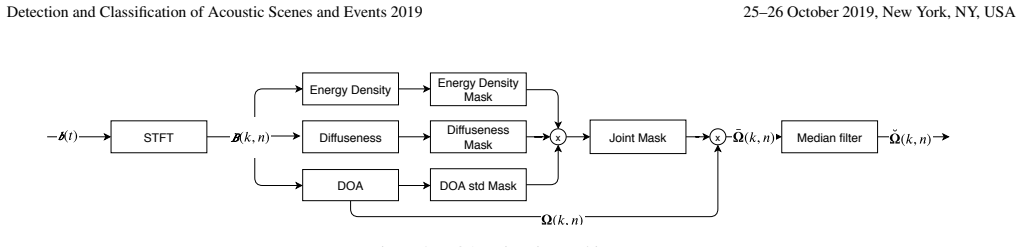
The load-bearing mechanism is the instantaneous active intensity vector $\mathbf{I}(k,n) = -\frac{1}{Z_0}\Re\{[B_x(k,n), B_y(k,n), B_z(k,n)]B_w(k,n)^*\}$, computed from the first-order ambisonic signal, whose direction $\Omega(k,n)=[\phi(k,n),\theta(k,n)]$ is the raw direction-of-arrival estimate at each time-frequency bin. Three binary masks (energy density, diffuseness, DOA variance) and a median filter discard bins that do not carry direct-sound information; an association step resamples and clusters the surviving DOAs into frame-level events with onsets, offsets, and locations; and a first-order hypercardioid beamformer $\tilde{b}_S(t) = \mathbf{Y}(\Omega_S)\mathbf{b}^\intercal(t)$ produces a monophonic estimate of each event's signal. The deep back end is then only a monophonic event classifier, which is why the whole network stays at about 175k weights and why the paper can frame classification as multi-class rather than multi-label.
What would settle it
Retrain the same CRNN on signals produced by the real, non-ideal front end during the development splits and compare evaluation SED scores; if using real front-end output for training raises F or lowers ER substantially, then the ideal-front-end training assumption, rather than the front end itself, is the bottleneck.
Extended reading notes
Core claim
The paper's central claim is that the SELD problem can be split so that a hand-designed parametric front end performs DOA estimation, event segmentation, and beamforming, leaving the deep network the single job of classifying the separated monophonic event signals. Using first-order ambisonic input, the front end computes per-time-frequency-bin DOA from the active intensity vector, cleans it with energy-density, diffuseness, and DOA-variance masks plus a median filter, groups the estimates into events, and beams each event with a virtual hypercardioid. A CRNN with roughly 175k weights then classifies the event's log-mel patch into one of 11 classes. On the DCASE2019 evaluation set the authors report DOA error falling from 24.6 degrees (baseline) to 9.3 degrees while event detection scores remain comparable (ER 0.29 versus 0.28; F 82.1% versus 85.4%). They take this as evidence that parametric spatial analysis can substantially improve localization in SELD without requiring a larger model.
Load-bearing premise
The whole pipeline is trained on an ideal front end whose event locations and activation times come from ground truth, but at test time it is run on the real front end's imperfect estimates, and the paper assumes that this difference is not large enough to break the system.
Editorial extensions
If this is right
- If the claim holds, localization accuracy in SELD can be improved without adding network capacity; the gain comes from the signal-processing front end, not from more learned parameters.
- The decomposition into DOA, association, beamforming, and classification makes the SELD problem modular: each stage can be improved and tested independently, and the classifier is relieved of the multi-label burden.
- The front end's frame recall becomes the critical bottleneck: the ideal-front-end row (ER 0.08, F 93.2%) shows that fixing the association step is the highest-leverage next move.
- The roughly 175k-weight result implies that competitive SELD does not require the multi-million-weight ensembles used by many challenge systems.
Reading between the lines
- Editorial inference: the same parametric front end could be used as a teacher to train a learned DOA estimator, which might recover the ideal-front-end conditions used in training and remove the distribution shift that costs frame recall.
- Editorial inference: closing the loop by feeding classifier posteriors back into the association stage, as the baseline's multi-task design effectively does, is a direct test of whether the low frame recall is fixable without sacrificing the DOA gain.
- Editorial inference: the pattern seen across challenge submissions, that parametric preprocessing methods grouped lower DOA error, suggests the hybrid recipe may transfer to other array geometries where a parametric estimator of the sound field exists.
- Editorial inference: the system's reliance on overlap assumptions makes it worth testing on denser polyphonic scenes where source counting errors would dominate.
Signed reviews
Editorial analysis
A structured set of objections, weighed in public.
Referee Report
Summary. The paper presents a hybrid system for sound event localization and detection (SELD) in the DCASE2019 Task 3 challenge. The method splits the problem into a parametric front-end, which estimates DOAs from first-order ambisonic signals via active-intensity analysis, applies association and grouping heuristics to form events, and beamforms monophonic event signals, and a CRNN back-end that classifies each event into one of 11 classes. The front-end also supplies event onsets and offsets, so the back-end solves a monophonic multi-class problem rather than a multi-label frame-wise one. On the DCASE2019 evaluation set, the proposed system reduces DOA error from 24.6 to 9.3 degrees relative to the baseline, at the cost of a 10-point drop in frame recall (75.8% vs. 85.7%), while SED metrics remain comparable (ER 0.29 vs. 0.28, F 82.1% vs. 85.4%). The overall SELD score is slightly worse on evaluation (0.1907 vs. 0.1764). The classifier is trained on ideal front-end outputs built from groundtruth DOA and activity annotations, then tested on the real front-end output.
Significance. If the reported localization gain is robust, the paper makes a useful contribution: it demonstrates that a low-complexity parametric spatial-analysis front-end can beat a joint CRNN baseline on DOA estimation by a large margin while using only roughly 175k weights, far fewer than many challenge submissions. The work is also reproducible in principle: the code is openly available and the evaluation uses a public benchmark with standard metrics. The central weakness is that the headline DOA improvement is entangled with a substantial drop in frame recall, so the improvement may partly reflect the system withholding estimates on difficult frames rather than genuinely better localization. The train/test distribution shift between ideal and real front-end outputs is acknowledged but not analyzed quantitatively, and this matters for the claim that the SED performance transfers. These issues are fixable with additional experiments, so the paper's core idea remains promising.
major comments (2)
- [Section 4, Table 2] The headline claim of a factor-2.6 reduction in DOA error (24.6 to 9.3 degrees on the evaluation set) is confounded by the simultaneous 10-percentage-point drop in frame recall (85.7% to 75.8%). Under the DCASE metrics, DOA error is computed over the frames in which the system actually produces DOA estimates, while frame recall penalizes frames where sources are missed entirely. A system that emits estimates only on easy, high-SNR frames can therefore report a lower DOA error without truly localizing better. The paper itself states in Section 4 that the low FR is due to the association step and that it severely impacts back-end performance. To support the localization claim, the authors should report DOA error on matched frames where both the baseline and the proposed system produce estimates, or otherwise show that the DOA error gain persists as a function of recall. Without this, the factor-2.6 improvement may be an artifact of selectivity rather than a genuine localization advantage.
- [Section 3.3, Table 2] The back-end classifier is trained exclusively on the output of an ideal front-end that uses groundtruth DOA and activation times, but at test time it is applied to the real front-end output, which contains DOA estimation errors, missing events, and source leakage. The development-set results in Table 2 show a large gap between the ideal-front-end condition (ER 0.08, F 93.2%) and the real-front-end condition (ER 0.32, F 79.7%), confirming a substantial distribution shift. The paper's claim that the system achieves SED performance comparable to the baseline depends on the classifier transferring to this shifted distribution, yet the manuscript provides no analysis of how specific front-end errors (missed events, poor association, beamformer leakage) affect classification, and no mitigation such as fine-tuning on real front-end outputs or data augmentation from the real front-end. The authors should either quantify the transfer explicitly or temper the claim that the proposed pipeline is a generally applicable SELD solution.
minor comments (5)
- [Section 2.2, Eq. (5)] The text says 'delaying event onsets in frames where o(m) > 2', but Eq. (5) defines o(m) as taking only the values 1 or 2. The condition is therefore unreachable; either the definition or the threshold (possibly o(m) > 1) is a typo and should be corrected for reproducibility.
- [Section 4] The sentence 'This is probably due to the complexity added by the association step [6]' cites reference [6], which is the baseline CRNN SELD paper and does not describe association-grouping heuristics. Please cite an appropriate source or rephrase.
- [Figure 5] In grayscale printing, the hatched versus non-hatched bars in Figure 5a are difficult to distinguish. Please use distinct colors or add direct labels to the figure.
- [Reference [18]] The title of reference [18] contains the typo 'uetection'; it should read 'detection'.
- [Section 3.3] The paper says predictions are made at the event level, but also that patch-level predictions are aggregated with the geometric mean to produce a clip-level prediction. Please clarify how event-level predictions are derived from the patch-level probabilities, including how variable-length events are handled.
Circularity Check
No significant circularity: the central DOA-error reduction is an external-benchmark result, not a reduction to fitted inputs or self-citations.
full rationale
The paper's central claim is an empirical comparison on the DCASE2019 Task 3 evaluation set (Table 2), using the challenge's official metrics. The parametric front-end parameters are selected once on the development folds and then applied to the held-out evaluation set; the CRNN is trained on development folds and evaluated on the evaluation set. The 'ideal front-end' row is explicitly an ablation using ground-truth annotations, not a disguised prediction. Self-citations [19], [24], [27] support auxiliary techniques (mixup, noisy labels, shallow fusion) and are not load-bearing for the localization result. No equation reduces a predicted quantity to a fitted input, and no uniqueness theorem or definitional equivalence is invoked. The lower frame recall is a correctness and interpretation concern, not circularity.
Assumptions & free parameters
free parameters (7)
- overlapping std threshold sigma_max =
10 degrees
- grouping maximum angle dANGLE_max =
20 degrees
- grouping maximum frame distance dFRAME_max =
20 frames
- event minimum length =
8 frames
- diffuseness mask threshold Psi_max =
0.5
- mixup hyper-parameter alpha =
0.1
- log-mel patch size T, F =
T=50, F=64
assumptions (4)
- domain assumption The active intensity vector (Eq. 2) provides an unbiased instantaneous DOA estimate for direct sources in first-order ambisonic recordings.
- domain assumption The three binary masks (energy density, diffuseness, DOA variance) select TF bins dominated by direct sound, as described in [12] and [15].
- domain assumption The CRNN trained with categorical cross-entropy on log-mel patches with mixup is an adequate classifier for the 11 event classes.
- domain assumption The DCASE2019 evaluation metrics (ER, F, DOA, FR, SELD) as defined in [6] measure the intended SELD performance.
Cite this review
Pith. "Pith review of A hybrid parametric-deep learning approach for sound event localization and detection." pith.science (2026). https://pith.science/paper/ZZTJJBGL
@misc{pith2026190810133,
  author       = {Pith},
  title        = {Pith review of: A hybrid parametric-deep learning approach for sound event localization and detection},
  year         = {2026},
  howpublished = {\url{https://pith.science/paper/ZZTJJBGL}},
  note         = {Machine review of arXiv:1908.10133}
}
read the original abstract
This work describes and discusses an algorithm submitted to the Sound Event Localization and Detection Task of DCASE2019 Challenge. The proposed methodology relies on parametric spatial audio analysis for source localization and detection, combined with a deep learning-based monophonic event classifier. The evaluation of the proposed algorithm yields overall results comparable to the baseline system. The main highlight is a reduction of the localization error on the evaluation dataset by a factor of 2.6, compared with the baseline performance.
Figures


Figures from the paper (2 more)


Reference graph
Works this paper leans on
-
[1]
INTRODUCTION Sound Event Localization and Detection (SELD) refers to the prob- lem of identifying, for each individual event present in a sound field, the temporal activity, spatial location, and sound class to which it belongs. SELD is a current research topic which deals with mi- crophone array processing and sound classification, with potential applicati...
work page 2018
-
[2]
A hybrid parametric-deep learning approach for sound event localization and detection
METHOD The proposed method presents a solution for the SELD problem splitting the task into four different problems: DOA estimation, as- sociation, beamforming and classification, which will be described in the following subsections. The former three systems follow a heuristic approach—in what follows, they will be jointly referred to as the parametric fro...
work page Pith review arXiv 1908
-
[3]
EXPERIMENTS 3.1. Dataset, evaluation metrics and baseline system We use the TAU Spatial Sound Events 2019 - Ambisonic, which provides first-order ambisonic recordings. Details about the record- ing format and dataset specifications can be found in [18]. The dataset features a vocabulary of 11 classes encompassing human sounds and sound events typically foun...
work page 2019
-
[4]
RESULTS AND DISCUSSION Table 2: Results for development (top) and evaluation (bottom) sets. Method ER F DOA FR SELD Baseline 0.34 79.9% 28.5 ◦ 85.4% 0.2113 Proposed 0.32 79.7% 9.1 ◦ 76.4% 0.2026 Ideal front-end 0.08 93.2% ∼ 0◦ ∼ 100% 0.0379 Baseline 0.28 85.4% 24.6 ◦ 85.7% 0.1764 Proposed 0.29 82.1% 9.3 ◦ 75.8% 0.1907 Table 2 shows the results of the prop...
work page 2026
-
[5]
CONCLUSION We present a novel approach for the SELD task. Our method relies on spatial parametric analysis for the computation of event DOAs, onsets and offsets. This information is used to filter the input sig- nals in time and space, and the resulting event estimations are fed into a CRNN which predicts the class to which the events belong; the classifica...
work page 2019
-
[6]
Sound based localization and identification in industrial en- vironments,
C. Grobler, C. P. Kruger, B. J. Silva, and G. P. Hancke, “Sound based localization and identification in industrial en- vironments,” in IECON 2017-43rd Annual Conference of the IEEE Industrial Electronics Society. IEEE, 2017, pp. 6119– 6124
work page 2017
-
[7]
Two-source acoustic event detection and localization: On- line implementation in a smart-room,
T. Butko, F. G. Pla, C. Segura, C. Nadeu, and J. Hernando, “Two-source acoustic event detection and localization: On- line implementation in a smart-room,” in2011 19th European Signal Processing Conference. IEEE, 2011, pp. 1317–1321
work page 2011
-
[8]
Sound-model-based acous- tic source localization using distributed microphone arrays,
R. Chakraborty and C. Nadeu, “Sound-model-based acous- tic source localization using distributed microphone arrays,” in 2014 IEEE International Conference on Acoustics, Speech and Signal Processing (ICASSP). IEEE, 2014, pp. 619–623
work page 2014
Show all 35 references
-
[9]
Classification of spatial audio location and con- tent using convolutional neural networks,
T. Hirvonen, “Classification of spatial audio location and con- tent using convolutional neural networks,” inAudio Engineer- ing Society Convention 138 . Audio Engineering Society, 2015
2015
-
[10]
Detection, classi- fication and localization of acoustic events in the presence of background noise for acoustic surveillance of hazardous sit- uations,
K. Lopatka, J. Kotus, and A. Czyzewski, “Detection, classi- fication and localization of acoustic events in the presence of background noise for acoustic surveillance of hazardous sit- uations,” Multimedia Tools and Applications, vol. 75, no. 17, pp. 10 407–10 439, 2016
2016
-
[11]
Sound event localization and detection of overlapping sources using convolutional recurrent neural networks,
S. Adavanne, A. Politis, J. Nikunen, and T. Virtanen, “Sound event localization and detection of overlapping sources using convolutional recurrent neural networks,”IEEE Journal of Se- lected Topics in Signal Processing, pp. 1–1, 2018
2018
-
[12]
Periphony: With-height sound reproduction,
M. A. Gerzon, “Periphony: With-height sound reproduction,” Journal of the Audio Engineering Society , vol. 21, no. 1, pp. 2–10, 1973
1973
-
[13]
Repr ´esentation de champs acoustiques, application `a la transmission et `a la reproduction de sc `enes sonores com- plexes dans un contexte multim´edia,
J. Daniel, “Repr ´esentation de champs acoustiques, application `a la transmission et `a la reproduction de sc `enes sonores com- plexes dans un contexte multim´edia,” 2000
2000
-
[14]
Directional audio coding in spatial sound repro- duction and stereo upmixing,
V . Pulkki, “Directional audio coding in spatial sound repro- duction and stereo upmixing,” in Audio Engineering Society Conference: 28th International Conference: The Future of Audio Technology–Surround and Beyond. Audio Engineer- ing Society, 2006
2006
-
[15]
High angular resolution planewave expansion,
S. Berge and N. Barrett, “High angular resolution planewave expansion,” in Proc. of the 2nd International Symposium on Ambisonics and Spherical Acoustics May, 2010, pp. 6–7
2010
-
[16]
COMPASS: Cod- ing and Multidirectional Parameterization of Ambisonic Sound Scenes,
A. Politis, S. Tervo, and V . Pulkki, “COMPASS: Cod- ing and Multidirectional Parameterization of Ambisonic Sound Scenes,” IEEE International Conference on Acous- tics, Speech, and Signal Processing, no. May, pp. 6802–6806, 2018
2018
-
[17]
Pulkki, S
V . Pulkki, S. Delikaris-Manias, and A. Politis, Parametric time-frequency domain spatial audio. Wiley Online Library, 2018
2018
-
[18]
https://github.com/andresperezlopez/DCASE2019 task3
-
[19]
Normalization schemes in ambisonic: does it matter?
T. Carpentier, “Normalization schemes in ambisonic: does it matter?” in Audio Engineering Society Convention 142. Au- dio Engineering Society, 2017
2017
-
[20]
Reactive acoustic in- tensity for general fields and energy polarization,
D. Stanzial, N. Prodi, and G. Schiffrer, “Reactive acoustic in- tensity for general fields and energy polarization,” The Jour- nal of the Acoustical Society of America , vol. 99, no. 4, pp. 1868–1876, 1996
1996
-
[21]
Spatial impulse response rendering i: Analysis and synthesis,
J. Merimaa and V . Pulkki, “Spatial impulse response rendering i: Analysis and synthesis,” Journal of the Audio Engineering Society, vol. 53, no. 12, pp. 1115–1127, 2005
2005
-
[22]
Rectified linear units improve re- stricted boltzmann machines,
V . Nair and G. E. Hinton, “Rectified linear units improve re- stricted boltzmann machines,” in Proceedings of the 27th in- ternational conference on machine learning (ICML-10), 2010, pp. 807–814
2010
-
[23]
A multi- room reverberant dataset for sound event localization and uetection,
S. Adavanne, A. Politis, and T. Virtanen, “A multi- room reverberant dataset for sound event localization and uetection,” in Submitted to Detection and Classification of Acoustic Scenes and Events 2019 Workshop (DCASE2019) ,
2019
-
[24]
A simple fusion of deep and shallow learning for acoustic scene classification,
E. Fonseca, R. Gong, and X. Serra, “A simple fusion of deep and shallow learning for acoustic scene classification,” inPro- ceedings of the 15th Sound & Music Computing Conference (SMC 2018), Limassol, Cyprus, 2018
2018
-
[25]
Learning sound event classifiers from web audio with noisy labels,
E. Fonseca, M. Plakal, D. P. W. Ellis, F. Font, X. Favory, and X. Serra, “Learning sound event classifiers from web audio with noisy labels,” in Proc. IEEE ICASSP 2019 , Brighton, UK, 2019
2019
-
[26]
MobileNets: Effi- cient Convolutional Neural Networks for Mobile Vision Ap- plications,
A. G. Howard, M. Zhu, B. Chen, D. Kalenichenko, W. Wang, T. Weyand, M. Andreetto, and H. Adam, “MobileNets: Effi- cient Convolutional Neural Networks for Mobile Vision Ap- plications,”arXiv preprint arXiv:1704.04861, 2017
2017 arXiv
-
[27]
Convolutional recurrent neural networks for polyphonic sound event detection,
E. Cakır, G. Parascandolo, T. Heittola, H. Huttunen, and T. Virtanen, “Convolutional recurrent neural networks for polyphonic sound event detection,” IEEE/ACM Transactions on Audio, Speech, and Language Processing , vol. 25, no. 6, pp. 1291–1303, 2017
2017
-
[28]
Dropout: a simple way to prevent neural networks from overfitting,
N. Srivastava, G. Hinton, A. Krizhevsky, I. Sutskever, and R. Salakhutdinov, “Dropout: a simple way to prevent neural networks from overfitting,” The Journal of Machine Learning Research, vol. 15, no. 1, pp. 1929–1958, 2014
1929
-
[29]
Batch normalization: Accelerating deep network training by reducing internal covariate shift,
S. Ioffe and C. Szegedy, “Batch normalization: Accelerating deep network training by reducing internal covariate shift,” in International Conference on Machine Learning , 2015, pp. 448–456
2015
-
[31]
Adam: A method for stochastic optimization,
D. P. Kingma and J. Ba, “Adam: A method for stochastic optimization,” in ICLR 2015. [Online]. Available: https://arxiv.org/abs/1412.6980
2015 arXiv
-
[32]
mixup: Beyond empirical risk minimization,
H. Zhang, M. Cisse, Y . N. Dauphin, and D. Lopez-Paz, “mixup: Beyond empirical risk minimization,” arXiv preprint arXiv:1710.09412, 2017
2017 arXiv
-
[33]
Model-agnostic ap- proaches to handling noisy labels when training sound event classifiers,
E. Fonseca, F. Font, and X. Serra, “Model-agnostic ap- proaches to handling noisy labels when training sound event classifiers,” inProceedings of IEEE Workshop on Applications of Signal Processing to Audio and Acoustics , New York, US, 2019
2019
-
[34]
Detecting the num- ber of clusters in n-way probabilistic clustering,
Z. He, A. Cichocki, S. Xie, and K. Choi, “Detecting the num- ber of clusters in n-way probabilistic clustering,”IEEE Trans- actions on Pattern Analysis and Machine Intelligence, vol. 32, no. 11, pp. 2006–2021, 2010
2006
-
[35]
Perpendicular Cross-Spectra Fusion for Sound Source Localization with a Planar Microphone Array,
N. Stefanakis, D. Pavlidi, and A. Mouchtaris, “Perpendicular Cross-Spectra Fusion for Sound Source Localization with a Planar Microphone Array,”IEEE/ACM Transactions on Audio Speech and Language Processing , vol. 25, no. 9, pp. 1517– 1531, 2017
2017
-
[2019]
Available: https://arxiv.org/abs/1905.08546
[Online]. Available: https://arxiv.org/abs/1905.08546
1905 arXiv
Reviewed August 14, 2026 · model on record in the stance chip above.
Discussion (0). Continue with ORCID to comment.