REVIEW 3 major objections 4 minor 93 references
Boosting the performance of small autonomous refrigerators via common environmental effects
T0 review · 3 major / 4 minor · reviewed 2026-08-14 · deepseek-v4-flash
Pith's one-line read Coupling the three qubits of a small autonomous refrigerator to common thermal reservoirs can nearly double its steady-state cooling power without reducing its coefficient of performance.
desk verdict Interesting idea with a real quantitative claim that may not survive a global master equation; deserves peer review with a demand for a consistency check. read the letter →
The pith
A machine-rendered reading of the paper's core claim, the machinery that carries it, and where it could break.
The reading
What carries the argument
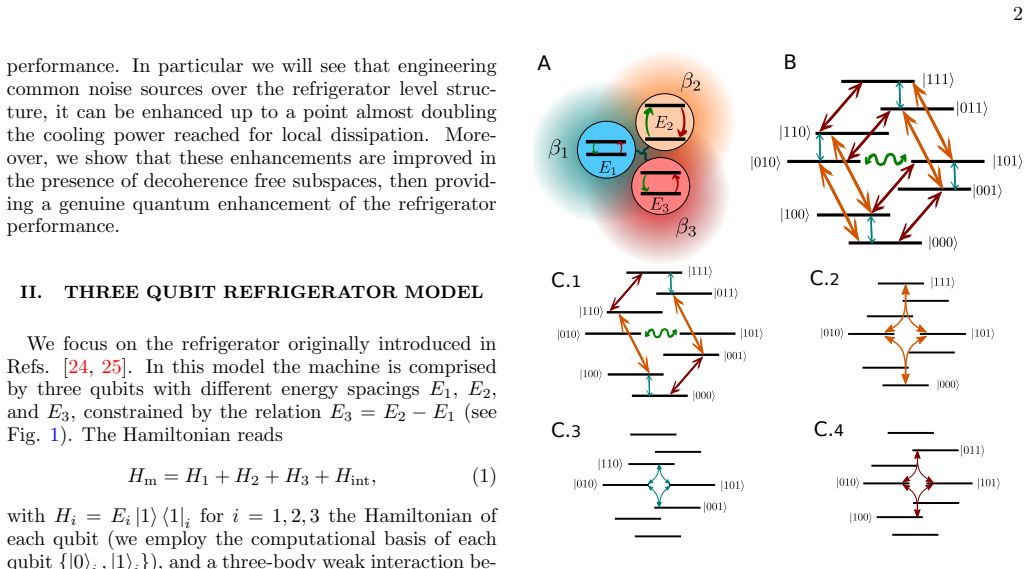
The load-bearing objects are the three jump operators $s_1 = \sigma^-_1 + \alpha \sigma^-_2 \sigma^+_3$, $s_2 = \sigma^-_2 + \alpha \sigma^-_1 \sigma^-_3$, and $s_3 = \sigma^-_3 + \alpha \sigma^+_1 \sigma^-_2$ appearing in a local Born-Markov master equation. Each operator makes a single reservoir at frequency $E_i$ act on both the one-qubit flip at that frequency and on a two-qubit correlated flip, with $\alpha$ weighing the two-spin processes; the cross-terms generated by these operators couple the populations of the degenerate levels $|010\rangle$ and $|101\rangle$ to their coherence, which is what transfers the common-environment effect into the heat currents. At $\alpha=1$ the jump algebra admits the dark state $|\psi_D\rangle=(|010\rangle-|101\rangle)/\sqrt{2}$, a decoherence-free subspace whose population is conserved and which removes part of the state space from the dissipative dynamics. The thermodynamic effect is explained through cycle counting: the 6 original four-step cooling cycles are joined by 6 shorter three-step cycles involving correlated two-spin jumps, which accelerates the heat flow.
What would settle it
Recompute the steady-state cooling power $\dot Q_1$ for the same parameter ranges ($\beta_2=0.5\beta_1$, $\beta_3=0.05\beta_1$, $g=0.005$ to $0.01$, symmetric $\gamma_0$) using a global Gorini-Kossakowski-Sudarshan-Lindblad master equation or an exact Redfield treatment, and compare the ratio $\dot Q_1(\alpha=1)/\dot Q_1(\alpha=0)$. If the ratio falls below about 1.5 or shrinks substantially, the reported enhancement is an artifact of the local approximation rather than a physical common-reservoir effect.
Extended reading notes
Core claim
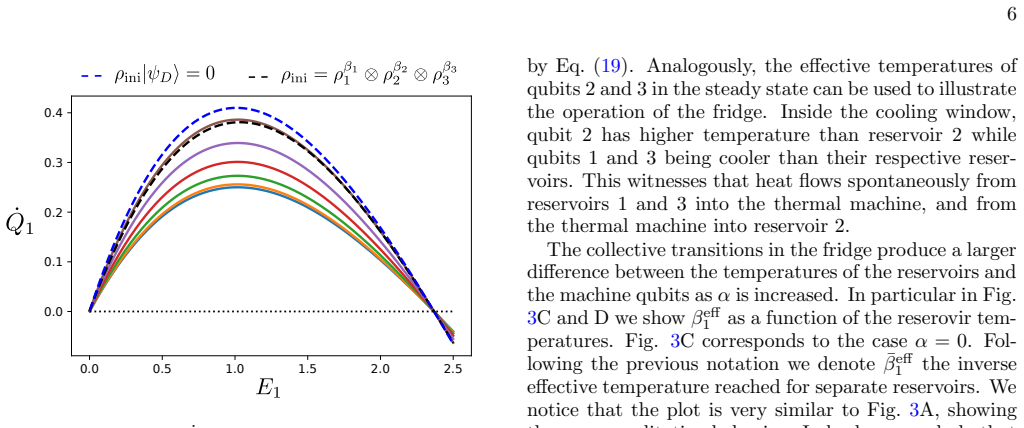
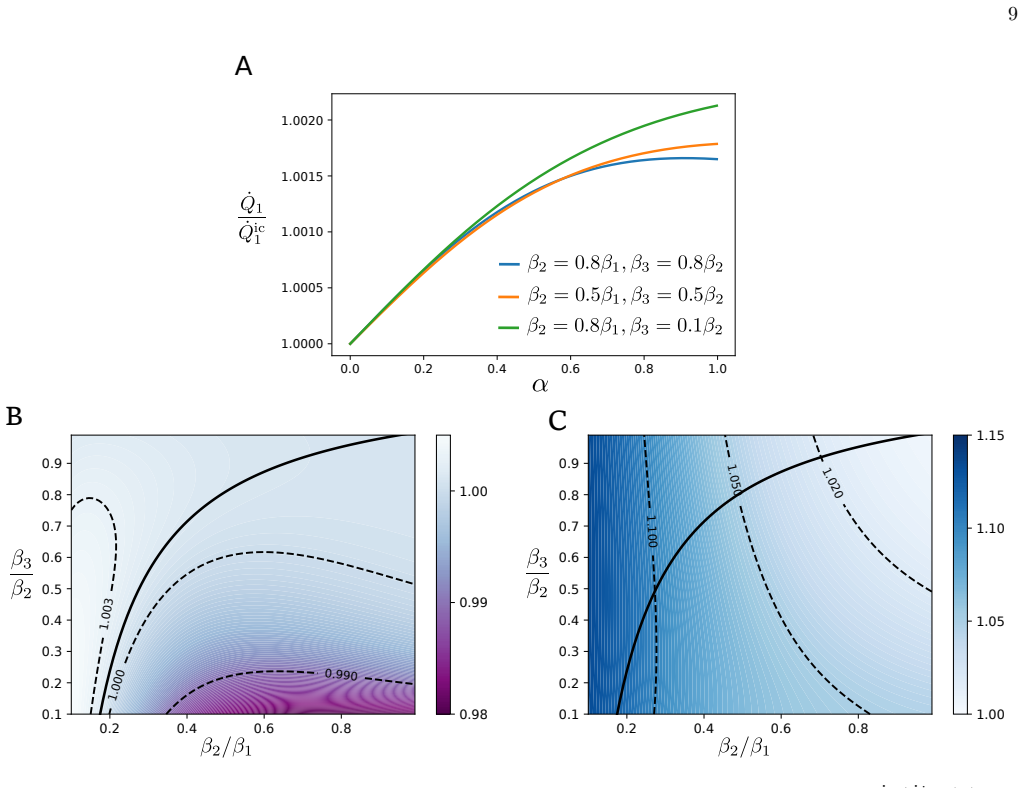
On its own terms, the paper establishes that replacing the three independent thermal baths of the three-qubit absorption refrigerator with common baths, each bath inducing both single-spin and two-spin correlated jumps at its characteristic frequency, is a performance resource. For every parameter set explored, the cooling power $\dot Q_1$ grows monotonically with $\alpha$ over the whole cooling window, reaching about 1.45 times the local-bath value for $\alpha=0.8$ at high cooling power and coming close to doubling it, with the exact factor depending on initial state when $\alpha=1$. The coefficient of performance $\eta$ is almost independent of $\alpha$, so the gain in power is not bought by reduced efficiency; in the parametric $(\eta, \dot Q_1)$ plot, larger $\alpha$ gives more cooling power at every fixed $\eta$. The largest gains are linked to the appearance at $\alpha=1$ of the dark state $|\psi_D\rangle=(|010\rangle-|101\rangle)/\sqrt{2}$, which is immune to the collective dissipation; if the machine starts orthogonal to this state, its cooling power is enhanced, whereas populating the dark state reduces refrigeration. A comparison with an incoherent correlated model shows that, for $\alpha<1$, essentially all the enhancement comes from the additional correlated transitions rather than from their coherent superposition, so the effect is largely a classical rate-structure effect in that regime.
Load-bearing premise
The whole steady-state calculation rests on a local Born-Markov master equation in which the dissipative jump operators are built from the non-interacting qubit basis and the inter-qubit coupling $g$ appears only in the coherent Hamiltonian; if a global master equation is required at the parameters used, the rate structure, and with it the size of the enhancement, could change.
Editorial extensions
If this is right
- For any fixed coefficient of performance, increasing $\alpha$ yields strictly more cooling power across the cooling window, so common reservoirs extend the power-efficiency tradeoff frontier of this refrigerator.
- The cooling window $E_1 \le \eta_C E_3$ is unchanged by $\alpha$, meaning the common-bath enhancement does not relax the fundamental design constraint set by the reservoir temperatures and energy levels.
- At $\alpha=1$ the refrigerator's steady state is not unique: its cooling power depends on the initial population of the decoherence-free subspace, so preparing the machine orthogonal to the dark state becomes an additional controllable resource.
- Because the incoherent correlated model reproduces most of the enhancement for $\alpha<1$, the boost is available to classical stochastic motors with correlated transitions, not only to quantum-coherent ones.
- As $\alpha \to 1$ the three-body interaction Hamiltonian $H_{\mathrm{int}}$ becomes dispensable, since the correlated dissipative jumps themselves close the cooling cycles; common reservoirs offer an alternative way to realize the fridge without the three-qubit interaction.
Reading between the lines
- If the mechanism extends to many-body or shared-environment networks, the per-unit enhancement could grow with system size, since collective dissipation typically produces decoherence-free subspaces of growing dimension; the authors suggest this but do not demonstrate it.
- One testable engineering implication is that frequency-filtered common baths with controllable $\alpha$ could be implemented with superconducting qubits placed at the ends of a transmission line, where two-spin joint absorption has been proposed; the paper mentions platforms but does not quantify the required filter bandwidths.
- The result suggests that the common-environment enhancement should also appear in transient single-shot cooling, where previous work found coherence-assisted lower transient temperatures; a direct calculation of the time-dependent heat current for $\alpha>0$ would test this.
- Since the enhancement is insensitive to coherence for $\alpha<1$, a semiclassical master equation with the same rate structure, dropping the $c_R$ coupling, would serve as a robust benchmark for experiments, isolating the genuinely quantum contribution near $\alpha=1$.
Signed reviews
Editorial analysis
A structured set of objections, weighed in public.
Referee Report
Summary. The paper studies a three-qubit autonomous absorption refrigerator in which the three thermal reservoirs are engineered to act as common environments. A parameter alpha controls the amplitude of two-spin transition processes relative to single-spin ones in each reservoir jump operator, and the steady state is obtained from a local Born-Markov master equation. The central claims are that increasing alpha enhances the cooling power by up to nearly a factor of two without degrading the coefficient of performance, that the largest enhancements occur when a decoherence-free subspace emerges at alpha=1, and that coherent (as opposed to merely correlated) dissipation contributes only modestly except at alpha=1. The paper also derives heat currents, checks the first and second laws, and compares the coherent collective model with an incoherent correlated model.
Significance. If the reported effect survives scrutiny, the paper offers a simple and experimentally plausible resource—common reservoirs—for improving the performance of small autonomous thermal machines. The model is fully specified, with explicit master equations, population-coherence dynamics, and thermodynamic currents, making the calculations transparent and reproducible from the text. The comparison between coherent collective dissipation and incoherent correlated dissipation is a useful step toward identifying which quantum features are thermodynamically relevant. The main weakness is that the quantitative results rest on a local master equation in a parameter regime where the global dissipator structure could differ materially, and some efficiency-related claims rely on an unproven ratio relation.
major comments (3)
- [Sec. II.B and Sec. III; Eqs. (3)–(5); Sec. IV] The central quantitative claims rely on a local Born-Markov master equation whose dissipators are constructed from the uncoupled qubit operators, with the inter-qubit coupling g appearing only in the coherent part. In the parameter regime used in Figs. 2–4 (g = 0.005–0.01 kBT1 and gamma0 = 0.01 kBT1), the coherent splitting 2g inside the degenerate |010>, |101> manifold is comparable to the dissipative rates, so the standard validity condition for the local approach is not evidently satisfied. The consistency check in Sec. IV only bounds the neglected Tr[H_int L_i(pi)] terms; it does not test whether L_i itself should be constructed in the dressed eigenbasis of H_m. Because the enhancement is mediated by the coherence c_R in exactly this degenerate subspace, the authors should either derive the global GKLS dissipators in the eigenbasis of H_m and recompute the main figures, or provide a quantitative estimate of the finite-g correction to the local rates, for example using the partial secular approximation discussed in Refs. [66,69]. Without this, the magnitude of the enhancement and the 'no efficiency cost' conclusion remain an open risk.
- [Sec. II.D, Eqs. (17)–(18), and Fig. 4] Equation (17) states that |Q_i/Q_j| = E_i/E_j for all i,j in the regime alpha in [0,1), and this relation is used to derive the cooling window (18) and the value of the COP at maximum cooling power eta* shown in Fig. 4. However, no proof or direct numerical verification of Eq. (17) is provided for alpha>0. Given the additional alpha^2 and 2 alpha c_R terms in the heat currents (12)–(14), this ratio is not an obvious consequence of the dynamics. The authors should supply either a derivation or an explicit numerical check over the parameter ranges of Figs. 2–4. If the relation fails for alpha>0, the cooling window and the statement that the COP is essentially unchanged when alpha is varied would need revision.
- [Sec. III.A and Figs. 2 and 4 (alpha=1 case)] At alpha=1 the steady state and hence the cooling power depend on the initial population of the decoherence-free subspace p_D, as the authors correctly note. The two dashed curves in Fig. 2 correspond to two particular initial preparations, one with a finite p_D and one with p_D=0. Since the largest claimed improvements are associated with the p_D=0 preparation, the paper should state explicitly, in the abstract and conclusions, that the alpha=1 enhancement is preparation-dependent and that the upper bound is obtained only when the dark state is initially unpopulated. This does not invalidate the alpha<1 results, but it is necessary for a fair presentation of the headline claim.
minor comments (4)
- [Eq. (10) and Eqs. (B8)–(B9)] The printed equation for dot{c}_R in Eq. (10) and in Eqs. (B8)–(B9) is dimensionally inconsistent: the final term should read -(alpha^2+1) sum_i (gamma_i^uparrow + gamma_i^downarrow) c_R, with the factor c_R included. As printed, the term has units of a rate rather than a rate times a population/coherence.
- [Fig. 2 caption] The notation 'rho_ini |psi_D> = 0' in the caption of Fig. 2 should be replaced by a clear statement such as 'the initial state has zero population in the dark state, i.e., p_D = 0', since the written expression is not a well-defined operator equation.
- [Sec. II.B] The sentence 'we consider that the three thermal reservoirs are common to the whole machine distinct' is grammatically garbled and should be rephrased, for example as 'the three thermal reservoirs are common to the whole machine yet are distinct from one another'.
- [References] Reference [50] and reference [72] are the same publication (D. A. Lidar, Review of Decoherence-Free Subspaces) and should be merged or cross-referenced to avoid duplication.
Circularity Check
No significant circularity: the enhancement is a numerically computed consequence of the stated microscopic model, with alpha as a control parameter rather than a fitted input.
full rationale
The central claim—that common reservoirs (alpha > 0) increase the cooling power of the three-qubit refrigerator without reducing its COP—is obtained by solving the master equation derived in the paper, not by imposing the result. The jump operators in Eq. (5) follow from the explicit system-bath interaction Hamiltonian in Eq. (A1), with alpha parameterizing the ratio of two-atom to single-atom processes; alpha is a model control, not a parameter fitted to the reported cooling powers. The steady state is computed as the kernel of the transition matrix W in Eq. (7) and Appendix B, and the heat currents in Eqs. (12)-(14) are then evaluated from that solution. The claimed near-constant COP is a consequence of the resulting rate structure, not an input. The relation |Q_i/Q_j| = E_i/E_j, Eq. (17), is cited to earlier works but is also verifiable from the computed steady state, and it is not used to define the heat currents. Self-citations in the bibliography (e.g., Refs. [58], [60], [69], [83]-[85]) are contextual or methodological; they do not carry the central derivation, and no uniqueness theorem or ansatz is imported from the authors' prior work to force the conclusion. The comparison against the alpha = 0 separate-reservoir case provides an internal baseline rather than a circular target. The apparent missing c_R factor in Eq. (10)/(B9) is a typographical defect in the displayed equation, not evidence of a circular argument. The reliance on the local Born-Markov master equation is a physical approximation that carries correctness risk, but that is a modeling concern, not a circularity: the paper's claims do not reduce to their inputs by definition or by fitted parameters.
Assumptions & free parameters
free parameters (2)
- alpha (common reservoir coupling ratio) =
varied from 0 (separate baths) to 1 (fully common)
- gamma0 (spontaneous emission rate) =
0.01 kBT1 for all qubits
assumptions (4)
- domain assumption Born-Markov approximation and local master equation are valid in the weak-coupling limit.
- domain assumption Each reservoir has a spectral density peaked at its corresponding energy Ei and negligible at the other two frequencies.
- ad hoc to paper The ratio of two-atom to single-atom process amplitudes is the same positive real number alpha for all reservoirs.
- domain assumption The three-body interaction Hint is energy-preserving and weak (g << Ei).
Cite this review
Pith. "Pith review of Boosting the performance of small autonomous refrigerators via common environmental effects." pith.science (2026). https://pith.science/paper/GF6KPJ5C
@misc{pith2026190810259,
  author       = {Pith},
  title        = {Pith review of: Boosting the performance of small autonomous refrigerators via common environmental effects},
  year         = {2026},
  howpublished = {\url{https://pith.science/paper/GF6KPJ5C}},
  note         = {Machine review of arXiv:1908.10259}
}
read the original abstract
We explore the possibility of enhancing the performance of small thermal machines by the presence of common noise sources. In particular, we study a prototypical model for an autonomous quantum refrigerator comprised by three qubits coupled to thermal reservoirs at different temperatures. Our results show that engineering the coupling to the reservoirs to act as common environments lead to relevant improvements in the performance. The enhancements arrive to almost double the cooling power of the original fridge without compromising its efficiency. The greater enhancements are obtained when the refrigerator may benefit from the presence of a decoherence-free subspace. The influence of coherent effects in the dissipation due to one- and two-spin correlated processes is also examined by comparison with an equivalent incoherent yet correlated model of dissipation.
Figures

Figures from the paper (2 more)

Reference graph
Works this paper leans on
-
[1]
( 1818) is reached
The black solid line corresponds to ˙Q1 = 0, which oc- curs when equality in Eq. ( 1818) is reached. As expected, the refrigerator stops running either for high tempera- tures of reservoir 2 (left region) or when the temperature of reservoir 3 is not high enough (top region). In any case β1≥β2≥β3. We obtain the same qualitative behavior when consid- ering...
1919
-
[2]
Therefore, in order to obtain a refrigerator showing a continuous mode of operation we couple each qubit of the machine to a different thermal reservoir at temperatures T1 <T 2 <T 3, or equivalently β1 >β 2 >β 3. A. Three distinct common reservoirs In order to model the contact with thermal baths, the original works considering this setup used a phenomeno-...
-
[3]
G.P. Beretta, Time-energy and time-entropy uncertainty relations in nonequilibrium quantum thermodynamics un- der steepest-entropy-ascent nonlinear master equations , Entropy 21, 679 (2019)
2019
-
[4]
Goold, M
J. Goold, M. Huber, A. Riera, L. del Rio, and P. Skrzypczyk, The role of quantum information in thermo- dynamics — a topical review , J. Phys. A: Math. Theor. 49, 143001 (2016)
2016
-
[5]
Vinjanampathy and J
S. Vinjanampathy and J. Anders, Quantum thermody- namics, Contemp. Phys. 57, 135 (2016)
2016
-
[6]
J. E. Geusic, E. O. Schulz-DuBois, and H. E. D. Scovil, Quantum Equivalent of the Carnot Cycle , Physical Re- view 156, 343 (1967)
1967
-
[7]
H. E. D. Scovil and E. O. Schulz-DuBois, Three-Level Masers as Heat Engines , Phys. Rev. Lett. 2, 262 (1959)
1959
-
[8]
J. E. Geusic, E. O. S.-D. Bois, R. W. De Grasse, and H. E. D. Scovil, Three Level Spin Refrigeration and Maser Ac- tion at 1500 mc/sec, J. Appl. Phys. 30, 11131114 (1959)
1959
Show all 93 references
-
[9]
Kosloff, and Y
R. Kosloff, and Y. Rezek, The quantum harmonic Otto cycle, Entropy 19, 136 (2017)
2017
-
[10]
H. T. Quan, Y.-x. Liu, C. P. Sun, and F. Nori, Quantum thermodynamic cycles and quantum heat engines , Phys. Rev. E 76, 031105 (2007); H. T. Quan, Quantum thermo- dynamic cycles and quantum heat engines II , Phys. Rev. E 79, 041129 (2009)
2007
-
[11]
Campisi, J
M. Campisi, J. Pekola and R. Fazio, Nonequilibrium fluc- tuations in quantum heat engines: theory, example, and possible solid state experiments, New J. Phys. 17, 035012 (2015)
2015
-
[12]
Uzdin, A
R. Uzdin, A. Levy, and R. Kosloff, Equivalence of Quan- tum Heat Machines, and Quantum-Thermodynamic Sig- natures, Phys. Rev. X 5, 031044 (2015)
2015
-
[13]
Kosloff and A
R. Kosloff and A. Levy, Quantum Heat Engines and Refrigerators: Continuous Devices , Annu. Rev. Phys. Chem. 65, 365-393 (2014)
2014
-
[14]
Gelbwaser-Klimovsky, W
D. Gelbwaser-Klimovsky, W. Niedenzu, and G. Kurizki, Chapter Twelve — Thermodynamics of quantum systems under dynamical control , Adv. At. Mol. Opt. Phys. 64, 329 (2015)
2015
-
[15]
K. Y. Tan, M. Partanen, R. E. Lake, J. Govenius, S. Masuda, and M. Mottonen, Quantum-circuit refrigera- tor, Nat. Commun. 8, 15189 (2017)
2017
-
[16]
J. V. Koski, A. Kutvonen, I. M. Khaymovich, T. Ala- Nissila, and J. P. Pekola, On-Chip Maxwell’s Demon as an Information-Powered Refrigerator , Phys. Rev. Lett. 115, 260602 (2015)
2015
-
[17]
Roßnagel, S
J. Roßnagel, S. T. Dawkins, K. N. Tolazzi, O. Abah, E. Lutz, F. Schmidt-Kaler, K. Singer, A single-atom heat engine, Science 15, 325-329 (2016)
2016
-
[18]
K. E. Dorfman, D. V. Voronine, S. Mukamel, and M. O. Scully, Photosynthetic reaction center as a quantum heat engine, Proc. Natl. Acad. Sci. U.S.A. 110, 27462751 (2013)
2013
-
[19]
Maslennikov, S
G. Maslennikov, S. Ding, R. Habl¨ utzel, J. Gan, A. Roulet, S. Nimmrichter, J. Dai, V. Scarani, and D. Mat- sukevich, Quantum absorption refrigerator with trapped ions, Nature Comm. 10, 202 (2019)
2019
-
[20]
Klatzow, J
J. Klatzow, J. N. Becker, P. M. Ledingham, C. Weinzetl, K.T. Kaczmarek, D. J. Saunders, J. Nunn, I. A. Walms- ley, R. Uzdin, and E. Poem, Experimental demonstration of quantum effects in the operation of microscopic heat engines, Phys. Rev. Lett. 112, 110601 (2019)
2019
-
[21]
P. P. Hofer, J. B. Brask, M. Perarnau-Llobet, and N. Brunner, Quantum Thermal Machine as a Thermometer, Phys. Rev. Lett. 119, 090603 (2017)
2017
-
[22]
Killoran, S
N. Killoran, S. F. Huelga, and M. B. Plenio, Enhancing light-harvesting power with coherent vibrational interac- tions: A quantum heat engine picture , J. Chem. Phys. 143, 155102 (2015)
2015
-
[23]
Erker, M
P. Erker, M. T. Mitchison, R. Silva, M. P. Woods, N. Brunner, and M. Huber, Autonomous Quantum Clocks: Does Thermodynamics Limit Our Ability to Measure Time?, Phys. Rev. X 7, 031022 (2017)
2017
-
[24]
Linden, S
N. Linden, S. Popescu, and P. Skrzypczyk,How small can thermal machines be? The smallest possible refrigerator , Phys. Rev. Lett. 105, 130401 (2010)
2010
-
[25]
J. B. Brask, G. Haack, N. Brunner, and M. Huber, Autonomous quantum thermal machine for generating steady-state entanglement , New J. Phys. 17, 113029 (2015)
2015
-
[26]
Manzano, R
G. Manzano, R. Silva, and J. M. R. Parrondo, Au- tonomous thermal machine for amplification and control of energetic coherence, Phys. Rev. E 99, 042135 (2019)
2019
-
[27]
Brunner, M
N. Brunner, M. Huber, N. Linden, S. Popescu, R. Silva, and P. Skrzypczyk, Entanglement enhances cooling in microscopic quantum refrigerators , Phys. Rev. E 89, 032115 (2014)
2014
-
[28]
Skrzypczyk, N
P. Skrzypczyk, N. Brunner, N. Linden, and S. Popescu, The smallest refrigerators can reach maximal efficiency , J. Phys. A: Math. Theor. 44, 492002 (2011)
2011
-
[29]
Brunner, N
N. Brunner, N. Linden, S. Popescu, and P. Skrzypczyk, Virtual qubits, virtual temperatures, and the foundations of thermodynamics, Phys. Rev. E 85, 051117 (2012)
2012
-
[30]
Levy and R
A. Levy and R. Kosloff, Quantum absorption refrigerator, Phys. Rev. Lett. 108, 070604 (2012)
2012
-
[31]
Silva, G
R. Silva, G. Manzano, P. Skrzypczyk, and N. Brunner, Performance of autonomous quantum thermal machines: Hilbert space dimension as a thermodynamical resource , Phys. Rev. E 94, 032120 (2016)
2016
-
[32]
J. P. Palao and R. Kosloff, Quantum thermodynamic cooling cycle, Phys. Rev. E 64, 056130 (2001)
2001
-
[33]
Silva, P
R. Silva, P. Skrzypczyk, and N. Brunner, Small quantum absorption refrigerator with reversed couplings , Phys. Rev. E 92, 012136 (2015)
2015
-
[34]
L. A. Correa, J. P. Palao, Gerardo Adesso, and D. Alonso, Performance bound for quantum absorption re- frigerators, Phys. Rev. E 87, 042131 (2013)
2013
-
[35]
L. A. Correa, J. P. Palao, D. Alonso, and G. Adesso, Quantum-enhanced absorption refrigerators, Sci. Rep. 4, 3949 (2014)
2014
-
[36]
C. L. Latune, I. Sinayskiy, and F. Petruccione, Quantum coherence, many-body correlations, and non-thermal ef- fects for autonomous thermal machines, Sci. Rep. 9, 3191 (2019)
2019
-
[37]
A. Mu, B. K. Agarwalla, G. Schaller, and D. Segal, Qubit absorption refrigerator at strong coupling , New J. Phys. 13 19, 123034 (2017)
2017
-
[38]
S. Seah, S. Nimmrichter, and V. Scarani, Refrigeration beyond weak internal coupling Phys. Rev. E 98, 012131 (2018)
2018
-
[39]
Clivaz, R
F. Clivaz, R. Silva, G. Haack, J. B. Brask, N. Brunner, and M. Huber, Unifying paradigms of quantum refrigera- tion: A universal and attainable bound on cooling , Phys. Rev. Lett. 123, 170605 (2019)
2019
-
[40]
M. P. Woods, R. Silva, and J. Oppenheim Autonomous quantum machines and finite sized clocks , Ann. Henri Poincar 20 125 (2018)
2018
-
[41]
Clivaz, R
F. Clivaz, R. Silva, G. Haack, J. B. Brask, N. Brunner, and M. Huber, Unifying paradigms of quantum refriger- ation: how resource-control determines fundamental lim- its, Phys. Rev. E 100, 042130 (2017)
2017
-
[42]
M. T. Mitchison, M. Huber, J. Prior, M. P. Woods, and M. B. Plenio, Realising a quantum absorption refrigerator with an atom-cavity system , Quantum Sci. Technol. 1 015001 (2016)
2016
-
[43]
Venturelli, R
D. Venturelli, R. Fazio, and V. Giovannetti,Minimal self- contained quantum refrigeration machine based on four quantum dots, Phys. Rev. Lett. 110, 256801 (2013)
2013
-
[44]
P. A. Erdman, B. Bhandari, R. Fazio, Jukka P. Pekola, and F. Taddei, Absorption refrigerators based on Coulomb-coupled single-electron systems , Phys. Rev. B 98, 045433 (2018)
2018
-
[45]
Manzano, Entropy production and fluctuations in a Maxwell’s refrigerator with squeezing , Eur
G. Manzano, Entropy production and fluctuations in a Maxwell’s refrigerator with squeezing , Eur. Phys. J. Spe- cial Topics 227, 285 (2018)
2018
-
[46]
Chen and S.-W
Y.-X. Chen and S.-W. Li, Quantum refrigerator driven by current noise , EPL 97, 40003 (2012)
2012
-
[47]
P. P. Hofer, M. Perarnau-Llobet, J. B. Brask, R. Silva, M. Huber, and N. Brunner, Autonomous quantum refriger- ator in a circuit QED architecture based on a Josephson junction, Phys. Rev. B 94, 235420 (2016)
2016
-
[48]
G. M. Palma, K.-A. Suominen, and A. K. Ekert, Quan- tum Computers and Dissipation, Proc. R. Soc. London A 452, 567 (1996)
1996
-
[49]
Karimi and J
B. Karimi and J. P. Pekola, Correlated versus uncorre- lated noise acting on a quantum refrigerator , Phys. Rev. B 96, 115408 (2017)
2017
-
[50]
R. H. Dicke, Coherence in Spontaneous Radiation Pro- cesses, Phys. Rev. 93, 99-110 (1954)
1954
-
[51]
Zanardi, and M
P. Zanardi, and M. Rasetti, Noiseless Quantum Codes , Phys. Rev. Lett. 79, 3306-3309 (1997)
1997
-
[52]
Zanardi, Dissipation and decoherence in a quantum register, Phys
P. Zanardi, Dissipation and decoherence in a quantum register, Phys. Rev. A 57, 3276-3284 (1998)
1998
-
[53]
D. A. Lidar, Review of Decoherence-Free Subspaces, Noiseless Subsystems, and Dynamical Decoupling , Adv. Chem. Phys. 154, 295-354 (2014)
2014
-
[54]
Benatti, R
F. Benatti, R. Floreanini, and M. Piani, Environment induced entanglement in Markovian dissipative dynamics, Phys. Rev. Lett. 91, 070402 (2003)
2003
-
[55]
Duan, and G.-C
L.-M. Duan, and G.-C. Guo, Preserving Coherence in Quantum Computation by Pairing Quantum Bits , Phys. Rev. Lett. 79, 1953-1956 (1997)
1997
-
[56]
Braun, Creation of Entanglement by Interaction with a Common Heat Bath, Phys
D. Braun, Creation of Entanglement by Interaction with a Common Heat Bath, Phys. Rev. Lett. 89, 277901 (2002)
2002
-
[57]
T. Zell, F. Queisser, and R. Klesse, Distance dependence of entanglement generation via a bosonic heat bath, Phys. Rev. Lett. 102, 160501 (2009)
2009
-
[58]
Aguado, Entanglement be- tween charge qubits induced by a common dissipative en- vironment, Phys
L.D Contreras-Pulido, and R. Aguado, Entanglement be- tween charge qubits induced by a common dissipative en- vironment, Phys. Rev. B 77, 155420 (2008)
2008
-
[59]
J. P. Paz and A. J. Roncaglia, Dynamics of entanglement between two oscillators in the same envrionment , Phys. Rev. Lett. 100, 220401 (2008)
2008
-
[60]
Galve, A
F. Galve, A. Mandarino, M. G. A. Paris, C. Benedetti, and R. Zambrini, Microscopic description for the emer- gence of collective dissipation in extended quantum sys- tems, Sci. Rep. 7, 42050 (2017)
2017
-
[61]
Manzano, F
G. Manzano, F. Galve and R. Zambrini, Avoiding dissi- pation in a system of three quantum harmonic oscillators, Phys. Rev. A 87, 032114 (2013)
2013
-
[62]
Z.-X. Man, A. Tavakoli, J. B. Brask, L.-Z. Hu, and Y.-J. Xia, Improving autonomous thermal entanglement gen- eration using a common reservoir , Phys. Scr. 94 075101 (2019)
2019
-
[63]
Breuer and F
H.-P. Breuer and F. Petruccione, The theory of open quantum systems (Oxford University Press, UK 2002)
2002
-
[64]
Chang, J.S
D.E. Chang, J.S. Douglas, A. Gonzlez-Tudela, C.-L. Hung, and H.J. Kimble, Colloquium: Quantum matter built from nanoscopic lattices of atoms and photons , Rev. Mod. Phys. 90, 031002 (2018)
2018
-
[65]
Karimi, and J
B. Karimi, and J. P. Pekola, Otto refrigerator based on a superconducting qubit: Classical and quantum perfor- mance, Phys. Rev. B 94, 184503 (2016)
2016
-
[66]
P. P. Hofer, M. Perarnau-Llobet, L. D. M. Miranda, G. Haack, R. Silva, J. B. Brask, and N. Brunner, Markovian master equations for quantum thermal machines: local versus global approach, New J. Phys. 19, 123037 (2017)
2017
-
[67]
Lindblad, Commun
G. Lindblad, Commun. Math. Phys. 48, 119-130 (1976)
1976
-
[68]
Rivas, A
A. Rivas, A. D. K. Plato, S. F. Huelga, and M. B. Ple- nio, Markovian master equations: a critical study , New J. Phys. 12, 113032 (2012)
2012
-
[69]
Cattaneo, G
M. Cattaneo, G. L. Giorgi, S. Maniscalco, R. Zambrini, Local vs global master equation with common and sepa- rate baths: superiority of the global approach in partial secular approximation, New J. Phys. 21 113045 (2019)
2019
-
[70]
J. O. Gonzalez, L. A. Correa, G. Nocerino, J. P. Palao, D. Alonso, and G. Adesso, Testing the Validity of the Local and Global GKLS Master Equations on an Exactly Solvable Model, Open Systems and Information Dynam- ics 24, 1740010 (2017)
2017
-
[71]
M. T. Mitchison and M. B. Plenio, Non-additive dissipa- tion in open quantum networks out of equilibrium , New J. Phys. 20, 033005 (2018)
2018
-
[72]
D. A. Lidar, Review of Decoherence Free Subspaces, Noiseless Subsystems, and Dynamical Decoupling , Adv. Chem. Phys. 154, 295-354 (2014)
2014
-
[73]
Levy, and R
A. Levy, and R. Kosloff, The local approach to quantum transport may violate the second law of thermodynamics , EPL 107, 20004 (2012)
2012
-
[74]
A. S. Trushechkin, and I. V. Volovich, Perturbative treat- ment of inter-site couplings in the local description of open quantum networks , EPL 113, 30005 (2016)
2016
-
[75]
Seifert, Stochastic thermodynamics, fluctuation the- 14 orems, and molecular machines , Rep
U. Seifert, Stochastic thermodynamics, fluctuation the- 14 orems, and molecular machines , Rep. Prog. Phys. 75, 126001 (2012)
2012
-
[76]
Benenti, G
G. Benenti, G. Casati, K. Saito, and R. S. Whitney, Fundamental aspects of steady-state conversion of heat to work at the nanoscale , Phys. Rep. 694, 1 (2017)
2017
-
[77]
H. Ge, M. Qian, and H. Qian, Stochastic theory of nonequilibrium steady states. Part II: Applications in chemical biophysics. , Physics Reports 510, 87-118 (2012)
2012
-
[78]
Perarnau-Llobet, R
M. Perarnau-Llobet, R. Uzdin, Collective operations can extremely reduce work fluctuations , New J. Phys. 21, 083023 (2019)
2019
-
[79]
Campisi, and R
M. Campisi, and R. Fazio, The power of a critical heat engine, Nat. Commun. 7 11895 (2016)
2016
-
[80]
Niedenzu and G
W. Niedenzu and G. Kurizki, Cooperative many-body en- hancement of quantum thermal machine power , New J. Phys. 20 113038 (2018)
2018
-
[81]
M. T. Mitchison, M. P. Woods, J. Prior, and M. Hu- ber, Coherence-assisted single-shot cooling by quantum absorption refrigerators, New J. Phys. 17 115013 (2015)
2015
-
[82]
Garziano, V
L. Garziano, V. Macr` ı, R. Stassi, O. Di Stefano, F. Nori, and S. Savasta, One Photon Can Simultaneously Ex- cite Two or More Atoms , Phys. Rev. Lett. 117, 043601 (2016)
2016
-
[83]
Majer, J
J. Majer, J. M. Chow, J. M. Gambetta, J. Koch, B. R. Johnson, J. A. Schreier, L. Frunzio, D. I. Schuster, A. A. Houck, A. Wallraff, A. Blais, M. H. Devoret, S. M. Girvin, and R. J. Schoelkopf, Coupling superconducting qubits via a cavity bus, Nature (London) 449, 443 (2007)
2007
-
[84]
Manzano, F
G. Manzano, F. Galve, G.-L. Giorgi, E. Hern´ andez- Garc´ ıa, and R. Zambrini,Synchronization, quantum cor- relations and entanglement in oscillator networks , Sci. Rep. 3, 1439 (2013)
2013
-
[85]
J. B. Brask, and N. Brunner, Small quantum absorp- tion refrigerator in the transient regime: Time scales, enhanced cooling, and entanglement , Phys. Rev. E 92, 062101 (2015)
2015
-
[86]
Giorgi, F
G.-L. Giorgi, F. Galve, G. Manzano, P. Colet, and R Zambrini, Quantum correlations and mutual synchro- nization, Phys. Rev. A 85, 052101 (2012)
2012
-
[87]
M. Xu, S. B. J¨ ager, S. Sch¨ utz, J. Cooper, G. Morigi, and M. J. Holland, Supercooling of atoms in an optical resonator, Phys. Rev. Lett. 116, 153002 (2016)
2016
-
[88]
Giorgi, F
G.-L. Giorgi, F. Plastina, G. Francica, and R. Zam- brini, Spontaneous synchronization and quantum corre- lation dynamics of open spin systems , Phys. Rev. A 88, 042115 (2013)
2013
-
[89]
Iemini, A
F. Iemini, A. Russomanno, J. Keeling, M. Schir` o, M. Dalmonte, and R. Fazio, Boundary time crystals , Phys. Rev. Lett. 121, 035301 (2018)
2018
-
[90]
Vasile, F
R. Vasile, F. Galve, and R. Zambrini, Spectral origin of non-Markovian open-system dynamics: A finite har- monic model without approximations , Phys. Rev. A 89, 022109 (2014)
2014
-
[91]
F. C. Binder, S. Vinjanampathy, K. Modi, and J. Goold, Quantacell: powerful charging of quantum batteries , New J. Phys. 17, 075015 (2015)
2015
-
[92]
Ferraro, M
D. Ferraro, M. Campisi, G. M. Andolina, V. Pellegrini, and M. Polini, High-power collective charging of a solid- state quantum battery , Phys. Rev. Lett. 120, 117702 (2018)
2018
-
[2020]
A particularly interesting class of quantum thermal machines are autonomous quantum refrigerators [2424–2828], also called absorption refrigerators [ 2929–3636]
or small temperatures [ 2121], as well as producing quantum resources such as entanglement [ 2222] or coher- ence [2323]. A particularly interesting class of quantum thermal machines are autonomous quantum refrigerators [2424–2828], also called absorption refrigerators [ 2929–...
2020 arXiv
Reviewed August 14, 2026 · model on record in the stance chip above.
Discussion (0). Continue with ORCID to comment.