REVIEW 4 major objections 5 minor 48 references
Neutral pion mass in the linear sigma model coupled to quarks at arbitrary magnetic field
T0 review · 4 major / 5 minor · reviewed 2026-08-14 · deepseek-v4-flash
Pith's one-line read In the quark-coupled linear sigma model, the neutral pion mass decreases with a weak magnetic field and increases with a strong one.
desk verdict Useful weak-field correction to Ayala et al., but the advertised nonmonotonic pion mass rests on an unjustified and internally inconsistent effective-parameter substitution. read the letter →
The pith
A machine-rendered reading of the paper's core claim, the machinery that carries it, and where it could break.
The reading
What carries the argument
The load-bearing object is the vacuum-subtracted one-loop neutral pion self-energy at zero three-momentum, Eq. (50), written in Schwinger proper-time form and transformed to the $(u,v)$ integration variables used in thermal field theory. It combines the quark-antiquark loop, whose magnetic structure enters through factors like $\tanh(|q_f B|u)$ and $\sinh^2(|q_f B|u)$, with the charged-pion tadpole $\Pi_{\pi^\pm}(B)$. The decisive step is the replacement of Eq. (48) by Eq. (50), in which the bare $\lambda$, $M_f$, and $v_0'$ inside the self-energy are replaced by the one-loop effective quantities $\lambda_{\rm eff}$, $M_{f,\rm eff}$, and $v_0^B$ computed in Appendices A-C, together with the relation $a^2+M_\pi^2=\lambda_{\rm eff}(v_0^B)^2$; this substitution generates the nonmonotonic behavior.
What would settle it
A lattice QCD computation of the neutral pion mass at zero temperature for $|eB|$ between about $2\,m_\pi^2$ and $10\,m_\pi^2$: if the mass continues to decrease or flattens instead of rising, the central claim fails. A cheaper check is to evaluate the same self-energy with a full two-loop or functional-renormalization-group treatment and see whether the turnaround survives the effective-vertex substitution in Eq. (50).
Extended reading notes
Core claim
After including the one-loop magnetic corrections from the quark-antiquark loop, the charged-pion tadpole, and the dressed effective quantities $v_0^B$, $\lambda_{\rm eff}$, and $M_{f,\rm eff}$, the neutral pion mass $M_\pi(B)$ obtained from the dispersion relation $p_0^2-m_\pi^2-\operatorname{Re}\Pi(B,p_0)=0$ is nonmonotonic in $B$. With bare vertices the one-loop self-energy alone gives a monotonically rising mass; the decrease at weak field and the subsequent rise both emerge only after the effective vertices are inserted in Eq. (50). In the weak-field limit the result reduces to previously published expressions, and the paper finds its weak-field expansion is accurate up to about $|eB|\lesssim m_\pi^2$. The authors caution that the model is reliable only for weak to moderate fields, since the linear $\sigma$ model is a low-energy effective theory.
Load-bearing premise
The nonmonotonic turnaround rests on the step that replaces the bare $\lambda$, $M_f$, and $v_0'$ inside the one-loop self-energy with the magnetic-field-dependent effective quantities $\lambda_{\rm eff}$, $M_{f,\rm eff}$, and $v_0^B$ without a systematic proof that this substitution avoids double-counting the same loop corrections.
Editorial extensions
If this is right
- At weak fields the neutral pion mass decreases with $|eB|$, consistent with the earlier weak-field calculation and with the qualitative trend seen in lattice QCD.
- When effective vertices are included, the originally rising mass curve becomes nonmonotonic, with the turnaround occurring where $|eB|$ is a few times $m_\pi^2$.
- The weak-field expression in Eq. (55) is a good approximation up to $|eB|\simeq m_\pi^2$; beyond about $0.85\,m_\pi^2$ the corrected earlier weak-field formula begins to deviate from the exact solution.
- The paper's corrected coefficient for the weak-field effective self-coupling changes the corresponding expression in the earlier weak-field treatment.
- The rising branch at strong fields is presented as a qualitative prediction, since the model's reliability is limited to weak and moderate magnetic fields.
Reading between the lines
- A clean test of the mechanism is to compute the same self-energy with a systematic two-loop or functional-renormalization-group treatment: if the turnaround disappears, the effective-vertex substitution in Eq. (50) is the culprit.
- If the turnaround is physical, the minimum of $M_\pi^2(B)$ at intermediate fields is a sharp target for lattice QCD calculations at $|eB|\simeq 2\text{--}6\,m_\pi^2$; a monotonic curve there would single out the replacement step as the source.
- Applying the same dressed-vertex procedure to the charged pion and sigma masses could change their mass ordering at strong fields, a consequence the paper does not explore.
- Extending the calculation to finite temperature would connect the nonmonotonic pion mass to the magnetized QCD phase diagram, an extension the paper lists as future work.
Signed reviews
Editorial analysis
A structured set of objections, weighed in public.
Referee Report
Summary. The paper computes the neutral-pion mass in the linear sigma model coupled to quarks (LSMq) in a homogeneous external magnetic field B at zero temperature. Starting from the one-loop self-energy with quark-antiquark and charged-pion contributions, the authors solve the dispersion relation p0^2 - |p|^2 - m_pi^2 - Re[Pi] = 0. With tree-level couplings this gives a monotonically increasing M_pi(B) (Eq. (48), Fig. 3). The paper then replaces the tree-level parameters by magnetic-field-dependent effective quantities lambda_eff, v0^B, and M_f,eff (Eq. (50)) and obtains a nonmonotonic M_pi(B): decreasing at weak field, in agreement with Ayala et al. [39], and increasing at strong field (Fig. 4). Appendices provide the effective potential, effective four-boson coupling, and effective quark mass. Section V gives weak-field expansions and a comparison with Ref. [39], and Section VI concludes that the calculation is valid for weak to moderate fields.
Significance. If the central result were established, the weak-field match with Ayala et al. and the predicted turnaround at |eB| of order a few m_pi^2 would be a useful extension of LSMq calculations and a qualitative benchmark for lattice QCD. The paper contains substantial analytic work: the proper-time evaluation of the quark and charged-pion self-energies, the effective potential in Appendix A, the effective coupling in Appendix B, and the Dyson-Schwinger quark mass in Appendix C are presented in enough detail to be checked independently, and the weak-field limit is compared explicitly with the literature rather than fitted to the target result. However, the novelty—the nonmonotonic behavior—rests entirely on the ad hoc replacement in Eq. (50), which is not derived from a systematic approximation scheme.
major comments (4)
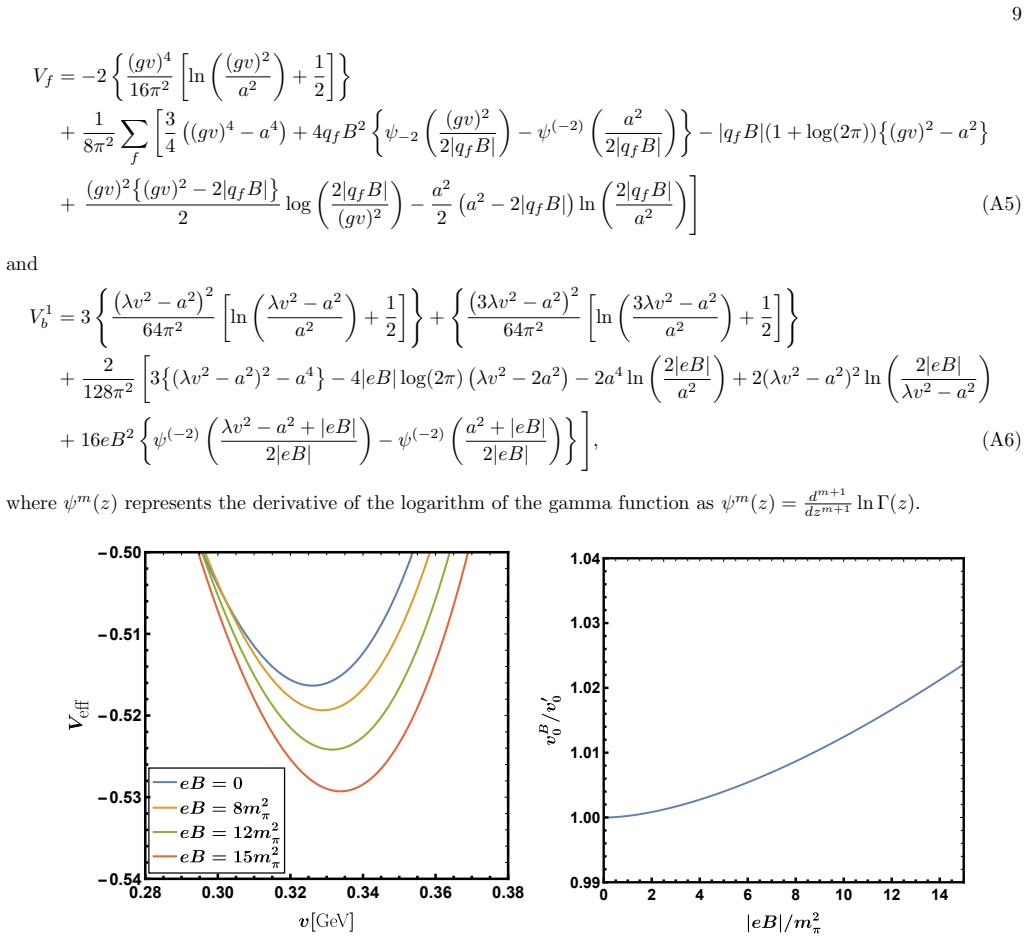
- [Section IV, Eqs. (48)-(50)] The simultaneous replacement of lambda, v'_0, and g by lambda_eff, v0^B, and M_f,eff in the one-loop self-energy is not derived from a systematic loop expansion. In particular, lambda_eff (Appendix B) already includes the charged-pion bubble, which is the same charged-pion loop added as Pi_{pi+-} in Eq. (45), so using both risks double-counting; moreover, v0^B and M_f,eff come from one-loop resummations whose internal lines overlap with those of Eq. (45). The turnaround in Fig. 4 is governed by this substitution, so without a derivation (for example, from an effective action or a consistent resummation scheme) the central nonmonotonic claim is not established.
- [Equation (50)] Equation (50) is internally inconsistent in its quark-mass dependence: M_f,eff appears only in the overall prefactor (through M_f,eff^2/(v0^B)^2), while the exponent and the bracketed terms still use the tree-level M_f, and the identification a^2 + m_pi^2 = lambda_eff (v0^B)^2 is used implicitly. If the effective mass is to be used, it should appear in all M_f-dependent places; if it is not, the replacement in the prefactor is unjustified. This mixed substitution directly controls the nonmonotonic turnaround, so the inconsistency is load-bearing.
- [Abstract and Section VI] The abstract claims the calculation is valid at 'arbitrary strength' of the magnetic field, but Section VI states that the calculation is valid only for 'weak to moderate' external fields. Since the increasing branch at large |eB| in Fig. 4 lies outside the stated regime, the paper should either restrict the abstract and the central claim, or explain why the model remains reliable in that region (for example, by comparing with lattice data for eB >~ 3 m_pi^2).
- [Section III/IV, Eq. (45)] The neutral-meson loops Pi_{pi0} and Pi_sigma are dropped from the pole equation on the grounds that they 'do not receive any magnetic field corrections.' This conflates magnetic-field independence with p0-independence. These loops depend on the external energy p0, and after solving p0 = M_pi(B) they contribute to the pole condition in a B-dependent way through their p0-dependence unless a renormalization scheme is specified in which they are fully absorbed. Please clarify or include their p0-dependent finite parts, or justify their omission within the chosen scheme.
minor comments (5)
- [Figure 4 caption] The right-panel caption says 'for a fixed m_pi = 0.14 GeV with m_pi = 0.40, 0.45, 0.50, 0.55 GeV'; the second set should be m_sigma values.
- [Abstract] The phrase 'arbitrary strength' should be reconciled with the weak-to-moderate restriction stated in Section VI.
- [Section V, before Eq. (52)] The sentence 'we get the vacuum-subtracted contribution from the charged pion loop' refers to Pi^w_fbarf, which is the quark-loop contribution; this should be corrected to 'quark loop.'
- [Reference [7]] Reference [7] contains OCR-style errors in the author names ('Endrdi' and 'Glle'); these should be spelled 'Endrődi' and 'Göll'.
- [Appendix B, around Eq. (B17)] The comparison with Ref. [39] would be easier to follow if the authors explicitly show the intermediate step leading to lambda_eff^Ayala, since the text states 'we are able to get our expression' without displaying the calculation.
Circularity Check
No circularity: the pion mass is solved from a self-consistent dispersion relation with independent effective parameters.
full rationale
The derivation chain is self-contained. The magnetic-field-dependent neutral pion mass is obtained by solving the pole condition, Eq. (44), with the one-loop self-energy Eq. (45), producing the fixed-point equation Eq. (48). The appearance of M_pi(B) on both sides is a standard self-consistency condition for a pole mass, not a definitional circularity. The subsequent replacement leading to Eq. (50) uses dressed quantities v0^B, lambda_eff, and M_f,eff that are computed independently in Appendices A, B, and C from the effective potential, the one-loop vertex, and the quark self-energy respectively; none of these is fitted to the neutral-pion mass, and none is defined through the pion dispersion relation. At zero field the equations reduce to the known vacuum relation m_pi^2 = lambda v0'^2 - a^2. The weak-field result is derived and compared with the existing literature, and the input couplings lambda and g are taken from an external reference. Citations to Ayala et al. are not self-citations by the present authors and are not used to force the central result. The undereived character of the simultaneous tree-to-effective substitution in Eq. (50) is a possible model-consistency and double-counting concern, but it is not a circular reduction: no fitted parameter is renamed as a prediction, and no equation reduces to its own input by construction.
Assumptions & free parameters
free parameters (3)
- lambda (boson self-coupling) =
0.86
- g (quark-meson Yukawa coupling) =
1.11
- m_sigma (sigma meson mass) =
0.40-0.55 GeV in Fig. 4
assumptions (3)
- domain assumption The LSMq model is a valid effective description of low-energy QCD, and one-loop perturbation theory around the shifted vacuum is reliable.
- domain assumption Vacuum parts of the self-energy can be subtracted so that only magnetic-field-dependent pieces matter, with the B=0 pion mass fixed at m_pi = 0.14 GeV.
- ad hoc to paper The simultaneous replacement of lambda, M_f, and v0' with lambda_eff, M_f,eff, and v0^B in Eq. (50), together with a^2 + m_pi^2 = lambda_eff (v0^B)^2, is legitimate at one-loop order.
Cite this review
Pith. "Pith review of Neutral pion mass in the linear sigma model coupled to quarks at arbitrary magnetic field." pith.science (2026). https://pith.science/paper/63CTENCM
@misc{pith2026190810323,
  author       = {Pith},
  title        = {Pith review of: Neutral pion mass in the linear sigma model coupled to quarks at arbitrary magnetic field},
  year         = {2026},
  howpublished = {\url{https://pith.science/paper/63CTENCM}},
  note         = {Machine review of arXiv:1908.10323}
}
read the original abstract
We calculate the neutral pion mass in the presence of an external magnetic field of arbitrary strength in the framework of the linear sigma model coupled to quarks at zero temperature. We find nonmonotonic behavior of the pion mass as a function of magnetic field. We are also able to reproduce existing results for the weak-field approximation.
Figures


Figures from the paper (5 more)



Reference graph
Works this paper leans on
-
[39]
A. Ayala, S. Hernandez-Ortiz and L. A. Hernandez, “QCD phase diagram from chiral symmetry restoration: analytic approach at high and low temperature using the Linear Sigma Model with Quarks ”, Rev. Mex. Fis. 64, no. 3, 302 (2018) [arXiv:1710.09007 [hep-ph]]
arXiv 2018
-
[1]
=g (a2 +m2 π λ )1/2 , (13) M2 π(v′
-
[2]
(14) The value of a is given by solving Eq
= 2a2 + 3m2 π. (14) The value of a is given by solving Eq. (14) as a = √ M2σ(v′ 0)− 3M2π(v′ 0) 2 ≃ √ m2σ− 3m2π 2 (15) We consider a time-independent homogeneous back- ground magnetic field in the z direction B =B ˆz, which can be obtained from the symmetric four-potential Aµ = B 2 (0,−y,x, 0). As a result, for the charged d.o.f (quarks and charged pions), ...
-
[3]
(C2) 12 Expanding the matrix structure in Eq
Structure coefficients of S∗ f −1 The interaction term in the Lagrangian density, which contributes to the effective constituent quark mass, is given as Lf =−g ¯ψ (σ +iγ5τ.π)ψ. (C2) 12 Expanding the matrix structure in Eq. (C2) and simply writing it in terms of the LSM bosons ( π+, π−, π0, and σ) and constituent light quark (u and d) fields, we get Lf =−g ( σ...
-
[4]
It has five tensor structures: /P q, /P⊥, /P qγ1γ2, γ1γ2, and 1
Inversion of tensor structure in S∗ f −1 To achieve the inversion of Eq (C18), we first have to note the number of Dirac matrix structures involved in the expression. It has five tensor structures: /P q, /P⊥, /P qγ1γ2, γ1γ2, and 1. The trick is to reduce the number of matrix structures as follows. Suppose we have any matrix M whose inverse is de- sired. We ...
-
[5]
Estimate of the magnetic field strength in heavy-ion collisions ,
V. Skokov, A. Y. Illarionov and V. Toneev, “ Estimate of the magnetic field strength in heavy-ion collisions ,” Int. J. Mod. Phys. A 24, 5925 (2009) [arXiv:0907.1396 [nucl- th]]
arXiv 2009
-
[6]
Y. Zhong, C. B. Yang, X. Cai and S. Q. Feng, “ A sys- tematic study of magnetic field in Relativistic Heavy-ion Collisions in the RHIC and LHC energy regions ,” Adv. High Energy Phys.2014, 193039 (2014) [arXiv:1408.5694 [hep-ph]]
arXiv 2014
-
[7]
Photon decay in strong magnetic field in heavy-ion collisions ,
K. Tuchin, “ Photon decay in strong magnetic field in heavy-ion collisions ,” Phys. Rev. C 83, 017901 (2011) [arXiv:1008.1604 [nucl-th]]
arXiv 2011
Show all 48 references
-
[8]
Electromagnetic field and the chiral magnetic effect in the quark-gluon plasma ,
K. Tuchin, “Electromagnetic field and the chiral magnetic effect in the quark-gluon plasma ,” Phys. Rev. C 91, no. 6, 064902 (2015) [arXiv:1411.1363 [hep-ph]]
2015 arXiv
-
[9]
Magnetic contribution to dilepton production in heavy-ion collisions,
K. Tuchin, “Magnetic contribution to dilepton production in heavy-ion collisions,” Phys. Rev. C 88, 024910 (2013) [arXiv:1305.0545 [nucl-th]]
2013 arXiv
-
[10]
Formation of very strongly magnetized neutron stars - implications for gamma-ray bursts,
R. C. Duncan and C. Thompson, “ Formation of very strongly magnetized neutron stars - implications for gamma-ray bursts,” Astrophys. J. 392, L9 (1992)
1992
-
[11]
Meson masses in electromagnetic fields with Wilson fermions
G. S. Bali, B. B. Brandt, G. Endrdi and B. Glle, “ Meson masses in electromagnetic fields with Wilson fermions ”, Phys. Rev. D 97, no. 3, 034505 (2018) [arXiv:1707.05600 16 [hep-lat]]
2018 arXiv
-
[12]
Thermal pions in a magnetic background,
J. O. Andersen, “ Thermal pions in a magnetic background,” Phys. Rev. D 86, 025020 (2012) [arXiv:1202.2051 [hep-ph]]
2012 arXiv
-
[13]
Gell-Mann-Oakes- Renner relation in a magnetic field at finite temperature,
N. O. Agasian and I. A. Shushpanov, “Gell-Mann-Oakes- Renner relation in a magnetic field at finite temperature,” JHEP 0110, 006 (2001) [hep-ph/0107128]
2001 arXiv
-
[14]
Pionic dispersion relations in the presence of a weak magnetic field ,
S. P. Adhya, M. Mandal, S. Biswas and P. K. Roy, “Pionic dispersion relations in the presence of a weak magnetic field ,” Phys. Rev. D 93, no. 7, 074033 (2016) [arXiv:1601.04578 [nucl-th]]
2016 arXiv
-
[15]
Mass modification of hot pions in a magne- tized dense medium ,
A. Mukherjee, S. Ghosh, M. Mandal, P. Roy and S. Sarkar, “ Mass modification of hot pions in a magne- tized dense medium ,” Phys. Rev. D 96, no. 1, 016024 (2017) [arXiv:1708.02385 [hep-ph]]
2017 arXiv
-
[16]
Proper- ties of neutral mesons in a hot and magnetized quark mat- ter
S. Fayazbakhsh, S. Sadeghian and N. Sadooghi, “Proper- ties of neutral mesons in a hot and magnetized quark mat- ter”, Phys. Rev. D 86, 085042 (2012) [arXiv:1206.6051 [hep-ph]]
2012 arXiv
-
[17]
Charged pion masses under strong magnetic fields in the NJL model ,
M. Coppola, D. Gmez Dumm and N. N. Scoccola, “Charged pion masses under strong magnetic fields in the NJL model ,” Phys. Lett. B 782, 155 (2018) [arXiv:1802.08041 [hep-ph]]
2018 arXiv
-
[18]
Neutral meson properties under an external magnetic field in nonlocal chiral quark models ,
D. Gmez Dumm, M. F. Izzo Villafae and N. N. Scoccola, “Neutral meson properties under an external magnetic field in nonlocal chiral quark models ,” Phys. Rev. D 97, no. 3, 034025 (2018) [arXiv:1710.08950 [hep-ph]]
2018 arXiv
-
[19]
Prop- erties of magnetized neutral mesons within a full RPA evaluation,
S. S. Avancini, W. R. Tavares and M. B. Pinto, “ Prop- erties of magnetized neutral mesons within a full RPA evaluation,” Phys. Rev. D 93, no. 1, 014010 (2016) [arXiv:1511.06261 [hep-ph]]
2016 arXiv
-
[20]
Properties of Mesons in a Strong Magnetic Field ,
R. Zhang, W. j. Fu and Y. x. Liu, “ Properties of Mesons in a Strong Magnetic Field ,” Eur. Phys. J. C 76, no. 6, 307 (2016) [arXiv:1604.08888 [hep-ph]]
2016 arXiv
-
[21]
Neutral meson properties in hot and magnetized quark matter: a new magnetic field independent regularization scheme applied to NJL-type model
S. S. Avancini, R. L. S. Farias and W. R. Tavares, “Neutral meson properties in hot and magnetized quark matter: a new magnetic field independent regularization scheme applied to NJL-type model ”, Phys. Rev. D 99, no. 5, 056009 (2019) [arXiv:1812.00945 [hep-ph]]
2019 arXiv
-
[22]
π0 pole mass calcula- tion in a strong magnetic field and lattice constraints
S. S. Avancini, R. L. S. Farias, M. Benghi Pinto, W. R. Tavares and V. S. Timteo, “π0 pole mass calcula- tion in a strong magnetic field and lattice constraints ”, Phys. Lett. B 767, 247 (2017) [arXiv:1606.05754 [hep- ph]]
2017 arXiv
-
[23]
Dressed Polyakov loop and phase diagram of hot quark matter under magnetic field ,
R. Gatto and M. Ruggieri, “ Dressed Polyakov loop and phase diagram of hot quark matter under magnetic field ,” Phys. Rev. D 82, 054027 (2010) [arXiv:1007.0790 [hep- ph]]
2010 arXiv
-
[24]
Entanglement between chiral and de- confinement transitions under strong uniform magnetic background field ,
K. Kashiwa, “ Entanglement between chiral and de- confinement transitions under strong uniform magnetic background field ,” Phys. Rev. D 83, 117901 (2011) [arXiv:1104.5167 [hep-ph]]
2011 arXiv
-
[25]
Phase diagram of hot QCD in an external magnetic field: pos- sible splitting of deconfinement and chiral transitions ,
A. J. Mizher, M. N. Chernodub and E. S. Fraga, “ Phase diagram of hot QCD in an external magnetic field: pos- sible splitting of deconfinement and chiral transitions ,” Phys. Rev. D 82, 105016 (2010) [arXiv:1004.2712 [hep- ph]]
2010 arXiv
-
[26]
Phase diagram in an external magnetic field beyond a mean-field approximation ,
V. Skokov, “ Phase diagram in an external magnetic field beyond a mean-field approximation ,” Phys. Rev. D 85, 034026 (2012) [arXiv:1112.5137 [hep-ph]]
2012 arXiv
-
[27]
Quark matter under strong magnetic field in chiral models ,
A. Rabhi and C. Providencia, “ Quark matter under strong magnetic field in chiral models ,” Phys. Rev. C 83, 055801 (2011) [arXiv:1104.1512 [nucl-th]]
2011 arXiv
-
[28]
The Chiral transi- tion in a magnetic background: Finite density effects and the functional renormalization group ,
J. O. Andersen and A. Tranberg, “ The Chiral transi- tion in a magnetic background: Finite density effects and the functional renormalization group ,” JHEP 1208, 002 (2012) [arXiv:1204.3360 [hep-ph]]
2012 arXiv
-
[29]
Chiral transition in a strong magnetic background ,
E. S. Fraga and A. J. Mizher, “ Chiral transition in a strong magnetic background ,” Phys. Rev. D 78, 025016 (2008) [arXiv:0804.1452 [hep-ph]]
2008 arXiv
-
[30]
Magnetic Susceptibility of the Quark Condensate and Polarization from Chiral Mod- els,
M. Frasca and M. Ruggieri, “ Magnetic Susceptibility of the Quark Condensate and Polarization from Chiral Mod- els,” Phys. Rev. D 83, 094024 (2011) [arXiv:1103.1194 [hep-ph]]
2011 arXiv
-
[31]
Chiral transition in a mag- netic field and at finite baryon density,
J. O. Andersen and R. Khan, “Chiral transition in a mag- netic field and at finite baryon density,” Phys. Rev. D 85, 065026 (2012) [arXiv:1105.1290 [hep-ph]]
2012 arXiv
-
[32]
The axial vector current in beta decay,
M. Gell-Mann and M. Levy, “ The axial vector current in beta decay,” Nuovo Cim. 16, 705 (1960)
1960
-
[33]
Linear sigma model at finite tempera- ture,
N. Petropoulos, “ Linear sigma model at finite tempera- ture,” hep-ph/0402136
-
[34]
Magnetic correc- tions toπ-π scattering lengths in the linear sigma model
M. Loewe, L. Monje and R. Zamora, “ Magnetic correc- tions toπ-π scattering lengths in the linear sigma model”, Phys. Rev. D 97, no. 5, 056023 (2018) [arXiv:1712.10047 [hep-ph]]
2018 arXiv
-
[35]
Thermo-magnetic corrections toπ-π Scattering Lengths in the Linear Sigma Model
M. Loewe, E. Muoz and R. Zamora, “ Thermo-magnetic corrections toπ-π Scattering Lengths in the Linear Sigma Model”, arXiv:1905.03783 [hep-ph]
1905 arXiv
-
[36]
Linear sigma model and the formation of a charged pion con- densate in the presence of an external magnetic field
M. Loewe, C. Villavicencio and R. Zamora, “ Linear sigma model and the formation of a charged pion con- densate in the presence of an external magnetic field ”, Phys. Rev. D 89, no. 1, 016004 (2014) [arXiv:1310.5789 [hep-ph]]
2014 arXiv
-
[37]
Pinning down the QCD critical end point
A. Ayala, L. A. Hernndez, M. Loewe, J. C. Rojas and R. Zamora, “Pinning down the QCD critical end point ”, arXiv:1904.11905 [hep-ph]
1904 arXiv
-
[38]
The effective QCD phase diagram and the critical end point
A. Ayala, A. Bashir, J. J. Cobos-Martinez, S. Hernandez- Ortiz and A. Raya, “ The effective QCD phase diagram and the critical end point”, Nucl. Phys. B 897, 77 (2015), [arXiv:1411.4953 [hep-ph]]
2015 arXiv
-
[40]
Chiral phase transition within effective models with constituent quarks,
O. Scavenius, A. Mocsy, I. N. Mishustin and D. H. Rischke, “ Chiral phase transition within effective models with constituent quarks,” Phys. Rev. C64, 045202 (2001), [nucl-th/0007030]
2001 arXiv
-
[41]
Magnetized effective QCD phase diagram
A. Ayala, C. A. Dominguez, L. A. Hernandez, M. Loewe and R. Zamora, “ Magnetized effective QCD phase diagram ”, Phys. Rev. D 92, no. 9, 096011 (2015),[arXiv:1509.03345 [hep-ph]], Addendum : [ Phys. Rev. D 92, no. 11, 119905 (2015)]
2015 arXiv
-
[42]
Inverse magnetic catalysis in the linear sigma model with quarks ,
A. Ayala, M. Loewe and R. Zamora, “ Inverse magnetic catalysis in the linear sigma model with quarks ,” Phys. Rev. D 91, no. 1, 016002 (2015) [arXiv:1406.7408 [hep- ph]]
2015 arXiv
-
[43]
Magnetic field- dependence of the neutral pion mass in the linear sigma model coupled to quarks: The weak field case,
A. Ayala, R. L. S. Farias, S. Hernndez-Ortiz, L. A. Hern- ndez, D. M. Paret and R. Zamora, “ Magnetic field- dependence of the neutral pion mass in the linear sigma model coupled to quarks: The weak field case,” Phys. Rev. D 98, no. 11, 114008 (2018) [arXiv:1809.08312 [hep-ph]]
2018 arXiv
-
[44]
Vacuum polarization in thermal QED with an external magnetic field ,
J. Alexandre, “Vacuum polarization in thermal QED with an external magnetic field ,” Phys. Rev. D 63, 073010 (2001) [hep-th/0009204]
2001 arXiv
-
[45]
Vacuum Polarization in Homogeneous Mag- netic Fields,
W. y. Tsai, “Vacuum Polarization in Homogeneous Mag- netic Fields,” Phys. Rev. D 10, 2699 (1974). 17
1974
-
[46]
Chi- ral Symmetry transition in the Linear Sigma Model with quarks: Counting effective QCD degrees of freedom from low to high temperature
A. Ayala, J. D. Castao-Yepes, J. J. Cobos-Martnez, S. Hernndez-Ortiz, A. Julia Mizher and A. Raya, “ Chi- ral Symmetry transition in the Linear Sigma Model with quarks: Counting effective QCD degrees of freedom from low to high temperature ”, Int. J. Mod. Phys. A 31, no. 36, 16...
2016 arXiv
-
[47]
Aspects of chiral symmetry ,
V. Koch, “ Aspects of chiral symmetry ,” Int. J. Mod. Phys. E 6, 203 (1997) [nucl-th/9706075]
1997 arXiv
-
[48]
Introduction to chiral symmetry ,
V. Koch, “ Introduction to chiral symmetry ,” [nucl- th/9512029]
Reviewed August 14, 2026 · model on record in the stance chip above.
Discussion (0). Continue with ORCID to comment.