REVIEW 2 major objections 6 minor 1 cited by
GALACTICNUCLEUS: A high-angular-resolution JHKs imaging survey of the Galactic centre II. First data release of the catalogue and the most detailed CMDs of the GC
T0 review · 2 major / 6 minor · reviewed 2026-08-14 · deepseek-v4-flash
Pith's one-line read This paper presents the first public data release of the GALACTICNUCLEUS survey: accurate $JHK_s$ photometry for about 3.3 million stars in the Milky Way's nuclear bulge, with 0.2-arcsecond resolution and detection limits about two…
desk verdict A genuinely useful data release paper: the GALACTICNUCLEUS catalogue becomes the NIR reference for the nuclear bulge; completeness is measured only in the most crowded fields, so treat faint-end regional CMD comparisons with caution. read the letter →
The pith
A machine-rendered reading of the paper's core claim, the machinery that carries it, and where it could break.
The reading
What carries the argument
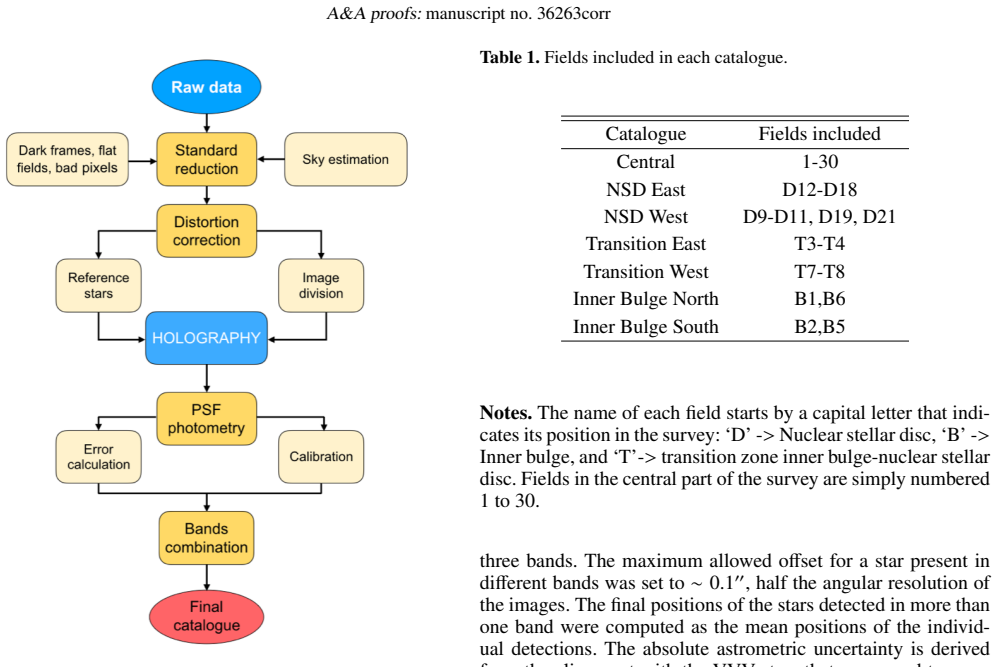
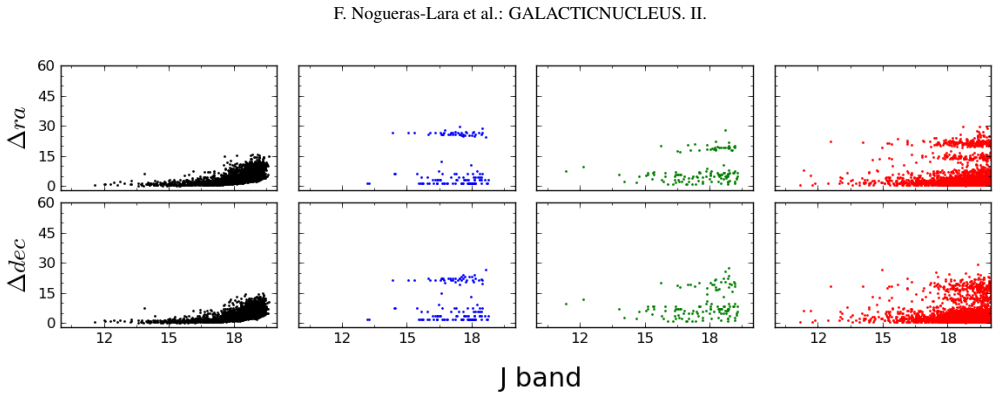
The load-bearing mechanism is speckle holography applied to the short-exposure data: roughly a thousand quick frames per pointing are combined by an averaged division of their Fourier transforms, yielding reconstructed images with $\sim0.2''$ resolution that are then convolved to a uniform Gaussian PSF. On top of this, the catalogue rests on a deliberately conservative detection and uncertainty pipeline: each chip's data are split into three independent sub-images, a star is accepted only if detected in all three, the final flux is measured from the deep image, and the photometric uncertainty is estimated from the maximum--minimum spread of the sub-image fluxes plus a PSF-variation term. Astrometric and photometric calibration are anchored to VVV positions and SIRIUS/IRSF magnitudes, and completeness is quantified with the critical-distance method on $2'\times1.4'$ subregions of the central pointings, with artificial-star tests restricted to the most crowded field, F1. This combination of resolution, triple-detection filtering, and external calibration is what lets the survey claim its faint limits and its stable zero points.
What would settle it
A direct test would be to run artificial-star completeness tests on the transition and inner-bulge fields, not just pointings 1 through 15; if those fields show completeness far below $80\%$ at $K_s\sim16$ or $H\sim18$ mag, or with strong spatial variation, the faint-end CMD features presented as stellar populations would instead reflect variable detection efficiency.
Extended reading notes
Core claim
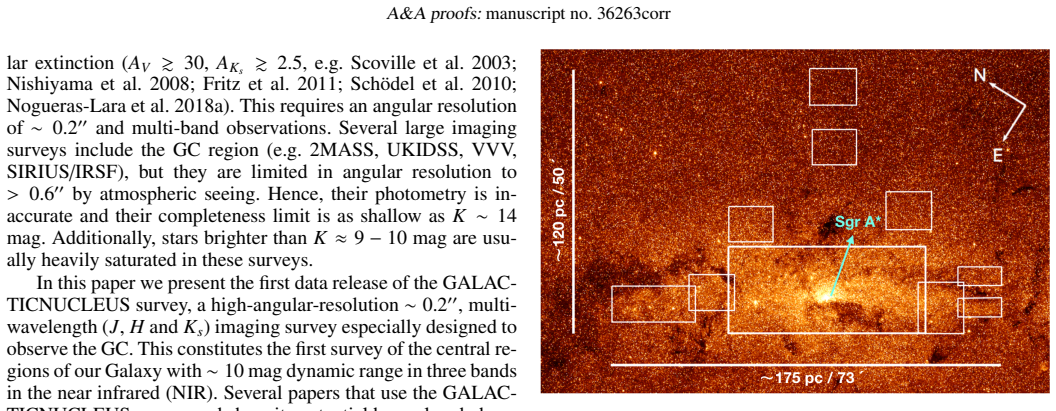
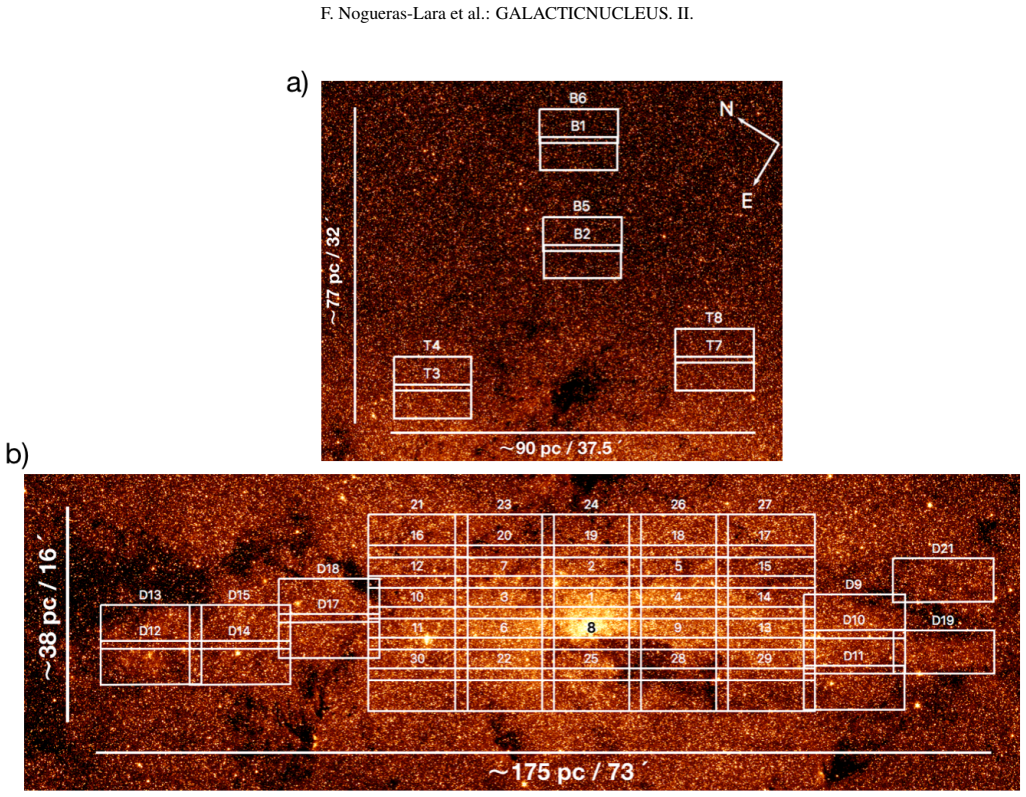
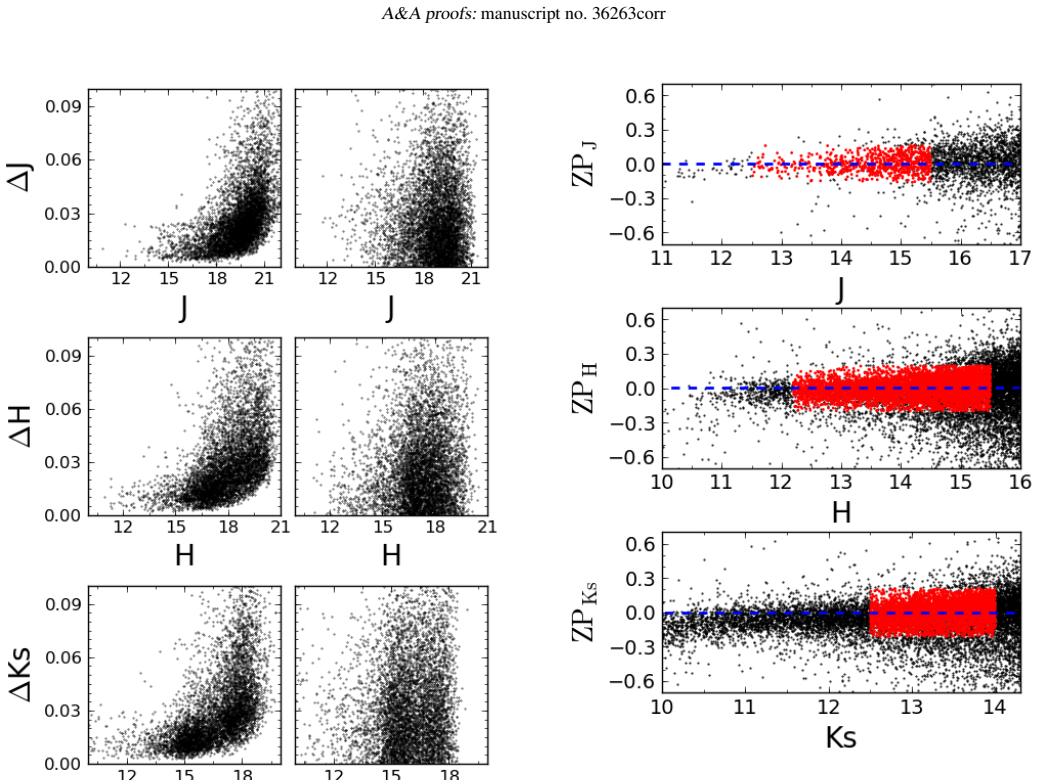
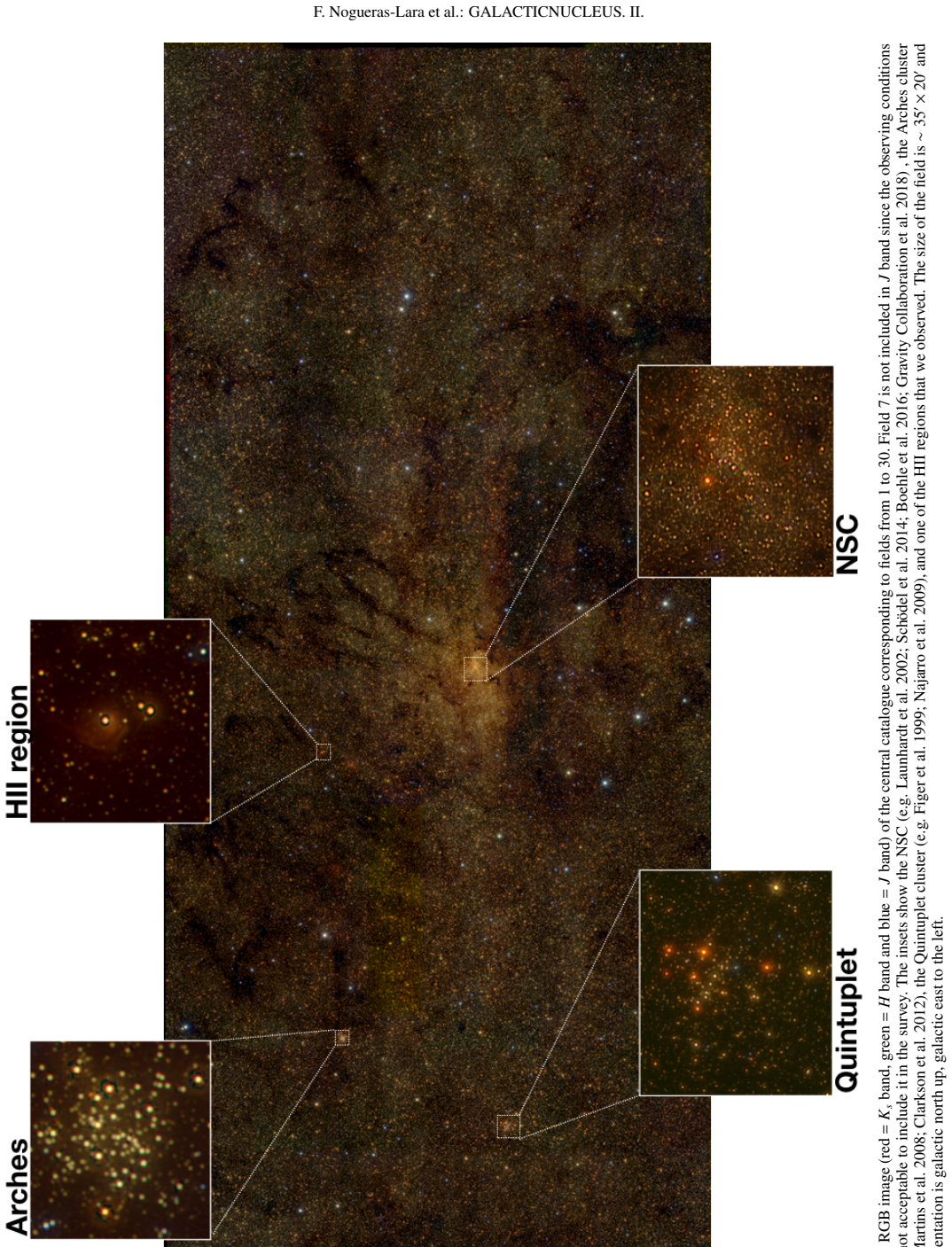
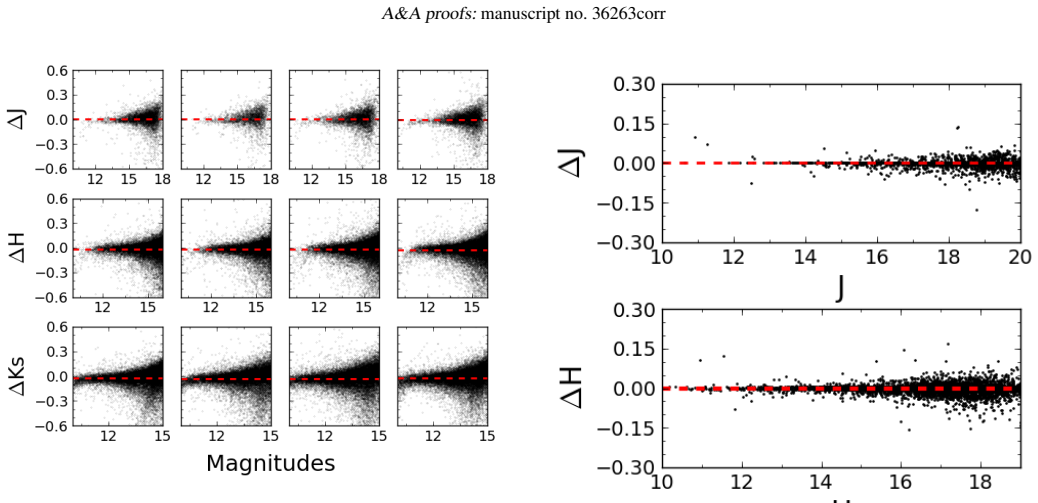
In the paper's own terms, the discovery is the catalogue itself: $J$, $H$, and $K_s$ photometry for roughly $3.3\times10^6$ individual stars across an area of about $0.3$ square degrees centred on the Galactic centre, observed with the HAWK-I instrument at the VLT and reduced to a uniform $0.2''$ angular resolution. The authors show that the catalogue reaches $5\sigma$ detection limits of $J\sim22$, $H\sim21$, and $K_s\sim21$ mag, that relative photometric uncertainties stay below $0.05$ mag down to $J\sim21$, $H\sim19$, and $K_s\sim18$ mag, and that the zero-point systematic uncertainty is $\lesssim0.04$ mag in all three bands. On the data-quality side, they compare against SIRIUS/IRSF and VVV and find that GALACTICNUCLEUS is about one magnitude deeper in $J$ and two magnitudes deeper in $H$ and $K_s$ than VVV in the same region, with photometric uncertainties improved by factors of two to three and a nearly complete bright end where VVV saturates. Part of the claim is completeness: roughly $80\%$ completeness at $K_s\sim16$ and $H\sim18$ mag in the most crowded central pointings, with the J-band conservative limit near $J\sim20$ mag. On this basis the paper presents colour-magnitude diagrams that separate the foreground population, the AGB bump, the red clump, and the red giant branch bump across the nuclear disc, transition zone, and inner bulge, and argues these are the most detailed CMDs of the Galactic centre so far.
Load-bearing premise
The load-bearing premise is that the completeness measured in the most crowded central pointings, roughly $80\%$ at $K_s\sim16$ and $H\sim18$ mag, also holds in the less crowded transition and inner-bulge fields, where no completeness analysis was run.
Editorial extensions
If this is right
- The $H$ and $K_s$ luminosity functions of the nuclear bulge are measured about two magnitudes deeper than with VVV, so the red clump bump in $K_s$ is now fully covered rather than truncated by saturation or shallowness.
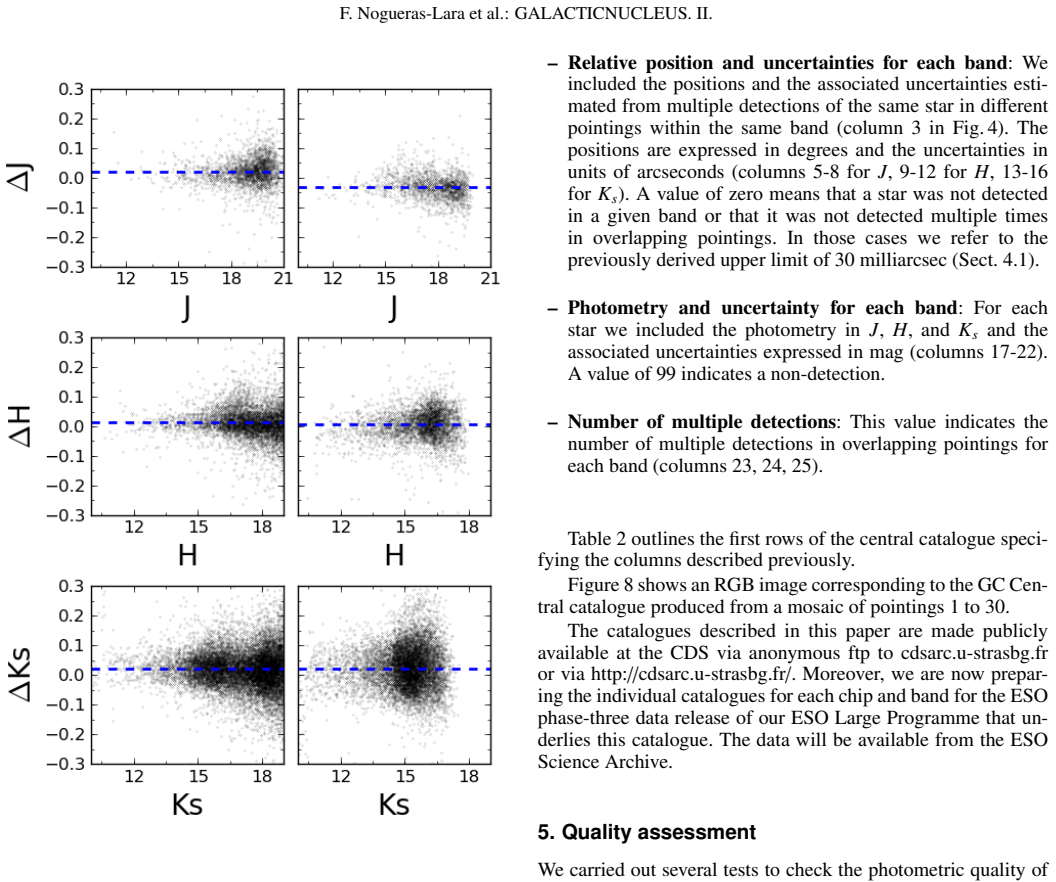
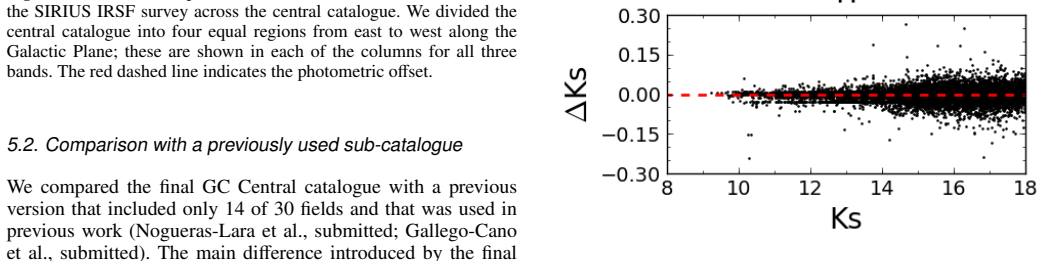
- With zero-point offsets smaller than $0.01$ mag between the east--west columns of the central catalogue, red clump and red giant branch bump positions can be compared across the central field to trace extinction and population gradients.
- The stated completeness of roughly $80\%$ at $K_s\sim16$ and $H\sim18$ mag in the most crowded fields, with less crowded fields expected to be more complete, gives other surveys a benchmark for what a $0.2''$ ground-based catalogue can recover in the Galactic centre.
- Absolute astrometry good to about $0.05''$, and relative astrometry near $1$ mas within a single pointing for moderately bright stars, makes the catalogue a suitable positional reference for follow-up work in the nuclear cluster.
Reading between the lines
- Because the survey's detection criterion rejects an estimated 30 to 40 percent of stars, a re-reduction of the same raw frames with a bootstrap uncertainty scheme could push the same data roughly a magnitude deeper, changing the faint-end luminosity functions in a testable way.
- The completeness analysis is confined to the most crowded central pointings; extending artificial-star tests to the transition and inner-bulge fields would directly test whether the faint-end CMD features, such as the prominence of the red clump relative to the red giant branch bump, are stable across the full survey area.
- The survey's low-extinction windows east and west of the nucleus, together with its inner-bulge comparison fields, make it possible in principle to separate the nuclear stellar disc from the surrounding bulge stellar populations by differential CMD analysis; the paper stops at identifying the features rather than modelling the star-formation history.
Signed reviews
Editorial analysis
A structured set of objections, weighed in public.
Referee Report
Summary. The paper presents the first data release of the GALACTICNUCLEUS survey, a JHKs imaging survey of the Galactic centre and inner bulge obtained with HAWK-I at the VLT. The reduction uses speckle-holography image reconstruction to reach about 0.2 arcsec resolution, PSF photometry with StarFinder, and a conservative three-subimage detection criterion to estimate per-star uncertainties. Photometric zero points are tied to the SIRIUS/IRSF catalogue, and astrometry is tied to VVV. The resulting public catalogue contains about 3.3 million stars over about 0.3 square degrees, reaching 5-sigma detections at J~22, H~21, and Ks~21 mag, with photometric uncertainties below 0.05 mag at J~21, H~19, and Ks~18 and a zero-point systematic uncertainty no larger than 0.04 mag. The paper assesses data quality through comparisons with SIRIUS, VVV, and NICMOS, and then presents CMDs for the central, transition, and inner-bulge catalogues, identifying the foreground population, AGBB, RC, RGBB, post-main-sequence, and ascending-giant-branch features.
Significance. This is a valuable dataset: if the results hold, it is the deepest and sharpest ground-based NIR catalogue of the nuclear bulge to date, and it is publicly released at the CDS. The main strengths are the detailed and largely honest uncertainty analysis (three independent sub-images, PSF spatial variation, zero-point drift checks), the independent validation against VVV and NICMOS, and the explicit statement of survey limitations in Section 6. The catalogue and the description of the reduction pipeline constitute a useful resource for the community. The completeness caveat discussed below is the main barrier to accepting the survey-wide CMD claims as they are currently stated.
major comments (2)
- [§4.3, §7, Fig. 14] The completeness analysis in Section 4.3 is restricted to central pointings 1–15, with artificial-star tests only on F1, and the paper itself calls the result a rough assessment. This restriction is load-bearing for the survey-wide statement in the abstract and conclusions that the paper presents the most detailed or most complete CMDs of the GC. Figure 14 compares the central, transition-east, and inner-bulge-south CMDs and interprets the relative strengths of the RC, RGBB, and AGBB and of faint-end features as population and extinction differences, but no completeness estimate is given for the transition or inner-bulge fields. Since the seeing varies substantially across these fields (e.g., Table A.2: T4 H 0.79 arcsec, B5 Ks 0.95 arcsec; Table A.3: D10 H 0.91 arcsec, D11 H 0.89 arcsec), and since Section 6 reports that the three-subimage acceptance criterion removes 30–40% of stars in a crowding- and condition-dependent way, a field-dependent completeness difference of several tenths of a magnitude could change the relative CMD features. I ask the authors either to add completeness estimates for at least representative transition and inner-bulge fields (e.g., artificial-star tests on one T field and one B field), or to restrict the completeness and CMD claims to the central catalogue and present the Figure 14 comparisons as qualitative pending completeness measurements.
- [§4.3] Even for the central catalogue, the completeness result is derived only from pointings 1–15, whereas the central catalogue combines 30 pointings (Table 1). Fields 16–30 are not covered by the completeness analysis, and the paper gives no formal uncertainty for the quoted 80% completeness at Ks~16 and H~18. The critical-distance method assumes a locally constant detection probability within each 2 arcmin by 1.4 arcmin subregion, but the paper does not report how much the completeness varies from subregion to subregion or between pointings. I request that the completeness curves be reported with their subregion scatter, and that the authors either extend the analysis to fields 16–30 or give an explicit justification for why their crowding is bracketed by fields 1–15.
minor comments (6)
- [Table 2] The header of Table 2 appears to repeat raH for the Ks coordinate columns; it should read raKs, decKs, and the corresponding uncertainty columns.
- [§4.4] The sentence Approximately 20% of them where detected in J contains a typo; where should be were.
- [§4.2.2, §5.1] Because the photometric zero points are defined by matching SIRIUS, the SIRIUS comparison in Section 5.1 is partly a closure test rather than an independent validation. The VVV and NICMOS comparisons in Sections 5.3 and 5.4 are the independent checks and could be presented as the primary external validation.
- [§2.1, Tables A.1–A.2] The abstract and Section 4.4 quote a single survey area of about 0.3 square degrees and global detection fractions, but F7 has no J-band data and B6 has no H-band data. Please add a caveat stating that the effective sky coverage differs per band, or quote per-band coverage areas.
- [§5.5] Section 5.5 states that F1 results can be used as upper limits for the rest of the fields under the same observing conditions, but Tables A.2 and A.3 show clear seeing variations across non-central fields; this statement should be reconciled with those conditions or softened.
- [§4.3] The agreement with NACO photometry mentioned as supporting the completeness limits is not quantified; please give the comparison in numbers or refer to the figure/table where it appears.
Circularity Check
Minor closure test: the SIRIUS comparison re-checks the very zero point the catalogue was calibrated against; the central claims are otherwise independently validated by VVV and NICMOS.
-
self definitional
[Section 4.2.2 (Calibration, Zero point) and Section 5.1 (Comparison with SIRIUS catalogue)]
"The photometric calibration was carried out with stars common with the SIRIUS/IRSF GC survey... For the combination of the pointings, we recomputed the zero point (ZP) using the Sirius catalogue when adding new pointings to the final catalogue... We compared the photometry obtained for all three bands with the SIRIUS IRSF survey catalogue to check that the ZP does not change significantly across the final region covered by the catalogues when combining the different fields."
The final GALACTICNUCLEUS magnitudes are defined by matching SIRIUS: the zero point is computed from common stars with SIRIUS and is recomputed against SIRIUS whenever pointings are merged. Therefore the mean GALACTICNUCLEUS-minus-SIRIUS offset is zero by construction at every calibration step, and a global SIRIUS comparison cannot independently validate the absolute zero point. It can only test whether the enforced offset stays constant across the field, an internal consistency check rather than an external validation. The paper uses it in that limited sense, and the absolute ZP uncertainty is propagated from SIRIUS's quoted 0.03 mag systematic plus internal differential comparisons, not from this closure test.
full rationale
The central deliverable is a photometric catalogue, and its main quality claims (depth, precision, zero-point systematic uncertainty) are supported by self-contained internal tests and by external benchmarks. The photometry is calibrated to the SIRIUS/IRSF survey (Section 4.2.2), so the Section 5.1 SIRIUS comparison is formally a closure test for the absolute zero point: the mean offset is set to zero during calibration and re-anchored whenever pointings are combined. I flag this as a minor self-definitional element. However, the paper uses the SIRIUS comparison only to demonstrate that the zero point does not vary across the combined field, which is not guaranteed by the per-field re-anchoring, and the absolute ZP uncertainty is propagated from SIRIUS's published 0.03 mag uncertainty plus internal differential comparisons, not from the closure test. The independent VVV comparison (Section 5.3) and the NICMOS/HST comparison (Section 5.4) directly validate the photometric scale, depth, and angular resolution against data not used in the calibration. The completeness estimates in Section 4.3 are restricted to the most crowded pointings (1-15, F1) and then extrapolated to less crowded fields; this is a conservative extrapolation and a limitation for faint-end CMD interpretation, but not a circularity, because the completeness is not an input into the catalogue construction. No load-bearing claim in the paper reduces by construction to its own inputs.
Assumptions & free parameters
free parameters (1)
- JHKs photometric zero points =
matched to SIRIUS/IRSF; uncertainty ~0.04 mag
assumptions (5)
- domain assumption SIRIUS/IRSF provides an accurate absolute photometric reference for the GC.
- domain assumption VVV astrometry provides a reliable absolute reference frame.
- domain assumption Speckle holography reconstruction and StarFinder PSF photometry yield unbiased fluxes in the extreme crowding of the GC.
- domain assumption The critical-distance completeness method, applied in subregions, gives valid completeness estimates when averaged.
- domain assumption The photometric systems of SIRIUS and HAWK-I are effectively identical after calibration.
Cite this review
Pith. "Pith review of GALACTICNUCLEUS: A high-angular-resolution JHKs imaging survey of the Galactic centre II. First data release of the catalogue and the most detailed CMDs of the GC." pith.science (2026). https://pith.science/paper/DOCB7M6G
@misc{pith2026190810366,
  author       = {Pith},
  title        = {Pith review of: GALACTICNUCLEUS: A high-angular-resolution JHKs imaging survey of the Galactic centre II. First data release of the catalogue and the most detailed CMDs of the GC},
  year         = {2026},
  howpublished = {\url{https://pith.science/paper/DOCB7M6G}},
  note         = {Machine review of arXiv:1908.10366}
}
abstract
The high extinction and extreme source crowding of the central regions of the Milky Way are serious obstacles to the study of the structure and stellar population of the Galactic centre (GC). Existing surveys that cover the GC region (2MASS, UKIDSS, VVV, SIRIUS) do not have the necessary high angular resolution. Therefore, a high-angular-resolution survey in the near infrared is crucial to improve the state of the art. Here, we present the GALACTICNUCLEUS catalogue, a near infrared $JHK_s$ high-angular-resolution ($0.2''$) survey of the nuclear bulge of the Milky Way. We explain in detail the data reduction, data analysis, calibration, and uncertainty estimation of the GALACTICNUCLEUS survey. We assess the data quality comparing our results with previous surveys. We obtained accurate $JHK_s$ photometry for $\sim 3.3\times10^6$ stars in the GC detecting around 20 \% in $J$, 65 \% in $H,$ and 90 \% in $K_s$. The survey covers a total area of $\sim0.3$ square degrees, which corresponds to $\sim 6,000$ pc$^2$. The GALACTICNUCLEUS survey reaches 5\,$\sigma$ detections for $J \sim 22$ mag, $H \sim 21$ mag, and $K_s \sim 21$ mag. The uncertainties are below 0.05 mag at $J \sim 21$ mag, $H \sim 19$ mag, and $K_s \sim 18$ mag. The zero point systematic uncertainty is $\lesssim0.04$ mag in all three bands. We present colour-magnitude diagrams for the different regions covered by the survey.
Figures
Figures from the paper (9 more)


Forward citations
Cited by 1 Pith paper
-
Variability of the near-infrared extinction curve towards the Galactic centre
Toward the Galactic center, the near-infrared extinction index is constant along the line of sight but differs between the JH and HKs band pairs by about 0.19, so a single power-law index for JHKs is not accurate.
Reference graph
Works this paper leans on
-
[1]
Alonso-Garc \' a , J., Saito , R. K., Hempel , M., et al. 2018, , 619, A4
work page 2018
-
[2]
Boehle , A., Ghez , A. M., Sch \"o del , R., et al. 2016, , 830, 17
work page 2016
- [3]
- [4]
-
[5]
Crocker , R. M. 2012, , 423, 3512
work page 2012
-
[6]
Diolaiti , E., Bendinelli , O., Bonaccini , D., et al. 2000, , 147, 335
work page 2000
- [7]
-
[8]
Eisenhauer , F., Quirrenbach , A., Zinnecker , H., & Genzel , R. 1998, , 498, 278
work page 1998
Show all 46 references
-
[9]
F., McLean , I
Figer , D. F., McLean , I. S., & Morris , M. 1999, , 514, 202
1999
-
[10]
K., Gillessen , S., Dodds-Eden , K., et al
Fritz , T. K., Gillessen , S., Dodds-Eden , K., et al. 2011, , 737, 73
2011
-
[11]
2018, , 609, A26
Gallego-Cano , E., Sch \"o del , R., Dong , H., et al. 2018, , 609, A26
2018
-
[12]
2016, , 54, 95
Girardi , L. 2016, , 54, 95
2016
-
[13]
A., Minniti , D., Valenti , E., et al
Gonzalez , O. A., Minniti , D., Valenti , E., et al. 2018, , 481, L130
2018
-
[14]
A., Rejkuba , M., Minniti , D., et al
Gonzalez , O. A., Rejkuba , M., Minniti , D., et al. 2011, , 534, L14
2011
-
[15]
2018, , 615, L15
Gravity Collaboration , Abuter , R., Amorim , A., et al. 2018, , 615, L15
2018
-
[16]
2008, , 675, 1319
Harayama , Y., Eisenhauer , F., & Martins , F. 2008, , 675, 1319
2008
-
[17]
2008, , 491, 941
Kissler-Patig , M., Pirard , J.-F., Casali , M., et al. 2008, , 491, 941
2008
-
[18]
Launhardt , R., Zylka , R., & Mezger , P. G. 2002, , 384, 112
2002
-
[19]
J., Paumard , T., et al
Martins , F., Hillier , D. J., Paumard , T., et al. 2008, , 478, 219
2008
-
[20]
C., Muno , M
Mauerhan , J. C., Muno , M. P., Morris , M. R., Stolovy , S. R., & Cotera , A. 2010, , 710, 706
2010
-
[21]
W., Emerson , J
Minniti , D., Lucas , P. W., Emerson , J. P., et al. 2010, , 15, 433
2010
-
[22]
& Serabyn , E
Morris , M. & Serabyn , E. 1996, , 34, 645
1996
-
[23]
2003, in , Vol
Nagayama , T., Nagashima , C., Nakajima , Y., et al. 2003, in , Vol. 4841, Instrument Design and Performance for Optical/Infrared Ground-based Telescopes, ed. M. Iye & A. F. M. Moorwood , 459--464
2003
-
[24]
F., Hillier , D
Najarro , F., Figer , D. F., Hillier , D. J., Geballe , T. R., & Kudritzki , R. P. 2009, , 691, 1816
2009
-
[25]
M., Cassisi , S., & Athanassoula , E
Nataf , D. M., Cassisi , S., & Athanassoula , E. 2014, , 442, 2075
2014
-
[26]
2006 a , , 638, 839
Nishiyama , S., Nagata , T., Kusakabe , N., et al. 2006 a , , 638, 839
2006
-
[27]
2006 b , , 647, 1093
Nishiyama , S., Nagata , T., Sato , S., et al. 2006 b , , 647, 1093
2006
-
[28]
2008, , 680, 1174
Nishiyama , S., Nagata , T., Tamura , M., et al. 2008, , 680, 1174
2008
-
[29]
T., Dong , H., et al
Nogueras-Lara , F., Gallego-Calvente , A. T., Dong , H., et al. 2018 a , , 610, A83
2018
-
[30]
2018 b , , 620, A83
Nogueras-Lara , F., Sch \"o del , R., Dong , H., et al. 2018 b , , 620, A83
2018
-
[31]
G., Coude Du Foresto , V., Beckwith , S
Petr , M. G., Coude Du Foresto , V., Beckwith , S. V. W., Richichi , A., & McCaughrean , M. J. 1998, , 500, 825
1998
-
[32]
K., Zilka , M., et al
Pfuhl , O., Fritz , T. K., Zilka , M., et al. 2011, , 741, 108
2011
-
[33]
F., Makino , J., McMillan , S
Portegies Zwart , S. F., Makino , J., McMillan , S. L. W., & Hut , P. 2002, , 565, 265
2002
-
[34]
Primot , J., Rousset , G., & Fontanella , J. C. 1990, Journal of the Optical Society of America A, 7, 1598
1990
-
[35]
Reid , M. J. & Brunthaler , A. 2004, , 616, 872
2004
-
[36]
K., Minniti , D., Dias , B., et al
Saito , R. K., Minniti , D., Dias , B., et al. 2012, , 544, A147
2012
-
[37]
2002, , 114, 375
Salaris , M., Cassisi , S., & Weiss , A. 2002, , 114, 375
2002
-
[38]
2007, , 469, 125
Sch \"o del , R., Eckart , A., Alexander , T., et al. 2007, , 469, 125
2007
-
[39]
2014, , 566, A47
Sch \"o del , R., Feldmeier , A., Kunneriath , D., et al. 2014, , 566, A47
2014
-
[40]
2018, , 609, A27
Sch \"o del , R., Gallego-Cano , E., Dong , H., et al. 2018, , 609, A27
2018
-
[41]
2010, , 511, A18+
Sch \"o del , R., Najarro , F., Muzic , K., & Eckart , A. 2010, , 511, A18+
2010
-
[42]
2013, , 429, 1367
Sch \"o del , R., Yelda , S., Ghez , A., et al. 2013, , 429, 1367
2013
-
[43]
Z., Stolovy , S
Scoville , N. Z., Stolovy , S. R., Rieke , M., Christopher , M., & Yusef-Zadeh , F. 2003, , 594, 294
2003
-
[44]
W., Arendt , R
Yusef-Zadeh , F., Hewitt , J. W., Arendt , R. G., et al. 2009, , 702, 178
2009
-
[45]
, " * write output.state after.block = add.period write newline
ENTRY address archiveprefix author booktitle chapter edition editor howpublished institution eprint journal key month note number organization pages publisher school series title type volume year label extra.label sort.label short.list INTEGERS output.state before.all mid.sent...
-
[46]
write newline
" write newline "" before.all 'output.state := FUNCTION n.dashify 't := "" t empty not t #1 #1 substring "-" = t #1 #2 substring "--" = not "--" * t #2 global.max substring 't := t #1 #1 substring "-" = "-" * t #2 global.max substring 't := while if t #1 #1 substring * t #2 gl...
Reviewed August 14, 2026 · model on record in the stance chip above.
Discussion (0). Continue with ORCID to comment.