REVIEW 4 major objections 6 minor 42 references
A Data-Efficient Deep Learning Approach for Deployable Multimodal Social Robots
T0 review · 4 major / 6 minor · reviewed 2026-08-14 · deepseek-v4-flash
Pith's one-line read A robot can be trained to play two board games from a few hundred images, a dozen dialogues, a few demonstrations, and simulated games, using two proposed algorithms that beat DQN baselines.
desk verdict A rare in-the-wild humanoid robot deployment whose headline claim about competitive play is under-supported by the reported human data. read the letter →
The pith
A machine-rendered reading of the paper's core claim, the machinery that carries it, and where it could break.
The reading
What carries the argument
The load-bearing machinery is a cascade of two learners plus a compact multimodal state representation. Algorithm 1, the game move recogniser, uses image-processing contour detection to locate the board, a CNN to classify each cell as nought, cross, or nothing, a hand-filtering step that skips frames whose transformation distance is too large, and a three-frame majority vote to commit to a move. Algorithm 2, competitive DQN learning, replaces the usual greedy action selection with a filtered rule: remove actions whose immediate reward is negative, force the winning move if one exists, and otherwise argmax over the remaining actions; the state vector also encodes when each move happened, using a normalised time step, which the paper shows improves task success. These mechanisms feed a state vector of 73 features for standard Noughts and Crosses and 289 for Ultimate, and restrict actions to legal, dialogue-plausible moves.
What would settle it
A decisive test would be to record explicit win/loss/draw outcomes for the deployed robot against a larger sample of human opponents and compare them with the robot's performance against random-legal-move simulations; if human play differs enough that the win/draw rate collapses or the misrecognition rate stays high under varied lighting and handwriting styles, the transfer claim fails. A second, calculation-level check is to retrain the competitive DQN against a strategic (for example minimax) opponent and see whether the random-trained policy still wins.
Extended reading notes
Core claim
The central claim is that a multimodal humanoid robot can learn to perceive and play two board games using only modest human-provided resources: a few hundred example images for a CNN character classifier, a dozen example dialogues for language behaviour, a few pre-recorded demonstrations of drawing moves, and simulated games for reinforcement learning. The proposed visual game recogniser (Algorithm 1) finds the board in the camera image, splits it into cells, classifies each cell with a CNN, filters out frames where the player's hand is present, and takes a majority vote over three frames before recording a move. The proposed competitive DQN policy learner (Algorithm 2) prunes actions with negative immediate reward, locks onto a winning move when one exists, and otherwise picks the highest-Q action among the remaining legal moves; it also adds temporal move-order features to the state. In automatic tests, this combination achieves higher win/draw rates and shorter dialogues than the two DQN baselines, and in a deployment against 130 human visitors the robot won or drew whenever its game-move recogniser made no misrecognitions.
Load-bearing premise
The training sessions pit the robot only against a simulated opponent that makes random but legal moves, and the paper's central claim stands or falls on the assumption that this distribution of play is close enough to how real humans play that the learned policy will remain competitive against people.
Editorial extensions
If this is right
- A new board game or similar joint activity could be added to a robot with a few hundred labelled images, a dozen dialogue examples, a few demonstrations, and simulated practice, rather than a large curated dataset.
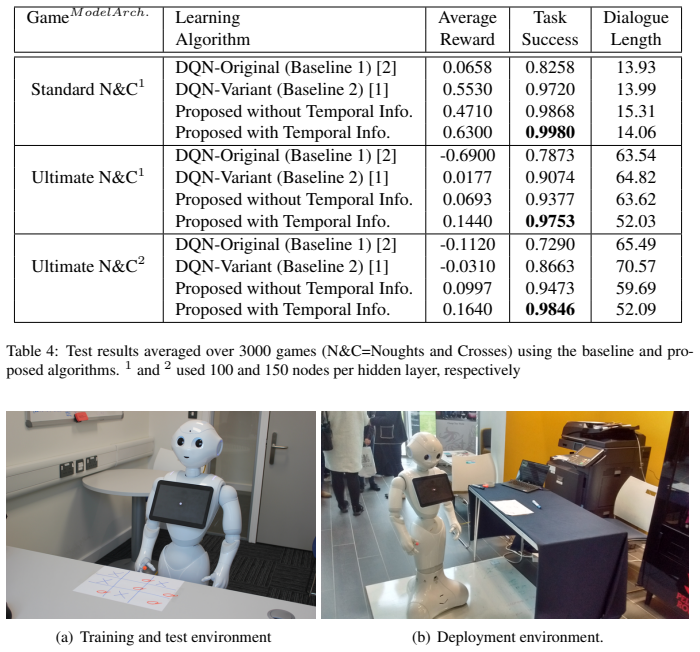
- The proposed policy learner's one-step look-ahead and losing-action pruning yields substantially higher win/draw rates and shorter dialogues than vanilla DQN, making deep RL practical for real-time interaction.
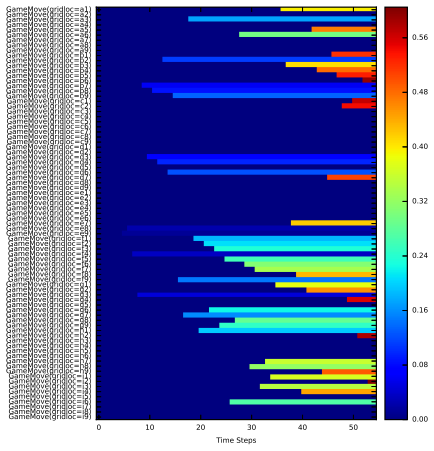
- Temporal move-order information is a cheap and effective state augmentation: including it raises win/draw rate and shortens games.
- The visual tracker's hand-filtering and three-frame voting reduced game-move misrecognitions from 31% to 10% across deployment days, and the paper attributes successful human-robot games to accurate perception.
- Because the approach is not game-specific—only the action set, reward function, and perception labels change—the same pipeline should extend to other social games and interactive tasks.
Reading between the lines
- Editorial inference: A natural extension not tested in the paper would be to run the same pipeline on a second game, such as Connect Four or draughts, to see whether the few-hundred-images and dozen-dialogues budget really is task-independent rather than specific to tic-tac-toe's simple symbols.
- Editorial inference: The one-step look-ahead in the competitive DQN suggests a family of algorithms that interpolate between Q-learning and tree search; multi-step look-ahead or Monte Carlo tree search would likely strengthen play further at the cost of computation, which the paper explicitly leaves open.
- Editorial inference: If the simulated random opponent is the bottleneck, a practical extension would be to seed simulations with human game logs or with increasingly strong self-play opponents, which would directly test whether human competitiveness improves.
- Editorial inference: The observed success of hand-filtering plus temporal voting suggests a transferable design principle for any robot vision system that reads handwriting or gestures in the wild: transient occluders should be detected and excluded before classification.
Signed reviews
Editorial analysis
A structured set of objections, weighed in public.
Referee Report
Summary. The paper proposes a data-efficient deep learning pipeline for training a Pepper humanoid robot to play Noughts and Crosses and Ultimate Noughts and Crosses. The pipeline combines a supervised CNN for recognizing hand-drawn game moves (Algorithm 1) with a deep reinforcement learning policy that is trained in simulation (Algorithm 2, called 'competitive DQN'). The policy learner augments standard DQN with a one-step look-ahead that prunes actions leading to immediate loss and forces winning moves when available. The manuscript reports simulation results showing that the proposed algorithm outperforms two DQN baselines in win/draw rate and average reward, and it describes a four-day field trial in which the robot played against 130 human opponents, with game-move misrecognition rates decreasing from 31% to 10% after incremental improvements. The conclusion claims that the approach achieves high task success in both game variants and that accurate visual perception is essential for successful human-robot interaction.
Significance. If the claims are supported, the paper is a useful demonstration that a multimodal social robot can be trained for a joint human-robot activity with modest human effort: a few hundred images, a small set of demonstration dialogues, and automatically generated simulated games. The field deployment with 130 spontaneous human opponents is a strength and goes beyond typical lab-based or simulation-only evaluations. The algorithmic idea of using game-rules-based one-step look-ahead to constrain Deep Q-learning is clearly described and likely explains much of the reported performance difference over plain DQN. However, the manuscript's strongest claims—competitive play against humans and substantial improvement over baselines—rest on evidence that is currently incomplete: the human evaluation reports no win/loss/draw statistics, and the simulation results lack variance estimates and are measured against a random-legal-move opponent.
major comments (4)
- [Section 6] The human evaluation does not report any win/loss/draw statistics. The only quantitative numbers are game-move misrecognition rates per day (31%, 25%, 22%, 10%), and the statement 'In games without misrecognitions the robot ended up winning or in a draw' appears without counts and applies only to the subset of games without perception errors. Since the abstract and introduction claim successful play against unknown humans and 'competitive robot behaviours,' the absence of human-game outcomes is a load-bearing gap. In addition, the deployed policy was 'without temporal information' even though Table 4 shows temporal information improves task success in simulation, so the field trial tests a weaker configuration than the one reported as best.
- [Section 4.1.6 and Table 4] The simulation opponent is 'semi-random user behaviour, i.e. from random but legal game moves.' All quantitative policy results in Table 4 and Figures 8–9 are obtained against this opponent, and task success is defined as win/draw rate, with draws receiving +1 reward. A random legal opponent is a weak baseline; high win/draw rates against it do not establish competitive play against humans, whose play is likely to be more structured. The paper should either evaluate against stronger simulated opponents (e.g., minimax-based or human-data-driven) or provide quantitative human-game outcomes.
- [Section 3.2, Algorithm 2] The proposed algorithm is not a purely learning-based policy; lines 5–6 of Algorithm 2 inject the game rules by pruning all actions with negative immediate reward and forcing the winning move when one exists. The DQN baselines in the comparison do not have this action filter. Thus the performance difference in Table 4 may be attributed to the injected domain knowledge rather than to the Deep Q-learning procedure itself. An ablation is needed—for example, DQN with the same action-filtering oracle—and the paper should discuss the fraction of wins that result from the forced winning moves.
- [Section 5.2] The experimental results are based on single training runs with no random seeds, and Table 4 reports averages over 3000 test games without standard deviations or significance tests. Overlapping or small differences (e.g., 0.9868 vs 0.9980 for Standard N&C in Table 4) cannot be judged to be 'substantially' different without run-to-run variance. The claim that the proposed algorithm substantially outperforms the baselines requires repeated runs and a report of variance.
minor comments (6)
- [Section 3.2] The loss-function text writes 'θi are the parameters of the network at iteration i, and θi are the target parameters' but the second θi should be θ̄i for the target network.
- [Section 4.1.5] 'maxium number of actions per dialogue=100' contains a typo; it should read 'maximum.'
- [Table 3] The confusion matrix would benefit from an explicit statement that rows are true classes and columns are predicted classes; the current layout is ambiguous.
- [Section 4.1.1] The definition of TemporalInfo uses only RobotGameMoves in the denominator; it is unclear whether user moves are excluded by design and whether this asymmetry affects the learned policies.
- [Section 6] It is unclear whether the reported misrecognition rates (31%, 25%, 22%, 10%) are measured online during live games or offline after each day; please clarify the measurement procedure.
- [Algorithm 1, line 7] The condition uses dist(P'_t, P'_{t-1}) + dist(P'_{t-1}, P'_{t-2}) > τ; the Euclidean distance is named in a footnote, but the threshold τ and the rationale for using two successive differences are not given.
Circularity Check
No circularity: the visual tracker and policy learners are evaluated on measured outcomes, and the 1-step-lookahead advantage is transparently injected rather than derived from the inputs.
full rationale
The paper's main derivations are not circular. The visual game-move recogniser is a CNN trained on a few hundred labeled images and evaluated on separate noisy/clean test sets; its reported accuracies are measured generalisation results, not identities with the training data. The reinforcement learners are trained in a simulated environment with semi-random legal opponents and then evaluated in the same simulator over 3000 games; this is an in-distribution evaluation with limited external validity, but it is not a case of a fitted parameter being renamed as a prediction. The proposed competitive DQN algorithm does inject game knowledge through its 1-step look-ahead action filter (Algorithm 2, lines 5-7): it removes actions with negative reward (losing/repeated moves) and forces immediate winning moves, so part of the win-rate advantage over DQN baselines comes from this rule rather than from learned Q-values. However, the paper explicitly describes this mechanism ('Why should agents learn what to do if they have the ability to infer that a game is about to be won or lost?'), and the reported win/draw rates are measured outcomes of the resulting policy, not quantities equivalent to the reward definition by construction. This is a possible confound or credit-assignment issue, but not circularity. The self-citations to [1] and [21] supply example dialogues and the simulation tool, but the central claims about visual tracking, policy learning, and field-trial perception do not reduce to those citations; they are supported by the paper's own experiments and by direct comparison with DQN baselines. The field trial reports misrecognition rates and the qualitative statement that games without misrecognitions ended in wins or draws, but the absence of win/loss statistics is an evidence gap about human transfer, not a circular derivation. Overall, no load-bearing step is equivalent to its input by definition or by self-citation chain.
Assumptions & free parameters
free parameters (5)
- reward_values =
+5 win, +1 draw, -5 repeated action, -5 loss
- discount_factor =
0.7
- action_restriction_threshold =
0.001
- cnn_architecture =
8 and 16 filters, pooling sizes 2x2 and 3x3
- temporal_info_normalization =
TimeStep / |RobotGameMoves|
assumptions (5)
- domain assumption The camera can locate the game grid as the largest contour in the image.
- domain assumption The simulated semi-random opponent provides a training distribution that transfers to human play.
- domain assumption The temporary-action look-ahead in Algorithm 2 returns the true next state and reward in the simulator.
- domain assumption The speech recognizer provides word hypotheses with confidence scores that are sufficient as state features.
- domain assumption The environment is fully observable through the 73/289 feature vector.
Cite this review
Pith. "Pith review of A Data-Efficient Deep Learning Approach for Deployable Multimodal Social Robots." pith.science (2026). https://pith.science/paper/GXGNDN5W
@misc{pith2026190810398,
  author       = {Pith},
  title        = {Pith review of: A Data-Efficient Deep Learning Approach for Deployable Multimodal Social Robots},
  year         = {2026},
  howpublished = {\url{https://pith.science/paper/GXGNDN5W}},
  note         = {Machine review of arXiv:1908.10398}
}
read the original abstract
The deep supervised and reinforcement learning paradigms (among others) have the potential to endow interactive multimodal social robots with the ability of acquiring skills autonomously. But it is still not very clear yet how they can be best deployed in real world applications. As a step in this direction, we propose a deep learning-based approach for efficiently training a humanoid robot to play multimodal games---and use the game of `Noughts & Crosses' with two variants as a case study. Its minimum requirements for learning to perceive and interact are based on a few hundred example images, a few example multimodal dialogues and physical demonstrations of robot manipulation, and automatic simulations. In addition, we propose novel algorithms for robust visual game tracking and for competitive policy learning with high winning rates, which substantially outperform DQN-based baselines. While an automatic evaluation shows evidence that the proposed approach can be easily extended to new games with competitive robot behaviours, a human evaluation with 130 humans playing with the Pepper robot confirms that highly accurate visual perception is required for successful game play.
Figures


Figures from the paper (7 more)




Reference graph
Works this paper leans on
-
[1]
H. Cuay ´ahuitl, Deep reinforcement learning for conversational robots playing games, in: IEEE-RAS International Conference on Humanoid Robots (Hu- manoids), 2017
work page 2017
-
[2]
V . e. a. Mnih, Human-level control through deep reinforcement learning, Nature 518 (7540) (2015) 529–533
work page 2015
-
[3]
K. Noda, H. Arie, Y . Suga, T. Ogata, Multimodal integration learning of robot behavior using deep neural networks, Robotics and Autonomous Systems 62 (6) (2014) 721–736. 20
work page 2014
-
[4]
A. H. Qureshi, Y . Nakamura, Y . Yoshikawa, H. Ishiguro, Robot gains social in- telligence through multimodal deep reinforcement learning, in: IEEE-RAS Inter- national Conference on Humanoid Robots (Humanoids), 2016, pp. 745–751
work page 2016
-
[5]
H. Cuay ´ahuitl, G. Couly, C. Olalainty, Training an interactive humanoid robot using multimodal deep reinforcement learning, in: NIPS Workshop on the Future of Interactive Learning Machines, 2016
work page 2016
-
[6]
S. Wermter, C. Weber, M. Elshaw, C. Panchev, H. R. Erwin, F. Pulverm ¨uller, Towards multimodal neural robot learning, Robotics and Autonomous Systems 47 (2-3)
- [7]
-
[8]
N. Srivastava, R. Salakhutdinov, Multimodal learning with deep boltzmann ma- chines, Journal of Machine Learning Research 15 (1)
Show all 42 references
-
[9]
Levine, C
S. Levine, C. Finn, T. Darrell, P. Abbeel, End-to-end training of deep visuomotor policies, CoRR abs/1504.00702
-
[10]
D. C. Bentivegna, C. G. Atkeson, A. Ude, G. Cheng, Learning to act from obser- vation and practice, International Journal of Humanoid Robotics 01 (04) (2004) 585–611. doi:10.1142/S0219843604000307
2004 doi
-
[11]
Short, J
E. Short, J. Hart, M. Vu, B. Scassellati, No fair!!: an interaction with a cheating robot, in: International Conference on Human-Robot Interaction (HRI), ACM, 2010, pp. 219–226
2010
-
[12]
Kober, M
J. Kober, M. Glisson, M. Mistry, Playing catch and juggling with a humanoid robot, in: IEEE-RAS International Conference on Humanoid Robots (Hu- manoids), 2012
2012
-
[13]
T. e. a. Belpaeme, Multimodal child-robot interaction: Building social bonds, Journal of Human-Robot Interaction 1 (2013) 33–53. doi:10.5898/JHRI. 1.2.Belpaeme
2013 doi
-
[14]
M. Kim, K. Suzuki, Comparative study of human behavior in card playing with a humanoid playmate, I. J. Social Robotics 6 (1) (2014) 5–15
2014
-
[15]
E. I. Barakova, M. D. Haas, W. Kuijpers, N. Irigoyen, A. Betancourt, So- cially grounded game strategy enhances bonding and perceived smartness of a humanoid robot, Connection Science 30 (1) (2018) 81–98. doi:10.1080/ 09540091.2017.1350938
2018
-
[16]
M. Jung, P. Hinds, Robots in the wild: A time for more robust theories of human- robot interaction, ACM Trans. Hum.-Robot Interact. 7 (1) (2018) 2:1–2:5. doi: 10.1145/3208975
2018 doi
-
[17]
Cuay ´ahuitl, Robot learning from verbal interaction: A brief survey, in: 4th International Symposium on New Frontiers in HRI, 2015
H. Cuay ´ahuitl, Robot learning from verbal interaction: A brief survey, in: 4th International Symposium on New Frontiers in HRI, 2015. 21
2015
-
[18]
Cuay ´ahuitl, K
H. Cuay ´ahuitl, K. Komatani, G. Skantze, Introduction for speech and language for interactive robots, Comput. Speech Lang. 34 (1) (2015) 83–86. doi:10. 1016/j.csl.2015.05.006. URL http://dx.doi.org/10.1016/j.csl.2015.05.006
2015 doi
-
[19]
Thrun, et al., Probabilistic algorithms and the interactive museum tour-guide robot minerva, The International Journal of Robotics Research 19 (11) (2000) 972–999
S. Thrun, et al., Probabilistic algorithms and the interactive museum tour-guide robot minerva, The International Journal of Robotics Research 19 (11) (2000) 972–999
2000
-
[20]
Bohus, C
D. Bohus, C. W. Saw, E. Horvitz, Directions robot: In-the-wild experiences and lessons learned, in: Proceedings of the 2014 International Conference on Au- tonomous Agents and Multi-agent Systems, AAMAS ’14, International Founda- tion for Autonomous Agents and Multiagent Syste...
2014
-
[21]
Cuay ´ahuitl, SimpleDS: A simple deep reinforcement learning dialogue sys- tem, in: International Workshop on Spoken Dialogue Systems (IWSDS), 2016
H. Cuay ´ahuitl, SimpleDS: A simple deep reinforcement learning dialogue sys- tem, in: International Workshop on Spoken Dialogue Systems (IWSDS), 2016
2016
-
[22]
LeCun, L
Y . LeCun, L. Bottou, Y . Bengio, P. Haffner, Gradient-based learning applied to document recognition, in: Proceedings of the IEEE, V ol. 86, 1998, pp. 2278– 2324
1998
-
[23]
Cuay ´ahuitl, D
H. Cuay ´ahuitl, D. Lee, S. Ryu, S. Choi, I. Hwang, J. Kim, Deep reinforcement learning for chatbots using clustered actions and human-likeness rewards, in: To appear in International Joint Conference on Neural Networks (IJCNN), 2019
2019
-
[24]
R. S. Sutton, A. G. Barto, Reinforcement learning - an introduction, 2nd Edition, Adaptive computation and machine learning, MIT Press, 2018. URL http://www.worldcat.org/oclc/37293240
2018
-
[25]
Szepesv ´ari, Algorithms for Reinforcement Learning, Morgan and Claypool Publishers, 2010
C. Szepesv ´ari, Algorithms for Reinforcement Learning, Morgan and Claypool Publishers, 2010
2010
-
[26]
Cuay ´ahuitl, SimpleDS: A Simple Deep Reinforcement Learning Dia- logue System, Springer, Singapore, 2017, pp
H. Cuay ´ahuitl, SimpleDS: A Simple Deep Reinforcement Learning Dia- logue System, Springer, Singapore, 2017, pp. 109–118. doi:10.1007/ 978-981-10-2585-3_8
2017
-
[27]
L. Deng, Y . Liu, Deep Learning in Natural Language Processing, Springer Singa- pore, 2018
2018
-
[28]
Dethlefs, Domain transfer for deep natural language generation from abstract meaning representations, IEEE Comp
N. Dethlefs, Domain transfer for deep natural language generation from abstract meaning representations, IEEE Comp. Int. Mag. 12 (3) (2017) 18–28. doi: 10.1109/MCI.2017.2708558
2017
-
[29]
A. H. Qureshi, Y . Nakamura, Y . Yoshikawa, H. Ishiguro, Show, attend and in- teract: Perceivable human-robot social interaction through neural attention q- network, CoRR abs/1702.08626
-
[30]
Settles, Active Learning, Morgan & Claypool Publishers, 2012
B. Settles, Active Learning, Morgan & Claypool Publishers, 2012. 22
2012
-
[31]
Cuay ´ahuitl, N
H. Cuay ´ahuitl, N. Dethlefs, Dialogue systems using online learning: Beyond em- pirical methods, in: NAACL-HLT Workshop on Future directions and needs in the Spoken Dialog Community: Tools and Data, 2012
2012
-
[32]
A. Nair, P. Srinivasan, S. Blackwell, C. Alcicek, R. Fearon, A. D. Maria, V . Panneershelvam, M. Suleyman, C. Beattie, S. Petersen, S. Legg, V . Mnih, K. Kavukcuoglu, D. Silver, Massively parallel methods for deep reinforcement learning, CoRR abs/1507.04296. URL http://arxiv.o...
-
[33]
V . Mnih, A. P. Badia, M. Mirza, A. Graves, T. P. Lillicrap, T. Harley, D. Silver, K. Kavukcuoglu, Asynchronous methods for deep reinforcement learning, CoRR abs/1602.01783
-
[34]
Schaul, J
T. Schaul, J. Quan, I. Antonoglou, D. Silver, Prioritized experience replay, CoRR abs/1511.05952. URL http://arxiv.org/abs/1511.05952
-
[35]
F. S. He, Y . Liu, A. G. Schwing, J. Peng, Learning to play in a day: Faster deep reinforcement learning by optimality tightening, CoRR abs/1611.01606
-
[36]
T. D. Kulkarni, K. Narasimhan, A. Saeedi, J. Tenenbaum, Hierarchical deep rein- forcement learning: Integrating temporal abstraction and intrinsic motivation, in: Advances in Neural Information Processing Systems (NIPS), 2016
2016
-
[37]
Cuay ´ahuitl, S
H. Cuay ´ahuitl, S. Yu, A. Williamson, J. Carse, Scaling up deep reinforcement learning for multi-domain dialogue systems, in: International Joint Conference on Neural Networks (IJCNN), 2017
2017
-
[38]
Cuay ´ahuitl, S
H. Cuay ´ahuitl, S. Yu, Deep reinforcement learning for multidomain dialogue sys- tems using less weight updates, in: Proc. of INTERSPEECH, 2017
2017
-
[39]
Gregor, I
K. Gregor, I. Danihelka, A. Graves, D. J. Rezende, D. Wierstra, DRAW: A re- current neural network for image generation, in: F. R. Bach, D. M. Blei (Eds.), Proceedings of the 32nd International Conference on Machine Learning, ICML 2015, Lille, France, 6-11 July 2015, V ol. 37 ...
2015
-
[40]
Bullock, S
D. Bullock, S. Grossberg, C. Mannes, A neural network model for cursive script production, Biological Cybernetics 70 (1) (1993) 15–28. doi:10.1007/ BF00202562
1993
-
[41]
Kalles, P
D. Kalles, P. Kanellopoulos, A minimax tutor for learning to play a board game, in: ECAI Workshop on Artificial Intelligence in Games (AIG@ECAI), 2008
2008
-
[42]
Silver, A
D. Silver, A. Huang, C. J. Maddison, A. Guez, L. Sifre, G. van den Driess- che, J. Schrittwieser, I. Antonoglou, V . Panneershelvam, M. Lanctot, S. Diele- man, D. Grewe, J. Nham, N. Kalchbrenner, I. Sutskever, T. Lillicrap, M. Leach, K. Kavukcuoglu, T. Graepel, D. Hassabis, Ma...
2016
Reviewed August 14, 2026 · model on record in the stance chip above.
Discussion (0). Continue with ORCID to comment.