REVIEW 3 major objections 6 minor 47 references
Emotion Recognition in Low-Resource Settings: An Evaluation of Automatic Feature Selection Methods
T0 review · 3 major / 6 minor · reviewed 2026-08-14 · deepseek-v4-flash
Pith's one-line read This paper shows that speech emotion recognition can match or exceed full-feature accuracy using a fraction of the acoustic features, around 30 of 88 eGeMAPs and 100 of 988 emobase features.
desk verdict Useful comparison of feature-selection methods for speech emotion recognition, but the headline accuracy numbers are selected on the same LOSO folds used to report them, so treat them as optimistic until a nested or independent evaluation is done. read the letter →
The pith
A machine-rendered reading of the paper's core claim, the machinery that carries it, and where it could break.
The reading
What carries the argument
The central object is the feature-selection comparison pipeline, built on leave-one-speaker-out (LOSO) cross-validation, a linear-kernel SVM classifier, and Unweighted Average Recall (UAR) as the performance measure. Three ranking-based selectors—ILFS, ReliefF, and the generalized Fisher score—score individual features and are evaluated at increasing feature-count cutoffs, while Active Feature Selection (AFS) clusters features with a self-organizing map and picks the cluster with the highest validation accuracy. The mechanism that carries the argument is the observation that UAR curves flatten well before the full feature count, meaning most of the discriminative information is concentrated in a small subset. This is what licenses the conclusion that a model trained on about 30 eGeMAPs or 100 emobase features can substitute for the full set on low-power devices.
What would settle it
A direct test is to split the data by speaker, select feature subsets using only the training speakers, and then measure UAR on the held-out speakers. If a 30-feature eGeMAPs or 100-feature emobase subset no longer matches full-feature accuracy under this nested procedure, the claimed resource reduction would be called into question.
Extended reading notes
Core claim
The paper's central claim is that feature selection can preserve or slightly improve emotion recognition accuracy while cutting the feature count by roughly two-thirds to nine-tenths. With eGeMAPs, around 30 of 88 features suffice; with emobase, around 100 of 988 suffice. Across the six corpus/feature-set combinations, the best subset for each method usually matched or exceeded the full-feature baseline, with a few exceptions, most notably Active Feature Selection on SAVEE. When all three datasets were pooled into an eight-class task, ReliefF gave the highest UAR (48.0% on emobase and 46.6% on eGeMAPs). The discovery is meant to show that model size and computational load can be reduced without sacrificing recognition performance.
Load-bearing premise
The reported gains come from picking the feature subset that performed best on the same leave-one-speaker-out evaluation used to report accuracy, so the result assumes that this selection would also pick a good subset on new data.
Editorial extensions
If this is right
- Deploying emotion recognition on low-power devices becomes feasible: a classifier using roughly 30 eGeMAPs or 100 emobase features needs a fraction of the memory and computation of an 88- or 988-feature model.
- Feature selection can serve as an alternative to feature transformation methods such as PCA when interpretability or resource constraints matter.
- The best method depends on the data: the generalized Fisher score wins most per-corpus comparisons, while ReliefF wins when corpora from different languages are pooled, so method choice should be corpus-dependent.
- Active Feature Selection can reach competitive accuracy with very small subsets (for example, 2 eGeMAPs features on EMOVO), suggesting strong redundancy in these acoustic feature sets.
- Reducing features does not necessarily reduce accuracy, so model-size reduction and recognition performance are not in direct tension in this setting.
Reading between the lines
- An implication the authors leave implicit is that a system trained on the small subsets could run with much lower latency on wearable or ambient sensors, making real-time emotion monitoring in assisted-living settings more practical than the accuracy numbers alone suggest.
- Because the best feature subset differs across corpora and languages, a single universal small acoustic feature set is unlikely; practical deployments may need to run feature selection on target-domain data.
- The flatness of the UAR curves suggests that many of the 988 emobase features are redundant; a testable extension is to compare the selected subsets with random subsets of the same size, which would indicate whether the gains come from selector quality or from sheer redundancy.
- The paper names fusing features from several AFS clusters as future work; one natural extension is to check whether combining the top two or three clusters improves on the single-cluster result.
Signed reviews
Editorial analysis
A structured set of objections, weighed in public.
Referee Report
Summary. The paper evaluates four feature selection methods—Infinite Latent Feature Selection (ILFS), ReliefF, the generalized Fisher score, and the authors' Active Feature Selection (AFS)—for emotion recognition from speech on three acted corpora (EmoDB, SAVEE, EMOVO) with two standard acoustic feature sets (eGeMAPs, emobase). Classification is performed with a linear SVM in leave-one-subject-out (LOSO) cross-validation, and performance is measured as unweighted average recall (UAR). The central claim is that substantially smaller feature subsets (around 30 of 88 eGeMAPs features and 100 of 988 emobase features) achieve UAR comparable to or better than the full feature set, with the generalized Fisher score providing the best average UAR and ReliefF best on a combined eight-class task.
Significance. If the quantitative claim were validated, the paper would make a useful practical contribution to low-resource and ambient-intelligence emotion recognition, where memory and compute constraints matter. The study has concrete strengths: it uses three public multilingual corpora, two standard acoustic feature sets, a class-imbalance-appropriate metric (UAR), a full-feature baseline, and a comparison of a recent method (AFS) with established ranking methods. The qualitative direction—that feature selection can prune many acoustics features without obvious loss—is plausible and worth investigating. However, as detailed below, the evaluation protocol selects the reported feature subset on the same LOSO data used to report performance, which invalidates the headline numbers as estimates of the accuracy a practitioner would obtain with a pre-specified selection rule.
major comments (3)
- [Section 5, Table 3 and Figure 2] The central claim that small feature subsets achieve the same or better UAR than the full feature set is not supported by the reported evaluation because the 'best' UAR for each method is selected on the same LOSO folds used to report accuracy. For ILFS, ReliefF, and Fisher, the Table 3 entries are the maximum of the LOSO UAR curves in Figure 2 over the number of features; for AFS, they are the maximum over the evaluated cluster counts. This amounts to choosing the feature subset on the test speakers. Under the null hypothesis that no subset generalizes better than the full set, the maximum of many positively correlated LOSO estimates will typically lie above the full-set estimate, so the observed improvements (e.g., 69.7% vs. 68.5%, 41.0% vs. 37.4%) and the ranking of methods can arise from selection bias alone. The paper needs a nested or independent evaluation: the feature count or cluster index should be selected on training partitions only, then evaluated on held-out folds, and the reported UAR should be the UAR of that fixed selection rule, not a maximum over configurations.
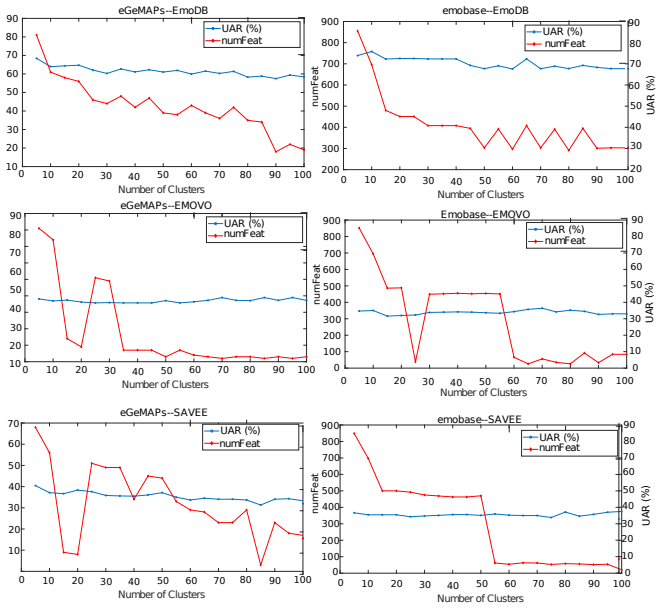
- [Section 5, Table 3 and Section 3.4] For the AFS method, the protocol explicitly states that the cluster with the highest validation accuracy is selected, and Figure 7 plots the UAR of that best cluster. The AFS entries in Table 3 (e.g., 2 eGeMAPs features at 39.0% UAR for EMOVO, and 21 emobase features at 37.5% UAR for SAVEE) are therefore the maximum over the cluster sizes N = 5, 10, ..., 100. The improvement over baseline (37.4% and 38.1%, respectively) may be regression to the mean. Because a user cannot know in advance which cluster size will be best, the reported UAR does not estimate the performance of the AFS method as a deployable procedure. The authors should report the performance of a fixed rule, such as selecting N on an inner LOOCV loop or using a prespecified N, and then evaluating on the held-out speakers.
- [Table 3 and Figures 2/7 (comparability of methods)] The comparison across methods is not apples-to-apples: for AFS the reported result is the best over 20 cluster sizes, while for the ranking methods it is the best over up to 88 or 988 feature-count thresholds. The number of candidate models searched differs by an order of magnitude, so the ranking of methods in Table 3 (Fisher best in 3 of 6 cases, ILFS in 2, ReliefF in 1, AFS second in 3) is confounded with the number of configurations evaluated. The paper should either compare methods under a common, fixed model-selection budget (e.g., inner cross-validation for both the feature count and the AFS cluster size) or report the full performance curves with a clear statement of how a practitioner would choose the operating point without access to test labels.
minor comments (6)
- [Section 3.4] The sentence 'It involves clustering the data set into N clusters' is ambiguous on first reading; the paper later clarifies that the clustering is applied to feature dimensions, not data instances. The wording should be updated to avoid confusion.
- [Table 4] The method name is spelled 'reliefF' in most places but 'relifF' in Table 4; the spelling should be made consistent throughout.
- [Abstract and Section 5] The abstract's claim that 'around 30 out of 88 eGeMAPs features and around 100 out of 988 emobase features suffice' does not correspond to the best configurations in Table 3 (e.g., AFS selects 2 eGeMAPs features for EMOVO, Fisher selects 25). The statement appears to refer to the visual curves in Figure 2; this should be stated explicitly and qualified with the selection-bias caveat.
- [Section 5, EMOVO paragraph] The text states that the SAVEE best UAR is 42.9%, but Table 3 and the confusion matrix in Figure 5 show 42.4%. One of these is a typo and should be corrected.
- [Section 5, AFS discussion] The text says the best AFS result for EMOVO is obtained with 70 clusters, while Figure 6 shows that the selected cluster contains only 2 features. The relationship between the number of clusters (70), the 2-feature cluster, and the UAR value of 39.0% should be spelled out in the caption or text.
- [Section 5 and Table 4] The combined-dataset experiment in Table 4 uses a 7+1 emotion setup, but the text does not specify how the feature counts for each method are selected in that setting; the same best-over-LOSO selection issue applies there as well, and the table should state the selection rule.
Circularity Check
Reported UARs are selection maxima over feature counts/clusters on the same LOSO folds, so the 'smaller subset matches full set' conclusion is not independently validated.
-
fitted input called prediction
[Section 3.4 (Active feature selection method); Table 3; Figure 7]
"evaluating discrimination power of features present in each cluster CN using Leave-One-Subject Out (LOSO) cross-validation setting, as depicted in Figure 1, and selecting the cluster with the highest validation accuracy (see Figure 6 in Section 5)."
AFS defines its selected feature subset as the cluster with the highest LOSO validation UAR, and Table 3 then reports exactly that selected cluster's UAR as the AFS result. Thus the reported performance is, by construction, the maximum of the validation accuracies over all clusters. Claiming that this subset provides better results than the full set is equivalent to stating that the maximum over many evaluated clusters exceeds the full-set accuracy on the same folds; no held-out or nested evaluation is performed. The central low-resource claim therefore rests on a fitted selection statistic rather than an independent prediction.
-
fitted input called prediction
[Section 5, Table 3 and Figure 2; Conclusion]
"The best results of each feature selection method are depicted in Table 3. ... Where x-axis represents the number of features and y-axis represents the UAR."
For ILFS, ReliefF and Fisher, the table's 'Best UAR' entries are the maxima over the feature-count grid of the LOSO curves in Figure 2. The paper does not specify a nested or independent selection of the feature count; the count is chosen after seeing the same LOSO UAR that is reported. Therefore the conclusion that around 30 eGeMAPs or around 100 emobase features give almost the same UAR as the full set is read off the curve at the count that maximizes that same curve. The reported advantage is a maximum-over-candidates artifact, not the expected performance of a fixed small-subset rule.
full rationale
The paper's feature-selection algorithms (ILFS, ReliefF, Fisher) and datasets are external and are not defined in terms of the outcome. AFS is the authors' own method, but the citation to [16] is a prior application, not a load-bearing proof, so self-citation alone does not raise the score. The circularity is in the evaluation protocol: for AFS the selected subset is chosen as the cluster with the highest LOSO validation UAR and that same value is reported; for the ranking methods the 'best UAR' is the maximum of the LOSO curves over the number of features, with no nested or held-out selection. Hence the central claim that small subsets match or beat the full feature set is partially forced by construction: the reported numbers are maxima over many candidate subsets evaluated on the same folds. This is a fitted-input-called-prediction pattern rather than definitional equivalence, so the score is 6 rather than 8-10. The qualitative motivation and standard benchmarks are sound; an independent test protocol would resolve the issue.
Assumptions & free parameters
free parameters (4)
- Number of clusters N for AFS =
5, 10, 15, ..., 100
- SVM box constraint k =
0.75
- Number of selected features for ranking methods =
varies per dataset and method (e.g., 74, 685 for ILFS on EmoDB)
- ReliefF hyperparameters (e.g., number of neighbors) =
not specified
assumptions (4)
- domain assumption The eGeMAPs and emobase feature sets are adequate bases for emotion recognition.
- domain assumption The acted emotion corpora are representative and annotations are correct.
- standard math UAR is an appropriate metric for the imbalanced emotion classes.
- domain assumption Reducing the number of features reduces computational resource usage of the trained model.
Cite this review
Pith. "Pith review of Emotion Recognition in Low-Resource Settings: An Evaluation of Automatic Feature Selection Methods." pith.science (2026). https://pith.science/paper/USBGWUOF
@misc{pith2026190810623,
  author       = {Pith},
  title        = {Pith review of: Emotion Recognition in Low-Resource Settings: An Evaluation of Automatic Feature Selection Methods},
  year         = {2026},
  howpublished = {\url{https://pith.science/paper/USBGWUOF}},
  note         = {Machine review of arXiv:1908.10623}
}
read the original abstract
Research in automatic affect recognition has seldom addressed the issue of computational resource utilization. With the advent of ambient intelligence technology which employs a variety of low-power, resource-constrained devices, this issue is increasingly gaining interest. This is especially the case in the context of health and elderly care technologies, where interventions may rely on monitoring of emotional status to provide support or alert carers as appropriate. This paper focuses on emotion recognition from speech data, in settings where it is desirable to minimize memory and computational requirements. Reducing the number of features for inductive inference is a route towards this goal. In this study, we evaluate three different state-of-the-art feature selection methods: Infinite Latent Feature Selection (ILFS), ReliefF and Fisher (generalized Fisher score), and compare them to our recently proposed feature selection method named `Active Feature Selection' (AFS). The evaluation is performed on three emotion recognition data sets (EmoDB, SAVEE and EMOVO) using two standard acoustic paralinguistic feature sets (i.e. eGeMAPs and emobase). The results show that similar or better accuracy can be achieved using subsets of features substantially smaller than the entire feature set. A machine learning model trained on a smaller feature set will reduce the memory and computational resources of an emotion recognition system which can result in lowering the barriers for use of health monitoring technology.
Figures


Figures from the paper (6 more)


Reference graph
Works this paper leans on
-
[1]
H. Akira, F. Haider, L. Cerrato, N. Campbell, S. Luz, Detection o f cognitive states and their correlation to speech recognition performance in speech- to-speech machine translation systems, in: Proceedings of the 16 th An- nual Conference of the International Speech Communication Ass ociation, INTERSPEECH 2015, International Speech Communications Assoc i...
work page 2015
-
[2]
B. Schuller, S. Steidl, A. Batliner, J. Epps, F. Eyben, F. Ringeval, E. Marchi, Y. Zhang, The INTERSPEECH 2014 computational paralin - guistics challenge: Cognitive & physical load, in: Proceedings of the 1 5th Annual conference of the International Speech Communication A ssociation, INTERSPEECH 2014, International Speech Communications Assoc iation, 2014...
work page 2014
-
[3]
F. Haider, L. Cerrato, N. Campbell, S. Luz, Presentation quality assessment using acoustic information and hand movements, in: Proceedings of the IEEE International Conference on Acoustics, Speech and Signal Processing 18 (ICASSP), Institute of Electrical and Electronics Engineers (IEE E), 2016, pp. 2812–2816
work page 2016
-
[4]
M. El Ayadi, M. S. Kamel, F. Karray, Survey on speech emotion re cogni- tion: Features, classification schemes, and databases, Pattern Recognition 44 (3) (2011) 572–587
work page 2011
-
[5]
B. Schuller, A. Batliner, S. Steidl, D. Seppi, Recognising realistic em otions and affect in speech: State of the art and lessons learnt from the fi rst challenge, Speech Communication 53 (910) (2011) 1062–1087
work page 2011
-
[6]
N. S. Consedine, J. T. Moskowitz, The role of discrete emotions in health outcomes: A critical review, Applied and Preventive Psychology 12 ( 2) (2007) 59–75
work page 2007
-
[7]
J. E. Dimsdale, Psychological stress and cardiovascular disease , Journal of the American College of Cardiology 51 (13) (2008) 1237–1246
work page 2008
-
[8]
M. Valstar, B. Schuller, K. Smith, F. Eyben, B. Jiang, S. Bilakhia, S. Schnieder, R. Cowie, M. Pantic, A VEC 2013: the continuous au- dio/visual emotion and depression recognition challenge, in: Procee dings of the 3rd ACM international workshop on Audio/visual emotion cha llenge (A VEC), Association for Computing Machinery, 2013, pp. 3–10
work page 2013
Show all 47 references
-
[9]
Desmet, V
B. Desmet, V. Hoste, Emotion detection in suicide notes, Expert Systems with Applications 40 (16) (2013) 6351–6358
2013
-
[10]
Haider, S
F. Haider, S. De La Fuente Garcia, P. Albert, S. Luz, Affective s peech for alzheimer’s dementia recognition., in: D. Kokkinakis, K. Lundholm Fors , C. Themistocleous, M. Antonsson, M. Eckerstr¨ om (Eds.), LREC:Resources and ProcessIng of linguistic, para-linguistic and extra-l...
2020
-
[11]
L. Y. Mano, B. S. Faial, L. H. Nakamura, P. H. Gomes, G. L. Libra lon, R. I. Meneguete, P. R. Geraldo Filho, G. T. Giancristofaro, G. Pessin, B. Krish- namachari, Exploiting IoT technologies for enhancing Health Smart H omes through patient identification and emotion recognitio...
2016
-
[12]
J. Su, S. Luz, Predicting cognitive load levels from speech data, in: Recent Advances in Nonlinear Speech Processing, Springer, 2016, pp. 255 –263
2016
-
[13]
Eyben, M
F. Eyben, M. W¨ ollmer, B. Schuller, Openearintroducing the mun ich open- source emotion and affect recognition toolkit, in: Proceedings of th e 3rd International Conference on Affective Computing and Intelligent I nterac- tion and Workshops (ACII), IEEE, 2009, pp. 1–6
2009
-
[14]
Ververidis, C
D. Ververidis, C. Kotropoulos, Emotional speech recognition: Resources, features, and methods, Speech Communication 48 (9) (2006) 116 2–1181
2006
-
[15]
Weninger, F
F. Weninger, F. Eyben, B. W. Schuller, M. Mortillaro, K. R. Scher er, On the Acoustics of Emotion in Audio: What Speech, Music, and Sound ha ve in Common, Frontiers in Psychology 4 (May 2013)
2013
-
[16]
Haider, S
F. Haider, S. Pollak, E. Zarogianni, S. Luz, SAAMEAT: active fea ture transformation and selection methods for the recognition of user eating conditions, in: Proceedings of the 2018 International Conferenc e on Mul- timodal Interaction (ICMI), ACM, Association for Computing Ma...
2018
-
[17]
Schuller, S
B. Schuller, S. Steidl, A. Batliner, S. Hantke, F. Hnig, J. R. Oroz co- Arroyave, E. Nth, Y. Zhang, F. Weninger, The INTERSPEECH 2015 computational paralinguistics challenge: nativeness, parkinson’s & eating condition, in: Proceedings of the 16th Annual Conference of the I nte...
2015
-
[18]
Anagnostopoulos, T
C.-N. Anagnostopoulos, T. Iliou, I. Giannoukos, Features and classifiers for emotion recognition from speech: a survey from 2000 to 2011, Artificial Intelligence Review 43 (2) (2015) 155–177
2015
-
[19]
Eyben, K
F. Eyben, K. R. Scherer, B. W. Schuller, J. Sundberg, E. Andr ´ e, C. Busso, L. Y. Devillers, J. Epps, P. Laukka, S. S. Narayanan, et al., The gen eva minimalistic acoustic parameter set (gemaps) for voice research an d affec- tive computing, IEEE Transactions on Affective Compu...
-
[20]
A. Knig, A. Satt, A. Sorin, R. Hoory, O. Toledo-Ronen, A. Derr eumaux, V. Manera, F. Verhey, P. Aalten, P. H. Robert, Automatic speech anal- ysis for the assessment of patients with predementia and Alzheimer ’s dis- ease, Alzheimer’s & Dementia: Diagnosis, Assessment & Disease...
2015
-
[21]
Haider, S
F. Haider, S. de la Fuente, S. Luz, An assessment of paralinguis tic acoustic features for detection of alzheimer’s dementia in spontaneous spe ech, IEEE Journal of Selected Topics in Signal Processing 14 (2) (2020) 272– 281
2020
-
[22]
Goldshtein, A
E. Goldshtein, A. Tarasiuk, Y. Zigel, Automatic detection of obs tructive sleep apnea using speech signals, IEEE Transactions on biomedical e ngi- neering 58 (5) (2011) 1373–1382
2011
-
[23]
Dhall, A
A. Dhall, A. Kaur, R. Goecke, T. Gedeon, Emotiw 2018: Audio-vid eo, student engagement and group-level affect prediction, in: Proce edings of the 2018 on International Conference on Multimodal Interaction , ACM, 2018, pp. 653–656
2018
-
[24]
Dhall, R
A. Dhall, R. Goecke, S. Ghosh, J. Joshi, J. Hoey, T. Gedeon, Fr om individ- ual to group-level emotion recognition: Emotiw 5.0, in: Proceedings of the 19th ACM International Conference on Multimodal Interaction (I CMI), ICMI 2017, Association for Computing Machinery, 2017, pp....
2017
-
[25]
Knyazev, R
B. Knyazev, R. Shvetsov, N. Efremova, A. Kuharenko, Conv olutional neu- ral networks pretrained on large face recognition datasets for e motion clas- sification from video, arXiv preprint arXiv:1711.04598 (2017)
2017 arXiv
-
[26]
Haider, L
F. Haider, L. S. Cerrato, S. Luz, N. Campbell, Attitude recogn ition of video bloggers using audio-visual descriptors, in: Proceedings of the Wo rkshop on Multimodal Analyses Enabling Artificial Agents in Human-Machine In - teraction, MA3HMI 2016, Association for Computing Mach...
2016
-
[27]
N. A. Madzlan, Y. Huang, N. Campbell, Automatic classification an d pre- diction of attitudes: Audio-visual analysis of video blogs, in: Procee dings of the International Conference on Speech and Computer, Sprin ger, 2015, pp. 96–104
2015
-
[28]
P. Hu, D. Cai, S. Wang, A. Yao, Y. Chen, Learning supervised sc oring ensemble for emotion recognition in the wild, in: Proceedings of the 19 th ACM International Conference on Multimodal Interaction (ICMI) , ICMI 2017, Association for Computing Machinery, 2017, pp. 553–560
2017
-
[29]
Vielzeuf, S
V. Vielzeuf, S. Pateux, F. Jurie, Temporal multimodal fusion fo r video emotion classification in the wild, in: Proceedings of the 19th ACM Inte r- national Conference on Multimodal Interaction (ICMI), ICMI 201 7, Asso- ciation for Computing Machinery, 2017, p. 569576
2017
-
[30]
S. Wang, W. Wang, J. Zhao, S. Chen, Q. Jin, S. Zhang, Y. Qin, Em otion recognition with multimodal features and temporal models, in: Proc eed- ings of the 19th ACM International Conference on Multimodal Inte raction (ICMI), ICMI 2017, Association for Computing Machinery, 2017,...
2017
-
[31]
Ouyang, S
X. Ouyang, S. Kawaai, E. G. H. Goh, S. Shen, W. Ding, H. Ming, D.- Y. Huang, Audio-visual emotion recognition using deep transfer lea rning 22 and multiple temporal models, in: Proceedings of the 19th ACM Inter na- tional Conference on Multimodal Interaction (ICMI), ACM, Assoc...
2017
-
[32]
M. A. Hall, Correlation-based feature selection for machine lear ning, Ph.D. thesis, The University of Waikato (1999)
1999
-
[33]
Q. Gu, Z. Li, J. Han, Generalized fisher score for feature selec tion, arXiv preprint arXiv:1202.3725 (2012)
2012 arXiv
-
[34]
Wang, C.-I
J. Wang, C.-I. Chang, Independent component analysis-base d dimension- ality reduction with applications in hyperspectral image analysis, IEE E transactions on geoscience and remote sensing 44 (6) (2006) 158 6–1600
2006
-
[35]
N. P. Jagini, R. R. Rao, Exploring emotion specific features for e motion recognition system using pca approach, in: Proceedings of the Int erna- tional Conference on Intelligent Computing and Control Systems ( ICICCS), IEEE, 2017, pp. 58–62
2017
-
[36]
P. K. Aher, S. D. Daphal, A. N. Cheeran, Analysis of feature ex traction techniques for improved emotion recognition in presence of additive noise, in: Proceedings of the International Conference on Computation System and Information Technology for Sustainable Solutions (CSITS...
2016
-
[37]
S. Wang, X. Ling, F. Zhang, J. Tong, Speech emotion recognitio n based on principal component analysis and back propagation neural netw ork, in: Proceedings of the International Conference on Measuring Tech nology and Mechatronics Automation (ICMTMA), Vol. 3, IEEE, 2010, pp. 437– 440
2010
-
[38]
Haider, F
F. Haider, F. A. Salim, O. Conlan, S. Luz, An active feature transformation method for attitude recognitio n of video bloggers, in: Proc. Interspeech 2018, 2018, pp. 431–435. doi:10.21437/Interspeech.2018-1222. URL http://dx.doi.org/10.21437/Interspeech.2018-1222 23
2018 doi
-
[39]
G. Roffo, S. Melzi, U. Castellani, A. Vinciarelli, Infinite latent featu re selec- tion: A probabilistic latent graph-based ranking approach, in: Proc eedings of the IEEE International Conference on Computer Vision (ICCV) , IEEE, 2017, pp. 1407–1415
2017
-
[40]
Kononenko, E
I. Kononenko, E. ˇSimec, M. Robnik- ˇSikonja, Overcoming the myopia of inductive learning algorithms with ReliefF, Applied Intelligence 7 (1) (19 97) 39–55
-
[41]
K. Kira, L. A. Rendell, et al., The feature selection problem: Trad itional methods and a new algorithm, in: Aaai, Vol. 2, 1992, pp. 129–134
1992
-
[42]
Robnik- ˇSikonja, I
M. Robnik- ˇSikonja, I. Kononenko, An adaptation of Relief for attribute estimation in regression, in: Proceedings of the Fourteenth Inter national Conference on Machine Learning (ICML), Vol. 5 of ICML 1997, 1997 , pp. 296–304
1997
-
[43]
Kohonen, The self-organizing map, Neurocomputing 21 (1-3 ) (1998) 1–6
T. Kohonen, The self-organizing map, Neurocomputing 21 (1-3 ) (1998) 1–6
1998
-
[44]
Burkhardt, A
F. Burkhardt, A. Paeschke, M. Rolfes, W. F. Sendlmeier, B. We iss, A database of german emotional speech, in: Proceedings of the nint h Eu- ropean Conference on Speech Communication and Technology, 200 5, pp. 1516–1520
-
[45]
S. Haq, P. Jackson, Speaker-dependent audio-visual emotio n recognition, in: Proceedings of the International Conference on Auditory-Vis ual Speech Processing (A VSP), 2009, pp. 53–58
2009
-
[46]
Costantini, I
G. Costantini, I. Iaderola, A. Paoloni, M. Todisco, Emovo corpu s: an ital- ian emotional speech database, in: Proceedings of the Ninth Inter national Conference on Language Resources and Evaluation (LREC), LREC 2014, European Language Resources Association (ELRA), 2014, pp. 3...
2014
-
[47]
placeholder.jpg
F. Eyben, F. Weninger, F. Groß, B. Schuller, Recent developme nts in opensmile, the munich open-source multimedia feature extractor, in: Pro- 24 ceedings of the 21st ACM international conference on Multimedia, A CM, Association for Computing Machinery, 2013, pp. 835–838. 25 Th...
2013 arXiv
Reviewed August 14, 2026 · model on record in the stance chip above.
Discussion (0). Continue with ORCID to comment.