REVIEW 3 major objections 4 minor 1 cited by
Investigating extended scalar sectors at current and future colliders
T0 review · 3 major / 4 minor · reviewed 2026-08-14 · deepseek-v4-flash
Pith's one-line read A simple two-real-scalar extension of the Standard Model could produce scalar-to-scalar decays at rates up to about 60 pb at the 13 TeV LHC while evading all current constraints, a gap that dedicated searches should close.
desk verdict Useful proceedings summary of singlet and inert doublet constraints; the standout 60 pb scalar-to-scalar rates are imported from the companion paper and deserve a cross-check. read the letter →
The pith
A machine-rendered reading of the paper's core claim, the machinery that carries it, and where it could break.
The reading
What carries the argument
The load-bearing object is the scalar potential of the two-real-scalar model with a $Z_2\otimes Z_2'$ symmetry. After the doublet and the two singlet fields take vacuum expectation values and mix, the three neutral mass eigenstates $h_1,h_2,h_3$ couple to Standard Model particles through rescaling factors $\kappa_i$, with orthogonality enforcing $\sum_i \kappa_i^2 = 1$; the measured 125 GeV scalar must have $|\kappa_{125}| \gtrsim 0.96$. The new signatures come from the trilinear scalar couplings among these eigenstates, which allow a heavier state to decay into two lighter ones, $h_3 \to h_1 h_2$ or $h_a \to h_b h_b$, with the light scalars subsequently decaying into Standard Model particles, typically $b\bar{b}$ pairs. For the inert doublet model, the same exact $Z_2$ symmetry that provides the dark matter candidate forces all collider signatures to end in electroweak gauge bosons plus missing energy.
What would settle it
A dedicated ATLAS or CMS search for $p p \to h_3 \to h_1 h_2$ and $p p \to h_a \to h_b h_b$ in final states with four or six b-jets, using the Run 2 dataset, would settle the central claim: predicted rates of tens of picobarns would be visible, while the absence of an excess would exclude the benchmark regions where those rates are quoted.
Extended reading notes
Core claim
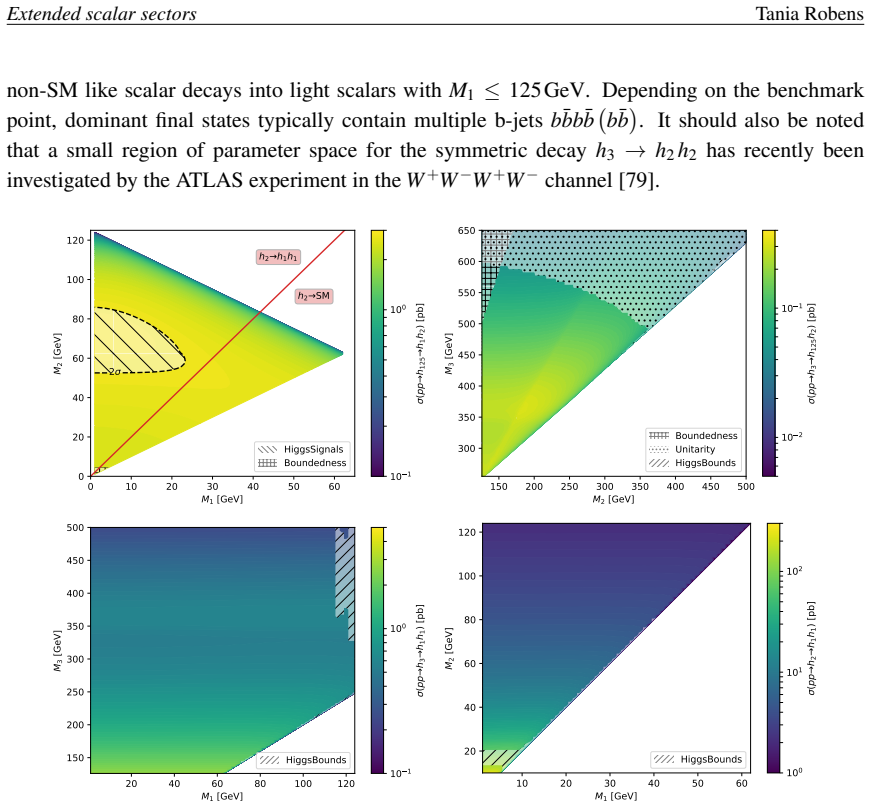
The paper's central claim is that the most promising unprobed corner of the extended scalar sector is not the already-searched resonant or Higgs-pair channels but scalar-to-scalar decays between non-SM scalars. In the $Z_2\otimes Z_2'$ two-real-scalar model, three neutral scalars mix and couple to Standard Model particles through rescaling factors that must satisfy an orthogonality relation; the measured 125 GeV scalar has a near-unity rescaling factor, yet the other two scalars can still be produced at the LHC and decay into each other. Companion benchmark scans give production rates up to approximately 60 pb for $p p \to h_3 \to h_1 h_2$ and $p p \to h_a \to h_b h_b$ at 13 TeV while satisfying perturbative unitarity, boundedness, Higgs signal-rate measurements, and current search limits. For the singlet extension and the inert doublet model, the paper concludes that viable parameter regions remain, with the inert doublet model requiring modified search strategies such as lower missing transverse energy cuts rather than entirely new final states.
Load-bearing premise
The paper's maps of which parameter points survive rely on the reliability of the computer tools and search re-interpretations used to enforce constraints; in particular, one inert-doublet exclusion comes from a leading-order recast with an estimated missing-energy cut, and the two-real-scalar rates were imported from a companion paper using a private scanner with no independent cross-check here.
Editorial extensions
If this is right
- If the two-real-scalar model is realized, Run 2 data should already contain multi-b-jet events from scalar-to-scalar decays, with the largest benchmark rates reaching tens of picobarns.
- The singlet extension's allowed parameter space is dominated by Higgs signal-rate measurements and direct heavy-scalar searches up to masses around 1 TeV, with the W-boson mass and coupling perturbativity cutting in at higher masses.
- The inert doublet model survives all current constraints but has not been directly tested by the LHC experiments; recasts of vector-boson-fusion and monojet searches exclude only part of its parameter space, mainly the region where the dark-matter scalar is slightly off shell.
- At a future $e^+e^-$ collider, lepton-plus-missing-energy final states could reveal the inert doublet model for dark scalar masses below roughly 500 GeV, with the semi-leptonic channel extending the reach toward 1 TeV.
- Scalar-to-scalar signatures with final states different from the 125 GeV Higgs should be included in future search menus, since simple counting implies the existing dataset already has enough collisions to contain them if the predicted rates are correct.
Reading between the lines
- If the scalar-to-scalar production rates are as large as reported, the main obstacle is the absence of a dedicated search rather than luminosity; even a small signal efficiency would make these events visible in the accumulated Run 2 data.
- The same asymmetric-decay mechanism could appear in other multi-scalar models, so a model-independent search for $h_a \to h_b h_b$ with four or six b-jets might be broadly useful beyond this specific benchmark model.
- Lowering missing-transverse-energy thresholds in multi-lepton analyses could open up the inert doublet model's parameter space, and likely also other dark-sector scenarios with compressed mass spectra, a direct testable consequence of the recast discussion in the paper.
Editorial analysis
A structured set of objections, weighed in public.
Referee Report
Summary. This proceedings contribution surveys constraints on three extended scalar sectors: the real singlet extension, the inert doublet model (IDM), and the two-real-singlet extension. The author updates the singlet model parameter space using HiggsBounds, HiggsSignals, the W-boson mass, and perturbativity constraints; recasts VBF and monojet searches for the IDM; reports CLIC projection significances for IDM scalar pair production; and presents benchmark rates for scalar-to-scalar decays pp -> h3 -> h1h2 and pp -> ha -> hbhb in the two-real-singlet model, including a BP4 point with pp -> h3 -> h1h1 rates up to about 60 pb at the 13 TeV LHC, claimed to satisfy all current theoretical and experimental bounds. The paper recommends dedicated experimental searches for these signatures.
Significance. The paper is a compact status report and a useful motivator for new LHC searches. Its strengths include the use of publicly available tools (HiggsBounds, HiggsSignals, 2HDMC, micrOmegas), the explicit caveats attached to the IDM VBF recast, and the CLIC projection results drawn from dedicated simulations. If the Section 4 rates are correct, they identify an uncovered signature with multi-picobarn production rates, which would be a genuinely useful experimental target. However, the central quantitative claim is not independently established in this manuscript: the benchmark planes and rate maps are imported from the companion paper [76] and computed with a private version of ScannerS, with no independent cross-check, no recast of the relevant multi-b-jet searches, and no uncertainty estimate. The paper's strongest recommendation therefore inherits the reliability of an external, non-public implementation.
major comments (3)
- [Section 4, Figure 6 (BP4)] The O(60 pb) rate for pp -> h3 -> h1h1 is the load-bearing quantitative claim of the paper, but it is not supported within this manuscript. The text states that "results have been obtained using a private version of the ScannerS framework," and the benchmark rates are taken from the companion paper [76] without independent verification. Since BP4 has M3 = 125 GeV, a 60 pb rate requires near-SM h3 production and near-unity h3 -> h1h1 branching; small corrections in kappa_125, in the branching ratio, or in the treatment of the 4b final state by HiggsBounds/HiggsSignals could all change the conclusion. The authors should provide an independent cross-check, for example a public model file, a comparison of the cross-section normalization with an established tool, and a recast of existing multi-b resonance searches, or should explicitly re-label the claim as an inherited result from [76] with the associated uncertainty.
- [Section 3.1, Figure 4] The IDM viability conclusion depends on the VBF recast, which the author correctly describes as a leading-order calculation with a K-factor and hand-estimated missing transverse energy. The caveat is stated, but its practical impact is not quantified. Since the surviving region labelled "Allowed by Dark Matter + VBF Constr." in Figure 4 is defined by this approximate recast, the paper should state an estimated uncertainty on the recast boundary or identify which parts of the surviving parameter space are robust to a 10-20% change in the signal efficiency or to offshell/interference effects.
- [Section 4, text after Eq. (4.4)] The claim that scalar-to-scalar decays with all final-state scalars different from 125 GeV "have not yet been fully explored" is too strong without a more systematic check of existing searches. The paper mentions only the ATLAS WWWW search [79] as covering a small region of the h3 -> h2h2 plane, but does not discuss constraints from existing 4b, bbtautau, or bbll resonance searches that can be sensitive to the benchmark final states. Please specify which existing searches have been explicitly checked for BPs 1, 3, 4, and 5, and why they do not exclude the high-rate regions shown in Figure 6.
minor comments (4)
- [General] There are several typographical errors, including "goverend" in Section 3.2, "signatures has been" in Section 4, and "Mh & Mh/2" in the caption of Figure 4; these should be corrected to read "governed," "signatures have been," and "MH & Mh/2," respectively.
- [Figure 5] The axis label "M_H + mA" should be "MA + MH", and the notation "S+B/S = S/sqrt(S+B)" is not defined explicitly in the text; please add a sentence defining the significance variable used in the plots.
- [References] Several references are given only as arXiv identifiers without journal or proceedings information (for example [30], [61], [62], and [79]); adding full citation details would improve the manuscript's usability.
- [Figure 3] The left and right panels of Figure 3 are reproduced from other works and are not described in enough detail for the reader to understand the scan ranges or the meaning of the grey and red points; please expand the caption or refer more explicitly to the defining equations and parameter ranges.
Circularity Check
No significant circularity: the constraint inputs are external, and the Section 4 rates, although imported from a same-author companion paper via a private ScannerS build, are externally falsifiable model scan outputs rather than definitional reductions.
full rationale
The paper's constraint maps are anchored in external data and public tools: HiggsBounds-5.4.0, HiggsSignals-2.3.0, micrOmegas, 2HDMC, ATLAS/CMS search combinations, XENON and relic-density inputs. Section 2's maximal pp->h2->h1h1 curves are scans of the singlet model against those external limits; the W-mass line is a precision-observable calculation, not a fit to the plotted rate. Section 3's IDM discussion relies on the VBF recast of [34], and the paper itself flags the limitation: 'This emphasizes the importance of comparing fully simulated samples, including all offshell and interference effects, with current limits.' That is an acknowledged approximation, not circularity. Section 4's central claim, rates up to O(60 pb) for scalar-to-scalar decays while satisfying all constraints, is not derived in this paper; it is imported from the companion paper [76] (Robens, Stefaniak, Wittbrodt) and from 'a private version of the ScannerS framework.' This is a load-bearing self-citation and a transparency/verification weakness, and the skeptical concern that no independent check is provided is legitimate. However, it is not circular in the defined sense: the benchmark planes are model scans subject to external constraints, and the resulting signal rates are falsifiable by LHC searches; the paper does not define any parameter in terms of the predicted rate, nor rename a fitted quantity as a prediction, nor invoke a uniqueness theorem from the authors' prior work. No equation in the paper reduces by construction to an input. Hence the circularity score is 0, with the Section 4 reproducibility caveat noted separately.
Assumptions & free parameters
free parameters (4)
- singlet model: scalar masses M_H, M_h and mixing angle sin alpha
- singlet model: tan beta =
0.1 (fixed in Fig. 1)
- IDM parameters: M_H, M_A, M_H+-, lambda2, lambda345
- Two-singlet model: benchmark plane masses and couplings (BP1, BP3, BP4, BP5)
assumptions (5)
- domain assumption The Z2-symmetric singlet potential of Eq. (2.1), with both fields acquiring vevs, is a valid framework for extended scalar sector studies.
- domain assumption The Inert Doublet Model with the exact Z2 symmetry of Eq. (3.1) and H as the stable dark matter candidate is the correct interpretation of the second doublet.
- domain assumption HiggsBounds 5.4.0 and HiggsSignals 2.3.0 correctly encode the relevant ATLAS and CMS searches and signal-rate measurements.
- domain assumption The theoretical admissibility conditions (perturbativity, boundedness from below, perturbative unitarity) as implemented in the scans define the allowed parameter space.
- domain assumption The recast of the CMS VBF invisible-Higgs search performed in [34] is a faithful approximation of the experimental analysis.
invented entities (3)
-
Real singlet scalar S (mass eigenstates h, H)
-
Inert doublet scalars H, A, H+-
-
Two real singlet scalars S and X (mass eigenstates h1, h2, h3)
Cite this review
Pith. "Pith review of Investigating extended scalar sectors at current and future colliders." pith.science (2026). https://pith.science/paper/IZR72DBZ
@misc{pith2026190810809,
  author       = {Pith},
  title        = {Pith review of: Investigating extended scalar sectors at current and future colliders},
  year         = {2026},
  howpublished = {\url{https://pith.science/paper/IZR72DBZ}},
  note         = {Machine review of arXiv:1908.10809}
}
read the original abstract
In this work, I briefly report on constraints that can be obtained on new physics models that extend the scalar sector of the Standard Model (SM) of particle physics at the LHC. I concentrate on a few simple examples which serve to demonstrate advantages as well as possible drawbacks of current experimental searches, and comment on the discovery prospects of such models at future colliders.
Figures


Figures from the paper (3 more)


Forward citations
Cited by 1 Pith paper
-
Implications of portal vector-like lepton on associated Higgs production at a multi-TeV muon collider
At a future muon collider, Higgs production with an invisible dark photon could outshine Higgs+Z by 1–100 times in a vector-like-lepton portal model, giving a kinetic-mixing-independent dark photon probe.
Reference graph
Works this paper leans on
- [76]
-
[79]
ATLAS collaboration, Search for Higgs boson pair production in the WW(∗)WW (∗) decay channel using ATLAS data recorded at√s = 13 TeV, JHEP 05 (2019) 124 [1811.11028]. 15
work page Pith review arXiv 2019
-
[1]
ATLAS public results, https://twiki.cern.ch/twiki/bin/view/AtlasPublic
-
[2]
CMS public results, https://twiki.cern.ch/twiki/bin/view/CMSPublic/PhysicsResults
-
[3]
ATLAS collaboration, Observation of a new particle in the search for the Standard Model Higgs boson with the ATLAS detector at the LHC, Phys. Lett. B716 (2012) 1 [1207.7214]. 10 Extended scalar sectors Tania Robens
arXiv 2012
-
[4]
CMS collaboration, Observation of a New Boson at a Mass of 125 GeV with the CMS Experiment at the LHC, Phys. Lett. B716 (2012) 30 [1207.7235]
arXiv 2012
-
[5]
R. M. Schabinger and J. D. Wells, A Minimal spontaneously broken hidden sector and its impact on Higgs boson physics at the large hadron collider, Phys. Rev. D72 (2005) 093007 [hep-ph/0509209]
arXiv 2005
- [6]
Show all 79 references
-
[7]
N. G. Deshpande and E. Ma, Pattern of Symmetry Breaking with Two Higgs Doublets, Phys. Rev. D18 (1978) 2574
1978
-
[8]
Barbieri, L
R. Barbieri, L. J. Hall and V . S. Rychkov,Improved naturalness with a heavy Higgs: An Alternative road to LHC physics, Phys.Rev. D74 (2006) 015007 [hep-ph/0603188]
2006 arXiv
-
[9]
Q.-H. Cao, E. Ma and G. Rajasekaran, Observing the Dark Scalar Doublet and its Impact on the Standard-Model Higgs Boson at Colliders, Phys. Rev. D76 (2007) 095011 [0708.2939]
2007 arXiv
-
[10]
Bechtle, O
P. Bechtle, O. Brein, S. Heinemeyer, G. Weiglein and K. E. Williams, HiggsBounds: Confronting Arbitrary Higgs Sectors with Exclusion Bounds from LEP and the Tevatron, Comput.Phys.Commun. 181 (2010) 138 [0811.4169]
2010 arXiv
-
[11]
Bechtle, O
P. Bechtle, O. Brein, S. Heinemeyer, G. Weiglein and K. E. Williams, HiggsBounds 2.0.0: Confronting Neutral and Charged Higgs Sector Predictions with Exclusion Bounds from LEP and the Tevatron, Comput.Phys.Commun. 182 (2011) 2605 [1102.1898]
2011 arXiv
-
[12]
Bechtle, O
P. Bechtle, O. Brein, S. Heinemeyer, O. Stål, T. Stefaniak, G. Weiglein et al., Recent Developments in HiggsBounds and a Preview of HiggsSignals, PoS CHARGED2012 (2012) 024 [1301.2345]
2012 arXiv
-
[13]
Bechtle, O
P. Bechtle, O. Brein, S. Heinemeyer, O. Stal, T. Stefaniak et al., HiggsBounds− 4: Improved Tests of Extended Higgs Sectors against Exclusion Bounds from LEP , the Tevatron and the LHC, Eur.Phys.J. C74 (2014) 2693 [1311.0055]
2014 arXiv
-
[14]
Bechtle, S
P. Bechtle, S. Heinemeyer, O. Stal, T. Stefaniak and G. Weiglein, Applying Exclusion Likelihoods from LHC Searches to Extended Higgs Sectors, Eur. Phys. J. C75 (2015) 421 [1507.06706]
2015 arXiv
-
[15]
Stål and T
O. Stål and T. Stefaniak, Constraining extended Higgs sectors with HiggsSignals, PoS EPS-HEP2013 (2013) 314 [1310.4039]
2013 arXiv
-
[16]
Bechtle, S
P. Bechtle, S. Heinemeyer, O. Stal, T. Stefaniak and G. Weiglein, HiggsSignals: Confronting arbitrary Higgs sectors with measurements at the Tevatron and the LHC, Eur.Phys.J. C74 (2014) 2711 [1305.1933]
2014 arXiv
-
[17]
Bechtle, S
P. Bechtle, S. Heinemeyer, O. Stål, T. Stefaniak and G. Weiglein, Probing the Standard Model with Higgs signal rates from the Tevatron, the LHC and a future ILC, JHEP 11 (2014) 039 [1403.1582]
2014 arXiv
-
[18]
Robens and T
T. Robens and T. Stefaniak, Status of the Higgs Singlet Extension of the Standard Model after LHC Run 1, Eur. Phys. J. C75 (2015) 104 [1501.02234]
2015 arXiv
-
[19]
Robens and T
T. Robens and T. Stefaniak, LHC Benchmark Scenarios for the Real Higgs Singlet Extension of the Standard Model, Eur. Phys. J. C76 (2016) 268 [1601.07880]
2016 arXiv
-
[20]
Ilnicka, T
A. Ilnicka, T. Robens and T. Stefaniak, Constraining Extended Scalar Sectors at the LHC and beyond, Mod. Phys. Lett. A33 (2018) 1830007 [1803.03594]
2018 arXiv
-
[21]
Lopez-Val and T
D. Lopez-Val and T. Robens, ∆r and the W-boson mass in the singlet extension of the standard model, Phys. Rev. D90 (2014) 114018 [1406.1043]. 11 Extended scalar sectors Tania Robens
2014 arXiv
-
[22]
CMS C OLLABORATION collaboration, Combination of standard model Higgs boson searches and measurements of the properties of the new boson with a mass near 125 GeV, Tech. Rep. CMS-PAS-HIG-12-045, CERN, Geneva, 2012
2012
-
[23]
CMS C OLLABORATION collaboration, Evidence for a particle decaying to W+W- in the fully leptonic final state in a standard model Higgs boson search in pp collisions at the LHC, Tech. Rep. CMS-PAS-HIG-13-003, CERN, Geneva, 2013
2013
-
[24]
CMS collaboration, Search for a Higgs boson in the mass range from 145 to 1000 GeV decaying to a pair of W or Z bosons, JHEP 10 (2015) 144 [1504.00936]
2015 arXiv
-
[25]
ATLAS collaboration, Search for heavy ZZ resonances in the 𝓁+𝓁−𝓁+𝓁− and 𝓁+𝓁−ν ¯ν final states using proton-proton collisions at√s = 13 TeV with the ATLAS detector, Eur. Phys. J. C78 (2018) 293 [1712.06386]
2018 arXiv
-
[26]
CMS collaboration, Search for a new scalar resonance decaying to a pair of Z bosons in proton-proton collisions at√s = 13 TeV, JHEP 06 (2018) 127 [1804.01939]
2018 arXiv
-
[27]
ATLAS collaboration, Combination of searches for heavy resonances decaying into bosonic and leptonic final states using 36 fb−1 of proton-proton collision data at√s = 13 TeV with the ATLAS detector, Phys. Rev. D98 (2018) 052008 [1808.02380]
2018 arXiv
-
[28]
CMS collaboration, Combination of searches for Higgs boson pair production in proton-proton collisions at√s = 13 TeV, Phys. Rev. Lett. 122 (2019) 121803 [1811.09689]
2019 arXiv
-
[29]
ATLAS collaboration, Combination of searches for Higgs boson pairs in pp collisions at√s =13 TeV with the ATLAS detector, 1906.02025
1906 arXiv
-
[30]
WG benchmarks, Z2 symmetric model
A. Papaefsthathiou, T. Robens, T. Stefaniak and J. Zurita, “WG benchmarks, Z2 symmetric model.” Note submitted to the Higgs Cross Section Working Group, June 2019
2019
-
[31]
Ilnicka, M
A. Ilnicka, M. Krawczyk and T. Robens, Inert Doublet Model in light of LHC Run I and astrophysical data, Phys. Rev. D93 (2016) 055026 [1508.01671]
2016 arXiv
-
[32]
Dark Univ
LHC D ARK MATTER WORKING GROUP collaboration, LHC Dark Matter Working Group: Next-generation spin-0 dark matter models, Phys. Dark Univ. (2018) 100351 [1810.09420]
2018 arXiv
-
[33]
Kalinowski, W
J. Kalinowski, W. Kotlarski, T. Robens, D. Sokolowska and A. F. Zarnecki, Benchmarking the Inert Doublet Model for e+e− colliders, JHEP 12 (2018) 081 [1809.07712]
2018 arXiv
-
[34]
Dercks and T
D. Dercks and T. Robens, Constraining the Inert Doublet Model using Vector Boson Fusion, 1812.07913
-
[35]
Dolle, X
E. Dolle, X. Miao, S. Su and B. Thomas, Dilepton Signals in the Inert Doublet Model, Phys.Rev. D81 (2010) 035003 [0909.3094]
2010 arXiv
-
[36]
Swiezewska and M
B. Swiezewska and M. Krawczyk, Diphoton rate in the inert doublet model with a 125 GeV Higgs boson, Phys.Rev. D88 (2013) 035019 [1212.4100]
2013 arXiv
-
[37]
Gustafsson, S
M. Gustafsson, S. Rydbeck, L. Lopez-Honorez and E. Lundstrom, Status of the Inert Doublet Model and the Role of multileptons at the LHC, Phys. Rev. D86 (2012) 075019 [1206.6316]
2012 arXiv
-
[38]
Arhrib, R
A. Arhrib, R. Benbrik and N. Gaur, H→ γγ in Inert Higgs Doublet Model, Phys.Rev. D85 (2012) 095021 [1201.2644]
2012 arXiv
-
[39]
Krawczyk, D
M. Krawczyk, D. Sokolowska, P. Swaczyna and B. Swiezewska, Constraining Inert Dark Matter by Rγγ and WMAP data, JHEP 1309 (2013) 055 [1305.6266]. 12 Extended scalar sectors Tania Robens
2013 arXiv
-
[40]
Belanger, B
G. Belanger, B. Dumont, A. Goudelis, B. Herrmann, S. Kraml and D. Sengupta, Dilepton constraints in the Inert Doublet Model from Run 1 of the LHC, Phys. Rev. D91 (2015) 115011 [1503.07367]
2015 arXiv
-
[41]
Deciphering the Nature of the Higgs Sector, 1610.07922
LHC H IGGS CROSS SECTION WORKING GROUP collaboration, Handbook of LHC Higgs Cross Sections: 4. Deciphering the Nature of the Higgs Sector, 1610.07922
-
[42]
Poulose, S
P. Poulose, S. Sahoo and K. Sridhar, Exploring the Inert Doublet Model through the dijet plus missing transverse energy channel at the LHC, Phys. Lett. B765 (2017) 300 [1604.03045]
2017 arXiv
-
[43]
Datta, N
A. Datta, N. Ganguly, N. Khan and S. Rakshit, Exploring collider signatures of the inert Higgs doublet model, Phys. Rev. D95 (2017) 015017 [1610.00648]
2017 arXiv
-
[44]
Kanemura, M
S. Kanemura, M. Kikuchi and K. Sakurai, Testing the dark matter scenario in the inert doublet model by future precision measurements of the Higgs boson couplings, Phys. Rev. D94 (2016) 115011 [1605.08520]
2016 arXiv
-
[45]
A. G. Akeroyd et al., Prospects for charged Higgs searches at the LHC, Eur. Phys. J. C77 (2017) 276 [1607.01320]
2017 arXiv
-
[46]
N. Wan, N. Li, B. Zhang, H. Yang, M.-F. Zhao, M. Song et al., Searches for Dark Matter via Mono-W Production in Inert Doublet Model at the LHC, Commun. Theor. Phys. 69 (2018) 617
2018
-
[47]
Belyaev, T
A. Belyaev, T. R. Fernandez Perez Tomei, P. G. Mercadante, C. S. Moon, S. Moretti, S. F. Novaes et al., Advancing LHC probes of dark matter from the inert two-Higgs-doublet model with the monojet signal, Phys. Rev. D99 (2019) 015011 [1809.00933]
2019 arXiv
-
[48]
Bhardwaj, P
A. Bhardwaj, P. Konar, T. Mandal and S. Sadhukhan, Probing Inert Doublet Model using jet substructure with multivariate analysis, 1905.04195
1905 arXiv
-
[49]
Altarelli and R
G. Altarelli and R. Barbieri, Vacuum polarization effects of new physics on electroweak processes, Phys.~Lett.~B 253 (1991) 161
1991
-
[50]
M. E. Peskin and T. Takeuchi, A New constraint on a strongly interacting Higgs sector, Phys.Rev.Lett. 65 (1990) 964
1990
-
[51]
M. E. Peskin and T. Takeuchi, Estimation of oblique electroweak corrections, Phys.Rev. D46 (1992) 381
1992
-
[52]
Maksymyk, C
I. Maksymyk, C. Burgess and D. London, Beyond S, T and U, Phys.Rev. D50 (1994) 529 [hep-ph/9306267]
1994 arXiv
-
[53]
Eriksson, J
D. Eriksson, J. Rathsman and O. Stal, 2HDMC: Two-Higgs-Doublet Model Calculator Physics and Manual, Comput.Phys.Commun. 181 (2010) 189 [0902.0851]
2010 arXiv
-
[54]
Barducci, G
D. Barducci, G. Belanger, J. Bernon, F. Boudjema, J. Da Silva, S. Kraml et al., Collider limits on new physics within micrOMEGAs_4.3, Comput. Phys. Commun. 222 (2018) 327 [1606.03834]
2018 arXiv
-
[55]
IDM benchmarks for the LHC at 13 and 27 TeV , Talk at the Higgs Cross Section working group WG3 subgroup meeting, 24.10.18
T. Robens, “ IDM benchmarks for the LHC at 13 and 27 TeV , Talk at the Higgs Cross Section working group WG3 subgroup meeting, 24.10.18.”
-
[56]
CMS collaboration, Search for invisible decays of a Higgs boson produced through vector boson fusion in proton-proton collisions at√s = 13 TeV, Phys. Lett. B793 (2019) 520 [1809.05937]
2019 arXiv
-
[57]
ATLAS C OLLABORATION collaboration, Search for dark matter and other new phenomena in events with an energetic jet and large missing transverse momentum using the ATLAS detector, Tech. Rep. ATLAS-CONF-2017-060, CERN, Geneva, Jul, 2017. 13 Extended scalar sectors Tania Robens
2017
-
[58]
ATLAS collaboration, Search for dark matter and other new phenomena in events with an energetic jet and large missing transverse momentum using the ATLAS detector, JHEP 01 (2018) 126 [1711.03301]
2018 arXiv
-
[59]
Kalinowski, W
J. Kalinowski, W. Kotlarski, T. Robens, D. Sokolowska and A. F. Zarnecki, Exploring Inert Scalars at CLIC, JHEP 07 (2019) 053 [1811.06952]
2019 arXiv
-
[60]
de Blas et al., The CLIC Potential for New Physics, 1812.02093
J. de Blas et al., The CLIC Potential for New Physics, 1812.02093
-
[61]
A. F. Zarnecki, J. Kalinowski, J. Klamka, P. Sopicki, W. Kotlarski, T. Robens et al., Inert Doublet Model Signatures at Future e+e- Colliders, in An Alpine LHC Physics Summit 2019 (ALPS 2019) Obergurgl, Austria, April 22-27, 2019,PoS(ALPS2019)010, 2019, 1908.04659
2019 arXiv
-
[62]
D. Sokolowska, “ Inert Doublet Signatures at Future e+e− Colliders, Talk at the EPS-HEP 2019 conference, 12.7.19, to be published in proceedings of the European Physical Society Conference on High Energy Physics 2019 (EPS-HEP2019) PoS(EPS-HEP2019)570 (2019).”
2019
-
[63]
Staub, Exploring new models in all detail with SARAH, Adv
F. Staub, Exploring new models in all detail with SARAH, Adv. High Energy Phys. 2015 (2015) 840780 [arXiv:1503.04200]
2015 arXiv
-
[64]
Porod, SPheno, a program for calculating supersymmetric spectra, SUSY particle decays and SUSY particle production at e+ e- colliders, Comput
W. Porod, SPheno, a program for calculating supersymmetric spectra, SUSY particle decays and SUSY particle production at e+ e- colliders, Comput. Phys. Commun. 153 (2003) 275 [hep-ph/0301101]
2003 arXiv
-
[65]
Porod and F
W. Porod and F. Staub, SPheno 3.1: Extensions including flavour, CP-phases and models beyond the MSSM, Comput. Phys. Commun. 183 (2012) 2458 [1104.1573]
2012 arXiv
-
[66]
Moretti, T
M. Moretti, T. Ohl and J. Reuter, O’Mega: An Optimizing matrix element generator, 2001
2001
-
[67]
Kilian, T
W. Kilian, T. Ohl and J. Reuter, WHIZARD: Simulating Multi-Particle Processes at LHC and ILC, Eur. Phys. J. C71 (2011) 1742 [0708.4233]
2011 arXiv
-
[68]
Hocker et al., TMVA - Toolkit for Multivariate Data Analysis, physics/0703039
A. Hocker et al., TMVA - Toolkit for Multivariate Data Analysis, physics/0703039
-
[69]
ATLAS collaboration, Search for the Higgs boson produced in association with a vector boson and decaying into two spin-zero particles in the H→ aa→ 4b channel in pp collisions at√s = 13 TeV with the ATLAS detector, JHEP 10 (2018) 031 [1806.07355]
2018 arXiv
-
[70]
ATLAS collaboration, Search for Higgs boson decays into a pair of light bosons in the bbµ µ final state in pp collision at√s =13 TeV with the ATLAS detector, Phys. Lett. B790 (2019) 1 [1807.00539]
2019 arXiv
-
[71]
CMS collaboration, Search for an exotic decay of the Higgs boson to a pair of light pseudoscalars in the final state with two muons and two b quarks in pp collisions at 13 TeV, Phys. Lett. B795 (2019) 398 [1812.06359]
2019 arXiv
-
[72]
CMS collaboration, Search for light pseudoscalar boson pairs produced from decays of the 125 GeV Higgs boson in final states with two muons and two nearby tracks in pp collisions at√s = 13 TeV, 1907.07235
1907 arXiv
-
[73]
Barger, P
V . Barger, P. Langacker, M. McCaskey, M. Ramsey-Musolf and G. Shaughnessy,Complex Singlet Extension of the Standard Model, Phys. Rev. D79 (2009) 015018 [0811.0393]
2009 arXiv
-
[74]
Coimbra, M
R. Coimbra, M. O. P. Sampaio and R. Santos, ScannerS: Constraining the phase diagram of a complex scalar singlet at the LHC, Eur. Phys. J. C73 (2013) 2428 [1301.2599]
2013 arXiv
-
[75]
Costa, M
R. Costa, M. Mühlleitner, M. O. P. Sampaio and R. Santos, Singlet Extensions of the Standard Model at LHC Run 2: Benchmarks and Comparison with the NMSSM, JHEP 06 (2016) 034 [1512.05355]. 14 Extended scalar sectors Tania Robens
2016 arXiv
-
[77]
P. M. Ferreira, R. Guedes, M. O. P. Sampaio and R. Santos, Wrong sign and symmetric limits and non-decoupling in 2HDMs, JHEP 12 (2014) 067 [1409.6723]
2014 arXiv
-
[78]
Mühlleitner, M
M. Mühlleitner, M. O. P. Sampaio, R. Santos and J. Wittbrodt, The N2HDM under Theoretical and Experimental Scrutiny, JHEP 03 (2017) 094 [1612.01309]
2017 arXiv
Reviewed August 14, 2026 · model on record in the stance chip above.
Discussion (0). Continue with ORCID to comment.