REVIEW 2 major objections 5 minor 2 cited by
A portal vector-like lepton can make muon-collider production of a Higgs boson with a dark photon (hγd) outrun hZ production by a factor of 1–100, giving a kinetic-mixing-independent dark-photon probe.
Reviewed by Pith at T0; open to challenge. T0 means a machine referee read the full paper against a public rubric. the ladder, T0–T4 →
T0 review · deepseek-v4-flash
2026-08-04 00:31 UTC pith:IOTNXO2H
load-bearing objection Good first paper on a genuinely new hγd channel at a muon collider; printed Eq. (25) is a typo that must be fixed, and the abstract's DM relic-density claim is unsupported — but the core physics holds up and deserves referee time. the 2 major comments →
Implications of portal vector-like lepton on associated Higgs production at a multi-TeV muon collider
The pith
A machine-rendered reading of the paper's core claim, the machinery that carries it, and where it could break.
Core claim
Using a portal vector-like lepton (an SU(2)-singlet lepton with hypercharge −1 and a dark U(1)D charge, mixing only with the muon), the paper shows that the right-handed muon–heavy-muon–dark-photon coupling survives the mass-basis rotation, while the corresponding Z coupling cancels because the muon and its heavy partner share the same SM charges. This allows t/u-channel exchange of the TeV-scale heavy lepton to give an hγd cross section of roughly a few fb to 10^2 fb, exceeding hZ by 1–100 even for sinθL as small as 10^-6–10^-5, provided the right-handed mixing angle sinθR reaches O(0.1) as the paper argues. The hZ rate remains essentially SM-like across the allowed parameter space, so the
What carries the argument
The portal Yukawa interaction ωf Φd μ'pL μ'R together with U(1)D gauging; after spontaneous symmetry breaking this produces mixing angles θL and θR that diagonalize the muon–heavy-muon mass matrix. The right-handed mixing angle is the load-bearing quantity: it generates the off-diagonal μ–μp–γd vertex, and heavy-lepton t/u-channel exchange makes hγd non-decoupling, an enhancement that hZ lacks. The collider analysis then uses a mass-drop tagger on boosted jets, a missing-energy veto, and a b-bbar invariant-mass window to extract the h(b bbar) γd(invisible) signal.
Load-bearing premise
The entire enhancement rests on the right-handed mixing angle sinθR being O(0.1) for a TeV-scale heavy muon even when sinθL is tiny; the paper's printed Eq. (25) gives sinθR ~ 10^-9 for its own benchmarks, so if that formula rather than the prose is what the model implies, the hγd signal disappears.
What would settle it
Substitute the benchmark values mµp = 1 TeV and sinθL = 4×10^-5 into Eq. (25): the formula as printed yields sinθR ~ 4×10^-9, not ~0.1. Re-deriving the mixing angles from the mass matrix of Eq. (9) and checking which value of sinθR satisfies both the mass diagonalization and the g-2 bands is a one-line numerical test that would settle whether the claimed non-decoupling enhancement exists.
If this is right
- The μ+μ− → hZ rate at a muon collider remains close to the Standard Model prediction in a wide parameter range, so a measured deviation would point to physics beyond this pVLL setup.
- The hγd channel provides an additional Higgs-production sample, potentially giving up to about 10% better precision on Higgs properties than the hZ channel.
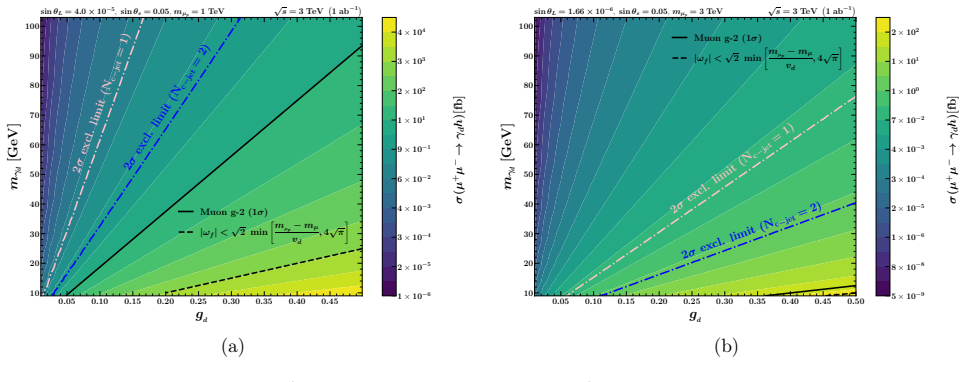
- Absence of a b-bbar plus missing-energy excess at a muon collider would place new constraints on mγd and gd for dark photon masses between 10 and 100 GeV, independent of kinetic mixing.
- At a 3 TeV muon collider with 1 ab^-1, the one-jet final state gives a 2σ exclusion up to mγd ≈ 80 GeV (76 GeV for the second benchmark set); the 10 TeV, 10 ab^-1 stage extends the reach in the mγd–mµp plane.
- A substantial part of the parameter space favored by the current muon g-2 measurement can be probed through this channel.
Where Pith is reading between the lines
- The numerical consistency of Eq. (25) is the clearest editorial concern: substituting the paper's own benchmarks (e.g., sinθL = 4×10^-5, mµp = 1 TeV) into the printed formula gives sinθR ~ 4×10^-9, not the O(0.1) value the prose and the g-2 bands require; a corrected mixing relation would settle whether the central mechanism survives.
- The hγd channel effectively replaces kinetic mixing with fermion mixing as the dark-photon portal, which suggests analogous portal-lepton setups for the electron or tau could yield flavour-selective dark-photon searches at other lepton colliders.
- Since the dominant SM backgrounds arise from hνν and Zνν, a dedicated low-mγd optimization with relaxed missing-energy cuts could extend the sensitivity below the 10 GeV range examined here.
- The authors parametrize the cross-section dependence on gd and mγd but do not fully exploit scalar-mixing-enhanced diagrams; including dark-Higgs contributions for larger sinθs could modify the reach in the mµp–mγd plane.
Editorial analysis
A structured set of objections, weighed in public.
Referee Report
Summary. This paper studies a Standard Model extension with a U(1)_D portal vector-like lepton (pVLL) mixing with the muon, a dark photon, and a dark Higgs. It computes μ+μ−→hZ and μ+μ−→hγ_d at √s=3 and 10 TeV muon colliders, claiming that the hγ_d rate can exceed the SM hZ rate by a factor of 1–100 thanks to a non-decoupling O(0.1) right-handed mixing angle sinθ_R, even for tiny left-handed mixing sinθ_L. The model is implemented in FeynRules/MadGraph, relevant constraints (muon g-2, LFU, electroweak precision, LHC) are applied, and a bbbar-plus-missing-energy collider analysis with jet substructure is presented, yielding 2σ exclusion projections for m_γd and g_d.
Significance. If the intended value of sinθ_R is used, the proposed hγ_d channel is a novel, testable signature of portal VLLs and a kinetic-mixing-independent probe of dark photons at a multi-TeV muon collider. The paper is self-contained, gives analytic matrix elements in Appendix B, and treats the muon g-2 measurement as an external constraint rather than a fitted target. Its main weakness is a load-bearing algebraic inconsistency in the printed definition of sinθ_R; the appendices and numerical results are consistent with the large sinθ_R value, so the central claim is plausible pending correction.
major comments (2)
- [Sec. 3.1, Eq. (25)] Equation (25) as printed gives sinθ_R = sinθ_L sqrt(m_μ^2/m_μp^2 cos^2θ_L + sin^2θ_L) ≈ sinθ_L m_μ/m_μp ≈ 4×10^-9 for BP1, while the text, vertex (A.2), Appendix B, Table 3/Fig. 3, and Fig. 1 all require sinθ_R ≈ (m_μp/m_μ) sinθ_L ≈ 0.38. The t/u-channel amplitude carries sinθ_R in both the γ_d vertex (A.2) and the Higgs vertex (A.8), so the printed relation suppresses the rate by many orders of magnitude, eliminating the claimed enhancement. Correct Eq. (25) and state explicitly which relation was used in the FeynRules/MadGraph implementation and in all numerical results.
- [Sec. 2.4, Eq. (21) and Fig. 1] The muon g-2 contribution in Eq. (21) is proportional to sin2θ_R sin2θ_L. With Eq. (25) taken literally, sin2θ_R ~ 10^-9 and the allowed bands in Fig. 1 cannot be populated for any benchmark; with the corrected large θ_R they can. The paper therefore currently contains two mutually inconsistent versions of the model. Please recompute Fig. 1 and the g-2-consistent regions using the corrected formula.
minor comments (5)
- [Abstract] 'We have explore' should read 'We have explored'; the phrase 'aportal' needs spacing.
- [Abstract and Sec. 3.1] The abstract states the hγ_d/hZ ratio is 1–100, but Fig. 5 shows ratios above 100 (up to ~3.6×10^3) in the unitarity-allowed region. Please state whether '1–100' is a representative range or a hard upper bound.
- [Tables 5 and 7] The signal cross-sections are quoted with BR(h→bb)=1, while the significance calculation uses 57%. This is stated only in the text near Eq. (31); an explicit note in the table captions would avoid confusion.
- [Sec. 3.1] 'The later is suppressed' should read 'The latter is suppressed'.
- [Sec. 3 / Reproducibility] The FeynRules model is described but not provided; making the UFO/parameter cards publicly available would improve reproducibility.
Circularity Check
No circularity found: model predictions follow from a specified Lagrangian with externally constrained inputs; Eq. (25) is an apparent typo, not a circular step.
full rationale
The paper derives µ+µ−→hγd rates from a concrete Lagrangian (Eqs. 1–8), a mass matrix (Eq. 9), and a bi-unitary rotation (Eq. 10). The enhancement is traced to the off-diagonal µR–µpR–γd vertex Eq. (A.2), proportional to g_d sinθR cosθR, and to the t/u-channel amplitudes in Appendix B. These are fixed by the model parameters, not fitted to the predicted signal. The muon g−2 measurement is used as an external constraint to restrict parameter space (Eq. 21 and Fig. 1); no parameter is adjusted to reproduce the hγd cross section. There are no load-bearing self-citations: the cited portal-matter literature is external model motivation, not a substitute for the calculation, and no uniqueness theorem or ansatz is imported from the authors' own prior work. The only notable issue is internal to the manuscript: Eq. (25) as printed gives sinθR ≈ sinθL·mµ/mµp ∼ 10^-9 for the benchmarks, whereas the prose, the vertex factors, the cross-section tables, and the g−2 bands require sinθR ∼ O(0.1). That is a numerical/typographical inconsistency to be corrected, not a case of a prediction reducing to its input by construction; the correct diagonalization relation is determined by Eqs. (9)–(10). Therefore the derivation is self-contained against external benchmarks and no circularity is present.
Axiom & Free-Parameter Ledger
free parameters (5)
- m_μp (pVLL mass) =
1, 2, 3 TeV in benchmarks
- sinθ_L (left muon-pVLL mixing) =
4×10^-5, 2×10^-5, 1.66×10^-6
- g_d (dark gauge coupling) =
0.05, 0.36, 0.45, 0.5
- m_γd (dark photon mass) =
50, 90 GeV
- sinθ_s (scalar mixing angle) =
0.05
axioms (4)
- domain assumption pVLL mixes only with the second-generation charged lepton
- domain assumption Gauge kinetic mixing ε is small and the dark photon decays invisibly
- standard math Perturbative unitarity bound |ω_f| < √2 min[(m_μp - m_μ)/v_d, 4√π]
- domain assumption SM background consists only of bbνν subprocesses
invented entities (1)
-
Portal vector-like lepton (pVLL) µ_p
no independent evidence
read the original abstract
We have explore a portal vector-like lepton (pVLL) extension of the Standard Model (SM) and study its implications for Higgs and vector-boson associated production ($hV$, with $~V = Z$-boson or dark photon) at a future muon collider facility. We show that while the $~\mu^+ \mu^- \to hZ~$ production rate remains close to its SM prediction in a wide range of parameter space, the rate for $~\mu^+ \mu^- \to h\gamma_d~$ can be substantially enhanced owing to the non-decoupling nature of the interaction involving the heavy lepton, the muon and the dark photon. We demonstrate that the $h\gamma_d$ production rate can exceed the corresponding $hZ$ rate by a factor of $1$-$100$ within the perturbative unitarity limit, making it a promising channel for probing Higgs interactions and potential new physics effects. We also examine the role of the pVLL state in the context of dark matter (DM) phenomenology and identify regions of parameter space consistent with the observed relic abundance by extending the simplified setup with a viable DM candidate. The $h\gamma_d$ production can also be used to constrain the dark photon mass ($m_{\gamma_d}$) and/or the dark gauge coupling ($g_d$) consistent with various constraints including the current muon $g-2$ measurements within the pVLL framework. We perform a detailed collider analysis of the $h\gamma_d$ process in the $b\bar{b}~+$ missing energy final state. A $2\sigma$ exclusion limit for $m_{\gamma_d}$ up to $80$ GeV is obtained assuming $~g_d=0.05$, $~\sin\theta_L=4\times10^{-5}$, $~\sin\theta_s=0.05$, for a heavy lepton mass $~\sim 3$ TeV at a $3$ TeV muon collider with an integrated luminosity of $1$ ab$^{-1}$.
Figures



Forward citations
Cited by 2 Pith papers
-
Portal Matter and Scotogenic-like Dirac Neutrino Masses
One-loop diagrams from dark-charged scalars and fermions in an E6-like portal matter model generate Dirac neutrino masses near 0.05 eV.
-
Prospects for probing neutral vector-like leptons via pair production at muon collider
Simulations indicate a 6 TeV muon collider with 4 ab^{-1} can reach >5σ significance for neutral doublet VLLs of 1.3-3 TeV mass using 4j2μ and 2ℓ2μ + missing energy channels under polarized beams.
Reference graph
Works this paper leans on
-
[3]
W. Kilian, M. Kramer and P. M. Zerwas,Higgsstrahlung and W W fusion in e+ e- collisions, Phys. Lett. B373(1996) 135–140, [hep-ph/9512355]
Pith/arXiv arXiv 1996
-
[4]
Z. Liu, L.-T. Wang and H. Zhang,Exotic decays of the 125 GeV Higgs boson at futuree+e− lepton colliders,Chin. Phys. C41(2017) 063102, [1612.09284]
Pith/arXiv arXiv 2017
-
[5]
A. G. Akeroyd, A. Arhrib and M. Capdequi Peyranere,CP odd Higgs boson production in association with neutral gauge boson in high-energy e+ e- collisions,Mod. Phys. Lett. A14 (1999) 2093–2108, [hep-ph/9907542]
Pith/arXiv arXiv 1999
-
[6]
S. Kanemura,Possible enhancement of the e+ e- —>H+- W-+ cross-section in the two Higgs doublet model,Eur. Phys. J. C17(2000) 473–486, [hep-ph/9911541]
Pith/arXiv arXiv 2000
-
[7]
B. A. Ouazghour, A. Arhrib, K. Cheung, E.-s. Ghourmin and L. Rahili,Associated charged Higgs boson production within the 2HDM: e-e+ versusµ-µ+ colliders,Phys. Rev. D110(2024) 095026, [2408.13952]. [8]LEP Working Group for Higgs boson searches, ALEPH, DELPHI, L3, OPAL collaboration, R. Barate et al.,Search for the standard model Higgs boson at LEP,Phys. Le...
Pith/arXiv arXiv 2024
-
[11]
Abramowicz et al.,Higgs physics at the CLIC electron–positron linear collider,Eur
H. Abramowicz et al.,Higgs physics at the CLIC electron–positron linear collider,Eur. Phys. J. C77(2017) 475, [1608.07538]. 29
Pith/arXiv arXiv 2017
-
[12]
R. Franceschini and M. Greco,Higgs and BSM Physics at the Future Muon Collider,Symmetry 13(2021) 851, [2104.05770]
Pith/arXiv arXiv 2021
-
[13]
Y. Hamada, R. Kitano, R. Matsudo, S. Okawa, R. Takai, H. Takaura et al.,Higgs boson production atµ+µ+ colliders,Phys. Rev. D110(2024) 113011, [2408.01068]
Pith/arXiv arXiv 2024
-
[14]
E. J. Chun and T. Mondal,Explainingg−2anomalies in two Higgs doublet model with vector-like leptons,JHEP11(2020) 077, [2009.08314]
Pith/arXiv arXiv 2020
-
[15]
P. Asadi, S. Homiller, A. Radick and T.-T. Yu,Fermion-portal dark matter at a high-energy muon collider,Phys. Rev. D112(2025) 055038, [2412.14235]
Pith/arXiv arXiv 2025
-
[16]
A. Crivellin, F. Kirk, C. A. Manzari and M. Montull,Global Electroweak Fit and Vector-Like Leptons in Light of the Cabibbo Angle Anomaly,JHEP12(2020) 166, [2008.01113]
Pith/arXiv arXiv 2020
-
[17]
M. Kirk,Cabibbo anomaly versus electroweak precision tests: An exploration of extensions of the Standard Model,Phys. Rev. D103(2021) 035004, [2008.03261]
Pith/arXiv arXiv 2021
-
[18]
G. N. Wojcik, L. L. Everett, S. T. Eu and R. Ximenes,Lepton flavor portal matter,Phys. Rev. D 108(2023) 055033, [2303.12983]
Pith/arXiv arXiv 2023
-
[19]
Z. Poh and S. Raby,Vectorlike leptons: Muon g-2 anomaly, lepton flavor violation, Higgs boson decays, and lepton nonuniversality,Phys. Rev. D96(2017) 015032, [1705.07007]
Pith/arXiv arXiv 2017
-
[20]
R. Dermisek, K. Hermanek and N. McGinnis,Muon g-2 in two-Higgs-doublet models with vectorlike leptons,Phys. Rev. D104(2021) 055033, [2103.05645]
Pith/arXiv arXiv 2021
-
[21]
H. M. Lee, J. Song and K. Yamashita,Seesaw lepton masses and muong−2from heavy vector-like leptons,J. Korean Phys. Soc.79(2021) 1121–1134, [2110.09942]
Pith/arXiv arXiv 2021
-
[22]
J. Kawamura, S. Raby and A. Trautner,Complete vectorlike fourth family with U(1)’ : A global analysis,Phys. Rev. D101(2020) 035026, [1911.11075]
Pith/arXiv arXiv 2020
-
[23]
M. Endo and S. Mishima,Muong−2and CKM unitarity in extra lepton models,JHEP08 (2020) 004, [2005.03933]
Pith/arXiv arXiv 2020
-
[24]
C. A. Manzari,Vector-Like Leptons in Light of the Cabibbo-Angle Anomaly, inBeyond Standard Model: From Theory to Experiment, 5, 2021.2105.03399
arXiv 2021
-
[25]
B. Capdevila, A. Crivellin, C. A. Manzari and M. Montull,Explainingb→sℓ+ℓ− and the Cabibbo angle anomaly with a vector triplet,Phys. Rev. D103(2021) 015032, [2005.13542]
Pith/arXiv arXiv 2021
-
[26]
W. Abdallah, M. Ashry, J. Kawamura and A. Moursy,Semivisible dark photon in a model with vectorlike leptons for the (g-2)e,µand W-boson mass anomalies,Phys. Rev. D109(2024) 015031, [2308.05691]
Pith/arXiv arXiv 2024
-
[27]
H. M. Lee and K. Yamashita,A model of vector-like leptons for the muong−2and the W boson mass,Eur. Phys. J. C82(2022) 661, [2204.05024]
Pith/arXiv arXiv 2022
-
[28]
C.-H. Lee and R. N. Mohapatra,Vector-Like Quarks and Leptons, SU(5)⊗SU(5) Grand Unification, and Proton Decay,JHEP02(2017) 080, [1611.05478]
Pith/arXiv arXiv 2017
-
[29]
Gursey, P
F. Gursey, P. Ramond and P. Sikivie,A Universal Gauge Theory Model Based on E6,Phys. Lett. B60(1976) 177–180
1976
-
[30]
B. Kyae and C. S. Shin,Vector-like leptons and extra gauge symmetry for the natural Higgs boson,JHEP06(2013) 102, [1303.6703]
Pith/arXiv arXiv 2013
-
[31]
M. Cvetic, G. Shiu and A. M. Uranga,Three family supersymmetric standard - like models from intersecting brane worlds,Phys. Rev. Lett.87(2001) 201801, [hep-th/0107143]. 30
Pith/arXiv arXiv 2001
-
[32]
G. B. Cleaver, A. E. Faraggi, D. V. Nanopoulos and J. W. Walker,Phenomenological study of a minimal superstring standard model,Nucl. Phys. B593(2001) 471–504, [hep-ph/9910230]
Pith/arXiv arXiv 2001
-
[33]
F. Marchesano, D. Regalado and L. Vazquez-Mercado,Discrete flavor symmetries in D-brane models,JHEP09(2013) 028, [1306.1284]. [34]ATLAScollaboration, G. Aad et al.,Search for vector-like leptons coupling to first- and second-generation Standard Model leptons in pp collisions at√s= 13 TeV with the ATLAS detector,JHEP05(2025) 075, [2411.07143]. [35]CMScolla...
Pith/arXiv arXiv 2013
-
[37]
C.-X. Yue, Y.-Q. Wang, H. Wang, Y.-H. Wang and S. Li,Searching for singlet vector-like leptons via pair production at ILC,Nucl. Phys. B1000(2024) 116482, [2402.02072]
Pith/arXiv arXiv 2024
-
[38]
Shang, M
L. Shang, M. Wang, Z. Heng and B. Yang,Search for the singlet vector-like lepton at future e+e− colliders,Eur. Phys. J. C81(2021) 415
2021
-
[39]
Q. Guo, L. Gao, Y. Mao and Q. Li,Vector-like lepton searches at a muon collider in the context of the 4321 model,Chin. Phys. C47(2023) 103106, [2304.01885]
Pith/arXiv arXiv 2023
-
[40]
N. Ghosh, S. K. Rai and T. Samui,Search for a leptoquark and vector-like lepton in a muon collider,Nucl. Phys. B1004(2024) 116564, [2309.07583]
Pith/arXiv arXiv 2024
-
[41]
P. N. Bhattiprolu and S. P. Martin,Prospects for vectorlike leptons at future proton-proton colliders,Phys. Rev. D100(2019) 015033, [1905.00498]
Pith/arXiv arXiv 2019
-
[42]
T. G. Rizzo,Portal Matter and Dark Sector Phenomenology at Colliders, inSnowmass 2021, 2, 2022.2202.02222
arXiv 2021
-
[43]
T. D. Rueter and T. G. Rizzo,Towards A UV-Model of Kinetic Mixing and Portal Matter,Phys. Rev. D101(2020) 015014, [1909.09160]
Pith/arXiv arXiv 2020
-
[44]
T. G. Rizzo,Kinetic Mixing and Portal Matter Phenomenology,Phys. Rev. D99(2019) 115024, [1810.07531]
Pith/arXiv arXiv 2019
-
[45]
A. Belyaev, L. Panizzi, N. Thongyoi and F. Wilhelm,The Muonic Portal to Vector Dark Matter:connecting precision muon physics, cosmology, and colliders,2510.18564
-
[46]
J. Lahiri, D. Pradhan and A. Sarkar,The influence of lepton portal on the WIMP-pFIMP framework,JHEP08(2025) 019, [2410.19734]
Pith/arXiv arXiv 2025
-
[47]
J. P. Delahaye, M. Diemoz, K. Long, B. Mansoulié, N. Pastrone, L. Rivkin et al.,Muon Colliders,1901.06150. [48]International Muon Collidercollaboration, D. Schulte,The Muon Collider,JACoW IPAC2022(2022) 821–826
Pith/arXiv arXiv 1901
-
[49]
K. M. Black et al.,Muon Collider Forum report,JINST19(2024) T02015, [2209.01318]. [50]International Muon Collidercollaboration, C. Accettura et al.,Interim report for the International Muon Collider Collaboration (IMCC),CERN Yellow Rep. Monogr.2/2024(2024) 176, [2407.12450]
Pith/arXiv arXiv 2024
-
[51]
Holdom,Searching forϵCharges and a New U(1),Phys
B. Holdom,Searching forϵCharges and a New U(1),Phys. Lett. B178(1986) 65–70. 31
1986
-
[52]
Fayet,Extra U(1)’s and New Forces,Nucl
P. Fayet,Extra U(1)’s and New Forces,Nucl. Phys. B347(1990) 743–768
1990
-
[53]
M. Fabbrichesi, E. Gabrielli and G. Lanfranchi,The Dark Photon,2005.01515
Pith/arXiv arXiv 2005
-
[54]
Alexander et al.,Dark Sectors 2016 Workshop: Community Report, tech
J. Alexander et al.,Dark Sectors 2016 Workshop: Community Report, tech. rep., Fermi National Accelerator Laboratory (FNAL), Batavia, IL (United States), 8, 2016
2016
-
[55]
J. H. Kim, S. D. Lane, H.-S. Lee, I. M. Lewis and M. Sullivan,Searching for Dark Photons with Maverick Top Partners,Phys. Rev. D101(2020) 035041, [1904.05893]
Pith/arXiv arXiv 2020
-
[56]
M. Bauer, P. Foldenauer and J. Jaeckel,Hunting All the Hidden Photons,JHEP07(2018) 094, [1803.05466]. [57]APEXcollaboration, D. He et al.,Dark photon constraints from a 7.139 GHz cavity haloscope experiment,Phys. Rev. D110(2024) L021101, [2404.00908]
Pith/arXiv arXiv 2018
-
[58]
T. Robens and T. Stefaniak,Status of the Higgs Singlet Extension of the Standard Model after LHC Run 1,Eur. Phys. J. C75(2015) 104, [1501.02234]
Pith/arXiv arXiv 2015
-
[59]
T. Robens,Investigating extended scalar sectors at current and future colliders,PoS LHCP2019(2019) 138, [1908.10809]
Pith/arXiv arXiv 2019
-
[61]
S. Adhikari, S. D. Lane, I. M. Lewis and M. Sullivan,Complex Scalar Singlet Model Benchmarks for Snowmass, inSnowmass 2021, 3, 2022.2203.07455
arXiv 2021
-
[62]
S. D. Lane, I. M. Lewis and M. Sullivan,Resonant multiscalar production in the generic complex singlet model in the multi-TeV region,Phys. Rev. D110(2024) 055017, [2403.18003]
Pith/arXiv arXiv 2024
-
[63]
T. Robens,Constraining extended scalar sectors at current and future colliders - an update, in 8th Workshop on Theory, Phenomenology and Experiments in Flavour Physics: Neutrinos, Flavor Physics and Beyond, 9, 2022.2209.15544
arXiv 2022
-
[64]
T. Robens and R. Santos,BSM: Extended Scalar Sectors, tech. rep., Boskovic Inst., Zagreb, CERN, 7, 2025. [65]ATLAScollaboration, G. Aad et al.,Combination of searches for invisible decays of the Higgs boson using 139 fb−1 of proton-proton collision data at s=13 TeV collected with the ATLAS experiment,Phys. Lett. B842(2023) 137963, [2301.10731]. [66]CMScol...
Pith/arXiv arXiv 2025
-
[67]
A. Papaefstathiou, T. Robens and G. White,Signal strength and W-boson mass measurements as a probe of the electro-weak phase transition at colliders - Snowmass White Paper, in Snowmass 2021, 5, 2022.2205.14379. [68]ALEPH, DELPHI, L3, OPAL, SLD, LEP Electroweak Working Group, SLD Electroweak Group, SLD Hea vy Fla vour Groupcollaboration, S. Schael et al., ...
arXiv 2021
-
[69]
Sopczak,Search for new particles at LEP,Acta Phys
A. Sopczak,Search for new particles at LEP,Acta Phys. Polon. B30(1999) 3229–3245, [hep-ph/9911445]. [70]CMScollaboration, A. Tumasyan et al.,Inclusive nonresonant multilepton probes of new phenomena at √s=13 TeV,Phys. Rev. D105(2022) 112007, [2202.08676]. 32 [71]ATLAScollaboration, G. Aad et al.,Search for third-generation vector-like leptons inpp collisi...
Pith/arXiv arXiv 1999
-
[73]
C.-Y. Chen, S. Dawson and E. Furlan,Vectorlike fermions and Higgs effective field theory revisited,Phys. Rev. D96(2017) 015006, [1703.06134]. [74]Particle Data Groupcollaboration, S. Navas et al.,Review of particle physics,Phys. Rev. D 110(2024) 030001. [75]Muon g-2collaboration, D. P. Aguillard et al.,Measurement of the Positive Muon Anomalous Magnetic M...
Pith/arXiv arXiv 2017
-
[77]
Aliberti et al.,The anomalous magnetic moment of the muon in the Standard Model: an update,Phys
R. Aliberti et al.,The anomalous magnetic moment of the muon in the Standard Model: an update,Phys. Rept.1143(2025) 1–158, [2505.21476]
Pith/arXiv arXiv 2025
-
[78]
Alloul, N
A. Alloul, N. D. Christensen, C. Degrande, C. Duhr and B. Fuks,Feynrules 2.0— a complete toolbox for tree-level phenomenology,Computer Physics Communications185(Aug., 2014) 2250–2300
2014
-
[79]
C. Degrande, C. Duhr, B. Fuks, D. Grellscheid, O. Mattelaer and T. Reiter,UFO - The Universal FeynRules Output,Comput. Phys. Commun.183(2012) 1201–1214, [1108.2040]
Pith/arXiv arXiv 2012
-
[80]
Alwall, R
J. Alwall, R. Frederix, S. Frixione, V. Hirschi, F. Maltoni, O. Mattelaer et al.,The automated computation of tree-level and next-to-leading order differential cross sections, and their matching to parton shower simulations,Journal of High Energy Physics2014(July, 2014)
2014
-
[81]
Bierlich et al.,A comprehensive guide to the physics and usage of PYTHIA 8.3,SciPost Phys
C. Bierlich et al.,A comprehensive guide to the physics and usage of PYTHIA 8.3,SciPost Phys. Codeb.2022(2022) 8, [2203.11601]
Pith/arXiv arXiv 2022
-
[82]
T. H. Park,Jet energy resolution measurement of the atlas detector using momentum balance, Oct., 2018. [83]CMScollaboration, V. Khachatryan et al.,Jet energy scale and resolution in the CMS experiment in pp collisions at 8 TeV,JINST12(2017) P02014, [1607.03663]
Pith/arXiv arXiv 2018
-
[84]
I. Pezzotti et al.,Dual-Readout Calorimetry for Future Experiments Probing Fundamental Physics,2203.04312
-
[85]
M. Cacciari, G. P. Salam and G. Soyez,The anti-kt jet clustering algorithm,JHEP04(2008) 063, [0802.1189]
Pith/arXiv arXiv 2008
-
[86]
M. Cacciari, G. P. Salam and G. Soyez,FastJet User Manual,Eur. Phys. J. C72(2012) 1896, [1111.6097]
Pith/arXiv arXiv 2012
-
[87]
J. M. Butterworth, A. R. Davison, M. Rubin and G. P. Salam,Jet substructure as a new Higgs search channel at the LHC,Phys. Rev. Lett.100(2008) 242001, [0802.2470]
Pith/arXiv arXiv 2008
-
[88]
S. Bentvelsen and I. Meyer,The Cambridge jet algorithm: Features and applications,Eur. Phys. J. C4(1998) 623–629, [hep-ph/9803322]
Pith/arXiv arXiv 1998
-
[89]
G. Cowan, K. Cranmer, E. Gross and O. Vitells,Asymptotic formulae for likelihood-based tests of new physics,Eur. Phys. J. C71(2011) 1554, [1007.1727]. 33
Pith/arXiv arXiv 2011
-
[90]
N. Kumar and S. P. Martin,Vectorlike Leptons at the Large Hadron Collider,Phys. Rev. D92 (2015) 115018, [1510.03456]
Pith/arXiv arXiv 2015
-
[91]
P. N. Bhattiprolu, S. P. Martin and J. D. Wells,Criteria for projected discovery and exclusion sensitivities of counting experiments,Eur. Phys. J. C81(2021) 123, [2009.07249]. 34
Pith/arXiv arXiv 2021
discussion (0)
Sign in with ORCID, Apple, or X to comment. Anyone can read and Pith papers without signing in.