REVIEW 3 major objections 4 minor 1 cited by
Stochastic AUC Maximization with Deep Neural Networks
T0 review · 3 major / 4 minor · reviewed 2026-08-14 · deepseek-v4-flash
Pith's one-line read This paper extends provable AUC maximization from linear scoring models to deep neural networks, achieving an O~(1/ε) stochastic convergence rate through a proximal primal-dual method that exploits the Polyak-Łojasiewicz condition.
desk verdict First O~(1/epsilon) rates for deep AUC via PL in a primal-dual setting, with an honest but load-bearing unverified PL assumption. read the letter →
The pith
A machine-rendered reading of the paper's core claim, the machinery that carries it, and where it could break.
The reading
What carries the argument
Four objects carry the argument. The saddle-point reformulation (Proposition 1) expresses the pairwise AUC probability through a min over weights $(w,a,b)$ and a max over a single dual scalar $\alpha$, making the stochastic gradient computable from one example. On top of it, the Polyak-Łojasiewicz condition $\mu(\varphi(v)-\varphi(v^*)) \le \frac12\|\nabla\varphi(v)\|^2$ is the engine: it asserts that small gradients force near-optimality of $\varphi$, which turns the per-epoch suboptimality bound of each proximal solve into a geometric contraction of the gap across epochs, and Lemma 1 shows this property is inherited from a PL condition on the plain minimization objective $P(w)$. The algorithmic skeleton is the inexact proximal point method — each outer loop approximately solves the strongly convex-concave subproblem $\min_v\max_\alpha \{f(v,\alpha)+\frac{1}{2\gamma}\|v-\bar v_{k-1}\|^2\}$; PPD-SG differs from the generic template in its geometrically decaying step size $\eta_k=\eta_0\exp(-(k-1)(\mu/L)/(5+\mu/L))$ and its minibatch estimate of the optimal dual variable. PPD-AdaGrad swaps the inner primal-dual update for an AdaGrad-preconditioned step with $H_t=\delta I+\mathrm{diag}(s_t)$, whose per-coordinate scaling converts a bound on cumulative gradient growth into an adaptive iteration count.
What would settle it
Run PPD-SG on a deep network (e.g., ResNet-20 on an imbalanced CIFAR10 split) and along the trajectory estimate the surrogate gap $\varphi(v)-\varphi(v^*)$ and the squared gradient norm $\|\nabla\varphi(v)\|^2$; if the effective PL coefficient $\|\nabla\varphi(v)\|^2/(2(\varphi(v)-\varphi(v^*)))$ is near zero or shrinks toward zero as training proceeds, the premise fails and the claimed $\widetilde{O}(1/\epsilon)$ rate cannot hold. A sharper, easier disproof: exhibit a dataset and architecture for which the squared-loss AUC surrogate has a spurious local minimum, since PL forbids that by definition.
Extended reading notes
Core claim
The paper's central claim is that the Polyak-Łojasiewicz (PL) gradient-dominance property, known to hold for several classes of overparameterized networks trained with square loss, transfers to the AUC min-max surrogate and unlocks provably faster convergence for deep AUC maximization. The route is: replace the AUC indicator by the squared loss, which by Proposition 1 turns the pairwise objective $\min_w P(w)$ into $\min_{w,a,b}\max_{\alpha} \mathbb{E}_z[F(w,a,b,\alpha;z)]$, a non-convex-concave stochastic min-max problem in which each gradient step consumes one sample. Assuming $\mu(\varphi(v)-\varphi(v^*)) \le \frac12 \|\nabla\varphi(v)\|^2$ for $\varphi(v)=\max_\alpha f(v,\alpha)$ (Assumption 1(1)), Theorem 2 shows that PPD-SG returns a point with $\mathbb{E}[\varphi(\bar v_K)-\varphi(v^*)]\le\epsilon$ in $\widetilde{O}(L G^2/(\mu^2\epsilon))$ iterations using $\widetilde{O}(L^3\sigma^2/(\mu^2\epsilon))$ samples, where the two algorithmic keys are a geometrically decaying step size across outer loops and a minibatch refresh of the dual variable to its closed-form optimum $\alpha^*=\mathbb{E}[h(w;x)|y=-1]-\mathbb{E}[h(w;x)|y=1]$. Theorem 3 gives the AdaGrad-style variant a matching sample bound and an adaptive iteration count $\widetilde{O}((L\delta^2 d/(\mu^2\epsilon))^{1/(2(1-\alpha))})$ under a growth condition on cumulative gradients. The paper presents these as the first non-asymptotic guarantees for stochastic AUC maximization with deep networks and as strictly better than the $\widetilde{O}(1/\epsilon^3)$ cost of the generic proximal framework.
Load-bearing premise
The load-bearing premise is the Polyak-Łojasiewicz condition on the AUC surrogate objective, $\mu(\varphi(v)-\varphi(v^*)) \le \frac12\|\nabla\varphi(v)\|^2$: the assumption that every low-gradient point is within a proportional gap of the global minimum, which the paper supports only with PL results for square-loss networks and a one-hidden-layer example rather than a proof or empirical check for deep networks, and without which all claimed $\widetilde{O}(1/\epsilon)$ and adaptive rates fall back to the generic $\widetilde{O}(1/\epsilon^3)$.
Editorial extensions
If this is right
- If the PL condition holds, deep AUC maximization is asymptotically no harder than plain SGD training: the $\widetilde{O}(1/\epsilon)$ iteration rate matches the standard stochastic-gradient rate under PL, and the sample count $\widetilde{O}(L^3\sigma^2/(\mu^2\epsilon))$ is independent of the model dimension.
- The generic inexact proximal framework for non-convex concave min-max problems costs $\widetilde{O}(1/\epsilon^3)$; this paper's rates improve on that in both $\epsilon$ and the dependence on the conditioning parameters, so any one-sided min-max problem whose outer objective satisfies PL inherits the speedup.
- PPD-AdaGrad supplies the first adaptive convergence guarantee for non-convex concave min-max problems: when cumulative gradient norms grow like $\delta T^\alpha$ with $\alpha < 1/2$, its iteration bound $\widetilde{O}((L\delta^2 d/(\mu^2\epsilon))^{1/(2(1-\alpha))})$ beats the non-adaptive rate.
- The closed-form dual refresh, estimating $\alpha^*=\mathbb{E}[h(w;x)|y=-1]-\mathbb{E}[h(w;x)|y=1]$ from a small minibatch, removes dual-error accumulation and extends to any min-max problem with a conditional-expectation maximizer.
- The same framework covers multi-class AUC and online settings with unknown class prior (Section 4.3), so the rates carry over with only the overhead of maintaining estimators for $p$ and $p(1-p)$.
Reading between the lines
- The empirical value of the construction rests on how often the PL condition actually holds along real training trajectories; since the paper's PL evidence is by analogy (square-loss networks, a one-hidden-layer example), a direct measurement of the effective PL coefficient during PPD-SG runs on deep networks would settle the question.
- A natural extension the paper does not explore: combining the geometric-restart schedule with variance-reduced inner loops (an SVRG-style estimator) could plausibly remove the $\sigma^2$ sample-factor, since the contraction argument only needs unbiased gradients.
- The same saddle-point-plus-PL blueprint should transfer to other pairwise objectives, such as ranking surrogates and metric learning, whenever the inner maximization is convex and admits a closed form; the dual-refresh trick is the piece that generalizes most directly.
Signed reviews
Editorial analysis
A structured set of objections, weighed in public.
Referee Report
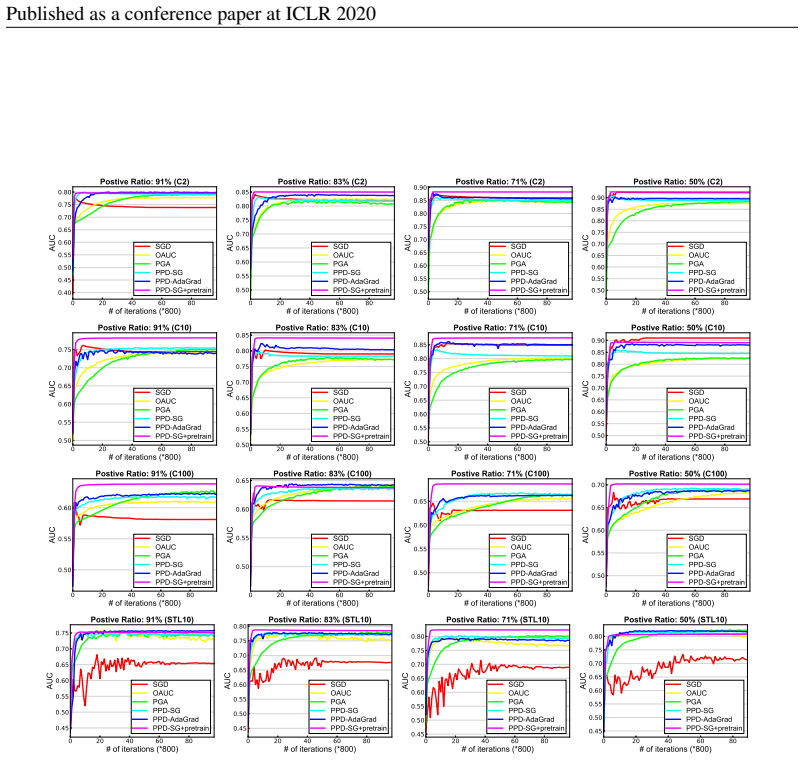
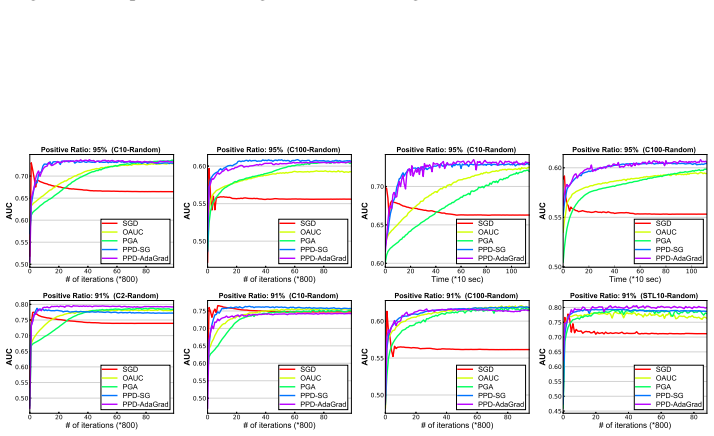
Summary. The paper studies stochastic AUC maximization when the scoring function is a deep neural network. It uses a squared surrogate loss and the saddle-point reformulation of Ying et al. to cast the problem as a nonconvex-concave min-max problem in the primal variables (w,a,b) and dual variable α. The authors propose two stochastic primal-dual algorithms built on the proximal-point framework of Rafique et al.: PPD-SG, which uses a geometrically decaying step-size sequence and a closed-form dual correction, and PPD-AdaGrad, which uses AdaGrad-style adaptive preconditioning. Under Assumption 1, which includes a Polyak-Łojasiewicz condition on φ(v)=max_α f(v,α), they prove an O~(LG^2/(μ^2 ε)) iteration complexity and O~(L^3 σ^2/(μ^2 ε)) sample complexity for PPD-SG (Theorem 2), and for PPD-AdaGrad an iteration bound of O~((L δ^2 d/(μ^2 ε))^{1/(2(1-α))}) under a cumulative-gradient-growth condition (Theorem 3). Experiments on Cat&Dog, CIFAR10, CIFAR100, and STL10 compare test AUC against PGA, OAUC, and SGD baselines.
Significance. The conditional rates are substantial improvements over the O(1/ε^3) baseline from Rafique et al., and the proof structure is careful: the one-epoch analyses in Lemmas 2 and 3, the use of strong convexity of the proximal subproblem, and the function-gap contraction via the PL condition are transparent and internally consistent. The paper is honest about the main gap: the remark after Lemma 1 states that proving PL for P(w) is not the focus, and Appendix A.7 gives only a one-hidden-layer example. The idea of exploiting PL in primal-dual nonconvex-concave optimization, and the adaptive AdaGrad-style extension, are likely to be useful beyond AUC maximization. The main weakness is that the advertised improvements for deep networks are conditional on an unverified landscape condition and on unknown constants, so the contribution is best understood as a conditional complexity analysis rather than an end-to-end guarantee for deep AUC maximization as implemented.
major comments (3)
- [Assumption 1(1), Lemma 1, Appendix A.7] The advertised O~(1/ε) iteration and sample rates in Theorems 2 and 3 all require the PL condition μ(φ(v)−φ(v*)) ≤ (1/2)‖∇φ(v)‖^2. The paper does not establish this condition for the deep AUC surrogate objective (1) with networks such as ResNet-20. Lemma 1 only transfers PL from P(w) to φ, and the remark after Lemma 1 explicitly defers the proof of PL for P(w); Theorem 4 in Appendix A.7 covers only a one-hidden-layer Leaky ReLU network under zero-mean conditional features and E[xx'^T | y=1, y'=−1] = 0, which does not cover the experimental architectures or data. The experiments report only test AUC, not the ratio (φ(v)−φ(v*))/‖∇φ(v)‖^2, so the central rate claims rest on an unverified condition. I request that the authors either prove PL for a broader class of deep AUC objectives relevant to the experiments, or add an empirical measurement of the PL ratio during training on the benchmark datasets, and if this is not possible, state explicitly in the abstract and introduction that all rates are conditional on a PL assumption that is not verified for the studied models.
- [Sections 4.1, 4.3, and 5] The theoretical schedules in Theorems 2 and 3 are specified in terms of unknown constants μ, L, G, and σ; Section 4.3 only provides heuristics such as decreasing η by a constant factor when validation performance saturates. The experiments in Section 5 use η_s = η0/3^s and T_s = T0·3^s, which is not the exact schedule exp(−(k−1) μ/L / (5+μ/L)) required by the theorems, and no estimates of μ, L, G, or σ are reported. Consequently, the experimental results do not directly instantiate the theoretical guarantees. Please either provide a parameter-free or easily estimable schedule with a matching guarantee, or clearly separate the heuristic implementation from the theoretical algorithm and explain why the reported experiments are a meaningful test of the conditional rates.
- [Theorem 3] The claimed adaptive advantage of PPD-AdaGrad rests on the assumption ‖ĝ_{1:T_k,i}‖_2 ≤ δ T_k^α for 0 ≤ α ≤ 1/2. This is an assumption on the realized stochastic gradient path that is neither derived from the model class nor verified empirically; the paper does not report cumulative gradient norms on the benchmark tasks. As with the PL condition, the adaptive improvement is therefore conditional on an unmeasured quantity. I ask the authors to state this caveat more prominently and, if possible, to provide empirical evidence about the growth exponent α on the datasets considered.
minor comments (4)
- [Algorithm 2, Step 12] The dual correction in Step 12 divides by the numbers of negative and positive examples in the minibatch; if a minibatch happens to contain no positive or no negative example, the denominators are zero. The paper should state how this event is handled in the implementation or in the analysis.
- [Figures 1 and 3] In the version I received, the legends of Figures 1 and 3 contain garbled text (e.g., 'uni00000006/...'), which makes it impossible to identify which curve corresponds to which method; please replace these with readable labels.
- [Section 4.3] The extension for unknown p claims that the estimators for p and p(1−p) are unbiased, but the update rule in Algorithm 4 is described without a proof of unbiasedness; a short derivation or a reference would help.
- [Appendix A.8] There is a typo in the dataset description: 'positve' should be 'positive'.
Circularity Check
No significant circularity: the convergence rates are conditional theorems from explicit assumptions, and no prediction reduces to a fitted input or to a self-citation chain.
full rationale
The paper's central claims (Theorems 2 and 3) are of the form: under Assumption 1, Algorithm 2 (resp. Algorithm 3) returns v-bar_K with E[phi(v-bar_K)-phi(v*)] <= epsilon after the stated iteration and sample counts. Assumption 1(1) is a Polyak-Lojasiewicz condition on phi, and the proofs use it explicitly as a premise, e.g., in Eqs. (16) and (32) with the words "(b) holds by the PL property of phi." This is an assumption, not a conclusion derived from the target rate; there is no fitted parameter that is later renamed as a prediction. The min-max reformulation (Proposition 1) is proved from the squared-loss AUC surrogate, and the algorithms are not defined in terms of phi(v*) or the final guarantee. The self-citations to Rafique et al. (2018), Liu et al. (2018), and Chen et al. (2019) supply the proximal-point template and AdaGrad tools, but the one-epoch Lemmas 2 and 3 and the recursion analyses in Appendices A.2-A.5 are carried out in the paper and do not reduce to those citations. The paper itself flags the main limitation: after Lemma 1 it states "The PL condition of P(w) could be proved for learning a neural network similar to existing studies, which is not the main focus of this paper," and Appendix A.7 only proves PL for a one-hidden-layer Leaky ReLU example. That is an unverified assumption and a correctness risk for the deep AUC objective, not a circularity, because the theorems are explicitly conditional on Assumption 1. For the same reason, the paper's claim that PL "has been proved and observed in deep learning" is a literature-support statement for an assumption, not a derivation of the paper's own rates from that statement. No equation in the paper is shown to equal its input by construction, and no benchmark prediction is generated from data fitted to that same prediction. Therefore the circularity score is 0.
Assumptions & free parameters
free parameters (3)
- eta0 (initial step size) =
tuned in [0.1, 0.05, 0.01, 0.008, 0.005] on validation
- T0 (initial inner-loop length) =
tuned in [200, 2000] on validation
- gamma (proximal parameter) =
tuned for PGA and reused for PPD-SG and PPD-AdaGrad
assumptions (8)
- domain assumption Assumption 1(1): phi(v) satisfies the PL inequality mu(phi(v)-phi(v*)) <= (1/2)||grad phi(v)||^2 for mu > 0.
- domain assumption Assumption 1(2): h(w;x) is \tilde L-Lipschitz in w for all x.
- domain assumption Assumption 1(3): phi(v) is L-smooth.
- domain assumption Assumption 1(4): Var[h(w;x)|y=+1] <= sigma^2 and Var[h(w;x)|y=-1] <= sigma^2.
- domain assumption Assumption 1(5): 0 <= h(w;x) <= 1.
- domain assumption Assumption 1(6): phi(bar v0) - phi(v*) <= Delta0 for a given initial solution.
- domain assumption Bounded stochastic gradients: ||hat g_t^k||^2 <= G in Lemma 2 and ||hat g_t^k||_infty <= delta in Lemma 3.
- ad hoc to paper Cumulative gradient growth: ||hat g_{1:T_k,i}||_2 <= delta T_k^alpha for 0 <= alpha <= 1/2 in Theorem 3.
Cite this review
Pith. "Pith review of Stochastic AUC Maximization with Deep Neural Networks." pith.science (2026). https://pith.science/paper/QLE64HXU
@misc{pith2026190810831,
  author       = {Pith},
  title        = {Pith review of: Stochastic AUC Maximization with Deep Neural Networks},
  year         = {2026},
  howpublished = {\url{https://pith.science/paper/QLE64HXU}},
  note         = {Machine review of arXiv:1908.10831}
}
read the original abstract
Stochastic AUC maximization has garnered an increasing interest due to better fit to imbalanced data classification. However, existing works are limited to stochastic AUC maximization with a linear predictive model, which restricts its predictive power when dealing with extremely complex data. In this paper, we consider stochastic AUC maximization problem with a deep neural network as the predictive model. Building on the saddle point reformulation of a surrogated loss of AUC, the problem can be cast into a {\it non-convex concave} min-max problem. The main contribution made in this paper is to make stochastic AUC maximization more practical for deep neural networks and big data with theoretical insights as well. In particular, we propose to explore Polyak-\L{}ojasiewicz (PL) condition that has been proved and observed in deep learning, which enables us to develop new stochastic algorithms with even faster convergence rate and more practical step size scheme. An AdaGrad-style algorithm is also analyzed under the PL condition with adaptive convergence rate. Our experimental results demonstrate the effectiveness of the proposed algorithms.
Figures

Forward citations
Cited by 1 Pith paper
-
Enhancing Topic Interpretability for Neural Topic Modeling through Topic-wise Contrastive Learning
A topic-wise contrastive regularizer using precomputed NPMI similarities improves coherence and diversity of neural topic model topics on 20NG, Yahoo, and NYTimes.
Reference graph
Works this paper leans on
-
[1]
A convergence theory for deep learning via over-parameterization
Zeyuan Allen-Zhu, Yuanzhi Li, and Zhao Song. A convergence theory for deep learning via over-parameterization. arXiv preprint arXiv:1811.03962, 2018
arXiv 2018
-
[2]
A convergence analysis of gradient descent for deep linear neural networks
Sanjeev Arora, Nadav Cohen, Noah Golowich, and Wei Hu. A convergence analysis of gradient descent for deep linear neural networks. arXiv preprint arXiv:1810.02281, 2018
arXiv 2018
-
[3]
Neural machine translation by jointly learning to align and translate
Dzmitry Bahdanau, Kyunghyun Cho, and Yoshua Bengio. Neural machine translation by jointly learning to align and translate. arXiv preprint arXiv:1409.0473, 2014
arXiv 2014
-
[4]
Stability and Generalization of Learning Algorithms that Converge to Global Optima
Zachary Charles and Dimitris Papailiopoulos. Stability and generalization of learning algorithms that converge to global optima. arXiv preprint arXiv:1710.08402, 2017
work page Pith review arXiv 2017
-
[5]
Universal stagewise learning for non-convex problems with convergence on averaged solutions
Zaiyi Chen, Zhuoning Yuan, Jinfeng Yi, Bowen Zhou, Enhong Chen, and Tianbao Yang. Universal stagewise learning for non-convex problems with convergence on averaged solutions. In International Conference on Learning Representations, 2019. URL https://openreview.net/forum?id=Syx5V2CcFm
work page 2019
-
[6]
Bert: Pre-training of deep bidirectional transformers for language understanding
Jacob Devlin, Ming-Wei Chang, Kenton Lee, and Kristina Toutanova. Bert: Pre-training of deep bidirectional transformers for language understanding. arXiv preprint arXiv:1810.04805, 2018
arXiv 2018
-
[7]
Gradient descent finds global minima of deep neural networks
Simon S Du, Jason D Lee, Haochuan Li, Liwei Wang, and Xiyu Zhai. Gradient descent finds global minima of deep neural networks. arXiv preprint arXiv:1811.03804, 2018 a
arXiv 2018
-
[8]
Gradient descent provably optimizes over-parameterized neural networks
Simon S Du, Xiyu Zhai, Barnabas Poczos, and Aarti Singh. Gradient descent provably optimizes over-parameterized neural networks. arXiv preprint arXiv:1810.02054, 2018 b
arXiv 2018
Show all 54 references
-
[9]
Adaptive subgradient methods for online learning and stochastic optimization
John Duchi, Elad Hazan, and Yoram Singer. Adaptive subgradient methods for online learning and stochastic optimization. Journal of Machine Learning Research, 12 0 (Jul): 0 2121--2159, 2011
2011
-
[10]
Composite objective mirror descent
John C Duchi, Shai Shalev-Shwartz, Yoram Singer, and Ambuj Tewari. Composite objective mirror descent. In COLT, pp.\ 14--26, 2010
2010
-
[11]
The foundations of cost-sensitive learning
Charles Elkan. The foundations of cost-sensitive learning. In International joint conference on artificial intelligence, volume 17, pp.\ 973--978. Lawrence Erlbaum Associates Ltd, 2001
2001
-
[12]
One-pass auc optimization
Wei Gao, Rong Jin, Shenghuo Zhu, and Zhi-Hua Zhou. One-pass auc optimization. In ICML (3), pp.\ 906--914, 2013
2013
-
[13]
Generating sequences with recurrent neural networks
Alex Graves. Generating sequences with recurrent neural networks. arXiv preprint arXiv:1308.0850, 2013
2013 arXiv
-
[14]
A simple generalisation of the area under the roc curve for multiple class classification problems
David J Hand and Robert J Till. A simple generalisation of the area under the roc curve for multiple class classification problems. Machine learning, 45 0 (2): 0 171--186, 2001
2001
-
[15]
The meaning and use of the area under a receiver operating characteristic (roc) curve
James A Hanley and Barbara J McNeil. The meaning and use of the area under a receiver operating characteristic (roc) curve. Radiology, 143 0 (1): 0 29--36, 1982
1982
-
[16]
A method of comparing the areas under receiver operating characteristic curves derived from the same cases
James A Hanley and Barbara J McNeil. A method of comparing the areas under receiver operating characteristic curves derived from the same cases. Radiology, 148 0 (3): 0 839--843, 1983
1983
-
[17]
Identity matters in deep learning
Moritz Hardt and Tengyu Ma. Identity matters in deep learning. arXiv preprint arXiv:1611.04231, 2016
2016 arXiv
-
[18]
Deep residual learning for image recognition
Kaiming He, Xiangyu Zhang, Shaoqing Ren, and Jian Sun. Deep residual learning for image recognition. In Proceedings of the IEEE conference on computer vision and pattern recognition, pp.\ 770--778, 2016
2016
-
[19]
Deep neural networks for acoustic modeling in speech recognition
Geoffrey Hinton, Li Deng, Dong Yu, George Dahl, Abdel-rahman Mohamed, Navdeep Jaitly, Andrew Senior, Vincent Vanhoucke, Patrick Nguyen, Brian Kingsbury, et al. Deep neural networks for acoustic modeling in speech recognition. IEEE Signal processing magazine, 29, 2012
2012
-
[20]
Minmax optimization: Stable limit points of gradient descent ascent are locally optimal
Chi Jin, Praneeth Netrapalli, and Michael I Jordan. Minmax optimization: Stable limit points of gradient descent ascent are locally optimal. arXiv preprint arXiv:1902.00618, 2019
1902 arXiv
-
[21]
Linear convergence of gradient and proximal-gradient methods under the polyak- ojasiewicz condition
Hamed Karimi, Julie Nutini, and Mark Schmidt. Linear convergence of gradient and proximal-gradient methods under the polyak- ojasiewicz condition. In Joint European Conference on Machine Learning and Knowledge Discovery in Databases, pp.\ 795--811. Springer, 2016
2016
-
[22]
An alternative view: When does sgd escape local minima? arXiv preprint arXiv:1802.06175, 2018
Robert Kleinberg, Yuanzhi Li, and Yang Yuan. An alternative view: When does sgd escape local minima? arXiv preprint arXiv:1802.06175, 2018
2018 arXiv
-
[23]
Imagenet classification with deep convolutional neural networks
Alex Krizhevsky, Ilya Sutskever, and Geoffrey E Hinton. Imagenet classification with deep convolutional neural networks. In Advances in neural information processing systems, pp.\ 1097--1105, 2012
2012
-
[24]
Non-convex finite-sum optimization via scsg methods
Lihua Lei, Cheng Ju, Jianbo Chen, and Michael I Jordan. Non-convex finite-sum optimization via scsg methods. In Advances in Neural Information Processing Systems, pp.\ 2348--2358, 2017
2017
-
[25]
Learning overparameterized neural networks via stochastic gradient descent on structured data
Yuanzhi Li and Yingyu Liang. Learning overparameterized neural networks via stochastic gradient descent on structured data. In Advances in Neural Information Processing Systems, pp.\ 8157--8166, 2018
2018
-
[26]
Convergence analysis of two-layer neural networks with relu activation
Yuanzhi Li and Yang Yuan. Convergence analysis of two-layer neural networks with relu activation. In Advances in Neural Information Processing Systems, pp.\ 597--607, 2017
2017
-
[27]
A simple proximal stochastic gradient method for nonsmooth nonconvex optimization
Zhize Li and Jian Li. A simple proximal stochastic gradient method for nonsmooth nonconvex optimization. In Advances in Neural Information Processing Systems, pp.\ 5564--5574, 2018
2018
-
[28]
Solving weakly-convex-weakly-concave saddle-point problems as weakly-monotone variational inequality
Qihang Lin, Mingrui Liu, Hassan Rafique, and Tianbao Yang. Solving weakly-convex-weakly-concave saddle-point problems as weakly-monotone variational inequality. arXiv preprint arXiv:1810.10207, 2018
2018 arXiv
-
[29]
Fast stochastic auc maximization with o (1/n)-convergence rate
Mingrui Liu, Xiaoxuan Zhang, Zaiyi Chen, Xiaoyu Wang, and Tianbao Yang. Fast stochastic auc maximization with o (1/n)-convergence rate. In International Conference on Machine Learning, pp.\ 3195--3203, 2018
2018
-
[30]
Hybrid block successive approximation for one-sided non-convex min-max problems: Algorithms and applications
Songtao Lu, Ioannis Tsaknakis, Mingyi Hong, and Yongxin Chen. Hybrid block successive approximation for one-sided non-convex min-max problems: Algorithms and applications. arXiv preprint arXiv:1902.08294, 2019
1902 arXiv
-
[31]
Acoustic modeling using deep belief networks
Abdel-rahman Mohamed, George E Dahl, and Geoffrey Hinton. Acoustic modeling using deep belief networks. IEEE Transactions on Audio, Speech, and Language Processing, 20 0 (1): 0 14--22, 2012
2012
-
[32]
Stochastic proximal algorithms for auc maximization
Michael Natole, Yiming Ying, and Siwei Lyu. Stochastic proximal algorithms for auc maximization. In International Conference on Machine Learning, pp.\ 3707--3716, 2018
2018
-
[33]
Robust stochastic approximation approach to stochastic programming
Arkadi Nemirovski, Anatoli Juditsky, Guanghui Lan, and Alexander Shapiro. Robust stochastic approximation approach to stochastic programming. SIAM Journal on optimization, 19 0 (4): 0 1574--1609, 2009
2009
-
[34]
Introductory lectures on convex optimization: A basic course, volume 87
Yurii Nesterov. Introductory lectures on convex optimization: A basic course, volume 87. Springer Science & Business Media, 2013
2013
-
[35]
Stochastic recursive gradient algorithm for nonconvex optimization
Lam M Nguyen, Jie Liu, Katya Scheinberg, and Martin Takac. Stochastic recursive gradient algorithm for nonconvex optimization. arXiv preprint arXiv:1705.07261, 2017
2017 arXiv
-
[36]
Gradient methods for minimizing functionals
Boris Teodorovich Polyak. Gradient methods for minimizing functionals. Zhurnal Vychislitel'noi Matematiki i Matematicheskoi Fiziki, 3 0 (4): 0 643--653, 1963
1963
-
[37]
Non-convex min-max optimization: Provable algorithms and applications in machine learning
Hassan Rafique, Mingrui Liu, Qihang Lin, and Tianbao Yang. Non-convex min-max optimization: Provable algorithms and applications in machine learning. arXiv preprint arXiv:1810.02060, 2018
2018 arXiv
-
[38]
Stochastic variance reduction for nonconvex optimization
Sashank J Reddi, Ahmed Hefny, Suvrit Sra, Barnabas Poczos, and Alex Smola. Stochastic variance reduction for nonconvex optimization. In International conference on machine learning, pp.\ 314--323, 2016
2016
-
[39]
Faster r-cnn: Towards real-time object detection with region proposal networks
Shaoqing Ren, Kaiming He, Ross Girshick, and Jian Sun. Faster r-cnn: Towards real-time object detection with region proposal networks. In Advances in neural information processing systems, pp.\ 91--99, 2015
2015
-
[40]
Monotone operators and the proximal point algorithm
R Tyrrell Rockafellar. Monotone operators and the proximal point algorithm. SIAM journal on control and optimization, 14 0 (5): 0 877--898, 1976
1976
-
[41]
Solving non-convex non-concave min-max games under polyak-l ojasiewicz condition
Maziar Sanjabi, Meisam Razaviyayn, and Jason D Lee. Solving non-convex non-concave min-max games under polyak-l ojasiewicz condition. arXiv preprint arXiv:1812.02878, 2018
2018 arXiv
-
[42]
Very deep convolutional networks for large-scale image recognition
Karen Simonyan and Andrew Zisserman. Very deep convolutional networks for large-scale image recognition. arXiv preprint arXiv:1409.1556, 2014
2014 arXiv
-
[43]
Sequence to sequence learning with neural networks
Ilya Sutskever, Oriol Vinyals, and Quoc V Le. Sequence to sequence learning with neural networks. In Advances in neural information processing systems, pp.\ 3104--3112, 2014
2014
-
[44]
Spiderboost: A class of faster variance-reduced algorithms for nonconvex optimization
Zhe Wang, Kaiyi Ji, Yi Zhou, Yingbin Liang, and Vahid Tarokh. Spiderboost: A class of faster variance-reduced algorithms for nonconvex optimization. arXiv preprint arXiv:1810.10690, 2018
2018 arXiv
-
[45]
Stochastic online auc maximization
Yiming Ying, Longyin Wen, and Siwei Lyu. Stochastic online auc maximization. In Advances in Neural Information Processing Systems, pp.\ 451--459, 2016
2016
-
[46]
Online auc maximization
Peilin Zhao, Rong Jin, Tianbao Yang, and Steven C Hoi. Online auc maximization. In Proceedings of the 28th international conference on machine learning (ICML-11), pp.\ 233--240, 2011
2011
-
[47]
Stochastic nested variance reduced gradient descent for nonconvex optimization
Dongruo Zhou, Pan Xu, and Quanquan Gu. Stochastic nested variance reduced gradient descent for nonconvex optimization. In Advances in Neural Information Processing Systems, pp.\ 3921--3932, 2018
2018
-
[48]
Characterization of gradient dominance and regularity conditions for neural networks
Yi Zhou and Yingbin Liang. Characterization of gradient dominance and regularity conditions for neural networks. arXiv preprint arXiv:1710.06910, 2017
2017 arXiv
-
[49]
An improved analysis of training over-parameterized deep neural networks
Difan Zou and Quanquan Gu. An improved analysis of training over-parameterized deep neural networks. arXiv preprint arXiv:1906.04688, 2019
1906 arXiv
-
[50]
Stochastic gradient descent optimizes over-parameterized deep relu networks
Difan Zou, Yuan Cao, Dongruo Zhou, and Quanquan Gu. Stochastic gradient descent optimizes over-parameterized deep relu networks. arXiv preprint arXiv:1811.08888, 2018
2018 arXiv
-
[51]
write newline
" write newline "" before.all 'output.state := FUNCTION n.dashify 't := "" t empty not t #1 #1 substring "-" = t #1 #2 substring "--" = not "--" * t #2 global.max substring 't := t #1 #1 substring "-" = "-" * t #2 global.max substring 't := while if t #1 #1 substring * t #2 gl...
-
[52]
@esa (Ref
\@ifxundefined[1] #1\@undefined \@firstoftwo \@secondoftwo \@ifnum[1] #1 \@firstoftwo \@secondoftwo \@ifx[1] #1 \@firstoftwo \@secondoftwo [2] @ #1 \@temptokena #2 #1 @ \@temptokena \@ifclassloaded agu2001 natbib The agu2001 class already includes natbib coding, so you should ...
-
[53]
\@lbibitem[] @bibitem@first@sw\@secondoftwo \@lbibitem[#1]#2 \@extra@b@citeb \@ifundefined br@#2\@extra@b@citeb \@namedef br@#2 \@nameuse br@#2\@extra@b@citeb \@ifundefined b@#2\@extra@b@citeb @num @parse #2 @tmp #1 NAT@b@open@#2 NAT@b@shut@#2 \@ifnum @merge>\@ne @bibitem@firs...
-
[54]
1h A XHT J e ,..b ] K Lxb-
@open @close @open @close and [1] URL: #1 \@ifundefined chapter * \@mkboth \@ifxundefined @sectionbib * \@mkboth * \@mkboth\@gobbletwo \@ifclassloaded amsart * \@ifclassloaded amsbook * \@ifxundefined @heading @heading NAT@ctr thebibliography [1] @ \@biblabel @NAT@ctr \@bibset...
Reviewed August 14, 2026 · model on record in the stance chip above.
Discussion (0). Continue with ORCID to comment.