REVIEW 3 major objections 5 minor 2 references
Characteristics of solar wind rotation
T0 review · 3 major / 5 minor · reviewed 2026-08-14 · deepseek-v4-flash
Pith's one-line read Fast solar wind rotates faster than slow solar wind
desk verdict A plausible but under-verified claim that solar wind rotation rate depends on flow speed, from a 54-year OMNI2 auto-correlation analysis; the visible text lacks methods and safeguards against gappy-sampling bias. read the letter →
The pith
A machine-rendered reading of the paper's core claim, the machinery that carries it, and where it could break.
The reading
What carries the argument
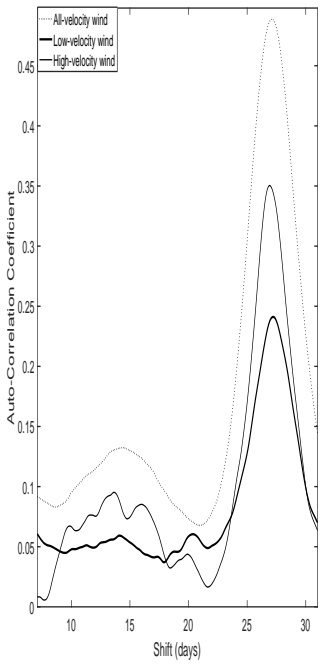
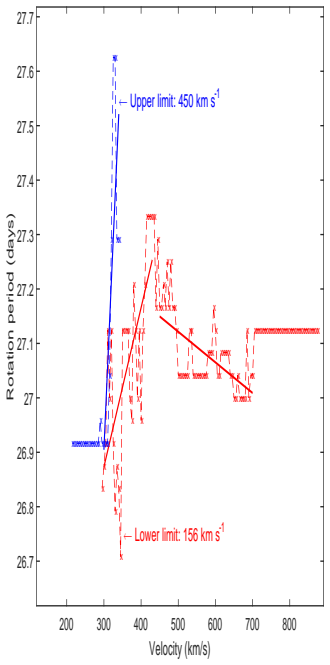
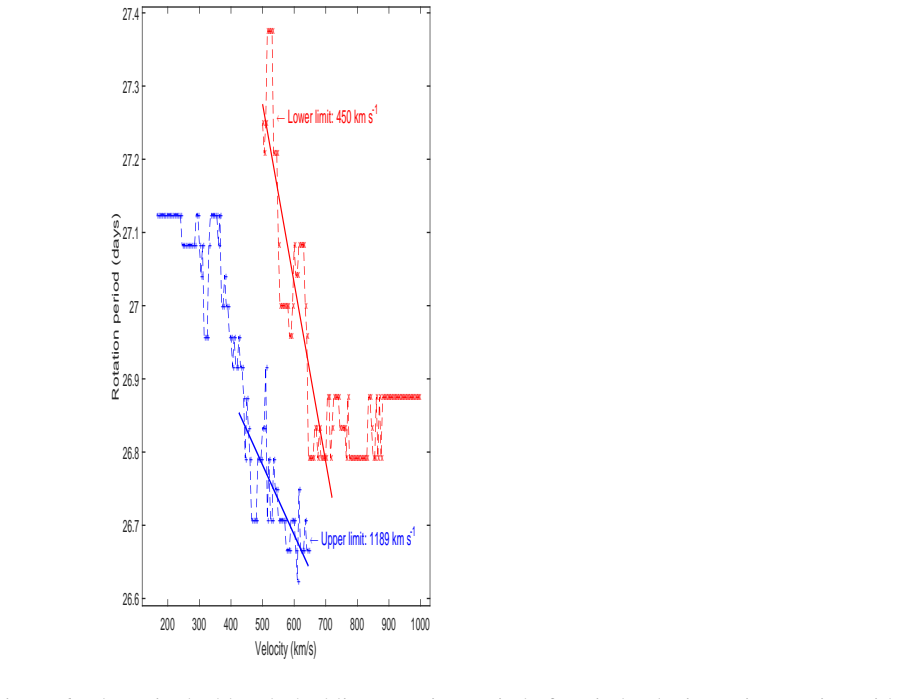
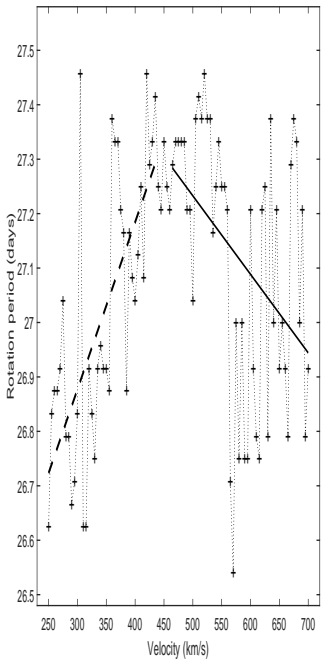
The central object is the autocorrelation function of the hourly solar-wind velocity series, which measures how well the series matches itself at increasing time lags; its peaks mark periodicities. The rotation period is read from the position of the main peak near the expected ~27.5-day rotation, alongside harmonic peaks near 13.7 and 9.1 days. A 'wave packet' of closely spaced significant peaks around the main period is attributed to several impulse streams that persist for a varying number of solar rotations, and it is the shift of these peaks with wind speed that carries the argument for velocity-dependent rotation.
What would settle it
Compute the autocorrelation rotation period separately for the nearly complete post-1994 hourly data and for the sparse pre-1994 data; if the fast-wind rotation advantage does not appear in both subsets, the full-sample result is not robust. A complementary check is to generate synthetic time series with one fixed rotation period, impose the actual 74.8% sampling pattern, and see whether inferred periods shift with simulated velocity.
Extended reading notes
Core claim
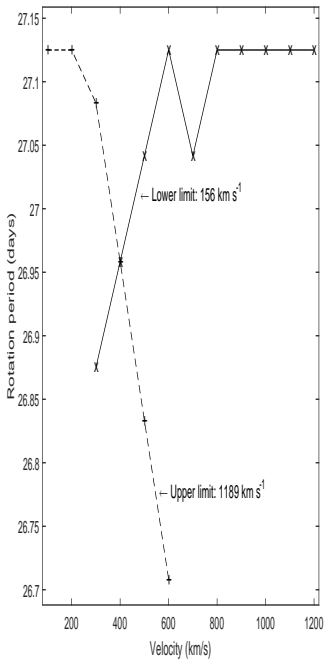
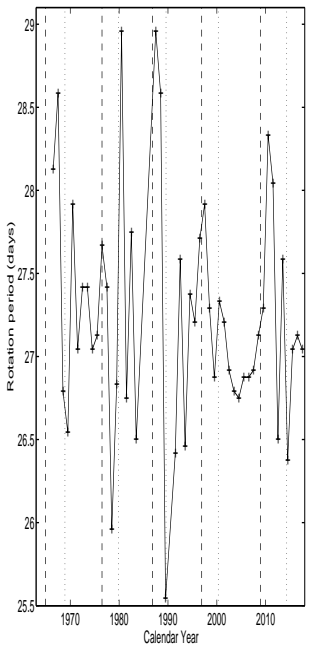
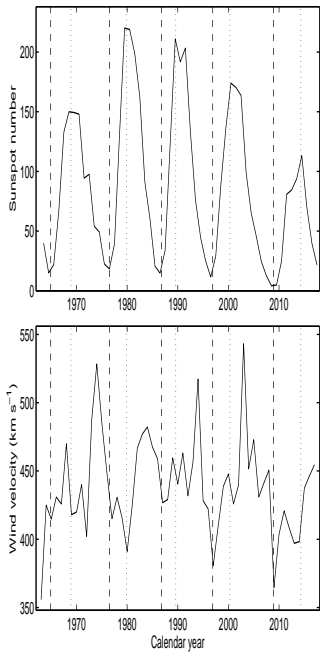
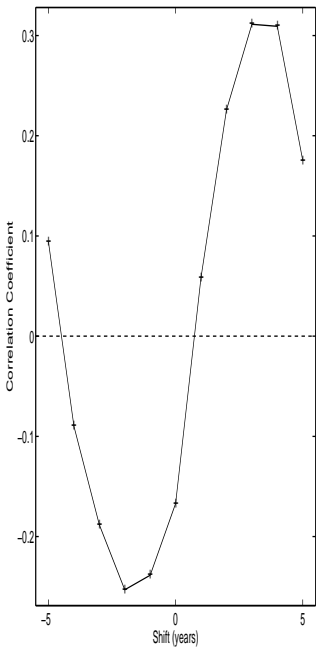
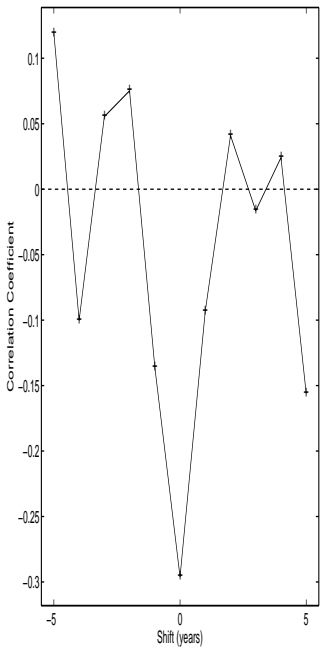
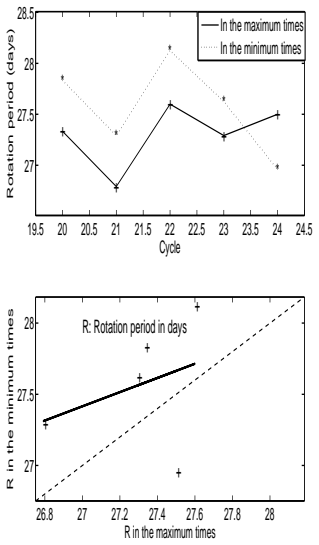
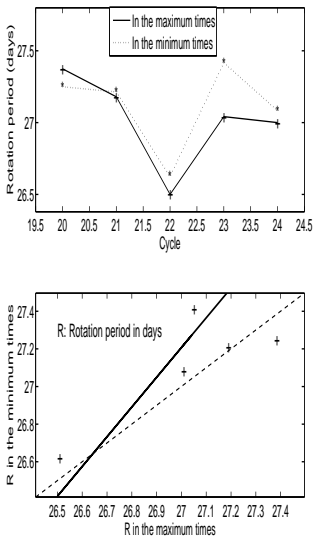
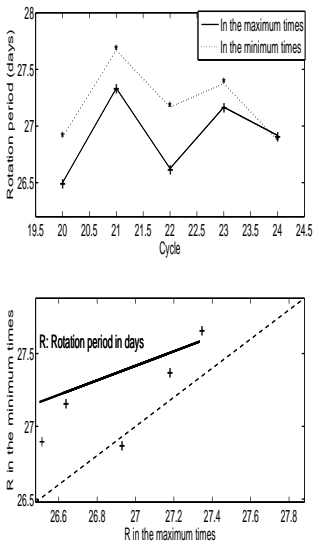
The central discovery is that the rotation period of the solar wind, extracted from autocorrelation peaks in hourly velocity, is not a single value. Higher-velocity wind statistically rotates faster than lower-velocity wind; the rotation rate increases with speed among high-speed wind and decreases with speed among low-speed wind. The paper further claims that the yearly rotation rate is not a simple Schwabe-cycle tracer: it is significantly negatively correlated with yearly sunspot number, with the rotation rate leading by three years. Physical explanations are proposed for these findings.
Load-bearing premise
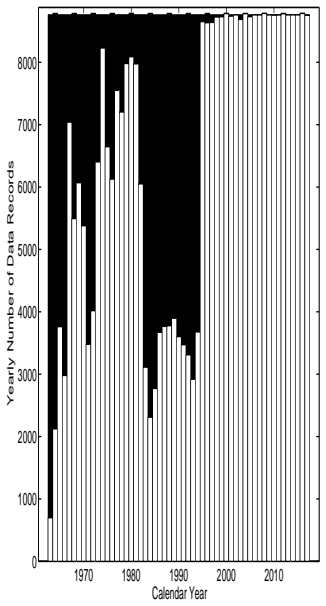
The load-bearing premise is that the roughly 25% of missing hourly records before 1994, and the uneven sampling overall, do not shift the autocorrelation peaks differently for fast and slow wind, and that the velocity-dependent differences are not an artifact of how the data are binned.
Editorial extensions
If this is right
- Reported solar-wind rotation periods should be quoted with the velocity range that produced them, because the autocorrelation peak shifts with speed.
- Predictions of high-speed stream recurrence that assume a fixed 27-day rotation will misplace coronal-hole source longitudes by an amount that grows with wind speed.
- The 3-year negative lead-lag between yearly rotation rate and sunspot number, if real, gives a testable time offset connecting solar activity to the large-scale rotation of the wind.
- Future autocorrelation studies need to separate fast and slow wind before estimating a single rotation period, since the two populations have opposite velocity trends.
Reading between the lines
- A testable extension is to split the 54-year record by source type rather than speed alone: if the velocity trend disappears within coronal-hole wind or within streamer wind, the effect is source-dependent rather than intrinsically speed-dependent.
- If the 3-year lead is physical, the same delayed negative correlation should appear between sunspot number and other large-scale wind parameters, such as coronal-hole area or open magnetic flux; that would be an independent check.
- The opposite slopes for fast and slow wind suggest two populations with different origins; binning by composition tracers such as helium abundance or charge state could separate the regimes more cleanly than velocity bins alone.
- A direct sampling check is to run the same autocorrelation pipeline on synthetic data with a known single rotation period but the real 74.8% observation pattern; any apparent speed-dependent shift would indict the gaps rather than the Sun.
Signed reviews
Editorial analysis
A structured set of objections, weighed in public.
Referee Report
Summary. The paper analyzes 54 years of hourly OMNI2 solar wind velocity data (27 Nov 1963 to 31 Dec 2017) using autocorrelation analysis to infer solar wind rotation periods. The central claims are: (1) high-velocity solar wind rotates faster than low-velocity wind; (2) for high-velocity wind the rotation rate increases with increasing velocity, whereas for low-velocity wind it decreases with increasing velocity; (3) for the entire solar wind, higher-velocity wind statistically has a faster rotation rate; and (4) the yearly rotation rate of solar wind velocity does not follow the Schwabe cycle but is significantly negatively correlated with yearly sunspot number when it leads by 3 years. Physical explanations for these findings are also proposed.
Significance. If the empirical claims are substantiated, the velocity dependence of solar wind rotation would provide a new observational constraint on coronal source structure and solar wind mapping, and the 3-year lead-lag with sunspot number would be relevant to solar cycle coupling studies. The paper has clear strengths: it uses the long, relatively homogeneous OMNI2 hourly record and applies a simple, direct autocorrelation approach, and the claims are falsifiable in principle. However, the manuscript as presented does not provide the statistical backbone needed to support these claims: there are no error bars on the reported rotation periods, no significance tests for the correlations, no details of how rotation periods are extracted from autocorrelation peaks, and no sensitivity analysis for the velocity binning. No code or extracted peak tables are provided, so the analysis cannot be independently reproduced from the manuscript.
major comments (3)
- [Section 2.1] The data completeness and sampling should be addressed directly. The manuscript reports that only 74.8% of the 474204 hourly records are present, and that before 1994 records are frequently missing. It does not state whether missing values were interpolated, how the autocorrelation was computed on the uneven series, or what minimum number of pairs was required at each lag. The standard lagged-product autocorrelation estimator uses only the pairs available at each lag, so the effective sample changes with lag and with solar cycle phase; this can shift the positions of autocorrelation peaks and distort the 'wave packet' structure from which rotation periods are read. The central velocity-dependence claim therefore needs a controlled check: repeat the analysis on the nearly complete post-1994 subset, and on unevenly resampled synthetic data with known periods, and show that the inferred rotation periods are stable.
- [Section 1 and abstract] The claimed non-monotonic velocity dependence is the paper's main empirical result, but the manuscript does not report the extracted rotation period (or rotation rate) for each velocity bin, the associated uncertainties, or the exact bin edges used in the analysis beyond the Section 1 categories v<450, 450≤v<725, and v≥725 km/s. Shifting these boundaries, or treating the v≥725 km/s class differently as transient streams, could change the sign of the within-bin slopes. Please provide a table of the extracted rotation period for each velocity bin with confidence intervals, and a sensitivity analysis in which the bin edges are varied and transient intervals are removed.
- [Abstract and yearly correlation analysis] The claim that the yearly rotation rate is 'significantly negatively correlated' with yearly sunspot number when it leads by 3 years is reported without a correlation coefficient, a p-value, or any statement of how serial correlation in the yearly solar wind and sunspot series was handled. With roughly 54 annual points and a 3-year lead applied, the effective number of independent samples is small, so naively computed significance may be overstated. The authors should show the full cross-correlation function over a range of lags, state the direction of the lead explicitly, and report significance levels that account for autocorrelation in both series.
minor comments (5)
- [Abstract and text] The solar cycle is consistently misspelled as 'Schwable cycle'; it should be 'Schwabe cycle'.
- [Author affiliations] The affiliations contain stray spaces: 'Y unnan Observatories' and 'Unive rsity' should be corrected to 'Yunnan Observatories' and 'University'.
- [Units and notation] The unit is written as 'kms−1' in several places; the standard form 'km s−1' should be used consistently.
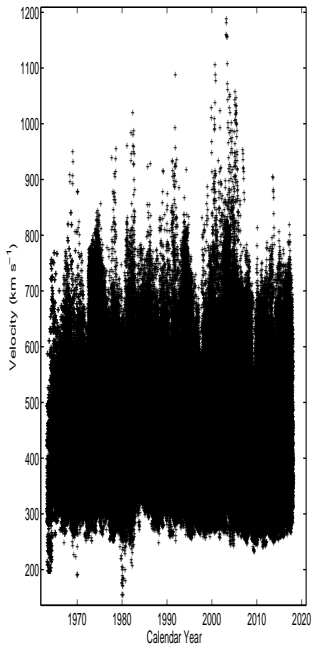
- [Figure 1] Figure 1 is nearly illegible because the '+' markers are heavily overplotted in the dense post-1994 portion. The authors should consider showing a binned or decimated version, or a separate inset, to make the full 54-year time series readable.
- [Section 2.1] The term 'wave packet' is used without a precise definition of how a set of nearby autocorrelation peaks is converted into a single 'rotation period'; this should be defined explicitly in the methods discussion.
Circularity Check
Observational autocorrelation study with no fitted-parameter-as-prediction or self-definitional steps; no circularity found.
full rationale
The paper is an observational analysis of the OMNI2 solar wind velocity time series. The central claims are that higher-velocity solar wind statistically rotates faster and that yearly rotation rate is negatively correlated with yearly sunspot number at a 3-year lead. These are derived by applying autocorrelation analysis to measured data and then comparing the inferred rotation characteristics across velocity bins and years. No parameter is fitted to a subset and then renamed a prediction; no quantity is defined in terms of the quantity it is said to explain. The velocity bins (v < 450, 450 to 725, >= 725 km/s) are conventional categories introduced in the introduction, not products of the analysis. The cited prior works, including papers by the same authors (e.g., Li, Zhang & Feng 2016, 2017), are used only as background explanations for the 1/2 and 1/3 harmonic periods and for the 'wave packet' feature; they do not supply a uniqueness theorem or force the velocity-dependence conclusion. Concerns about uneven sampling, missing data before 1994, and possible post hoc selection of the 3-year lead are legitimate soundness questions, but they are not circularity: the rotation periods and correlations are still measured from the data rather than being equivalent to the inputs by construction. The paper is self-contained against the external OMNI2 benchmark, and no reduction of a predicted quantity to a fitted or self-cited input can be exhibited from the text.
Assumptions & free parameters
free parameters (1)
- Lead of 3 years in sunspot correlation =
3 years
assumptions (3)
- domain assumption The OMNI2 hourly solar wind velocity data are accurate and representative over 54 years.
- domain assumption Auto-correlation analysis on the unevenly sampled time series yields unbiased estimates of the solar wind rotation period.
- domain assumption The three-way velocity classification (background low-velocity wind, background high-velocity wind, extreme-high-velocity streams) is physically meaningful for studying rotation.
Cite this review
Pith. "Pith review of Characteristics of solar wind rotation." pith.science (2026). https://pith.science/paper/IDB374JC
@misc{pith2026190811021,
  author       = {Pith},
  title        = {Pith review of: Characteristics of solar wind rotation},
  year         = {2026},
  howpublished = {\url{https://pith.science/paper/IDB374JC}},
  note         = {Machine review of arXiv:1908.11021}
}
read the original abstract
Over 54 years of hourly mean value of solar wind velocity from 27 Nov. 1963 to 31 Dec. 2017 are used to investigate characteristics of the rotation period of solar wind through auto-correlation analysis. Solar wind of high velocity is found to rotate faster than low-velocity wind, while its rotation rate increases with velocity increasing, but in contrast for solar wind of low velocity, its rotation rate decreases with velocity increasing. Our analysis shows that solar wind of a higher velocity statistically possesses a faster rotation rate for the entire solar wind. The yearly rotation rate of solar wind velocity does not follow the Schwable cycle, but it is significantly negatively correlated to yearly sunspot number when it leads by 3 years. Physical explanations are proposed to these findings.
Figures
Figures from the paper (11 more)
Reference graph
Works this paper leans on
-
[1]
G., 2009, Astronomy Reports, 53, 262 [ ] Badalyan O
[ ] Badalyan O. G., 2009, Astronomy Reports, 53, 262 [ ] Badalyan O. G., Obridko V . N., 2018a, Astronomy Letters, 4 4, 727 [ ] Badalyan O. G., Obridko V . N., 2018b, Solar Phys., 293, 128 [ ] Bagashvili S. R., Shergelashvili B. M., Japaridze D. R., C hargeishvili B. B., Kosovichev A. G., Kukhianidze V ., Ramishvili G., Zaqarashvili T. V ., et al., 2017, ...
work page 2009
-
[461]
[ ] Temmer M., Vr ˘snak B., V eronig A. M., 2007, Sol. Phys., 241, 371 [ ] Wang Y . M., 2012, Space Sci. Rev., 172, 123 [ ] Wang Y .M., Sheeley N. R., 1990, ApJ, 355, 726 [ ] Wang Y . M., Ko Y . K., Grappin R., 2009, ApJ, 691, 760 [ ] Waldmeier M., 1950 Zeitschrift fr Astrophysik, 27, 24 [ ] V ats H. O., Cecatto J. R., Mehta M., Sawant H. S., Neri J. A. C...
work page 2007
Reviewed August 14, 2026 · model on record in the stance chip above.
Discussion (0). Continue with ORCID to comment.