REVIEW 4 major objections 8 minor 24 references
Zero-shot Text-to-SQL Learning with Auxiliary Task
T0 review · 4 major / 8 minor · reviewed 2026-08-14 · deepseek-v4-flash
Pith's one-line read An auxiliary task that maps question words to column names improves text-to-SQL accuracy on tables never seen in training.
desk verdict A genuinely useful zero-shot split for WikiSQL plus a simple auxiliary mapping task that helps; the 'zero-shot' label oversells it slightly because 72% of column names appear in training. read the letter →
The pith
A machine-rendered reading of the paper's core claim, the machinery that carries it, and where it could break.
The reading
What carries the argument
The load-bearing mechanism is the auxiliary mapping model: a BIO tagger over the question that labels condition-column and condition-value spans, followed by a pointer network that maps each word tagged as part of a condition value to a column name. It shares the question and table-schema encoders with the main generation model, so the multi-task objective $\lambda L_{gen} + (1-\lambda)L_{map}$ regularizes the shared representations. The generation model itself is the coarse-to-fine decoder baseline, augmented with bi-directional question-to-table attention and attentive pooling for the AGG/SEL decision. The mapping task's job is to force the shared representations to encode the alignment between question entities and schema columns, the ability that degrades on unseen tables.
What would settle it
Take the W-0 subset and further restrict it to questions whose tables contain no column name that appeared in any training table; if the Full-model's advantage over the baseline on that restricted subset is close to zero or vanishes, the claim that the auxiliary mapping task teaches generalization to novel column names is refuted.
Extended reading notes
Core claim
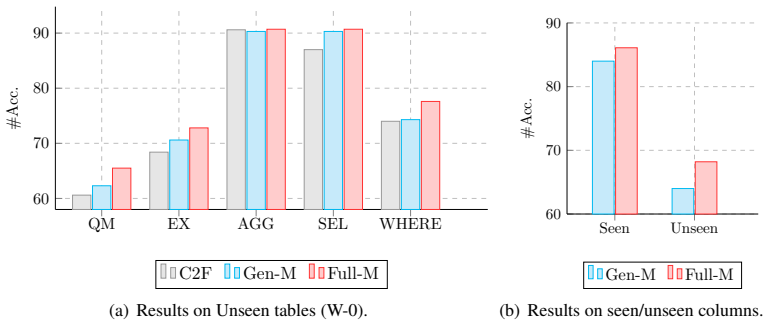
The paper claims that the poor zero-shot performance of neural text-to-SQL models is largely a column-mapping problem: the decoder must point from a natural-language expression to a column name it may never have seen in training. To address it, the authors add a two-step auxiliary task to a coarse-to-fine seq2seq generation model. The auxiliary model first tags question words as beginning or inside of a condition value or condition column, then points each predicted condition value to a table column. This mapping loss is added to the generation loss with a mixing weight, so the shared encoder learns question and schema representations that support explicit word-to-column alignment. The paper's evidence is that the Full-model beats the generation model alone by 4.2 points on WHERE conditions whose column name was unseen in training and by 2.1 points on seen column names, and that error analysis attributes most corrected errors to wrong condition-column predictions.
Load-bearing premise
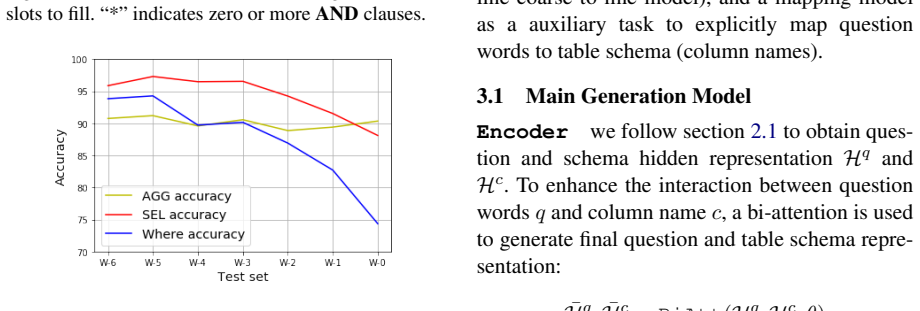
The load-bearing assumption is that 'zero-shot' can be measured by table occurrence in training; on W-0, 72% of column names on the unseen test tables do appear somewhere in training, so the reported advantage may mostly reflect handling new schemas composed of known column names rather than truly never-before-seen names.
Editorial extensions
If this is right
- If the Full-model generalizes as the paper argues, adding an explicit word-to-column mapping task should keep helping whenever a decoder must point to schema elements, not just on WikiSQL.
- Because the zero-shot testbed W-0 is a stricter evaluation than the original WikiSQL split, reported gains on W-0 indicate that part of the prior test accuracy was inflated by shared table schemas.
- Since the gain is concentrated in WHERE-clause condition-column prediction, other models that struggle on WHERE should benefit most from the same auxiliary mapping regularizer.
- The multi-task loss can be added to any sketch-based text-to-SQL decoder without changing the decoder's inference procedure; the only additional training-time need is span labels for condition values and columns.
Reading between the lines
- Editorial inference: the paper's zero-shot set still shares 72% of column names with training data, so the headline gain of 4.4-4.9 points mostly tests robustness to recombining familiar column names into new schemas; a stricter subset with entirely novel schemas would be a harder test of the mapping task.
- Editorial inference: the same two-step mapping idea could transfer to other semantic-parsing problems where a span of input text must be aligned to an output structure, such as slot filling or knowledge-base query generation, and the gains there could be similar in size.
- Editorial inference: because the mapping model learns only from words tagged as condition values, an ablation that replaces the tagging gate with raw word-to-column attention over all words would isolate whether the explicit selection of condition values is what drives the gain.
Signed reviews
Editorial analysis
A structured set of objections, weighed in public.
Referee Report
Summary. The paper addresses text-to-SQL generalization on WikiSQL. It introduces an auxiliary mapping task that tags condition-value spans in the question and maps those spans to condition column names, trained jointly with the generation model via a multi-task loss. The generation model itself uses a coarse-to-fine decoder enhanced with bi-attention and attentive pooling. On the full WikiSQL test set, the Full-model reaches 75.0% query-match accuracy and 81.7% execution accuracy, about 3% absolute above the coarse-to-fine baseline. On a new subset W-0 consisting of test tables with zero occurrences in training, the model improves over the baseline by 4.9% in query-match accuracy and 4.4% in execution accuracy. The paper includes ablations (removing attentive pooling, removing the mapping task) and a case study attributing the zero-shot gains to improved condition-column prediction.
Significance. The contribution is a simple and plausible auxiliary objective for improving cross-table generalization, together with a new table-frequency split (W-0) that exposes a generalization gap in existing WikiSQL models. The ablations and the case study provide useful diagnostic evidence. The main caveat is that W-0 is table-disjoint but not schema-disjoint: Section 5.2 reports that only 28% of column names in W-0 are unseen at training time, so the headline 'zero-shot' claim is partially a claim about compositional generalization over familiar column names. If the authors add column-level zero-shot analysis and temper the terminology, the paper would be a solid incremental contribution to text-to-SQL and semantic parsing generalization.
major comments (4)
- [§4.1, §5.2, Abstract] The abstract and Section 2.2 describe W-0 as a 'zero-shot' testbed, but W-0 is defined by table frequency, not by schema novelty. Section 5.2 states that only 28% of column names on unseen test tables never appear in the training set, meaning 72% of column names in W-0 have been seen individually. The auxiliary mapping task is trained on those seen column names, so W-0 mostly measures robustness to new combinations of familiar column names. The paper should either (a) explicitly qualify the claim as table-level zero-shot, or (b) add a column-level zero-shot subset (e.g., test conditions whose column name never occurs in training) and report the headline C2F-vs-Full comparison on that subset. Without such a restriction, the conclusion that the model generalizes to 'unseen data' is not supported at the schema level.
- [§5.2, Figure 5] The 4.9% ACCqm and 4.4% ACCex improvement on W-0 in Figure 5(a) is reported against the C2F baseline, which lacks both the bi-attention layer and the attentive pooling of Gen-model. The paper does not break this headline comparison down by seen versus unseen column names. Figure 5(b) provides a seen/unseen breakdown only for Gen-model versus Full-model, showing a 4.2% gain on unseen column names and 2.1% on seen column names. To support the claim that the auxiliary mapping task is responsible for the zero-shot improvement, the authors should report the same seen/unseen column-name breakdown for C2F and Gen-model as well, or otherwise isolate the contribution of the mapping task from the architectural changes.
- [§3.2, §3.3, §5.3] The auxiliary mapping task is the main novelty, but it is never evaluated directly (e.g., precision and recall of value-to-column mapping). The case study in Section 5.3 uses 100 samples per category with overlapping categories, and while it suggests that the mapping task corrects wrong condition-column predictions, it does not quantify how often the mapping task is responsible for the improvement on W-0. The authors should report direct mapping accuracy on W-0 or an analysis of the mapping task's predictions, to make the mechanism claim testable.
- [§5, Tables 1 and 5] No variance or significance estimates are reported. The absolute gains are 1.5–1.6% on the full set and 4.9% on W-0; given typical run-to-run variance in neural text-to-SQL models, the reader cannot determine whether the overall gains are statistically reliable. The authors should report results over multiple random seeds with standard deviations, or at least provide a bootstrap significance test for the main comparisons (Full-model vs. baseline and Full-model vs. Gen-model) in Tables 1 and Figure 5.
minor comments (8)
- [Abstract] The sentence 'Experimentally, We evaluate our models...' has an inconsistent capitalization of 'We'; please fix the capitalization and punctuation throughout.
- [§2.2] The phrase 'true zero-shot sub test-set' is ambiguous and arguably inaccurate given the column-name overlap discussed in Section 5.2; please define zero-shot precisely at the schema level or avoid the word 'true'.
- [§3.1] The word 'meassure' is a typo for 'measure'; also, in Eq. (3), the bias term b is written without a subscript, while the preceding text uses b with attention parameters; please make the notation consistent.
- [§4.3] '300-dim Glove' should be '300-dim GloVe'.
- [§5.1] The sentence 'We believe this is due to the fact that table itself is the other fact affecting models’ performance' contains a redundant and confusing use of 'fact'; please rephrase, e.g., 'table identity is another factor affecting performance.'
- [§5.3, Table 3] The definitions of Case-Correct and Case-Wrong are easy to misread; please state explicitly that Case-Correct contains examples where Full-model is correct and Gen-model is wrong, and Case-Wrong the reverse. Also clarify that an example can belong to more than one error category.
- [References] The IncSQL reference is garbled: 'Tianze Shi, Kedar Tatwawadi, Kaushik Chakrabarti, Yi Zhang, and Chen Weizhu Polozov, Oleksandr...' should be corrected to list all authors accurately.
- [Footnote 1] The footnote says 'Our code will be released after paper is reviewed.' If this manuscript is under journal review, please provide a statement of code availability consistent with the journal's policy, or include an anonymized release mechanism.
Circularity Check
No circularity: the auxiliary mapping task is a training-signal regularizer, and all headline numbers are evaluated against the external WikiSQL benchmark with independent baselines.
full rationale
The paper's central claims are evaluated on the public WikiSQL benchmark against independent baselines (SEQ2SQL, SQLNET, TypeSQL, and the coarse-to-fine model of Dong and Lapata 2018). There is no load-bearing self-citation: the coarse-to-fine decoder is used as a prototype, not as an authority that forces the paper's conclusions, and no uniqueness theorem or prior same-author result is imported to justify the design. The auxiliary mapping model is trained with a multi-task loss defined by the paper's own equations (Section 3.3), and the reported gains are measured on held-out test splits, not on the training loss. The mapping task re-expresses part of the gold SQL supervision (condition columns and values) at the word level, but this is a training objective; it is not a fitted parameter that is later renamed as a prediction. The zero-shot testbed W-0 is a table-occurrence split, and Section 5.2 reports that 28% of column names on unseen tables never appear in training, meaning 72% do appear. That observation raises a legitimate question about what kind of generalization the zero-shot gain measures, but it is a question about experimental validity and interpretation, not a circular derivation: the test split and the accuracy metrics are external to the model's fitted quantities, and none of the paper's equations equates a prediction with an input by construction. Therefore, no circular step meeting the quoted-evidence standard is present; the appropriate score is 0.
Assumptions & free parameters
free parameters (1)
- loss weight lambda =
0.5
assumptions (3)
- domain assumption Condition values and column names in WikiSQL questions are identifiable as contiguous word spans, so BIO tags can be applied.
- standard math The gold SQL queries provide correct BIO and mapping labels for the auxiliary task.
- domain assumption The number of table occurrences in training (shots) is a meaningful proxy for generalization difficulty.
Cite this review
Pith. "Pith review of Zero-shot Text-to-SQL Learning with Auxiliary Task." pith.science (2026). https://pith.science/paper/B6QTNHDO
@misc{pith2026190811052,
  author       = {Pith},
  title        = {Pith review of: Zero-shot Text-to-SQL Learning with Auxiliary Task},
  year         = {2026},
  howpublished = {\url{https://pith.science/paper/B6QTNHDO}},
  note         = {Machine review of arXiv:1908.11052}
}
read the original abstract
Recent years have seen great success in the use of neural seq2seq models on the text-to-SQL task. However, little work has paid attention to how these models generalize to realistic unseen data, which naturally raises a question: does this impressive performance signify a perfect generalization model, or are there still some limitations? In this paper, we first diagnose the bottleneck of text-to-SQL task by providing a new testbed, in which we observe that existing models present poor generalization ability on rarely-seen data. The above analysis encourages us to design a simple but effective auxiliary task, which serves as a supportive model as well as a regularization term to the generation task to increase the models generalization. Experimentally, We evaluate our models on a large text-to-SQL dataset WikiSQL. Compared to a strong baseline coarse-to-fine model, our models improve over the baseline by more than 3% absolute in accuracy on the whole dataset. More interestingly, on a zero-shot subset test of WikiSQL, our models achieve 5% absolute accuracy gain over the baseline, clearly demonstrating its superior generalizability.
Figures


Figures from the paper (2 more)

Reference graph
Works this paper leans on
-
[1]
URL: " 'urlintro :=
ENTRY address author booktitle chapter edition editor howpublished institution journal key month note number organization pages publisher school series title type volume year eprint doi pubmed url lastchecked label extra.label sort.label short.list INTEGERS output.state before.all mid.sentence after.sentence after.block STRINGS urlintro eprinturl eprintpr...
-
[2]
write newline
" write newline "" before.all 'output.state := FUNCTION n.dashify 't := "" t empty not t #1 #1 substring "-" = t #1 #2 substring "--" = not "--" * t #2 global.max substring 't := t #1 #1 substring "-" = "-" * t #2 global.max substring 't := while if t #1 #1 substring * t #2 global.max substring 't := if while FUNCTION word.in bbl.in capitalize " " * FUNCT...
-
[3]
Ankur Bapna, Gokhan Tur, Dilek Hakkani-Tur, and Larry Heck. 2017. Towards zero-shot frame semantic parsing for domain scaling. arXiv preprint arXiv:1707.02363
work page Pith review arXiv 2017
-
[4]
Ruichu Cai, Boyan Xu, Xiaoyan Yang, Zhenjie Zhang, and Zijian Li. 2018. An encoder-decoder framework translating natural language to database queries. In Proceedings of the 27th International Joint Conference on Artificial Intelligence
work page 2018
-
[5]
Deborah A. Dahl, Madeleine Bates, Michael Brown, William Fisher, Kate Hunicke-Smith, David Pallett, Christine Pao, Alexander Rudnicky, and Elizabeth Shriberg. 1994. Expanding the scope of the atis task: The atis-3 corpus. In Proceedings of the Workshop on Human Language Technology, pages 43--48
work page 1994
-
[6]
Li Dong and Mirella Lapata. 2016. Language to logical form with neural attention. In Proceedings of the 54th Annual Meeting of the Association for Computational Linguistics, pages 33--43
work page 2016
-
[7]
Li Dong and Mirella Lapata. 2018. Coarse-to-fine decoding for neural semantic parsing. In Proceedings of the 56th Annual Meeting of the Association for Computational Linguistics, pages 731--742
work page 2018
-
[8]
Kummerfeld, Li Zhang, Karthik Ramanathan, Sesh Sadasivam, Rui Zhang, and Dragomir Radev
Cathetine Finegan-Dollak, Jonathan K. Kummerfeld, Li Zhang, Karthik Ramanathan, Sesh Sadasivam, Rui Zhang, and Dragomir Radev. 2018. Improving text-to-sql evaluation methodology. In Proceedings of the 56th Annual Meeting of the Association for Computational Linguistics, pages 351--360
work page 2018
Show all 24 references
-
[9]
Jonathan Herzig and Jonathan Berant. 2018. Decoupling structure and lexicon for zero-shot semantic parsing. arXiv preprint arXiv:1804.07918
2018 arXiv
-
[10]
Po-Sen Huang, Chenglong Wang, Rishabh Singh, Wen-tau Yih, and Xiaodong He. 2018. Natural language to structured query generation via meta-learning. In Proceedings of the 2018 Conference of the North American Chapter of the Association for Computational Linguistics: Human Langu...
2018
-
[11]
Srinivasan Iyer, Ioannis Konstas, Alvin Cheung, Jayant Krishnamurthy, and Luke Zettlemoyer. 2017. Learning a neural semantic parser from user feedback. In Proceedings of the 55th Annual Meeting of the Association for Computational Linguistics, pages 963--973
2017
-
[12]
David Nadeau and Satoshi Sekine. 2007. A survey of named entity recognition and classification. Lingvisticae Investigationes, 30(1):3--26
2007
-
[13]
Arvind Neelakantan, Quoc V Le, Martin Abadi, Andrew MacCallum, and Dario Amodei. 2017. Learning a natural language interface with neural programmer. In Proceedings of the 5th International Conference on Learning Representations, pages 1--10
2017
-
[14]
C \' cero Nogueira dos Santos, Ming Tan, Bing Xiang, and Bowen Zhou. 2016. Attentive pooling networks. CoRR
2016
-
[15]
MinJoon Seo, Aniruddha Kembhavi, Ali Farhadi, and Hannaneh Hajishirzi. 2017. Bidirectional attention flow for machine comprehension. In Proceedings of the 5th International Conference on Learning Representations
2017
-
[16]
Tianze Shi, Kedar Tatwawadi, Kaushik Chakrabarti, Yi Mao, and and Chen Weizhu Polozov, Oleksandr. 2017. Incsql: Training incremental text-to-sql parsers with non-deterministic oracles. arXiv preprint arXiv:1809.05054v2
2017 arXiv
-
[17]
Chenglong Wang, Alvin Cheung, and Rastislav Bodik. 2017 a . Synthesizing highly expressive sql queries from input-output examples. In ACM SIGPLAN Notices, volume 52, pages 452--466. ACM
2017
-
[18]
Chenglong Wang, Tatwawadi Kedar, Brockschmidt Marc, Huang Po-Sen, Mao Yi, Polozov Oleksandr, and Singh Rishabh. 2017 b . Robust text-to-sql generation with execution-guided decoding. arXiv preprint arXiv:1807.03100v3
2017 arXiv
-
[19]
Xiaojun Xu, Chang Liu, and Dawn Song. 2017. Sqlnet: Generating structured queries from natural language without reinforcement learning. arXiv preprint arXiv:1711.04436
2017 arXiv
-
[20]
Pengcheng Yin and Graham Neubig. 2017. A syntactic neural model for general-purpose code generation. In Proceedings of the 55th Annual Meeting of the Association for Computational Linguistics, pages 440--450
2017
-
[21]
Tao Yu, Zifan Li, Zilin Zhang, Rui Zhang, and Dragomir Radev. 2018 a . Typesql: knowledge-based type-aware neural text-to-sql generation. In Proceedings of the 2018 Conference of the North American Chapter of the Association for Computational Linguistics: Human Language Techno...
2018
-
[22]
Tao Yu, Rui Zhang, Kai Yang, Michihiro Yasunaga, Dongxu Wang, Zifan Li, James Ma, Irene Li, Qingning Yao, Shanelle Roman, Zilin Zhang, and Dragomir Radev. 2018 b . Spider: A large-scale human-labeled dataset for complex and cross-domain semantic parsing and text-to-sql task. I...
2018
-
[23]
Zelle and Raymond J
John M. Zelle and Raymond J. Mooney. 1996. Learning to parse database queries using inductive logic programming. In Proceedings of the Thirteenth National Conference on Artificial Intelligence - Volume 2, pages 1050--1055
1996
-
[24]
Victor Zhong, Caiming Xiong, and Richard Socher. 2017. Seq2sql: Generating structured queries from natural language using reinforcement learning. arXiv preprint arXiv:1709.00103
2017 arXiv
Reviewed August 14, 2026 · model on record in the stance chip above.
Discussion (0). Continue with ORCID to comment.