REVIEW 3 major objections 4 minor 45 references
SYK non Fermi Liquid Correlations in Nanoscopic Quantum Transport
T0 review · 3 major / 4 minor · reviewed 2026-08-14 · deepseek-v4-flash
Pith's one-line read Nanoscopic quantum dots with narrow bands and strong interactions can host a non-Fermi liquid in the SYK universality class, with T^(3/2) cotunneling conductance replacing the Fermi-liquid T^2.
desk verdict New SYK cotunneling law T^{3/2} and a modified AES action, but the Gaussian-random-coupling assumption and a parameter inconsistency in the text need to be addressed before the claims hold. read the letter →
The pith
A machine-rendered reading of the paper's core claim, the machinery that carries it, and where it could break.
The reading
What carries the argument
The load-bearing object is the complex SYK interaction term, $\hat H_{\rm SYK}=\sum_{ijkl} J_{ijkl}c_i^\dagger c_j^\dagger c_k c_l$, with independent zero-mean Gaussian couplings of variance $J^2/N^3$, added to the charging-energy term $\frac{1}{2}E_C\hat n^2$. The low-energy action built from it is controlled by two collective modes: the charge phase $\varphi(\tau)$, canonically conjugate to the dot charge, with action contribution $\frac{1}{2}E_C^{-1}\dot\varphi^2$, and the reparameterization mode $h(\tau)$ with Schwarzian action $-m\{h,\tau\}$, where $m\propto N/J$. The fermion Green function transforms as $G_{\tau_1,\tau_2}=e^{-i\varphi(\tau_1)}(\dot h(\tau_1)\dot h(\tau_2)/(h(\tau_1)-h(\tau_2))^2)^{1/4}e^{i\varphi(\tau_2)}$, so the SYK mean field gives $|\tau|^{-1/2}$ decay, while strong $h$-fluctuations at long times change the effective dimension to give $|\tau|^{-3/2}$. That crossover, combined with the Coulomb-blockade phase factor, produces the anomalous power laws in Eqs. (7) and (8).
What would settle it
Measure the inelastic cotunneling conductance of a narrow-band quantum dot below its charging energy down to $T<J/N$: if it follows $T^2$ rather than $T^{3/2}$, the SYK fixed point is not controlling that dot. A complementary check is to compute the joint distribution of interaction matrix elements $J_{ijkl}$ from a realistic microscopic Coulomb model for a chaotic few-orbital dot and test whether it matches the independent zero-mean Gaussian ensemble; a clear mismatch would falsify the premise before transport is measured.
Extended reading notes
Core claim
The paper's central discovery is that the SYK interaction term $\hat H_{\rm SYK}=\sum_{ijkl} J_{ijkl} c_i^\dagger c_j^\dagger c_k c_l$ with zero-mean random couplings is not an innocuous correction to the universal Hamiltonian of a quantum dot: it generates a distinct low-energy theory with two soft modes, a U(1) charge phase and a time-reparameterization mode. On that basis the paper derives the two main transport results: for direct tunneling, $g_{\rm dt}\propto g_0\,e^{-E_C/T}$ for $T<E_C$ and $g_{\rm dt}\propto g_0\sqrt{J/T}$ for $E_C<T<J$; for inelastic cotunneling, $g_{\rm it}=(g_0^2/E_C^2)\sqrt{NJ}\,T^{3/2}$ for $T<J/N$ and $g_{\rm it}=(g_0^2/E_C^2)JT$ for $J/N<T<E_C$. The $T^{3/2}$ law comes from the long-time $|\tau|^{-3/2}$ decay of the reparameterization-fluctuation-dressed particle-hole propagator, in contrast to the $T^2$ of a Fermi liquid. The paper further claims that a quantum phase transition at bandwidth $W_c\propto J/N$ separates the SYK non-Fermi liquid from a Fermi liquid, and that the SYK universality class may therefore be realized in generic narrow-band chaotic quantum dots, not only in specially designed SYK systems.
Load-bearing premise
The argument assumes that the random four-fermion couplings $J_{ijkl}$ in a real chaotic quantum dot are effectively independent, zero-mean, and Gaussian, as in the SYK model; the paper's footnote [13] states that wave-function chaos makes this difference inessential, but no microscopic derivation is given, and if the real couplings are correlated or non-Gaussian the SYK fixed point and every transport power law derived from it fail.
Editorial extensions
If this is right
- Below the charging energy, the inelastic cotunneling conductance of an SYK dot grows as $T^{3/2}$ (for $T<J/N$) instead of the Fermi-liquid $T^2$, an unambiguous qualitative difference.
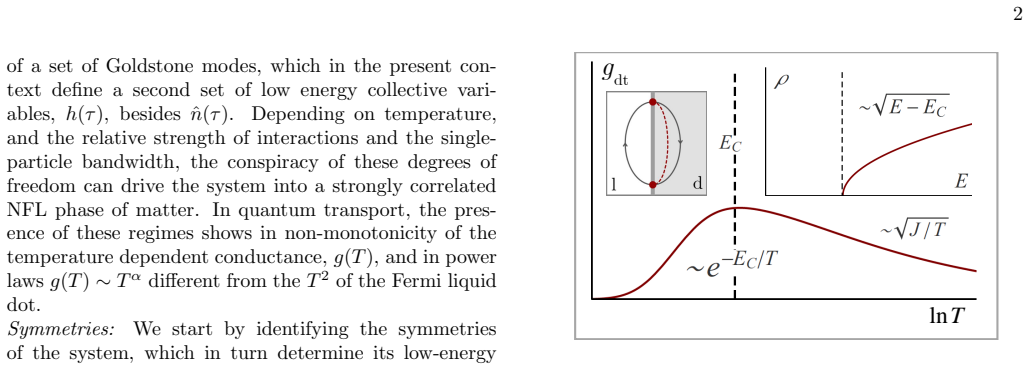
- Above the charging energy, direct tunneling gives $g_{\rm dt}\sim(J/T)^{1/2}$, so the conductance is non-monotonic: exponential Coulomb blockade at low $T$ turns into a square-root power law at higher $T$.
- A quantum critical point at bandwidth $W_c\propto J/N$ separates the non-Fermi-liquid phase from a Fermi-liquid phase; on the SYK side the single-particle term is irrelevant, on the other side it is relevant.
- The physical requirements—narrow band, strong interactions, chaotic single-particle states—are expected to be met by complex molecules, semiconductor artificial atoms, and exfoliated 2D flakes.
- The intrinsic charging energy from the SYK action is $K^{-1}\sim J/N$, which implies the observable regime requires $E_C>J/N$.
Reading between the lines
- Unstated corollary: the same two-mode action should generate anomalous power laws in shot noise and thermopower, so a $T^{3/2}$ conductance could be cross-checked with noise measurements.
- Testable check: compute the joint distribution of Coulomb matrix elements $J_{ijkl}$ in a realistic chaotic few-orbital dot and compare it with the independent zero-mean Gaussian SYK ensemble; deviations would shift or destroy the predicted exponents.
- Experimental targeting: since $W_c\propto J/N$, the largest non-Fermi-liquid windows should appear in the smallest systems—single molecules or few-electron artificial atoms—rather than large-area flakes.
- Diagnostic distinction: the separation of the $\varphi$ (charge) and $h$ (reparameterization) modes implies the $T^{3/2}$ exponent specifically tracks $h$-fluctuations, which may distinguish SYK correlations from other non-Fermi-liquid mechanisms with different exponents.
Editorial analysis
A structured set of objections, weighed in public.
Referee Report
Summary. The manuscript argues that in nanoscopic quantum dots with a narrow band of single-particle orbitals, the residual off-diagonal four-fermion interaction, normally discarded in the universal Hamiltonian approach, generically has the form of a complex SYK interaction. Starting from this premise, the authors derive an effective low-energy action for the U(1) phase mode φ and the reparametrization mode h, and use it to predict transport power laws: the direct tunneling conductance scales as gdt ~ g0 (J/T)^{1/2} for EC < T < J, while the inelastic cotunneling conductance scales as git ~ (g0^2/E_C^2) sqrt(NJ) T^{3/2} for T < J/N, replacing the Fermi-liquid T^2 law. The paper also presents an RG argument, following Ref. [27], for a quantum phase transition at Wc ~ J/N between an SYK non-Fermi-liquid phase and a Fermi-liquid phase.
Significance. If the random-coupling premise is granted, the transport predictions are concrete, falsifiable, and parameter-free in the sense that no quantity is fitted to transport data. The derivation of the cotunneling kernel (26) and the resulting T^{3/2} power law is a genuine calculation that goes beyond a scaling argument, and the extension of the Ambegaokar-Eckern-Schön action to SYK dots is a useful conceptual step. The main significance is the proposal that SYK non-Fermi-liquid physics could be diagnosed in transport through relatively ordinary nanoscopic devices. However, this significance is conditional on the Gaussian random-coupling assumption for the residual interaction and on parameter hierarchies that are internally inconsistent under the paper's own estimates.
major comments (3)
- [Introduction, after Eq. (1), footnote [13]] The claim that the residual couplings J_ijkl are effectively independent zero-mean Gaussian variables is load-bearing but is asserted rather than derived. Coulomb interaction matrix elements are bilinear in single-particle wavefunctions, so even if the wavefunctions are Gaussian-distributed, the matrix elements have symmetries, connected correlations, and non-Gaussian cumulants that need not vanish. The SYK fixed point and the transport power laws in Eqs. (7) and (8) follow only if the four-fermion vertex has the SYK distribution. The paper should either derive this distribution from a microscopic model or provide a random-matrix argument showing why the offending cumulants are suppressed. Footnote [13] does not provide such an argument.
- [After Eq. (3), footnote [32], and Eq. (7)] The parameter estimates are internally inconsistent. Footnote [32] estimates J ≈ N^{3/2} E_C. Then J/N ≈ sqrt(N) E_C > E_C for any N > 1, so the hierarchy E_C > J/N stated after Eq. (3) and used to justify the second line of Eq. (7) cannot hold. In addition, Supplemental Eq. (13) gives m = N ln N / (64 J) sqrt(cos 2θ / (2π)), which with the same estimate yields m^{-1} ≈ 64 sqrt(N) E_C / ln N ≫ E_C, contradicting the hierarchy m^{-1} ≪ E_C stated after Eq. (3) and the condition T > m^{-1} used in Eq. (36). Under the paper's own estimates, the temperature windows in which Eqs. (7) and (8) are derived are empty. The authors should reconcile the estimate of J with the required hierarchies, or identify a concrete microscopic regime in which both hierarchies hold.
- [RG analysis, Eq. (10) and Eq. (43)] The RG flow leading to the critical value λc = 12 is derived only to lowest order in w and uses the asymptotic expressions in Eq. (41) taken from Refs. [36,37]. Since the quantum phase transition at Wc ~ J/N is a central part of the stability claim, the truncation should be justified. In particular, the paper should indicate whether higher-order terms in w or finite-N corrections can shift the critical point, or should state explicitly the accuracy of the one-loop, asymptotic calculation. As written, the conclusion Wc ~ J/N rests on an uncontrolled truncation.
minor comments (4)
- [Eq. (7) and Fig. 1] The text before Eq. (7) describes the high-temperature regime as T > E_C > J/N, while Eq. (7) states the window as E_C < T < J. Please make the regime boundaries consistent throughout the paper and in the figure caption.
- [Eq. (8) and Supplemental Eq. (13)] The crossover scale J/N in Eq. (8) differs from the supplemental scale m^{-1} = 64 J / (N ln N) (up to O(1) factors). The main text drops logarithmic factors when quoting J/N and sqrt(NJ). Please clarify whether these logarithms are intentionally omitted and whether they affect the comparison with experiment.
- [Section 'Stability of the NFL phase'] There are small editorial errors: 'NLF' should be 'NFL', 'such as such as' is duplicated, and 'the Existence' should be lowercased. These do not affect the physics but should be corrected.
- [Eq. (6) and footnote [39]] The notation g0 is used as a dimensionless tunneling coupling in Eq. (6), but the text says g0 ∝ ν v^2 N / J. Please define the proportionality constant and state the weak-tunneling condition g0 ≪ 1 precisely.
Circularity Check
No circularity: the transport power laws are obtained by substituting an assumed SYK interaction into genuine linear-response kernels; the questionable input is an unproved physical assumption, not a circular reduction.
full rationale
The derivation chain is conditional on an assumed microscopic input: Eq. (1) includes the random four-fermion term H_SYK with zero-mean Gaussian couplings, and footnote [13] asserts without proof that the Gaussian ensemble is inessential. That is a physical modeling assumption, not a circular step; the paper never claims to derive that term from transport data or to fit it to the conductance it later predicts. Given that input, Eqs. (7) and (8) follow from well-defined calculations: the tunneling action (6) is expanded to first or second order, and the conductance is obtained by linear response from the kernel (26)/(33) with the SYK/Schwarzian Green functions. The low-temperature T^{3/2} law inherits the long-time tau^{-3/2} behavior of the squared Green function cited from Refs. [36,37,43]; those are independent prior calculations of SYK/Schwarzian correlators and are not used as a uniqueness theorem, as fitted parameters, or as a definition of the transport observable. Self-citations are present but not load-bearing in the circularity sense. The paper's own footnote [32] and Eq. (13) may be internally inconsistent with the stated hierarchy m^{-1}<<E_C, and the Gaussian-randomness claim for the residual interaction is not microscopically established; both are correctness risks, not instances of prediction-by-construction. No parameter is fitted to the target conductance data, and no equation in the paper reduces to its own input by construction.
Assumptions & free parameters
assumptions (4)
- domain assumption The four-fermion residual interaction in a chaotic quantum dot is an effectively Gaussian, independent, zero-mean random ensemble with variance J^2/N^3.
- domain assumption The low-energy action of the complex SYK dot is the U(1) phase action plus the Schwarzian action (3), with hierarchy m^{-1} << Ec << J.
- domain assumption The exact long-time asymptotics of the Schwarzian propagators, including <(G(h))^2> ~ tau^{-3/2} and the piecewise form (41), are correct.
- domain assumption The perturbative RG flow (10) with SL(2,R) symmetry protection captures the quantum phase transition at lambda_c = 12.
Cite this review
Pith. "Pith review of SYK non Fermi Liquid Correlations in Nanoscopic Quantum Transport." pith.science (2026). https://pith.science/paper/LZKNPSWC
@misc{pith2026190811351,
  author       = {Pith},
  title        = {Pith review of: SYK non Fermi Liquid Correlations in Nanoscopic Quantum Transport},
  year         = {2026},
  howpublished = {\url{https://pith.science/paper/LZKNPSWC}},
  note         = {Machine review of arXiv:1908.11351}
}
abstract
Electronic transport in nano-structures, such as long molecules or 2D exfoliated flakes, often goes through a nearly degenerate set of single-particle orbitals. Here we show that in such cases a conspiracy of the narrow band and strong e-e interactions may stabilize a non Fermi liquid phase in the universality class of the complex Sachdev-Ye-Kitaev (SYK) model. Focusing on signatures in quantum transport, we demonstrate the existence of anomalous power laws in the temperature dependent conductance, including algebraic scaling $T^{3/2}$ in the inelastic cotunneling channel, separated from the conventional Fermi liquid $T^2$ scaling via a quantum phase transition. The relatively robust conditions under which these results are obtained indicate that the SYK non Fermi liquid universality class might be not as exotic as previously thought.
Figures


Reference graph
Works this paper leans on
-
[13]
The difference is that in the standard SYK-Hamiltonian the couplings are drawn from a Gaussian distribution. However, in view of the effectively Gaussian distribution of chaotic single particle wave functions, this difference is inessential
- [32]
-
[27]
A. Altland, D. Bagrets, and A. Kamenev, Phys. Rev. Lett. 123, 106601 (2019)
work page 2019
-
[1]
A. Vilan, D. Aswal, and D. Cahen, Chemi- cal Reviews 117, 4248 (2017), pMID: 28177226, https://doi.org/10.1021/acs.chemrev.6b00595
-
[2]
This indicates a critical value λc = 12, separating a NFL phase at smallerλ from FL phase at largerλ
(10) These equations are best analyzed by defining λ≡ wm, which leads to the closed equationd lnλ/dl =λ/24−1/2. This indicates a critical value λc = 12, separating a NFL phase at smallerλ from FL phase at largerλ. In terms of the bare parameters λ∝ (NW/J )2 and thus Wc∝J/N. Phase diagram: A summary of the regimes with differ- ent algebraic or exponential te...
-
[3]
T. A. Su, M. Neupane, M. L. Steigerwald, L. Venkatara- man, and C. Nuckolls, Nature Reviews Materials 1, 16002 (2016)
work page 2016
-
[4]
L. Merces, R. F. de Oliveira, D. H. S. de Ca- margo, and C. C. B. Bufon, The Journal of Physical Chemistry C 121, 16673 (2017), https://doi.org/10.1021/acs.jpcc.7b02528
-
[5]
W. G. van der Wiel, S. De Franceschi, J. M. Elzerman, T. Fujisawa, S. Tarucha, and L. P. Kouwenhoven, Rev. Mod. Phys. 75, 1 (2002)
work page 2002
Show all 45 references
-
[6]
Charge transport in dna-based devices,
D. Porath, N. Lapidot, and J. Gomez-Herrero, “Charge transport in dna-based devices,” in Introducing Molecu- lar Electronics, edited by G. Cuniberti, K. Richter, and G. Fagas (Springer Berlin Heidelberg, Berlin, Heidelberg,
-
[7]
I. L. Kurland, I. L. Aleiner, and B. L. Altshuler, Phys. Rev. B 62, 14886 (2000)
2000
-
[8]
Y. V. Nazarov and Y. M. Blanter, Quantum Trans- port: Introduction to Nanoscience (Cambridge Univer- sity Press, 2009)
2009
-
[9]
Alhassid, Reviews of Modern Physics 72, 895 (2000), arXiv:cond-mat/0102268 [cond-mat.mes-hall]
Y. Alhassid, Reviews of Modern Physics 72, 895 (2000), arXiv:cond-mat/0102268 [cond-mat.mes-hall]
2000 arXiv
-
[10]
Aleiner, P
I. Aleiner, P. Brouwer, and L. Glazman, Physics Reports 358, 309 (2002)
2002
-
[11]
Sachdev and J
S. Sachdev and J. Ye, Phys. Rev. Lett. 70, 3339 (1993), arXiv:cond-mat/9212030
1993 arXiv
-
[12]
Urbina and K
J.-D. Urbina and K. Richter, Advances in Physics62, 363 (2013), https://doi.org/10.1080/00018732.2013.860277
2013
-
[14]
A simple model of quantum holography,
A. Kitaev, “A simple model of quantum holography,” http://online.kitp.ucsb.edu/online/entangled15/ kitaev/ and http://online.kitp.ucsb.edu/online/ entangled15/kitaev2/ (7 April 2015 and 27 May 2015)
2015
- [15]
-
[16]
R. A. Davison, W. Fu, A. Georges, Y. Gu, K. Jensen, and S. Sachdev, Phys. Rev. B 95, 155131 (2017), arXiv:1612.00849
2017 arXiv
- [17]
-
[18]
A. M. Garc´ ıa-Garc´ ıa and J. J. M. Verbaarschot, Phys. Rev. D 94, 126010 (2016), arXiv:1610.03816
2016 arXiv
- [19]
-
[20]
A. M. Garc´ ıa-Garc´ ıa and J. J. M. Verbaarschot, Phys. Rev. D 96, 066012 (2017), arXiv:1701.06593
2017 arXiv
-
[21]
J. S. Cotler, G. Gur-Ari, M. Hanada, J. Polchinski, P. Saad, S. H. Shenker, D. Stanford, A. Streicher, and M. Tezuka, JHEP 05, 118 (2017), arXiv:1611.04650
2017 arXiv
-
[22]
Maldacena and D
J. Maldacena and D. Stanford, Phys. Rev. D 94, 106002 (2016), arXiv:1604.07818
2016 arXiv
-
[23]
Song, C.-M
X.-Y. Song, C.-M. Jian, and L. Balents, Phys. Rev. Lett. 119, 216601 (2017)
2017
-
[24]
Engels¨ oy, T
J. Engels¨ oy, T. G. Mertens, and H. Verlinde, JHEP 07, 139 (2016), arXiv:1606.03438
2016 arXiv
-
[25]
Bi, C.-M
Z. Bi, C.-M. Jian, Y.-Z. You, K. A. Pawlak, and C. Xu, Phys. Rev. B 95, 205105 (2017), arXiv:1701.07081
2017 arXiv
-
[26]
Berkooz, P
M. Berkooz, P. Narayan, M. Rozali, and J. Sim´ on, JHEP 01, 138 (2017), arXiv:1610.02422
2017 arXiv
- [28]
-
[29]
A. V. Lunkin, K. S. Tikhonov, and M. V. Feigel’man, Phys. Rev. Lett. 121, 236601 (2018), arXiv:1806.11211
2018 arXiv
-
[30]
O. Can, E. M. Nica, and M. Franz, Phys. Rev. B 99, 9 045419 (2019)
2019
-
[31]
Maldacena, D
J. Maldacena, D. Stanford, and Z. Yang, Prog. Theor. Exp. Phys. 2016, 12C104 (2016), arXiv:1606.01857
2016 arXiv
- [33]
-
[34]
Assuming all matrix elements being comparable, Jijkl≈ Ec, one finds J≈N 3/2Ec≫Ec
-
[35]
Wang and H
X. Wang and H. Grabert, Phys. Rev. B 53, 12621 (1996)
1996
-
[36]
Kamenev and Y
A. Kamenev and Y. Gefen, Phys. Rev. B 54, 5428 (1996)
1996
-
[37]
T. G. Mertens, G. J. Turiaci, and H. L. Verlinde, JHEP 08, 136 (2017), arXiv:1705.08408
2017 arXiv
-
[38]
Bagrets, A
D. Bagrets, A. Altland, and A. Kamenev, Nucl. Phys. B 911, 191 (2016), arXiv:1607.00694
2016 arXiv
-
[39]
the calculation of g(T ) reduces to that of the Green function, ⟨G[φ,h ]⟩φ,h, of the isolated dot. In this ap- proximation, the conductance g≃ gdt probes the direct tunneling processes amplitude converting a lead quasi- particle into a single-particle excitation of the dot (se...
-
[40]
Ambegaokar, U
V. Ambegaokar, U. Eckern, and G. Sch¨ on, Phys. Rev. Lett. 48, 1745 (1982)
1982
-
[41]
Since g0∝ v2N, in the limit of large number of chan- nels, N, the matrix elements, v, should decrease to keep g0 ≪ 1
-
[42]
N. V. Gnezdilov, J. A. Hutasoit, and C. W. J. Beenakker, Phys. Rev. B 98, 081413(R) (2018)
2018
-
[43]
D. V. Averin and Y. V. Nazarov, Phys. Rev. Lett. 65, 2446 (1990)
1990
-
[44]
See Supplemental Material for the technical derivations of the results presented in the main text
-
[45]
Bagrets, A
D. Bagrets, A. Altland, and A. Kamenev, Nucl. Phys. B 921, 727 (2017), arXiv:1702.08902
2017 arXiv
Reviewed August 14, 2026 · model on record in the stance chip above.
Discussion (0). Continue with ORCID to comment.