REVIEW 3 major objections 4 minor 34 references
Hierarchical Pointer Net Parsing
T0 review · 3 major / 4 minor · reviewed 2026-08-14 · deepseek-v4-flash
Pith's one-line read Parent-sibling decoder links raise parsing accuracy
desk verdict Plausible hierarchical decoder idea with genuinely promising discourse results, but the dependency-parsing SOTA claim is contradicted by the paper's own Table 2 and needs reframing. read the letter →
The pith
A machine-rendered reading of the paper's core claim, the machinery that carries it, and where it could break.
The reading
What carries the argument
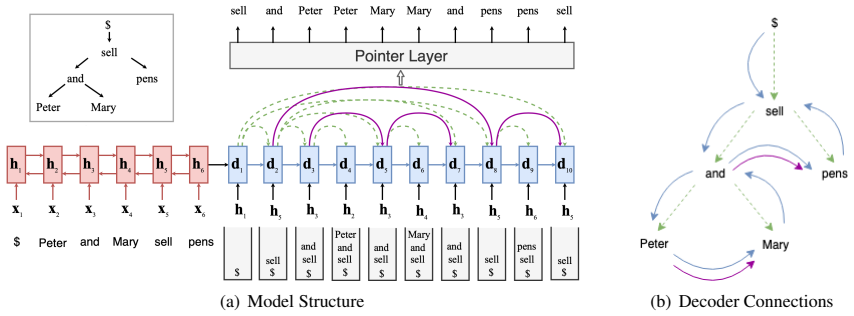
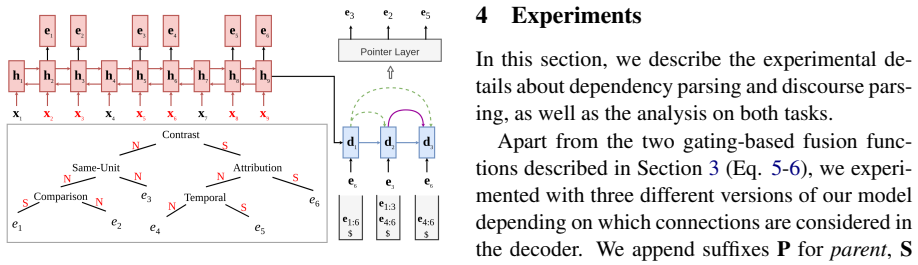
Pointer networks are encoder-decoder models that produce outputs by attending over input positions, effectively pointing to elements of the input. The central mechanism introduced here is the hierarchical decoder connection defined by Eq. (2), $d_t = f(d_{p(t)}, d_{s(t)}, d_{t-1}, h_{p(t)})$, where $d_{p(t)}$ and $d_{s(t)}$ are the decoder states of the current node's parent and immediate sibling, $d_{t-1}$ is the previous decoder state, and $h_{p(t)}$ is the parent's encoder state. In dependency parsing, $f$ is implemented as an LSTM with a learned gate (Eqs. 5-9) that controls information flow from the parent, sibling, and previous decoder states; in discourse parsing, a GRU variant is used without the gating layer because gating did not help there. The resulting decoder state feeds the pointer layer, which for dependency parsing points from a head word to a dependent and for discourse parsing points from a span to a split position. The gating mechanism is load-bearing because it suppresses error accumulation from earlier parsing mistakes on long sentences.
What would settle it
A decisive test would be an ablation that feeds the decoder the parent and sibling encoder states but not their decoder states; if the reported gains on UD and RST-DT disappear, the hierarchical decoder-state connections are the source, whereas if the gains remain, the improvement comes from extra input information rather than the hierarchical inductive bias.
Extended reading notes
Core claim
The central claim is that a sequential decoder is the wrong inductive bias for tree construction. When a pointer-network parser decodes a word such as a dependent noun, the most relevant context is not the token decoded immediately before it but the head word that dominates it and the sibling that shares that head. The paper implements this by replacing the decoder recurrence with a hierarchical fusion, Eq. (2), that combines the parent decoder state, the immediate sibling decoder state, the previous decoder state, and the parent encoder state. In dependency parsing the full H-PtrNet-PST model with gating improves over the StackPointer baseline on six of seven UD languages and on English Penn Treebank, while an ablation without gating degrades on long sentences, showing that the gate is what prevents error accumulation from earlier parsing mistakes. In sentence-level RST discourse parsing, the parent-only variant improves span F1 beyond the human-agreement baseline, and the full variant improves relation labeling to near human level. The paper concludes that hierarchical decoder connections are more appropriate than purely sequential ones for deriving tree structures.
Load-bearing premise
The load-bearing premise is that the parent and sibling decoder states carry structural context that helps the next decoding decision, and that the gating mechanism can keep that context from being corrupted by earlier parsing errors.
Editorial extensions
If this is right
- The hierarchical decoder preserves the $O(n^2)$ decoding complexity of the baseline, so the accuracy improvements come without an asymptotic speed penalty.
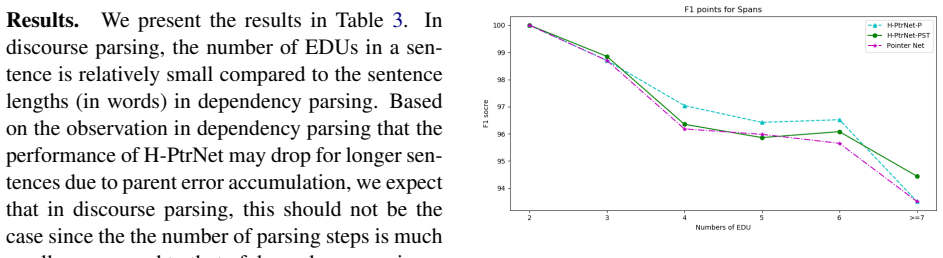
- Parent connections alone carry most of the benefit in discourse parsing; sibling and temporal connections add little for span identification but improve relation labeling.
- The gating mechanism is essential on long sentences: without it, conditioning on parent and sibling states amplifies error accumulation and accuracy drops.
- For sentence-level RST discourse parsing, relation labeling reaches 82.77 F1, within 0.23 of the 83.0 human-agreement figure, when the model is selected on relation performance.
Reading between the lines
- The same parent-sibling conditioning could apply to other tree-generating decoders, such as constituency parsers or semantic graph readers, wherever node hierarchy defines the contextual dependency.
- Because the dependency-parsing comparison relies on a rerun of the baseline under identical settings, some of the gain could stem from training conditions rather than the hierarchical inductive bias; an ablation feeding the same extra encoder states without the parent and sibling decoder states would separate the two.
- The gating result suggests a depth-adaptive gate: in shallow trees gating may be unnecessary, while in deep trees it is crucial, so a gate whose strength grows with subtree depth would be a direct testable extension.
Editorial analysis
A structured set of objections, weighed in public.
Referee Report
Summary. The paper proposes hierarchical pointer network parsers (H-PtrNet) for dependency parsing and sentence-level RST discourse parsing. The decoder conditions each decoding state on the parent decoder state, the immediate sibling decoder state, the previous decoder state, and the parent encoder state, with gated fusion variants. The authors evaluate on English Penn Treebank and seven UD treebanks for dependency parsing, and on RST-DT for discourse parsing, reporting improvements over rerun baselines and claiming new state-of-the-art results on both tasks. The paper also includes ablations over parent/sibling/temporal connections and a sentence-length breakdown analysis.
Significance. If the claims were fully supported, the paper would be a useful contribution: the hierarchical decoder is a plausible inductive bias for tree-structured outputs, the code is released, and the discourse parsing results are strong, with the relation F1 of 82.77 approaching the reported human agreement of 83.0. The paper also does a fair amount of controlled comparison by rerunning the StackPtr and Pointer Net baselines under identical settings. However, the headline claim of state-of-the-art dependency parsing is not supported by the paper's own Table 2, where every proposed variant is below the published StackPtr result on PTB. The UD improvements are mostly within one standard deviation and lack significance testing, and the un-gated model degrades on long sentences. These issues are fixable by recalibrating the claims and adding appropriate statistical analysis, but they are central to the current presentation.
major comments (3)
- [Abstract; §4.1; §5] The abstract and Section 5 claim that the parsers 'outperform existing methods and set a new state-of-the-art' on both tasks, but Table 2 contradicts this for dependency parsing. The best proposed model, H-PtrNet-PS (Gate), reaches 96.09 UAS and 95.03 LAS on English PTB, below the published StackPtr result of 96.12 UAS and 95.06 LAS reported in the same table. The gains described in §4.1 are relative to the rerun StackPtr (code) baseline (95.94/94.91), not to the published system, and the paper does not explain why the code rerun is lower. The two-task state-of-the-art claim is therefore not supported by the dependency results.
- [§4.1, Table 1] The UD dependency results do not support the claimed 'consistent improvements' without significance testing. In Table 1, H-PtrNet-PST (Gate) is worse than StackPtr (code) on ca (93.78 vs 93.82 UAS) and it (93.73 vs 93.76), and H-PtrNet-PST (SGate) is worse on en (90.94 vs 90.97) and ro (91.09 vs 91.15). The positive differences are mostly within 0.2 points, which is comparable to the reported standard deviations (0.05–0.26), and no paired significance test is provided. The text also states that H-PtrNet-PS is worse than StackPtr on all seven languages, so the claim of a consistent gain should be qualified substantially.
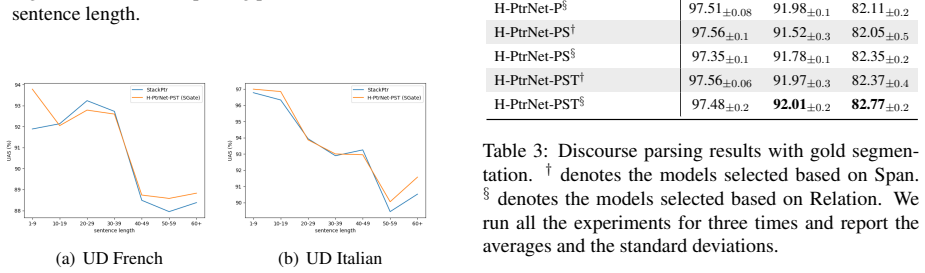
- [§3.3, §4.1 Performance Analysis, §5] The paper's own analysis in Figure 4(a) shows that the un-gated H-PtrNet-PST performs better on short sentences but its accuracy drops on longer sentences, which the text attributes to error accumulation. This directly undercuts the general conclusion in §5 that the parsers 'perform better for long sequences.' The gated version improves some long-sentence cases, but the improvement is not shown to be statistically significant and is demonstrated only on selected languages (German, French, Italian). The limitation should be acknowledged and the conclusion should be scoped to the gated variants with supporting significance tests.
minor comments (4)
- [§4.1, Table 2] The sentence 'Our model H-PtrNet-PST (Gate) outperforms the baseline by 0.09 and 0.08 in terms of UAS and LAS' should explicitly state that the baseline is StackPtr (code), not StackPtr (paper), because the latter comparison is negative for all proposed variants.
- [§4.1] The sentence claiming 'consistent improvements against the baseline on bg, en, de, fr, it and ro' is inaccurate: H-PtrNet-PST (Gate) is below the baseline on ca and it, and H-PtrNet-PST (SGate) is below on en and ro. The wording should be corrected or the table should be described more precisely.
- [§3.4 and §4.2] There are small typographical errors: 'as the the hidden state' in §3.4 should be 'as the hidden state', and 'sibing' in §4.2 should be 'sibling'.
- [§3.4 and §3.5] The 'partial tree information' provided to the decoder is mentioned but not formally specified; for reproducibility, the exact parent and sibling representations fed into the fusion function should be described or referenced precisely.
Circularity Check
No significant circularity: the hierarchical decoder is defined openly and evaluated on held-out test sets; the flawed SOTA claim is a fidelity/fairness issue, not a circular derivation.
full rationale
The paper's central contribution is an architectural variant of pointer-network parsers, specified by Eqs. 2–9, not a derivation of a result from a fitted constant or from an imported uniqueness claim. Each proposed variant is trained by minimizing cross-entropy (Eq. 12) and evaluated on held-out test portions of PTB, UD Treebanks, and RST-DT. No parameter is fitted to the test set and then renamed a prediction, and no load-bearing conclusion is justified by citing the authors' own prior work as an external mathematical fact. The only self-citation chain is the direct reuse of and comparison with Pointer Net (Lin et al., 2019), a system with overlapping authorship; this is an openly disclosed baseline and architectural backbone, not evidence that the present results hold. The paper is therefore not circular. A separate concern, worth recording as a correctness or fidelity issue rather than circularity, is that Section 5's claim that 'our parsers outperform existing methods and set new state-of-the-arts' is inconsistent with Table 2: the best proposed dependency-parsing system, H-PtrNet-PS (Gate), reaches 96.09 UAS / 95.03 LAS, below the published StackPtr baseline of 96.12 / 95.06, and the apparent PTB gain comes only when comparing against the authors' own rerun of StackPtr (code). This discrepancy affects the strength of the empirical claims, but it does not make any derivation circular.
Assumptions & free parameters
assumptions (3)
- domain assumption Tree structures are better decoded with explicit hierarchical (parent/sibling) conditioning than with a purely sequential decoder.
- domain assumption The standard parsing benchmarks and metrics (UAS/LAS, RST span/nuclearity/relation F1) are reliable measures of parser quality.
- standard math Softmax attention over encoder states provides a differentiable pointing mechanism.
Cite this review
Pith. "Pith review of Hierarchical Pointer Net Parsing." pith.science (2026). https://pith.science/paper/JQCUA4B3
@misc{pith2026190811571,
  author       = {Pith},
  title        = {Pith review of: Hierarchical Pointer Net Parsing},
  year         = {2026},
  howpublished = {\url{https://pith.science/paper/JQCUA4B3}},
  note         = {Machine review of arXiv:1908.11571}
}
read the original abstract
Transition-based top-down parsing with pointer networks has achieved state-of-the-art results in multiple parsing tasks, while having a linear time complexity. However, the decoder of these parsers has a sequential structure, which does not yield the most appropriate inductive bias for deriving tree structures. In this paper, we propose hierarchical pointer network parsers, and apply them to dependency and sentence-level discourse parsing tasks. Our results on standard benchmark datasets demonstrate the effectiveness of our approach, outperforming existing methods and setting a new state-of-the-art.
Figures

Figures from the paper (3 more)

Reference graph
Works this paper leans on
-
[1]
URL: " 'urlintro :=
ENTRY address author booktitle chapter edition editor howpublished institution journal key month note number organization pages publisher school series title type volume year eprint doi pubmed url lastchecked label extra.label sort.label short.list INTEGERS output.state before.all mid.sentence after.sentence after.block STRINGS urlintro eprinturl eprintpr...
-
[2]
write newline
" write newline "" before.all 'output.state := FUNCTION n.dashify 't := "" t empty not t #1 #1 substring "-" = t #1 #2 substring "--" = not "--" * t #2 global.max substring 't := t #1 #1 substring "-" = "-" * t #2 global.max substring 't := while if t #1 #1 substring * t #2 global.max substring 't := if while FUNCTION word.in bbl.in capitalize " " * FUNCT...
-
[3]
Rami Al-Rfou, Bryan Perozzi, and Steven Skiena. 2013. Polyglot: Distributed word representations for multilingual nlp. arXiv preprint arXiv:1307.1662
arXiv 2013
-
[4]
Daniel Andor, Chris Alberti, David Weiss, Aliaksei Severyn, Alessandro Presta, Kuzman Ganchev, Slav Petrov, and Michael Collins. 2016. https://doi.org/10.18653/v1/P16-1231 Globally normalized transition-based neural networks . In Proceedings of the 54th Annual Meeting of the Association for Computational Linguistics (Volume 1: Long Papers), pages 2442--24...
-
[5]
Miguel Ballesteros, Chris Dyer, and Noah A. Smith. 2015. https://doi.org/10.18653/v1/D15-1041 Improved transition-based parsing by modeling characters instead of words with LSTM s . In Proceedings of the 2015 Conference on Empirical Methods in Natural Language Processing, pages 349--359, Lisbon, Portugal. Association for Computational Linguistics
-
[6]
Lynn Carlson, Daniel Marcu, and Mary Ellen Okurowski. 2002. RST Discourse Treebank (RST--DT) LDC2002T07 . Linguistic Data Consortium, Philadelphia
work page 2002
-
[7]
Kyunghyun Cho, Bart van Merrienboer, C aglar G \" u l c ehre, Dzmitry Bahdanau, Fethi Bougares, Holger Schwenk, and Yoshua Bengio. 2014. http://aclweb.org/anthology/D/D14/D14-1179.pdf Learning phrase representations using RNN encoder-decoder for statistical machine translation . In Proceedings of the 2014 Conference on Empirical Methods in Natural Languag...
work page 2014
-
[8]
Timothy Dozat and Christopher D. Manning. 2017. http://arxiv.org/abs/1611.01734 Deep biaffine attention for neural dependency parsing . In ICLR
arXiv 2017
Show all 34 references
-
[9]
Chris Dyer, Miguel Ballesteros, Wang Ling, Austin Matthews, and Noah A. Smith. 2015. https://doi.org/10.3115/v1/P15-1033 Transition-based dependency parsing with stack long short-term memory . In Proceedings of the 53rd Annual Meeting of the Association for Computational Lingu...
2015 doi
-
[10]
Jason Eisner. 1996. Three new probabilistic models for dependency parsing: An exploration. In Proceedings of the 16th Conference on Computational Linguistics - Volume 1, COLING '96, pages 340--345, Copenhagen, Denmark. ACL
1996
-
[11]
Vanessa Wei Feng and Graeme Hirst. 2014. https://doi.org/10.3115/v1/P14-1048 A linear-time bottom-up discourse parser with constraints and post-editing . In Proceedings of the 52nd Annual Meeting of the Association for Computational Linguistics (Volume 1: Long Papers), pages 5...
2014 doi
-
[12]
Yangfeng Ji and Jacob Eisenstein. 2014. http://www.aclweb.org/anthology/P/P14/P14-1002 Representation learning for text-level discourse parsing . In Proceedings of the 52nd Annual Meeting of the Association for Computational Linguistics (Volume 1: Long Papers), pages 13--24, B...
2014
-
[13]
Shafiq Joty, Giuseppe Carenini, and Raymond Ng. 2012. http://aclweb.org/anthology/D12-1083 A novel discriminative framework for sentence-level discourse analysis . In Proceedings of the 2012 Joint Conference on Empirical Methods in Natural Language Processing and Computational...
2012
-
[14]
Shafiq Joty, Giuseppe Carenini, and Raymond T Ng. 2015. Codra: A novel discriminative framework for rhetorical analysis. Computational Linguistics, 41:3:385--435
2015
-
[15]
Kingma and Jimmy Ba
Diederik P. Kingma and Jimmy Ba. 2015. Adam: A method for stochastic optimization. CoRR, abs/1412.6980
2015 arXiv
-
[16]
Eliyahu Kiperwasser and Yoav Goldberg. 2016. https://doi.org/10.1162/tacl_a_00101 Simple and accurate dependency parsing using bidirectional LSTM feature representations . Transactions of the Association for Computational Linguistics, 4:313--327
2016 doi
-
[17]
Sujian Li, Liang Wang, Ziqiang Cao, and Wenjie Li. 2014. http://aclweb.org/anthology/P14-1003 Text-level discourse dependency parsing . In Proceedings of the 52nd Annual Meeting of the Association for Computational Linguistics (Volume 1: Long Papers), pages 25--35. ACL
2014
-
[18]
Xiang Lin, Shafiq Joty, Prathyusha Jwalapuram, and M Saiful Bari. 2019. https://arxiv.org/abs/1905.05682 A Unified Linear-Time Framework for Sentence-Level Discourse Parsing . In Proceedings of the 57th Annual Meeting of the Association for Computational Linguistics, ACL '19, ...
2019 arXiv
-
[19]
Wang Ling, Chris Dyer, Alan W Black, and Isabel Trancoso. 2015. Two/too simple adaptations of word2vec for syntax problems. In Proceedings of the 2015 Conference of the North American Chapter of the Association for Computational Linguistics: Human Language Technologies, pages ...
2015
-
[20]
Xuezhe Ma, Zecong Hu, Jingzhou Liu, Nanyun Peng, Graham Neubig, and Eduard Hovy. 2018. http://aclweb.org/anthology/P18-1130 Stack-pointer networks for dependency parsing . In Proceedings of the 56th Annual Meeting of the Association for Computational Linguistics (Volume 1: Lon...
2018
-
[21]
William Mann and Sandra Thompson. 1988. Rhetorical Structure Theory: Toward a Functional Theory of Text Organization . Text, 8(3):243--281
1988
-
[22]
Daniel Marcu. 1999. The automatic construction of large-scale corpora for summarization research. In Proceedings of SIGIR, pages 137--144
1999
-
[23]
Daniel Marcu. 2000. The Rhetorical Parsing of Unrestricted Texts: A Surface-based Approach . Computational Linguistics, 26:395--448
2000
-
[24]
Mitchell Marcus, Mary Marcinkiewicz, and Beatrice Santorini. 1994. Building a Large Annotated Corpus of English: The Penn Treebank . Computational Linguistics, 19(2):313--330
1994
-
[25]
Mathieu Morey, Philippe Muller, and Nicholas Asher. 2018. https://doi.org/10.1162/COLI_a_00314 A dependency perspective on RST discourse parsing and evaluation . American Journal of Computational Linguistics, 44(2):197--235
2018 doi
-
[26]
Philippe Muller, Stergos Afantenos, Pascal Denis, and Nicholas Asher. 2012. https://www.aclweb.org/anthology/C12-1115 Constrained decoding for text-level discourse parsing . In Proceedings of COLING 2012 , pages 1883--1900, Mumbai, India. The COLING 2012 Organizing Committee
2012
-
[27]
Dat Quoc Nguyen and Karin Verspoor. 2018. http://arxiv.org/abs/1807.03955 An improved neural network model for joint POS tagging and dependency parsing . CoRR, abs/1807.03955
2018 arXiv
-
[28]
Peters, Mark Neumann, Mohit Iyyer, Matt Gardner, Christopher Clark, Kenton Lee, and Luke Zettlemoyer
Matthew E. Peters, Mark Neumann, Mohit Iyyer, Matt Gardner, Christopher Clark, Kenton Lee, and Luke Zettlemoyer. 2018. Deep contextualized word representations. In Proc. of NAACL
2018
-
[29]
McDonald
Slav Petrov, Dipanjan Das, and Ryan T. McDonald. 2011. http://arxiv.org/abs/1104.2086 A universal part-of-speech tagset . CoRR, abs/1104.2086
2011 arXiv
-
[30]
Sebastian Schuster and Christopher D. Manning. 2016. Enhanced english universal dependencies: An improved representation for natural language understanding tasks. In LREC
2016
-
[31]
Radu Soricut and Daniel Marcu. 2003. Sentence Level Discourse Parsing Using Syntactic and Lexical Information . In Proceedings of the 2003 Conference of the North American Chapter of the Association for Computational Linguistics on Human Language Technology - Volume 1, NAACL'0...
2003
-
[32]
Oriol Vinyals, Meire Fortunato, and Navdeep Jaitly. 2015. http://papers.nips.cc/paper/5866-pointer-networks.pdf Pointer networks . In C. Cortes, N. D. Lawrence, D. D. Lee, M. Sugiyama, and R. Garnett, editors, Advances in Neural Information Processing Systems 28, pages 2692--2...
2015
-
[33]
Yizhong Wang, Sujian Li, and Houfeng Wang. 2017. https://doi.org/10.18653/v1/P17-2029 A two-stage parsing method for text-level discourse analysis . In Proceedings of the 55th Annual Meeting of the Association for Computational Linguistics (Volume 2: Short Papers), pages 184--...
2017 doi
-
[34]
Yue Zhang and Joakim Nivre. 2011. https://www.aclweb.org/anthology/P11-2033 Transition-based dependency parsing with rich non-local features . In Proceedings of the 49th Annual Meeting of the Association for Computational Linguistics: Human Language Technologies, pages 188--19...
2011
Reviewed August 14, 2026 · model on record in the stance chip above.
Discussion (0). Continue with ORCID to comment.