REVIEW 4 major objections 5 minor 99 references
Thermodynamics and stability of $f(T,B)$ gravity with viscous fluid by observational constraints
T0 review · 4 major / 5 minor · reviewed 2026-08-14 · deepseek-v4-flash
Pith's one-line read This paper argues that a viscous f(T,B) modified-gravity model, fitted to Hubble data, produces accelerated expansion, late-time stability, and a valid generalized second law of thermodynamics.
desk verdict Central results are hand-selected, not data-constrained; the GSL condition is a tautology. read the letter →
The pith
A machine-rendered reading of the paper's core claim, the machinery that carries it, and where it could break.
The reading
What carries the argument
The central machinery is the $f(T,B)$ action $S=\int d^4x\,e(f(T,B)/\kappa^2+L_m)$ together with the power-law function $f(T,B)=\alpha B^m+\beta T^n$, where $T=-6H^2$ is the torsion scalar and $B=-6(\dot H+3H^2)$ is the boundary term. The identity $R=-T+B$ connects the torsion and curvature formulations, which lets $f(T,B)$ recover both $f(T)$ and $f(R)$ limits. The argument then inserts the fitted cubic $E(z)$ into the derived formulas for the dark-energy density and pressure, uses these to plot $\omega_d=p_d/\rho_d$ and the sound speed, and applies horizon thermodynamics (horizon entropy and the Gibbs equation) to derive the generalized-second-law condition.
What would settle it
Recompute $\omega_d(z)$ and $c_s^2(z)$ using the fitted coefficients $A_3=-0.16$, $A_2=2.39$, $A_1=-3.80$, $A_0=2.57$ while keeping $\alpha=\beta=1$, $m=1$, $n=-2$, $\xi=0.5$, and require the dark-energy density to stay positive and pressure negative. If the equation of state no longer crosses the phantom divide, or if $c_s^2(0)$ turns negative, the paper's late-time acceleration and stability claims are artifacts of the hand-picked parameters rather than consequences of the data.
Extended reading notes
Core claim
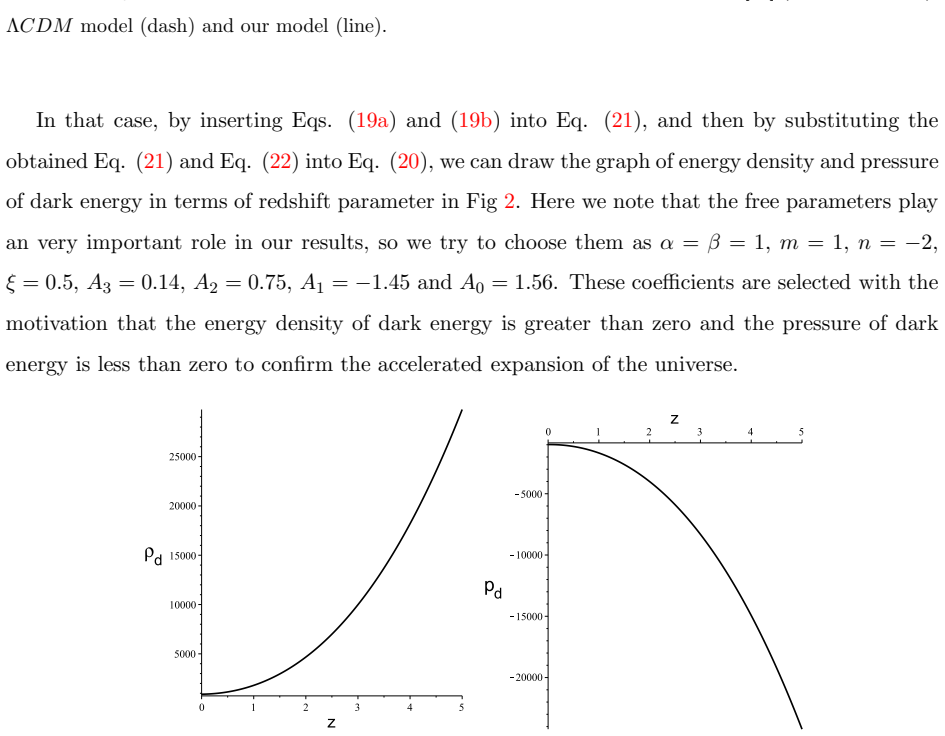
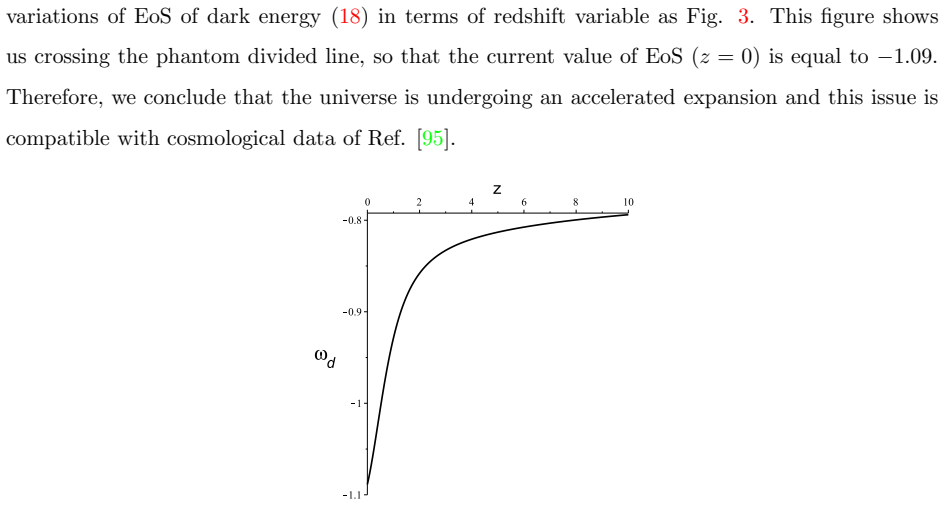
The paper's central claim is that the viscous $f(T,B)$ model with $f(T,B)=\alpha B^m+\beta T^n$ and $E(z)=A_3(1+z)^3+A_2(1+z)^2+A_1(1+z)+A_0$ produces a dark-energy component whose equation of state crosses the phantom divide, reaching $\omega_d(0)=-1.09$ today, while the adiabatic sound speed $c_s^2=\partial_z p_d/\partial_z \rho_d$ remains positive at late times, with $c_s^2(0)=0.59$. The same construction is claimed to satisfy the generalized second law of thermodynamics at the apparent horizon through the condition $\dot H^2/(2GH^4)\ge 0$, written in redshift form as $(1+z)^2 E'^2(z)/(2G E^2(z))\ge 0$. The conclusion is that the model is compatible with the accelerated expansion of the universe and is stable in the late-time regime.
Load-bearing premise
The load-bearing step is the paper's choice to plot the model with hand-selected parameter values chosen so that the dark-energy density comes out positive and the pressure negative, instead of with the coefficient values obtained from the Hubble-data fit; if those hand-picked values do not faithfully represent the data-constrained model, the reported $\omega_d$, $c_s^2$, and stability results do not follow from the observations.
Editorial extensions
If this is right
- If the model is right, this particular $f(T,B)$ construction is a late-time dark-energy candidate that accelerates the expansion while staying classically stable.
- The phantom-crossing value $\omega_d(0)=-1.09$ means the model can mimic the observational behavior associated with $\omega<-1$ without introducing a phantom scalar field.
- Because the generalized second law holds, the model is not excluded by horizon thermodynamics, a common consistency check for modified gravity cosmologies.
- The cubic parametrization with the reported fitted coefficients reproduces the 38 Hubble-parameter measurements, so the background kinematics are consistent with the data used.
- The interaction $Q=3b^2H\rho$ changes the matter dilution law to $\rho=\rho_0 a^{-3(1-b^2+\omega)}$, so energy exchange between matter and dark energy is built into the model's evolution equations.
Reading between the lines
- The generalized-second-law condition Eq (31) is nonnegative for any differentiable $E(z)$, so this thermodynamic check is automatic and does not distinguish the model from others; a more informative test would compute the separate rates $\dot S_{ih}$ and $\dot S_{oh}$.
- Replacing the hand-selected coefficients with the fitted values $A_3=-0.16$, $A_2=2.39$, $A_1=-3.80$, $A_0=2.57$ would show whether the reported acceleration and stability are genuinely data-driven.
- Treating the viscosity coefficient $\xi$ and the interaction strength $b$ as free parameters to be fit, rather than fixing them, would turn the qualitative redshift plots into actual parameter constraints.
Editorial analysis
A structured set of objections, weighed in public.
Referee Report
Summary. The paper studies f(T,B) gravity in a flat FRW universe with a bulk-viscous fluid, reconstructing the dark-energy density, pressure, and equation of state in terms of redshift for a power-law ansatz f(T,B)=αB^m+βT^n. The Hubble parameter is parameterized by a cubic polynomial E(z)=A3(1+z)^3+A2(1+z)^2+A1(1+z)+A0 and fitted to 38 H(z) data points. Using a set of hand-selected coefficients, the authors report an accelerating universe with ω_d(0)=-1.09, a late-time stability c_s^2(0)=0.59, and validity of the generalized second law of thermodynamics via a non-negative condition on ˙H^2. The central claims are that this f(T,B) model with viscous fluid is observationally compatible, stable, and thermodynamically consistent.
Significance. If correct, the paper would demonstrate a viable dark-energy model that combines f(T,B) gravity, bulk viscosity, and interaction with matter, supported by H(z) data. The authors do derive the f(T,B) field equations in tetrad form and provide a systematic redshift-space reconstruction, which are useful steps. However, the central results do not follow from the analysis: the observational fit is discarded in favor of parameters chosen to force the desired sign of energy density and pressure, the redshift-space pressure equation contains chain-rule coefficient errors, and the generalized second law reduces to the square of a quantity, holding identically for any E(z). These issues undermine the paper's main conclusions. The manuscript is not yet suitable for publication.
major comments (4)
- [Sec. IV, after Eq. (22)] The fitted coefficients from the 38 H(z) data points are reported as A3=-0.16±0.30, A2=2.39±1.71, A1=-3.80±2.89, A0=2.57, but all subsequent physical results (Figs. 2–4, ω_d(0)=-1.09, c_s^2(0)=0.59) are computed with A3=0.14, A2=0.75, A1=-1.45, A0=1.56, and α=β=1, m=1, n=-2, ξ=0.5. The authors state that these coefficients were 'selected with the motivation that the energy density of dark energy is greater than zero and the pressure of dark energy is less than zero to confirm the accelerated expansion of the universe.' This is circular: the observational fit is not used to constrain the model, and no error bars are propagated. The conclusion that the model is compatible with observational data is therefore unsupported.
- [Eq. (20b)] The conversion of the pressure equation (15b) to redshift space contains incorrect chain-rule coefficients. For the term ∂B¨f, using d/dt = -H(1+z)d/dz with H=H0√E gives ∂B¨f = (1/2)H0^2(1+z)^2E'∂Bf' + H0^2(1+z)E∂Bf' + H0^2(1+z)^2E∂Bf''. The published Eq. (20b) instead has coefficient 1 on (1+z)^2E'∂Bf' and coefficient 2 on (1+z)E∂Bf'. This error propagates into p_d, ω_d, and c_s^2, so the quantitative claims about the equation of state and stability are not reliable.
- [Eq. (31), Sec. V] The generalized-second-law condition is stated as ˙H^2/(2GH^4) = (1+z)^2E'^2(z)/(2GE^2(z)). This equality has a factor-of-4 error: substituting ˙H = -(1/2)H0^2(1+z)E' and H^2=H0^2E gives ˙H^2/H^4 = (1/4)(1+z)^2E'^2/E^2, so the right-hand side should be (1+z)^2E'^2/(8GE^2). More importantly, the expression is a square and is therefore non-negative for any function E(z). The claimed validity of the generalized second law is thus an identity that holds for every f(T,B) model, regardless of the viscous fluid, the interaction, or the fitted parameters. It cannot serve as a test or validation of the model.
- [Secs. III–IV, Eqs. (15b), (18), (20b)] The treatment of the viscous term is inconsistent. Eq. (15b) defines p_d as the pure f(T,B) contribution to the dark-energy pressure, and Eq. (18) defines the equation of state using ¯p_d = p_d - 3ξH. However, Eq. (20b) appends '-3ξH0√E' directly to the expression for p_d. If Eq. (20b) is meant to be p_d, then substituting it into Eq. (18) double-counts the viscosity; if Eq. (20b) is meant to be ¯p_d, the notation conflicts with Eq. (15b). The plotted equation of state is therefore ambiguous, and this ambiguity affects the reported ω_d values.
minor comments (5)
- [Abstract and Sec. I] The paper states that '38 supernova data' are used, but Ref. [85] is a compilation of Hubble parameter measurements, not supernova data; the wording should be corrected.
- [Sec. IV, around Eq. (22)] The constraint A3+A2+A1+A0=1 is used, but the fitted values are reported with uncertainties that are not propagated into any derived quantity; the absence of a goodness-of-fit statistic (e.g., χ^2) also makes the quality of the fit difficult to assess.
- [Fig. 1] It is unclear whether the 'our model' curve in Fig. 1 uses the fitted coefficients or the later hand-selected coefficients; this should be stated explicitly.
- [Sec. IV] The sentence 'From the result of fitting, we obtain the coefficients ... which Fig. 1 shows the matter' is grammatically incomplete and should be rewritten.
- [Throughout] There are numerous typographical errors (e.g., 'tortion', 'paramet erize', 'institing') and awkward phrasings that would need copyediting.
Circularity Check
The central acceleration and stability results are manufactured by hand-selecting coefficients to force rho_d>0 and p_d<0, and the GSL check reduces to a square being nonnegative.
-
self definitional
[Section IV, paragraph after Eq. (22)]
"Here we note that the free parameters play an very important role in our results, so we try to choose them as α = β = 1, m = 1, n = −2, ξ = 0.5, A3 = 0.14, A2 = 0.75, A1 = −1.45 and A0 = 1.56. These coefficients are selected with the motivation that the energy density of dark energy is greater than zero and the pressure of dark energy is less than zero to confirm the accelerated expansion of the universe."
The data fit reported just above gives A3 = −0.16, A2 = 2.39, A1 = −3.80, A0 = 1 − A3 − A2 − A1, but all subsequent quantities (Figs. 2-4, ωd(0) = −1.09, c_s^2(0) = 0.59) are computed with the different, hand-picked A3 = 0.14, A2 = 0.75, A1 = −1.45, A0 = 1.56. These coefficients are explicitly chosen so that ρd > 0 and pd < 0, i.e., so that the universe accelerates. The conclusion 'accelerated expansion, ωd ≈ −1.09' is therefore an input to the coefficient selection, not an output of the observational constraints, making the central viability claim circular by construction.
-
other
[Section V, Eq. (31)]
"now by inserting (11) and (24) into aforesaid relationship, we can clearly find the condition for the validity of the generalized second law of thermodynamics in the following form ˙H 2 2GH 4 = (1 + z)2E′2(z) 2GE2(z) ≥ 0. The result shows us that the validity of the generalized second law of thermodynamics be satisfied by condition of thermodynamics equilibrium."
The final expression is (1+z)^2 E'^2 / (2 G E^2), which is nonnegative for every real differentiable E(z) because it is a ratio of a square to positive quantities. Thus Eq. (31) is an identity, not a model-specific condition, and the claimed validity of the generalized second law holds for any E(z) in this framework. The GSL test therefore contains no information about the f(T,B) viscous-fluid model and cannot confirm or falsify it.
full rationale
The paper's headline numerical results do not follow from the observational fit. After fitting Eq. (22) to 38 H(z) points and reporting A3 = −0.16, A2 = 2.39, A1 = −3.80, the analysis switches to A3 = 0.14, A2 = 0.75, A1 = −1.45, A0 = 1.56, selected explicitly to make ρd > 0 and pd < 0, and then reads off accelerated expansion (ωd(0) = −1.09) and late-time stability (c_s^2(0) = 0.59). These outputs are therefore consequences of the parameter choice, not of the data or of the f(T,B) dynamics; the phrase 'by observational constraints' is not realized for the plotted model. The thermodynamic check in Eq. (31) is likewise vacuous, reducing the GSL to a square that is nonnegative for any E(z). These are internal, textually documented reductions of the central claims to their own inputs, so the appropriate score is 8; no external benchmark or independent derivation rescues the central claim.
Assumptions & free parameters
free parameters (10)
- alpha (amplitude of B^m term) =
1
- beta (amplitude of T^n term) =
1
- m (power of B) =
1
- n (power of T) =
-2
- xi (bulk viscosity coefficient) =
0.5
- A3 (coefficient of (1+z)^3 in E(z)) =
0.14 (plots) / -0.16±0.30 (fit)
- A2 (coefficient of (1+z)^2 in E(z)) =
0.75 (plots) / 2.39±1.71 (fit)
- A1 (coefficient of (1+z) in E(z)) =
-1.45 (plots) / -3.80±2.89 (fit)
- A0 (constant term in E(z)) =
1.56 (plots) / 2.57 (fit)
- b (interaction strength in Q=3b^2H*rho) =
not specified
assumptions (7)
- domain assumption Flat FRW metric with tetrad diag(1,a,a,a) and Weitzenbock connection yield T=-6H^2 and B=-6(Hdot+3H^2).
- domain assumption Bulk viscosity pressure pb=-3*xi*H with constant xi.
- domain assumption Interaction term Q=3b^2H*rho between matter and dark energy.
- ad hoc to paper Power-law form f(T,B)=alpha*B^m+beta*T^n.
- ad hoc to paper Polynomial E(z)=A3(1+z)^3+A2(1+z)^2+A1(1+z)+A0.
- domain assumption Thermal equilibrium between apparent horizon and fluid.
- standard math Bekenstein-Hawking entropy S=A/(4G) and Gibbs equation for the fluid within the horizon.
Cite this review
Pith. "Pith review of Thermodynamics and stability of $f(T,B)$ gravity with viscous fluid by observational constraints." pith.science (2026). https://pith.science/paper/7OFRJEBO
@misc{pith2026190811595,
  author       = {Pith},
  title        = {Pith review of: Thermodynamics and stability of $f(T,B)$ gravity with viscous fluid by observational constraints},
  year         = {2026},
  howpublished = {\url{https://pith.science/paper/7OFRJEBO}},
  note         = {Machine review of arXiv:1908.11595}
}
abstract
In this paper, we study the model of $f(T, B)$ gravity with viscous fluid in flat-FRW metric, in which $T$ and $B$ are torsion scalar and boundary term, respectively. We obtain the Friedmann equations in the framework of modified teleparallel gravity by tetrad components. We consider an interacting model between matter and dark energy so that universe dominates by viscous fluid. Then, we write the corresponding cosmological parameters in terms of the redshift parameter, and, we parameterize the Hubble parameter with experimental data. In what follows, we plot the corresponding cosmological parameters for dark energy components in terms of redshift, thereafter we investigate the accelerated expansion of the universe. Moreover, we discuss the stability of the model by using the sound speed parameter. Finally, we investigate the validity of the generalized second law of thermodynamics.
Figures

Figures from the paper (1 more)

Reference graph
Works this paper leans on
-
[84]
S. Bahamonde and S. Capozziello, Eur. Phys. J. C 77 (2017) no.2 , 107
work page 2017
-
[1]
(3) According to the cosmology principle, the universe has both homogeneous and isotropic space- time models
with respect to tetrad as 2eδλ ν ∇µ ∇µ ∂Bf − 2e∇λ ∇ν ∂Bf + eB∂ Bf δλ ν + 4e (∂µ ∂Bf + ∂µ ∂T f ) Sν µλ + 4ea ν ∂µ ( eSaµλ ) ∂T f −4e∂T f Tσ µν Sσ λµ − ef δλ ν = 16πe T λ ν . (3) According to the cosmology principle, the universe has both homogeneous and isotropic space- time models. However, here we consider the flat metric of FR W i n the following form ds...
-
[2]
Perlmutter, G
S. Perlmutter, G. Aldering, G. Goldhaber, R. A. Knop, P. Nugent , P. G. Castro, S. Deustua, and et al, The Astrophysical Journal 517, no. 2 (1999): 565
1999
-
[3]
A. G. Riess, A. V. Filippenko, P. Challis, A. Clocchiatti, A. Diercks, P . M. Garnavich, R. L. Gilliland, and et al, The Astronomical Journal 116, no. 3 (1998): 1009
1998
-
[4]
as ei µ = eµ i = diag(1, a, a, a ), (5a) T = −6H 2. (5b) The important point of the job is that both the torsion scalar and Ricci scalar are related together as R = −T + B, (6) this means that standard action of general relativity is mad e with Ricci scalar R, but the f (T, B ) action is made with torsion scalar and boundary term. This is sue tell us that...
-
[5]
C. L. Bennett, M. Halpern, G. Hinshaw, N. Jarosik, A. Kogut, M. Limon, S. S. Meyer et al, The Astrophysical Journal Supplement Series 148, no. 1 (2003): 1
2003
-
[6]
Tegmark, M
M. Tegmark, M. A. Strauss, M. R. Blanton, K. Abazajian, S. Dod elson, H. Sandvik, X. Wang et al, Physical Review D 69, no. 10 (2004): 103501
2004
-
[7]
Weinberg, Reviews of modern physics 61, no
S. Weinberg, Reviews of modern physics 61, no. 1 (1989): 1
1989
Show all 99 references
-
[8]
R. R. Caldwell, Physics Letters B, 545(1):23, 2002
2002
-
[9]
A. R. Amani, International Journal of Theoretical Physics, 50 (10):3078, 2011
2011
-
[10]
Sadeghi, and A
J. Sadeghi, and A. R. Amani, International Journal of Theoret ical Physics, 48(1):14, 2009
2009
-
[11]
M. R. Setare, J. Sadeghi, and A. R. Amani, Physics Letters B, 67 3(4):241, 2009
2009
-
[12]
M. R. Setare, J. Sadeghi, and A. R. Amani, International Jour nal of Modern Physics D, 18, no. 08 (2009): 1291-1301
2009
-
[13]
R. A. Battye and F. Pace, Physical Review D 94, no. 6 (2016): 0 63513
2016
-
[14]
M. Li, T. Qiu, Y. Cai and X. Zhang, Journal of Cosmology and Ast roparticle Physics 2012, no. 04 (2012): 003
2012
-
[15]
Sadeghi, M
J. Sadeghi, M. Khurshudyan, A. Movsisyan and H. Farahani, Jo urnal of Cosmology and Astroparticle Physics 2013, no. 12 (2013): 031
2013
-
[16]
Sadeghi, M
J. Sadeghi, M. Khurshudyan and H. Farahani, International J ournal of Modern Physics D (2014): 1650108
2014
-
[17]
Pourhassan and J
B. Pourhassan and J. Naji, International Journal of Modern Physics D (2014): 1750012
2014
-
[18]
Sadeghi and H
J. Sadeghi and H. Farahani, Modern Physics Letters A 30, no. 01 (2015): 1550008
2015
-
[19]
A. R. Amani and S. L. Dehneshin, Canadian Journal of Physics 9 3.12 (2015): 1453-1459. 12
2015
-
[20]
Iorio, M
L. Iorio, M. L. Ruggiero, N. Radicella and E. N. Saridakis, Physics of the Dark Universe 13 (2016): 111-120
2016
-
[21]
Faraoni, Physics of the Dark Universe 11 (2016): 11-15
V. Faraoni, Physics of the Dark Universe 11 (2016): 11-15
2016
-
[22]
Khurshudyan, B
M. Khurshudyan, B. Pourhassan and A. Pasqua, Canadian Jou rnal of Physics 93, no. 4 (2014): 449-455
2014
-
[23]
Sadeghi, B
J. Sadeghi, B. Pourhassan, A. S. Kubeka and M. Rostami, Inte rnational Journal of Modern Physics D 25, no. 07 (2016): 1650077
2016
-
[24]
Wei, Communications in Theoretical Physics, 52(4):743, 2009
H. Wei, Communications in Theoretical Physics, 52(4):743, 2009
2009
-
[25]
A. R. Amani, J. Sadeghi, H. Farajollahi, and M. Pourali, Canadian J ournal of Physics, 90(1):61, 2011
2011
-
[26]
A. R. Amani, and A. Samiee-Nouri, Communications in Theoretical Physics, 64(4):485, 2015
2015
-
[27]
Nojiri and S
S. Nojiri and S. D. Odintsov, Physical Review D 74.8 (2006): 086 005
2006
-
[28]
Nojiri and S
S. Nojiri and S. D. Odintsov, Physics Letters B 657.4 (2007): 2 38-245
2007
-
[29]
Li, Physics Letters B 603, no
M. Li, Physics Letters B 603, no. 1 (2004): 1-5
2004
-
[30]
Del Campo, J
S. Del Campo, J. C. Fabris, R. Herrera and W. Zimdahl, Physical Review D 83, no. 12 (2011): 123006
2011
-
[31]
Y. Hu, M. Li, N. Li and Z. Zhang, Journal of Cosmology and Astr oparticle Physics 2015, no. 08 (2015): 012
2015
-
[32]
Fayaz, H
V. Fayaz, H. Hossienkhani, A. Pasqua, M. Amirabadi, and M. Gan ji, The European Physical Journal Plus 130, no. 2 (2015): 1-12
2015
-
[33]
Saadat, International Journal of Theoretical Physics 52 , no
H. Saadat, International Journal of Theoretical Physics 52 , no. 3 (2013): 1027-1032
2013
-
[34]
A. R. Amani, C.Escamilla-Rivera, and H. R. Faghani, Phys. Rev. D 8 8:124008, 2013
2013
-
[35]
A. R. Amani, and B. Pourhassan, International Journal of Ge ometric Methods in Modern Physics, 11(08):1450065, 2014
2014
-
[36]
J. Naji, B. Pourhassan, and A. R. Amani, International Journ al of Modern Physics D, 23, no. 02 (2014): 1450020
2014
-
[37]
Morais, M
J. Morais, M. Bouhmadi-Lopez, K. Sravan Kumar, J. Marto and Y. Tavakoli, Physics of the Dark Universe 15 (2017): 7-30
2017
-
[38]
Khurshudyan, B
M. Khurshudyan, B. Pourhassan and E. O. Kahya, Internatio nal Journal of Geometric Methods in Modern Physics 11, no. 06 (2014): 1450061
2014
-
[40]
Zhang, Physics of the Dark Universe 15 (2017) 82
Y. Zhang, Physics of the Dark Universe 15 (2017) 82
2017
-
[41]
Bouhmadi-Lopez, J
M. Bouhmadi-Lopez, J. Morais and A. Zhuk, Physics of the Dark Universe 14 (2016): 11-20
2016
-
[42]
Khurshudyan, J
M. Khurshudyan, J. Sadeghi, M. Hakobyan, H. Farahani and R . Myrzakulov, The European Physical Journal Plus 129, no. 6 (2014): 119
2014
-
[43]
Sadeghi, B
J. Sadeghi, B. Pourhassan and Z. Abbaspour Moghaddam, Int ernational Journal of Theoretical Physics 53, no. 1 (2014): 125-135
2014
-
[44]
Sadeghi, F
J. Sadeghi, F. Milani, and A. R. Amani, Modern Physics Letters A 2 4, no. 29 (2009): 2363-2376
2009
-
[45]
Sadeghi, M
J. Sadeghi, M. R. Setare, A. R. Amani, and S. M. Noorbakhsh, P hysics Letters B 685, no. 4 (2010): 13 229-234
2010
-
[46]
A. R. Amani, International Journal of Modern Physics D 25, no . 06 (2016): 1650071
2016
-
[47]
Singh, R
T. Singh, R. Chaubey and A. Singh, Canadian Journal of Physics 94, no. 7 (2016): 623-627
2016
-
[48]
Sahni, and Y
V. Sahni, and Y. Shtanov, Journal of Cosmology and Astropar ticle Physics, 2003(11):014, 2003
2003
-
[49]
M. R. Setare, J. Sadeghi, and A. R. Amani, Physics Letters B, 6 60(4):299, 2008
2008
-
[50]
G. P. de Brito, J. M. Hoff da Silva, P. Michel LT da Silva, and A. de So uza Dutra, International Journal of Modern Physics D, 24, no. 11 (2015): 1550089
2015
-
[51]
M. R. , J. Sadeghi and A. R. Amani, Physics Letters B 666, no. 4 (2008): 288-298
2008
-
[52]
A. R. Amani and H. Farahani, International Journal of Theor etical Physics 51, no. 5 (2012): 1498-1502
2012
-
[53]
A. R. Amani and H. Farahani, International Journal of Theor etical Physics 51, no. 9 (2012): 2943-2949
2012
-
[54]
A. R. Amani and B. Pourhassan, International Journal of Th eoretical Physics 51, no. 1 (2012): 49-54
2012
-
[55]
V. R. Chirde and S. H. Shekh, Bulgarian Journal of Physics 43, n o. 2 (2016)
2016
-
[56]
S. R. Bhoyar, V. R. Chirde and S. H. Shekh, Astrophysics 60, n o. 2 (2017): 259-272
2017
-
[57]
V. R. Chirde and S. H. Shekh, Journal of Astrophysics and Ast ronomy 39, no. 5 (2018): 56
2018
-
[58]
V. R. Chirde and S. H. Shekh, Indian Journal of Physics 92, no. 11 (2018): 1485-1494
2018
-
[59]
E. V. Linder, Physical Review D 81.12 (2010): 127301
2010
-
[60]
Myrzakulov, The European Physical Journal C 71.9 (2011): 1-8
R. Myrzakulov, The European Physical Journal C 71.9 (2011): 1-8
2011
-
[61]
Myrzakulov, The European Physical Journal C 72, no
R. Myrzakulov, The European Physical Journal C 72, no. 11 (2 012): 2203
-
[62]
B. Li, T. P. Sotiriou and J. D. Barrow, Physical Review D 83.6 (201 1): 064035
-
[63]
Harko, F
T. Harko, F. S. N. Lobo, S. Nojiri and S. D. Odintsov, Physical Review D 84.2 (2011): 024020
2011
-
[64]
Nojiri and S
S. Nojiri and S. D. Odintsov, Physics Letters B 631.1 (2005): 1 -6
2005
-
[65]
Einstein, Sitzungsberichte der Preussischen Akademie der W issenschaften, Physikalisch- mathematische Klasse, 17, (1928) 224227
A. Einstein, Sitzungsberichte der Preussischen Akademie der W issenschaften, Physikalisch- mathematische Klasse, 17, (1928) 224227
1928
-
[66]
Weitzenbock, Noordhoff, Groningen (1923)
R. Weitzenbock, Noordhoff, Groningen (1923)
1923
-
[67]
G. R. Bengochea and R. Ferraro, Physical Review D 79, no. 12 ( 2009): 124019
2009
-
[68]
V. F. Cardone, H. Farajollahi and A. Ravanpak, Phys. Rev. D 8 4, 043527 (2011)
2011
-
[69]
Jamil, D
M. Jamil, D. Momeni, N. S. Serikbayev and R. Myrzakulov, Astrop hys. Space Sci. 339, 37 (2012)
2012
-
[70]
Sharif and S
M. Sharif and S. Azeem, Astrophys. Space Sci. 342, 521 (2012 )
2012
-
[71]
S. H. Shekh, and V. R. Chirde, General Relativity and Gravitatio n 51, no. 7 (2019): 87
2019
-
[72]
Mirza and F
B. Mirza and F. Oboudiat, General Relativity and Gravitation 51, no. 7 (2019): 96
2019
-
[73]
Harko, S
T. Harko, S. L. Francisco, G. Otalora and E. N. Saridakis, Jour nal of Cosmology and Astroparticle Physics 2014, no. 12 (2014): 021
2014
-
[74]
T. M. Rezaei, and A. Amani, Canadian Journal of Physics 95, no. 11 (2017): 1068-1073
2017
-
[75]
Bahamonde and S
S. Bahamonde and S. Capozziello, The European Physical Journ al C 77, no. 2 (2017): 107
2017
-
[76]
Sadeghi, A
J. Sadeghi, A. R. Amani and N. Tahmasbi, Astrophysics and Spa ce Science 348, no. 2 (2013): 559-564
2013
-
[77]
Pourhassan, International Journal of Modern Physics D 2 2, no
B. Pourhassan, International Journal of Modern Physics D 2 2, no. 09 (2013): 1350061
2013
-
[78]
Saadat and B
H. Saadat and B. Pourhassan Astrophysics and Space Science 344, no. 1 (2013): 237-241. 14
2013
-
[79]
A. R. Amani and B. Pourhassan, International Journal of Th eoretical Physics 52, no. 4 (2013): 1309- 1313
2013
-
[80]
J. M. Bardeen, B. Carter and S. W. Hawking, Communications in m athematical physics 31, no. 2 (1973): 161-170
1973
-
[81]
S. W. Hawking, Communications in mathematical physics 43, no. 3 (1975): 199-220
1975
-
[82]
Zubair, S
M. Zubair, S. Bahamonde and M. Jamil, The European Physical Jo urnal C 77, no. 7 (2017): 472
2017
-
[83]
and Wright, M.: Phys
Bahamonde, S., B¨ ohmer, C.G. and Wright, M.: Phys. Rev. D 92, 1 04042 (2015)
2015
-
[85]
Bahamonde, M
S. Bahamonde, M. Zubair, and G. Abbas, Physics of the dark un iverse 19 (2018): 78-90
2018
-
[86]
Sahni, T
V. Sahni, T. D. Saini, A. A. Starobinsky and U. Alam, Journal of E xperimental and Theoretical Physics Letters 77, no. 5 (2003): 201-206
2003
-
[87]
Farooq, F
O. Farooq, F. R. Madiyar, S. Crandall and B. Ratra, The Astro physical Journal, 835, no. 1 (2017): 26
2017
-
[88]
Simon, L
J. Simon, L. Verde, and R. Jimenez, Physical Review D 71, no. 12 (2005): 123001
2005
-
[89]
Stern, R
D. Stern, R. Jimenez, L. Verde, M. Kamionkowski, and S. A. Sta nford, JCAP, 2010, no. 02 (2010): 008
2010
-
[90]
2012, JCAP, 1208, 00 6
Moresco, M., Cimatti, A., Jimenez, R., et al. 2012, JCAP, 1208, 00 6
2012
-
[91]
2012, MNRAS, 425, 405
Blake, C., Brough, S., Colless, M., et al. 2012, MNRAS, 425, 405
2012
-
[92]
2014, JCAP, 1405, 027
Font-Ribera, A., et al. 2014, JCAP, 1405, 027
2014
-
[93]
E., Busca, N
Delubac, T., Bautista, J. E., Busca, N. G., et al. 2015, A and A, 57 4, A59
2015
-
[94]
2015, MNRAS, 450, L16
Moresco, M. 2015, MNRAS, 450, L16
2015
- [95]
-
[96]
2016, JCAP, 1605, 0 14
Moresco, M., Pozzetti, L., Cimatti, A., et al. 2016, JCAP, 1605, 0 14
2016
-
[97]
Amanullah, C
R. Amanullah, C. Lidman, D. Rubin, G. Aldering, P. Astier, K. Barb ary, M. S. Burns et al, The Astrophysical Journal 716, no. 1 (2010): 712
2010
-
[98]
Bekenstein, J.D., Phys. Rev. D 7(1973)2333
1973
-
[99]
Hawking, S.W., Commun. Math. Phys. 43(1975)199
1975
-
[100]
Karami and A
K. Karami and A. Abdolmaleki, Journal of Cosmology and Astrop article Physics 2012, no. 04 (2012): 007. 15
2012
Reviewed August 14, 2026 · model on record in the stance chip above.
Discussion (0). Continue with ORCID to comment.