REVIEW 3 major objections 5 minor 53 references
Strong interactions and bi-excitons in a polariton mixture
T0 review · 3 major / 5 minor · reviewed 2026-08-14 · deepseek-v4-flash
Pith's one-line read This paper claims that a single biexciton-mediated Feshbach resonance explains the measured energy shifts of both upper and lower polaritons in a polariton BEC mixture, and extracts the biexciton energy ($E_B=-0.7$ meV) and decay…
desk verdict A solid strong-coupling ladder theory for biexciton-mediated Feshbach physics in polariton mixtures; the parameter extraction is softer than the abstract suggests, but the cross-experiment transfer is a real result. read the letter →
The pith
A machine-rendered reading of the paper's core claim, the machinery that carries it, and where it could break.
The reading
What carries the argument
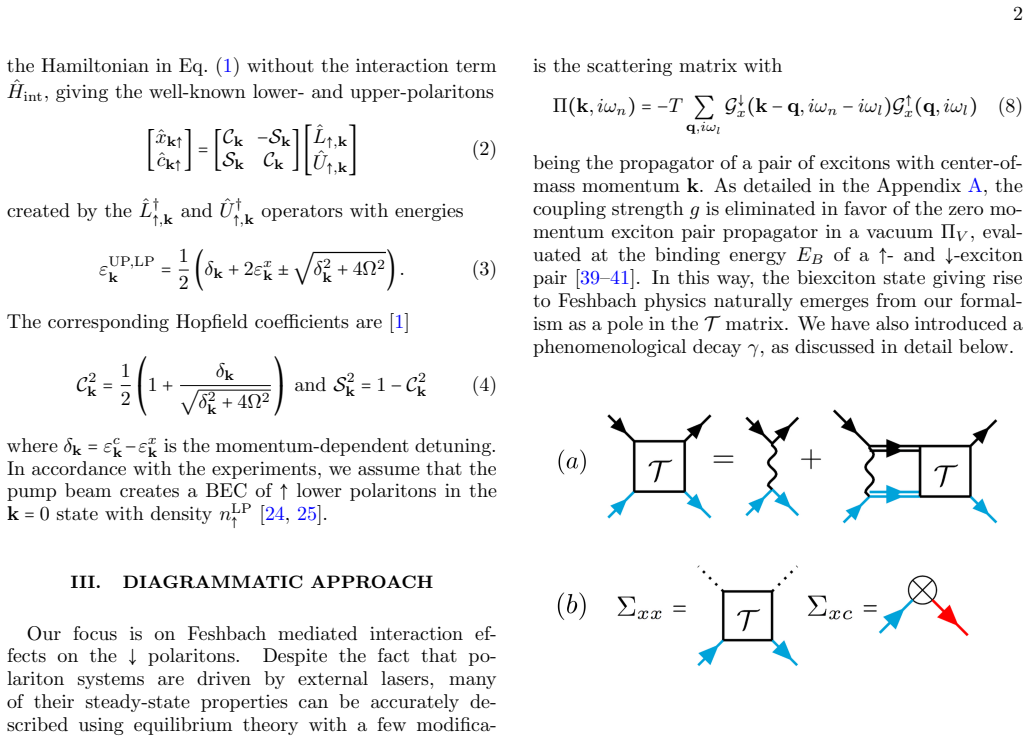
The load-bearing object is the retarded impurity self-energy $\Sigma(k,\omega)=n_{x\uparrow}T(k,\omega)$, built from the $\uparrow\downarrow$ exciton scattering matrix $T(k,\omega)=1/[\operatorname{Re}\Pi_V(E_B)-\Pi(k,\omega)+i\gamma]$. The key step is to evaluate the pair propagator $\Pi(k,\omega)$ in the polariton basis using Hopfield coefficients: the pair can be any combination of lower and upper polaritons, which lets the same object describe both the resonance position (the pole at the biexciton energy $E_B-\varepsilon_0^{LP}$) and the decay into two free polaritons (the imaginary part). The interaction strength $g$ is eliminated in favor of $E_B$ through the vacuum pair propagator, so the biexciton appears as a pole in the T-matrix rather than as an added parameter.
What would settle it
Independently measure the polariton condensate density in the same samples and re-fit the two resonance curves; if the two experiments then require different biexciton energies, or the decay needed differs strongly from 0.4 meV, the single-biexciton explanation fails. Direct observation of a biexciton spectral feature at $E_B = -0.7$ meV with width near 0.4 meV would confirm it; resolving no such feature would count against it.
Extended reading notes
Core claim
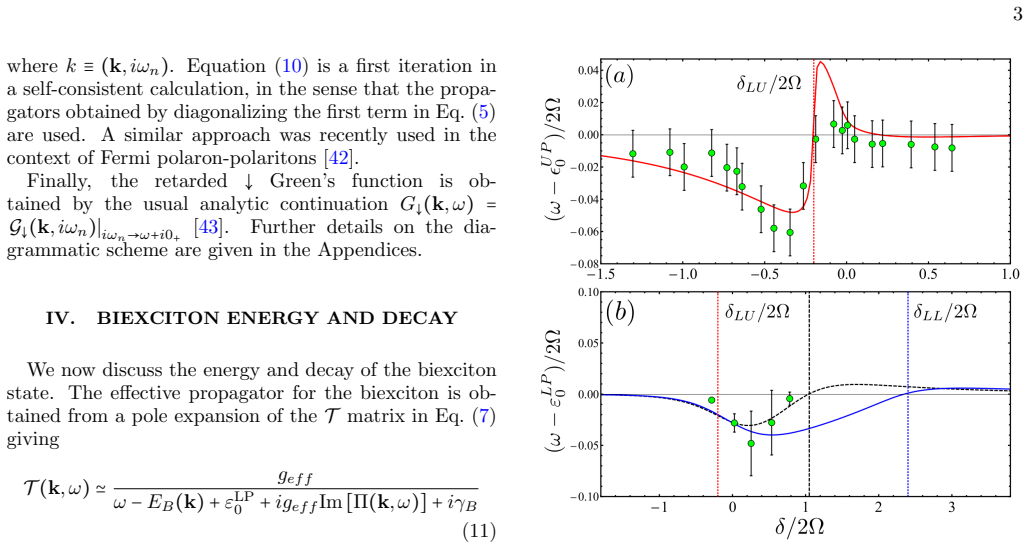
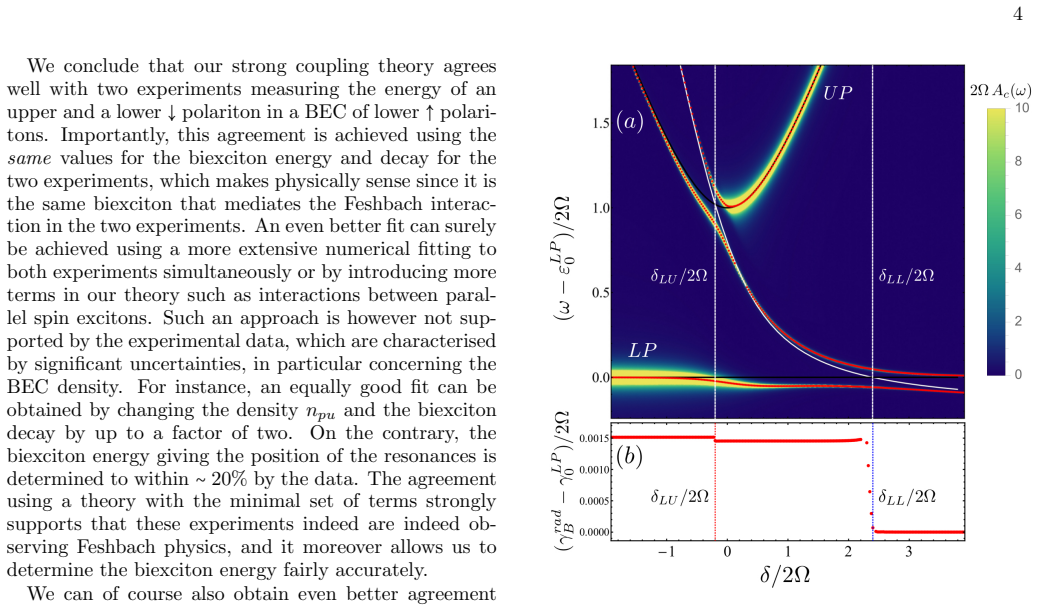
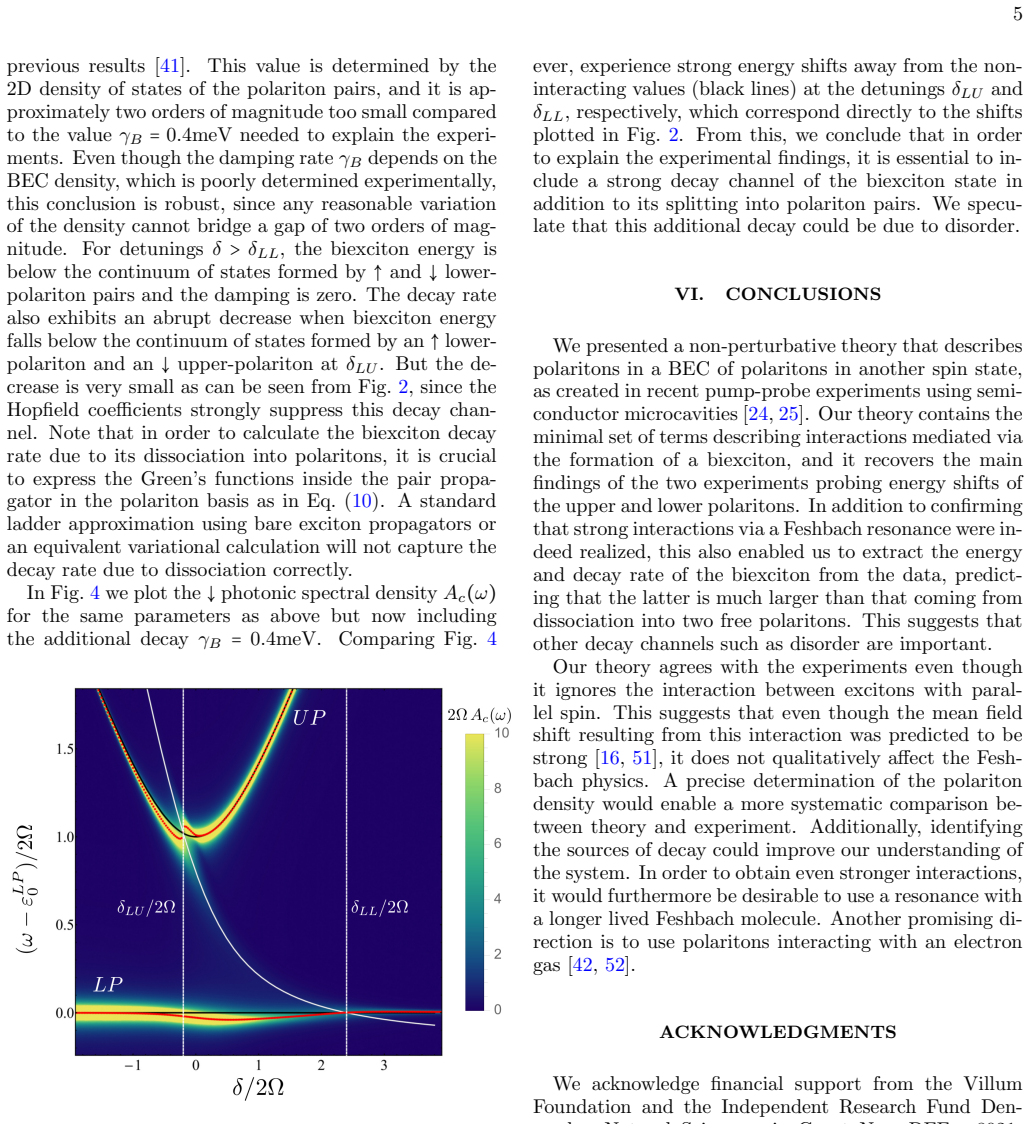
The paper's central claim is that the strong interaction effects observed when a low-density probe polariton travels through a condensate of polaritons in the opposite spin state are Feshbach resonances caused by a two-exciton bound state, the biexciton. The claim is established by a ladder (T-matrix) many-body calculation that contains exactly the terms needed for this physics: an inter-spin exciton interaction renormalized by the vacuum biexciton binding energy, plus a phenomenological biexciton decay. With the two parameters set to $E_B=-0.7\,$meV and $\gamma_B=0.4\,$meV, the theory reproduces both the upper-polariton energy shifts of one experiment and the lower-polariton shifts of the other, with the second comparison requiring no new fitting. The same calculation shows that the biexciton's decay into two free polaritons is only about $\sim 5\,\mu$eV for relevant detunings, roughly two orders of magnitude smaller than the value needed to match experiment; the paper therefore concludes that an additional, likely disorder-induced, decay channel dominates the biexciton lifetime.
Load-bearing premise
The load-bearing premise is that the steady driven-dissipative polariton gas can be treated as an equilibrium condensate and that the condensate density can be taken from the pump photon density rather than measured directly; a wrong density changes the extracted biexciton decay by up to a factor of two.
Editorial extensions
If this is right
- The same $E_B=-0.7\,$meV and $\gamma_B=0.4\,$meV describe both an upper-polariton and a lower-polariton experiment, so both observations are caused by the same biexciton-mediated resonance.
- The predicted dissociation decay, $\sim 5\,\mu$eV, is two orders smaller than the fitted total decay, so the biexciton must have a dominant decay channel beyond splitting into polariton pairs; the paper names disorder as the likely candidate.
- A minimal theory without parallel-spin exciton interactions reproduces the data, implying those interactions do not qualitatively alter the Feshbach physics.
- A direct measurement of the condensate density would pin down $\gamma_B$, currently uncertain by roughly a factor of two, and enable a more quantitative comparison.
- Near the resonance detunings $\delta_{LU}$ and $\delta_{LL}$, the theory predicts branch splittings when the extra decay is absent, while the observed smooth shifts require the large $\gamma_B$.
Reading between the lines
- If the resonance picture holds, the cavity detuning becomes a tunable knob for the strength and sign of polariton interactions, directly analogous to a magnetic Feshbach resonance in ultracold atoms, and could serve as a switch for polariton nonlinearities.
- The same data-extraction scheme could be applied to other impurity problems in driven optical cavities, such as a polariton interacting with an electron gas, to infer bound-state parameters from resonance spectroscopy.
- Since the extra decay dominates the linewidth, reducing disorder in the microcavity should sharpen the resonance and would reveal whether the intrinsic Feshbach interaction can be made even stronger than observed.
- The equilibrium approximation leaves open whether non-equilibrium pumping changes the line shapes; a full non-equilibrium calculation near the resonance would provide a test of that assumption.
Editorial analysis
A structured set of objections, weighed in public.
Referee Report
Summary. The paper develops a many-body ladder-approximation theory for exciton-polaritons in a spin mixture, where one spin component forms a Bose-Einstein condensate and the other is probed as a dilute impurity. The interaction between opposite-spin excitons is renormalized by a biexciton bound state, leading to a Feshbach resonance in the polariton spectrum. The theory has two effectively free parameters, the biexciton binding energy E_B and a phenomenological decay gamma_B, which are fitted to the upper-polariton experiment of Ref. [25]. Using the same values, the theory then predicts the lower-polariton energy shift measured in Ref. [24] without further fitting. The authors conclude that Feshbach physics is realized, extract E_B = -0.7 meV and gamma_B = 0.4 meV, and predict that the biexciton decay is about two orders of magnitude larger than its decay into two free polaritons.
Significance. If correct, the paper provides a minimal microscopic mechanism that quantitatively connects two independent experiments on polariton mixtures, supporting the Feshbach-resonance interpretation and giving an estimate of the biexciton binding energy. The main strengths are the coherent diagrammatic derivation in Appendices A and B, the standard renormalization procedure eliminating the short-distance coupling, and the genuine cross-experiment prediction from the upper- to the lower-polariton measurement with fixed parameters. The paper is also transparent about the leading systematic uncertainty, the unmeasured condensate density, and its resulting degeneracy with gamma_B. The qualitative conclusion that the biexciton decay greatly exceeds dissociation into two free polaritons is robust, but the quantitative extraction of gamma_B is not uniquely pinned by the data.
major comments (3)
- [Section IV, Fig. 2 and following text] The extracted decay gamma_B = 0.4 meV is degenerate with the unmeasured condensate density n_pu, because the self-energy in Eq. (6) is Sigma = n_x^up T, so the entire interaction shift scales with the density. The authors themselves state that an equally good fit can be obtained by changing n_pu and gamma_B together by up to a factor of two. Therefore the abstract's claim to 'extract the energy and decay of the biexciton' overstates the constraint on gamma_B. The quantitative value 0.4 meV should be presented as a representative value within a range set by the density uncertainty, while the robust qualitative statement is that the extra decay far exceeds the ~5 micro-eV dissociation rate.
- [Section III, Eq. (9)] The condensate chemical potential is taken to be the ideal lower-polariton energy epsilon_0^LP, and the condensate density n_x^up is inferred as C_0^2 n_LP^up with n_LP^up = S_0^2 n_pu, where n_pu is a pump photon density. Neither quantity is measured directly in Refs. [24,25]. If the condensate is blue-shifted by mean-field interactions, which the paper notes are predicted to be strong and are deliberately neglected, the resonance condition E_B = epsilon_0^LP + epsilon_0^UP shifts, thereby changing the inferred E_B. The claimed ~20% accuracy of E_B does not appear to include this systematic effect, and the paper should quantify or at least explicitly bound it.
- [Section III, Eq. (5) and Section IV, Eq. (11)] The use of equilibrium finite-temperature Green's functions for a driven-dissipative polariton condensate is an assumption whose limitations are acknowledged only briefly. The phenomenological gamma_B in Eq. (11) is introduced to describe 'additional decay, for instance due to disorder,' but it could also absorb non-equilibrium linewidth contributions from pumping and dissipation. This means the extracted gamma_B is a phenomenological broadening of the biexciton resonance in the steady state, not necessarily an intrinsic biexciton decay constant. The paper's physical interpretation of gamma_B as a biexciton property should be softened accordingly.
minor comments (5)
- [Section V, text before Eq. (3)] There is a typo: 'CComparing' should be 'Comparing' in the sentence describing the spectral function.
- [Appendix A, Eq. (A1)] In the denominator of the first term, 'iωnu' appears to be a typo for 'iωn' or a Matsubara-frequency index; please correct.
- [Section IV, Fig. 2 discussion] The important degeneracy between n_pu and gamma_B is stated in words but not shown. A small figure or table showing the family of (n_pu, gamma_B) values giving equivalent fits would make the claim quantitative and more transparent.
- [Section IV, Fig. 2(b)] The alternative fit with E_B = -1.4 meV and gamma_B = 1.28 meV, while explicitly disfavored on physical grounds, is presented as a dashed curve. Consider moving it to the Supplemental Material or adding a sentence that this curve demonstrates non-uniqueness rather than a viable competing scenario.
- [References] Ref. [49] is cited as an arXiv preprint (arXiv:1806.10835). If it has been published in the interim, the published reference should be used.
Circularity Check
No significant circularity: the second experiment is a genuine out-of-sample prediction with fixed parameters.
full rationale
The paper's central quantitative outputs are the biexciton binding energy EB = -0.7 meV and decay γB = 0.4 meV, which are explicitly introduced as two free parameters ('There are two free parameters in our theory: the binding energy EB and the decay γB of the biexciton, which determine the position and width of the resonance.') and chosen to match the upper-polariton data of Ref. [25]. This is parameter estimation, not circular reasoning, and the paper does not disguise it as a parameter-free derivation. The lower-polariton comparison in Fig. 2(b) is then made with these same values with no further fitting, as the paper emphasizes ('the agreement is obtained with no fitting, as we use the values EB = -0.7meV and γB = 0.4meV extracted from the fit to the other experiment described above'). That is a genuine out-of-sample check: the lower-polariton curve is not equal to its inputs by construction. The density n_LP↑ and the ideal chemical potential assumption enter the model, and the authors disclose that n_pu and γB are degenerate up to a factor of two, but a degeneracy among assumed inputs and fitted outputs is a robustness caveat, not a circular reduction. The ladder approximation is supported by independent literature (Refs. [36-38]), and no load-bearing claim rests on a self-citation chain. The abstract's phrase 'extract the energy and decay of the biexciton from the experimental data' describes a fit honestly; nothing in the derivation chain makes the lower-polariton result identical to the upper-polariton input by construction.
Assumptions & free parameters
free parameters (5)
- EB (biexciton binding energy) =
-0.7 meV (alternative fit uses -1.4 meV)
- gamma_B (phenomenological biexciton decay) =
0.4 meV (alternative 1.28 meV)
- n_pu (pump photon density) =
3.7 x 10^10 cm^-2
- gamma_0^LP (lower polariton decay) =
0.1 meV
- eta (impurity propagator broadening) =
0.07 meV
assumptions (6)
- domain assumption The driven-dissipative polariton system can be described by equilibrium finite-temperature Green's functions.
- domain assumption The up-polariton BEC is ideal, undepleted, and has chemical potential epsilon_0^LP.
- domain assumption The ladder approximation with a non-self-consistent first iteration is quantitatively accurate for a mobile impurity in a BEC.
- domain assumption The opposite-spin exciton interaction is momentum-independent contact, and parallel-spin interactions and photon-assisted scattering terms are negligible.
- domain assumption The bare contact interaction can be eliminated in favor of the vacuum biexciton binding energy EB, and the same EB applies inside the cavity.
- ad hoc to paper An additional phenomenological decay gamma_B exists beyond dissociation into free polaritons.
Cite this review
Pith. "Pith review of Strong interactions and bi-excitons in a polariton mixture." pith.science (2026). https://pith.science/paper/MYSLZ6TQ
@misc{pith2026190811607,
  author       = {Pith},
  title        = {Pith review of: Strong interactions and bi-excitons in a polariton mixture},
  year         = {2026},
  howpublished = {\url{https://pith.science/paper/MYSLZ6TQ}},
  note         = {Machine review of arXiv:1908.11607}
}
read the original abstract
We develop a many-body theory for the properties of exciton-polaritons interacting strongly with a Bose-Einstein condensate (BEC) of exciton-polaritons in another spin state. Interactions lead to the presence of a two-body bound state, the bi-exciton, giving rise to a Feshbach resonance in the polariton spectrum when its energy is equal to that of two free polaritons. Using the minimal set of terms to describe this resonance, our theory recovers the main findings of two experiments probing interaction effects for upper and lower polaritons in a BEC. This strongly supports that Feshbach physics has indeed been realized, and we furthermore extract the energy and decay of biexciton from the experimental data. The decay rate is predicted to be much larger than that coming from its dissociation into two free polaritons indicating that other decay channels are important.
Figures
Figures from the paper (1 more)
Reference graph
Works this paper leans on
-
[25]
N. Takemura, M. D. Anderson, M. Navadeh-Toupchi, D. Y. Oberli, M. T. Portella-Oberli, and B. Deveaud, Phys. Rev. B 95, 205303 (2017)
work page 2017
-
[24]
N. Takemura, S. Trebaol, M. Wouters, M. T. Portella- Oberli, and B. Deveaud, Phys. Rev. B 90, 195307 (2014)
work page 2014
-
[1]
Then, the last expression becomes Π(k,iωn) = /integral.disp d2q (2π)2 /uni23A7/uni23AA/uni23AA/uni23A8/uni23AA/uni23AA/uni23A9 C2 k+qC2 −q iωn −εLP k+q −εLP−q +εLP 0 +iγLP 0 + C2 k+qS2 −q iωn −εLP k+q −εUP−q +εLP 0 +iγUP 0 (A3) + S2 k+qC2 −q iωn −εUP k+q −εLP−q +εLP 0 +iγLP 0 + S2 k+qS2 −q iωn −εUP k+q −εUP−q +εLP 0 +iγUP 0 /uni23AB/uni23AA/uni23AA/uni23A...
-
[2]
J. J. Hopfield, Phys. Rev. 112, 1555 (1958)
work page 1958
-
[3]
C. Weisbuch, M. Nishioka, A. Ishikawa, and Y. Arakawa, Phys. Rev. Lett. 69, 3314 (1992)
work page 1992
-
[4]
Carusotto and C
I. Carusotto and C. Ciuti, Rev. Mod. Phys. 85, 299 (2013)
2013
-
[5]
A. V. Kavokin, J. J. Baumberg, G. Malpuech, and F. P. Laussy, Microcavities, Series on Semiconductor Science and Technology (Oxford University Press, 2017)
work page 2017
-
[6]
J. Kasprzak, M. Richard, S. Kundermann, A. Baas, P. Jeambrun, J. M. J. Keeling, F. M. Marchetti, M. H. Szyma´ nska, R. Andr´ e, J. L. Staehli, V. Savona, P. B. Lit- tlewood, B. Deveaud, and L. S. Dang, Nature 443, 409 (2006)
work page 2006
Show all 53 references
-
[7]
Wouters and I
M. Wouters and I. Carusotto, Phys. Rev. Lett. 99, 140402 (2007)
2007
-
[8]
A. Amo, J. Lefr` ere, S. Pigeon, C. Adrados, C. Ciuti, I. Carusotto, R. Houdr´ e, E. Giacobino, and A. Bramati, Nature Physics 5, 805 EP (2009)
2009
-
[9]
H. Deng, H. Haug, and Y. Yamamoto, Rev. Mod. Phys. 82, 1489 (2010)
2010
-
[10]
Kohnle, Y
V. Kohnle, Y. L´ eger, M. Wouters, M. Richard, M. T. Portella-Oberli, and B. Deveaud-Pl´ edran, Phys. Rev. Lett. 106, 255302 (2011)
2011
-
[11]
Kohnle, Y
V. Kohnle, Y. L´ eger, M. Wouters, M. Richard, M. T. Portella-Oberli, and B. Deveaud, Phys. Rev. B 86, 064508 (2012)
2012
-
[12]
K. G. Lagoudakis, M. Wouters, M. Richard, A. Baas, I. Carusotto, R. Andr´ e, L. S. Dang, and B. Deveaud- Pl´ edran, Nature Physics4, 706 EP (2008)
2008
-
[13]
St-Jean, V
P. St-Jean, V. Goblot, E. Galopin, A. Lemaˆ ıtre, T. Ozawa, L. Le Gratiet, I. Sagnes, J. Bloch, and A. Amo, Nature Photonics 11, 651 (2017)
2017
-
[14]
Klembt, T
S. Klembt, T. H. Harder, O. A. Egorov, K. Winkler, R. Ge, M. A. Bandres, M. Emmerling, L. Worschech, T. C. H. Liew, M. Segev, C. Schneider, and S. H¨ ofling, Nature 562, 552 (2018)
2018
-
[15]
Sanvitto and S
D. Sanvitto and S. K´ ena-Cohen, Nature Materials 15, 1061 EP (2016)
2016
-
[16]
Mu˜ noz-Matutano, A
G. Mu˜ noz-Matutano, A. Wood, M. Johnsson, X. Vidal, B. Q. Baragiola, A. Reinhard, A. Lemaˆ ıtre, J. Bloch, A. Amo, G. Nogues, B. Besga, M. Richard, and T. Volz, Nature Materials 18, 213 (2019)
2019
-
[17]
Delteil, T
A. Delteil, T. Fink, A. Schade, S. H¨ ofling, C. Schneider, and A. ˙Imamo˘ glu, Nature Materials18, 219 (2019)
2019
-
[18]
Kn¨ uEppel, S
P. Kn¨ uEppel, S. Ravets, M. Kroner, S. F¨ alt, W. Wegscheider, and A. Imamoglu, Nature 572, 91 (2019)
2019
-
[19]
Cristofolini, G
P. Cristofolini, G. Christmann, S. I. Tsintzos, G. Delige- orgis, G. Konstantinidis, Z. Hatzopoulos, P. G. Savvidis, and J. J. Baumberg, Science 336, 704 (2012)
2012
-
[20]
Byrnes, G
T. Byrnes, G. V. Kolmakov, R. Y. Kezerashvili, and Y. Yamamoto, Phys. Rev. B 90, 125314 (2014)
2014
-
[21]
Rosenberg, D
I. Rosenberg, D. Liran, Y. Mazuz-Harpaz, K. West, L. Pfeiffer, and R. Rapaport, Science Advances 4, eaat8880 (2018)
2018
-
[22]
Togan, H.-T
E. Togan, H.-T. Lim, S. Faelt, W. Wegscheider, and A. Imamoglu, Phys. Rev. Lett. 121, 227402 (2018)
2018
-
[23]
Takemura, S
N. Takemura, S. Trebaol, M. Wouters, M. T. Portella- Oberli, and B. Deveaud, Nature Physics 10, 500 EP (2014)
2014
-
[26]
Navadeh-Toupchi, N
M. Navadeh-Toupchi, N. Takemura, M. D. Anderson, D. Y. Oberli, and M. T. Portella-Oberli, Phys. Rev. Lett. 122, 047402 (2019). 8
2019
-
[27]
G. C. L. Rocca, F. Bassani, and V. M. Agranovich, J. Opt. Soc. Am. B 15, 652 (1998)
1998
-
[28]
Borri, W
P. Borri, W. Langbein, U. Woggon, J. R. Jensen, and J. M. Hvam, Phys. Rev. B 62, R7763 (2000)
2000
-
[29]
Borri, W
P. Borri, W. Langbein, U. Woggon, A. Esser, J. R. Jensen, and J. rn M Hvam, Semiconductor Science and Technology 18, S351 (2003)
2003
-
[30]
A. L. Ivanov, P. Borri, W. Langbein, and U. Woggon, Phys. Rev. B 69, 075312 (2004)
2004
-
[31]
C. Chin, R. Grimm, P. Julienne, and E. Tiesinga, Rev. Mod. Phys. 82, 1225 (2010)
2010
-
[32]
Kokkelmans, in Quantum Gas Experiments , edited by P
S. Kokkelmans, in Quantum Gas Experiments , edited by P. T´’orm´’a and K. Sengstock (Imperial College Press,
-
[33]
Takemura, M
N. Takemura, M. D. Anderson, S. Biswas, M. Navadeh- Toupchi, D. Y. Oberli, M. T. Portella-Oberli, and B. De- veaud, Phys. Rev. B 94, 195301 (2016)
2016
-
[34]
Ciuti, P
C. Ciuti, P. Schwendimann, and A. Quattropani, Semi- conductor Science and Technology 18, S279 (2003)
2003
-
[35]
Combescot, M
M. Combescot, M. A. Dupertuis, and O. Betbeder- Matibet, Europhysics Letters (EPL) 79, 17001 (2007)
2007
-
[36]
Ciuti and I
C. Ciuti and I. Carusotto, physica status solidi (b) 242, 2224 (2005)
2005
-
[37]
Massignan, M
P. Massignan, M. Zaccanti, and G. M. Bruun, Rep. Progr. Phys. 77, 034401 (2014)
2014
-
[38]
S. P. Rath and R. Schmidt, Phys. Rev. A 88, 053632 (2013)
2013
-
[39]
L. A. Pe˜ na Ardila, N. B. Jørgensen, T. Pohl, S. Giorgini, G. M. Bruun, and J. J. Arlt, Phys. Rev. A 99, 063607 (2019)
2019
-
[40]
Randeria, J.-M
M. Randeria, J.-M. Duan, and L.-Y. Shieh, Phys. Rev. B 41, 327 (1990)
1990
-
[41]
Wouters, Phys
M. Wouters, Phys. Rev. B 76, 045319 (2007)
2007
-
[42]
Carusotto, T
I. Carusotto, T. Volz, and A. Imamo˘ glu, EPL (Euro- physics Letters) 90, 37001 (2010)
2010
-
[43]
L. B. Tan, O. Cotlet, A. Bergschneider, R. Schmidt, P. Back, Y. Shimazaki, M. Kroner, and A. Imamoglu, arXiv e-prints , arXiv:1903.05640 (2019), arXiv:1903.05640 [cond-mat.mes-hall]
2019 arXiv
-
[44]
Fetter and J
A. Fetter and J. Walecka, Quantum Theory of Many- Particle Systems , Dover Books on Physics Series (Dover Publications, 1971)
1971
-
[45]
Grassi Alessi, F
M. Grassi Alessi, F. Fragano, A. Patan` e, M. Capizzi, E. Runge, and R. Zimmermann, Phys. Rev. B 61, 10985 (2000)
2000
-
[46]
Yamamoto, T
Y. Yamamoto, T. Tassone, and H. Cao, Semiconduc- tor Cavity Quantum Electrodynamics , Springer Tracts in Modern Physics (Springer-Verlag, 2000)
2000
-
[47]
Deveaud-Pl´ edran and K
B. Deveaud-Pl´ edran and K. G. Lagoudakis, in Exciton Polaritons in Microcavities. New Frontiers , Springer Se- ries in Solid-State Sciences, edited by D. Sanvitto and V. Timofeev (Springer-Verlag, 2012) pp. 233–243
2012
-
[48]
As typical val- ues range from mx = 0.1me to 0.25me we could have an uncertainty of 50% of the chosen value for the density
The reported value of the density npu in cm −2 depends on the chosen value of the exciton mass. As typical val- ues range from mx = 0.1me to 0.25me we could have an uncertainty of 50% of the chosen value for the density
-
[49]
Birkedal, J
D. Birkedal, J. Singh, V. G. Lyssenko, J. Erland, and J. M. Hvam, Phys. Rev. Lett. 76, 672 (1996)
1996
-
[50]
Levinsen, F
J. Levinsen, F. M. Marchetti, J. Keeling, and M. M. Parish, arXiv e-prints , arXiv:1806.10835 (2018), arXiv:1806.10835 [cond-mat.quant-gas]
2018 arXiv
-
[51]
Observation of rydberg exciton polaritons and their con- densate in a perovskite cavity,
W. Bao, X. Liu, F. Xue, F. Zheng, R. Tao, S. Wang, Y. Xia, M. Zhao, J. Kim, S. Yang, Q. Li, Y. Wang, Y. Wang, L.-W. Wang, A. MacDonald, and X. Zhang, “Observation of rydberg exciton polaritons and their con- densate in a perovskite cavity,” (2018), arXiv:1803.07282 [cond-mat.mtrl-sci]
2018 arXiv
-
[52]
S. R. K. Rodriguez, A. Amo, I. Sagnes, L. Le Gratiet, E. Galopin, A. Lemaˆ ıtre, and J. Bloch, Nature Commu- nications 7, 11887 EP (2016), article
2016
-
[53]
Sidler, P
M. Sidler, P. Back, O. Cotlet, A. Srivastava, T. Fink, M. Kroner, E. Demler, and A. Imamoglu, Nature Physics 13, 255 EP (2016)
2016
Reviewed August 14, 2026 · model on record in the stance chip above.
Discussion (0). Continue with ORCID to comment.