REVIEW 4 major objections 4 minor 55 references
Realization of a multifrequency celestial reference frame through a combination of normal equation systems
T0 review · 4 major / 4 minor · reviewed 2026-08-14 · deepseek-v4-flash
Pith's one-line read Astronomers stack three radio frequency bands into one celestial reference frame that stays aligned with ICRF3 to within 3 microarcseconds and shows no detectable deformation.
desk verdict Useful and genuinely novel as a first full-covariance multifrequency VLBI frame combination, but the headline deformation-free claim is partly enforced by a tuned XKa weight, so the validation is weaker than the abstract suggests. read the letter →
The pith
A machine-rendered reading of the paper's core claim, the machinery that carries it, and where it could break.
The reading
What carries the argument
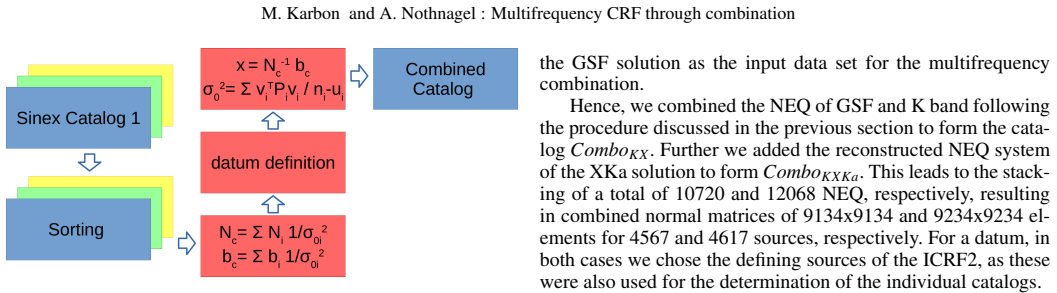
The load-bearing object is the normal equation system (NEQ) from each VLBI global solution, with all non-source parameters already eliminated, carrying the variance-covariance relationships of the estimated source positions. The combination itself is Helmert stacking: the NEQ matrices and right-hand side vectors of common parameters are summed, a no-net-rotation datum is imposed with the ICRF2 defining sources, and the stacked system is solved. Because the XKa input arrived as a covariance matrix rather than NEQs, it is first converted back to datum-free normal equations using the Grafarend-Sanso identity; the XKa system is then scaled down empirically so its network-geometry rotations no longer dominate. This machinery makes the full covariance matrix of all 4,617 sources, across frequency bands, a direct output of the combination rather than an a posteriori construct.
What would settle it
Measure the angular separation between radio cores of the same compact sources at 8, 24, and 32 GHz with a VLBI campaign reaching per-source precision well below 0.1 mas; if the offsets are not isotropically distributed but systematically aligned with jet directions or grow with frequency separation for many sources, the white-noise assumption fails.
Extended reading notes
Core claim
The paper's central claim is that ComboKXKa is a rigorous, multifrequency realization of the ICRS: 4,617 compact radio sources positioned jointly from SX (8 GHz), K (24 GHz), and XKa (32 GHz) observations, with all variance-covariance information carried through the combination. The frame is aligned with ICRF3 to within 3 microarcseconds and has an average positional uncertainty of 0.1 mas in both coordinates; rotation and deformation parameters from vector-spherical-harmonic analysis show no significant deformations once the XKa solution is down-weighted. Adding the higher-frequency catalogs also extends the frame southward, since 16 of the 31 XKa-only sources lie below -30 degrees declination. Comparisons with Gaia-CRF2 are called inconclusive because the transformation parameters depend strongly on source selection, yet the paper states that significant differences between all frames are attested.
Load-bearing premise
The load-bearing premise is that frequency-dependent source position offsets, or core shifts, are random in orientation and too small to be detected at current VLBI precision, so combining 8, 24, and 32 GHz positions adds only white noise.
Editorial extensions
If this is right
- The same pipeline can be applied to future ICRF realizations directly from normal equations of all analysis centers, replacing the monolithic-solution-plus-alignment scheme.
- Common sources present in more than one catalog are effectively re-determined from the union of observations, which improves formal errors for some sources and mitigates network deficiencies.
- The southern extension from XKa-only sources improves sky coverage in the deep south, a region where SX catalogs remain sparsely populated.
- The full covariance matrix enables proper statistical interpretation of the frame, including frame ties and comparisons with Gaia, without requiring ad hoc error inflation.
- The absence of detectable deformation suggests that the weak network geometry of the XKa solution can be prevented from propagating into a stacked product by appropriate weighting.
Reading between the lines
- A dedicated VLBI campaign measuring the same compact sources in all three bands with matched networks could convert the random core-shift assumption into a measured correction; if core-shift vectors align with jet position angles, the stacked frame would need per-source frequency offsets.
- The empirical down-weighting of XKa (a variance factor of 2 plus an additional 0.05 mas-squared inflation) indicates the combination is only as good as the weakest geometry; future frames could formalize such weights from VSH residuals instead of tuning them.
- If Gaia DR3 confirms the radio-optical differences seen here, the combined multifrequency radio frame could serve as a clean intermediate frame for disentangling optical structure effects from true source position offsets.
Signed reviews
Editorial analysis
A structured set of objections, weighed in public.
Referee Report
Summary. The paper presents a method for combining multifrequency VLBI celestial reference frame catalogs (SX, K, XKa) via stacking of normal equation systems, thereby carrying full variance-covariance information into the combined solution. The resulting catalog, ComboKXKa, contains 4617 sources and is compared with ICRF2, ICRF3, and Gaia-CRF2 using vector spherical harmonic decomposition. The central claims are that the combination is rigorous, that the frame is aligned with ICRF3 within 3 microarcseconds, that no significant deformations are present, and that core-shift effects are negligible at current precision.
Significance. If the claims hold, the paper provides a useful methodological advance for future ICRF realizations: it is the first application of full covariance transfer through normal equation stacking to a multifrequency VLBI frame, and the resulting catalog with cross-frequency covariance information would be a valuable community product. The authors also ship the catalog and covariance matrix publicly, which is a concrete strength. However, the central validation is weakened by the empirical tuning of the XKa weight, the self-referential comparison with ICRF3, and the admitted low power of the core-shift test, so the 'deformation-free' claim is not established as an independent outcome.
major comments (4)
- [Sec. 4, step 3 and Sec. 5.2] The XKa down-weighting is circular with respect to the deformation claim. Section 4 step 3 states that the weighting parameter of 0.05 mas^2 'was determined empirically in such a manner that the originally dominant rotations are just no longer discernible in the residuals,' and Section 5.2 reports that for ComboKXKa 'the rotation in R2 is very small' with the explicit note that without the scaling it would be -30 microas. The absence of a significant R2 rotation is therefore enforced by construction rather than demonstrated, yet the abstract and conclusions cite the small rotations as evidence that 'No significant deformations can be identified.' This circularity also affects the stated axis stability of 3 microas, since the stability is estimated from the same weighted solution. The authors should present the weighting as a deliberate regularization choice, quantify the resulting systematic uncertainty (e.g., by repeating the analysis with a range of weights), and avoid citing the suppressed R2 as an independent validation.
- [Abstract and Sec. 6] The alignment claim in the abstract ('aligned with ICRF3 within 3 microas') is not supported by the reported transformation parameters. Table 3 gives |R| = 13 +/- 1 microas for ComboKXKa with respect to ICRF3 and |R| = 31 +/- 7 microas with respect to ICRF2. The 3 microas value that appears in Sec. 5.2 refers to the scatter of rotation parameters across different source subsets (axis stability), not to the absolute alignment. The abstract and Sec. 6 should be reworded to distinguish 'axis stability of 3 microas' from 'rotation magnitude of about 13 microas with respect to ICRF3,' and the wording in Sec. 6 ('aligned with ICRF2 within +/-3 microas') should be corrected; as written it is inconsistent with Table 3.
- [Sec. 2.1.1 and Sec. 5.2] The comparison of the combined product with ICRF3 is partly self-referential. As the paper notes, the GSF SX solution 'is identical in content to that used for the determination of the SX catalog of ICRF3,' so the small deformation parameters between ComboKXKa and ICRF3 largely reflect the propagation of the same SX input. Because the K and XKa catalogs are down-weighted and the XKa weight is empirically tuned, the agreement with ICRF3 does not provide an independent external check of the frame. The authors should state this limitation explicitly when interpreting the ICRF3 comparison, and should place more weight on the Gaia-CRF2 comparison (which they admit is inconclusive) or on comparisons against realizations not built from the same input.
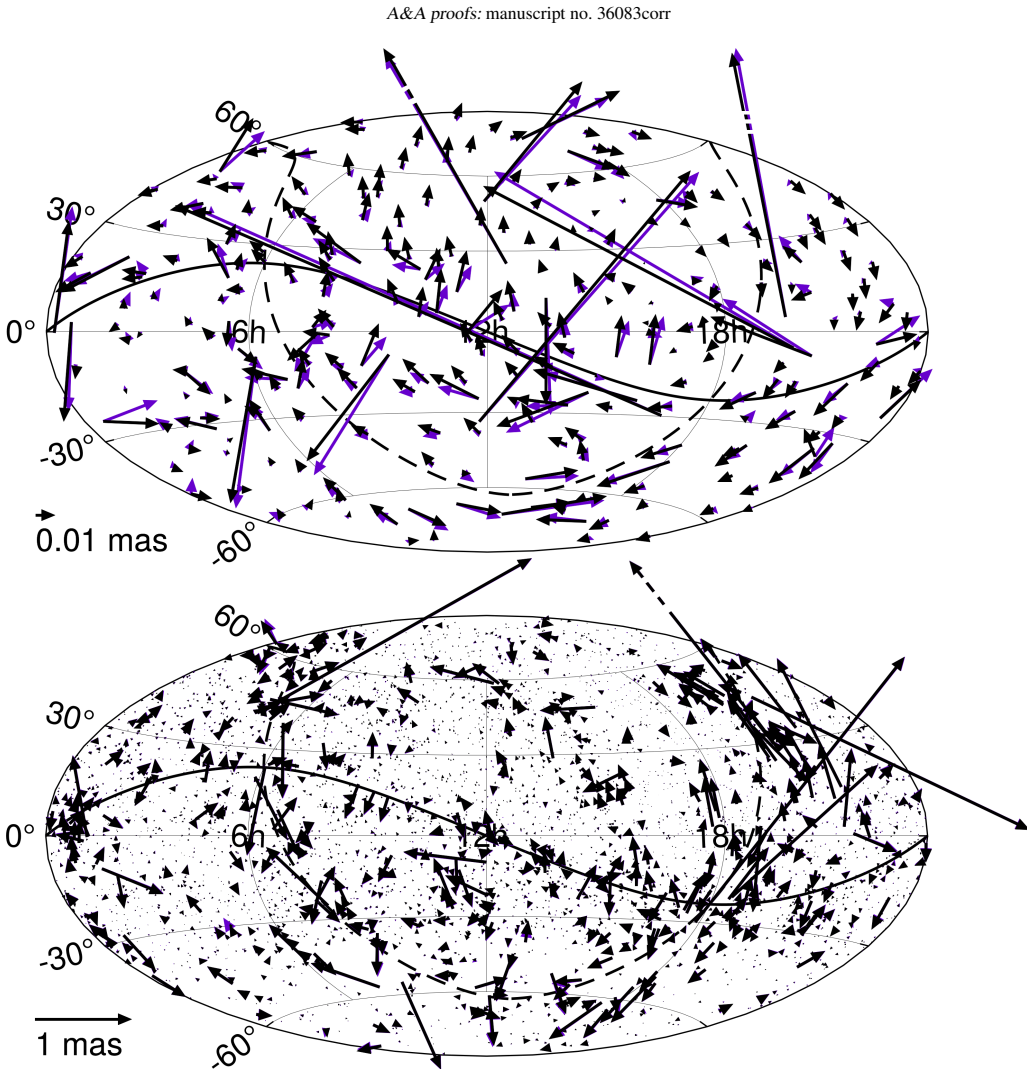
- [Sec. 3] The core-shift analysis does not substantiate the claim that core shifts 'only add white noise.' The angular-separation test in Fig. 3 has low power, as the authors themselves conclude: 'the failure of any statistical testing of core shifts of a large number of sources, as the individual source position is too inaccurate at the current state and the standard deviations are too optimistic.' Absence of detection is not evidence of random orientation, and the two K-band outliers (3C119, 2018+295) are dismissed as analysis artifacts without a quantitative argument beyond their large separations. The conclusion in Sec. 1 that 'we demonstrate that the effect is of a random nature for catalog combinations' therefore overstates what the data show. The paper should present the randomness of core shifts as an assumption required by current precision, not as a demonstrated property, and should discuss the potential impact of a systematic frequency-dependent component on the combined positions.
minor comments (4)
- [Table 3] The column header 'CommboKXKa' contains a typo; it should be 'ComboKXKa'.
- [Abstract and throughout] The abstract uses 'Ghz' but the standard unit symbol is 'GHz'; please correct for consistency.
- [Sec. 5.4] In the text, 'aM2,0 which describes a sharing of the two hemispheres' should read 'shearing,' not 'sharing,' to match the earlier definition in Sec. 2.4.
- [Tables 1 and 4] The column labels 'wmean' and 'σwmean' are ambiguous; consider relabeling as 'weighted mean' and 'weighted standard deviation' or adding a footnote explaining the notation.
Circularity Check
XKa weighting is tuned to hide R2 rotations, which are then reported as absent; ICRF3 alignment is partly built-in via the identical GSF input.
-
fitted input called prediction
[Section 4, step 3 and Section 5.2]
"Because initial results have shown that the XKa solution introduces significant rotations around R2, we chose to down-weight this catalog. The weighting parameter of 0.05 mas 2 was determined empirically in such a manner that the originally dominant rotations are just no longer discernible in the residuals. [...] This is the axis mostly affected by XKa, or rather its scaling. Without the scaling this parameter amounts to -30 µas and clearly dominates the rotations."
The XKa down-weighting is not estimated from the data's covariance but is adjusted until the XKa-induced R2 rotation disappears from the residuals. Section 5.2 then reports R2 = -2 ± 1 µas and axis stability to within 3 µas, and the abstract concludes that no significant deformations can be identified. The absence of the R2 rotation is therefore not an independent outcome of the combination; it is the fitting target used to choose 0.05 mas^2. The claim that the frame is deformation-free is, for this degree of freedom, enforced by construction rather than demonstrated by the combination.
-
self definitional
[Sections 2.1.1, 2.4, and 5.2]
"We note that ICRF3 at SX frequency and GSF are the same catalog simply represented in different ways. Only the formal errors of GSF were inflated a posteriori according to Eq. 7 for the reported ICRF3 uncertainties. [...] This was expected, as the combination contains the ICRF3 equivalent GSF."
The reported alignment with ICRF3 within 3 µas is not an external validation of the combination: the GSF SX input is identical to ICRF3's SX catalog, and the same ICRF2 defining sources set the datum. The combined frame therefore inherits the orientation and source positions of ICRF3's SX component almost by construction, so the small rotations and deformations with respect to ICRF3 are largely built-in. The authors disclose this, but the abstract's alignment-with-ICRF3 statement still presents an input identity as a result.
full rationale
The derivation core is standard and self-contained: Helmert stacking of normal equation systems (Eqs. 12-22) is described explicitly, and the combination itself is not posited in the inputs. I do not count the core-shift random-orientation assumption as circular; it is a weakly supported empirical assumption, not a construction. The load-bearing circularity is in the validation narrative: the XKa variance floor is hand-adjusted until its dominant R2 rotation is no longer discernible, and the same absence is then reported as evidence that the frame is stable and deformation-free. This is a fitted input presented as a prediction. A second, milder self-referentiality affects the 'aligned with ICRF3 within 3 µas' claim: the GSF input is identical to ICRF3's SX catalog and the same defining sources set the datum, so small rotations with respect to ICRF3 are partly guaranteed before the combination is performed. The method is real and the catalog is a useful product, but the specific conclusion that the multifrequency frame is deformation-free is partially enforced by the tuning parameter rather than independently established.
Assumptions & free parameters
free parameters (3)
- XKa variance factor =
2.0
- XKa weight =
0.05 mas^2
- Core shift test thresholds =
rho=10 mas, X=4.1
assumptions (3)
- domain assumption Core shift offsets between frequencies have random orientation and no global systematic component
- standard math The XKa covariance matrix can be transformed into a datum-free NEQ via C_xx = (N_free + B^T B)^-1 - B^T(B B^T B B^T)^-1 B
- domain assumption The GSF SX solution can stand in for the three SX analysis center solutions
Cite this review
Pith. "Pith review of Realization of a multifrequency celestial reference frame through a combination of normal equation systems." pith.science (2026). https://pith.science/paper/RRGH74M4
@misc{pith2026190811697,
  author       = {Pith},
  title        = {Pith review of: Realization of a multifrequency celestial reference frame through a combination of normal equation systems},
  year         = {2026},
  howpublished = {\url{https://pith.science/paper/RRGH74M4}},
  note         = {Machine review of arXiv:1908.11697}
}
abstract
Context. We present a celestial reference frame (CRF) based on the combination of independent, multifrequency radio source position catalogs using nearly 40 years of Very Long Baseline Interferometry observations at the standard geodetic frequencies at SX band and about 15 years of observations at higher frequencies (K and XKa). The final catalog contains 4617 sources. Aims. We produce a multifrequency catalog of radio source positions with full variance-covariance information across all radio source positions of all input catalogs. Methods. We combined three catalogs, one observed at 8 GHz (X band), one at 24 GHz (K band) and one at 32 GHz (Ka band). Rather than only using the radio source positions, we developed a new, rigorous combination approach by carrying over the full covariance information through the process of adding normal equation systems. Special validation routines were used to characterize the random and systematic errors between the input reference frames and the combined catalog. Results. The resulting CRF contains precise positions of 4617 compact radio astronomical objects, 4536 measured at 8 Ghz, 824 sources also observed at 24 GHz, and 674 at 32 GHz. The frame is aligned with ICRF3 within 3 $\mu$as and shows an average positional uncertainty of 0.1 mas in right ascension and declination. No significant deformations can be identified. Comparisons with Gaia-CRF remain inconclusive, nonetheless significant differences between all frames can be attested.
Figures


Figures from the paper (4 more)


Reference graph
Works this paper leans on
-
[1]
Z. Altamimi, X. Collilieux, J. Legrand, B. Garayt, and C. Boucher. ITRF2005: A new release of the International Terrestrial Reference Frame based on time series of station positions and Earth Orientation Parameters . JGR: Solid Earth, 112 0 (B9): 0 n/a--n/a, 2007. doi:10.1029/2007JB004949
-
[2]
Z. Altamimi, P. Rebischung, L. M \'e tivier, and X. Collilieux. ITRF2014: A new release of the International Terrestrial Reference Frame modeling nonlinear station motions . JGR: Solid Earth, 121, 2016. doi:10.1002/2016JB013098
-
[3]
S. Bachmann and D. Thaller. Adding source positions to the IVS combination-First results . Journal of Geodesy, 91 0 (7): 0 743--753, Jul 2017. doi:10.1007/s00190-016-0979-5
-
[4]
Combining the orbits of the igs analysis centers
Gerhard Beutler, Jan Kouba, and Tim Springer. Combining the orbits of the igs analysis centers. Bulletin g \'e od \'e sique , 69 0 (4): 0 200--222, Dec 1995. ISSN 1432-1394. doi:10.1007/BF00806733. URL https://doi.org/10.1007/BF00806733
-
[5]
S. B \"o ckmann, T. Artz, A. Nothnagel, and V. Tesmer. International vlbi service for geodesy and astrometry: Earth orientation parameter combination methodology and quality of the combined products. Journal of Geophysical Research: Solid Earth, 115 0 (B4), 2010 a . doi:10.1029/2009JB006465
-
[6]
Sarah B \"o ckmann, T. Artz, and A. Nothnagel. VLBI terrestrial reference frame contributions to ITRF2008 . Journal of Geodesy, 84 0 (3): 0 201--219, 2010 b . doi:10.1007/s00190-009-0357-7
-
[7]
J. B \"o hm, S. B \"o hm, J. Boisits, A. Girdiuk, J. Gruber, A. Hellerschmied, H. Kr \' a sn \' a , D. Landskron, M. Madzak, D. Mayer, J. McCallum, L. McCallum, M. Schartner, and K. Teke. Vienna VLBI and satellite software ( VieVS ) for geodesy and astrometry. Publications of the Astronomical Society of the Pacific, 130 0 (986): 0 044503, feb 2018. doi:10...
-
[8]
P. Brosche . Representation of Systematic Differences in Positions and Proper Motions of Stars by Spherical Harmonics . Veroeffentlichungen des Astronomischen Rechen-Instituts Heidelberg, 17, 1966
work page 1966
Show all 55 references
-
[9]
P. Brosche . Programs for the Determination of Systematic Differences and Application to W3\_50 - FK4 . Veroeffentlichungen des Astronomischen Rechen-Instituts Heidelberg, 23, 1970
1970
-
[10]
The Third Realization of the International Celestial Reference Frame by Very Long Baseline Interferometry
Charlot et al. The Third Realization of the International Celestial Reference Frame by Very Long Baseline Interferometry . Astronomy & Astrophysics, ?? 0 (??): 0 ??, 2019. doi:http://dx.doi.org/10.1088/xxx
2019 doi
-
[11]
u r Kartographie und Geod \
W.R. Dick and D. Thaller, editors. IERS Annual Report 2017. International Earth Rotation and Reference Systems Service, Central Bureau, Frankfurt am Main: Verlag des Bundesamts f \"u r Kartographie und Geod \"a sie , 2017
2017
-
[12]
Eichhorn
H. Eichhorn. Astronomy of Star Positions. F. Ungar, New York, 1974
1974
-
[13]
Feissel-Vernier, C
M. Feissel-Vernier, C. Ma, A. M. Gontier, and C. Barache. Sidereal orientation of the Earth and stability of the VLBI celestial reference frame . Astron Astrophys, 438: 0 1141--1148, 2005. doi:10.1051/0004-6361:20042209
2005 doi
-
[14]
A. L. Fey, D. Gordon, C. S. Jacobs, C. Ma, R. A. Gaume, E. F. Arias, G. Bianco, D. A. Boboltz, S. Boeckmann, S. Bolotin, P. Charlot, A. Collioud, G. Engelhardt, J. Gipson, A. M. Gontier, R. Heinkelmann, S. Kurdubov, S. Lambert, S. Lytvyn, D. S. MacMillan, Z. Malkin, A. Nothnag...
2015
-
[15]
Fricke , A
W. Fricke , A. Kopff , W. Gliese , F. Gondolatsch , T. Lederle , H. Nowacki , W. Strobel , and P. Stumpff . Fourth Fundamental Catalogue (FK4) . Veroeffentlichungen des Astronomischen Rechen-Instituts Heidelberg, 10, 1963
1963
-
[16]
a hrling , H. Jahrei , S. R \
W. Fricke , H. Schwan , T. Lederle , U. Bastian , R. Bien , G. Burkhardt , B. Du Mont , R. Hering , R. J \"a hrling , H. Jahrei , S. R \"o ser , H.-M. Schwerdtfeger , and H. G. Walter . Fifth fundamental catalogue (FK5). Part 1: The basic fundamental stars . Veroeffentlichunge...
1988
-
[17]
Gaia Collaboration, Mignard , S. A. Klioner , L. Lindegren , , and T. Zwitter . Gaia Data Release 2. The celestial reference frame (Gaia-CRF2) . , 616: 0 A14, August 2018. doi:10.1051/0004-6361/201832916
2018 doi
-
[18]
Gaia Collaboration, Prusti , J. H. J. de Bruijne , A. G. A. Brown, , and S. Zschocke. The Gaia mission . Astron Astrophys, 595: 0 A1, 2016. doi:10.1051/0004-6361/201629272
2016 doi
-
[19]
Grafarend and F Sanso
E.W. Grafarend and F Sanso. Optimization and Design of Geodetic Networks . Springer, Berlin, Germany, 1985. doi:10.1007/978-3-642-70659-2
1985 doi
-
[20]
K. Hada, A. Doi, M. Kino, H. Nagai, Y. Hagiwara, and N. Kawaguchi. An origin of the radio jet in M87 at the location of the central black hole . Nature, 477: 0 185--187, 2011. doi:10.1038/nature10387
2011 doi
-
[21]
F.R. Helmert. Die Ausgleichungsrechnung nach der Methode der kleinsten Quadrate . B. G. Teubner, Leipzig, Germany, 1872
-
[22]
Iddink, T
A. Iddink, T. Artz, and A. Nothnagel. Development of a Combination Procedure for Celestial Reference Frame Determination . In P. Willis, editor, Proceedings of IAG Scientific Assembly 2013. International Association of Geodesy Symposia , pages 63--68. Springer, Berlin Heidelberg, 2015
2013
-
[23]
Jacobs, M.B
C.S. Jacobs, M.B. Heflin, G.E. Lanyi, O.J. Sovers, and J.A. Steppe. Rotational Alignment Altered by Source Position Correlations . In D. Behrend and K. D. Baver, editors, IVS 2010 General Meeting Proceedings, ``VLBI2010: From Vision to Reality'', 7\,--\,13 February 2010, Hobar...
2010
-
[24]
Jacobs, J.E
C.S. Jacobs, J.E. Clark, C. Garcia-Miro, S. Horiuchi, A. Romero-Wolf, L. Snedeker, U. Schreiber, and I. Sotuela. A celestial reference frame at x/ka-band (8.4/32 ghz) for deep space navigation. In 23rd Symposium on Space Fligh Dynamics, page 15. 2012
2012
-
[25]
Comparison of vlbi radio source catalogs
S Lambert. Comparison of vlbi radio source catalogs. Astronomy & Astrophysics, 570: 0 A108, 2014. doi:10.1051/0004-6361/201424477
2014 doi
-
[26]
Lestrade , D
J.-F. Lestrade , D. L. Jones , R. A. Preston , R. B. Phillips , M. A. Titus , J. Kovalevsky , L. Lindegren , R. Hering , M. Froeschle , J. L. Falin , F. Mignard , C. S. Jacobs , O. J. Sovers , M. Eubanks , and D. Gabuzda . Preliminary link of the HIPPARCOS and VLBI reference f...
1995
-
[27]
Lindegren , Lammers, U
L. Lindegren , Lammers, U. , Hobbs, D. , O\' Mullane, W. , Bastian, U. , and Hern\'andez, J. The astrometric core solution for the gaia mission - overview of models, algorithms, and software implementation. A&A, 538: 0 A78, 2012. doi:10.1051/0004-6361/201117905. URL https://do...
2012 doi
-
[28]
Lindegren , J
L. Lindegren , J. Hern \'a ndez , A. Bombrun , , and A. Vecchiato . Gaia Data Release 2. The astrometric solution . , 616: 0 A2, August 2018. doi:10.1051/0004-6361/201832727
2018 doi
-
[29]
N. Liu , Z. Zhu, and J.-C. Liu. Possible systematics in the vlbi catalogs as seen from gaia. A&A, 609: 0 A19, 2018. doi:10.1051/0004-6361/201732006. URL https://doi.org/10.1051/0004-6361/201732006
2018 doi
-
[30]
C. Ma , J. M. Sauber , T. A. Clark , J. W. Ryan , L. J. Bell , D. Gordon , and W. E. Himwich . Measurement of horizontal motions in Alaska using very long baseline interferometry . Journal of Geophysical Research, 95 0 (B13): 0 21 991--22 011, December 1990. doi:10.1029/JB095i...
1990 doi
-
[31]
C. Ma, E. F. Arias, T. M. Eubanks, A. L. Fey, A.-M. Gontier, C. S. Jacobs, O. J. Sovers, B. A. Archinal, and P. Charlot. The international celestial reference frame as realized by very long baseline interferometry. The Astronomical Journal, 116 0 (1): 0 516, 1998. URL http://s...
1998
-
[32]
Tensor Spherical Harmonics
Jon Mathews. Tensor Spherical Harmonics. California Institute of Technology, 1981
1981
-
[33]
Mayer, J
D. Mayer, J. Böhm, H. Krasna, and J. McCallum. The influence of phase calibration at the station hobart12 on the icrf. In R. Haas and G. Elgered, editors, Proceedings of the 23rd European VLBI Group for Geodesy and Astrometry (EVGA) Working Meeting , pages 177--180. Chalmers U...
2017
-
[34]
u r Geod \
David Mayer. VLBI Celestial Reference Frames and Assessment with Gaia. PhD thesis, Department f \"u r Geod \"a sie und Geoinformation (H \"o here Geod \"a sie), 2018
2018
-
[35]
McCallum, J
J. McCallum, J. McCallum, and J. Lovell. The hob experiments. In R. Haas and G. Elgered, editors, Proceedings of the 23rd European VLBI Group for Geodesy and Astrometry (EVGA) Working Meeting , pages 99--102. Chalmers University of Technology, 2017
2017
-
[36]
Mignard and S
F. Mignard and S. Klioner. Analysis of astrometric catalogues with vector spherical harmonics. A&A, 547: 0 A59, 2012. doi:10.1051/0004-6361/201219927
2012 doi
-
[37]
, Klioner, S
Mignard, F. , Klioner, S. , Lindegren, L. , Bastian, U. , Bombrun, A. , Hernández, J. , Hobbs, D. , Lammers, U. , Michalik, D. , Ramos-Lerate, M. , Biermann, M. , Butkevich, A. , Comoretto, G. , Joliet, E. , Holl, B. , Hutton, A. , Parsons, P. , Steidelmüller, H. , Andrei, A. ...
2016 doi
-
[38]
Nilsson, B
T. Nilsson, B. Soja, M. Karbon, R. Heinkelmann, and H. Schuh. Application of Kalman filtering in VLBI data analysis . Earth, Planets and Space, 67 0 (1): 0 1--9, 2015. ISSN 1880-5981. doi:10.1186/s40623-015-0307-y
2015 doi
-
[39]
Nothnagel, T
A. Nothnagel, T. Artz, D. Behrend, and Z. Malkin. International vlbi service for geodesy and astrometry. Journal of Geodesy, 91 0 (7): 0 711--721, Jul 2017. ISSN 1432-1394. doi:10.1007/s00190-016-0950-5
2017 doi
-
[40]
M. A. C. Perryman , L. Lindegren , J. Kovalevsky , E. Hoeg , U. Bastian , P. L. Bernacca , M. Cr \'e z \'e , F. Donati , M. Grenon , M. Grewing , F. van Leeuwen , H. van der Marel , F. Mignard , C. A. Murray , R. S. Le Poole , H. Schrijver , C. Turon , F. Arenou , M. Froeschl ...
1997
-
[41]
Petit and B
G. Petit and B. Luzum, editors. IERS Conventions (2010). 2010
2010
-
[42]
L. Petrov. The 13 th EVN Symposium & Users Meeting Proceedings , chapter VLBA Calibrator Survey 9 (VCS-9). IAA RAS, St. Petersburg, 2016. ISBN 978-5-93197-052-3
2016
-
[43]
Petrov and Y.Y
L. Petrov and Y.Y. Kovalev . On significance of VLBI/Gaia position offsets . The Astronomical Journal, 467: 0 L71--L75, May 2017. doi:10.1093/mnrasl/slx001
2017 doi
-
[44]
Petrov , Y.Y
L. Petrov , Y.Y. Kovalev , and A.V. Plavin. A quantitative analysis of systematic differences in the positions and proper motions of Gaia DR2 with respect to VLBI . Monthly Notices of the Royal Astronomical Society, pages 3023--3013, 2019. doi:10.1093/mnras/sty2807
2019 doi
-
[45]
Plavin, Y
A.V. Plavin, Y. Y. Kovalev , and L. Petrov . Dissecting the AGN disk-jet system with joint VLBI-Gaia analysis . Astrophysical Journal Letters, 2019 a
2019
-
[46]
Plavin, Y
A.V. Plavin, Y. Y. Kovalev , A. B. Pushkarev, and A. P. Lobanov. Significant core shift variability in parsec-scale jets of active galactic nuclei . Monthly Notices of the Royal Astronomical Society, 2019 b
2019
-
[47]
O. J. Sovers , J. L. Fanselow , and C. S. Jacobs . Astrometry and geodesy with radio interferometry: experiments, models, results . Rev Mod Phys , 70: 0 1393\,--\,1454, 1998. doi:10.1103/RevModPhys.70.1393
1998 doi
-
[48]
Titov and S
O. Titov and S. Lambert . Improved VLBI measurement of the solar system acceleration . Astronomy and Astrophysics, 559: 0 A95, November 2013. doi:10.1051/0004-6361/201321806
2013 doi
-
[49]
O. A. Titov. Construction of a celestial coordinate reference frame from vlbi data. Astronomy Reports, 48 0 (11): 0 941--948, Nov 2004. ISSN 1562-6881. doi:10.1134/1.1822976. URL https://doi.org/10.1134/1.1822976
2004 doi
-
[50]
Y. S. Yatskiv and A. N. Kuryanova . a New Approach to the Construction of a Compiled Catalogue of Positions of Extragalactic Radio Sources . In J. H. Lieske and V. K. Abalakin , editors, Inertial Coordinate System on the Sky, volume 141 of IAU Symposium, page 295, 1990
1990
-
[51]
, " * write output.state after.block = add.period write newline
ENTRY address archiveprefix author booktitle chapter edition editor howpublished institution eprint journal key month note number organization pages publisher school series title type volume year label extra.label sort.label short.list INTEGERS output.state before.all mid.sent...
-
[52]
write newline
" write newline "" before.all 'output.state := FUNCTION n.dashify 't := "" t empty not t #1 #1 substring "-" = t #1 #2 substring "--" = not "--" * t #2 global.max substring 't := t #1 #1 substring "-" = "-" * t #2 global.max substring 't := while if t #1 #1 substring * t #2 gl...
-
[53]
@esa (Ref
\@ifclassloaded agu2001 natbib The agu2001 class already includes natbib coding, so you should not add it explicitly Type <Return> for now, but then later remove the command natbib from the document \@ifclassloaded aguplus natbib The aguplus class already includes natbib codin...
-
[54]
@stdbsttrue NAT@ctr \@lbibitem[ NAT@ctr ] \@lbibitem[#1]#2 \@extra@b@citeb \@ifundefined br@#2\@extra@b@citeb \@namedef br@#2 \@nameuse br@#2\@extra@b@citeb \@ifundefined b@#2\@extra@b@citeb @num @parse #2 [ @natanchorstart #2\@extra@b@citeb \@biblabel @num @natanchorend] @ifc...
-
[55]
ڬ [ x s#]Y'NoNwdG hnlMNN o6 W+ mHvbݍ xE? : `duwt#;X @utc s V^ Q[jw wqs ەu (tGv ;HNh?
@open @close @open @close and [1] URL: #1 \@ifundefined chapter * \@mkboth \@ifundefined NAT@sectionbib * \@mkboth * \@mkboth\@gobbletwo \@ifclassloaded amsart * \@ifclassloaded amsbook * \@ifundefined bib@heading @heading NAT@ctr thebibliography [1] @ \@biblabel NAT@ctr \@bib...
2018
Reviewed August 14, 2026 · model on record in the stance chip above.
Discussion (0). Continue with ORCID to comment.