REVIEW 2 major objections 5 minor 50 references
Chaotic dynamics in a single excitation subspace: deviations from the ETH via long time correlations
T0 review · 2 major / 5 minor · reviewed 2026-08-14 · deepseek-v4-flash
Pith's one-line read Correlated quenches—one excitation on a system qubit, bath in a single number eigenstate—make local observables deviate from ETH predictions for fluctuations, time evolution, and scrambling.
desk verdict Correct core result in an extremal regime; the robustness claim is not supported by the paper's own Appendix D. read the letter →
The pith
A machine-rendered reading of the paper's core claim, the machinery that carries it, and where it could break.
The reading
What carries the argument
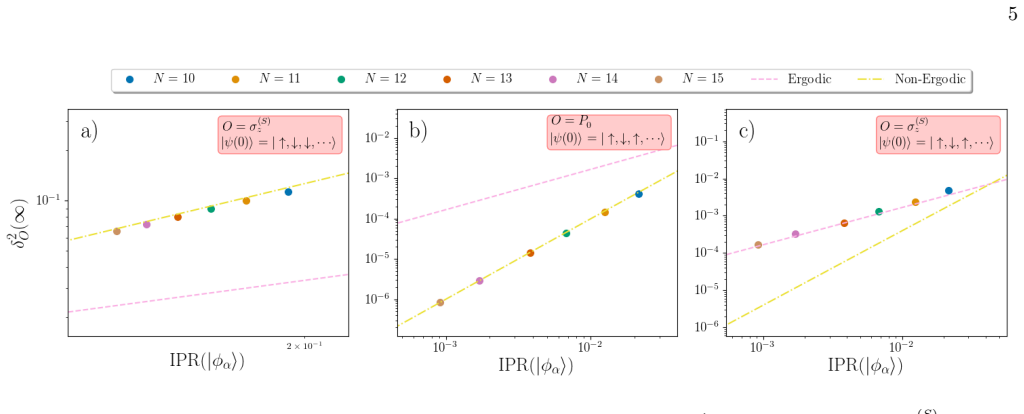
The load-bearing identity is the collapse of the overlap sum $\eta = \sum_k c_\mu(k,\uparrow)c_\nu(k,\uparrow)$ to the single term $c_\mu(\alpha_0)c_\nu(\alpha_0)$. This collapse is forced by the structure of the Hilbert space: with $[H,\hat N]=0$, $\hat N=\hat N_S+\hat N_B$ local, and the initial state $|\psi(0)\rangle=|\!\uparrow\rangle_S|k_0\rangle_B$ with $|k_0\rangle_B$ a non-degenerate eigenstate of $\hat N_B$, the only basis state in which the system qubit is excited has the bath in the fixed state $|k_0\rangle_B$. A local observable $O_S$ that commutes with $\hat N_S$ and $H_S$ is then identified with the survival probability up to a constant, so its matrix elements inherit the initial-state amplitude products. The inverse participation ratio, $\mathrm{IPR}(|\psi(0)\rangle)=\sum_\mu |c_\mu(\alpha_0)|^4$, enters as the natural measure of effective Hilbert-space dimension and controls both the fluctuation scaling and the size of finite-$N$ corrections to the OTOC.
What would settle it
A numerical exact-diagonalization experiment on the NN-XXX chain (Eqs. 25–26) can settle the claim: for initial states $|\!\uparrow\rangle_S|\downarrow\cdots\downarrow\rangle_B$ at increasing chain length $N$, compute the long-time variance $\delta^2_{\sigma_z^{(S)}}(\infty)$ and the IPR, and fit $\log\delta^2$ versus $\log \mathrm{IPR}$. The paper predicts an asymptotic slope of 2 ($\delta^2\propto \mathrm{IPR}^2$), while the ETH/RMT prediction is a slope of 1; observing slope 1 (or a crossover toward it at large $N$) would refute the correlated-quench scaling. The analogous test can be done for the long-time OTOC average $\overline{\langle W(t)VW(t)V\rangle}$: Eq. (29) predicts it saturates to the finite value of Eq. (30) for $W=V=\sigma_z^{(S)}$, whereas scrambling would give a vanishing average.
Extended reading notes
Core claim
The central claim is Eq. (22): for a correlated quench, observable matrix elements in the energy eigenbasis collapse to $O_{\mu\nu} = \Delta O\, c_\mu(\alpha_0)c_\nu(\alpha_0) + O_{\downarrow\downarrow}\delta_{\mu\nu}$, where $\alpha_0$ indexes the initial state $|\!\uparrow\rangle_S|k_0\rangle_B$. The off-diagonal part is therefore not a random matrix element but a product of the initial state's overlap amplitudes with the two eigenstates; this is what the paper calls an ETH-like relation with non-random off-diagonals. Substituting this form into the diagonal-ensemble formula gives $\delta^2_O(\infty) \approx \Delta O^2\,\mathrm{IPR}(|\psi(0)\rangle)^2$ (Eq. 23), the time dependence $\langle O(t)\rangle = \Delta O\,P_0(t)+O_{\downarrow\downarrow}$ (Eq. 28), and a long-time OTOC average $\overline{F(t)} = \overline{\langle W(t)VW(t)V\rangle}$ that does not vanish when $W=V=\sigma_z^{(S)}$ (Eqs. 29–30). The system still reaches the diagonal-ensemble expectation in the sense of Eq. (3), so it thermalizes, but it fails the ergodicity condition of Eq. (2) and does not scramble. Numerical exact-diagonalization calculations on a non-integrable NN-XXX spin chain and on a spin-boson model under the rotating-wave approximation match the analytic predictions.
Load-bearing premise
The argument depends on the bath starting in exactly one definite configuration with no extra excitations, so that when the system qubit is found excited the bath must be in that single configuration; if the bath starts with several possible configurations, the collapse that produces the non-random matrix elements fails.
Editorial extensions
If this is right
- Under a correlated quench, equilibrium fluctuations of a local charge-diagonal observable scale as $\mathrm{IPR}^2$, an extra factor of the inverse participation ratio smaller than the ETH scaling $\propto \mathrm{IPR}$; in a Hilbert space of effective dimension $D_{\rm eff}$, fluctuations are suppressed as $1/D_{\rm eff}^2$ rather than $1/D_{\rm eff}$.
- The time dependence of the local observable after the quench is exactly (up to a constant offset) the survival probability, $\langle O(t)\rangle = \Delta O\,P_0(t)+O_{\downarrow\downarrow}$; hence measuring local spin polarization gives a direct, experimentally accessible readout of $P_0(t)$ and, by Fourier transform, of the local density of states.
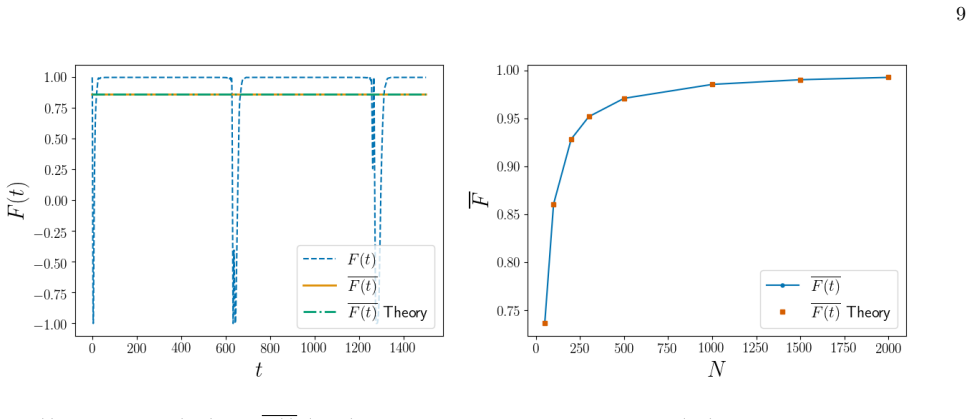
- The long-time average of the out-of-time-ordered correlator does not vanish for charge-diagonal operators: for $W=V=\sigma_z^{(S)}$, $\overline{\langle W(t)VW(t)V\rangle}\to 1$ in the large-system limit, so local information about that observable is not scrambled even though the Hamiltonian is non-integrable.
- The survival probability itself shows the non-ergodic $\mathrm{IPR}^2$ fluctuation scaling for both correlated and degenerate (e.g., Néel) initial bath states, whereas a local system observable shows it only when the bath state is non-degenerate; this difference is what makes scrambling initial-state dependent.
- In the rotating-wave approximation, the spin-boson model realizes exactly the correlated-quench condition, so the analytic predictions for fluctuations, dynamics, and OTOC apply to that familiar open-system setting.
Reading between the lines
- Editorial inference: The same mechanism should appear for any conserved quantity that links a local observable to a projection onto the initial state (particle number, magnetization, momentum sectors), so one could look for $\mathrm{IPR}^2$ fluctuation scaling in Hubbard or lattice-gauge models prepared with one particle on a vacuum-like bath.
- Editorial inference: The OTOC result implies that in single-excitation sectors, late-time OTOC decay is not a reliable chaos diagnostic for charge-diagonal operators; scrambling tests should instead use operators with support transverse to the conserved charge or multi-excitation initial states to avoid false negatives.
- Editorial inference: Appendix D suggests the non-ergodic scaling survives weak breaking of the conservation law at finite sizes but degrades as the system grows; a systematic finite-size crossover study could map how much symmetry breaking is tolerable before the ETH scaling is restored.
Signed reviews
Editorial analysis
A structured set of objections, weighed in public.
Referee Report
Summary. The paper studies quantum thermalization in the presence of a single conserved charge, focusing on initial states with exactly one excitation localized on a system qubit while the bath starts in a non-degenerate eigenstate of its local conserved quantity. Under these conditions, the authors derive a rank-one off-diagonal structure for system-local observable matrix elements, Eq. (22), which leads to three deviations from standard ETH expectations: equilibrium fluctuations that scale as IPR^2 (Eq. (23)), a time-dependent decay proportional to the survival probability (Eq. (28)), and a long-time OTOC that need not vanish (Eq. (29)). The analytical results are supported by exact diagonalization in a non-integrable spin chain and in the spin-boson model under the rotating-wave approximation. The paper also discusses the robustness of the effect when the conservation law is only approximate, and outlines a possible extension to larger system Hilbert spaces.
Significance. The central observation is valuable: in a single-excitation sector with an extremal bath state, the standard ETH ansatz for off-diagonal matrix elements is replaced by a deterministic rank-one form, and this yields concrete, testable predictions for fluctuations, correlation functions, and scrambling. The derivations of Eqs. (22), (23), and (28) are straightforward and internally consistent, and the numerical checks in Figs. 2, 3, and 4 and in the spin-boson appendix support the formulas. The identification of the survival probability as governing the observable's time evolution is a clean and useful result. However, the paper's broader claims about robustness and generality go beyond what the evidence establishes, as detailed in the major comments. The exact conservation-law mechanism is a special, although physically relevant, situation rather than a generic feature of non-integrable systems.
major comments (2)
- [Appendix D and Abstract] The abstract states that predictions are 'robust to perturbations that break this approximation,' but Appendix D explicitly says that the non-ergodic scaling 'gets worse as the system size increases' (Fig. 7a). This is a finite-size effect whose scaling direction is unfavorable: for a fixed perturbation, the deviation grows with system size and would destroy the effect in the thermodynamic limit. The robustness claim is therefore not supported by the numerical evidence, and the abstract and discussion should be tempered accordingly, or additional evidence should be provided that the deviation remains bounded for a given perturbation strength as N increases.
- [Section III.B and Appendix C] The central collapse of the sum in Eq. (20) to a single term, Eq. (21), relies critically on the initial bath state being a unique eigenstate of N_B, which occurs only in extremal charge sectors (e.g., vacuum or fully filled states). The paper's own Appendix C shows that the extension to larger system Hilbert spaces introduces a correction term, Eq. (C2), that can dominate when N_S is large, and the subsequent translational-invariance assumption, Eq. (C5), is not generally justified for a finite system coupled to a bath. The paper should state more precisely the domain of applicability of Eq. (22) and avoid implying that the mechanism is generic for arbitrary system sizes or initial states.
minor comments (5)
- [Figure 2 caption] The caption says 'all qubits up' for panel (a), but the text in Section VI describes the correlated initial state as '|↓,↓,...>_B (All down)'. This inconsistency should be corrected.
- [Appendix C] There is a typo: 'transnationally invariant' should be 'translationally invariant'.
- [Appendix B and Eq. (29)] The derivation of the long-time OTOC uses I_n := sum_mu c_mu^n without complex conjugation, which implicitly assumes real eigenvector coefficients. The paper should state this assumption, since the final expression Eq. (29) is not valid for complex coefficients without modification, although the numerical model has a real Hamiltonian.
- [Equation (27)] In the second line, the term O_downarrow downarrow sum_mu c_mu^2(k0,uparrow) should be written as O_downarrow downarrow sum_mu |c_mu|^2 = O_downarrow downarrow if complex coefficients are allowed; the current notation silently assumes real c_mu.
- [Section V, Eq. (24)] The penultimate line indicates that <O(t)O> equals O_uparrow uparrow O_downarrow downarrow, but the equality is only approximate after dropping IPR-weighted terms; using 'approximately equals' at that step would be clearer.
Circularity Check
No significant circularity; the central matrix-element relation is derived from the single-excitation sector, and the paper's self-citations are comparative baselines rather than load-bearing assumptions.
full rationale
The derivation chain is self-contained. Equation (18) is obtained exactly from [O_S, N_S]=0 and the completeness relation; equations (20)-(22) reduce eta = sum_k c_mu(k,up)c_nu(k,up) to c_mu(alpha0)c_nu(alpha0) because the single-excitation initial state leaves only k=k0. This is a stated assumption, not a fit, and equations (23), (28), and (29) are algebraic consequences of (22). The paper explicitly identifies the design feature: 'A following measurement of sigma(S)_z is thus the same as a measurement of the survival probability P0,' so the survival-probability scaling is not concealed as an input. The only self-citations are to the authors' earlier RMT work (Ref. [20] for the ETH form and the ergodic delta^2 proportional to IPR baseline, and Ref. [12] as an independent numerical context); these are used for comparison and motivation, not to force the new result. Appendix D does state that the non-conserving robustness case 'this gets worse as the systems size increases,' which is a limitation of the claimed robustness but is not a circularity in the conserving derivation. On balance, one minor self-citation baseline without load-bearing weight gives score 2.
Assumptions & free parameters
assumptions (6)
- domain assumption The total Hamiltonian conserves the number of excitations, [H, N] = 0, with N = N_S + N_B, and N_S and N_B are separately conserved by H_S and H_B.
- domain assumption The initial bath state |k0⟩_B is a non-degenerate eigenstate of N_B, and the initial state has exactly one excitation localized to the system.
- domain assumption The local system observable O_S is diagonal in the basis of the local excitation number and commutes with H_S, so [O_S, N_S] = [O_S, H_S] = 0.
- domain assumption Eigenstates have a large number of principal components, so max_µ |cµ(α0)| ≪ 1 and Σ_µ |cµ|^8 ≪ (Σ_µ |cµ|^4)^2.
- standard math No extensive degeneracies, so the time average of e^{-i(Eµ-Eν)t} is δµν.
- standard math Completeness of the single-excitation basis {|s⟩_S|k⟩_B} within the conserved sector.
Cite this review
Pith. "Pith review of Chaotic dynamics in a single excitation subspace: deviations from the ETH via long time correlations." pith.science (2026). https://pith.science/paper/P66KDF3P
@misc{pith2026190811773,
  author       = {Pith},
  title        = {Pith review of: Chaotic dynamics in a single excitation subspace: deviations from the ETH via long time correlations},
  year         = {2026},
  howpublished = {\url{https://pith.science/paper/P66KDF3P}},
  note         = {Machine review of arXiv:1908.11773}
}
read the original abstract
In this work we study a scenario where dynamics is restricted to a single excitation manifold, for particular physical observables with support in the manifold, which we label a `correlated quench'. We ask how such dynamics may in general differ from predictions of the eigenstate thermalization hypothesis (ETH). We show that if thermalization occurs, it will not fulfil other key predictions of the ETH; instead following differing generic behaviours. We show this by analysing long-time fluctuations, two-point correlation functions, and the out-of-time-ordered correlator; analytically detailing deviation from ETH predictions. We derive instead an ETH-like relation, with non-random off-diagonals, for matrix elements of observables, with correlations that alter long-time behaviour and constrain dynamics. Further, we analytically compute the time-dependence of the decay to equilibrium, showing that it is proportional to the survival probability of the initial state. We finally note that the conditions studied are common in many physical scenarios, such as under the rotating-wave approximation. We show numerically that predictions are robust to perturbations that break this approximation.
Figures


Figures from the paper (4 more)



Reference graph
Works this paper leans on
-
[1]
Rigol, V
M. Rigol, V. Dunjko, and M. Olshanii, Nature (London) 452, 854 (2008)
2008
-
[2]
Eisert, M
J. Eisert, M. Friesdorf, and C. Gogolin, Nature Physics 11, 124 (2014)
2014
-
[3]
D’Alessio, Y
L. D’Alessio, Y. Kafri, A. Polkovnikov, and M. Rigol, Advances in Physics 65, 239 (2016)
2016
-
[4]
Gogolin and J
C. Gogolin and J. Eisert, Reports on Progress in Physics 79, 056001 (2016)
2016
-
[5]
F. Borgonovi, F. M. Izrailev, L. F. Santos, and V. G. Zelevinsky, Physics Reports 626, 1 (2016)
work page 2016
- [6]
-
[7]
C. Schneider, D. Porras, and T. Schaetz, Rep. Prog. Phys. 75, 24401 (2012)
work page 2012
-
[8]
I. M. Georgescu, S. Ashhab, and F. Nori, Rev. Mod. Phys. 86, 153 (2014)
2014
Show all 50 references
-
[9]
Schreiber, S
M. Schreiber, S. S. Hodgman, P. Bordia, H. P. L¨ uschen, M. H. Fischer, R. Vosk, E. Altman, U. Schneider, and I. Bloch, Science 349, 842 (2015)
2015
-
[10]
Neill, P
C. Neill, P. Roushan, M. Fang, Y. Chen, M. Kolodru- betz, Z. Chen, A. Megrant, R. Barends, B. Campbell, B. Chiaro, A. Dunsworth, E. Jeffrey, J. Kelly, J. Mutus, P. J. O’Malley, C. Quintana, D. Sank, A. Vainsencher, J. Wenner, T. C. White, A. Polkovnikov, and J. M. Martinis, Nat...
2016
-
[11]
A. M. Kaufman, M. Eric Tai, A. Lukin, M. Rispoli, R. Schittko, P. M. Preiss, and M. Greiner, Science 353, 790 (2016)
2016
-
[12]
G. Clos, D. Porras, U. Warring, and T. Schaetz, Phys. Rev. Lett. 117, 170401 (2016)
2016
-
[13]
J. M. Deutsch, Physical Review A 43, 2046 (1991)
1991
-
[14]
Srednicki, Journal of Physics A: Mathematical and General 29, 75 (1996), 9511001 [chao-dyn]
M. Srednicki, Journal of Physics A: Mathematical and General 29, 75 (1996), 9511001 [chao-dyn]
1996
-
[15]
H. Kim, T. N. Ikeda, and D. A. Huse, Physical Review E - Statistical, Nonlinear, and Soft Matter Physics 90 (2014)
2014
-
[16]
Mondaini, K
R. Mondaini, K. R. Fratus, M. Srednicki, and M. Rigol, Phys. Rev. E 93, 032104 (2016)
2016
-
[17]
Mondaini and M
R. Mondaini and M. Rigol, Phys. Rev. E 96, 012157 (2017)
2017
-
[18]
Srednicki, J
M. Srednicki, J. Phys. A: Math. Gen. 32, 1163 (1999)
1999
-
[19]
Reimann, Physical Review Letters 101 (2008)
P. Reimann, Physical Review Letters 101 (2008)
2008
-
[20]
Nation and D
C. Nation and D. Porras, New J. Phys.20, 103003 (2018)
2018
-
[21]
Nation and D
C. Nation and D. Porras, Physical Review E 99, 052139 (2019)
2019
- [22]
-
[23]
A. C. Cassidy, C. W. Clark, and M. Rigol, Physical Review Letters 106, 1 (2011), arXiv:1008.4794
2011 arXiv
-
[24]
A. S. L. Malabarba, L. P. Garcia-Pintos, N. Linden, T. C. Farrelly, and A. J. Short, Physical Review E - Statistical, Nonlinear, and Soft Matter Physics 90 (2014)
2014
-
[25]
L. P. Garc´ ıa-Pintos, N. Linden, A. S. Malabarba, A. J. Short, and A. Winter, Physical Review X 7 (2017)
2017
-
[26]
Reimann, Nature Communications 7, 10821 (2016)
P. Reimann, Nature Communications 7, 10821 (2016)
2016
-
[27]
Borgonovi, F
F. Borgonovi, F. M. Izrailev, and L. F. Santos, Phys. Rev. E 99, 010101 (2019)
2019
-
[28]
´A. M. Alhambra, J. Riddell, and L. P. Garc´ ıa-Pintos, (2019), arXiv:1906.11280
2019 arXiv
-
[29]
Berkovitz, R
J. Berkovitz, R. Frigg, and F. Kronz, Studies in History and Philosophy of Science Part B - Studies in History and Philosophy of Modern Physics 37, 661 (2006)
2006
-
[30]
Peres, Physical Review A 30 (1984)
A. Peres, Physical Review A 30 (1984)
1984
-
[31]
Feingold, N
M. Feingold, N. Moiseyev, and A. Peres, Physical Review A 30 (1984)
1984
-
[32]
Zhang, H
D. Zhang, H. T. Quan, and B. Wu, Physical Review E 94 (2016)
2016
-
[33]
Mazur, Physica 43, 533 (1969)
P. Mazur, Physica 43, 533 (1969)
1969
-
[34]
Suzuki, Physica 51, 277 (1971)
M. Suzuki, Physica 51, 277 (1971)
1971
-
[35]
L. C. Venuti and L. Liu, (2019), arXiv:1904.02336
2019 arXiv
-
[36]
Vidmar and M
L. Vidmar and M. Rigol, Journal of Statistical Mechan- ics: Theory and Experiment 2016 (2016)
2016
- [37]
-
[38]
Borgonovi, F
F. Borgonovi, F. Mattiotti, and F. M. Izrailev, Physical Review E 95, 42135 (2017)
2017
-
[39]
A. J. Short, New Journal of Physics 13, 053009 (2011)
2011
-
[40]
Borgonovi and F
F. Borgonovi and F. M. Izrailev, Physical Review E 99, 12115 (2019)
2019
-
[41]
Maldacena, S
J. Maldacena, S. H. Shenker, and D. Stanford, Journal of High Energy Physics 2016, 106 (2016)
2016
-
[42]
Hashimoto, K
K. Hashimoto, K. Murata, and R. Yoshii, Journal of High Energy Physics 2017 (2017)
2017
-
[43]
B. Yan, L. Cincio, and W. H. Zurek, (2019), arXiv:1903.02651
2019 arXiv
-
[44]
Swingle, Nature Physics 14, 988 (2018)
B. Swingle, Nature Physics 14, 988 (2018)
2018
-
[45]
Iyoda and T
E. Iyoda and T. Sagawa, Physical Review A 97 (2018)
2018
- [46]
-
[47]
Foini and J
L. Foini and J. Kurchan, Physical Review E 99 (2019)
2019
-
[48]
Schiulaz, E
M. Schiulaz, E. J. Torres-Herrera, F. P´ erez-Bernal, and L. F. Santos, (2019), arXiv:1906.11856
2019 arXiv
-
[49]
Weisskopf and E
V. Weisskopf and E. Wigner, Zeitschrift f¨ ur Physik 63, 54 (1930)
1930
-
[50]
Cohen-Tannoudji, J
C. Cohen-Tannoudji, J. Dupont-Roc, and G. Grynberg, Atom-Photon Interactions: Basic Processes and Applica- tions, by Claude Cohen-Tannoudji, Jacques Dupont-Roc, Gilbert Grynberg, pp. 678. ISBN 0-471-29336-9. Wiley- VCH , March 1998. -1 (1998), 10.1063/1.2809840
1998 doi
Reviewed August 14, 2026 · model on record in the stance chip above.
Discussion (0). Continue with ORCID to comment.