REVIEW 3 major objections 5 minor 143 references
Learning Rich Representations For Structured Visual Prediction Tasks
T0 review · 3 major / 5 minor · reviewed 2026-08-14 · deepseek-v4-flash
Pith's one-line read A feedforward classifier that sees each pixel's features across nested, increasingly broad image regions — the 'zoom-out' descriptor — can match or beat segmentation models built on explicit structured prediction.
desk verdict The thesis is mostly a retrospective of the author's own published work, but the depth-from-segmentation experiments are genuinely new and make the document worth a careful read. read the letter →
The pith
A machine-rendered reading of the paper's core claim, the machinery that carries it, and where it could break.
The reading
What carries the argument
The zoom-out descriptor: for each image element, a single vector $\phi_{\text{zoom-out}}(s,I) = [\phi_1(s,I), \dots, \phi_L(s,I)]$ formed by concatenating CNN features computed over $L$ nested regions of increasing spatial extent, starting at the superpixel or pixel, expanding through proximal and distant neighborhoods, adding a sub-scene window, and ending at the whole scene. Each level's features come from a convolutional layer whose receptive field defines the level, so the fixed architecture of a backbone CNN (the 16-layer network used initially, then ResNet, DenseNet, and NASNet) supplies both the features and the levels. This mechanism replaces explicit pairwise or higher-order potentials with implicitly encoded smoothness: nearby superpixels share largely overlapping zoom-out regions, so their feature vectors already reflect that context, and the final classifier is a feedforward multilayer network rather than an inference procedure over a graph.
What would settle it
On a suite of validation images with long-range label dependencies, compare raw zoom-out predictions to the same predictions after dense CRF post-processing; if the CRF improves mean IoU by more than about one point, the thesis's claim that the feedforward descriptor already captures the structure is falsified, since the thesis itself reports only a 0.1-point improvement for its strongest variant on VOC 2012.
Extended reading notes
Core claim
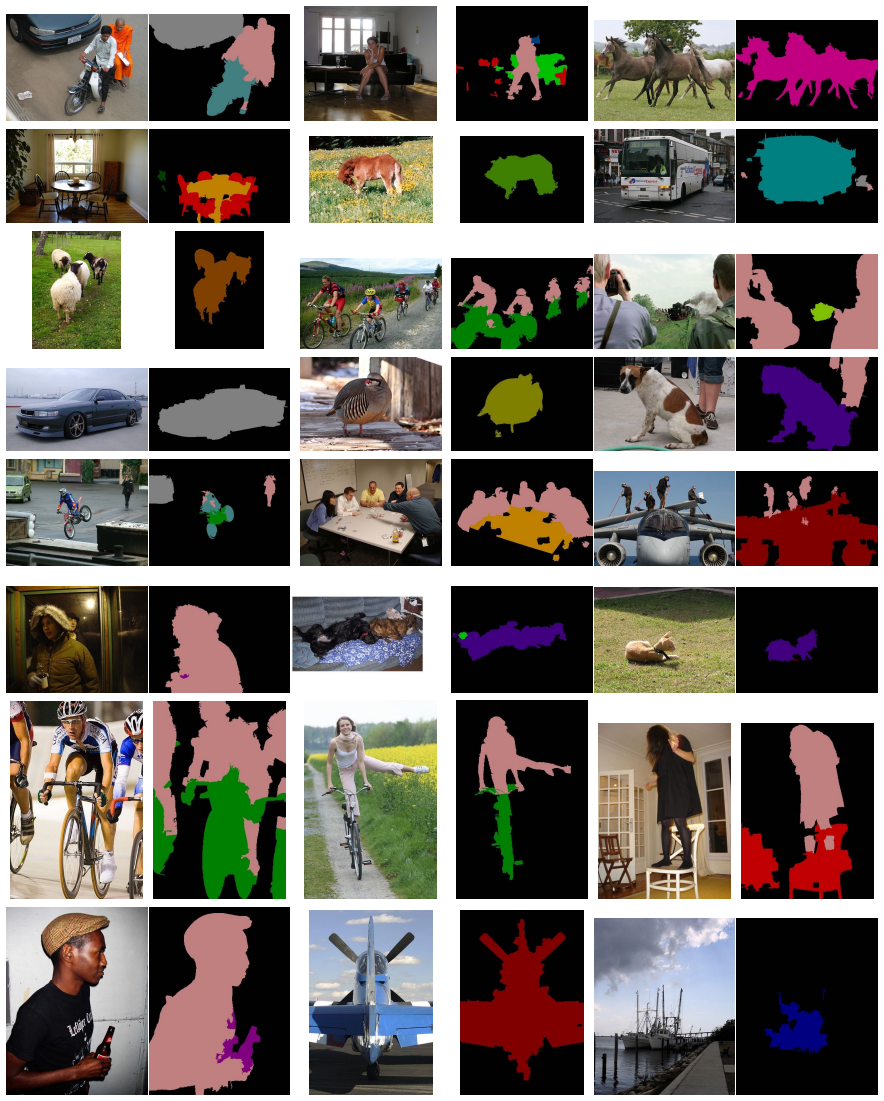
On its own terms, the thesis establishes that per-element image labeling can be treated as plain classification if the feature vector for each element incorporates context at multiple scales. For each superpixel (or pixel), the method concatenates CNN activations from nested regions, from the element itself through sub-scene windows and up to the entire image, then feeds the resulting vector to a multilayer network with skip connections spanning the zoom-out levels. The thesis reports that this representation, with no explicit structured prediction machinery, surpasses prior state of the art built on hand-crafted features with CRFs and structured SVMs on PASCAL VOC 2012, and that adding an off-the-shelf CRF on top of its best variant changes mean IoU by only 0.1 points — evidence that the feedforward model already captures the label dependencies the CRF would add. The same descriptor then supports a weakly supervised pipeline (localization score maps plus diverse point sampling) and a label-space autoencoder regularizer, each presented as a further extension of the same representation idea.
Load-bearing premise
The load-bearing premise is that the label dependencies needed for accurate segmentation are present in the multiscale feature vector of each element alone, so no explicit pairwise or higher-order model is required; if there exist scene structures whose resolution requires reasoning about distant elements that the zoom-out vector cannot encode, the central claim collapses.
Editorial extensions
If this is right
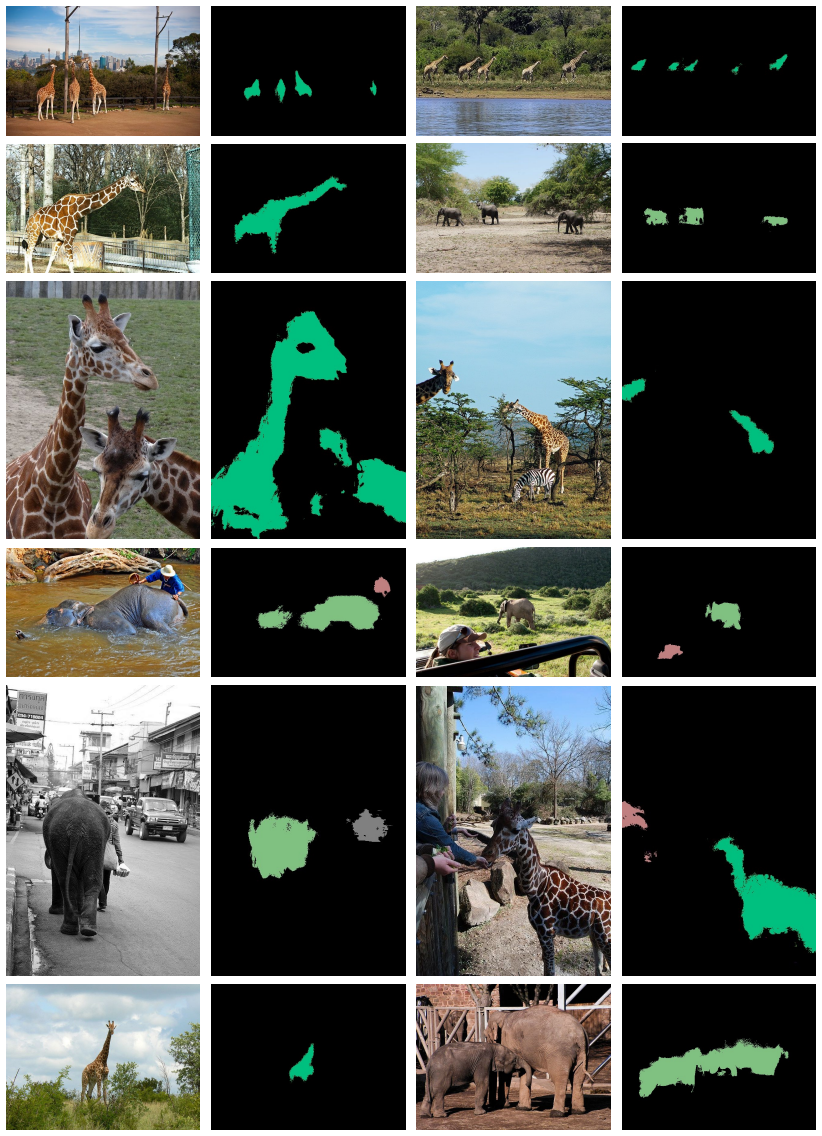
- A segmentation network can be built by attaching a small classifier on top of any modern CNN backbone; the thesis shows zoom-out turning VGG-16, ResNet, DenseNet, and NASNet into competitive segmenters without dilated convolutions or CRFs.
- Because each level's features are concatenated rather than summed, a nonlinear classifier can learn how much to rely on local versus global evidence; the paper reports that every zoom-out level group contributes to accuracy, with the full feature set reaching 58.6 mIoU on VOC 2012 val under a linear model.
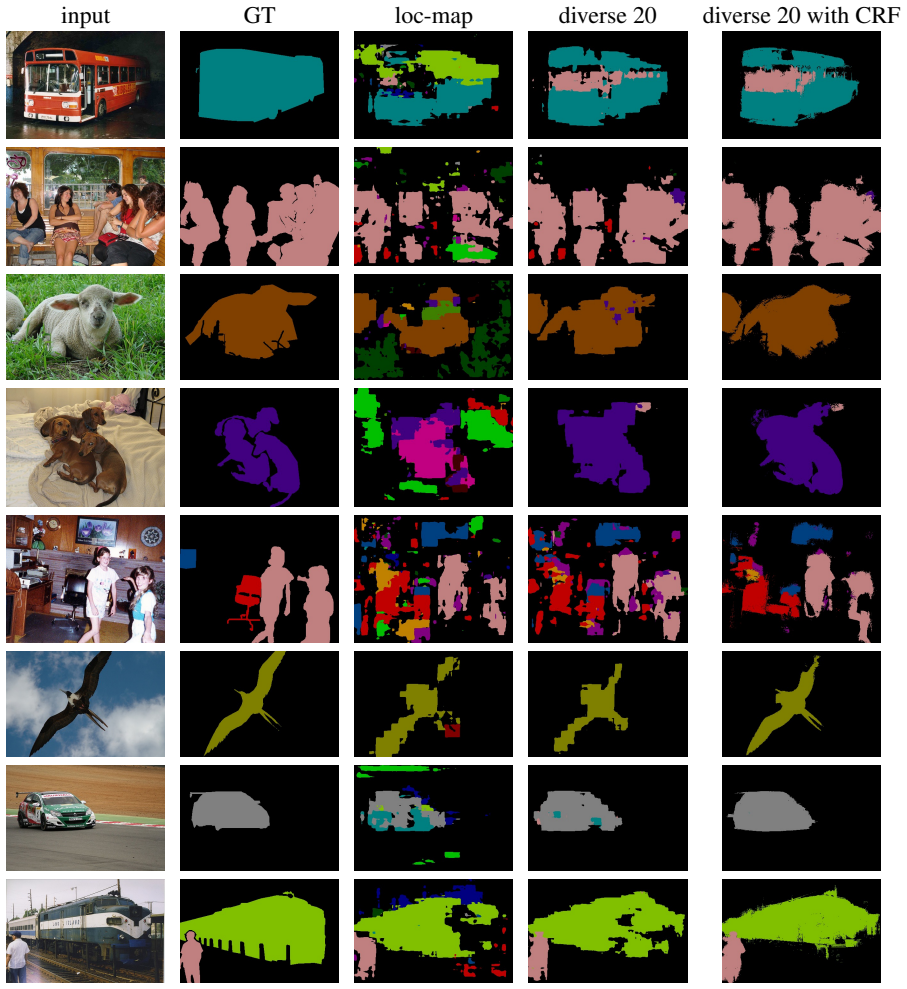
- The same representation drives a weakly supervised pipeline: class-specific localization score maps, combined with feature-space diverse sampling of 20 points per class per image, yield 40.6 mIoU on VOC 2012 val (45.2 with CRF), competitive with human point supervision.
- Learning an autoencoder over ground-truth label maps and asking the network to predict through its frozen decoder improves a trained-from-scratch DenseNet-67 by 4.7 mIoU (40.5 to 45.2) and remains beneficial with ImageNet or COCO pretraining.
- Depth maps can be predicted from semantic segmentation masks with lower error than from RGB in the thesis's NYUv2 experiments (linear RMSE 0.548 versus 0.628), indicating segmentation is a strong intermediate representation for jointly estimating depth.
Reading between the lines
- A consequence the author leaves implicit is that the zoom-out recipe is a cheap, backbone-agnostic way to retrofit any image-classification network for dense prediction; a testable extension is whether the same concatenation scheme transfers unchanged to instance or panoptic segmentation, where the label structure is richer than in semantic segmentation.
- The near-zero CRF gain on VOC suggests the representation saturates existing benchmark structure; a stress test with long-range label dependencies (for example, scenes where correctly labeling a region requires global competition among all object classes) would separate implicit structure capture from explicit structured reasoning.
- The diverse-sampling rule penalizes feature-space similarity rather than spatial proximity; a direct extension would be to learn the embedding used for both the score map and the diversity term, so selected points maximize expected information gain for the downstream pixel classifier.
- Label autoencoding could transfer to other structured outputs such as depth, surface normals, or pose, since the regularizer is derived purely from annotations; any label space with recoverable structure could receive the same two-phase training procedure.
Signed reviews
Editorial analysis
A structured set of objections, weighed in public.
Referee Report
Summary. The thesis presents three connected contributions to structured visual prediction. The core contribution is the zoom-out feature representation: for each pixel or superpixel, features are extracted from a nested sequence of regions of increasing spatial extent and concatenated, and a feedforward network classifies each element independently. The thesis argues that this simple construction captures local, proximal, distant, and scene-level context, making explicit structured prediction mechanisms such as CRFs unnecessary for competitive semantic segmentation. The second contribution is a weakly supervised segmentation pipeline that uses image-level class tags, class-specific localization score maps, and a diverse point-sampling procedure to generate automatic point supervision. The third contribution is a label-embedding regularizer: an autoencoder is learned over ground-truth label maps, and its frozen decoder is used as an auxiliary prediction branch during CNN training; the thesis also proposes a two-part architecture for joint depth and semantic segmentation. Experiments are reported on PASCAL VOC 2012, Stanford Background, Cityscapes, and NYUv2, with detailed ablations and test-set numbers.
Significance. If the claims hold, the zoom-out representation would be a simple and general recipe for injecting multiscale context into per-element classifiers, and the label-embedding regularizer would provide a way to exploit structure in annotations beyond the usual training loss. The manuscript has notable strengths: it reports extensive ablations on public benchmarks, including a superpixel oracle bound (94.4 mIoU, Section 3.4.2), level-by-level contribution analysis (Table 3.4), sampling-strategy comparisons (Tables 4.2 and 4.3), regularizer ablations (Tables 5.1 and 5.2), and held-out VOC 2012 test numbers that are falsifiable. However, two load-bearing points need work: the modern-backbone version of the zoom-out claim lacks a controlled baseline isolating the zoom-out construction from backbone strength and training protocol, and the weakly supervised pipeline rests on an assumption about score-map-to-pixel correspondence that the text admits was only qualitatively checked.
major comments (3)
- [Section 3.5, Table 3.9] The central claim that zoom-out features, rather than the backbone or the training/inference protocol, are responsible for the reported accuracy is not directly tested in the modern-backbone experiments. Table 3.9 compares zoom-out ResNet-101 (77.6 mIoU) with dilated ResNet-101 (77.4 mIoU), but these are different architectures, and the dilated baseline is not the same network with the zoom-out head removed. No result is reported for a plain DenseNet-121, DenseNet-201, or NASNet-A FCN trained with the same crop size, multi-scale inference, and COCO pretraining but using only the final-layer feature map or a simple skip-connection head. The ablations in Table 3.4 that show the contribution of individual levels use VGG-16 features with a linear superpixel classifier, a substantially different regime. Adding a controlled baseline with the same backbone and training protocol would make the zoom-out contribution identifiable.
- [Section 4.3.2, Eqs. (4.3.3)-(4.3.5)] The weakly supervised pipeline assumes that maximum activations of a class-specific score map correspond to pixels of that class when the class is present. The manuscript states: 'the maximum activations of a class scoremap when that class is present appear to reliably correspond with pixels containing the correct class. (We verified this qualitatively, on a few classes and a number of training images)' (Section 4.3.2). This assumption is load-bearing for the Chapter 4 results (40.6 mIoU on val, 45.2 with CRF), yet the correctness of the automatically generated point labels is never measured. I recommend quantifying label precision on a held-out subset with available ground truth, or otherwise providing a direct evaluation of the point labels, so that the reported segmentation accuracy can be attributed to the proposed sampling mechanism rather than to an untested localization assumption.
- [Section 5.3.3, Tables 5.1-5.2] The label-embedding regularizer is evaluated through several ablations, which is a strength. However, Table 5.1 reports gains that in some settings are small (e.g., DenseNet-121 with ImageNet pretraining: 71.6 to 71.9 mIoU), and the paper does not report variance or significance over multiple runs. Given that the central claim of Chapter 5 is a consistent accuracy boost, reporting the mean and spread over at least a few random seeds for the main comparisons would strengthen the claim and rule out optimization noise.
minor comments (5)
- [Table 3.8] The row 'zoom-out DenseNet-201 256x256' appears twice with different values (77.4 and 78.6 mIoU) under the same column settings; the difference (for example, COCO pretraining or some other configuration) should be stated explicitly.
- [Section 3.4.2] The text refers to 'asymmetric log-loss (3.4.1)', but Equation 3.4.1 defines IoU; the loss is defined in Equation 3.3.1. The cross-reference should be corrected.
- [Chapter 4, reference [10]] In the Introduction and in Section 4.3, the VOC 2012 benchmark is cited with reference [10], which is the author's own arXiv preprint on diverse sampling; this citation mismatch should be fixed to the PASCAL VOC reference.
- [Figure 3.1 caption] The caption contains a typo: 'comcantenated' should be 'concatenated'.
- [Section 4.4.1] The final segmentation model is trained on the selected points with batch size 100 and for two epochs in less than three minutes; reporting the number of optimization steps and convergence behavior would make this speed claim more reproducible.
Circularity Check
No significant circularity: the thesis's claims are evaluated against external benchmarks and each stage is empirically grounded rather than reducing to its inputs.
full rationale
The thesis does not derive its headline results from definitions that already contain those results. The zoom-out claim in Chapter 3 is an empirical architecture proposal: features are concatenated from nested regions and classified by a feedforward network, with accuracy measured on held-out VOC test server, Stanford Background, and later Cityscapes and NYUv2. The VOC 2012 test numbers are genuine external benchmark submissions, not quantities fitted into the model. The weak supervision pipeline in Chapter 4 trains localization models from image-level tags, samples diverse points, and then trains a segmentation model on those points; the reported mIoU is computed against independent validation/test ground truth, so the evaluation is not forced by the label-generation procedure. The label-embedding regularizer in Chapter 5 is an auxiliary training signal learned from training annotations and measured on held-out validation, not a redefinition of the target. The paper does cite the author's prior work ([91], [137], [10], [17]), but the thesis is self-contained: the zoom-out method is fully described in Chapter 3, and the citations do not supply an unverified premise that carries the argument. One limitation in Section 4.3.2 is the qualitative verification of score-to-pixel correspondence, but that is an unsupported assumption about localization quality, not a circular reduction. Missing controlled baselines in the modern-backbone experiments would be a correctness or experimental-design concern, not a circularity, and therefore does not raise the circularity score.
Assumptions & free parameters
free parameters (5)
- diverse sampling count k =
20
- auxiliary loss weight =
0.5 relative weight
- SLIC superpixel count and compactness =
about 500 superpixels, m = 15
- zoom-out level set =
13 conv layers plus window and scene levels (15 total)
- autoencoder bottleneck width =
128 channels
assumptions (5)
- domain assumption ImageNet-pretrained CNN features, without fine-tuning on VOC, serve as useful spatial features for segmentation and localization.
- domain assumption Locations of maximum class score in global-softmax localization maps coincide with pixels of that class when the class is present.
- domain assumption Autoencoding ground-truth label maps through a bottleneck yields structure (shape, co-occurrence) whose prediction regularizes the segmentation network.
- domain assumption Majority-vote labeling of SLIC superpixels loses little information relative to pixel-level supervision.
- domain assumption External implementations (Caffe, Torch7, PyTorch, torchvision pretrained weights, fully connected CRF of Krahenbuhl and Koltun) behave as documented.
invented entities (2)
-
zoom-out feature representation
independent evidence
-
label-space autoencoder decoder branch
independent evidence
Cite this review
Pith. "Pith review of Learning Rich Representations For Structured Visual Prediction Tasks." pith.science (2026). https://pith.science/paper/GVOU4JMN
@misc{pith2026190811820,
  author       = {Pith},
  title        = {Pith review of: Learning Rich Representations For Structured Visual Prediction Tasks},
  year         = {2026},
  howpublished = {\url{https://pith.science/paper/GVOU4JMN}},
  note         = {Machine review of arXiv:1908.11820}
}
read the original abstract
We describe an approach to learning rich representations for images, that enables simple and effective predictors in a range of vision tasks involving spatially structured maps. Our key idea is to map small image elements to feature representations extracted from a sequence of nested regions of increasing spatial extent. These regions are obtained by "zooming out" from the pixel/superpixel all the way to scene-level resolution, and hence we call these zoom-out features. Applied to semantic segmentation and other structured prediction tasks, our approach exploits statistical structure in the image and in the label space without setting up explicit structured prediction mechanisms, and thus avoids complex and expensive inference. Instead image elements are classified by a feedforward multilayer network with skip-layer connections spanning the zoom-out levels. When used in conjunction with modern neural architectures such as ResNet, DenseNet and NASNet (to which it is complementary) our approach achieves competitive accuracy on segmentation benchmarks. In addition, we propose an approach for learning category-level semantic segmentation purely from image-level classification tag. It exploits localization cues that emerge from training a modified zoom-out architecture tailored for classification tasks, to drive a weakly supervised process that automatically labels a sparse, diverse training set of points likely to belong to classes of interest. Finally, we introduce data-driven regularization functions for the supervised training of CNNs. Our innovation takes the form of a regularizer derived by learning an autoencoder over the set of annotations. This approach leverages an improved representation of label space to inform extraction of features from images
Figures


Figures from the paper (24 more)







Reference graph
Works this paper leans on
-
[1]
Pushmeet Kohli, L’ubor Ladicky, and Philip H. S. Torr. Robust higher order potentials for enforcing label consistency. In CVPR, 2008. ISBN 978-1-4244-2242-5. doi: http://doi.ieeecomputersociety.org/10.1109/CVPR.2008.4587417
arXiv 2008
-
[2]
Shotton, J
J.D.J. Shotton, J. Winn, C. Rother, and A. Criminisi. Textonboost for image under- standing: Multi-class object recognition and segmentation by jointly modeling texture, layout, and context. IJCV, 81(1), 2009
2009
-
[3]
Efficient inference in fully connected crfs with gaussian edge potentials
Philipp Krähenbühl and Vladlen Koltun. Efficient inference in fully connected crfs with gaussian edge potentials. Adv. Neural Inf. Process. Syst, 2011
2011
-
[4]
Ladick`y, C
L. Ladick`y, C. Russell, P. Kohli, and P. H. S. Torr. Associative hierarchical CRFs for object class image segmentation. ICCV, 2009
2009
-
[5]
Pylon model for semantic segmentation
Victor Lempitsky, Andrea Vedaldi, and Andrew Zisserman. Pylon model for semantic segmentation. In NIPS, pages 1485–1493, 2011
2011
-
[6]
Discriminative re-ranking of diverse segmentations
Payman Yadollahpour, Dhruv Batra, and Gregory Shakhnarovich. Discriminative re-ranking of diverse segmentations. In CVPR, 2013
2013
-
[7]
Diverse M-Best Solutions in Markov Random Fields
Dhruv Batra, Payman Yadollahpour, Abner Guzman-Rivera, and Greg Shakhnarovich. Diverse M-Best Solutions in Markov Random Fields. In ECCV, 2012. 108
2012
-
[8]
Gonfaus, Joost van de Weijer, Andrew D
Xavier Boix, Josep M. Gonfaus, Joost van de Weijer, Andrew D. Bagdanov, Joan Serrat Gual, and Jordi Gonzàlez. Harmony potentials - fusing global and local scale for semantic image segmentation. IJCV, 96(1):83–102, 2012
2012
Show all 143 references
-
[9]
A robust multilevel segment de- scription for multi-class object recognition
Mohammadreza Mostajabi and Iman Gholampour. A robust multilevel segment de- scription for multi-class object recognition. Machine Vision and Applications, 2014
2014
-
[10]
Kolkin, and Gregory Shakhnarovich
Mohammadreza Mostajabi, Nicholas I. Kolkin, and Gregory Shakhnarovich. Diverse sampling for self-supervised learning of semantic segmentation. arXiv preprint, 2016
2016
-
[11]
ImageNet: A large-scale hierarchical image database
Jia Deng, Wei Dong, Richard Socher, Li-Jia Li, Kai Li, and Li Fei-Fei. ImageNet: A large-scale hierarchical image database. CVPR, 2009
2009
-
[12]
Semantic image segmentation via deep parsing network
Ziwei Liu, Xiaoxiao Li, Ping Luo, Chen Change Loy, and Xiaoou Tang. Semantic image segmentation via deep parsing network. ICCV, 2015
2015
-
[14]
Pyramid scene parsing network
Hengshuang Zhao, Jianping Shi, Xiaojuan Qi, Xiaogang Wang, and Jiaya Jia. Pyramid scene parsing network. CVPR, 2017
2017
-
[15]
The PASCAL Visual Object Classes (VOC) challenge
Mark Everingham, Luc van Gool, Chris Williams, John Winn, and Andrew Zisserman. The PASCAL Visual Object Classes (VOC) challenge. IJCV, 2010
2010
-
[16]
Lawrence Zitnick
Tsung-Yi Lin, Michael Maire, Serge Belongie, James Hays, Pietro Perona, Deva Ramanan, Piotr Dollár, and C. Lawrence Zitnick. Microsoft COCO: Common objects in context. ECCV, 2014
2014
-
[17]
Regularizing 109 deep networks by modeling and predicting label structure
Mohammadreza Mostajabi, Michael Maire, and Gregory Shakhnarovich. Regularizing 109 deep networks by modeling and predicting label structure. In The IEEE Conference on Computer Vision and Pattern Recognition (CVPR), June 2018
2018
-
[18]
Arbelaez, M
P. Arbelaez, M. Maire, C. Fowlkes, and J. Malik. Contour detection and hierarchical image segmentation. IEEE Transactions on Pattern Analysis and Machine Intelligence, 33(5):898–916, May 2011
2011
-
[19]
Martin, C
D. Martin, C. Fowlkes, D. Tal, and J. Malik. A database of human segmented natural images and its application to evaluating segmentation algorithms and measuring eco- logical statistics. In Proc. 8th Int’l Conf. Computer Vision, volume 2, pages 416–423, July 2001
2001
-
[20]
Slic superpixels compared to state-of-the-art superpixel methods
Radhakrishna Achanta, Appu Shaji, Kevin Smith, Aurelien Lucchi, Pascal Fua, and Sabine Susstrunk. Slic superpixels compared to state-of-the-art superpixel methods. IEEE TPAMI, 34(11), 2012
2012
-
[21]
Comaniciu and P
D. Comaniciu and P. Meer. Mean shift: a robust approach toward feature space analysis. PAMI, 24(5):603–619, 2002
2002
-
[22]
Carreira and C
J. Carreira and C. Sminchisescu. Constrained parametric min-cuts for automatic object segmentation. In CVPR, 2010. doi: 10.1109/CVPR.2010.5540063
2010
-
[23]
Normalized cuts and image segmentation
Jianbo Shi and Jitendra Malik. Normalized cuts and image segmentation. PAMI, 22(8): 888–905, 2000. ISSN 0162-8828. doi: http://doi.ieeecomputersociety.org/10.1109/34. 868688
2000 doi
-
[24]
W. Tu, M. Liu, V . Jampani, D. Sun, S. Chien, M. Yang, and J. Kautz. Learning superpixels with segmentation-aware affinity loss. In 2018 IEEE/CVF Conference on Computer Vision and Pattern Recognition, pages 568–576, June 2018. doi: 10.1109/ CVPR.2018.00066. 110
2018
-
[25]
W-net: A deep model for fully unsupervised image segmen- tation
Xide Xia and Brian Kulis. W-net: A deep model for fully unsupervised image segmen- tation. arXiv preprint, abs/1711.08506, 2017. URL
2017 arXiv
-
[26]
Girshick, Carsten Rother, and Piotr Dollár
Alexander Kirillov, Kaiming He, Ross B. Girshick, Carsten Rother, and Piotr Dollár. Panoptic segmentation. arXiv preprint, abs/1801.00868, 2018
2018 arXiv
-
[27]
Cpmc: Automatic object segmentation using constrained parametric min-cuts
Joao Carreira and Cristian Sminchisescu. Cpmc: Automatic object segmentation using constrained parametric min-cuts. Pattern Analysis and Machine Intelligence, IEEE Transactions on, 34(7), 2012
2012
-
[28]
J. R. R. Uijlings, K. E. A. van de Sande, T. Gevers, and A. W. M. Smeulders. Selective search for object recognition. International Journal of Computer Vision, 104(2), 2013
2013
-
[29]
Arbelaez, B
P. Arbelaez, B. Hariharan, Chunhui Gu, S. Gupta, L. Bourdev, and J. Malik. Semantic segmentation using regions and parts. In CVPR, 2012
2012
-
[30]
Semantic segmentation with second-order pooling
João Carreira, Rui Caseiro, Jorge Batista, and Cristian Sminchisescu. Semantic segmentation with second-order pooling. In Computer Vision–ECCV 2012, pages 430–443. Springer, 2012
2012
-
[31]
Probabilistic joint image segmentation and labeling
Adrian Ion, Joao Carreira, and Cristian Sminchisescu. Probabilistic joint image segmentation and labeling. In NIPS, pages 1827–1835, 2011
2011
-
[32]
Object recognition by sequential figure-ground ranking
João Carreira, Fuxin Li, and Cristian Sminchisescu. Object recognition by sequential figure-ground ranking. IJCV, 98(3):243–262, 2012
2012
-
[33]
Z. Li, E. Gavves, K. E. A. van de Sande, C. G. M. Snoek, and A. W. M. Smeulders. Codemaps segment, classify and search objects locally. In ICCV, 2013
2013
-
[34]
Simultaneous detection and segmentation
Bharath Hariharan, Pablo Arbeláez, Ross Girshick, and Jitendra Malik. Simultaneous detection and segmentation. In Computer Vision–ECCV 2014, 2014. 111
2014
-
[35]
Combining the best of graphical models and convnets for semantic segmentation
Michael Cogswell, Xiao Lin, Senthil Purushwalkam, and Dhruv Batra. Combining the best of graphical models and convnets for semantic segmentation. arXiv preprint, abs/1412.4313, 2014. URL
2014 arXiv
-
[36]
Class segmentation and object localization with superpixel neighborhoods
Brian Fulkerson, Andrea Vedaldi, and Stefano Soatto. Class segmentation and object localization with superpixel neighborhoods. In CVPR, 2009
2009
-
[37]
Context by region ancestry
Joseph J Lim, Pablo Arbeláez, Chunhui Gu, and Jitendra Malik. Context by region ancestry. In ICCV, 2009
2009
-
[38]
Are spatial and global constraints really necessary for segmentation? In ICCV, 2011
Aurélien Lucchi, Yunpeng Li, Xavier Boix, Kevin Smith, and Pascal Fua. Are spatial and global constraints really necessary for segmentation? In ICCV, 2011
2011
-
[39]
Learning hierarchical features for scene labeling
Clément Farabet, Camille Couprie, Laurent Najman, and Yann LeCun. Learning hierarchical features for scene labeling. IEEE TPAMI, 35(8), 2013
2013
-
[40]
P. H. O. Pinheiro and R. Collobert. Recurrent convolutional neural networks for scene labeling. In ICML, 2014
2014
-
[41]
Lin, Andrew Y
Richard Socher, Cliff C. Lin, Andrew Y . Ng, and Christopher D. Manning. Parsing Natural Scenes and Natural Language with Recursive Neural Networks. In ICML, 2011
2011
-
[42]
Deep and wide multiscale recursive networks for robust image labeling
Gary B Huang and Viren Jain. Deep and wide multiscale recursive networks for robust image labeling. arXiv preprint arXiv:1310.0354, 2013
2013 arXiv
-
[43]
Fully convolutional networks for semantic segmentation
Jonathan Long, Evan Shelhamer, and Trevor Darrell. Fully convolutional networks for semantic segmentation. CVPR, 2015
2015
-
[44]
Hypercolumns for object segmentation and fine-grained localization
Bharath Hariharan, Pablo Arbelaez, Ross Girshick, and Jitendra Malik. Hypercolumns for object segmentation and fine-grained localization. CVPR, 2015. 112
2015
-
[45]
Slic superpixels compared to state-of-the-art superpixel methods
Radhakrishna Achanta, Appu Shaji, Kevin Smith, Aurelien Lucchi, Pascal Fua, and Sabine SŸsstrunk. Slic superpixels compared to state-of-the-art superpixel methods. IEEE TPAMI, 2012
2012
-
[46]
Williams, John Winn, and Andrew Zisserman
Mark Everingham, S.M.Ali Eslami, Luc Van Gool, ChristopherK.I. Williams, John Winn, and Andrew Zisserman. The pascal visual object classes challenge: A retrospec- tive. International Journal of Computer Vision, 2014
2014
-
[47]
Imagenet large scale visual recognition challenge
Olga Russakovsky, Jia Deng, Hao Su, Jonathan Krause, Sanjeev Satheesh, Sean Ma, Zhiheng Huang, Andrej Karpathy, Aditya Khosla, Michael Bernstein, et al. Imagenet large scale visual recognition challenge. arXiv:1409.0575, 2014
2014 arXiv
-
[48]
Structured output learning with high order loss functions
Daniel Tarlow and Richard S Zemel. Structured output learning with high order loss functions. In AISTATS, 2012
2012
-
[49]
Segmentation propagation in imagenet
Daniel Kuettel, Matthieu Guillaumin, and Vittorio Ferrari. Segmentation propagation in imagenet. In ECCV, 2012
2012
-
[50]
Semantic contours from inverse detectors
Bharath Hariharan, Pablo Arbelaez, Lubomir Bourdev, Subhransu Maji, and Jitendra Malik. Semantic contours from inverse detectors. In International Conference on Computer Vision (ICCV), 2011
2011
-
[51]
Textonboost: Joint appearance, shape and context modeling for multi-class object recognition and segmentation
Jamie Shotton, John Winn, Carsten Rother, and Antonio Criminisi. Textonboost: Joint appearance, shape and context modeling for multi-class object recognition and segmentation. In ECCV, 2006. URL
2006
-
[52]
David G. Lowe. Distinctive image features from scale-invariant keypoints. Int. J. Comput. Vision, 60(2):91–110, November 2004. ISSN 0920-5691. doi: 10.1023/B: VISI.0000029664.99615.94
2004
-
[53]
Chatfield, K
K. Chatfield, K. Simonyan, A. Vedaldi, and A. Zisserman. Return of the devil in the details: Delving deep into convolutional nets. In BMVC, 2014. 113
2014
-
[54]
Simonyan and A
K. Simonyan and A. Zisserman. Very deep convolutional networks for large-scale image recognition. arXiv preprint , 2014
2014
-
[55]
Girshick, J
R. Girshick, J. Donohue, T. Darrell, and J. Malik. Rich feature hierarchies for accurate object detection and semantic segmentation. arXiv preprint , 2014
2014
-
[56]
Deep residual learning for image recognition
Kaiming He, Xiangyu Zhang, Shaoqing Ren, and Jian Sun. Deep residual learning for image recognition. CVPR, 2016
2016
-
[57]
Weinberger
Gao Huang, Zhuang Liu, Laurens van der Maaten, and Kilian Q. Weinberger. Densely connected convolutional networks. CVPR, 2017
2017
-
[58]
Barret Zoph, Vijay Vasudevan, Jonathon Shlens, and Quoc V . Le. Learning transferable architectures for scalable image recognition. arXiv preprint, abs/1707.07012, 2017
2017 arXiv
-
[59]
Caffe: Convolutional architecture for fast feature embedding
Yangqing Jia, Evan Shelhamer, Jeff Donahue, Sergey Karayev, Jonathan Long, Ross Girshick, Sergio Guadarrama, and Trevor Darrell. Caffe: Convolutional architecture for fast feature embedding. arXiv preprint , 2014
2014
-
[60]
Srivastava, G
N. Srivastava, G. Hinton, A. Krizhevsky, I. Sutskever, and R. Salakhutdinov. Dropout: A simple way to prevent neural networks from overfitting.Journal of Machine Learning Research, 15, 2014
2014
-
[61]
J. Long, E. Shelhamer, and T. Darrell. Fully convolutional networks for semantic segmentation. arXiv preprint , 2015
2015
-
[62]
Hariharan, P
B. Hariharan, P. Aberláez an R. Girshick, and J. Malik. Hypercolumns for object segmentation and fine-grained localization. arXiv preprint , 2015
2015
-
[63]
Imagenet classification with deep convolutional neural networks
Alex Krizhevsky, Ilya Sutskever, and Geoffrey E Hinton. Imagenet classification with deep convolutional neural networks. In NIPS, 2012
2012
-
[64]
https://github.com/pytorch/pytorch
PyTorch. https://github.com/pytorch/pytorch. 114
-
[65]
Kingma and Jimmy Ba
Diederik P. Kingma and Jimmy Ba. Adam: A method for stochastic optimization. ICLR, 2015
2015
-
[66]
https://github.com/pytorch/vision
PyTorch torchvision. https://github.com/pytorch/vision
-
[67]
Multi-scale context aggregation by dilated convolutions
Fisher Yu and Vladlen Koltun. Multi-scale context aggregation by dilated convolutions. ICLR, 2016
2016
-
[68]
Deeplab: Semantic image segmentation with deep convolutional nets, atrous convolution, and fully connected CRFs
Liang-Chieh Chen, George Papandreou, Iasonas Kokkinos, Kevin Murphy, and Alan L Yuille. Deeplab: Semantic image segmentation with deep convolutional nets, atrous convolution, and fully connected CRFs. arXiv:1606.00915, 2016
2016 arXiv
-
[69]
Holschneider, R
M. Holschneider, R. Kronland-Martinet, J. Morlet, and Ph. Tchamitchian. A real-time algorithm for signal analysis with the help of the wavelet transform. In Jean-Michel Combes, Alexander Grossmann, and Philippe Tchamitchian, editors, Wavelets, pages 286–297, Berlin, Heidelberg...
1990
-
[70]
Semantic understanding of scenes through the ade20k dataset
Bolei Zhou, Hang Zhao, Xavier Puig, Tete Xiao, Sanja Fidler, Adela Barriuso, and Antonio Torralba. Semantic understanding of scenes through the ade20k dataset. International Journal on Computer Vision, 2018
2018
-
[71]
Re- thinking atrous convolution for semantic image segmentation
Liang-Chieh Chen, George Papandreou, Florian Schroff, and Hartwig Adam. Re- thinking atrous convolution for semantic image segmentation. arXiv preprint , abs/1706.05587, 2017
2017 arXiv
-
[72]
Encoder-decoder with atrous separable convolution for semantic image seg- mentation
Liang-Chieh Chen, Yukun Zhu, George Papandreou, Florian Schroff, and Hartwig Adam. Encoder-decoder with atrous separable convolution for semantic image seg- mentation. arXiv preprint, abs/1802.02611, 2018
2018 arXiv
-
[73]
Multi-scale context intertwining for semantic segmentation
Di Lin, Yuanfeng Ji, Dani Lischinski, Daniel Cohen-Or, and Hui Huang. Multi-scale context intertwining for semantic segmentation. In The European Conference on Computer Vision (ECCV), September 2018. 115
2018
-
[74]
Cordts, M
M. Cordts, M. Omran, S. Ramos, T. Rehfeld, M. Enzweiler, R. Benenson, U. Franke, S. Roth, and B. Schiele. The cityscapes dataset for semantic urban scene understanding. In 2016 IEEE Conference on Computer Vision and Pattern Recognition (CVPR), pages 3213–3223, June 2016
2016
-
[75]
Torchcv: A pytorch-based framework for deep learning in computer vision
Ansheng You and Yunhai Tong. Torchcv: A pytorch-based framework for deep learning in computer vision. , 2019
2019
-
[76]
H. Shin, H. R. Roth, M. Gao, L. Lu, Z. Xu, I. Nogues, J. Yao, D. Mollura, and R. M. Summers. Deep convolutional neural networks for computer-aided detection: Cnn architectures, dataset characteristics and transfer learning. IEEE Transactions on Medical Imaging, 35(5):1285–1298...
2016
-
[77]
Roth, Le Lu, Amal Farag, Hoo-Chang Shin, Jiamin Liu, Evrim B
Holger R. Roth, Le Lu, Amal Farag, Hoo-Chang Shin, Jiamin Liu, Evrim B. Turkbey, and Ronald M. Summers. Deeporgan: Multi-level deep convolutional networks for auto- mated pancreas segmentation. In Nassir Navab, Joachim Hornegger, William M. Wells, and Alejandro Frangi, editors...
2015
-
[78]
Roth, Jiamin Liu, Evrim Turkbey, and Ronald M
Amal Farag, Le Lu, Holger R. Roth, Jiamin Liu, Evrim Turkbey, and Ronald M. Summers. A bottom-up approach for pancreas segmentation using cascaded superpixels and (deep) image patch labeling. Trans. Img. Proc., 26(1):386–399, January 2017. ISSN 1057-7149. doi: 10.1109/TIP.2016...
2017
-
[79]
Training deep networks to be spatially sensitive
Nicholas Kolkin, Eli Shechtman, and Gregory Shakhnarovich. Training deep networks to be spatially sensitive. In The IEEE International Conference on Computer Vision (ICCV), Oct 2017
2017
-
[80]
Shimoda and K
W. Shimoda and K. Yanai. Weakly-supervised segmentation by combining cnn feature 116 maps and object saliency maps. In 2016 23rd International Conference on Pattern Recognition (ICPR), pages 1935–1940, Dec 2016
2016
-
[81]
Learning representations for automatic colorization
Gustav Larsson, Michael Maire, and Gregory Shakhnarovich. Learning representations for automatic colorization. ECCV, 2016
2016
-
[82]
T. M. H. C. Santana, K. Nogueira, A. M. C. Machado, and J. A. dos Santos. Deep contextual description of superpixels for aerial urban scenes classification. In 2017 IEEE International Geoscience and Remote Sensing Symposium (IGARSS) , pages 3027–3031, July 2017
2017
-
[83]
A. M. El Amin, Q. Liu, and Y . Wang. Zoom out cnns features for optical remote sensing change detection. In 2017 2nd International Conference on Image, Vision and Computing (ICIVC), pages 812–817, June 2017
2017
-
[84]
Learning deep features for scene recognition using places database
Bolei Zhou, Agata Lapedriza, Jianxiong Xiao, Antonio Torralba, and Aude Oliva. Learning deep features for scene recognition using places database. In NIPS, 2014
2014
-
[85]
The pascal visual object classes challenge: A retrospective
Mark Everingham, SM Ali Eslami, Luc Van Gool, Christopher KI Williams, John Winn, and Andrew Zisserman. The pascal visual object classes challenge: A retrospective. IJCV, 111(1), 2015
2015
-
[86]
Microsoft coco: Common objects in context
Tsung-Yi Lin, Michael Maire, Serge Belongie, James Hays, Pietro Perona, Deva Ramanan, Piotr Dollár, and C Lawrence Zitnick. Microsoft coco: Common objects in context. In ECCV, 2014
2014
-
[87]
Object detectors emerge in deep scene cnns
Bolei Zhou, Aditya Khosla, Agata Lapedriza, Aude Oliva, and Antonio Torralba. Object detectors emerge in deep scene cnns. In ICLR, 2015
2015
-
[88]
Is object localization for free?-weakly-supervised learning with convolutional neural networks
Maxime Oquab, Léon Bottou, Ivan Laptev, and Josef Sivic. Is object localization for free?-weakly-supervised learning with convolutional neural networks. In CVPR, 2015. 117
2015
-
[89]
What’s the point: Semantic segmentation with point supervision
Olga Russakovsky, Amy L Bearman, Vittorio Ferrari, and Fei-Fei Li. What’s the point: Semantic segmentation with point supervision. arXiv:1506.02106, 2015
2015 arXiv
-
[90]
Hariharan, P
B. Hariharan, P. Aberláez an R. Girshick, and J. Malik. Hypercolumns for object segmentation and fine-grained localization. In CVPR, 2015
2015
-
[91]
Mostajabi, P
M. Mostajabi, P. Yadollahpour, and G. Shakhnarovich. Feedforward semantic segmen- tation with zoom-out features. In CVPR, 2015
2015
-
[92]
Weakly- and semi-supervised learning of a deep convolutional network for semantic image segmentation
George Papandreou, Liang-Chieh Chen, Kevin P Murphy, and Alan L Yuille. Weakly- and semi-supervised learning of a deep convolutional network for semantic image segmentation. In ICCV, 2015
2015
-
[93]
Boxsup: Exploiting bounding boxes to supervise convolutional networks for semantic segmentation
Jifeng Dai, Kaiming He, and Jian Sun. Boxsup: Exploiting bounding boxes to supervise convolutional networks for semantic segmentation. In ICCV, 2015
2015
-
[94]
Weakly supervised semantic labelling and instance segmentation
Anna Khoreva, Rodrigo Benenson, Jan Hosang, Matthias Hein, and Bernt Schiele. Weakly supervised semantic labelling and instance segmentation. arXiv:1603.07485, 2016
2016 arXiv
-
[95]
Constrained convolutional neural networks for weakly supervised segmentation
Deepak Pathak, Philipp Krahenbuhl, and Trevor Darrell. Constrained convolutional neural networks for weakly supervised segmentation. In CVPR, 2015
2015
-
[96]
Self-taught object localization with deep networks
Alessandro Bergamo, Loris Bazzani, Dragomir Anguelov, and Lorenzo Torresani. Self-taught object localization with deep networks. arXiv:1409.3964, 2014
2014 arXiv
-
[97]
Weakly supervised object localization with multi-fold multiple instance learning
Ramazan Gokberk Cinbis, Jakob Verbeek, and Cordelia Schmid. Weakly supervised object localization with multi-fold multiple instance learning. arXiv:1503.00949, 2015
2015 arXiv
-
[98]
Schwing, and Raquel Urtasun
Jia Xu, Alexander G. Schwing, and Raquel Urtasun. Learning to segment under various forms of weak supervision. In CVPR, 2015. 118
2015
-
[99]
Fully convolu- tional multi-class multiple instance learning
Deepak Pathak, Evan Shelhamer, Jonathan Long, and Trevor Darrell. Fully convolu- tional multi-class multiple instance learning. In ICLR workshop, 2015
2015
-
[100]
From image-level to pixel-level labeling with convolutional networks
Pedro O Pinheiro and Ronan Collobert. From image-level to pixel-level labeling with convolutional networks. In CVPR, 2015
2015
-
[101]
Deconvolutional feature stacking for weakly- supervised semantic segmentation
Hyo-Eun Kim and Sangheum Hwang. Deconvolutional feature stacking for weakly- supervised semantic segmentation. arXiv:1602.04984, 2016
2016 arXiv
-
[102]
Seed, expand and constrain: Three principles for weakly-supervised image segmentation
Alexander Kolesnikov and Christoph H Lampert. Seed, expand and constrain: Three principles for weakly-supervised image segmentation. arXiv:1603.06098, 2016
2016 arXiv
-
[103]
Diverse M-Best Solutions in Markov Random Fields
Dhruv Batra, Payman Yadollahpour, Abner Guzman-Rivera, and Greg Shakhnarovich. Diverse M-Best Solutions in Markov Random Fields. In ECCV, 2012
2012
-
[104]
Stc: A simple to complex framework for weakly-supervised semantic segmentation
Yunchao Wei, Xiaodan Liang, Yunpeng Chen, Xiaohui Shen, Ming-Ming Cheng, Yao Zhao, and Shuicheng Yan. Stc: A simple to complex framework for weakly-supervised semantic segmentation. arXiv:1509.03150, 2015
2015 arXiv
-
[105]
Adam: A method for stochastic optimization
Diederik Kingma and Jimmy Ba. Adam: A method for stochastic optimization. In ICLR, 2015
2015
-
[106]
Liang-Chieh Chen, George Papandreou, Iasonas Kokkinos, Kevin Murphy, and Alan L. Yuille. Semantic image segmentation with deep convolutional nets and fully connected CRFs. In ICLR, 2015
2015
-
[107]
High-performance semantic segmentation using very deep fully convolutional networks
Zifeng Wu, Chunhua Shen, and Anton van den Hengel. High-performance semantic segmentation using very deep fully convolutional networks. arXiv:1604.04339, 2016
2016 arXiv
-
[108]
Context encoders: Feature learning by inpainting
Deepak Pathak, Philipp Krähenbühl, Jeff Donahue, Trevor Darrell, and Alexei Efros. Context encoders: Feature learning by inpainting. CVPR, 2016. 119
2016
-
[109]
Unsupervised learning of visual representations by solving jigsaw puzzles
Mehdi Noroozi and Paolo Favaro. Unsupervised learning of visual representations by solving jigsaw puzzles. ECCV, 2016
2016
-
[110]
Colorful image colorization
Richard Zhang, Phillip Isola, and Alexei A Efros. Colorful image colorization. ECCV, 2016
2016
-
[111]
Colorization as a proxy task for visual understanding
Gustav Larsson, Michael Maire, and Gregory Shakhnarovich. Colorization as a proxy task for visual understanding. CVPR, 2017
2017
-
[112]
Split-brain autoencoders: Unsuper- vised learning by cross-channel prediction
Richard Zhang, Phillip Isola, and Alexei A Efros. Split-brain autoencoders: Unsuper- vised learning by cross-channel prediction. CVPR, 2017
2017
-
[113]
Adversarial feature learning
Jeff Donahue, Philipp Krähenbühl, and Trevor Darrell. Adversarial feature learning. ICLR, 2017
2017
-
[114]
Very deep convolutional networks for large- scale image recognition
Karen Simonyan and Andrew Zisserman. Very deep convolutional networks for large- scale image recognition. ICLR, 2015
2015
-
[115]
DeCAF: A deep convolutional activation feature for generic visual recognition
Jeff Donahue, Yangqing Jia, Oriol Vinyals, Judy Hoffman, Ning Zhang, Eric Tzeng, and Trevor Darrell. DeCAF: A deep convolutional activation feature for generic visual recognition. ICML, 2014
2014
-
[116]
Generative adversarial nets
Ian Goodfellow, Jean Pouget-Abadie, Mehdi Mirza, Bing Xu, David Warde-Farley, Sherjil Ozair, Aaron Courville, and Yoshua Bengio. Generative adversarial nets. NIPS, 2014
2014
-
[117]
Deep learning from temporal coherence in video
Hossein Mobahi, Ronan Collobert, and Jason Weston. Deep learning from temporal coherence in video. ICML, 2009
2009
-
[118]
Slow and steady feature analysis: Higher order temporal coherence in video
Dinesh Jayaraman and Kristen Grauman. Slow and steady feature analysis: Higher order temporal coherence in video. CVPR, 2016. 120
2016
-
[119]
Learning visual groups from co-occurrences in space and time
Phillip Isola, Daniel Zoran, Dilip Krishnan, and Edward H Adelson. Learning visual groups from co-occurrences in space and time. ICLR, workshop paper, 2016
2016
-
[120]
Unsupervised learning using sequential verification for action recognition
Ishan Misra, C Lawrence Zitnick, and Martial Hebert. Unsupervised learning using sequential verification for action recognition. ECCV, 2016
2016
-
[121]
Unsupervised learning of visual representations using videos
Xiaolong Wang and Abhinav Gupta. Unsupervised learning of visual representations using videos. ICCV, 2015
2015
-
[122]
Unsupervised learning of video representations using LSTMs
Nitish Srivastava, Elman Mansimov, and Ruslan Salakhutdinov. Unsupervised learning of video representations using LSTMs. ICML, 2015
2015
-
[123]
Learning features by watching objects move
Deepak Pathak, Ross Girshick, Piotr Dollár, Trevor Darrell, and Bharath Hariharan. Learning features by watching objects move. CVPR, 2017
2017
-
[124]
McDermott, William T
Andrew Owens, Jiajun Wu, Josh H. McDermott, William T. Freeman, and Antonio Torralba. Ambient sound provides supervision for visual learning. ECCV, 2016
2016
-
[125]
Learn- ing to poke by poking: Experiential learning of intuitive physics
Pulkit Agrawal, Ashvin Nair, Pieter Abbeel, Jitendra Malik, and Sergey Levine. Learn- ing to poke by poking: Experiential learning of intuitive physics. NIPS, 2016
2016
-
[126]
Combining self-supervised learning and imitation for vision-based rope manipulation
Ashvin Nair, Dian Chen, Pulkit Agrawal, Phillip Isola, Pieter Abbeel, Jitendra Malik, and Sergey Levine. Combining self-supervised learning and imitation for vision-based rope manipulation. ICRA, 2017
2017
-
[127]
Augmenting supervised neural networks with unsupervised objectives for large-scale image classification
Yuting Zhang, Kibok Lee, and Honglak Lee. Augmenting supervised neural networks with unsupervised objectives for large-scale image classification. ICML, 2016
2016
-
[128]
Top-down learning for structured labeling with convolutional pseudoprior
Saining Xie, Xun Huang, and Zhuowen Tu. Top-down learning for structured labeling with convolutional pseudoprior. ECCV, 2016
2016
-
[129]
Contextual priming for object detection
Antonio Torralba. Contextual priming for object detection. IJCV, 2003. 121
2003
-
[130]
Discriminative models for multi-class object layout
Chaitanya Desai, Deva Ramanan, and Charless Fowlkes. Discriminative models for multi-class object layout. IJCV, 2011
2011
-
[131]
Sudderth, Antonio Torralba, William T
Erik B. Sudderth, Antonio Torralba, William T. Freeman, and Alan S. Willsky. Learning hierarchical models of scenes, objects, and parts. ICCV, 2005
2005
-
[132]
Poselets: Body part detectors trained using 3d human pose annotations
Lubomir Bourdev and Jitendra Malik. Poselets: Body part detectors trained using 3d human pose annotations. ICCV, 2009
2009
-
[133]
Detecting people using mutually consistent poselet activations
Lubomir Bourdev, Subhransu Maji, Thomas Brox, and Jitendra Malik. Detecting people using mutually consistent poselet activations. ECCV, 2010
2010
-
[134]
Alex Krizhevsky, Ilya Sutskever, and Geoffrey E. Hinton. ImageNet classification with deep convolutional neural networks. NIPS, 2012
2012
-
[135]
U-Net: Convolutional networks for biomedical image segmentation
Olaf Ronneberger, Philipp Fischer, and Thomas Brox. U-Net: Convolutional networks for biomedical image segmentation. MICCAI, 2015
2015
-
[136]
SegNet: A deep convolu- tional encoder-decoder architecture for image segmentation
Vijay Badrinarayanan, Alex Kendall, and Roberto Cipolla. SegNet: A deep convolu- tional encoder-decoder architecture for image segmentation. PAMI, 2017
2017
-
[137]
Feed- forward semantic segmentation with zoom-out features
Mohammadreza Mostajabi, Payman Yadollahpour, and Gregory Shakhnarovich. Feed- forward semantic segmentation with zoom-out features. CVPR, 2015
2015
-
[138]
Tsung-Wei Ke, Michael Maire, and Stella X. Yu. Multigrid neural architectures.CVPR, 2017
2017
-
[139]
Indoor segmenta- tion and support inference from rgbd images
Nathan Silberman, Derek Hoiem, Pushmeet Kohli, and Rob Fergus. Indoor segmenta- tion and support inference from rgbd images. In Proceedings of the 12th European Conference on Computer Vision - Volume Part V, ECCV’12, pages 746–760, Berlin, Heidelberg, 2012. ISBN 978-3-642-33714-7. 122
2012
-
[140]
Cohen, B
Peng Wang, Xiaohui Shen, Zhe Lin, S. Cohen, B. Price, and A. Yuille. Towards unified depth and semantic prediction from a single image. In 2015 IEEE Conference on Computer Vision and Pattern Recognition (CVPR), pages 2800–2809, June 2015
2015
-
[141]
Look deeper into depth: Monocular depth estimation with semantic booster and attention-driven loss
Jianbo Jiao, Ying Cao, Yibing Song, and Rynson Lau. Look deeper into depth: Monocular depth estimation with semantic booster and attention-driven loss. In The European Conference on Computer Vision (ECCV), September 2018
2018
-
[142]
Joint semantic segmentation and depth estimation with deep convolutional networks
Arsalan Mousavian, Hamed Pirsiavash, and Jana Kosecka. Joint semantic segmentation and depth estimation with deep convolutional networks. In 3DV, 2016
2016
-
[143]
Casas, and Montse Pardà s
Xiao Lin, Dalila Sánchez-Escobedo, Josep R. Casas, and Montse Pardà s. Depth esti- mation and semantic segmentation from a single rgb image using a hybrid convolutional neural network. Sensors, 19(8), 2019. ISSN 1424-8220
2019
-
[144]
Zamir, Alexander Sax, William Shen, Leonidas J
Amir R. Zamir, Alexander Sax, William Shen, Leonidas J. Guibas, Jitendra Malik, and Silvio Savarese. Taskonomy: Disentangling task transfer learning. In The IEEE Conference on Computer Vision and Pattern Recognition (CVPR), June 2018. 123
2018
Reviewed August 14, 2026 · model on record in the stance chip above.
Discussion (0). Continue with ORCID to comment.