REVIEW 5 major objections 6 minor 31 references
Systematic Analysis of Image Generation using GANs
T0 review · 5 major / 6 minor · reviewed 2026-08-14 · deepseek-v4-flash
Pith's one-line read This survey maps image-generation GANs into task-based categories and names the best framework for each, from text to sketch to super-resolution.
desk verdict A careless survey whose useful-looking taxonomy is undermined by a false central claim and multiple citation and formatting errors. read the letter →
The pith
A machine-rendered reading of the paper's core claim, the machinery that carries it, and where it could break.
The reading
What carries the argument
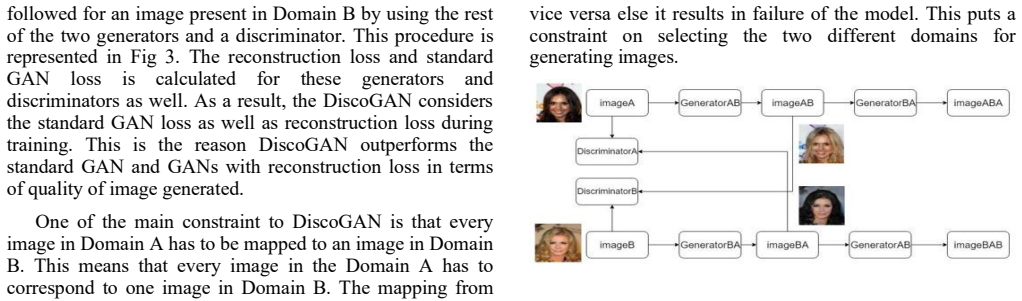
The paper's central object is a taxonomy of image-generation GANs, and the machinery it uses to compare them is the adversarial objective plus the specific loss or structural addition each framework makes to it. The shared base is the generator-discriminator minimax objective $V(D,G)$ from the original GAN, in which the generator tries to fool the discriminator while the discriminator tries to separate real from generated data. The paper then identifies the load-bearing mechanism in each family: auxiliary class or modality input for CGAN and ArtGAN; constrained convolutional architectures for DCGAN; stacked generators with conditioning augmentation for StackGAN; tree-structured joint training for StackGAN++; word-level attention and the Deep Attentional Multimodal Similarity Model (DAMSM) for AttnGAN; reconstruction loss for DiscoGAN and cycle-consistency loss for CycleGAN; perceptual loss (adversarial plus content) for SRGAN; masked residual units for SketchyGAN; and style, pixel, and colour losses for TextureGAN. These mechanisms are what explain the reported advantages and disadvantages in the survey's tables.
What would settle it
A re-implementation of the surveyed frameworks on a shared benchmark with standard metrics would settle the ordering: for example, if a non-attention text-to-image GAN matched or beat AttnGAN on the same dataset and compute budget, the paper's state-of-the-art claim would fail; likewise, a geometric-translation task where CycleGAN's output is quantitatively near-perfect would undercut the claimed limitation.
Extended reading notes
Core claim
The central claim is that image-generation GANs can be usefully grouped by conditioning input and loss design, and within each group a small number of architectures have emerged as the practical choices. Text-to-image progress is traced from 64x64 outputs in the earlier text-to-image line, through location-controlled 128x128 GAWWN, to StackGAN's two-stage 256x256 synthesis, StackGAN++'s tree-structured joint training, and AttnGAN's word-level attention with the DAMSM fine-grained similarity loss, which the paper labels state of the art. On the image-to-image side, the survey argues DiscoGAN and CycleGAN solve unpaired translation with reconstruction and cycle-consistency losses; SRGAN achieves 4x upsampling with a perceptual loss; Scribbler and TextureGAN add interactive sketch-and-texture control; SketchyGAN uses masked residual units; and ArtGAN and SemanticGAN cover special applications. It also claims these frameworks share hard limits: outputs beyond 256x256 are computationally impractical, mode collapse and training instability persist, and cycle-consistent translation handles geometric changes imprecisely.
Load-bearing premise
The survey's conclusions rest on the premise that the architectural descriptions and performance claims it takes from the cited papers are accurate and representative, since it performs no experiments or quantitative re-evaluation.
Editorial extensions
If this is right
- If the taxonomy is right, text-to-image work should default to AttnGAN when word-level fidelity matters, with StackGAN as the simpler 256x256 alternative; both cost GPU memory.
- For unpaired image translation, DiscoGAN and CycleGAN are presented as the go-to baselines, with the caveat that tasks requiring geometric changes will be handled imprecisely.
- For super-resolution, SRGAN is the stated quality leader at 4x upscaling, at the cost of a large, computationally expensive architecture.
- The shared resolution ceiling implies that any pipeline needing images beyond 256x256 must either stack more generators, which raises computational cost, or use a different mechanism entirely.
Reading between the lines
- Editorial inference: the paper's task-based grouping implies a selection rule the authors only hint at—match the loss family to the alignment difficulty, using cycle or consistency losses for unpaired translation and attention or fine-grained similarity for text-to-image.
- Editorial inference: because the paper offers no quantitative comparison, a natural next step is to benchmark the surveyed frameworks on a common set of datasets and metrics to test the qualitative rankings it asserts.
- Editorial inference: the paper's observation about the 256x256 resolution ceiling suggests that progressive or hierarchical generation, where later stages refine rather than rebuild, is the direction most likely to break that ceiling.
Signed reviews
Editorial analysis
A structured set of objections, weighed in public.
Referee Report
Summary. The paper is a survey of Generative Adversarial Network architectures for image generation. It organizes the literature into generic GANs (DCGAN, CGAN), text-to-image GANs (GAWWN, StackGAN, StackGAN++, AttnGAN), and image-to-image GANs (DiscoGAN, CycleGAN, SRGAN, TextureGAN, SketchyGAN, SemanticGAN, ArtGAN). The authors claim to provide a taxonomy of these frameworks, an analysis of their relative advantages and disadvantages, and a discussion of open challenges and future applications. The paper performs no experiments and its conclusions are drawn entirely from descriptions of previously published methods.
Significance. If the survey's descriptions were accurate, it would be a useful qualitative map of GAN architectures for image generation, particularly for readers seeking a compact overview of text-to-image and image-to-image approaches. The paper correctly highlights several important distinctions, such as unpaired versus paired image translation, multi-stage generation for higher resolution, and the role of attention mechanisms. However, the paper's central value depends entirely on the fidelity of its literature reporting, and the manuscript contains multiple factual errors, including a false universal claim about resolution limits, that undermine the reliability of its critical analysis in the current version.
major comments (5)
- [Section V (Conclusion)] The statement 'GANs are unable to generate images of a resolution higher than 256x256 pixels' is false and is presented as a known limitation without qualification. ProgressiveGAN (Karras et al., ICLR 2018) generates 1024x1024 images, and BigGAN (Brock et al., ICLR 2019) generates 512x512 ImageNet images; both predate this paper. Because the survey performs no experiments, this erroneous universal claim directly undermines the credibility of the critical analysis and should be corrected to refer only to the surveyed models, with appropriate citations to higher-resolution GANs.
- [Section II.A] The paper identifies DCGAN as 'Direct Convolution GAN', but the original work of Radford et al. (ICLR 2016) defines DCGAN as a 'Deep Convolutional Generative Adversarial Network'. This misidentification is a factual error in the foundational taxonomy and should be corrected throughout the paper.
- [Equation (1)] The minimax objective in equation (1) is garbled: the typesetting of the expectation subscripts and arguments is nonsensical as printed. The correct form is min_G max_D E_{x~p_data(x)}[log D(x)] + E_{z~p_z(z)}[log(1 - D(G(z)))]. Since this equation defines the core adversarial training loop, it is a load-bearing technical description that must be corrected.
- [Section IV.A.2] The CycleGAN subsection contains a verbatim duplicated block: the paragraph beginning 'CycleGAN learns to map G: X to Y such that...' appears twice, followed by the same limitation discussion in both instances. This duplication is a serious presentation defect and suggests the manuscript has not been carefully proofread; it must be removed.
- [Reference [26]] The text in Section IV.B cites reference [26] as 'recent approaches' for super-resolution, but the reference is to SegNet, a deep convolutional encoder-decoder architecture for image segmentation, not super-resolution. This mis-citation misattributes prior work and also breaks the chain of evidence for the super-resolution discussion. The authors should replace it with a correct super-resolution citation, such as the cited SRGAN paper [27] or other relevant prior art.
minor comments (6)
- [Section II.B] The phrase 'General Adversarial Network' should be 'Generative Adversarial Network'.
- [Section IV.B] The subsection heading '3.1.1. SRGAN:' uses an inconsistent numbering scheme that does not match the roman-numeral section structure; it should be renumbered, for example as IV.B.1.
- [Section III] Spellings of StackGAN++ are inconsistent ('Stack GAN ++', 'StackGAN ++'); please use 'StackGAN++' uniformly.
- [Section V] The word 'Inspite' should be 'In spite'.
- [Section III.D] The claim that AttnGAN 'outperforms all the GANs mentioned previously' is presented without quantitative evidence. Since the survey does not run benchmarks, this claim should either include the reported numbers from the cited paper or be qualified as the authors' conclusion.
- [Figure placement] Fig. 1 is labeled 'Block Schematic Of StackGAN' but is placed after Fig. 2, and the text in Section III.B refers to Fig. 1 while the AttnGAN text refers to Fig. 2. The figures should be reordered or renumbered for clarity.
Circularity Check
No circularity: the survey's taxonomy and comparisons are external literature claims, not derived from its own inputs.
full rationale
This paper is a taxonomy and qualitative survey of GAN architectures for image generation; it presents no derivation, no fitted parameters, and no quantitative prediction whose outcome is forced by an input. The only mathematical statement is the standard GAN minimax objective quoted from Goodfellow et al., and the architectural descriptions are summaries of external cited works. Claims such as 'AttnGAN is currently a state-of-the-art GAN for generation of images from text input and outperforms all the GANs mentioned previously' are inherited from the cited external paper, not from the authors' own prior work, so they are not circular even if they are unverified. The Section V statement that GANs are 'unable to generate images of a resolution higher than 256x256 pixels' is factually contradicted by earlier published work such as ProgressiveGAN and BigGAN, but an incorrect literature claim is a correctness risk, not a circularity. Accordingly, no step in the paper reduces to its own inputs by construction, and the appropriate circularity score is 0.
Assumptions & free parameters
assumptions (3)
- domain assumption All descriptions of GAN architectures, losses, and performance in Sections II-IV are faithful to cited papers [6,7,8,16,19,20,21,24,27,29,30].
- domain assumption The surveyed GAN families are representative enough to support the paper's general conclusions about GAN capabilities, such as the 256x256 resolution limit.
- standard math Equation (1) is the standard GAN minimax objective despite being garbled in the printed text.
Cite this review
Pith. "Pith review of Systematic Analysis of Image Generation using GANs." pith.science (2026). https://pith.science/paper/Z3EQIKVE
@misc{pith2026190811863,
  author       = {Pith},
  title        = {Pith review of: Systematic Analysis of Image Generation using GANs},
  year         = {2026},
  howpublished = {\url{https://pith.science/paper/Z3EQIKVE}},
  note         = {Machine review of arXiv:1908.11863}
}
read the original abstract
Generative Adversarial Networks have been crucial in the developments made in unsupervised learning in recent times. Exemplars of image synthesis from text or other images, these networks have shown remarkable improvements over conventional methods in terms of performance. Trained on the adversarial training philosophy, these networks aim to estimate the potential distribution from the real data and then use this as input to generate the synthetic data. Based on this fundamental principle, several frameworks can be generated that are paragon implementations in several real-life applications such as art synthesis, generation of high resolution outputs and synthesis of images from human drawn sketches, to name a few. While theoretically GANs present better results and prove to be an improvement over conventional methods in many factors, the implementation of these frameworks for dedicated applications remains a challenge. This study explores and presents a taxonomy of these frameworks and their use in various image to image synthesis and text to image synthesis applications. The basic GANs, as well as a variety of different niche frameworks, are critically analyzed. The advantages of GANs for image generation over conventional methods as well their disadvantages amongst other frameworks are presented. The future applications of GANs in industries such as healthcare, art and entertainment are also discussed.
Figures


Figures from the paper (3 more)


Reference graph
Works this paper leans on
-
[26]
SegNet: A Deep Convolutional Encoder -Decoder Architecture for Image Segmentation,
V. Badrinarayanan, A. Kendall and R. Cipolla, "SegNet: A Deep Convolutional Encoder -Decoder Architecture for Image Segmentation," in IEEE Transactions on Pattern Analysis and Machine Intelligence, vol. 39, no. 12, pp. 2481-2495, 1 Dec. 2017
work page 2017
-
[27]
Photo -realistic single image super - resolution using a generative adversarial network,
C. Ledig, L. Theis, F. Huszar, J. Caballero, A. Aitken, A. Tejani, J. Totz, Z. Wang, and W. Shi. , “Photo -realistic single image super - resolution using a generative adversarial network,” in CVPR, 2017
work page 2017
-
[1]
I. Goodfellow, J. Pouget -Abadie, M. Mirza, B. Xu, D. Warde - Farley, S. Ozair et al., “Generative adversarial nets” in Advances in Neural Information Processing Systems, pp. 2672-2680, 2014
work page 2014
-
[2]
Goodfellow, Y. Be ngio, A. Courville, "Deep learning" in Book in preparation, MIT Press, 2016
work page 2016
-
[3]
Unsupervised representation learning with deep convolutional generative adversarial networks,
Radford, L. Metz, and S. Chintala, “Unsupervised representation learning with deep convolutional generative adversarial networks,” in International Conference on Learning Represen tations (ICLR), 2016
work page 2016
-
[4]
Characterization and computation of local Nash equilibria in continuous games,
L. J. Ratliff, S. A. Burden, and S. S. Sastry, “Characterization and computation of local Nash equilibria in continuous games,” in Proc. 51st Annu. Allerton Conf. Communication, Control, and Computing (Allerton), Monticello, IL, USA, ,pp. 917−924, 2013
work page 2013
-
[5]
MidiNet: A convolutional generative adversarial network for symbolic -domain music generation,
Li-Chia Yang, Szu -Yu Chou, and Yi -Hsuan Yang, “MidiNet: A convolutional generative adversarial network for symbolic -domain music generation,” in Proceedings of the 18th International Society for Music Information Retrieval Conference (I SMIR 2017), Suzhou, China, pages 324–331, October 2017
work page 2017
-
[6]
StackGAN: Text to photo -realistic image synthesis with stacked generative adversarial networks,
H. Zhang, T. Xu, H. Li, S. Zhang, X. Huang, X. Wang, and D. Metaxas, “StackGAN: Text to photo -realistic image synthesis with stacked generative adversarial networks,” in IEEE Conference on Computer Vision and Pattern Recognition (CVPR), 2017
work page 2017
Show all 31 references
-
[7]
Learning to Discover Cross-Domain Relations with Generative Adversarial Networks,
T. Kim, M. Cha, H. Kim, J. K. Lee, J. Kim, “Learning to Discover Cross-Domain Relations with Generative Adversarial Networks,” in Proceedings of the 34th International Conference on Machine Learning, PMLR 70:1857-1865, 2017
2017
-
[8]
TextureGAN: Controlling Deep Image Synthesis With Texture Patches,
W. Xian, P. Sangkloy, V. Agrawal, A. Raj, J. Lu, C. Fang et al., “TextureGAN: Controlling Deep Image Synthesis With Texture Patches,” in The IEEE Conference on Computer Vision and Pattern Recognition (CVPR), pp. 8456-8465, 2018
2018
-
[9]
Generating videos with scene dynamics,
C. Vondrick, H. Pirsiavash, A. Torralba, “Generating videos with scene dynamics,” in Proc. 29th Conf. Neural Information Processing Systems, Barcelona, Spain, pp. 613–621, 2016
2016
-
[10]
GAN Based Synthetic Brain MR Image Generation,
C. Han, H. Hayashi, L. Rundo, R. Araki, W. Shimoda, S. Muramatsu, Y. Furukawa, G. Mauri, H. N akayama, “GAN Based Synthetic Brain MR Image Generation,” in IEEE 15th International Symposium on Biomedical Imaging (ISBI 2018), 2016
2018
-
[11]
Deep generative image models using a Laplacian pyramid of adversarial netw orks
E. Denton, S. Chintala, A. Szlam, R. Fergus, “Deep generative image models using a Laplacian pyramid of adversarial netw orks” in Advances in Neural Information Processing Systems (NIPS), 2015
2015
-
[12]
Infrared Image Colorization Based on a Triplet DCGAN Architecture
P. L. Suárez , A. D. Sappa , B. X. Vintimilla , “Infrared Image Colorization Based on a Triplet DCGAN Architecture” in 19th International Conference on Image Analysis and processing, 2017
2017
-
[13]
Generative adversarial models for people attribute recognition in surveillance,
M. Fabbri, S. Calderara ,R. Cucchiara, "Generative adversarial models for people attribute recognition in surveillance," 2017 14th IEEE International Conference on Advanced Video and Signal Based Surveillance (AVSS), Lecce, pp. 1-6,2017
2017
-
[14]
Face Aging Simulation with Deep Convolutional Generative Adversarial Networks,
X. Liu, C. Xie, H. Kuang and X. Ma, "Face Aging Simulation with Deep Convolutional Generative Adversarial Networks," 2018 10th International Conference on Measuring Technology and Mechatronics Automation (ICMTMA), Changsha, pp. 220 -224, 2018
2018
-
[15]
Conditional generative adversarial nets
M. Mirza and S. Osindero, “Conditional generative adversarial nets” in arXiv preprint arXiv:1411.1784, 2014
2014 arXiv
-
[16]
ArtGAN: Artwork synthesis with conditional categorical GANs,
W. R. Tan, C. S. Chan, H. E. Aguirre and K. Tanaka, “ArtGAN: Artwork synthesis with conditional categorical GANs,” in 2017 IEEE International Confere nce on Image Processing (ICIP) , pp. 3760-3764, Beijing, 2017. doi: 10.1109/ICIP.2017.8296985
2017
-
[17]
Face aging with conditional generative adversarial networks,
G. Antipov, M. Baccouche and J. Dugelay, “Face aging with conditional generative adversarial networks,” in 2017 IEEE International Conference on Image Processing ( ICIP), pp. 2089 - 2093, Beijing, 2017. doi: 10.1109/ICIP.2017.8296650
2017
-
[18]
Generative adversarial text-to-image synthesis
S. Reed, Z. Akata, X. Yan, L. Logeswaran, B. Schiele, and H. Lee. “Generative adversarial text-to-image synthesis” in Proceedings of The 33rd International Conference on Machine Learning, 2016
2016
-
[19]
Learning What and Where to Draw,
S. Reed , Z. Akata , S. Mohan , S. Tenka , B. Schiele and H Lee : “Learning What and Where to Draw,”in Advances in Neural Information Processing Systems, 2016
2016
-
[20]
StackGAN++: Realistic Image S ynthesis with Stacked Generative Adversarial Networks,
H. Zhang, T. Xu, H. Li, S. Zhang, X. Wang, X Huang et al. , “StackGAN++: Realistic Image S ynthesis with Stacked Generative Adversarial Networks,” in arXiv: 1710.10916, 2017
2017 arXiv
-
[21]
AttnGAN: Fine -Grained Text to Image Generation With Attentional Generative Adversarial Networks,
T. Xu, P. Zhang, Q. Huang, H. Zhang, Z. Gan, X. Huang et al. , “AttnGAN: Fine -Grained Text to Image Generation With Attentional Generative Adversarial Networks,” in The IEEE Conference on Computer Vision and Pattern Recognition (CVPR), pp. 1316-1324, 2018
2018
-
[22]
Image -to-image translation with conditional adversarial networks
P. Isola, J. -Y. Zhu, T. Zhou, and A. A. Efros, “Image -to-image translation with conditional adversarial networks” in IEEE Conference on Computer Vision and Pattern Recogniti on (CVPR), 2017
2017
-
[23]
Unsupervised crossdomain image generation,
Y. Taigman, A. Polyak, and L. Wolf, “Unsupervised crossdomain image generation,” in ICLR, 2017
2017
-
[24]
Unpaired Image -to- Image Translation Using Cycle -Consistent Adversarial Networks,
J. Zhu, T. Park, P. Isola and A. A. Efros, "Unpaired Image -to- Image Translation Using Cycle -Consistent Adversarial Networks," 2017 IEEE Internati onal Conference on Computer Vision (ICCV) , Venice, 2017, pp. 2242 -2251. doi: 10.1109/ICCV.2017.244
2017 doi
-
[25]
Learning dense correspondence via 3d -guided cycle consistency,
T. Zhou, P. Krahenbuhl, M. Aubry, Q. Huang, and A. A. Efros., “Learning dense correspondence via 3d -guided cycle consistency,” in CVPR, pp. 117–126, 2016
2016
-
[28]
Scribbler: Controlling deep image synthesis with sketch and color,
P. Sangkloy, J. Lu, C. Fang, F. Yu, and J. Hays. “Scribbler: Controlling deep image synthesis with sketch and color,” in CVPR, 2017
2017
-
[29]
SketchyGAN: Towards Diverse and Realistic Sketch to Image Synthesis,
W. Chen and J. Hays. 2018. “SketchyGAN: Towards Diverse and Realistic Sketch to Image Synthesis,” in arXiv preprint arXiv:1801.02753 (2018)
2018 arXiv
-
[30]
Semantic image sy nthesis via adversarial learning,
H. Dong, S. Yu, C. Wu, and Y. Guo, “Semantic image sy nthesis via adversarial learning,” in ICCV, 2017
2017
-
[31]
Multimodal neural language models,
R. Kiros, R. Salakhutdinov, & R. Zemel, “Multimodal neural language models,” in Proceedings of the 31st international conference on machine learning (ICML-14) (pp. 595–603), (2014)
2014
Reviewed August 14, 2026 · model on record in the stance chip above.
Discussion (0). Continue with ORCID to comment.