REVIEW 3 major objections 5 minor 84 references
Discontinuous Galerkin discretization for quantum simulation of chemistry
T0 review · 3 major / 5 minor · reviewed 2026-08-14 · deepseek-v4-flash
Pith's one-line read Block-diagonal basis cuts quantum chemistry cost to O(N^2.6)
desk verdict A genuinely new basis construction with a sound core, but the headline scaling claims rest on an unproven locality assumption and fits that shift with tolerance. read the letter →
The pith
A machine-rendered reading of the paper's core claim, the machinery that carries it, and where it could break.
The reading
What carries the argument
The central object is the blockwise singular value decomposition of the primitive-to-active-space coefficient matrix $\Phi$. Partitioning the primitive index set into blocks $\kappa$, writing the block restriction as $\Phi_\kappa \approx U_\kappa S_\kappa V_\kappa^\dagger$, and keeping the leading $n_\kappa$ left singular vectors defines DG functions $\varphi_{\kappa,j}(r)=\sum_{\mu\in\kappa}\chi_\mu(r)(U_\kappa)_{\mu,j}$. Because each block rotates only within itself, the two-electron tensor inherits the diagonal form of the primitive basis between different blocks, producing the block-diagonal sparsity pattern. This pattern is what the swap-network Trotter circuits and the LCU cost model exploit.
What would settle it
Run the same DG blocking on a delocalized or strongly correlated model, such as a uniform electron gas or a hydrogen chain at large bond stretching, with a fixed SVD tolerance, and check whether the average number of DG functions per block converges as the number of atoms grows; if it grows without bound for fixed accuracy, the core scaling claim fails.
Extended reading notes
Core claim
The central claim is that an arbitrary active-space basis can be re-expressed in a basis of spatially blocked functions so that the two-electron integral tensor is exactly block diagonal: $v_{\kappa,i;\kappa',i';\lambda,j;\lambda',j'} = v^{(d)}_{\kappa,\kappa';i,i',j,j'}\delta_{\kappa\lambda}\delta_{\kappa'\lambda'}$. Each DG function is built from primitive functions in one block by retaining the leading $n_\kappa$ left singular vectors of the primitive-to-active-space matrix restricted to that block. The block-diagonal form turns the quartic integral count into $O(N_b^2 n_\kappa^4)$, which becomes $O(N_d^2)$ when $n_\kappa$ is bounded by a constant. On hydrogen chains the empirical fault-tolerant evolution cost improves from $O(N^{4.5})$ to $O(N^{2.6})$, with the crossover in non-zero integrals and the $\lambda$ factor occurring before or around 15 to 20 atoms. The same locality and block structure preserves accuracy in coupled-cluster and DMRG calculations, and yields large classical speedups.
Load-bearing premise
The paper's scaling results assume that a fixed small number of basis functions per spatial block is enough to keep accuracy as the molecule grows; if that number must grow with system size for delocalized or strongly correlated systems, the claimed $O(N^2)$ integral scaling and the $O(N^{2.6})$ quantum cost would both degrade.
Editorial extensions
If this is right
- For fault-tolerant LCU simulation of hydrogen chains, the DG basis changes the empirical cost from about $O(N^{4.5})$ in a Gaussian active space to $O(N^{2.6})$, with the crossover in non-zero integral count and in $\lambda$ appearing before or around 15 to 20 atoms.
- For Trotter-based simulation, the block-diagonal structure yields swap-network depth $O(N_b n_\kappa^3)=O(N_d n_\kappa^2)$ for the quartic terms, interpolating between the diagonal linear-depth case and the dense cubic-depth case.
- For DMRG, DG bases built on Gausslets with a hybrid active space reach near-complete-basis-set accuracy with one to two orders of magnitude lower cost than the primitive Gausslet or Gaussian basis alone.
- The construction has a one-parameter family: setting $n_\kappa=1$ gives a strictly diagonal primitive basis, while a single block reproduces the dense active-space Hamiltonian, so the method interpolates between the two regimes.
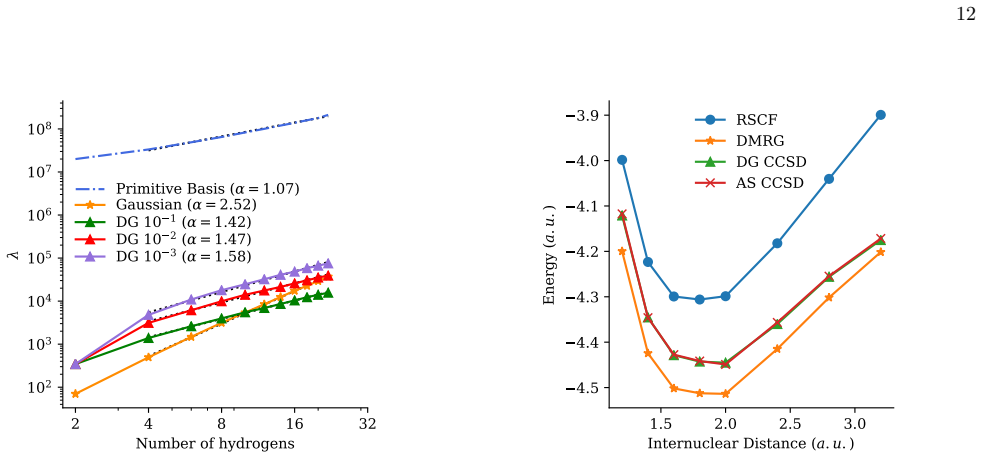
- The DG representation also lowers the $\lambda$ factor compared with the Gaussian active space on the tested chains (roughly $\lambda\propto N^{1.5}$ versus $N^{2.5}$), which benefits both fault-tolerant cost and measurement counts in variational algorithms.
Reading between the lines
- One testable extension is to iterate the construction self-consistently: use a trial density matrix to define the active space, build the DG basis, recompute the density, and repeat; the paper's hybrid weighting recipe suggests this tuning could be made systematic.
- If the per-block function count remains bounded in higher dimensions, the block-diagonal sparsity should transfer to plate or bulk systems; numerical checks on two-dimensional hydrogen clusters would test whether the chain results generalize.
- The block-local form should reduce the entanglement burden of any tensor-network method, not only DMRG, because inter-block correlation is carried only through block-interaction terms; tree tensor networks might inherit a similar speedup.
- The LCU estimate counts all non-zero integrals, but the block structure may allow further compression through blockwise low-rank factors, which would lower constants beyond the quoted crossover; the paper notes but does not quantify this possibility.
Editorial analysis
A structured set of objections, weighed in public.
Referee Report
Summary. The paper introduces a discontinuous Galerkin (DG) discretization for second-quantized electronic structure, obtained by partitioning a diagonal primitive basis into spatial blocks and SVD-compressing the projection of an active-space basis onto each block. The resulting DG basis has a block-diagonal two-electron tensor, interpolating between dense molecular-orbital bases with O(N^4) integrals and diagonal primitive bases with O(N^2) integrals. For quantum simulation, the authors design swap networks and LCU-based methods exploiting the block structure, and they report empirical scaling for hydrogen chains: the number of nonzero two-electron integrals grows as roughly N^{2.0-2.3}, lambda as N^{1.4-1.6}, leading to a claimed fault-tolerant evolution cost of O(N^{2.6}) versus O(N^{4.5}) for the Gaussian active-space basis, with a crossover around 15-20 atoms. They also test the DG basis in classical DMRG calculations, reporting one to two orders of magnitude speedups while maintaining accuracy relative to the complete basis set limit.
Significance. If the central scaling claims hold, this is a valuable contribution: it provides a concrete, systematic way to interpolate between diagonal and compact non-diagonal discretizations, with algorithmic machinery (swap networks, LCU preparation, and a hybrid active-space construction) that is likely to be useful beyond the specific hydrogen-chain tests. The block-diagonal sparsity pattern is derived cleanly from the SVD construction and is internally consistent. The paper also makes an honest empirical contribution by testing the representation in correlated DMRG calculations and reporting crossover data, rather than only presenting asymptotic arguments. However, the headline quantitative claims rest on fitted exponents and on the unproven constancy of the per-block DG basis count n_kappa at fixed physical accuracy; these are empirical rather than derived, and the manuscript itself labels the constancy of n_kappa as an expectation rather than a proven property.
major comments (3)
- [Section III, Eq. (8), and Figure 8] The asymptotic claims O(N_d^2) integral scaling, O(N^{2.6}) fault-tolerant evolution cost, and the 15-20 atom crossover all depend on n_kappa remaining O(1) at fixed accuracy as the system grows. Section III states this as an expectation ("we expect ... n_kappa ... bounded by a constant"), and Figure 8 substantiates it only for fixed SVD truncation tolerance tau, not for a fixed physical accuracy target. No convergence analysis links tau to the per-electron or total energy error, so the data do not exclude n_kappa growing with system size for delocalized, metallic, or strongly correlated systems. If n_kappa grows, the claimed scaling advantages degrade. The manuscript should either provide an error bound or rigorous argument for n_kappa at fixed accuracy, or present additional numerical evidence with error bars, including a test case with delocalized or strongly correlated orbitals.
- [Section V A, Figures 9-10, Table I] The headline exponent O(N^{2.6}) is obtained by fitting log-log slopes to L and lambda over hydrogen chains from N=2 to N=32 with no reported residuals or confidence intervals and with an integral-counting threshold of 10^{-6}. The fitted exponents themselves vary with the SVD tolerance (alpha_L = 2.03, 2.18, 2.34 and alpha_lambda = 1.42, 1.47, 1.58 for tau = 10^{-1}, 10^{-2}, 10^{-3}), giving cost exponents between about 2.44 and 2.75 rather than a robust 2.6. The crossover is also parameter-dependent, ranging from H6-H8 to H20-H22 in Table I depending on tolerance and bond length. The authors should report the fitting procedure and uncertainties, quantify sensitivity to the integral-counting threshold, and present the crossover as a range of system sizes for specific tolerances rather than as a single universal statement.
- [Section V A and Conclusion] The comparison baseline O(N^{4.5}) is described as applying "when not exploiting further low rank structure," yet the text immediately notes that state-of-the-art molecular-orbital algorithms use low-rank factorization to achieve O(N_a^{3/2} lambda t). With the paper's own empirical lambda ~ N^{2.5}, that improved molecular-orbital cost would be O(N^4), not O(N^{4.5}). Since the abstract and conclusion advertise a reduction "from O(N^{4.5}) to O(N^{2.6})," the baseline should be clarified and benchmarked against the best available molecular-orbital algorithm, or the authors should explicitly justify why the low-rank improvement is unavailable in the comparison. The qualitative DG advantage may survive this correction, but the headline factor would change.
minor comments (5)
- [Section V A, Figure 8] The text says "the average number of DG-basis per atom" while the construction groups primitive functions into spatial blocks, and in these hydrogen-chain runs there is one block per atom; please clarify the relation between blocks and atoms consistently in text, captions, and axis labels.
- [Figures 9-10 and Table I] The notation "DG 10 1" should read "DG 10^{-1}" or similar, and the exponents in the legends appear without their defining symbol; please label them as alpha or state explicitly that the shown numbers are the fitted power-law exponents.
- [Appendix B, Eq. (B1)] The notation excludes terms "{p = r, q = s}" but the meaning of p, q, r, s here is not defined in the appendix; please spell out the index convention used in the lambda computation.
- [Section IV A] The sentence giving the depth as O(N_b n_kappa^3) = O(N_d n_kappa^2) is correct only up to constants and the assumption of roughly equal block sizes; it would help to state that this is an asymptotic statement under that assumption.
- [Appendix B, Table I] Table I contains valuable crossover information but is not referenced in the main text where the 15-20 atom crossover is claimed; please add a pointer so the parameter dependence of the crossover is transparent to readers.
Circularity Check
No significant circularity: block-diagonal structure is a theorem of the DG construction, and the O(N^2.6) cost claim is explicitly empirical, not a fit renamed as a prediction.
full rationale
The DG basis is defined by a blockwise SVD of the active-space coefficient matrix (Eqs. 8-9), and the two-electron tensor in Eq. (14) inherits the primitive diagonal form, giving Eq. (16). The block-diagonal sparsity and the count O(N_b^2 n_kappa^4) follow by direct substitution and exact counting; they do not assume the conclusion. The swap-network depths are combinatorial results from the cited algorithm literature, and the LCU cost formula is taken from prior quantum-algorithm work. The scaling statement O(N_h^2.6) is introduced as 'Empirical results ... suggest' and is obtained by fitting the paper's own L and lambda curves in Figures 9-10; it is a measured finite-size scaling on hydrogen chains, not a parameter fitted to one subset and then claimed as an independent prediction. The premise that n_kappa is asymptotically constant is an explicitly stated expectation, supported numerically at fixed SVD tolerances in Figure 8; whether fixed tolerance implies fixed physical accuracy is a correctness/scoping question, not a circular reduction. Self-citations to Gausslets, adaptive local bases, and swap networks supply prior constructional or algorithmic content and are not used as unverified uniqueness theorems. No load-bearing step reduces to its own input by definition.
Assumptions & free parameters
free parameters (4)
- SVD truncation tolerance tau =
10^-1, 10^-2, 10^-3
- Hybrid active space weighting alpha =
0.01
- Integral zero threshold =
10^-6
- Plane wave kinetic energy cutoff =
20 hartree
assumptions (5)
- domain assumption The primitive basis has a diagonal two-electron operator, v_mu,sigma;gamma,nu approximately v_mu,nu delta_mu,sigma delta_gamma,nu.
- domain assumption Point sampling of Gaussian or molecular-orbital functions in the primitive basis accurately represents the active space.
- ad hoc to paper The number of DG basis functions per block, n_kappa, remains constant as system size grows for fixed accuracy.
- standard math The LCU/qubitization cost model with T-complexity scaling as O(sqrt(L) lambda t) is valid for the Hamiltonians considered.
- domain assumption ONCV pseudopotential plane-wave calculations reproduce the relevant accuracy of the target Gaussian active space.
Cite this review
Pith. "Pith review of Discontinuous Galerkin discretization for quantum simulation of chemistry." pith.science (2026). https://pith.science/paper/JEUGLWBN
@misc{pith2026190900028,
  author       = {Pith},
  title        = {Pith review of: Discontinuous Galerkin discretization for quantum simulation of chemistry},
  year         = {2026},
  howpublished = {\url{https://pith.science/paper/JEUGLWBN}},
  note         = {Machine review of arXiv:1909.00028}
}
abstract
Methods for electronic structure based on Gaussian and molecular orbital discretizations offer a well established, compact representation that forms much of the foundation of correlated quantum chemistry calculations on both classical and quantum computers. Despite their ability to describe essential physics with relatively few basis functions, these representations can suffer from a quartic growth of the number of integrals. Recent results have shown that, for some quantum and classical algorithms, moving to representations with diagonal two-body operators can result in dramatically lower asymptotic costs, even if the number of functions required increases significantly. We introduce a way to interpolate between the two regimes in a systematic and controllable manner, such that the number of functions is minimized while maintaining a block diagonal structure of the two-body operator and desirable properties of an original, primitive basis. Techniques are analyzed for leveraging the structure of this new representation on quantum computers. Empirical results for hydrogen chains suggest a scaling improvement from $O(N^{4.5})$ in molecular orbital representations to $O(N^{2.6})$ in our representation for quantum evolution in a fault-tolerant setting, and exhibit a constant factor crossover at 15 to 20 atoms. Moreover, we test these methods using modern density matrix renormalization group methods classically, and achieve excellent accuracy with respect to the complete basis set limit with a speedup of 1-2 orders of magnitude with respect to using the primitive or Gaussian basis sets alone. These results suggest our representation provides significant cost reductions while maintaining accuracy relative to molecular orbital or strictly diagonal approaches for modest-sized systems in both classical and quantum computation for correlated systems.
Figures


Figures from the paper (14 more)




Reference graph
Works this paper leans on
-
[1]
Two orbitals are from one block κ and two orbitals are from another blockκ′ (or all four from the same block when κ =κ′)
-
[2]
We will exploit both of these properties in constructing our swap network, which uses primitives originally de- signed for implementing unitary coupled cluster [59]
The orbital spins have even parity (i.e., all up, all down, or two and two). We will exploit both of these properties in constructing our swap network, which uses primitives originally de- signed for implementing unitary coupled cluster [59]. Figure 5 shows the overall swap network. Initially, the orbitals are arranged on the line in lexicographical or- d...
-
[3]
4-complete
The first layer acquaints all sets of four spin orbitals within each block in which all four orbitals have the same spin. This is achieved by a “4-complete” swap network on each half-block of orbitals, denoted by K 4 nκ/2 because the sets of orbitals it acquaints cor- respond to the edges of a complete 4-uniform hy- pergraph; it has depth O(n3 κ). Note tha...
-
[4]
double bipartite
The second layer acquaints all sets of four spin or- bitals within each block in which two orbitals have spin up and the other two have spin down. This is achieved by a “double bipartite” swap network on each block in depth O(n3 κ); see Figure 19
-
[5]
The third layer permutes, in O(nκ) depth, the or- bitals within each block in preparation for the inter- block acquaintances to follow
-
[6]
The rest of the strategy consists of Nb alternating layers that acquaint pairs of parts. In each layer, each block of qubits is paired up with an adjacent one and a “balanced double bipartite” swap net- work is executed on the pair of blocks; see Fig- ure 20. Each balanced double bipartite swap net- work acquaints the sets of four orbitals containing two ...
-
[7]
T. Helgaker, P. Jorgensen, and J. Olsen, Molecular electronic-structure theory (John Wiley & Sons, 2014)
work page 2014
-
[8]
Density matrix formulation for quan- tum renormalization groups,
S. R. White, “Density matrix formulation for quan- tum renormalization groups,” Phys. Rev. Lett. 69, 2863 (1992)
work page 1992
Show all 84 references
-
[9]
The density matrix renormalization group in quantum chemistry,
G. K.-L. Chan and S. Sharma, “The density matrix renormalization group in quantum chemistry,” Annu. Rev. Phys. Chem. 62, 465 (2011)
2011
-
[10]
Efficient tree tensor network states (ttns) for quantum chemistry: General- izations of the density matrix renormalization group al- gorithm,
N. Nakatani and G. K.-L. Chan, “Efficient tree tensor network states (ttns) for quantum chemistry: General- izations of the density matrix renormalization group al- gorithm,” J. Chem. Phys. 138, 134113 (2013)
2013
-
[11]
Tensor product meth- ods and entanglement optimization for ab initio quantum chemistry,
S. Szalay, M. Pfeffer, V. Murg, G. Barcza, F. Verstraete, R. Schneider, and ¨O. Legeza, “Tensor product meth- ods and entanglement optimization for ab initio quantum chemistry,” Int. J. Quantum Chem. 115, 1342 (2015)
2015
-
[12]
Simulation of Many-Body Fermi Systems on a Universal Quantum Computer,
D. S. Abrams and S. Lloyd, “Simulation of Many-Body Fermi Systems on a Universal Quantum Computer,” Phys. Rev. Lett. 79, 4 (1997)
1997
-
[13]
Quantum algorithms for fermionic simulations,
G. Ortiz, J. Gubernatis, E. Knill, and R. Laflamme, “Quantum algorithms for fermionic simulations,” Phys. Rev. A 64, 022319 (2001)
2001
-
[14]
Simulated Quantum Computation of Molecular Energies,
A. Aspuru-Guzik, A. D. Dutoi, P. J. Love, and M. Head- Gordon, “Simulated Quantum Computation of Molecular Energies,” Science 309, 1704 (2005)
2005
-
[15]
Gate-count estimates for performing quan- tum chemistry on small quantum computers,
D. Wecker, B. Bauer, B. K. Clark, M. B. Hastings, and M. Troyer, “Gate-count estimates for performing quan- tum chemistry on small quantum computers,” Phys. Rev. A 90, 1 (2014)
2014
-
[16]
Improving Quantum Algorithms for Quantum Chem- istry,
M. B. Hastings, D. Wecker, B. Bauer, and M. Troyer, “Improving Quantum Algorithms for Quantum Chem- istry,” Quantum Information & Computation 15, 1 (2015)
2015
-
[17]
Chemical Basis of Trotter-Suzuki Er- rors in Chemistry Simulation,
R. Babbush, J. McClean, D. Wecker, A. Aspuru-Guzik, and N. Wiebe, “Chemical Basis of Trotter-Suzuki Er- rors in Chemistry Simulation,” Phys. Rev. A 91, 022311 (2015)
2015
-
[18]
Exploiting locality in quantum computation for quantum chemistry,
J. R. McClean, R. Babbush, P. J. Love, and A. Aspuru- Guzik, “Exploiting locality in quantum computation for quantum chemistry,” J. Phys. Chem. Lett. 5, 4368 (2014)
2014
-
[19]
Hybrid Quantum-Classical Hierarchy for Mit- igation of Decoherence and Determination of Excited States,
J. R. McClean, M. E. Schwartz, J. Carter, and W. A. de Jong, “Hybrid Quantum-Classical Hierarchy for Mit- igation of Decoherence and Determination of Excited States,” Phys. Rev. A 95, 042308 (2017)
2017
-
[20]
Exponentially More Precise Quantum Simulation of Fermions in Second Quantization,
R. Babbush, D. W. Berry, I. D. Kivlichan, A. Y. Wei, P. J. Love, and A. Aspuru-Guzik, “Exponentially More Precise Quantum Simulation of Fermions in Second Quantization,” New J. Phys. 18, 033032 (2016)
2016
-
[21]
The theory of variational hybrid quantum- classical algorithms,
J. R. McClean, J. Romero, R. Babbush, and A. Aspuru- Guzik, “The theory of variational hybrid quantum- classical algorithms,” New J. Phys. 18, 23023 (2016)
2016
-
[22]
Towards quantum chemistry on a quantum computer,
B. P. Lanyon, J. D. Whitfield, G. G. Gillett, M. E. Goggin, M. P. Almeida, I. Kassal, J. D. Biamonte, M. Mohseni, B. J. Powell, M. Barbieri, A. Aspuru-Guzik, and A. G. White, “Towards quantum chemistry on a quantum computer,” Nat. Chem. 2, 106 (2010)
2010
-
[23]
NMR implementation of a molecular hydrogen quantum simulation with adiabatic state preparation,
J. Du, N. Xu, X. Peng, P. Wang, S. Wu, and D. Lu, “NMR implementation of a molecular hydrogen quantum simulation with adiabatic state preparation,” Phys. Rev. Lett. 104, 030502 (2010)
2010
-
[24]
A variational eigenvalue solver on a photonic quantum processor,
A. Peruzzo, J. McClean, P. Shadbolt, M.-H. Yung, X.-Q. Zhou, P. J. Love, A. Aspuru-Guzik, and J. L. O’Brien, “A variational eigenvalue solver on a photonic quantum processor,” Nat. Commun. 5, 1 (2014)
2014
-
[25]
Quantum Implementation of Unitary Cou- pled Cluster for Simulating Molecular Electronic Struc- ture,
Y. Shen, X. Zhang, S. Zhang, J.-N. Zhang, M.-H. Yung, and K. Kim, “Quantum Implementation of Unitary Cou- pled Cluster for Simulating Molecular Electronic Struc- ture,” e-print arXiv: 1506:00443 (2015)
2015
-
[26]
Quantum simulation of Hamiltonian spectra on a silicon chip,
R. Santagati, J. Wang, A. Gentile, S. Paesani, N. Wiebe, J. McClean, S. Short, P. Shadbolt, D. Bonneau, J. Silver- stone, D. Tew, X. Zhou, J. OBrien, and M. Thompson, “Quantum simulation of Hamiltonian spectra on a silicon chip,” e-print arXiv: 1611.03511 (2016)
2016 arXiv
-
[27]
Scalable Quantum Simulation of Molec- ular Energies,
P. J. J. O’Malley, R. Babbush, I. D. Kivlichan, J. Romero, J. R. McClean, R. Barends, J. Kelly, P. Roushan, A. Tranter, N. Ding, B. Campbell, Y. Chen, Z. Chen, B. Chiaro, A. Dunsworth, A. G. Fowler, E. Jef- frey, A. Megrant, J. Y. Mutus, C. Neill, C. Quintana, D. Sank, A. Vain...
2016
-
[28]
Computation of molecular spectra on a quantum processor with an error-resilient algorithm,
J. Colless, V. Ramasesh, D. Dahlen, M. Blok, M. Kimchi- Schwartz, J. McClean, J. Carter, W. De Jong, and I. Sid- diqi, “Computation of molecular spectra on a quantum processor with an error-resilient algorithm,” Phys. Rev. X 8, 011021 (2018)
2018
-
[29]
Hardware-efficient variational quantum eigensolver for small molecules and quantum magnets,
A. Kandala, A. Mezzacapo, K. Temme, M. Takita, M. Brink, J. M. Chow, and J. M. Gambetta, “Hardware-efficient variational quantum eigensolver for small molecules and quantum magnets,” Nature549, 242 (2017)
2017
-
[30]
Cloud quantum computing of an atomic nucleus,
E. F. Dumitrescu, A. J. McCaskey, G. Hagen, G. R. Jansen, T. D. Morris, T. Papenbrock, R. C. Pooser, D. J. Dean, and P. Lougovski, “Cloud quantum computing of an atomic nucleus,” Phys. Rev. Lett. 120, 210501 (2018)
2018
-
[31]
Quantum Chemistry Calculations on a Trapped-Ion Quantum Sim- ulator,
C. Hempel, C. Maier, J. Romero, J. McClean, T. Monz, H. Shen, P. Jurcevic, B. Lanyon, P. Love, R. Babbush, A. Aspuru-Guzik, R. Blatt, and C. Roos, “Quantum Chemistry Calculations on a Trapped-Ion Quantum Sim- ulator,” Physical Review X 8, 031022 (2018)
2018
-
[32]
Gaussian basis sets for use in corre- lated molecular calculations. i. the atoms boron through neon and hydrogen,
T. H. Dunning Jr, “Gaussian basis sets for use in corre- lated molecular calculations. i. the atoms boron through neon and hydrogen,” J. Chem. Phys. 90, 1007 (1989)
1989
-
[33]
Electron affinities of the first-row atoms revisited. sys- tematic basis sets and wave functions,
R. A. Kendall, T. H. Dunning Jr, and R. J. Harrison, “Electron affinities of the first-row atoms revisited. sys- tematic basis sets and wave functions,” J. Chem. Phys. 96, 6796 (1992)
1992
-
[34]
Gaussian basis sets for use in correlated molecular calculations. iii. the atoms aluminum through argon,
D. E. Woon and T. H. Dunning Jr, “Gaussian basis sets for use in correlated molecular calculations. iii. the atoms aluminum through argon,” J. Chem. Phys. 98, 1358 (1993)
1993
-
[35]
Linear scaling electronic structure meth- ods,
S. Goedecker, “Linear scaling electronic structure meth- ods,” Reviews of Modern Physics 71, 1085 (1999)
1999
-
[36]
Ahlrichs, H
R. Ahlrichs, H. Lischka, V. Staemmler, and W. Kutzel- nigg, “Pno–ci (pair natural orbital configuration interac- tion) and cepa–pno (coupled electron pair approximation with pair natural orbitals) calculations of molecular sys- tems. i. outline of the method for closed-shell st...
1975
-
[37]
Natural triple excitations in local coupled cluster calcu- lations with pair natural orbitals,
C. Riplinger, B. Sandhoefer, A. Hansen, and F. Neese, “Natural triple excitations in local coupled cluster calcu- lations with pair natural orbitals,” J. Chem. Phys. 139, 134101 (2013)
2013
-
[38]
An efficient and near linear scaling pair natural orbital based local coupled cluster method,
C. Riplinger and F. Neese, “An efficient and near linear scaling pair natural orbital based local coupled cluster method,” J. Chem. Phys. 138, 034106 (2013)
2013
-
[39]
Sliced basis density matrix renormalization group for electronic structure,
E. M. Stoudenmire and S. R. White, “Sliced basis density matrix renormalization group for electronic structure,” Phys. Rev. Lett. 119, 046401 (2017)
2017
-
[40]
Hybrid grid/basis set discretizations of the schr¨ odinger equation,
S. R. White, “Hybrid grid/basis set discretizations of the schr¨ odinger equation,” J. Chem. Phys.147, 244102 (2017)
2017
-
[41]
Multisliced gaus- slet basis sets for electronic structure,
S. R. White and E. M. Stoudenmire, “Multisliced gaus- slet basis sets for electronic structure,” Phys. Rev. B 99, 081110 (2019)
2019
-
[42]
Low-depth quantum simulation of materials,
R. Babbush, N. Wiebe, J. McClean, J. McClain, H. Neven, and G. K.-L. Chan, “Low-depth quantum simulation of materials,” Phys. Rev. X 8, 011044 (2018)
2018
-
[43]
Encoding electronic spectra in quantum circuits with linear t com- plexity,
R. Babbush, C. Gidney, D. W. Berry, N. Wiebe, J. Mc- Clean, A. Paler, A. Fowler, and H. Neven, “Encoding electronic spectra in quantum circuits with linear t com- plexity,” Phys. Rev. X 8, 041015 (2018)
2018
-
[44]
Qubitization of Arbitrary Basis Quantum Chem- istry by Low Rank Factorization,
D. Berry, C. Gidney, M. Motta, J. McClean, and R. Bab- bush, “Qubitization of Arbitrary Basis Quantum Chem- istry by Low Rank Factorization,” arXiv:1902.02134 (2019)
2019 arXiv
-
[45]
Low Rank Represen- tations for Quantum Simulation of Electronic Structure,
M. Motta, E. Ye, J. R. McClean, Z. Li, A. J. Minnich, R. Babbush, and G. K.-L. Chan, “Low Rank Represen- tations for Quantum Simulation of Electronic Structure,” arXiv:1808.02625 (2018)
2018 arXiv
-
[46]
Quantum Simulation of Chemistry with Sublinear Scal- ing to the Continuum,
R. Babbush, D. W. Berry, J. R. McClean, and H. Neven, “Quantum Simulation of Chemistry with Sublinear Scal- ing to the Continuum,” arXiv:1807.09802 (2018)
2018 arXiv
-
[47]
Hamiltonian Simulation in the Interaction Picture,
G. H. Low and N. Wiebe, “Hamiltonian Simulation in the Interaction Picture,” arXiv:1805.00675 (2018)
2018 arXiv
-
[48]
Exponentially More Precise Quantum Simula- tion of Fermions in the Configuration Interaction Repre- sentation,
R. Babbush, D. W. Berry, Y. R. Sanders, I. D. Kivlichan, A. Scherer, A. Y. Wei, P. J. Love, and A. Aspuru- Guzik, “Exponentially More Precise Quantum Simula- tion of Fermions in the Configuration Interaction Repre- sentation,” Quantum Sci. Technol. 3, 015006 (2018)
2018
-
[49]
Adaptive local basis set for Kohn-Sham density functional theory in a discon- tinuous Galerkin framework I: Total energy calculation,
L. Lin, J. Lu, L. Ying, and W. E, “Adaptive local basis set for Kohn-Sham density functional theory in a discon- tinuous Galerkin framework I: Total energy calculation,” J. Comput. Phys. 231, 2140 (2012)
2012
-
[50]
DGDFT: A massively parallel method for large scale density functional theory calculations,
W. Hu, L. Lin, and C. Yang, “DGDFT: A massively parallel method for large scale density functional theory calculations,” J. Chem. Phys. 143, 124110 (2015)
2015
-
[51]
Chebyshev polynomial filtered subspace itera- tion in the discontinuous galerkin method for large-scale electronic structure calculations,
A. S. Banerjee, L. Lin, W. Hu, C. Yang, and J. E. Pask, “Chebyshev polynomial filtered subspace itera- tion in the discontinuous galerkin method for large-scale electronic structure calculations,” J. Chem. Phys. 145, 154101 (2016)
2016
-
[52]
Two-level Chebyshev filter based comple- mentary subspace method for pushing the envelope of large-scale electronic structure calculations,
A. S. Banerjee, L. Lin, P. Suryanarayana, C. Yang, and J. E. Pask, “Two-level Chebyshev filter based comple- mentary subspace method for pushing the envelope of large-scale electronic structure calculations,” J. Chem. Theory Comput. 14, 2930 (2018)
2018
-
[53]
Globally constructed adaptive local basis set for spectral projectors of second order differen- tial operators,
Y. Li and L. Lin, “Globally constructed adaptive local basis set for spectral projectors of second order differen- tial operators,” Multiscale Model. Simul. 17, 92 (2019)
2019
-
[54]
An interior penalty finite element method with discontinuous elements,
D. N. Arnold, “An interior penalty finite element method with discontinuous elements,” SIAM J. Numer. Anal.19, 742 (1982)
1982
-
[55]
The development of discontinuous galerkin methods,
B. Cockburn, G. E. Karniadakis, and C.-W. Shu, “The development of discontinuous galerkin methods,” in Dis- continuous Galerkin Methods (Springer, 2000) pp. 3–50
2000
-
[56]
Edge reconstruction in armchair phosphorene nanoribbons revealed by discon- tinuous galerkin density functional theory,
W. Hu, L. Lin, and C. Yang, “Edge reconstruction in armchair phosphorene nanoribbons revealed by discon- tinuous galerkin density functional theory,” Phys. Chem. Chem. Phys. 17, 31397 (2015)
2015
-
[57]
Adaptive local basis set for kohn–sham density func- tional theory in a discontinuous galerkin framework ii: Force, vibration, and molecular dynamics calculations,
G. Zhang, L. Lin, W. Hu, C. Yang, and J. E. Pask, “Adaptive local basis set for kohn–sham density func- tional theory in a discontinuous galerkin framework ii: Force, vibration, and molecular dynamics calculations,” J. Comput. Phys. 335, 426 (2017)
2017
-
[58]
Discrete discontinuous basis projection method for large-scale electronic structure calculations,
Q. Xu, P. Suryanarayana, and J. E. Pask, “Discrete discontinuous basis projection method for large-scale electronic structure calculations,” J. Chem. Phys. 149, 094104 (2018)
2018
-
[59]
Finite element methods in ab initio electronic structure calculations,
J. E. Pask and P. A. Sterne, “Finite element methods in ab initio electronic structure calculations,” Modelling Simul. Mater. Sci. Eng. 13, R71 (2005)
2005
-
[60]
Adap- tive finite element approximations for Kohn–Sham mod- els,
H. Chen, X. Dai, X. Gong, L. He, and A. Zhou, “Adap- tive finite element approximations for Kohn–Sham mod- els,” Multiscale Model. Simul. 12, 1828 (2014)
2014
-
[61]
Large-scale all-electron density functional theory calculations using an enriched finite-element basis,
B. Kanungo and V. Gavini, “Large-scale all-electron density functional theory calculations using an enriched finite-element basis,” Phys. Rev. B 95, 035112 (2017)
2017
-
[62]
A review on non-relativistic, fully numerical electronic structure calculations on atoms and diatomic molecules,
S. Lehtola, “A review on non-relativistic, fully numerical electronic structure calculations on atoms and diatomic molecules,” Int. J. Quantum Chem. 0, e25968 (2019)
2019
-
[63]
Quantum simulation of electronic structure with linear depth and connectivity,
I. D. Kivlichan, J. McClean, N. Wiebe, C. Gidney, A. Aspuru-Guzik, G. K.-L. Chan, and R. Babbush, “Quantum simulation of electronic structure with linear depth and connectivity,” Phys. Rev. Lett. 120, 110501 (2018)
2018
-
[64]
Fermionic quantum computa- tion,
S. Bravyi and A. Kitaev, “Fermionic quantum computa- tion,” Annals of Physics 298, 210 (2002)
2002
-
[65]
Generalized swap networks for near-term quantum computing,
B. O’Gorman, W. J. Huggins, E. G. Rieffel, and K. B. Whaley, “Generalized swap networks for near-term quantum computing,” arXiv preprint arXiv:1905.05118 (2019)
2019 arXiv
-
[66]
Quantum measurements and the Abelian Stabilizer Problem,
A. Y. Kitaev, “Quantum measurements and the Abelian Stabilizer Problem,” arXiv:9511026 (1995)
1995
-
[67]
Quantum Algorithm Pro- viding Exponential Speed Increase for Finding Eigenval- ues and Eigenvectors,
D. S. Abrams and S. Lloyd, “Quantum Algorithm Pro- viding Exponential Speed Increase for Finding Eigenval- ues and Eigenvectors,” Physical Review Letters 83, 5162 (1999)
1999
-
[68]
Progress Towards Practical Quantum Variational Algorithms,
D. Wecker, M. B. Hastings, and M. Troyer, “Progress Towards Practical Quantum Variational Algorithms,” Physical Review A 92, 42303 (2015)
2015
-
[69]
Hamiltonian simulation us- ing linear combinations of unitary operations,
A. M. Childs and N. Wiebe, “Hamiltonian simulation us- ing linear combinations of unitary operations,” Quantum Information & Computation 12, 901 (2012)
2012
-
[70]
Simulating Hamiltonian Dynamics with a Truncated Taylor Series,
D. W. Berry, A. M. Childs, R. Cleve, R. Kothari, and R. D. Somma, “Simulating Hamiltonian Dynamics with a Truncated Taylor Series,” Physical Review Letters 114, 90502 (2015)
2015
-
[71]
Hamiltonian Simulation by Qubitization,
G. H. Low and I. L. Chuang, “Hamiltonian Simulation by Qubitization,” arXiv:1610.06546 (2016)
2016 arXiv
-
[72]
Encoding Electronic Spectra in Quantum Circuits with Linear T Complexity,
R. Babbush, C. Gidney, D. Berry, N. Wiebe, J. McClean, A. Paler, A. Fowler, and H. Neven, “Encoding Electronic Spectra in Quantum Circuits with Linear T Complexity,” Physical Review X 8, 041015 (2018)
2018
-
[73]
Trading T-gates for dirty qubits in state preparation and unitary synthesis,
G. H. Low, V. Kliuchnikov, and L. Schaeffer, “Trading T-gates for dirty qubits in state preparation and unitary synthesis,” arXiv:1812.00954 (2018). 17
2018 arXiv
-
[74]
Application of Fermionic Marginal Constraints to Hybrid Quantum Algorithms,
N. Rubin, R. Babbush, and J. McClean, “Application of Fermionic Marginal Constraints to Hybrid Quantum Algorithms,” New Journal of Physics 20, 053020 (2018)
2018
-
[75]
Generalized gradient approximation made simple,
J. P. Perdew, K. Burke, and M. Ernzerhof, “Generalized gradient approximation made simple,” Phys. Rev. Lett. 77, 3865 (1996)
1996
-
[76]
Optimized norm-conserving vanderbilt pseudopotentials,
D. Hamann, “Optimized norm-conserving vanderbilt pseudopotentials,” Phys. Rev. B 88, 085117 (2013)
2013
-
[77]
Ks- solva matlab toolbox for solving the kohn-sham equa- tions,
C. Yang, J. C. Meza, B. Lee, and L.-W. Wang, “Ks- solva matlab toolbox for solving the kohn-sham equa- tions,” ACM Trans. Math. Software 36, 10 (2009)
2009
-
[78]
Towards the solution of the many-electron problem in real materials: Equation of state of the hydrogen chain with state-of- the-art many-body methods,
M. Motta, D. M. Ceperley, G. K.-L. Chan, J. A. Gomez, E. Gull, S. Guo, C. A. Jim´ enez-Hoyos, T. N. Lan, J. Li, F. Ma, A. J. Millis, N. V. Prokof’ev, U. Ray, G. E. Scuse- ria, S. Sorella, E. M. Stoudenmire, Q. Sun, I. S. Tupitsyn, S. R. White, D. Zgid, and S. Zhang (Simons Col...
2017
-
[79]
Self-consistent Hartree- Fock and screened-exchange calculations in solids: Ap- plication to silicon,
F. Gygi and A. Baldereschi, “Self-consistent Hartree- Fock and screened-exchange calculations in solids: Ap- plication to silicon,” Phys. Rev. B 34, 4405 (1986)
1986
-
[80]
Parallel implementation of γ- point pseudopotential plane-wave DFT with exact ex- change,
E. J. Bylaska, K. Tsemekhman, S. B. Baden, J. H. Weare, and H. Jonsson, “Parallel implementation of γ- point pseudopotential plane-wave DFT with exact ex- change,” J. Comput. Chem. 32, 54 (2011). Appendix A: T rotter step by low-rank factorization As an alternative to the fixed...
2011
-
[81]
This acquaints all sets of 4 orbitals with the same spin and within each block
A 4-complete swap network within each half-block. This acquaints all sets of 4 orbitals with the same spin and within each block
-
[82]
This acquaints all sets of 4 orbitals with no net spin and within each block
A double bipartite swap network on each block. This acquaints all sets of 4 orbitals with no net spin and within each block. Details of the construction are given in Figure 19
-
[83]
This changes 20 = FIG
A permutation within each block. This changes 20 = FIG. 18. Notation and decomposition for a P-swap network with partition sizes (1, 2, 1, 2, 2). A P-swap network for a partition (P1,P 2,...,P |P|) of the qubits ⋃ iPi acquaints every union of a pair of parts, i.e., {P ∪P′|P,P′...
-
[84]
Each balanced double bipartite swap network acquaints, for some pair of blocks, all sets of 4 orbitals with an even number of each spin and with two orbitals from each block
Alternating layers of balanced double bipartite swap networks. Each balanced double bipartite swap network acquaints, for some pair of blocks, all sets of 4 orbitals with an even number of each spin and with two orbitals from each block. TheNb alternating layers ensure that ev...
Reviewed August 14, 2026 · model on record in the stance chip above.
Discussion (0). Continue with ORCID to comment.