REVIEW 3 major objections 4 minor 84 references
Eternal Inflation in Swampy Landscapes
T0 review · 3 major / 4 minor · reviewed 2026-08-14 · deepseek-v4-flash
Pith's one-line read Eternal inflation survives even in swampy landscapes
desk verdict Eternal inflation probably survives in swampy landscapes, but the paper's quantitative claims ride on a flyover rate estimate that is not under control. read the letter →
The pith
A machine-rendered reading of the paper's core claim, the machinery that carries it, and where it could break.
The reading
What carries the argument
Two mechanisms carry the argument. The first is the flyover transition: a quantum fluctuation gives the scalar field a large time derivative in a roughly spherical super-horizon region, letting it climb over potential barriers and land in a different vacuum without an instanton; its rate is estimated using the free-field variance of $\dot\phi$ in de Sitter space, Eqs. (9)–(13). The second is the compact 'creation from nothing' instanton in a potential whose maxima and saddles are too curved for hilltop inflation: a deformed Euclidean 4-sphere with the scalar field interpolating between two sides of a maximum, whose Lorentzian continuation gives a (2+1)-dimensional de Sitter bubble wall with open FRW regions on both sides. The same instanton doubles as the description of bubble-wall nucleation during slow-roll inflation, and flyover nucleation provides a non-instanton alternative. Numerical simulations establish the key spacetime outcomes: flyover regions end up inside black holes (mass $M\sim H_d^{-1}$) or AdS bubbles, and wormholes formed in wall nucleation collapse to black holes of radius about 1.2 times the wormhole radius at horizon crossing.
What would settle it
A direct lattice or interacting-field computation of the rate of super-horizon scalar velocity fluctuations in de Sitter space: if the rate is exponentially smaller than the free-field estimate of Eq. (13), the rare-dS multiverse loses its inter-island connections and eternal inflation in that scenario fails. For the no-dS scenario, a scan of generic potentials satisfying the refined swampland bound $|V''/V|>4/3$ at maxima: if compact instantons interpolating across the maximum exist only for fine-tuned examples (such as their Eq. (34)) and not generically, the bubble-wall mechanism would not fill the landscape.
Extended reading notes
Core claim
On the paper's own terms, the central claim is that eternal inflation is a robust feature of the multiverse even when the swampland conjectures severely deplete the landscape: in both scenarios studied, inflation is eternal and all parts of the landscape that can support inflation get represented in the multiverse. In the rare-dS scenario the connecting channel is provided by flyover transitions—coherent super-horizon velocity fluctuations that carry the field over potential barriers—whose rates are estimated from free-field fluctuations in de Sitter space and which populate every dS island, with new inflating regions hidden inside black holes or AdS bubbles. In the no-dS scenario, quantum creation from nothing is described by a compact Euclidean instanton whose Lorentzian continuation yields a bubble wall that inflates forever, so the universe is eternally inflating even though no hilltop supports stochastic eternal inflation.
Load-bearing premise
The load-bearing assumption is that coherent, roughly spherical super-horizon velocity fluctuations of the scalar field occur in de Sitter space at the rates estimated from free-field formulas, and that the field and metric outside the fluctuation region stay homogeneous.
Editorial extensions
If this is right
- In a landscape where dS vacua are rare but present, the multiverse is still eternal: every de Sitter island is populated through flyover transitions, so no vacuum is unreachable.
- New inflating regions in the rare-dS case are typically isolated from us inside black holes or AdS bubbles, so the standard picture of direct bubble nucleation is replaced by a more intricate global structure.
- The standard anthropic prediction for the cosmological constant is not destroyed by wildly varying prior probabilities, provided the number of Standard-Model-like dS vacua in the anthropic window satisfies $N_{\rm dS}\gg 10^{284}$ (under the paper's estimates).
- If dS vacua are absent and hilltops are too steep for stochastic inflation, quantum creation from nothing still yields a universe with an eternally inflating bubble wall; the same instanton describes wall nucleation during slow-roll inflation, so inflationary regions keep populating the landscape.
- Inflationary regions formed by bubble walls end up in baby universes behind black hole horizons or in regions that eventually crunch, yet late-time Cauchy surfaces always contain an inflating region, so the multiverse has no end state without inflation.
Reading between the lines
- If flyover rates behave as estimated, the same mechanism could also mediate transitions in more general settings where instantons are absent—for example, between vacua separated by steep barriers—making quantum diffusion in field space more connected than tunneling-based analyses suggest.
- The paper's instanton construction suggests a concrete possible signature of swampy landscapes: primordial black holes formed from wormhole collapse after wall nucleation, with masses set by the horizon radius at crossing, might be a generic prediction distinct from standard cosmic-string or bubble-collision signatures.
- One could extend the analysis to the measure problem: volume fractions computed with scale-factor cutoff depend on inter-island flyover rates, so a precise prediction for $\Lambda$ in the rare-dS landscape would require the actual distribution of Hessian eigenvalues rather than the worst-case bound of Eq. (14).
Editorial analysis
A structured set of objections, weighed in public.
Referee Report
Summary. The paper explores how the swampland conjectures affect the multiverse structure. It considers two scenarios: (i) a landscape in which de Sitter (dS) vacua exist but are vastly outnumbered by AdS/Minkowski vacua, so Coleman-DeLuccia tunneling between dS islands may be absent; and (ii) a 'bubble wall landscape' in which no dS vacua exist and hilltop eternal inflation is excluded, but slow-roll inflation can occur on slopes near inflection points. In the first scenario the authors argue that 'flyover' transitions, in which the scalar field acquires a large coherent velocity fluctuation and climbs over intervening AdS/Minkowski barriers, connect isolated dS islands and keep inflation eternal, with new inflating regions forming inside black holes or AdS bubbles. In the second scenario they construct a compact Euclidean instanton whose Lorentzian continuation describes an inflating bubble wall, and they argue that wall nucleation plus flyover transitions lead to eternal inflation and populate all slow-roll regions. The paper supports these claims with order-of-magnitude rate estimates, a numerical simulation of a 1D landscape transition, a numerical instanton solution, and simulations of wormhole-to-black-hole evolution in Appendix A.
Significance. If the central claims hold, the paper would significantly broaden the conditions under which eternal inflation is robust: even in landscapes heavily constrained by swampland conjectures, with rare or absent dS vacua, the multiverse may still be eternally inflating, though with a spacetime structure different from the standard picture. The paper's strengths are its explicit numerical demonstrations (the 1D flyover simulation in Sec. II.B and the wormhole simulations in Appendix A), its transparent order-of-magnitude estimates, and its construction of a concrete instanton example in Sec. III.A. The qualitative conclusion that a single inflating bubble wall yields eternal inflation is well supported by the causal-diagram argument. However, the quantitative statements about volume fractions and the anthropic prediction for the cosmological constant rest on the flyover rate estimate, which is the least controlled ingredient in the paper.
major comments (3)
- [Sec. II.A.2, Eqs. (8)-(13) and the discussion after Eq. (15)] The flyover rate is the load-bearing input for the rare-dS scenario, but the estimate is not controlled in the regime V_d << V_p, which is needed for low-energy daughter vacua. The required fluctuation scale l ~ (H_p^2 H_d)^(-1/3) is much larger than the parent horizon, so the process is a coherent super-Hubble fluctuation over N ~ H_p/H_d causally independent patches. Equation (9) treats this as a Gaussian tail of the smeared free-field variance, which does not include the exponential suppression ~ exp(-S_l) associated with the entropy of the region. The authors themselves note that Eq. (13) can violate the dS recurrence bound (14), and they repair this only by an additivity assumption for dS entropy on super-Hubble scales. Since the volume-fraction estimates of Sec. II.C (notably Eq. (28)) and the anthropic analysis of Sec. II.D (Eqs. (29)-(32)) are controlled by inter-island rates, the quantitative claim that all parts of the landscape are represented and that the Lambda prediction survives is not yet established. The paper should either derive the super-Hubble rate including the entropy suppression or explicitly restrict the quantitative conclusions to the regime where the free-field estimate is valid.
- [Sec. II.A.2, paragraph following Eq. (13)] No transition-rate estimate is given for the case Delta V >> V_p, which is the regime relevant for upward transitions out of a low-energy dominant vacuum. Such upward transitions are the standard channel that populates other dS vacua in the multiverse picture discussed in Sec. II.C. Without a rate estimate for this case, the claim that 'all parts of the landscape that can support inflation get represented' in the rare-dS scenario lacks quantitative support, even if the qualitative statement about eternal inflation in an infinite parent vacuum remains plausible.
- [Sec. II.D, Eq. (32) and surrounding discussion] The condition N_dS >> 10^284 is presented as sufficient for a successful anthropic prediction of Lambda, but this conclusion assumes that the spread of prior probabilities is of order K ~ S-bar, with the dS recurrence bound (14) saturated. If the actual flyover rates are smaller than this bound, the spread in prior probabilities can be larger, making the required number of SM vacua larger; if the rates are larger, the volume-fraction hierarchy changes. Thus the anthropic conclusion is conditional on the same uncontrolled rate estimates flagged above, and Eq. (32) should be stated as an order-of-magnitude condition that is not yet robust.
minor comments (4)
- [Sec. II.B, Fig. 2 caption and Eq. (16)] The notation for the black hole mass estimate M ~ H_d^{-1} is dimensionally mixed with the convention M_p = 1; it would be clearer to restore explicit Planck-mass factors or state explicitly that all quantities are pure numbers in Planck units.
- [Sec. III.A, Figs. 5 and 6] The instanton solution is presented for one specific potential (Eq. (34)); the authors should state more explicitly which features of the solution are generic for the class of potentials allowed by the refined swampland conjecture, and which are peculiar to the example.
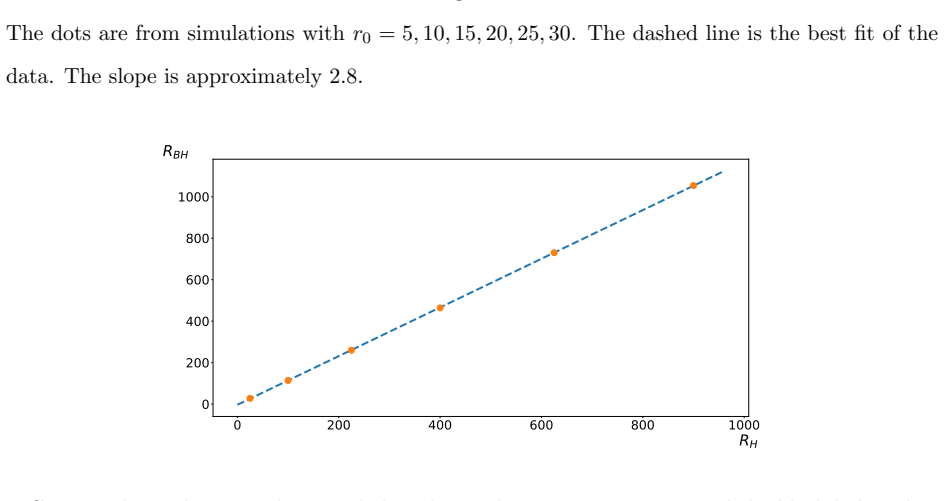
- [Appendix A] The numerical verification of wormhole-to-black-hole evolution is performed in a radiation-dominated universe rather than in the full scalar-field plus gravity system considered in Sec. III.D. This is a reasonable simplification, but the text should acknowledge that the quantitative relations t_BH ≈ 2.8 t_H and R_BH ≈ 1.2 R_H are only demonstrated in that simplified setting.
- [Sec. III.C, Eqs. (47)-(48)] The flyover wall-nucleation rate (48) relies on the variance estimate (47) with a coefficient 10^-2 imported from Ref. [46]. Since the authors show that tunneling dominates in the regimes considered, this uncertainty does not affect the main conclusion of Sec. III, but the caveat should be stated where Eq. (48) is introduced.
Circularity Check
No derivation reduces to its inputs; only a minor self-citation burden from Ref. [46] for flyover variance, not load-bearing for the qualitative eternal-inflation claim.
full rationale
The paper does not define its target into existence. In the rare-dS scenario, the transition rate (Eqs. (8)-(13)) is a Gaussian-tail estimate for a prescribed velocity fluctuation; the fluctuation profile is taken from the authors' prior Ref. [46], but the existence of non-tunneling transitions is independently attributed to Brown-Dahlen [45], and the paper's own simulations verify that such fluctuations, once prescribed, produce new inflating regions and the claimed black-hole/AdS-bubble structure. The numerical threshold C≈5 is a calibration for a sample potential, not a fit to the eternal-inflation verdict, and Eq. (13) is explicitly an order-of-magnitude estimate. The volume-fraction relation f_Y/f_X≈κ_YX/(κ_BY−κ_AX) follows from the rate equations rather than being assumed. In the bubble-wall scenario, the instanton is found by solving the Euclidean equations with stated boundary conditions; the wall's (2+1)-dimensional dS worldsheet is a property of the Lorentzian continuation, and the claim that late-time Cauchy surfaces always contain an inflating region follows from the causal structure of that solution. The principal weaknesses—coherent superhorizon velocity fluctuations and the entropy suppression of such fluctuations—are physical/correctness concerns about an imported ansatz, not circular reductions. The one mild self-citation burden is that the variance formulas (Eqs. (10)-(11)) and the flyover method are imported from Ref. [46] rather than re-derived here, but the qualitative conclusion only needs a nonzero transition rate, and the mechanism is separately demonstrated numerically, so this does not make the derivation circular.
Assumptions & free parameters
free parameters (4)
- Flyover numerical coefficient C in Eq. (8) =
C ≈ 5 (from simulation with l = 2 H_d^{-1})
- Potential coefficients in Eq. (34) =
V0 << 1; 0.001, 0.9, -0.16, 0.006
- SM fine-tuning fraction f_SM =
>~10^-100 (assumed)
- Fluctuation scale l =
l = 2 H_d^{-1}
assumptions (6)
- domain assumption The string landscape contains a vast number of vacua, including dS, AdS, and Minkowski states with densities specified by a random Gaussian potential.
- domain assumption The refined swampland conjecture is true, so no dS minima and no flat enough hilltops exist, while slow-roll slopes remain possible.
- domain assumption Flyover transitions occur: a quantum fluctuation can give a super-horizon region a large field velocity, after which evolution is classical (Sec. II.A.2, Eqs. (8)-(13)).
- domain assumption The scale-factor cutoff measure determines volume fractions (Sec. II.C).
- domain assumption Euclidean quantum gravity instantons describe creation from nothing and bubble nucleation (Sec. III.A).
- domain assumption The weak energy condition and standard causal structure arguments apply (Sec. III.D).
Cite this review
Pith. "Pith review of Eternal Inflation in Swampy Landscapes." pith.science (2026). https://pith.science/paper/EZT3ZMGW
@misc{pith2026190900068,
  author       = {Pith},
  title        = {Pith review of: Eternal Inflation in Swampy Landscapes},
  year         = {2026},
  howpublished = {\url{https://pith.science/paper/EZT3ZMGW}},
  note         = {Machine review of arXiv:1909.00068}
}
read the original abstract
The much-discussed swampland conjectures suggest significant constraints on the properties of string theory landscape and on the nature of the multiverse that this landscape can support. The conjectures are especially constraining for models of inflation; in particular, they exclude the existence of de Sitter (dS) vacua. If the conjectures are false and dS vacua do exist, it still appears that their construction in string theory requires a fair amount of fine-tuning, so they may be vastly outnumbered by AdS vacua. Here we explore the multiverse structure suggested by these considerations. We consider two scenarios: (i) a landscape where dS vacua are rare and (ii) a landscape where dS vacua do not exist and the dS potential maxima and saddle points are not flat enough to allow for the usual hilltop inflation, even though slow-roll inflation is possible on the slopes of the potential. We argue that in both scenarios inflation is eternal and all parts of the landscape that can support inflation get represented in the multiverse. The spacetime structure of the multiverse in such models is nontrivial and is rather different from the standard picture.
Figures


Figures from the paper (8 more)


Reference graph
Works this paper leans on
-
[1]
Tunneling transitions Consider now quantum decay of a metastable dS vacuum. We shall adopt a naive picture where the string landscape is locally represented by a random Gaussian field U(φ) charac- terized by an average value ¯U, a typical amplitude U0 and a correlation length ξ in field space. A simple analytic estimate of the tunneling action was given by ...
-
[2]
Non-tunneling transitions The above discussion assumes that quantum tunneling between dS vacua is possible. However, if the density of dS vacua is very low, most of them may be completely surrounded by AdS vacua, and Coleman-DeLuccia (CdL) instantons connecting such vacua may not exist.2 Some rare dS vacua would have other dS vacua in their vicinity and w...
- [3]
- [4]
-
[5]
M. R. Douglas, JHEP 05, 046 (2003), hep-th/0303194
arXiv 2003
- [6]
- [7]
-
[8]
M. R. Douglas and S. Kachru, Rev. Mod. Phys. 79, 733 (2007), hep-th/0610102
arXiv 2007
Show all 84 references
-
[9]
Vilenkin, Phys
A. Vilenkin, Phys. Rev. D27, 2848 (1983). 29
1983
-
[10]
A. A. Starobinsky, Lect. Notes Phys. 246, 107 (1986)
1986
-
[11]
A. D. Linde, Nucl. Phys. B372, 421 (1992), hep-th/9110037
1992 arXiv
- [12]
-
[13]
Agrawal, G
P. Agrawal, G. Obied, P. J. Steinhardt, and C. Vafa, Phys. Lett.B784, 271 (2018), 1806.09718
2018 arXiv
- [14]
- [15]
-
[16]
W. H. Kinney, S. Vagnozzi, and L. Visinelli, Class. Quant. Grav. 36, 117001 (2019), 1808.06424
2019 arXiv
-
[17]
S. K. Garg and C. Krishnan (2018), 1807.05193
2018 arXiv
-
[18]
M. Dias, J. Frazer, A. Retolaza, and A. Westphal, Fortsch. Phys. 67, 2 (2019), 1807.06579
2019 arXiv
- [19]
- [20]
-
[21]
K. Choi, D. Chway, and C. S. Shin, JHEP 11, 142 (2018), 1809.01475
2018 arXiv
-
[22]
Murayama, M
H. Murayama, M. Yamazaki, and T. T. Yanagida, JHEP 12, 032 (2018), 1809.00478
2018 arXiv
-
[23]
J. P. Conlon, Int. J. Mod. Phys. A33, 1850178 (2018), 1808.05040
2018 arXiv
-
[24]
J. J. Blanco-Pillado, M. A. Urkiola, and J. M. Wachter, JHEP 01, 187 (2019), 1811.05463
2019 arXiv
-
[25]
Olguin-Trejo, S
Y. Olguin-Trejo, S. L. Parameswaran, G. Tasinato, and I. Zavala, JCAP 1901, 031 (2019), 1810.08634
2019 arXiv
-
[26]
Ooguri, E
H. Ooguri, E. Palti, G. Shiu, and C. Vafa, Phys. Lett. B788, 180 (2019), 1810.05506
2019 arXiv
-
[27]
S. K. Garg, C. Krishnan, and M. Zaid Zaz, JHEP 03, 029 (2019), 1810.09406
2019 arXiv
- [28]
-
[29]
Motaharfar, V
M. Motaharfar, V. Kamali, and R. O. Ramos, Phys. Rev. D99, 063513 (2019), 1810.02816
2019 arXiv
- [30]
-
[31]
J. J. Heckman, C. Lawrie, L. Lin, J. Sakstein, and G. Zoccarato (2019), 1901.10489
2019 arXiv
- [32]
- [33]
-
[34]
W. H. Kinney, Phys. Rev. Lett. 122, 081302 (2019), 1811.11698
2019 arXiv
- [35]
-
[36]
Z. Wang, R. Brandenberger, and L. Heisenberg (2019), 1907.08943
2019 arXiv
- [37]
-
[38]
Dvali, C
G. Dvali, C. Gomez, and S. Zell, Fortsch. Phys. 67, 1800094 (2019), 1810.11002. 30
2019 arXiv
-
[39]
Rudelius, JCAP 2019, 009 (2020), 1905.05198
T. Rudelius, JCAP 2019, 009 (2020), 1905.05198
2020 arXiv
-
[40]
Kallosh, A
R. Kallosh, A. Linde, E. McDonough, and M. Scalisi, JHEP 03, 134 (2019), 1901.02022
2019 arXiv
-
[41]
Akrami, R
Y. Akrami, R. Kallosh, A. Linde, and V. Vardanyan, Fortsch. Phys. 67, 1800075 (2019), 1808.09440
2019 arXiv
- [42]
- [43]
-
[44]
A. R. Brown and A. Dahlen, Phys. Rev. D82, 083519 (2010), 1004.3994
2010 arXiv
-
[45]
Clifton, A
T. Clifton, A. D. Linde, and N. Sivanandam, JHEP 02, 024 (2007), hep-th/0701083
2007 arXiv
-
[46]
M. C. Johnson and I.-S. Yang, Phys. Rev. D82, 065023 (2010), 1005.3506
2010 arXiv
-
[47]
A. R. Brown and A. Dahlen, Phys. Rev. Lett. 107, 171301 (2011), 1108.0119
2011 arXiv
-
[48]
J. J. Blanco-Pillado, H. Deng, and A. Vilenkin (2019), 1906.09657
2019 arXiv
-
[49]
J. R. Ellis, A. D. Linde, and M. Sher, Phys. Lett. B252, 203 (1990)
1990
-
[50]
Braden, M
J. Braden, M. C. Johnson, H. V. Peiris, A. Pontzen, and S. Weinfurtner (2018), 1806.06069
2018 arXiv
-
[51]
M. P. Hertzberg and M. Yamada (2019), 1904.08565
2019 arXiv
-
[52]
Huang and L
H. Huang and L. Ford (2019), work in progress. Seminar given by H. Huang at Tufts University, April 2018
2019
-
[53]
H. Deng, J. Garriga, and A. Vilenkin, JCAP 1704, 050 (2017), 1612.03753
2017 arXiv
- [54]
- [55]
-
[56]
A. D. Linde and A. Mezhlumian, Phys. Lett. B307, 25 (1993), gr-qc/9304015
1993 arXiv
-
[57]
A. D. Linde, D. A. Linde, and A. Mezhlumian, Phys. Rev. D49, 1783 (1994), gr-qc/9306035
1994 arXiv
-
[58]
De Simone, A
A. De Simone, A. H. Guth, M. P. Salem, and A. Vilenkin, Phys. Rev. D78, 063520 (2008), 0805.2173
2008 arXiv
-
[59]
Bousso, B
R. Bousso, B. Freivogel, and I.-S. Yang, Phys. Rev. D79, 063513 (2009), 0808.3770
2009 arXiv
-
[60]
Schwartz-Perlov and A
D. Schwartz-Perlov and A. Vilenkin, JCAP 0606, 010 (2006), hep-th/0601162
2006 arXiv
-
[61]
Garriga, D
J. Garriga, D. Schwartz-Perlov, A. Vilenkin, and S. Winitzki, JCAP 0601, 017 (2006), hep- th/0509184
2006
-
[62]
Schwartz-Perlov and A
D. Schwartz-Perlov and A. Vilenkin, JCAP 1006, 024 (2010), 1004.4567
2010 arXiv
- [63]
- [64]
-
[65]
Basu and A
R. Basu and A. Vilenkin, Phys. Rev. D46, 2345 (1992). 31
1992
- [66]
- [67]
-
[68]
A. D. Linde, Phys. Lett. B327, 208 (1994), astro-ph/9402031
1994 arXiv
-
[69]
Vilenkin, Phys
A. Vilenkin, Phys. Lett. 117B, 25 (1982)
1982
- [70]
-
[71]
Vilenkin, Phys
A. Vilenkin, Phys. Lett. 133B, 177 (1983)
1983
-
[72]
Ipser and P
J. Ipser and P. Sikivie, Phys. Rev. D30, 712 (1984)
1984
-
[73]
L. M. Widrow, Phys. Rev. D39, 3571 (1989)
1989
-
[74]
Freivogel, M
B. Freivogel, M. Kleban, M. Rodriguez Martinez, and L. Susskind, JHEP 03, 039 (2006), hep-th/0505232
2006 arXiv
-
[75]
J. J. Blanco-Pillado, M. Gomez-Reino, and K. Metallinos, JCAP 1302, 034 (2013), 1209.0796
2013 arXiv
-
[76]
L. F. Abbott and S. R. Coleman, Nucl. Phys. B259, 170 (1985)
1985
-
[77]
R. Basu, A. H. Guth, and A. Vilenkin, Phys. Rev. D44, 340 (1991)
1991
-
[78]
S. W. Hawking and I. G. Moss, Phys. Lett. 110B, 35 (1982), [Adv. Ser. Astrophys. Cos- mol.3,154(1987)]
1982
-
[79]
S. R. Coleman and F. De Luccia, Phys. Rev. D21, 3305 (1980)
1980
-
[80]
S. W. Hawking and G. F. R. Ellis, The Large Scale Structure of Space-Time, Cambridge Mono- graphs on Mathematical Physics (Cambridge University Press, 2011), ISBN 9780521200165, 9780521099066, 9780511826306, 9780521099066
2011
-
[81]
R. P. Geroch, J. Math. Phys. 8, 782 (1967)
1967
-
[82]
Garriga, A
J. Garriga, A. Vilenkin, and J. Zhang, JCAP 1602, 064 (2016), 1512.01819. Appendix A: Wormhole evolution As discussed in Subsec. III D, after the AdS bubble is formed, the bubble wall grows into a region connected to the exterior FRW universe through a wormhole geometry. The w...
2016 arXiv
-
[83]
(A15) To evolve this system, we need initial and boundary conditions
(A5) ˙U =−1− Γ2 +U 2 2R − 4πRT 1 1 (A6) ˙Γ =−4πRT 0 1 B (A7) ˙ρ =− 4ρ 3−v2 [( 1−v2) K + 2v2U R + 2v Γ R + v′ B ] − 2 3−v2 ρ′v B , (A8) ˙v =−(1−v2) 3−v2 [ 2v ( K− 3U R ) − 2v2 Γ R + 3(1−v2)ρ′ 4ρB ] − 2 3−v2 v′v B , (A9) 33 ˙B =B ( K− 2U R ) , (A10) ˙R =U, (A11) where T00 = 3 +v...
-
[84]
35 0 100 200 300 400 500 tH 0 200 400 600 800 1000 1200 1400 tBH FIG
It is found that RBH≈ 1.2RH. 35 0 100 200 300 400 500 tH 0 200 400 600 800 1000 1200 1400 tBH FIG. 10: Relation between the horizon crossing time tH and the black hole formation time tBH . The dots are from simulations with r0 = 5, 10, 15, 20, 25, 30. The dashed line is the be...
Reviewed August 14, 2026 · model on record in the stance chip above.
Discussion (0). Continue with ORCID to comment.