REVIEW 4 major objections 6 minor 32 references
Toward Understanding The Effect Of Loss function On Then Performance Of Knowledge Graph Embedding
T0 review · 4 major / 6 minor · reviewed 2026-08-14 · deepseek-v4-flash
Pith's one-line read Loss function, not score function, settles TransE's limits
desk verdict Useful reframing of loss functions as shaping a 'region of truth', but the central theorem that margin losses let TransE encode symmetric/reflexive patterns is only proven locally and fails for large symmetric cliques. read the letter →
The pith
A machine-rendered reading of the paper's core claim, the machinery that carries it, and where it could break.
The reading
What carries the argument
The 'region of truth' is the central object: a hypersphere (or ball) in the score space that defines which triples count as positive. The paper distinguishes four conditions: (a) score exactly zero for positives, (b) score exactly gamma1 on the sphere boundary, (c) score at most gamma1 inside the ball, and (d) triple-specific margins. The loss functions corresponding to these conditions set different upper bounds on positive scores, and the lemmas show that limitations L1-L6 only hold under condition (a), where the region of truth is a single point. The key algebraic step for symmetric relations is deriving the necessity condition ||h + r - t|| = ||t + r - h||, which, after substituting u = h - t, yields ||u||^2 = ($alpha^{2}$ - 1)||r||^2 and forces orthogonality when $\alpha$ > 1.
What would settle it
Take a synthetic knowledge graph with a single symmetric relation r and many entity pairs (a_i, b_i) with both (a_i, r, b_i) and (b_i, r, a_i) as positive triples. Train TransE with loss 6 (inside-ball, gamma1 = alpha||r||, alpha > 1). If the theorem is right, the learned relation vector should be non-zero and each pair should satisfy u_i = a_i - b_i orthogonal to r. If the optimal solution collapses to r = 0, or if the margin constraints cannot be satisfied for all pairs simultaneously, the local-to-global extension fails and the central claim is refuted.
Extended reading notes
Core claim
The central claim is that existing proofs of TransE's limitations, which conclude that symmetric or reflexive relations force the relation vector to zero, rely on the strict condition that a positive triple must satisfy h + r = t exactly. Under less restrictive conditions—where a positive triple's score is allowed to lie on or inside a hypersphere of radius gamma1, with negative triples kept above a larger threshold gamma2—TransE can encode symmetric relations with non-zero relation vectors. In particular, Lemma 3 shows that for a symmetric relation, setting the radius to gamma1 = alpha||r|| with alpha > 1 permits a solution where the difference vector u = h - t is orthogonal to r, so entities remain distinct. The paper also proves that the other limitations (L4-L6) fail under these conditions, and it introduces TransComplEx, whose conjugate tail term allows symmetric and neither-reflexive-nor-irreflexive patterns even under the strictest condition.
Load-bearing premise
The proofs for encoding symmetric relations construct a solution for a single pair of entities (u perpendicular to r) and assume it can be extended consistently to all entity pairs in the relation graph without violating the margin constraints, but no global construction or argument is provided.
Editorial extensions
If this is right
- TransE trained with a loss that only upper-bounds positive scores (conditions b or c) can encode symmetric and reflexive relations, so practitioners no longer need to abandon TransE for these patterns.
- The same upper-bound argument applies to TransH, TransR, and other translation-based models, meaning their known limitations are also loss-dependent, not purely architectural.
- The theoretical comparison predicts that loss 6 (inside-ball) outperforms loss 4 (exact-boundary), which is confirmed by the reported experiments on FB15K and FB15K-237.
- TransComplEx, by using the conjugate of the tail vector, can represent symmetric relations even under the strictest condition (a), giving it a theoretical advantage over TransE without added computational cost.
- The reformulation of losses as constrained-optimization problems provides a principled way to select margins (gamma1, gamma2) for any distance-based embedding model.
Reading between the lines
- The 'region of truth' perspective generalizes beyond TransE: any distance-based scoring function, including RotatE and TorusE, likely has its relation-pattern limitations modulated by the loss function, so reported 'inherent' limitations should be re-examined with loss in mind.
- If loss choice is this influential, then comparisons between embedding models under a single fixed loss are incomplete; fair comparison requires tuning or reporting across the four condition types, which could change leaderboard rankings on benchmark datasets.
- A testable extension: on a synthetic graph containing only one symmetric relation and many entity pairs, training TransE with condition (b) should converge to a non-zero relation vector with u orthogonal to r for every pair; observing r collapse to zero would refute the global extension of the local proof.
- The paper leaves 1-N, N-1, and M-N relation handling as future work, but the same upper-bound argument suggests that these patterns can also be mitigated by loss design, potentially reducing the need for relation-specific projection matrices.
Signed reviews
Editorial analysis
A structured set of objections, weighed in public.
Referee Report
Summary. The paper argues that the widely cited limitations of TransE in encoding symmetric, reflexive, and transitive relation patterns are not intrinsic to the scoring function but depend on the choice of loss function. The authors define four conditions on positive and negative triple scores: exact equality at zero (a), equality at a positive margin (b), upper-bound at a positive margin (c), and triple-specific upper-bound (d). They then state lemmas claiming that under conditions (b), (c), and (d), TransE can encode reflexive and symmetric patterns, and that limitations L4, L5, and L6 no longer hold. They also propose TransComplEx, a complex-space translation model, and provide experimental comparisons on FB15K, FB15K-237, WN18, and WN18RR using margin-based losses and relation-pattern regularizers.
Significance. The conceptual point is genuinely valuable: prior impossibility proofs for TransE assume that positive triples must satisfy h+r=t exactly, whereas margin-based losses only require the score to lie below or at a positive bound. If the paper's existence claims were fully established, they would correct an overstatement in the existing literature and redirect attention to the joint role of score function and loss function. The paper also contains a useful reformulation of several losses as constrained optimization problems and proposes a simple new model, TransComplEx, with competitive empirical results across four standard datasets. The experimental section is broad and reports hyperparameter ranges and multiple baselines, which is a strength.
major comments (4)
- [Section 4.2, Supplementary Lemma 1] Lemma 1(1) is false as stated for TransComplEx under condition (a). From h+r−\bar{h}=0, the proof derives Re(r)=0 and Im(r)=−2Im(h), but this only fixes the imaginary part of every entity to be −Im(r)/2; the real parts of the entity embeddings are unconstrained. Choosing r=(0,i c) with c≠0 and h=a−i c/2 gives h+r−\bar{h}=0, so a non-zero relation vector encodes a reflexive relation in TransComplEx. The conclusion that "all entities will have same embedding vectors" is not implied by the equations. This error directly affects the lemma's central claim that TransComplEx cannot infer reflexive patterns with non-zero relation vectors.
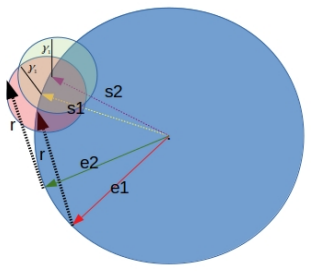
- [Section 4.2, Eqs. (8)-(10) and Supplementary Lemma 3] Lemma 3(3) is not established by the given proof. The derivation shows that for a single pair (h,t), the two positive triple constraints imply u=h−t is orthogonal to r and satisfies ‖u‖^2=(α^2−1)‖r‖^2. This is a local necessary condition, not a construction of a global embedding. The proof never shows that the equalities ‖h+r−t‖=γ1 and ‖t+r−h‖=γ1 can be satisfied simultaneously for all pairs in a symmetric relation, nor that all corrupted negative triples satisfy the score constraint ≥γ2. The gap is load-bearing: for a clique of d+1 entities in dimension d, all pairwise differences must be mutually equidistant and lie in the (d−1)-dimensional subspace orthogonal to r, which is impossible (e.g., a triangle in d=2). Thus the unqualified claim that "TransE can infer a relation pattern which is symmetric with conditions (b)" is false for general symmetric patterns; at best a restricted family of symmetric relations is demonstrated.
- [Supplementary Lemmas 4-6] The proofs of Lemmas 4, 5, and 6 exhibit the same local-to-global gap. For example, the proof of Lemma 6 verifies only that a single inequality ‖e2+r−s2‖>γ1 can be consistent with three equalities for a particular four-tuple of entities; it does not construct embeddings for all entities in the relation graph that simultaneously satisfy all positive and negative constraints. Similarly, the proof of Lemma 5 derives an inequality ⟨e2,(e1+e2+e3)⟩<0 as a non-contradiction condition but never shows a global assignment. These lemmas are used to conclude that limitations L4, L5, and L6 "are not valid" under conditions (b)-(d), so the missing global consistency argument is essential to the paper's central claim that the previous limitation theories are inaccurate.
- [Supplementary Lemma 3 statement] The supplementary statement of Lemma 3(3) says TransE can infer a relation pattern which is "symmetric and reflexive" under conditions (b), (c), and (d), while the main-text Lemma 3(3) claims only "symmetric." The proof only treats the symmetric pair constraints and does not show reflexivity. Additionally, the supplementary proof says α≥1 whereas the main proof requires α>1; if α=1 then ‖u‖=0, which collapses the two entities and does not give a non-trivial symmetric encoding. The intended claim and its exact conditions should be stated consistently and proved completely.
minor comments (6)
- [Title] The title contains a typo: "Then Performance" should read "the Performance."
- [Section 4.2, Eq. (10)] There is a typographical error in the derivation following Eq. (10): "−(|u‖2+(1−α2)‖r‖2)" should be "−(‖u‖2+(1−α2)‖r‖2)."
- [Supplementary Lemma 1] In the proof of Lemma 1, condition (b) is claimed to give ‖r‖=γ1 for TransComplEx; the correct residual is Re(r)+i(Im(r)+2Im(h)), so the norm is not generally ‖r‖. The existence claim may still be true with a different assignment, but the stated derivation is incorrect.
- [Section 5, Discussion] The subsection heading "Dissuasion of Results" should be "Discussion of Results," and the text contains the typo "PRTransComplEx" for "RPTransComplEx."
- [References] The references list two entries, Zhou et al. 2017a and Zhou et al. 2017b, with the same title and venue; it appears the same paper is cited twice with different year labels. The duplicate should be removed and the in-text citations unified.
- [Section 4.3] The algebraic formula listed for the symmetric pattern, RS=‖Re(h)−Re(t)‖=0, appears to omit the relation vector and is not derived in the text; please provide the intermediate steps connecting fr(h,t)=fr(t,h) to that formula.
Circularity Check
No circularity: the paper proves existence results from explicit score-bound equations, and its self-citations are not load-bearing.
full rationale
The paper's central derivation is a set of mathematical lemmas showing that, under relaxed positive-score bounds corresponding to specific loss functions, TransE can encode symmetric and reflexive relation patterns. These proofs solve the stated equations (e.g., Eqs. 8-10 and 20-22) directly; they are not fitted to data and do not rename any empirical result. The four conditions in Eq. 2 are modeling choices tied to real losses (Eqs. 4, 6, 7), and the paper proves consequences from those choices, so the conclusions are not equivalent to the premises by construction. The self-citations to Nayyeri et al. (2019) for the soft-margin loss formulations are not load-bearing because those losses are fully restated in this paper and the new theorems about them are proved here. The proof's reliance on local pair-wise constructions (e.g., Lemma 3 showing a single u perpendicular to r) is a possible mathematical gap regarding global consistency, but that is a correctness concern, not circularity. Accordingly, no circular step is identified.
Assumptions & free parameters
free parameters (3)
- gamma1 =
0.4, 1.5, 1, 0.6, 1.6 (per dataset)
- gamma2 =
0.5, 2, 2, 1.7, 2.7 (per dataset)
- lambda0 =
1, 10, 100 (per dataset)
assumptions (5)
- standard math Score functions are norms in real or complex vector spaces.
- domain assumption Relation vectors are assumed to be non-zero.
- ad hoc to paper Positive triples can be defined by score upper bounds (conditions b, c, d) rather than exact equality.
- ad hoc to paper Solutions for individual triple pairs can be combined into a global embedding satisfying all constraints simultaneously.
- domain assumption Negative samples are generated by corrupting head or tail of positive triples.
Cite this review
Pith. "Pith review of Toward Understanding The Effect Of Loss function On Then Performance Of Knowledge Graph Embedding." pith.science (2026). https://pith.science/paper/XLYACQ6A
@misc{pith2026190900519,
  author       = {Pith},
  title        = {Pith review of: Toward Understanding The Effect Of Loss function On Then Performance Of Knowledge Graph Embedding},
  year         = {2026},
  howpublished = {\url{https://pith.science/paper/XLYACQ6A}},
  note         = {Machine review of arXiv:1909.00519}
}
read the original abstract
Knowledge graphs (KGs) represent world's facts in structured forms. KG completion exploits the existing facts in a KG to discover new ones. Translation-based embedding model (TransE) is a prominent formulation to do KG completion. Despite the efficiency of TransE in memory and time, it suffers from several limitations in encoding relation patterns such as symmetric, reflexive etc. To resolve this problem, most of the attempts have circled around the revision of the score function of TransE i.e., proposing a more complicated score function such as Trans(A, D, G, H, R, etc) to mitigate the limitations. In this paper, we tackle this problem from a different perspective. We show that existing theories corresponding to the limitations of TransE are inaccurate because they ignore the effect of loss function. Accordingly, we pose theoretical investigations of the main limitations of TransE in the light of loss function. To the best of our knowledge, this has not been investigated so far comprehensively. We show that by a proper selection of the loss function for training the TransE model, the main limitations of the model are mitigated. This is explained by setting upper-bound for the scores of positive samples, showing the region of truth (i.e., the region that a triple is considered positive by the model). Our theoretical proofs with experimental results fill the gap between the capability of translation-based class of embedding models and the loss function. The theories emphasise the importance of the selection of the loss functions for training the models. Our experimental evaluations on different loss functions used for training the models justify our theoretical proofs and confirm the importance of the loss functions on the performance.
Figures


Reference graph
Works this paper leans on
-
[1]
URL: " 'urlintro :=
ENTRY address author booktitle chapter edition editor howpublished institution journal key month note number organization pages publisher school series title type volume year eprint doi pubmed url lastchecked label extra.label sort.label short.list INTEGERS output.state before.all mid.sentence after.sentence after.block STRINGS urlintro eprinturl eprintpr...
-
[2]
write newline
" write newline "" before.all 'output.state := FUNCTION n.dashify 't := "" t empty not t #1 #1 substring "-" = t #1 #2 substring "--" = not "--" * t #2 global.max substring 't := t #1 #1 substring "-" = "-" * t #2 global.max substring 't := while if t #1 #1 substring * t #2 global.max substring 't := if while FUNCTION word.in bbl.in capitalize " " * FUNCT...
-
[3]
Farahnaz Akrami, Lingbing Guo, Wei Hu, and Chengkai Li. 2018. Re-evaluating embedding-based knowledge graph completion methods. In Proceedings of the 27th ACM International Conference on Information and Knowledge Management, pages 1779--1782. ACM
work page 2018
-
[4]
Kurt Bollacker, Colin Evans, Praveen Paritosh, Tim Sturge, and Jamie Taylor. 2008. Freebase: a collaboratively created graph database for structuring human knowledge. In Proceedings of the 2008 ACM SIGMOD international conference on Management of data, pages 1247--1250. AcM
work page 2008
-
[5]
Antoine Bordes, Nicolas Usunier, Alberto Garcia-Duran, Jason Weston, and Oksana Yakhnenko. 2013. Translating embeddings for modeling multi-relational data. In Advances in neural information processing systems, pages 2787--2795
2013
-
[6]
Tim Dettmers, Pasquale Minervini, Pontus Stenetorp, and Sebastian Riedel. 2018. Convolutional 2d knowledge graph embeddings. In Thirty-Second AAAI Conference on Artificial Intelligence
2018
-
[7]
Boyang Ding, Quan Wang, Bin Wang, and Li Guo. 2018. Improving knowledge graph embedding using simple constraints. arXiv preprint arXiv:1805.02408
work page Pith review arXiv 2018
-
[8]
Takuma Ebisu and Ryutaro Ichise. 2018. Toruse: Knowledge graph embedding on a lie group. In Thirty-Second AAAI Conference on Artificial Intelligence
work page 2018
Show all 32 references
-
[9]
Takuma Ebisu and Ryutaro Ichise. 2019. Generalized translation-based embedding of knowledge graph. IEEE Transactions on Knowledge and Data Engineering
2019
-
[10]
Bahare Fatemi, Siamak Ravanbakhsh, and David Poole. 2018. Improved knowledge graph embedding using background taxonomic information. arXiv preprint arXiv:1812.03235
2018 arXiv
-
[11]
Jun Feng, Minlie Huang, Mingdong Wang, Mantong Zhou, Yu Hao, and Xiaoyan Zhu. 2016. Knowledge graph embedding by flexible translation. In Fifteenth International Conference on the Principles of Knowledge Representation and Reasoning
2016
-
[12]
Shu Guo, Quan Wang, Lihong Wang, Bin Wang, and Li Guo. 2016. Jointly embedding knowledge graphs and logical rules. In Proceedings of the 2016 Conference on Empirical Methods in Natural Language Processing, pages 192--202
2016
-
[13]
Shu Guo, Quan Wang, Lihong Wang, Bin Wang, and Li Guo. 2018. Knowledge graph embedding with iterative guidance from soft rules. In Thirty-Second AAAI Conference on Artificial Intelligence
2018
-
[14]
Frank L Hitchcock. 1927. The expression of a tensor or a polyadic as a sum of products. Journal of Mathematics and Physics, 6(1-4):164--189
1927
-
[15]
Guoliang Ji, Shizhu He, Liheng Xu, Kang Liu, and Jun Zhao. 2015. Knowledge graph embedding via dynamic mapping matrix. In Proceedings of the 53rd Annual Meeting of the Association for Computational Linguistics and the 7th International Joint Conference on Natural Language Proc...
2015
-
[16]
Seyed Mehran Kazemi and David Poole. 2018. Simple embedding for link prediction in knowledge graphs. In Advances in Neural Information Processing Systems, pages 4284--4295
2018
-
[17]
Yankai Lin, Zhiyuan Liu, Huanbo Luan, Maosong Sun, Siwei Rao, and Song Liu. 2015 a . Modeling relation paths for representation learning of knowledge bases. arXiv preprint arXiv:1506.00379
2015 arXiv
-
[18]
Yankai Lin, Zhiyuan Liu, Maosong Sun, Yang Liu, and Xuan Zhu. 2015 b . Learning entity and relation embeddings for knowledge graph completion. In Twenty-ninth AAAI conference on artificial intelligence
2015
-
[19]
Hanxiao Liu, Yuexin Wu, and Yiming Yang. 2017. Analogical inference for multi-relational embeddings. In Proceedings of the 34th International Conference on Machine Learning-Volume 70, pages 2168--2178. JMLR. org
2017
-
[20]
George A Miller. 1995. Wordnet: a lexical database for english. Communications of the ACM, 38(11):39--41
1995
-
[21]
Pasquale Minervini, Luca Costabello, Emir Munoz, Novacek, and Pierre-Yves Vandenbussche. 2017. Regularizing knowledge graph embeddings via equivalence and inversion axioms. In Joint European Conference on Machine Learning and Knowledge Discovery in Databases, pages 668--683. Springer
2017
-
[22]
Mojtaba Nayyeri, Sahar Vahdati, Jens Lehmann, and Hamed Shariat Yazdi. 2019. Soft marginal transe for scholarly knowledge graph completion. arXiv preprint arXiv:1904.12211
2019 arXiv
-
[23]
Dat Quoc Nguyen, Kairit Sirts, Lizhen Qu, and Mark Johnson. 2016. Stranse: a novel embedding model of entities and relationships in knowledge bases. arXiv preprint arXiv:1606.08140
2016 arXiv
-
[24]
Michael Schlichtkrull, Thomas N Kipf, Peter Bloem, Rianne Van Den Berg, Ivan Titov, and Max Welling. 2018. Modeling relational data with graph convolutional networks. In European Semantic Web Conference, pages 593--607. Springer
2018
-
[25]
Zhiqing Sun, Zhi-Hong Deng, Jian-Yun Nie, and Jian Tang. 2019. Rotate: Knowledge graph embedding by relational rotation in complex space. arXiv preprint arXiv:1902.10197
2019 arXiv
-
[26]
Kristina Toutanova and Danqi Chen. 2015. Observed versus latent features for knowledge base and text inference. In Proceedings of the 3rd Workshop on Continuous Vector Space Models and their Compositionality, pages 57--66
2015
-
[27]
Th \'e o Trouillon, Johannes Welbl, Sebastian Riedel, \'E ric Gaussier, and Guillaume Bouchard. 2016. Complex embeddings for simple link prediction. In International Conference on Machine Learning, pages 2071--2080
2016
-
[28]
Quan Wang, Zhendong Mao, Bin Wang, and Li Guo. 2017. Knowledge graph embedding: A survey of approaches and applications. IEEE Transactions on Knowledge and Data Engineering, 29(12):2724--2743
2017
-
[29]
Yanjie Wang, Rainer Gemulla, and Hui Li. 2018. On multi-relational link prediction with bilinear models. In Thirty-Second AAAI Conference on Artificial Intelligence
2018
-
[30]
Zhen Wang, Jianwen Zhang, Jianlin Feng, and Zheng Chen. 2014. Knowledge graph embedding by translating on hyperplanes. In Twenty-Eighth AAAI conference on artificial intelligence
2014
-
[31]
Xiaofei Zhou, Qiannan Zhu, Ping Liu, and Li Guo. 2017 a . Learning knowledge embeddings by combining limit-based scoring loss. In Proceedings of the 2017 ACM on Conference on Information and Knowledge Management, pages 1009--1018. ACM
2017
-
[32]
Xiaofei Zhou, Qiannan Zhu, Ping Liu, and Li Guo. 2017 b . Learning knowledge embeddings by combining limit-based scoring loss. In Proceedings of the 2017 ACM on Conference on Information and Knowledge Management, pages 1009--1018. ACM
2017
Reviewed August 14, 2026 · model on record in the stance chip above.
Discussion (0). Continue with ORCID to comment.