REVIEW 4 major objections 5 minor 2 cited by
ALMA images the many faces of the NGC1068 torus and its surroundings
T0 review · 4 major / 5 minor · reviewed 2026-08-14 · deepseek-v4-flash
Pith's one-line read A wide-angle wind from the accreting black hole in NGC 1068 is currently blowing 40–60% of its obscuring torus outward.
desk verdict A genuinely new, well-resolved view of the NGC1068 torus; the density stratification is the solid result, while the entrained fraction is a model-dependent extra. read the letter →
The pith
A machine-rendered reading of the paper's core claim, the machinery that carries it, and where it could break.
The reading
What carries the argument
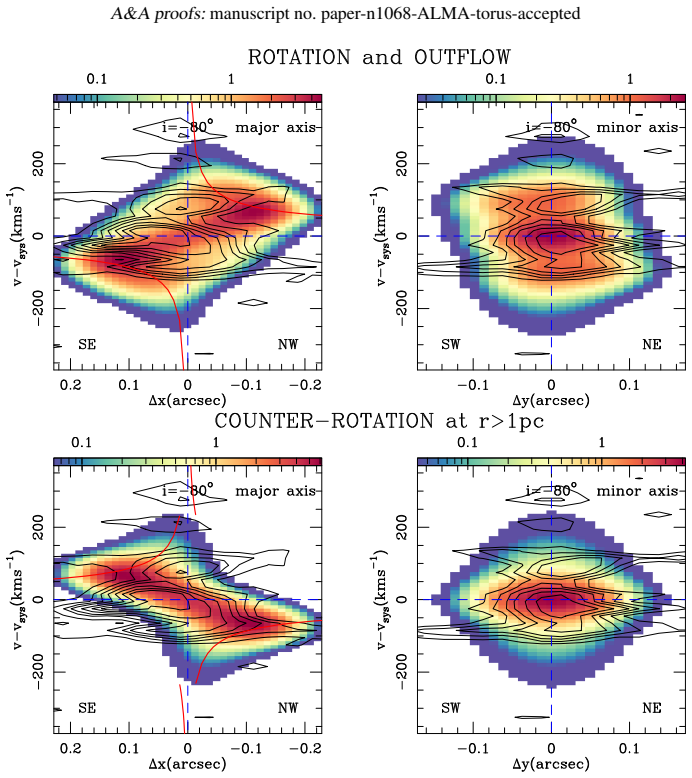
The load-bearing mechanism is the OUT-model: a morpho-kinematic model of the torus as a toroidal ringed disk (4–5 pc tube radius orbiting at 5–6 pc, full size 20–22 pc, position angle 113°, inclination about 80°) whose gas follows the maser rotation curve, with a fraction of the gas—determined by where a wide-angle AGN-wind bicone with half-opening angle $\theta\simeq80^\circ$ intersects the disk—given an extra radial outflow of about 100 km/s. Comparing synthetic and observed position-velocity diagrams along the torus major and minor axes, the model reproduces the apparent counter-rotation, the three velocity components seen on the minor axis, and a shallow minor-axis velocity gradient, and it fits better than a counter-rotating disk model. The model converts morphology and kinematics into the paper's quantitative statements about entrained mass and surviving reservoir.
What would settle it
Observe the torus minor axis in a dense-gas line at sub-parsec resolution and look for the south-redshifted, north-blueshifted velocity gradient predicted when an outflowing bicone is projected onto the disk plane. The paper reports that this gradient is absent in CO(2–1) yet tentatively present in CO(6–5); a clean detection or a firm non-detection after accounting for beam smearing would decide whether 40–60% of the torus is genuinely entrained.
Extended reading notes
Core claim
The central claim is that the torus of NGC 1068 is simultaneously the fuel supply and the target of AGN feedback: a wide-angle ionized wind launched from the accretion disk is sweeping through the torus along a hollow bicone, entraining roughly half of its molecular mass while leaving an equatorial reservoir intact. The evidence is morphological and kinematic: CO(2–1) and CO(3–2) trace an elongated disk with full sizes of 26–28 pc, HCO$^+$(4–3) traces a denser, smaller disk of 11 pc, and the velocity field contains gas at forbidden velocities that looks like counter-rotation but is better reproduced by outflow projected along the line of sight. The paper's favored model sets the entrained fraction at 0.4–0.6 of $M_{\rm torus}\simeq3\times10^5\,M_\odot$ and identifies the untouched equatorial gas as a reservoir of $1.2$–$1.8\times10^5\,M_\odot$, enough to sustain accretion for roughly 1–4 Myr even though supply through the 15–50 pc streamers is currently throttled.
Load-bearing premise
The paper's quantitative claims—40–60% of the torus mass outflowing and $1.2$–$1.8\times10^5$ solar masses still available—rest on a model that assumes the torus is a smooth, axisymmetric ringed disk of fixed size and orientation with uniform gas density; if the true torus is warped, clumpy, or non-axisymmetric, both numbers would change.
Editorial extensions
If this is right
- Torus size becomes tracer-dependent: low-density CO(2–1) and CO(3–2) disks span 26–28 pc, while the dense HCO$^+$(4–3) core spans only 11 pc.
- Obscuration and feedback coexist: a wide-angle wind from the accretion disk is actively removing roughly half the torus mass even as the torus continues to hide and feed the nucleus.
- The surviving equatorial reservoir of $1.2$–$1.8\times10^5$ solar masses can sustain accretion for 1–4 Myr at the inferred rate of 0.05–0.1 solar masses per year.
- Fresh gas is currently blocked at intermediate radii: the streamers connecting the torus to the circumnuclear disk are outflowing at about 0.6 solar masses per year, so fueling is thwarted between 15 and 50 pc.
- The circumnuclear disk is globally affected: about half of its $1.4\times10^8$ solar masses participates in an outflow with average radial speeds of about 85 km/s from 50 to 200 pc.
Reading between the lines
- A testable extension is that Seyfert type is partly a phase: a torus partially blown open by its own wind could expose the broad-line region for a few million years, then re-cover as material from the circumnuclear disk rebuilds the equatorial reservoir.
- The measured density stratification predicts a multi-transition size sequence: in other nearby Seyferts, low-J CO tori should appear systematically larger than HCN/HCO$^+$ tori, which a modest survey could check without full kinematic modeling.
- If the 1–4 Myr reservoir is consumed while the 15–50 pc streamers are outflowing, the AGN duty cycle in NGC 1068 may be set by a competition between wind erosion and streamer resupply, implying self-regulating, flickering accretion.
Signed reviews
Editorial analysis
A structured set of objections, weighed in public.
Referee Report
Summary. This paper presents ALMA observations of CO(2-1), CO(3-2), HCO+(4-3), and continuum at 229.7 and 344.5 GHz toward the circumnuclear disk (CND) and torus of NGC 1068 at 2-6 pc resolution. The authors resolve the CND as an asymmetric ~400 pc ringed disk with a central gas deficit, find edge-brightened NIR polarization arcs at its inner edge, and detect a molecular torus of ~3×10^5 M_sun extending over 10-30 pc, with the HCO+ torus (11 pc full size) a factor 2-3 smaller than the CO tori (26-28 pc), indicating radial density stratification. The kinematics show large non-circular motions and line splitting, modeled with kinemetry, 3DBarolo, and a custom morpho-kinematic torus model (OUT-model) that attributes the apparent counter-rotation to an AGN wind entraining 0.4-0.6 of the torus gas, leaving a residual equatorial reservoir of 1.2-1.8×10^5 M_sun that can fuel the AGN for 1-4 Myr.
Significance. If the quantitative claims hold, this is a landmark result: it directly images the long-postulated torus and demonstrates that it is not a passive rotating doughnut but a stratified structure actively shaped by AGN feedback, while still containing a reservoir for continued fueling. The strengths are the high angular resolution (2-6 pc), the multi-transition approach spanning n(H2)~1e3-1e7 cm^-3, the direct Gaussian-fitted sizes and orientations, the careful flux-recovery sanity checks against earlier IRAM data, and the consistency of the morphological results with independent NIR polarimetric and MIR interferometric evidence. The paper's observational framework is reproducible and the qualitative scenario of an outflowing torus with an equatorial reservoir is well supported. The quantitative values in the abstract, however, go beyond what the model discriminates, as discussed in the major comments.
major comments (4)
- [Section 7.2] The central quantitative claim, that the AGN wind entrains ~0.4-0.6 of the torus mass and leaves a 1.2-1.8×10^5 M_sun reservoir, is derived entirely from the geometric intersection of a fixed wide bicone (free half-opening angle θ) with an assumed uniform-density toroidal ringed disk of fixed size (20-22 pc), PA=113°, i=-80°, and the maser rotation curve. The paper itself states (Sect. 7.2) that the goodness-of-fit parameters are 'admittedly large (≥4)' and that the OUT-model beats the counter-rotating CR-model by only a factor ~1.2-1.3 in χ². With absolute χ² values this poor, the best-fit θ≈80° is not a robust measurement; a clumpy or vertically stratified density distribution, a warped ring, or a different inclination (the observed aspect ratio only gives i≥60-70°) could change the intersection volume substantially. Because the 1-4 Myr fueling time scales directly with the residual reservoir mass, the quantitative headline is not supported by the evidence as presented. I request either a sensitivity analysis of the entrained fraction and reservoir mass to the assumed density distribution and geometry, or a revised abstract/conclusions that present 0.4-0.6 and 1-4 Myr as order-of-magnitude model-dependent estimates.
- [Section 5.2] The absolute torus mass M_torus~3×10^5 M_sun is derived from CO(2-1) using a galactic XCO and line ratios R21=2.5, R31=2.9 taken from Viti et al. (2014). The paper acknowledges that XCO in AGN environments carries up to an order-of-magnitude uncertainty (Sect. 5.2). Since the reservoir mass (1.2-1.8×10^5 M_sun) and the fueling time (1-4 Myr) are fractions of M_torus, this systematic uncertainty propagates directly into the abstract's quantitative conclusions. The abstract should carry the same caveat that the paper applies to the column densities, or the authors should quote the mass-dependent quantities with an explicit XCO-dependence.
- [Section 7.1 and Appendix A] The 3DBarolo fit assumes axisymmetric tilted rings, and the vertical velocity component vvert is not fitted iteratively but explored over discrete values (0, 25, 50, 100, 150 km/s; Appendix A), yielding vvert~100±50 km/s. This velocity enters the OUT-model's outflow velocity vout=(vrad^2+vvert^2)^{1/2}, which is used to generate the model p-v diagrams that discriminate OUT from CR. The paper itself notes (Sect. 7.1) that the model cannot reproduce 'any substantial deviation from the axisymmetric dependence of the kinematic parameters.' The degeneracy between vrad, vvert, and the assumed inclination in the torus region (r<20 pc) is not quantified; this weakens the discrimination between the two models to a greater degree than the reported χ² ratio alone suggests.
- [Section 7.2 and Figs. 16-17] The model's rotation curve is taken from the H2O megamaser kinematics, which are confined to r<1 pc (Greenhill et al. 1996), and extrapolated to the 20-22 pc torus using a power-law vrot∝r^{-0.31}. Extrapolating the maser curve by a factor ~20 in radius is a strong assumption; a steeper or flatter rotation curve, or a substantial torus self-gravity, would change the model p-v diagrams and hence the best-fit θ. This assumption should be tested (e.g., by using the CO-derived rotation curve from the 3DBarolo fit where available) or its effect on the inferred entrained fraction quantified.
minor comments (5)
- [Section 7.2] The χ² formula reads χ2 = ∑[D(i, j)− M(i, j)/σ]^2, which is not the standard expression; it should be ∑[(D(i, j)-M(i, j))/σ]^2. Please correct the typo since the model comparison is based on this quantity.
- [Section 5.2] The phrase 'of≃ up to an oder of magnitude' contains a typo; it should read 'an order of magnitude.'
- [Section 2.1] The notation 'v−vHEL sys ⊂ [−350, 350] km s−1' is ambiguous because the subscript and superscript are scrambled; please write the systemic velocity frame explicitly.
- [Figure 22 caption] The labels 'Knot N' and 'Knot S' are introduced in the caption but not defined in the figure or the main text; please define them or remove the labels.
- [Section 6.2] The [SiVI] data are credited to 'Ric Davies, private communication'; for reproducibility, a reference to the published dataset should be provided if one exists.
Circularity Check
The 0.4–0.6 entrained torus fraction is the fitted bicone opening angle quoted as the result; the reservoir mass is its complement.
-
fitted input called prediction
[Section 7.2, OUT-model (definition of the entrained fraction and derivation of the 0.4–0.6 fraction); echoed in Abstract and Summary.]
"A fraction of the gas inside the torus, as determined by the intersection of the AGN wind bicone with the torus, is perturbed by the AGN wind creating a 3D radial outflow superposed to rotation. ... it is therefore a function of the half-opening angle of the wind (θ = FWHM/2) ... The value of θ≃80° favored by the OUT-model ... we estimate this fraction to be ≃(0.4−0.6)× Mtorus gas."
The entrained mass fraction is not measured independently: it is constructed as the geometric overlap of a fixed, uniform-density toroidal ring with a bicone whose half-opening angle θ is the model's main free parameter, tuned by χ² minimization against the CO(2–1) major/minor-axis position-velocity data. Once θ≃80° is adopted, the 0.4–0.6 fraction follows by construction, and the residual equatorial reservoir (1.2–1.8×10^5 M⊙) is simply the complement of that same fraction. The CO(6–5) minor-axis gradient provides a qualitative, largely independent check on the outflow-vs-counter-rotation mechanism, but it does not calibrate the entrained fraction.
full rationale
The direct ALMA measurements are self-contained and not circular: the detection of the molecular torus, its size (10–30 pc), the radial stratification between the HCO+(4–3) torus (D≈11 pc) and the CO(2–1)/CO(3–2) tori (D≈26–28 pc), the CND ring morphology, and the connecting streamers are image-plane results with internal flux checks against earlier data. The mass estimate of the torus follows from standard CO luminosity-to-mass conversion assumptions, which are input assumptions rather than circular reductions. The load-bearing quantitative conclusion that 0.4–0.6 of the torus mass is entrained and that only 1.2–1.8×10^5 M⊙ remains to fuel the AGN for 1–4 Myr is, however, model output rather than measurement: Section 7.2 defines the entrained fraction as the geometric intersection of a constant-density torus with a bicone of half-angle θ, fits θ to the same CO(2–1) kinematic data, and then quotes the resulting intersection fraction as the physical result. The reservoir mass and fueling time are arithmetic complements of that same fitted fraction. This is the fitted-input-called-prediction pattern, and it is central to the abstract's feedback/fueling claim. The independent CO(6–5) minor-axis gradient supports the existence of an outflow component, and the morphological stratification stands on its own, so the circularity is partial rather than total; nevertheless the specific numerical headline reduces to the fitted θ by construction.
Assumptions & free parameters
free parameters (7)
- XCO (CO-to-H2 conversion factor) =
2e20 mol cm^-2 (K km/s)^-1
- R21 (CO 2-1/1-0 brightness temperature ratio) =
2.2 (CND), 2.5 (torus)
- R31 (CO 3-2/1-0 brightness temperature ratio) =
2.9 (at AGN)
- Torus opening angle theta (AGN wind bicone on torus scale) =
80 degrees (best fit)
- vout (outflow velocity in OUT-model) =
100 km/s
- vvert (vertical velocity component in 3DBarolo) =
100 km/s
- Torus inclination i and PA =
i ~ -80 deg, PA ~ 113 deg
assumptions (5)
- domain assumption Molecular line emission traces H2 column with a constant CO-to-H2 conversion factor and fixed excitation ratios
- ad hoc to paper The torus and CND kinematics are described by a single tilted-ring axisymmetric disk plus radial and vertical bulk velocities
- domain assumption The AGN wind bicone geometry follows Das et al. 2006 (PA=30 deg, opening FWHM 40-80 deg)
- ad hoc to paper The H2O megamaser rotation curve (Greenhill et al. 1996) can be extrapolated to the 20 pc torus
- domain assumption The distance to NGC 1068 is 14 Mpc
Cite this review
Pith. "Pith review of ALMA images the many faces of the NGC1068 torus and its surroundings." pith.science (2026). https://pith.science/paper/HYI5ROZM
@misc{pith2026190900675,
  author       = {Pith},
  title        = {Pith review of: ALMA images the many faces of the NGC1068 torus and its surroundings},
  year         = {2026},
  howpublished = {\url{https://pith.science/paper/HYI5ROZM}},
  note         = {Machine review of arXiv:1909.00675}
}
read the original abstract
We investigate the fueling and the feedback of nuclear activity in the Seyfert 2 galaxy NGC1068, by studying the distribution and kinematics of molecular gas in the torus and its connections. We use ALMA to image the emission of a set of molecular gas tracers in the circumnuclear disk (CND) and the torus of the galaxy using the CO(2-1), CO(3-2) and HCO+(4-3) lines with spatial resolutions ~0.03"-0.09"(2-6pc). ALMA resolves the CND as an asymmetric ringed disk of D~400pc-size and mass of ~1.4x10^8 Msun. The inner edge of the ring is associated with edge-brightened arcs of NIR polarized emission identified with the working surface of the AGN ionized wind. ALMA proves the existence of a molecular torus of M_torus ~ 3x10^5Msun, which extends over a large range of spatial scales D=10-30pc around the central engine. The new observations evidence the density radial stratification of the torus: the HCO+(4-3) torus, with a full size D=11pc, is a factor of 2-3 smaller than its CO(2-1) and CO(3-2) counterparts, which have full-sizes D=26pc and D=28pc, respectively. The torus is connected to the CND through a network of gas streamers. The kinematics of molecular gas show strong departures from circular motions in the torus, the gas streamers, and the CND. These velocity distortions are interconnected and are part of a 3D outflow that reflects the effects of AGN feedback on the kinematics of molecular gas across a wide range of spatial scales. We conclude that a wide-angle AGN wind launched from the accretion disk is impacting a sizeable fraction of the gas inside the torus (~0.4-0.6 x M_torus). However, a large gas reservoir (~1.2-1.8 x 10^5Msun) close to the equatorial plane of the torus remains unaffected by the AGN wind and can continue fueling the AGN for ~1-4Myr. AGN fueling seems nevertheless thwarted on intermediate scales (15pc < r < 50pc).
Figures


Figures from the paper (25 more)



Forward citations
Cited by 2 Pith papers
-
AGN Feedback Models and AGN Demographics II: Comparing Predictions of Radiative and Total Feedback to Observations
EAGLE, SIMBA, and TNG100 all fail to reproduce observed trends in which galaxies host radiatively efficient AGN, and EAGLE matches only after a factor-of-ten normalization adjustment.
-
Active Galactic Nuclei as high-energy neutrino sources
Review summarizing correlations between astrophysical neutrinos and gamma-ray/radio AGN, specific source associations, proposed production mechanisms, and future prospects.
Reference graph
Works this paper leans on
-
[1]
2016, , 590, A73
Aalto , S., Costagliola , F., Muller , S., et al. 2016, , 590, A73
2016
-
[2]
2012, , 537, A44
Aalto , S., Garcia-Burillo , S., Muller , S., et al. 2012, , 537, A44
2012
-
[3]
M., et al
Alatalo , K., Blitz , L., Young , L. M., et al. 2011, , 735, 88
2011
-
[4]
2014, , 780, 186
Alatalo , K., Nyland , K., Graves , G., et al. 2014, , 780, 186
2014
-
[5]
2019, , 628, A65
Alonso-Herrero , A., Garc \' a-Burillo , S., Pereira-Santaella , M., et al. 2019, , 628, A65
2019
-
[6]
2018, , 859, 144
Alonso-Herrero , A., Pereira-Santaella , M., Garc \' a-Burillo , S., et al. 2018, , 859, 144
2018
-
[7]
2011, , 736, 82
Alonso-Herrero , A., Ramos Almeida , C., Mason , R., et al. 2011, , 736, 82
2011
-
[8]
Antonucci , R. R. J. & Miller , J. S. 1985, , 297, 621
1985
Show all 126 references
-
[9]
1996, , 463, 509
Arribas , S., Mediavilla , E., & Garcia-Lorenzo , B. 1996, , 463, 509
1996
-
[10]
Ashmore , I., van Loo , S., Caselli , P., Falle , S. A. E. G., & Hartquist , T. W. 2010, , 511, A41
2010
-
[11]
2019, arXiv e-prints, arXiv:1905.01979
Audibert , A., Combes , F., Garc \' a-Burillo , S., et al. 2019, arXiv e-prints, arXiv:1905.01979
2019 arXiv
-
[12]
Barbosa , F. K. B., Storchi-Bergmann , T., McGregor , P., Vale , T. B., & Rogemar Riffel , A. 2014, , 445, 2353
2014
-
[13]
A., et al
Barcos-Mu \ n oz , L., Aalto , S., Thompson , T. A., et al. 2018, , 853, L28
2018
-
[14]
V., Dopita , M
Bicknell , G. V., Dopita , M. A., Tsvetanov , Z. I., & Sutherland , R. S. 1998, , 495, 680
1998
-
[15]
F., Tacconi , L
Bland-Hawthorn , J., Gallimore , J. F., Tacconi , L. J., et al. 1997, , 248, 9
1997
-
[16]
Blandford , R. D. & Payne , D. G. 1982, , 199, 883
1982
-
[17]
J., Neugebauer , G., Matthews , K., et al
Bock , J. J., Neugebauer , G., Matthews , K., et al. 2000, , 120, 2904
2000
-
[18]
C., Savage , B
Bohlin , R. C., Savage , B. D., & Drake , J. F. 1978, , 224, 132
1978
-
[19]
D., Wolfire , M., & Leroy , A
Bolatto , A. D., Wolfire , M., & Leroy , A. K. 2013, , 51, 207
2013
-
[20]
T., Shlosman , I., & Blandford , R
Bottorff , M., Korista , K. T., Shlosman , I., & Blandford , R. D. 1997, , 479, 200
1997
-
[21]
Burtscher , L., Meisenheimer , K., Tristram , K. R. W., et al. 2013, , 558, A149
2013
-
[22]
A., Groves , B., et al
Cecil , G., Dopita , M. A., Groves , B., et al. 2002, , 568, 627
2002
-
[23]
& Krolik , J
Chan , C.-H. & Krolik , J. H. 2016, , 825, 67
2016
-
[24]
& Krolik , J
Chan , C.-H. & Krolik , J. H. 2017, , 843, 58
2017
-
[25]
2014, , 562, A21
Cicone , C., Maiolino , R., Sturm , E., et al. 2014, , 562, A21
2014
-
[26]
2019, , 623, A79
Combes , F., Garc \' a-Burillo , S., Audibert , A., et al. 2019, , 623, A79
2019
-
[27]
2013, , 558, A124
Combes , F., Garc \' a-Burillo , S., Casasola , V., et al. 2013, , 558, A124
2013
-
[28]
2014, , 565, A97
Combes , F., Garc \' a-Burillo , S., Casasola , V., et al. 2014, , 565, A97
2014
-
[29]
Crenshaw , D. M. & Kraemer , S. B. 2000, , 532, L101
2000
-
[30]
M., Kraemer , S
Das , V., Crenshaw , D. M., Kraemer , S. B., & Deo , R. P. 2006, , 132, 620
2006
-
[31]
Di Teodoro , E. M. & Fraternali , F. 2015, , 451, 3021
2015
-
[32]
2014, , 438, 846
D \"o nmez , O. 2014, , 438, 846
2014
-
[33]
2017, Modern Physics Letters A, 32, 1750108
Donmez , O. 2017, Modern Physics Letters A, 32, 1750108
2017
-
[34]
2008, , 52, 274
Elitzur , M. 2008, , 52, 274
2008
-
[35]
2012, , 747, L33
Elitzur , M. 2012, , 747, L33
2012
-
[36]
& Shlosman , I
Elitzur , M. & Shlosman , I. 2006, , 648, L101
2006
-
[37]
T., Blandford , R
Emmering , R. T., Blandford , R. D., & Shlosman , I. 1992, , 385, 460
1992
-
[38]
2006, , 365, 367
Emsellem , E., Fathi , K., Wozniak , H., et al. 2006, , 365, 367
2006
-
[39]
& Ford , H
Ferrarese , L. & Ford , H. 2005, , 116, 523
2005
-
[40]
2010, , 518, L155
Feruglio , C., Maiolino , R., Piconcelli , E., et al. 2010, , 518, L155
2010
-
[41]
Galliano , E., Pantin , E., Alloin , D., & Lagage , P. O. 2005, , 363, L1
2005
-
[42]
F., Baum , S
Gallimore , J. F., Baum , S. A., & O'Dea , C. P. 2004, , 613, 794
2004
-
[43]
F., Baum , S
Gallimore , J. F., Baum , S. A., O'Dea , C. P., & Pedlar , A. 1996, , 458, 136
1996
-
[44]
F., Elitzur , M., Maiolino , R., et al
Gallimore , J. F., Elitzur , M., Maiolino , R., et al. 2016, , 829, L7
2016
-
[45]
F., Henkel , C., Baum , S
Gallimore , J. F., Henkel , C., Baum , S. A., et al. 2001, , 556, 694
2001
-
[46]
2019, [ [arXiv] 1904.03694 ]
Garc \' a-Bernete , I., Ramos Almeida , C., Alonso-Herrero , A., et al. 2019, [ [arXiv] 1904.03694 ]
2019 arXiv
-
[47]
& Combes , F
Garc \' a-Burillo , S. & Combes , F. 2012, in Journal of Physics Conference Series, Vol. 372, Journal of Physics Conference Series, 012050
2012
-
[48]
2016, , 823, L12
Garc \' a-Burillo , S., Combes , F., Ramos Almeida , C., et al. 2016, , 823, L12
2016
-
[49]
Garc \' a-Burillo , S., Combes , F., Schinnerer , E., Boone , F., & Hunt , L. K. 2005, , 441, 1011
2005
-
[50]
2015, , 580, A35
Garc \' a-Burillo , S., Combes , F., Usero , A., et al. 2015, , 580, A35
2015
-
[51]
2014, , 567, A125
Garc \' a-Burillo , S., Combes , F., Usero , A., et al. 2014, , 567, A125
2014
-
[52]
C., et al
Gebhardt , K., Kormendy , J., Ho , L. C., et al. 2000, , 543, L5
2000
- [53]
-
[54]
Granato , G. L. & Danese , L. 1994, , 268, 235
1994
-
[55]
2015, , 581, L8
Gratadour , D., Rouan , D., Grosset , L., Boccaletti , A., & Cl \'e net , Y. 2015, , 581, L8
2015
-
[56]
M., et al
Gratadour , D., Rouan , D., Mugnier , L. M., et al. 2006, , 446, 813
2006
-
[57]
Greenhill , L. J. & Gwinn , C. R. 1997, , 248, 261
1997
-
[58]
J., Gwinn , C
Greenhill , L. J., Gwinn , C. R., Antonucci , R., & Barvainis , R. 1996, , 472, L21
1996
-
[59]
2018, , 612, A69
Grosset , L., Rouan , D., Gratadour , D., et al. 2018, , 612, A69
2018
-
[60]
O., Gebhardt , K., et al
G \"u ltekin , K., Richstone , D. O., Gebhardt , K., et al. 2009, , 698, 198
2009
-
[61]
H \"o nig , S. F. 2019, arXiv e-prints, arXiv:1909.08639
2019 arXiv
-
[62]
H \"o nig , S. F. & Kishimoto , M. 2017, , 838, L20
2017
-
[63]
F., Kishimoto , M., Tristram , K
H \"o nig , S. F., Kishimoto , M., Tristram , K. R. W., et al. 2013, , 771, 87
2013
-
[64]
2015, , 803, 57
Ichikawa , K., Packham , C., Ramos Almeida , C., et al. 2015, , 803, 57
2015
-
[65]
2016, , 822, L10
Imanishi , M., Nakanishi , K., & Izumi , T. 2016, , 822, L10
2016
-
[66]
2018, , 853, L25
Imanishi , M., Nakanishi , K., Izumi , T., & Wada , K. 2018, , 853, L25
2018
-
[67]
Impellizzeri , C. M. V., Gallimore , J. F., Baum , S. A., et al. 2019, arXiv e-prints, arXiv:1908.07981
2019 arXiv
-
[68]
2018, , 867, 48
Izumi , T., Wada , K., Fukushige , R., Hamamura , S., & Kohno , K. 2018, , 867, 48
2018
-
[69]
Jaffe , W., Meisenheimer , K., R \"o ttgering , H. J. A., et al. 2004, , 429, 47
2004
-
[70]
2019, , 624, A42
Kamali , F., Henkel , C., Koyama , S., et al. 2019, , 624, A42
2019
-
[71]
F., K \"o nigl , A., & Elitzur , M
Kartje , J. F., K \"o nigl , A., & Elitzur , M. 1999, , 513, 180
1999
-
[72]
& Nixon , C
King , A. & Nixon , C. 2015, Monthly Notices of the Royal Astronomical Society, 453, L46
2015
-
[73]
J., & Font , J
Kiuchi , K., Shibata , M., Montero , P. J., & Font , J. A. 2011, Physical Review Letters, 106, 251102
2011
-
[74]
& Richstone , D
Kormendy , J. & Richstone , D. 1995, , 33, 581
1995
-
[75]
2013, , 431, 349
Korobkin , O., Abdikamalov , E., Stergioulas , N., et al. 2013, , 431, 349
2013
-
[76]
T., & Copin , Y
Krajnovi \'c , D., Cappellari , M., de Zeeuw , P. T., & Copin , Y. 2006, , 366, 787
2006
-
[77]
2011, , 736, 37
Krips , M., Mart \' n , S., Eckart , A., et al. 2011, , 736, 37
2011
-
[78]
Krolik , J. H. & Begelman , M. C. 1988, , 329, 702
1988
-
[79]
L \'o pez-Gonzaga , N., Burtscher , L., Tristram , K. R. W., Meisenheimer , K., & Schartmann , M. 2016, , 591, A47
2016
-
[80]
L \'o pez-Gonzaga , N., Jaffe , W., Burtscher , L., Tristram , K. R. W., & Meisenheimer , K. 2014, , 565, A71
2014
-
[81]
F., et al
Lopez-Rodriguez , E., Packham , C., Roche , P. F., et al. 2016, , 458, 3851
2016
-
[82]
B., Axon , D
Macchetto , F., Capetti , A., Sparks , W. B., Axon , D. J., & Boksenberg , A. 1994, , 435, L15
1994
-
[83]
1998, , 115, 2285
Magorrian , J., Tremaine , S., Richstone , D., et al. 1998, , 115, 2285
1998
-
[84]
& Alloin , D
Marco , O. & Alloin , D. 2000, , 353, 465
2000
-
[85]
& Hunt , L
Marconi , A. & Hunt , L. K. 2003, , 589, L21
2003
-
[86]
2004, Monthly Notices of the Royal Astronomical Society, 351, 169
Marconi , A., Risaliti , G., Gilli , R., et al. 2004, Monthly Notices of the Royal Astronomical Society, 351, 169
2004
-
[87]
2016, , 456, L94
Marinucci , A., Bianchi , S., Matt , G., et al. 2016, , 456, L94
2016
-
[88]
& Steiner , J
May , D. & Steiner , J. E. 2017, , 469, 994
2017
-
[89]
& Ferrarese , L
Merritt , D. & Ferrarese , L. 2001, , 547, 140
2001
-
[90]
Miller , J. S. & Antonucci , R. R. J. 1983, , 271, L7
1983
-
[91]
Morganti , R., Frieswijk , W., Oonk , R. J. B., Oosterloo , T., & Tadhunter , C. 2013, , 552, L4
2013
-
[92]
Morganti , R., Oosterloo , T., Oonk , J. B. R., Frieswijk , W., & Tadhunter , C. 2015, , 580, A1
2015
-
[93]
I., Genzel , R., et al
M \"u ller S \'a nchez , F., Davies , R. I., Genzel , R., et al. 2009, , 691, 749
2009
-
[94]
A., Hicks , E
M \"u ller-S \'a nchez , F., Prieto , M. A., Hicks , E. K. S., et al. 2011, , 739, 69
2011
-
[95]
2010, , 518, A63
Murakawa , K. 2010, , 518, A63
2010
-
[96]
& Umemura , M
Namekata , D. & Umemura , M. 2016, , 460, 980
2016
-
[97]
2015, , 53, 365
Netzer , H. 2015, , 53, 365
2015
-
[98]
Papaloizou , J. C. B. & Pringle , J. E. 1984, , 208, 721
1984
-
[99]
2019, arXiv e-prints [ [arXiv] 1901.02280 ]
Pasetto , A., Gonz \'a lez-Mart \' n , O., Esparza-Arredondo , D., et al. 2019, arXiv e-prints [ [arXiv] 1901.02280 ]
2019 arXiv
-
[100]
Pier , E. A. & Krolik , J. H. 1992, , 401, 99
1992
-
[101]
Pier , E. A. & Krolik , J. H. 1993, , 418, 673
1993
-
[102]
2016, , 593, A118
Querejeta , M., Schinnerer , E., Garc \' a-Burillo , S., et al. 2016, , 593, A118
2016
-
[103]
Raban , D., Jaffe , W., R \"o ttgering , H., Meisenheimer , K., & Tristram , K. R. W. 2009, , 394, 1325
2009
-
[104]
A., Alonso-Herrero , A., et al
Ramos Almeida , C., Levenson , N. A., Alonso-Herrero , A., et al. 2011, , 731, 92
2011
-
[105]
& Ricci , C
Ramos Almeida , C. & Ricci , C. 2017, Nature Astronomy, 1, 679
2017
-
[106]
2018, arXiv e-prints [ [arXiv] 1809.10254 ]
Rouan , D., Grosset , L., & Gratadour , D. 2018, arXiv e-prints [ [arXiv] 1809.10254 ]
2018 arXiv
-
[107]
2004, , 417, L1
Rouan , D., Lacombe , F., Gendron , E., et al. 2004, , 417, L1
2004
-
[108]
Schawinski , K., Koss , M., Berney , S., & Sartori , L. F. 2015, Monthly Notices of the Royal Astronomical Society, 451, 2517
2015
-
[109]
J., Genzel , R., & Downes , D
Schinnerer , E., Eckart , A., Tacconi , L. J., Genzel , R., & Downes , D. 2000, , 533, 850
2000
-
[110]
Schoenmakers , R. H. M. 1999, PhD thesis, University of Groningen
1999
-
[111]
Schoenmakers , R. H. M., Franx , M., & de Zeeuw , P. T. 1997, , 292, 349
1997
-
[112]
Z., Matthews , K., Carico , D
Scoville , N. Z., Matthews , K., Carico , D. P., & Sanders , D. B. 1988, , 327, L61
1988
-
[113]
F., Cutri , R
Skrutskie , M. F., Cutri , R. M., Stiening , R., et al. 2006, , 131, 1163
2006
-
[114]
& Schnorr-M \"u ller , A
Storchi-Bergmann , T. & Schnorr-M \"u ller , A. 2019, Nature Astronomy, 3, 48
2019
-
[115]
2011, , 733, L16
Sturm , E., Gonz \'a lez-Alfonso , E., Veilleux , S., et al. 2011, , 733, L16
2011
-
[116]
2001, in IAU Symposium, Vol
Tecza , M., Thatte , N., & Maiolino , R. 2001, in IAU Symposium, Vol. 205, Galaxies and their Constituents at the Highest Angular Resolutions, ed. R. T. Schilizzi , 216
2001
-
[117]
2001, , 557, 637
Tomono , D., Doi , Y., Usuda , T., & Nishimura , T. 2001, , 557, 637
2001
-
[118]
Tristram , K. R. W., Raban , D., Meisenheimer , K., et al. 2009, , 502, 67
2009
-
[119]
Urry , C. M. & Padovani , P. 1995, , 107, 803
1995
-
[120]
2014, , 570, A28
Viti , S., Garc \' a-Burillo , S., Fuente , A., et al. 2014, , 570, A28
2014
-
[121]
2012, , 758, 66
Wada , K. 2012, , 758, 66
2012
-
[122]
2015, , 812, 82
Wada , K. 2015, , 812, 82
2015
-
[123]
2018, , 852, 88
Wada , K., Fukushige , R., Izumi , T., & Tomisaka , K. 2018, , 852, 88
2018
-
[124]
2016, , 828, L19
Wada , K., Schartmann , M., & Meijerink , R. 2016, , 828, L19
2016
-
[125]
Y., et al
Weigelt , G., Wittkowski , M., Balega , Y. Y., et al. 2004, , 425, 77
2004
-
[126]
2019, , 876, 137
Williamson , D., H \"o nig , S., & Venanzi , M. 2019, , 876, 137
2019
Reviewed August 14, 2026 · model on record in the stance chip above.
Discussion (0). Continue with ORCID to comment.