REVIEW 3 major objections 6 minor 75 references
Arrested States in Persistent Active Matter: Gelation without Attraction
T0 review · 3 major / 6 minor · reviewed 2026-08-14 · deepseek-v4-flash
Pith's one-line read Persistent activity makes hard repulsive particles form gel-like arrested states, just as attractions do in passive colloids.
desk verdict A solid simulation study of activity-induced gelation without attraction; the ASEP scaling argument is elegant, but the quantitative prediction rests on a fitted prefactor, so the abstract overstates the theory. read the letter →
The pith
A machine-rendered reading of the paper's core claim, the machinery that carries it, and where it could break.
The reading
What carries the argument
The central object is an active lattice gas of hard, cross-shaped particles whose shape imposes exclusion up to third nearest neighbours (the N3 model) and locks rotations. The argument is carried by viewing the late-time, infinitely persistent dynamics through a one-dimensional asymmetric simple exclusion process (ASEP) oriented perpendicular to a fluid-solid interface, and balancing a diffusive current $J_T = -D\,\partial\rho/\partial x$ against an active current $J_A = \alpha\,\Delta v\,\rho(\rho_{\mathrm{solid}}-\rho)$. The steady-state balance yields the spatial logistic equation $\partial\rho/\partial x = (\alpha\,\Delta v/D)\,\rho(\rho_{\mathrm{solid}}-\rho)$, whose sigmoidal solutions have a single activity-controlled length scale $\xi = D/(\alpha\,\Delta v)$; particle-number conservation then fixes when solid slabs and void regions can fit in the box, producing the predicted phase boundaries.
What would settle it
In the zero-rotation limit, measure the density profile of an arrested state at fixed global density for two activities $\Delta v_1$ and $\Delta v_2$; the claim predicts interface widths satisfying $\xi_2/\xi_1 = \Delta v_1/\Delta v_2$ and a solid-onset boundary moving as $1/\rho$. Any observed interface width not proportional to $1/\Delta v$, or arrest without a sigmoidal fluid-solid interface, would rule out the ASEP-based description.
Extended reading notes
Core claim
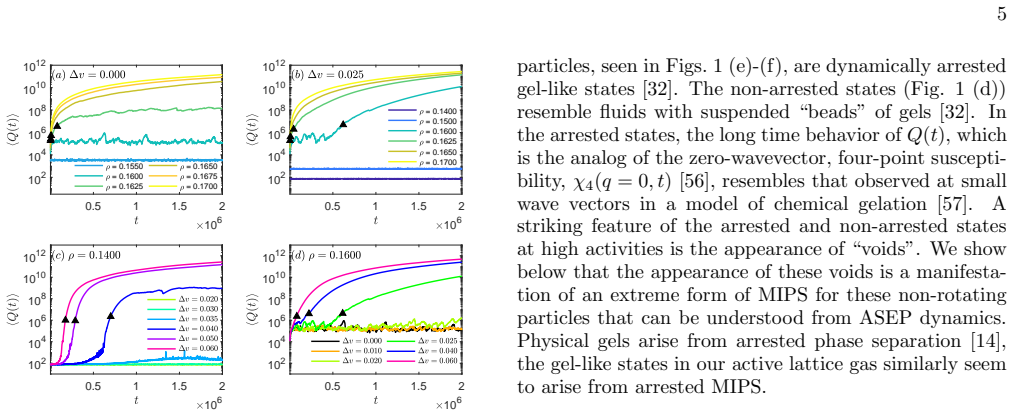
In a lattice gas of hard crosses with strong rotational locking, activity acts as an effective attraction. As the self-propulsion strength $\Delta v$ grows, the system passes from a passive fluid through aging, glassy states into arrested configurations in which a percolated, nearly immobile solid-like network coexists with voids and with a mobile active fluid wetting the interface; the authors identify this as the first activity-induced transition from a repulsive glass to a gel. The arrest is tracked by the log-derivative $\gamma(t)$ of the mean-squared displacement, which falls to zero in arrested runs, and by bimodal distributions of stationary times that appear at lower densities than in the passive system. In the zero-rotation limit the late-time density profile follows a spatial logistic equation obtained from asymmetric-exclusion mean-field currents, giving an interface width $\xi = D/(\alpha \Delta v)$ and phase boundaries for the solid-active-liquid and solid-active-liquid-void regions that match the simulated density fields. Small finite rotation rates leave the qualitative picture intact, with empty voids replaced by a dilute gas and a two-phase binodal similar to that of active dumbbells.
Load-bearing premise
The quantitative theory assumes that, once averaged over large boxes, the density obeys the same simple current equations as a one-lane traffic model, with only one fitted constant and with the extra blocking caused by cross arms ignored; the authors note this fails at low activity and high density.
Editorial extensions
If this is right
- Activity lowers the onset density for glassy dynamics: bimodal stationary-time distributions and aging appear at densities below the passive value $\rho \approx 0.1625$.
- The interface width diverges as activity is reduced ($\xi \sim 1/\Delta v$), so at weak persistence the active-liquid layer fills the system and the arrested void-solid morphology disappears.
- The void size is set by global density and activity, not by coarsening time; the arrested phase separation does not grow without bound.
- With a small finite rotation rate the empty voids are replaced by a low-density gas, yet at high activity a percolated arrested solid still forms because rotational locking suppresses reorientation.
- Because the predicted boundaries depend on system size $L$, smaller lattices can appear homogeneous where larger lattices develop voids, a finite-size signature that can be checked directly.
Reading between the lines
- As an extension not pursued in the paper, the same ASEP balance suggests a design rule: any persistent, non-rotating active species with strong excluded-volume frustration should develop void-solid coexistence with an interface width proportional to $1/\Delta v$, even if the particle shape is not cross-like.
- A direct test the paper leaves open is to extract the ratio $D/\alpha$ from one measured density profile and use it to predict all other phase boundaries, checking the theory's internal consistency.
- The Section VII crossover estimate implies a measurable experimental knob: increasing rotational diffusion should erase voids and restore ordinary fluid-solid coexistence, which could be tested in shaped colloidal swimmers.
- The finite-size divergence predicted by the theory implies that confinement could select between homogeneous and void-containing arrested states, a possible route to active-gel patterning in small devices.
Signed reviews
Editorial analysis
A structured set of objections, weighed in public.
Referee Report
Summary. The paper studies a lattice model of self-propelled hard-core cross-shaped particles (the N3 model) with tunable activity and rotation rate. In the passive limit the model shows a first-order fluid-solid transition and glassy aging. Using kinetic Monte Carlo simulations, the authors show that persistent activity induces two classes of dynamically arrested states: aging glass-like states at high density and gel-like states at lower density, characterized by void-solid coexistence with a wetting active-fluid layer. They propose a coarse-grained mean-field ASEP description that yields a wetting lengthscale xi = D/(alpha DeltaV) and a predicted phase diagram with active-liquid, solid-active-liquid, and solid-active-liquid-void phases. They also analyze finite rotation rates and finite-size effects.
Significance. The simulation-based classification of arrested states into aging glasses and gels is a valuable contribution, and the demonstration of activity-induced gelation without attractions in a non-convex lattice model is conceptually important. The mapping to ASEP is an interesting theoretical step, and the paper offers testable predictions for the DeltaV^{-1} scaling of the interface width, the finite-size dependence of phase boundaries, and a crossover rotation rate. The dynamical-heterogeneity analysis based on stationary times and gamma(t) is careful and well presented. However, the central quantitative claim is weakened because the prefactor D/alpha is fitted to the same data that the theory is said to predict, and the mean-field current is an untested simplification. The phase-boundary derivation also contains a mass-balance inconsistency that needs correction.
major comments (3)
- [Section V (Eq. (7)), Fig. 8, and Abstract] The claim that the ASEP coarse-grained model 'quantitatively predicts' the density profiles is not fully supported: the lengthscale xi = D/(alpha DeltaV) contains an undetermined proportionality constant D/alpha, and Fig. 8 fits this constant (xi = 10/DeltaV) to the same simulated widths that the theory is said to predict. The theory therefore tests the DeltaV^{-1} functional form but not the prefactor, and Eqs. (10) and (13) inherit the fitted value when constructing the phase boundaries. The Abstract and Section V should either derive D/alpha from first principles or explicitly state that the theory has one fitted parameter, and soften 'quantitatively predicts' accordingly.
- [Section VI (Eq. (8))] The mass balance equation N = rho_solid (xi + l_solid) is inconsistent with the linear density profile shown in Fig. 7. If the interface is a ramp from zero to rho_solid over width xi, its mass is approximately rho_solid xi / 2, not rho_solid xi; as written, Eq. (8) overcounts the interface mass by a factor of two. Since Eqs. (10) and (13) are derived from this balance, the theory of the phase boundaries needs to be re-examined. Please clarify the definition of the interface profile and correct the mass balance.
- [Section V (Eqs. (4)-(6)) and Section VIII] The mean-field current JA = alpha DeltaV rho (rho_solid - rho) assumes that the extended N3 exclusion reduces to simple exclusion with a single constant alpha and no correlations from adjacent rows. This assumption is acknowledged in Section V and Section VIII, where the authors note that the ASEP predictions fail at low activity and high densities, but the paper does not provide a direct test of the assumed current against simulation measurements. Since the quantitative claim rests on this functional form, the authors should either validate the current-density relation in the simulations or restrict the quantitative prediction to the regime where the assumption is expected to be accurate.
minor comments (6)
- [Abstract and Section III] The word 'heterogenities' appears in the Abstract and in Section III (e.g., 'appearance of density heterogenities'); it should be 'heterogeneities'.
- [Section VI, last paragraph] The phrase 'the physics in of void-solid coexistence' appears to have a missing word or a typo; please revise.
- [Fig. 8 caption] The caption states that the dashed black line is the best fit xi = 10/DeltaV but does not report the number of data points, error bars, or the fitting procedure; please include these details.
- [Section IV (Eq. (2))] The arrest threshold gamma(tmax) < 0.5 is an arbitrary choice; please discuss the sensitivity of the phase diagram in Fig. 1(g) to this threshold and to the maximum simulation time tmax.
- [Section II and Fig. 6] The coarse-graining box size L^2/900 (15x15 lattice sites) is used for the density profiles but its choice is not justified; a brief comment on how the results depend on this coarse-graining scale would be helpful.
- [Eq. (3)] The notation D0 and D(ρ) are used in the same equation without clarification; using a consistent notation for the density-dependent diffusion coefficient would improve readability.
Circularity Check
Quantitative ASEP width and phase-boundary predictions reuse the fitted constant D/alpha from the same simulated interface data; the scaling law is genuine, but the prefactor and boundary locations are fitted inputs.
-
fitted input called prediction
[Section V, Eqs. (5)-(7) and Fig. 8]
"JA = α∆v ρ(x) (ρsolid − ρ(x)), (5) ... where α is an as yet undetermined proportionality constant. ... implying a wetting lengthscale ξ = D/(α∆v). (7) ... The dashed black line shows the best fit ξ = 10/∆v."
Equation (5) introduces α as an undetermined constant, so Eq. (7) predicts only the functional form ξ ∝ 1/∆v; the prefactor D/α is free. Figure 8 tests this prediction by drawing the best fit ξ = 10/∆v through the simulated interface widths, meaning D/α is measured from the same quantity the paper says is predicted. The abstract's claim that the ASEP coarse-grained model 'quantitatively predicts the density profiles' is therefore only partly a derivation: the inverse-activity scaling and sigmoidal shape are genuine predictions, but the numerical prefactor is an input fitted to the data.
-
fitted input called prediction
[Section VI, Fig. 9 caption and Eqs. (10), (13)]
"The solid lines indicate the theoretically predicted boundary between the active liquid and solid + active liquid regions in Eq. (10), and the activity beyond which void regions open up (predicted by Eq. (13)). We have used the observed value D/α = 10, ρsolid = 0.19, and the simulated system size L = 450."
Equations (10) and (13) are derived by setting lsolid = 0 and lvoid = 0 in mass-conservation expressions that contain ξ = D/(α∆v). Thus D/α is the only microscopic parameter setting the boundary locations. That value is taken from the fit in Fig. 8, so the 'theoretically predicted' phase boundaries inherit a constant fitted to the simulated data rather than derived from the ASEP model. The paper itself later concedes that the boundary positions are not in quantitative agreement with simulations; what remains independently meaningful is the topology of the phase diagram, not the quantitative placement of the boundaries.
full rationale
The central simulation-based result, that persistent activity produces a percolated arrested gel-like state without attraction, is supported directly by MSD measurements, stationary-time distributions, and density profiles, and does not depend on the ASEP prefactor. The circularity is confined to the quantitative ASEP claims: Eq. (5) defines the active current with a free proportionality constant α; Eq. (7) therefore fixes only ξ ∝ 1/∆v, and Fig. 8 fixes D/α by fitting ξ = 10/∆v to the same interface widths. The phase boundaries in Eqs. (10) and (13) then reuse this fitted D/α and are labeled 'theoretically predicted,' even though their quantitative location is an input rather than a derivation. The paper acknowledges the ASEP-based predictions fail at low activity and high densities because only simple exclusion is included, and Appendix C restricts the predicted phase diagram to large enough activities; these are correctness limitations, not additional circularity. No load-bearing self-citation was found: the cited prior work of the same authors supplies the model and single-tracer input, but not the reduction that makes the central gelation claim circular. Overall, the scaling prediction and the classification framework have independent content, while part of the claimed quantitative agreement reduces to a fitted constant, giving a partial circularity score of 4.
Assumptions & free parameters
free parameters (4)
- D/alpha (active-current proportionality constant) =
10 (best fit xi = 10/DeltaV)
- Arrest threshold gamma < 0.5 =
0.5
- Heterogeneity onset threshold epsilon =
10^2
- Max simulation time tmax =
2x10^6
assumptions (5)
- domain assumption The passive hard-cross lattice gas exhibits a first-order fluid-solid transition between densities ~0.16 and 0.19 and a glass transition at high densities.
- domain assumption The RSAD protocol produces maximally random (disordered) packings up to density 0.1717...
- domain assumption The coarse-grained density field obeys the ASEP hydrodynamic limit with mean-field currents JA=alpha*DeltaV*rho(rhosolid-rho) and JT=-D*drho/dx.
- ad hoc to paper Density profiles in the arrested states can be approximated as linear (trapezoidal) for the purpose of deriving phase boundaries.
- standard math Standard kinetic Monte Carlo and stochastic process theory are valid for simulating the model.
Cite this review
Pith. "Pith review of Arrested States in Persistent Active Matter: Gelation without Attraction." pith.science (2026). https://pith.science/paper/7NLMF3NS
@misc{pith2026190901375,
  author       = {Pith},
  title        = {Pith review of: Arrested States in Persistent Active Matter: Gelation without Attraction},
  year         = {2026},
  howpublished = {\url{https://pith.science/paper/7NLMF3NS}},
  note         = {Machine review of arXiv:1909.01375}
}
read the original abstract
We explore phase separation and kinetic arrest in a model active colloidal system consisting of self-propelled, hard-core particles with nonconvex shapes. The passive limit of the model, namely cross-shaped particles on a square lattice, exhibits a first-order transition from a fluid phase to a solid phase with increasing density. Quenches into the two-phase coexistence region exhibit an aging regime. The nonconvex shape of the particles eases jamming in the passive system and leads to strong inhibition of rotations of the active particles. Using numerical simulations and analytical modeling, we quantify the nonequilibrium phase behavior as a function of density and activity. If we view activity as the analog of attraction strength, the phase diagram exhibits strong similarities to that of attractive colloids, exhibiting both aging, glassy states and gel-like arrested states. The two types of dynamically arrested states, glasses and gels, are distinguished by the appearance of density heterogenities in the latter. In the infinitely persistent limit, we show that a coarse-grained model based on the asymmetric exclusion process quantitatively predicts the density profiles of the gel states. The predictions remain qualitatively valid for finite rotation rates. Using these results, we classify the activity-driven phases and identify the boundaries separating them.
Figures


Figures from the paper (15 more)



Reference graph
Works this paper leans on
-
[1]
Toner, Y
J. Toner, Y. Tu, and S. Ramaswamy, Annals of Physics 318, 170 (2005)
2005
-
[2]
Narayan, S
V. Narayan, S. Ramaswamy, and N. Menon, Science 317, 105 (2007)
2007
-
[3]
S. Dey, D. Das, and R. Rajesh, Physical Review Letters 108, 238001 (2012)
work page 2012
-
[4]
H. H. Wensink, J. Dunkel, S. Heidenreich, K. Drescher, R. E. Goldstein, H. L¨ owen, and J. M. Yeomans, Pro- ceedings of the National Academy of Sciences 109, 14308 (2012)
work page 2012
-
[5]
I. Theurkauff, C. Cottin-Bizonne, J. Palacci, C. Ybert, and L. Bocquet, Physical Review Letters 108, 268303 (2012)
work page 2012
-
[6]
Palacci, S
J. Palacci, S. Sacanna, A. P. Steinberg, D. J. Pine, and P. M. Chaikin, Science 339, 936 (2013)
2013
-
[7]
Buttinoni, J
I. Buttinoni, J. Bialk´ e, F. K¨ ummel, H. L¨ owen, C. Bechinger, and T. Speck, Physical Review Letters 110, 238301 (2013)
2013
-
[8]
M. E. Cates and J. Tailleur, Annual Review of Condensed Matter Physics 6, 219 (2015)
2015
Show all 75 references
-
[9]
Fily and M
Y. Fily and M. C. Marchetti, Physical Review Letters 108, 235702 (2012)
2012
-
[10]
G. S. Redner, M. F. Hagan, and A. Baskaran, Physical Review Letters 110, 055701 (2013)
2013
-
[11]
Whitelam, K
S. Whitelam, K. Klymko, and D. Mandal, The Journal of Chemical Physics 148, 154902 (2018)
2018
-
[12]
L. F. Cugliandolo, P. Digregorio, G. Gonnella, and A. Suma, Physical review letters 119, 268002 (2017)
2017
-
[13]
Digregorio, D
P. Digregorio, D. Levis, A. Suma, L. F. Cugliandolo, G. Gonnella, and I. Pagonabarraga, Physical Review Letters 121, 098003 (2018)
2018
-
[14]
Zaccarelli, Journal of Physics: Condensed Matter 19, 323101 (2007)
E. Zaccarelli, Journal of Physics: Condensed Matter 19, 323101 (2007)
2007
-
[15]
Tailleur and M
J. Tailleur and M. E. Cates, Physical Review Letters100, 218103 (2008)
2008
-
[16]
Berthier and J
L. Berthier and J. Kurchan, Nature Physics 9, 310 (2013)
2013
-
[17]
Berthier, Physical Review Letters 112, 220602 (2014)
L. Berthier, Physical Review Letters 112, 220602 (2014)
2014
-
[18]
R. Ni, M. A. C. Stuart, and M. Dijkstra, Nature Com- munications 4, 2704 (2013)
2013
-
[19]
Szamel, E
G. Szamel, E. Flenner, and L. Berthier, Physical Review E 91, 062304 (2015)
2015
-
[20]
Flenner, G
E. Flenner, G. Szamel, and L. Berthier, Soft Matter 12, 7136 (2016)
2016
-
[21]
Berthier, E
L. Berthier, E. Flenner, and G. Szamel, New Journal of Physics 19, 125006 (2017)
2017
- [22]
-
[23]
S. K. Nandi and N. S. Gov, Soft Matter 13, 7609 (2017)
2017
-
[24]
S. K. Nandi, R. Mandal, P. J. Bhuyan, C. Dasgupta, M. Rao, and N. S. Gov, Proceedings of the National Academy of Sciences 115, 7688 (2018)
2018
-
[25]
Y. Fily, S. Henkes, and M. C. Marchetti, Soft Matter 10, 2132 (2014)
2014
-
[26]
Henkes, Y
S. Henkes, Y. Fily, and M. C. Marchetti, Physical Review E 84, 040301 (2011)
2011
-
[27]
Bechinger, R
C. Bechinger, R. Di Leonardo, H. L¨ owen, C. Reichhardt, G. Volpe, and G. Volpe, Reviews of Modern Physics 88, 045006 (2016)
2016
-
[28]
Mandal, P
R. Mandal, P. J. Bhuyan, P. Chaudhuri, C. Dasgupta, and M. Rao, arXiv:1902.05484 (2019)
2019 arXiv
-
[29]
Levis and L
D. Levis and L. Berthier, Physical Review E 89, 062301 (2014)
2014
-
[30]
Reichhardt and C
C. Reichhardt and C. J. O. Reichhardt, Soft Matter 10, 7502 (2014)
2014
-
[31]
Eisenberg and A
E. Eisenberg and A. Baram, Journal of Physics A: Math- ematical and General 33, 1729 (2000)
2000
-
[32]
M. E. Cates, M. Fuchs, K. Kroy, W. C. K. Poon, and A. M. Puertas, Journal of Physics: Condensed Matter 16, S4861 (2004)
2004
-
[33]
J. L. Lebowitz, E. Presutti, and H. Spohn, Journal of Statistical Physics 51, 841 (1988)
1988
-
[34]
Kourbane-Houssene, C
M. Kourbane-Houssene, C. Erignoux, T. Bodineau, and J. Tailleur, Physical Review Letters 120, 268003 (2018)
2018
-
[35]
Nath and R
T. Nath and R. Rajesh, Physical Review E 90, 012120 (2014)
2014
-
[36]
Zhao and T
K. Zhao and T. G. Mason, Journal of Physics: Condensed Matter 26, 152101 (2014)
2014
-
[37]
Eisenberg and A
E. Eisenberg and A. Baram, Europhysics Letters 44, 168 (1998)
1998
-
[38]
Eisenberg and A
E. Eisenberg and A. Baram, Europhysics Letters 71, 900 (2005)
2005
-
[39]
Rotman and E
Z. Rotman and E. Eisenberg, Physical Review E 80, 060104 (2009)
2009
-
[40]
Rotman and E
Z. Rotman and E. Eisenberg, Physical Review Letters 105, 225503 (2010)
2010
-
[41]
Bellemans and J
A. Bellemans and J. Orban, Physical Review Letters 17, 908 (1966)
1966
-
[42]
Orban and D
J. Orban and D. Van Belle, Journal of Physics A: Math- ematical and General 15, L501 (1982)
1982
-
[43]
H. C. M. Fernandes, J. J. Arenzon, and Y. Levin, The Journal of Chemical Physics 126, 114508 (2007)
2007
-
[44]
Khalil, A
N. Khalil, A. de Candia, A. Fierro, M. P. Ciamarra, and A. Coniglio, Soft Matter 10, 4800 (2014)
2014
-
[45]
Chatterjee, N
R. Chatterjee, N. Segall, C. Merrigan, K. Ramola, B. Chakraborty, and Y. Shokef, The Journal of Chemical Physics 150, 144508 (2019)
2019
-
[46]
Biham, A
O. Biham, A. A. Middleton, and D. Levine, Physical Review A 46, R6124 (1992)
1992
-
[47]
Soto and R
R. Soto and R. Golestanian, Physical Review E 89, 012706 (2014)
2014
-
[48]
K. A. Fichthorn and W. H. Weinberg, The Journal of Chemical Physics 95, 1090 (1991)
1991
-
[49]
D. T. Gillespie, Journal of Computational Physics 22, 403 (1976)
1976
-
[50]
Bortz, M
A. Bortz, M. Kalos, and J. Lebowitz, Journal of Com- putational Physics 17, 10 (1975)
1975
-
[51]
Y. Jung, J. P. Garrahan, and D. Chandler, The Journal of Chemical Physics 123, 084509 (2005)
2005
-
[52]
and Liu, A
Shokef, Y. and Liu, A. J., Europhysics Letters 90, 26005 (2010)
2010
-
[53]
Teomy and Y
E. Teomy and Y. Shokef, Physical Review E 92, 032133 (2015)
2015
-
[54]
A. C. Pan, J. P. Garrahan, and D. Chandler, Physical Review E 72, 041106 (2005)
2005
-
[55]
Mandal, P
R. Mandal, P. J. Bhuyan, M. Rao, and C. Dasgupta, Soft Matter 12, 6268 (2016)
2016
-
[56]
Mandal, P
R. Mandal, P. J. Bhuyan, P. Chaudhuri, M. Rao, and C. Dasgupta, Physical Review E 96, 042605 (2017)
2017
-
[57]
A. d. Candia, A. Fierro, R. Pastore, M. Pica Ciamarra, and A. Coniglio, The European Physical Journal Special Topics 226, 323 (2017). 18
2017
-
[58]
Chaudhuri, L
P. Chaudhuri, L. Berthier, P. I. Hurtado, and W. Kob, Physical Review E 81, 040502 (2010)
2010
-
[59]
P. I. Hurtado, L. Berthier, and W. Kob, Physical Review Letters 98, 135503 (2007)
2007
-
[60]
Kurzidim, D
J. Kurzidim, D. Coslovich, and G. Kahl, Journal of Physics Condensed Matter 23 (2011)
2011
-
[61]
Ghosh, E
A. Ghosh, E. Teomy, and Y. Shokef, EPL (Europhysics Letters) 106, 16003 (2014)
2014
-
[62]
Gomez, S
D. Gomez, S. Natan, Y. Shokef, and A. Lesman, arXiv preprint arXiv:1904.08340 (2019)
2019 arXiv
-
[63]
Liao and N
Q. Liao and N. Xu, Soft Matter 14, 853 (2018)
2018
-
[64]
Bodineau and B
T. Bodineau and B. Derrida, Journal of statistical physics 123, 277 (2006)
2006
-
[65]
C. P. Royall, S. R. Williams, and H. Tanaka, The Journal of Chemical Physics 148, 044501 (2018)
2018
-
[66]
J. U. Klamser, S. C. Kapfer, and W. Krauth, Nature Communications 9, 5045 (2018)
2018
-
[67]
Wittkowski and H
R. Wittkowski and H. L¨ owen, Molecular Physics 109, 2935 (2011)
2011
-
[68]
Berthier and G
L. Berthier and G. Biroli, Reviews of Modern Physics 83, 587 (2011)
2011
-
[69]
P. G. Debenedetti and F. H. Stillinger, Nature 410, 259 (2001)
2001
-
[70]
Kob and H
W. Kob and H. C. Andersen, Physical Review E 52, 4134 (1995)
1995
-
[71]
Berthier and W
L. Berthier and W. Kob, Journal of Physics: Condensed Matter 19, 205130 (2007)
2007
-
[72]
L. F. Cugliandolo, arXiv:cond-mat/0210312 (2002)
2002 arXiv
-
[73]
Kob and J.-L
W. Kob and J.-L. Barrat, Physical Review Letters 78, 4581 (1997)
1997
-
[74]
Barrat, R
A. Barrat, R. Burioni, and M. M´ ezard, Journal of Physics A: Mathematical and General 29, 1311 (1996)
1996
-
[600]
1H5nF/n7CAhsHn0f17m7qiGGFSQ=
The black scale bars indicate a length of 100 lattice sites. 16 0 1 2 3 4 5 6 0 1 2 3 4 5 6 0 1 2 3 4 5 6 0 1 2 3 4 5 6 0 1 2 3 4 5 6 0 1 2 3 4 5 6 0 1 2 3 4 5 6 0 1 2 3 4 5 6 DR =0 <latexit sha1_base64="1H5nF/n7CAhsHn0f17m7qiGGFSQ=">AAAB7nicbVDLSgNBEOyNrxhfUY9eBoPgKexGQS9CUA8...
Reviewed August 14, 2026 · model on record in the stance chip above.
Discussion (0). Continue with ORCID to comment.