REVIEW 3 major objections 5 minor 28 references
DC measurement of dressed states in a coupled 100~GHz resonator system using a single quasiparticle transistor as a sensitive microwave detector
T0 review · 3 major / 5 minor · reviewed 2026-08-14 · deepseek-v4-flash
Pith's one-line read By converting each absorbed photon into a cascade of electron transfers, a superconducting transistor can read out the dressed-state spectrum of a resonator–oscillator system near 100 GHz using only dc wiring.
desk verdict A credible high-frequency microwave detector demonstration whose 'dressed states' claim outruns the data: the anticrossing is real but does not discriminate quantum dressed states from classical normal-mode splitting. read the letter →
The pith
A machine-rendered reading of the paper's core claim, the machinery that carries it, and where it could break.
The reading
What carries the argument
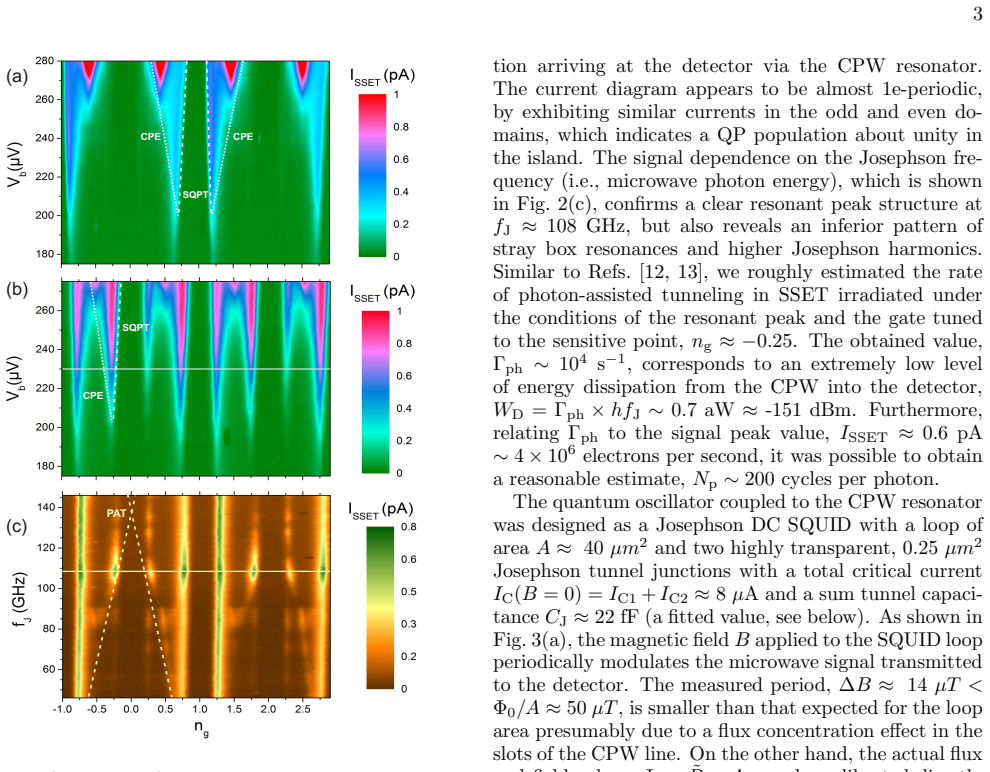
The central object is a superconducting single-electron transistor (SSET) operated as a photon-triggered current amplifier. In the bias window below $4\Delta/e$, a microwave photon above the photon-assisted-tunneling threshold creates an unpaired quasiparticle on the island; the subsequent cycle of single-quasiparticle tunneling (SQPT) and Cooper-pair–electron (CPE) cotunneling transfers a train of about 50–200 electrons per absorbed photon, giving an effective power sensitivity around 0.7 aW. The spectral carrier is the Josephson relation $V_J = h f_J / 2e$, and the fitting identity is the dressed-state dispersion $\omega_\pm(\Phi) = \left(\omega_p(\Phi)+\omega_r \pm \sqrt{4g^2 + (\omega_p(\Phi)-\omega_r)^2}\right)/2$, with the SQUID plasma frequency $\omega_p(\Phi) = \sqrt{2e I_C(\Phi)/(\hbar C_J)}$ and $g$ computed from the resonator geometry.
What would settle it
Replace the SQUID with a linear, non-tunable oscillator or drive the same sample at higher power while recording the detector map: if the splitting follows a classical two-oscillator model with the measured $\gamma$ and no photon-number-dependent frequency shifts appear, the quantum dressed-state assignment is not supported. A decisive version would be to reduce $\gamma$ below $g$, for example with sub-100 nm high-transparency junctions, and resolve the vacuum-Rabi doublet as two separate peaks whose splitting is $2g$ at the single-photon level.
Extended reading notes
Core claim
The paper's central claim is that the two lowest dressed states of a circuit-QED system can be detected as a dc-current map. The system is a coplanar-waveguide resonator at $f_r \approx 70$–$81$ GHz coupled to a DC SQUID acting as a Josephson oscillator whose plasma frequency is tuned by magnetic flux. The detector signal follows the flux-dependent resonance lines $\omega_\pm(\Phi)$ of Eq. (1), producing an anticrossing with splitting $g/\pi \approx 9.2$ GHz and fitted parameters $C_J \approx 22$ fF and asymmetry $d \approx 0.16$. The authors state that this observation is consistent with the Jaynes-Cummings model of the coupled system, and that the readout remains sensitive at $\langle n\rangle < 1$; they also state that because $\gamma \approx 21$–$43$ GHz exceeds $g/2\pi \approx 3.9$–$4.6$ GHz, the strong-coupling condition and Rabi oscillations are not achieved in these samples.
Load-bearing premise
The anticrossing is interpreted as the single-photon transitions of a Jaynes-Cummings ladder, which assumes the SQUID behaves as a coherent quantum oscillator with the plasma-frequency dispersion and that the measured lines are the lowest dressed states; since the decay rate $\gamma$ exceeds the coupling $g$, the same anticrossing would be produced by two classical coupled damped linear oscillators, so the data alone do not prove quantum dressed states.
Editorial extensions
If this is right
- Resonator–oscillator spectra near 100 GHz can be mapped with a fully dc-controlled on-chip setup, removing the need for high-frequency amplification and mixing.
- Continuous readout remains sensitive at mean photon number $\langle n\rangle < 1$, so the detector can in principle follow weakly populated microwave states.
- The fitted coupling $g/\pi \approx 9.2$ GHz matches the geometry-based estimate for the resonator, so the anticrossing provides a direct spectroscopic measurement of the Jaynes-Cummings coupling.
- Because $\gamma > g$, the samples do not support Rabi oscillations or strong-coupling qubit operation; reducing dissipation is the stated path to that regime.
- The observed broadening and its increase near the Cooper-pair-breaking threshold identify quasiparticle leakage and photon-assisted tunneling as the dominant loss channels at 100 GHz.
Reading between the lines
- Because $\gamma$ exceeds $g$ in the present data, the same anticrossing would also be produced by two classical coupled damped oscillators; discriminating the quantum interpretation requires reaching strong coupling or resolving a photon-number-dependent feature such as the second rung of the Jaynes-Cummings ladder.
- The train-like current response suggests the detector could be operated as a single-microwave-photon counter: counting current pulses rather than measuring their average would give direct photon statistics of the 100 GHz field.
- A natural extension is to use the same dc readout for dispersive qubit-state measurement at frequencies near 100 GHz, where conventional cryogenic amplifiers and mixers become impractical, if the oscillator's decay can be lowered sufficiently.
Signed reviews
Editorial analysis
A structured set of objections, weighed in public.
Referee Report
Summary. The manuscript reports an on-chip microwave detection technique operating near 100 GHz, based on photon-assisted tunneling in a superconducting single-electron transistor (SSET) with an intrinsic current-multiplication mechanism. The authors apply this detector to a coupled system consisting of a coplanar waveguide resonator and a Josephson DC SQUID oscillator, and observe a resonance anticrossing as a function of magnetic flux. They fit the dispersion with Eq. (1), using a geometry-derived coupling strength g and two adjustable parameters (C_J and d), and report g/π ≈ 9.2 GHz, decay rates γ ≈ 21–43 GHz, and mean photon numbers ⟨n⟩ < 1. The paper claims this is the spectrum of the Jaynes-Cummings dressed states of the system, while acknowledging that the strong-coupling limit g ≫ γ is not reached and that no Rabi oscillation is expected.
Significance. If the dressed-state interpretation were established, the paper would demonstrate a significant experimental step: continuous readout of sub-photon microwave states in the 100 GHz range with a simple dc-controlled on-chip detector. The detector concept itself, including the reported current-multiplication mechanism and the estimated sensitivity, is novel and potentially useful for mesoscopic microwave experiments. The data also provide a clear antenna of an anticrossing between a resonator and a SQUID at record-high frequencies. However, the central physical claim is weaker than the title and abstract suggest, because the anticrossing is equally compatible with a classical normal-mode splitting of two coupled linear oscillators. The published data cannot discriminate between the quantum and classical pictures, and the manuscript does not provide any additional quantum signature.
major comments (3)
- [Title/Abstract and Fig. 3(b)-(c)] The central claim that the experiment 'observed the spectrum of the dressed states' is not supported by the data. The manuscript itself states that γ (21–43 GHz) exceeds g/2π (3.9–4.6 GHz), so the strong-coupling regime is not reached, and the SQUID is a nearly harmonic transmon-like oscillator with E_J/E_CJ ≈ 4000. Under these conditions two linearly coupled damped oscillators produce exactly the same anticrossing formula as Eq. (1), so the measured double-peak dispersion does not discriminate between Jaynes-Cummings dressed states and classical normal-mode splitting. Please either add a discriminating measurement (e.g., photon-number dependence, nonlinearity-induced asymmetry, or time-domain Rabi oscillations) or revise the title, abstract, and conclusions to state that the data are consistent with, but do not uniquely establish, quantum dressed states.
- [Fit procedure and error analysis (Fig. 3(b), Table I)] The quantitative comparison is weakened by the absence of uncertainties. The solid lines in Fig. 3(b) are generated by adjusting C_J and d while g is taken from a geometry-based calculation, but no error bars are reported for C_J, d, g, or the fitted line positions. Likewise, the reported values of γ = 2π(Δf−Δf_J) and ⟨n⟩ = P_in/(γħω_r) in Table I depend on measured linewidths and on an assumed input power, with no propagation of uncertainties. Please provide at least rough error estimates for these quantities and state explicitly which parameters are measured versus fitted.
- [Detector sensitivity estimates (Fig. 2(c) and surrounding text)] The central detector figure of merit, Γ_ph ≈ 10^4 s^−1 and N_p ≈ 200 cycles per photon, is based on a simplified transport model and a single operating point, with no uncertainty or discussion of systematic errors. Since the claim of detecting ⟨n⟩ < 1 relies on these estimates, please add a more detailed error budget or clearly label these as order-of-magnitude estimates.
minor comments (5)
- [Abstract and Table I] The abstract quotes g/π ≈ 10 GHz while Table I lists g/2π = 4.6 and 3.9 GHz; please clarify that the splitting equals 2g/(2π) = g/π and check the consistency of the rounding.
- [Eq. (1) and Fig. 3(b)] The formula for g is only given by reference to [24]; please write the explicit expression for the CPW-resonator coupling strength in terms of resonator capacitance and frequency.
- [Fig. 3(b)] Please define the color scale and axes of the blow-up diagram, and state which experimental settings (V_b, V_g, B) correspond to the plotted data.
- [PAT threshold formula] The symbol m in the photon-assisted tunneling threshold is introduced as an even integer; please specify its range or definition more precisely.
- [Fig. 2(a)-(b) and text on transport cycle] The statement 'the CPE/CPE cotunneling current ... reaches the values I_SSET ∼ 10 pA beyond the diagram scope' is confusing; clarify whether this is a measured value or an extrapolation and how it is used for the τ_CPE estimate.
Circularity Check
No circular derivation: coupling g is fixed from CPW geometry and the detector is calibrated on a separate test sample.
full rationale
The central claim does not reduce to its inputs. The dressed-state splitting displayed in Fig. 3(b) is represented by Eq. (1) with g fixed by the CPW geometry: 'The frequency splitting interval, equal to g/π = ... ≈ 9.2 GHz, was calculated directly, based on the resonator geometry [24].' The only fitted parameters, C_J and d, enter through the uncoupled plasma frequency ω_p(Φ) and control the position and shape of the uncoupled branches, not the size of the splitting; if the observed anticrossing had a separation inconsistent with 2g, no choice of C_J or d would reproduce it. The detector's photon-triggering mechanism is separately validated on a test sample without an oscillator (Fig. 2), so the sensitivity claim is not defined in terms of the dressed-state data. Prior self-citations to detector work are supporting background and not load-bearing. The main skeptical objection—that an overdamped, weakly anharmonic SQUID gives the same anticrossing as two classical coupled oscillators—is an underdetermination of the quantum model, not a circular derivation, and is outside this pass.
Assumptions & free parameters
free parameters (3)
- SQUID total junction capacitance C_J =
22 fF
- SQUID asymmetry factor d =
0.16
- Input power P_in =
0.1 pW
assumptions (4)
- domain assumption Jaynes-Cummings model with Eq. (1) describes the resonator-SQUID coupled spectrum
- domain assumption SQUID plasma frequency follows omega_p(Phi)=sqrt(2e I_C(Phi)/(hbar C_J)) with I_C(Phi) modulated by flux
- domain assumption The detector responds via PAT with threshold E_ph >= 2Delta + E_C(1 -/+ 2n_g + 2m) - eV_b/2
- domain assumption Observed peaks are single-photon transitions in the first excited manifold
Cite this review
Pith. "Pith review of DC measurement of dressed states in a coupled 100~GHz resonator system using a single quasiparticle transistor as a sensitive microwave detector." pith.science (2026). https://pith.science/paper/37PGUETA
@misc{pith2026190902349,
  author       = {Pith},
  title        = {Pith review of: DC measurement of dressed states in a coupled 100~GHz resonator system using a single quasiparticle transistor as a sensitive microwave detector},
  year         = {2026},
  howpublished = {\url{https://pith.science/paper/37PGUETA}},
  note         = {Machine review of arXiv:1909.02349}
}
read the original abstract
We report on the on-chip detection of microwaves in the frequency range around 100GHz. For the purpose of detection, we employ a discrete transport channel triggered in a superconducting single-electron transistor by photon-assisted tunneling of quasiparticles. The technique is successfully applied to observe the spectrum of the dressed states of a model cQED system consisting of a superconducting coplanar resonator coupled to a quantum Josephson oscillator. The dressed states appear as typical resonance anticrossing exhibiting, in our case, an expectedly wide frequency splitting corresponding to the Jaynes-Cummings coupling strength, g/pi~10GHz. Due to the high decay rate, gamma~20-40GHz, in the very transparent Josephson junctions used, the strong coupling limit, g>>gamma, which is required for qubit operation, is not achieved, and the photon population in the resonator is low, <n>~1. Remarkably, the continuous readout of the low population states demonstrates the high microwave sensitivity of the detector.
Figures


Reference graph
Works this paper leans on
-
[1]
R. J. Schoelkopf and S. M. Girvin, Nature 451, 664 (2008)
work page 2008
- [2]
-
[3]
D. Walls and G. Milburn, Quantum Optics (Springer- Verlag, Berlin Heidelberg 2008)
work page 2008
-
[4]
A. Wallraff, D. I. Schuster, A. Blais, L. Frunzio, R.- S. Huang, J. Majer, S. Kumar, S.M. Girvin, and 5 R. J. Schoelkopf, Nature 431, 162 (2004)
work page 2004
-
[5]
J. M. Fink, M. G¨ oppl, M. Baur, R. Bianchetti, P. J. Leek, A. Blais, and A. Wallraff, Nature 454, 315 (2008)
work page 2008
-
[6]
Blais, R.-S
A. Blais, R.-S. Huang, A. Wallraff, S. M. Girvin, and R. J. Schoelkopf, Phys. Rev. A 69, 062320 (2004)
2004
-
[7]
R. Barends, J. Wenner, M. Lenander, Y. Chen, R. C. Bialczak, J. Kelly, E. Lucero, P. O’Malley, M. Mariantoni, D. Sank, H. Wang, T. C. White, Y. Yin, J. Zhao, A. N. Cleland, J. M. Martinis, and J. J. A. Basel- mans, Appl. Phys. Lett. 99, 113507 (2011)
work page 2011
-
[8]
L. Gruenhaupt, N. Maleeva, S. T. Skacel, M. Calvo, F. Levy-Bertrand, A. V. Ustinov, H. Rotzinger, A. Mon- fardini, G. Catelani, and I. M. Pop, Phys. Rev. Lett.121, 117001 (2018)
work page 2018
Show all 28 references
-
[9]
J. S. Lehtinen, E. Mykk¨ anen, A. Kemppinen, S. V. Lotkhov, D. Golubev, and A. J. Manninen, Supercond. Sci. Technol. 30, 055006 (2017)
2017
-
[10]
Billangeon, F
P.-M. Billangeon, F. Pierre, H. Bouchiat, and R. De- block, Phys. Rev. Lett. 96, 136804 (2006), also: Phys. Rev. Lett. 98, 126802 (2007); J. Basset, H. Bouchiat, and R. Deblock, Phys. Rev. B 85, 085435 (2012)
2006
-
[11]
S. V. Lotkhov and A. B. Zorin, Appl. Phys. Lett. 100, 242601 (2012)
2012
-
[12]
Jalali-Jafari, S
B. Jalali-Jafari, S. V. Lotkhov, and A. B. Zorin, Appl. Sci. 6, 35 (2016)
2016
-
[13]
S. V. Lotkhov, B. Jalali-Jafari, and A. B. Zorin, Appl. Phys. Lett. 108, 172603 (2016)
2016
-
[14]
G. J. Dolan, Appl. Phys. Lett., 31, 337 (1977)
1977
- [15]
-
[16]
Maassen van den Brink, G
A. Maassen van den Brink, G. Sch¨ on, and L. J. Geerligs, Phys. Rev. Lett. 67, 3030 (1991)
1991
-
[17]
Hadley, E
P. Hadley, E. Delvigne, E. H. Visscher, S. L¨ ahteenm¨ aki, and J. E. Mooij, Phys. Rev. B 58, 15317 (1998)
1998
-
[18]
M. T. Tuominen, J. M. Hergenrother, T. S. Tighe, and M. Tinkham, Phys. Rev. Lett. 69, 1997 (1992); A. Amar, D. Song, C. J. Lobb, and F. C. Wellstood, IEEE Trans. on Appl. Supercond., 7, 3544 (1993)
1992
-
[19]
J. P. Pekola, V. F. Maisi, S. Kafanov, N. Chekurov, A. Kemppinen, Y. A. Pashkin, O.-P. Saira, M. M¨ ott¨ onen, and J. S. Tsai, Phys. Rev. Lett. 105, 026803 (2010)
2010
-
[20]
Kemppinen, S
A. Kemppinen, S. V. Lotkhov, O.-P. Saira, A. B. Zorin, J. P. Pekola, and A. J. Manninen, Appl. Phys. Lett. 99, 142106 (2011)
2011
-
[21]
Saira, A
O.-P. Saira, A. Kemppinen, V. F. Maisi, and J. P. Pekola, Phys. Rev. B 85, 012504 (2012)
2012
-
[22]
V. F. Maisi, S. V. Lotkhov, A. Kemppinen, A. Heimes, J. T. Muhonen, and J. P. Pekola, Phys. Rev. Lett. 111, 147001 (2013)
2013
-
[23]
J. Koch, T. M. Yu, J. Gambetta, A. A. Houck, D. I. Schuster, J. Majer, A. Blais, M. H. Devoret, S. M. Girvin, and R. J. Schoelkopf, Phys. Rev. A 76, 042319 (2007)
2007
-
[24]
G¨ oppl, A
M. G¨ oppl, A. Fragner, M. Baur, R. Bianchetti, S. Fil- ipp, J. M. Fink, P. J. Leek, G. Puebla, L. Steffen, and A. Wallraff, J. Appl. Phys. 104, 113904 (2008)
2008
-
[25]
K. K. Likharev, Dynamics of Josephson Junctions and Circuits (Gordon and Breach, New York 1986)
1986
-
[26]
S. V. Lotkhov, E. M. Tolkacheva, D. V. Balashov, M. I. Khabipov, F.-I. Buchholz, and A. B. Zorin, Appl. Phys. Lett. 89, 132115 (2006)
2006
-
[27]
Sandberg, C
M. Sandberg, C. M. Wilson, F. Persson, T. Bauch, G. Jo- hansson, V. Shumeiko, T. Duty, and P. Delsing, Appl. Phys. Lett. 92, 203501 (2008)
2008
-
[28]
P. K. Tien and J. P. Gordon, Phys. Rev. 129, 647 (1963)
1963
Reviewed August 14, 2026 · model on record in the stance chip above.
Discussion (0). Continue with ORCID to comment.