REVIEW 4 major objections 4 minor 1 cited by
GmCN: Graph Mask Convolutional Network
T0 review · 4 major / 4 minor · reviewed 2026-08-14 · deepseek-v4-flash
Pith's one-line read A learnable binary mask lets each node select its own aggregation neighborhood, improving GCN accuracy and graph-noise robustness.
desk verdict GmCN is a legitimate but modest GCN variant with decent experiments; the claimed theoretical optimality of the learned mask is not actually established by the derivation. read the letter →
The pith
A machine-rendered reading of the paper's core claim, the machinery that carries it, and where it could break.
The reading
What carries the argument
The load-bearing object is the mask-weighted adjacency $M\odot \hat{A}$ inside the aggregation step. The optimization objective is $$R_{\mathrm{GmCN}}(M,U)=\mathrm{Tr}[$U^{{T}}$(I-M\odot\hat{A})U]+\mu\|U-H\|$_F^{2}$+\gamma\|M\|$_F^{2}$,$$ with the binary mask relaxed to a row-stochastic nonnegative matrix. The update alternates a doubly-stochastic-like projection for $M$ (Algorithm 1) and a $T$-step truncated power iteration for $U$; the mask directly controls which graph edges carry feature information, so the network can prune unwanted connections during training.
What would settle it
On a small graph, enumerate all binary masks satisfying the row-stochastic constraint, compute $R_{\mathrm{GmCN}}$ for each, and compare the true optimum with the mask returned by Algorithm 2 after its relaxation and discretization step; if the thresholded mask's objective is substantially worse than the best binary mask, the paper's theoretical grounding for GmCN fails.
Extended reading notes
Core claim
The paper's central claim is that a graph convolutional layer should not be tied to the given adjacency structure. GmCN instead computes $U^{(t)}=\alpha(M\odot \hat{A})U^{(t-1)}+(1-\alpha)H$, where $M$ is a per-layer learnable 0/1 mask; $M_{ij}=1$ means node $i$ aggregates features from node $j$, and $M_{ij}=0$ excludes that neighbor. The authors derive, by reinterpreting GCN's power-iteration aggregation as the solution of a regularization problem and adding a mask term, that the optimal mask is the solution of a constrained projection problem, which yields a closed-form update. They then discretize the relaxed mask and alternate mask optimization with feature aggregation, treating the whole scheme as controlled by two parameters, $\alpha$ and $\gamma$. The reported experiments claim consistent accuracy gains over fixed-graph GCN and over attention- and sampling-based alternatives, with the largest margins on the Amazon datasets and under edge perturbation.
Load-bearing premise
The theoretical interpretation assumes the continuous relaxation plus thresholding faithfully solves the original binary mask problem; the paper gives no bound or experiment measuring that discretization loss, and the threshold epsilon is not reported.
Editorial extensions
If this is right
- Semi-supervised classification accuracy increases on all five datasets at 10%, 20%, and 30% labeled nodes compared with fixed-graph GCN.
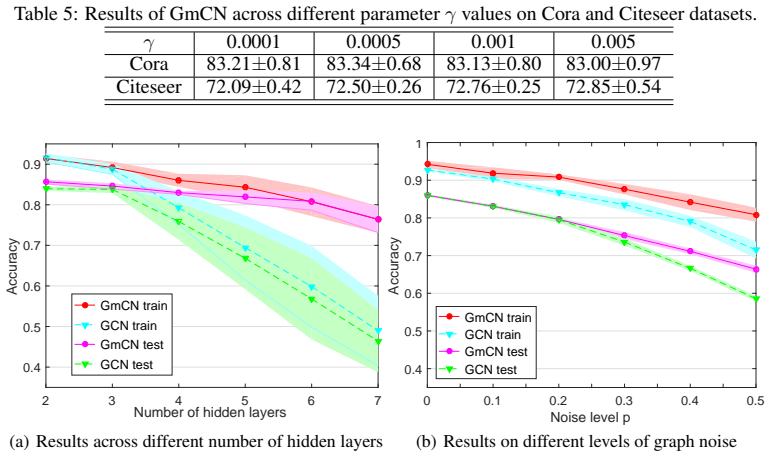
- The method stays competitive as the network deepens: GmCN outperforms GCN at every depth from two to seven layers on Cora.
- Under random edge rewiring, GmCN's test accuracy drops less than GCN's, indicating the mask filters structure noise.
- The mask update and feature aggregation come from the same regularized objective, so neighborhood selection is derived rather than set by an external heuristic.
- The extra computational cost is bounded by $O(n^2)$ for the mask update and $O(n^2d)$ for aggregation in the dense worst case, with better practical efficiency when both $\hat{A}$ and $M$ are sparse.
Reading between the lines
- Editorial inference: the mask can be viewed as a learned graph-denoising operator; pruning edges during propagation is a more general mechanism than selecting neighbors for accuracy, and the same objective could be used to output a denoised graph for downstream tasks.
- Editorial inference: replacing hard 0/1 discretization with a continuous mask or top-$k$ selection would make the method differentiable in the mask and could yield calibrated selection probabilities, which the current thresholding discards.
- Editorial inference: because the paper reports accuracy is stable across $\gamma$ but does not report the discretization threshold $\epsilon$, the sensitivity of the final mask to thresholding remains untested; a natural experiment is to sweep $\epsilon$ and measure objective degradation and accuracy change.
Signed reviews
Editorial analysis
A structured set of objections, weighed in public.
Referee Report
Summary. The paper proposes GmCN, a GCN variant in which a binary mask matrix M selects, for each node, a subset of neighbors to use in feature aggregation. The mask is motivated by a regularization objective (Eq. 10) that adds a sparsity penalty to a standard GCN smoothness term; the binary constraint is relaxed to a continuous row-stochastic constraint, and the resulting bi-convex problem is solved by alternating updates (Algorithm 2) followed by thresholding. Experiments on Cora, Citeseer, Cora-ML, Amazon Computers, and Amazon Photo report consistent accuracy gains over GCN, GAT, GraphSAGE, and other baselines, and a perturbation experiment shows robustness to edge noise.
Significance. The empirical results are consistently positive: GmCN obtains the best or near-best accuracy on all five datasets and label ratios, with gains of roughly 1-3 points over GCN and GAT, and the edge-perturbation experiment suggests that selective aggregation improves robustness. The regularization-based derivation is appealing in principle and differentiates the method from attention and sampling approaches. However, the paper does not provide code, and several load-bearing links between the discrete mask objective and Algorithm 2 are not established (see major comments). As it stands, the contribution is an empirically promising heuristic mask-selection method rather than a theoretically grounded optimal-mask method. If the authors repair the derivation, report the missing threshold parameter, and provide approximation analysis, the paper would be a solid contribution to the GNN literature.
major comments (4)
- [§4.1, Eqs. (11)-(13)] The relaxation changes the feasible set in an unaddressed way. The original constraint M_ij ∈ {0,1} allows each row to select any subset of neighbors, including the empty set and multiple neighbors, while the relaxed constraint M1^T = 1^T, M ≥ 0 forces every row to be a probability distribution over all n entries. The subsequent thresholding with an unspecified ε can produce rows with zero, one, or many selected entries, so the final discrete M is not in general a feasible point of either problem. Moreover, under row normalization the term γ||M||^2_F no longer encourages sparsity: for a fixed row sum, the Frobenius norm is minimized by a uniform row, so the statement that 'larger γ leads to more sparse M' is not true for the relaxed problem. The authors need either a formal relationship between the discrete and relaxed problems or a change of claim to 'heuristic mask selection'.
- [§4.2, Algorithms 1 and 2; §6.2] The projection step is neither derived nor matched to the stated constraint. Eq. (16) is a projection onto the row-stochastic nonnegative set, which can be solved row-wise by a simplex projection, but Algorithm 1 is described as the algorithm of [22], which is a doubly stochastic normalization, and the update in line 3 contains both left and right multiplications by 1^T1, i.e., it enforces column constraints absent from Eq. (13). The authors should either prove that the cited algorithm solves Eq. (16) or replace it with the correct projection; as written, the mask returned by Algorithm 2 is not shown to minimize Eq. (16) even before discretization.
- [§4.2, Eqs. (17)-(18); Algorithm 2] The alternating scheme is only an approximation, and the label 'optimal' is unsupported. Step 2 replaces the exact minimizer of Eq. (17) by T = 3 power iterations, and the outer loop is truncated at K = 4, L = 3, T = 3; no error bound, convergence criterion, or ablation on K, L, T is provided. Since M and U are never optimized to convergence, the output is not shown to be a stationary point of Eq. (12). The paper should either provide approximation guarantees or describe GmCN as an approximate/heuristic algorithm and temper the word 'optimal' in the abstract, Section 5, and conclusion.
- [§6.2; Algorithm 2] The discretization threshold ε is a free parameter of the method but is never reported or analyzed. The text lists settings for α, γ, K, L, T but not ε; the parameter analysis in Tables 4-5 covers only α and γ, and Figure 1 covers only depth and noise level. Since ε determines whether a row becomes empty, single-neighbor, or multi-neighbor after thresholding, the reported experiments are not reproducible without this value, and there is no evidence that thresholding the continuous solution preserves closeness to an optimum of Eq. (10). Please report ε, add a sensitivity study, and quantify the discretization loss, e.g., by comparing the objective value before and after thresholding.
minor comments (4)
- [§4.1] There are two typographical errors: 'Forbnuous norm' should be 'Frobenius norm', and 'combinational' should be 'combinatorial'.
- [§6.1] The Cora dataset is described as having six classes, but the standard Cora dataset has seven classes; please correct this and verify the corresponding statistics.
- [§6.5] The perturbation study compares GmCN only against GCN; including one or two additional baselines, such as GAT or APPNP, would make the robustness claim more convincing.
- [Tables 1-3] Several differences between GmCN and the runner-up are within one standard deviation; reporting paired significance tests or confidence intervals over the five splits would strengthen the claim that GmCN is consistently better.
Circularity Check
No circularity: the mask update is the minimizer of an explicitly stated variational objective, not a fitted parameter renamed as a prediction.
full rationale
The GmCN derivation chain is self-contained in the required sense. Section 4.1 invokes the known regularization interpretation of GCN power iteration, Eq. (9), with the proof attributed to the independent prior work [23] (Zhou et al.); refs. [7,8] are additional pointers and are not load-bearing. Eq. (10) is then a genuine variational extension obtained by replacing \hat A with M⊙\hat A and adding a penalty on M, not an objective defined in terms of the algorithm's output. The M-subproblem is algebraically reduced to the projection problem Eq. (16), and Algorithm 2 implements that projection together with the U-subproblem power iteration of Eq. (18). Thus the learned mask is the minimizer of a stated objective rather than a fitted quantity renamed as a prediction. The concerns raised about the paper—that the relaxation in Eq. (13) adds a row-sum constraint absent from the discrete problem, that the discretization threshold \epsilon is unreported, and that the projection is cited to a doubly stochastic algorithm while the constraint is only row-stochastic—are correctness/validation gaps, not circular reductions. No step in the paper reduces to its own inputs by construction, and no central claim depends on a self-citation chain.
Assumptions & free parameters
free parameters (4)
- alpha =
0.8
- gamma =
0.001
- epsilon =
not specified
- K, L, T =
4, 3, 3
assumptions (4)
- standard math The GCN feature aggregation in Eq. (3) is a T-step power iteration solution to the regularization framework in Eq. (9) (Zhou et al. 2004; Jiang et al. 2019).
- ad hoc to paper The binary mask constraint M_ij in {0,1} can be relaxed to a continuous row-stochastic constraint M1^T = 1^T, M >= 0, and the resulting solution can be post-discretized without significant loss.
- standard math The projection algorithm from Zass and Shashua (2007) solves the constrained projection problem in Eq. (16).
- ad hoc to paper The amortized aggregation step in Eq. (18) with T=3 is a sufficient approximation of the U-update in Eq. (17).
Cite this review
Pith. "Pith review of GmCN: Graph Mask Convolutional Network." pith.science (2026). https://pith.science/paper/VGBLEI2B
@misc{pith2026191001735,
  author       = {Pith},
  title        = {Pith review of: GmCN: Graph Mask Convolutional Network},
  year         = {2026},
  howpublished = {\url{https://pith.science/paper/VGBLEI2B}},
  note         = {Machine review of arXiv:1910.01735}
}
read the original abstract
Graph Convolutional Networks (GCNs) have shown very powerful for graph data representation and learning tasks. Existing GCNs usually conduct feature aggregation on a fixed neighborhood graph in which each node computes its representation by aggregating the feature representations of all its neighbors which is biased by its own representation. However, this fixed aggregation strategy is not guaranteed to be optimal for GCN based graph learning and also can be affected by some graph structure noises, such as incorrect or undesired edge connections. To address these issues, we propose a novel Graph mask Convolutional Network (GmCN) in which nodes can adaptively select the optimal neighbors in their feature aggregation to better serve GCN learning. GmCN can be theoretically interpreted by a regularization framework, based on which we derive a simple update algorithm to determine the optimal mask adaptively in GmCN training process. Experiments on several datasets validate the effectiveness of GmCN.
Figures
Forward citations
Cited by 1 Pith paper
-
Semi-supervised Learning with Adaptive Neighborhood Graph Propagation Network
ANGPN jointly learns an adaptive neighborhood graph and propagates node features through it, improving semi-supervised classification accuracy by a few points over fixed-graph GCN on SVHN, CIFAR, 20News, and CoraML.
Reference graph
Works this paper leans on
-
[22]
R. Zass and A. Shashua. Doubly stochastic normalization for spectral clustering. In Advances in neural information processing systems, pages 1569–1576, 2007
work page 2007
- [1]
-
[2]
J. Chen, J. Zhu, and L. Song. Stochastic training of graph convolutional networks with variance reduction. In International Conference on Machine Learning, pages 942–950, 2018
work page 2018
-
[3]
M. Defferrard, X. Bresson, and P. Vandergheynst. Convolutional neural networks on graphs with fast localized spectral filtering. In Advances in Neural Information Processing Systems, pages 3844–3852, 2016
work page 2016
-
[4]
X. Glorot and Y . Bengio. Understanding the difficulty of training deep feedforward neural networks. In International conference on artificial intelligence and statistics, pages 249–256, 2010
work page 2010
-
[5]
W. Hamilton, Z. Ying, and J. Leskovec. Inductive representation learning on large graphs. In Advances in Neural Information Processing Systems, pages 1024–1034, 2017. 8
work page 2017
- [6]
- [7]
Show all 24 references
-
[8]
Jiang, Z
B. Jiang, Z. Zhang, J. Tang, and B. Luo. Graph optimized convolutional networks. arXiv:1904.11883, 2019
1904 arXiv
-
[9]
D. P. Kingma and J. Ba. Adam: A method for stochastic optimization. In International Conference on Learning Representations, 2015
2015
-
[10]
T. N. Kipf and M. Welling. Semi-supervised classification with graph convolutional networks. arXiv preprint arXiv:1609.02907, 2016
2016 arXiv
-
[11]
Klicpera, A
J. Klicpera, A. Bojchevski, and S. Günnemann. Predict then propagate: Graph neural networks meet personalized pagerank. 2019
2019
-
[12]
Y . Li, R. Yu, C. Shahabi, and Y . Liu. Diffusion convolutional recurrent neural network: Data- driven traffic forecasting. In International Conference on Learning Representations (ICLR ’18), 2018
2018
-
[13]
McAuley, C
J. McAuley, C. Targett, Q. Shi, and A. Van Den Hengel. Image-based recommendations on styles and substitutes. In Proceedings of the 38th International ACM SIGIR Conference on Research and Development in Information Retrieval, pages 43–52, 2015
2015
-
[14]
A. K. McCallum, K. Nigam, J. Rennie, and K. Seymore. Automating the construction of internet portals with machine learning. Information Retrieval, 3(2):127–163, 2000
2000
-
[15]
Monti, D
F. Monti, D. Boscaini, J. Masci, E. Rodola, J. Svoboda, and M. M. Bronstein. Geometric deep learning on graphs and manifolds using mixture model cnns. In IEEE Conference on Computer Vision and Pattern Recognition, pages 5423–5434, 2017
2017
-
[16]
Perozzi, R
B. Perozzi, R. Al-Rfou, and S. Skiena. Deepwalk: Online learning of social representations. In Proceedings of the 20th ACM SIGKDD international conference on Knowledge discovery and data mining, pages 701–710, 2014
2014
-
[17]
Ruoyu, W
L. Ruoyu, W. Sheng, Z. Feiyun, and H. Junzhou. Adaptive graph convolutional neural networks. In AAAI Conference on Artificial Intelligence, pages 3546–3553, 2018
2018
-
[18]
P. Sen, G. Namata, M. Bilgic, L. Getoor, B. Galligher, and T. Eliassi-Rad. Collective classifica- tion in network data. AI magazine, 29(3):93, 2008
2008
-
[19]
Shchur, M
O. Shchur, M. Mumme, A. Bojchevski, and S. Günnemann. Pitfalls of graph neural network evaluation. arXiv preprint arXiv:1811.05868, 2018
2018 arXiv
-
[20]
Velickovic, G
P. Velickovic, G. Cucurull, A. Casanova, A. Romero, P. Lio, and Y . Bengio. Graph attention networks. arXiv preprint arXiv:1710.10903, 2017
2017 arXiv
-
[21]
Veliˇckovi´c, W
P. Veliˇckovi´c, W. Fedus, W. L. Hamilton, P. Liò, Y . Bengio, and R. D. Hjelm. Deep graph infomax. In ICLR, 2019
2019
-
[23]
D. Zhou, O. Bousquet, T. N. Lal, J. Weston, and B. Schölkopf. Learning with local and global consistency. In Advances in neural information processing systems, pages 321–328, 2004
2004
-
[24]
J. Zhou, G. Cui, Z. Zhang, C. Yang, Z. Liu, and M. Sun. Graph neural networks: A review of methods and applications. arXiv preprint arXiv:1812.08434, 2018. 9
2018 arXiv
Reviewed August 14, 2026 · model on record in the stance chip above.
Discussion (0). Continue with ORCID to comment.