Parallelized Discrete Exterior Calculus for Three-Dimensional Elliptic Problems
Pith reviewed 2026-05-24 12:47 UTC · model grok-4.3
The pith
A parallelized discrete exterior calculus library solves three-dimensional elliptic problems and handles material discontinuities with ease.
A machine-rendered reading of the paper's core claim, the machinery that carries it, and where it could break.
Core claim
A formulation of elliptic boundary value problems is used to develop the first discrete exterior calculus (DEC) library for massively parallel computations with 3D domains. This can be used for steady-state analysis of any physical process driven by the gradient of a scalar quantity, e.g. temperature, concentration, pressure or electric potential, and is easily extendable to transient analysis. In addition to offering this library to the community, we demonstrate one important benefit from the DEC formulation: effortless introduction of strong heterogeneities and discontinuities. These are typical for real materials, but challenging for widely used domain discretization schemes, such as the
What carries the argument
The parallelized discrete exterior calculus (DEC) formulation for elliptic boundary value problems in three dimensions, which discretizes the governing equations using exterior calculus operators.
If this is right
- Steady-state analysis of physical processes driven by scalar gradients becomes feasible on parallel computers for three-dimensional domains.
- Strong heterogeneities and discontinuities can be introduced into the model without substantial additional effort.
- The library supports straightforward extension to transient analysis of the same class of problems.
- Future extensions can address processes driven by gradients of vector quantities.
Where Pith is reading between the lines
- The same parallel structure may apply to other discretization schemes that rely on topological operators rather than local shape functions.
- Simulations of growing crack populations could be scaled to domains large enough to study statistical distributions of conductivity loss.
- The effortless handling of discontinuities suggests the formulation may combine readily with image-based or voxel input data from material scans.
Load-bearing premise
The DEC formulation can be parallelized efficiently for 3D domains without significant overhead and that introducing strong heterogeneities and discontinuities is effortless compared to finite elements.
What would settle it
A side-by-side run of the DEC library and a finite element code on the same large 3D domain containing many discontinuities, checking whether setup time and parallel scaling differ markedly.
Figures
read the original abstract
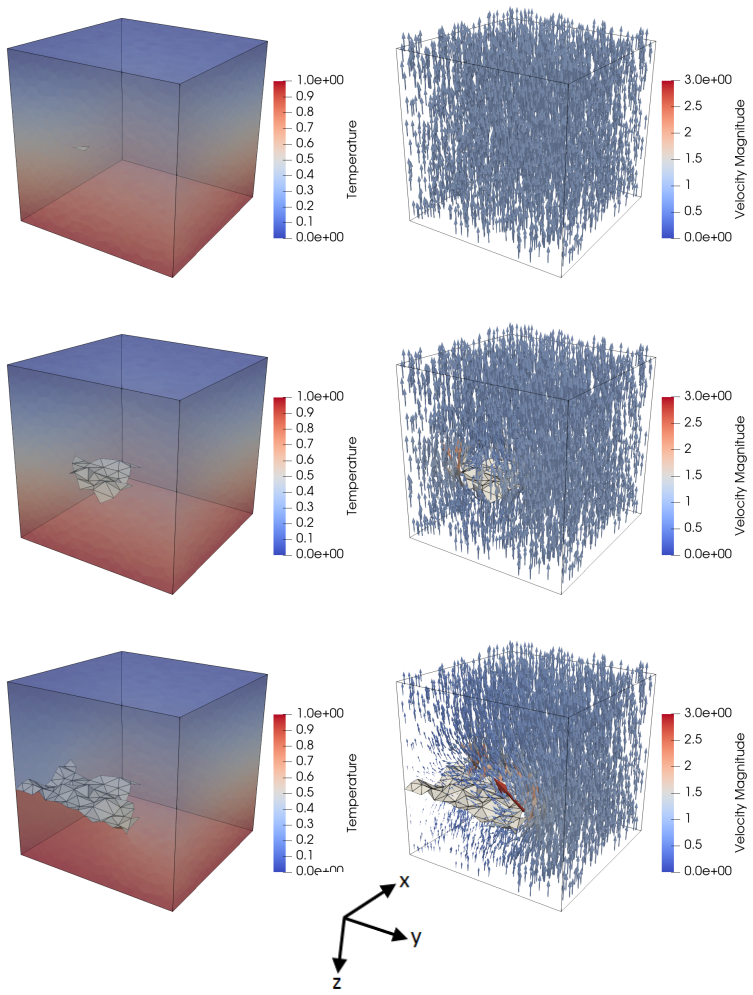
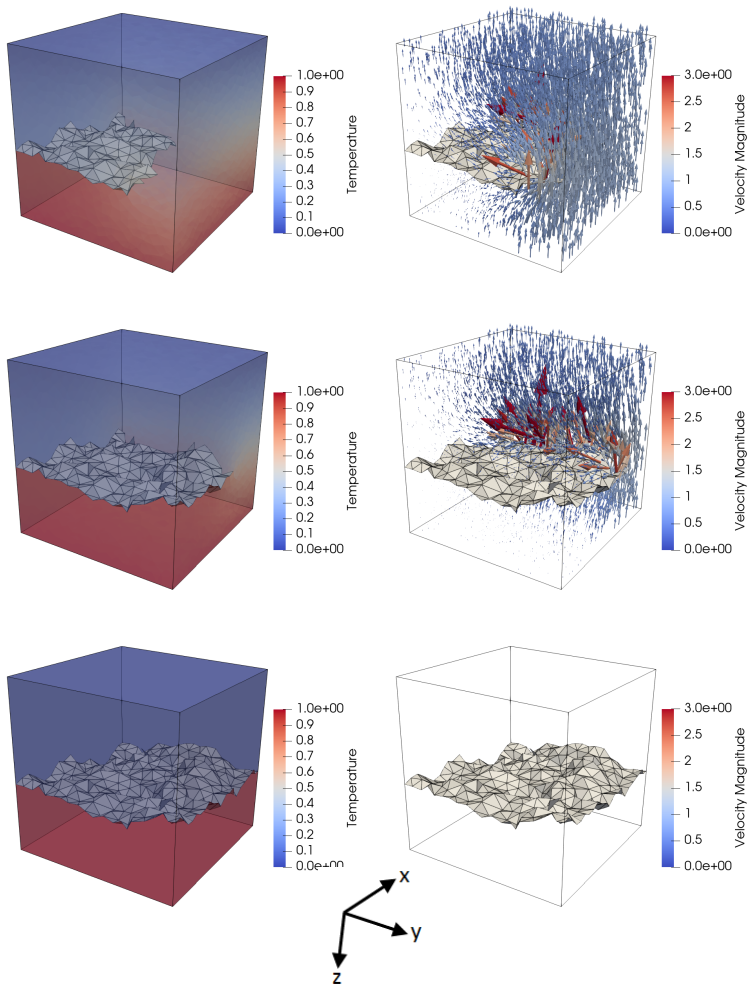
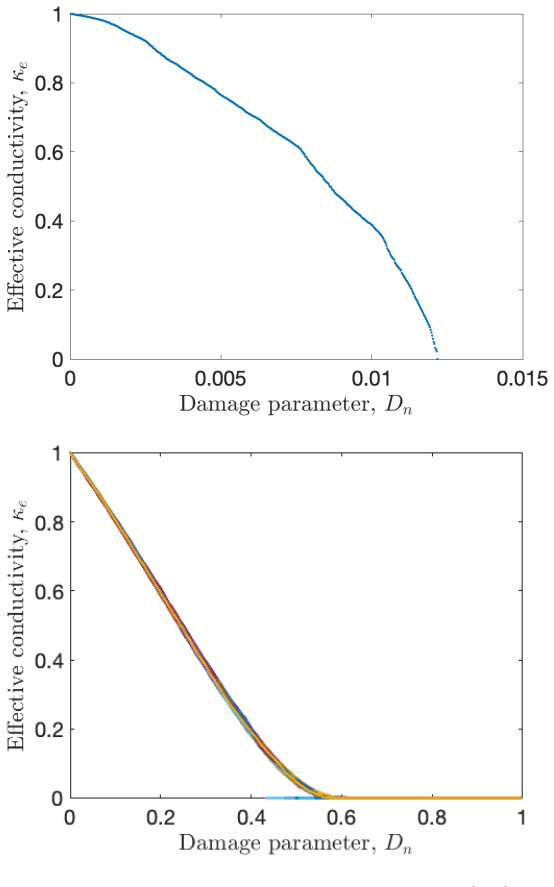
A formulation of elliptic boundary value problems is used to develop the first discrete exterior calculus (DEC) library for massively parallel computations with 3D domains. This can be used for steady-state analysis of any physical process driven by the gradient of a scalar quantity, e.g. temperature, concentration, pressure or electric potential, and is easily extendable to transient analysis. In addition to offering this library to the community, we demonstrate one important benefit from the DEC formulation: effortless introduction of strong heterogeneities and discontinuities. These are typical for real materials, but challenging for widely used domain discretization schemes, such as finite elements. Specifically, we demonstrate the efficiency of the method for calculating the evolution of thermal conductivity of a solid with a growing crack population. Future development of the library will deal with transient problems, and more importantly with processes driven by gradients of vector quantities.
Editorial analysis
A structured set of objections, weighed in public.
Referee Report
Summary. The paper develops a discrete exterior calculus (DEC) formulation for elliptic boundary value problems and presents the first DEC library for massively parallel computations on three-dimensional domains. It highlights the ease of incorporating strong heterogeneities and discontinuities, demonstrated through the simulation of thermal conductivity evolution in a solid with a growing crack population. The library is made available to the community and is positioned for extension to transient and vector-gradient driven processes.
Significance. If the parallel implementation and heterogeneity handling are as described, this provides a useful open library for simulating gradient-driven processes in complex 3D materials, where traditional discretizations encounter difficulties with discontinuities. The crack-growth demonstration supplies a concrete, falsifiable application. Credit is due for releasing the library and for aligning the domain decomposition with the primal-dual complex.
major comments (2)
- [§5] §5 (crack-growth demonstration): the update rule for conductivity on dual cells when cracks propagate is described at a high level but lacks an explicit equation or pseudocode showing how the DEC operators are reapplied after each topology change; this is load-bearing for the 'effortless' claim.
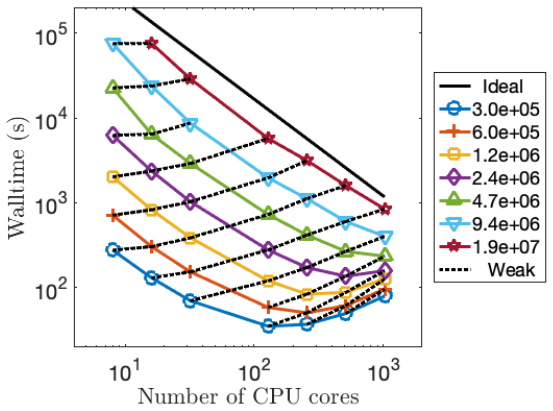
- [Table 4] Table 4 (strong-scaling results): the reported parallel efficiency drops below 60% beyond 512 cores for the heterogeneous case, yet no breakdown of communication volume versus computation is provided; this directly affects the 'massively parallel' assertion for realistic 3D problems.
minor comments (2)
- [Introduction] The introduction asserts this is the 'first' parallel 3D DEC library; add a short paragraph contrasting with any prior serial or 2D DEC codes cited in the references.
- [§3] Notation for primal and dual operators is introduced in §2 but the distinction between d and δ is not restated when the elliptic operator is assembled in §3; a one-sentence reminder would improve readability.
Simulated Author's Rebuttal
We thank the referee for the positive assessment and the recommendation of minor revision. We respond to each major comment below.
read point-by-point responses
-
Referee: [§5] §5 (crack-growth demonstration): the update rule for conductivity on dual cells when cracks propagate is described at a high level but lacks an explicit equation or pseudocode showing how the DEC operators are reapplied after each topology change; this is load-bearing for the 'effortless' claim.
Authors: We agree that an explicit description of the update procedure would strengthen the presentation of the 'effortless' claim. In the revised manuscript we will insert a short pseudocode block (or equivalent equation) that shows the sequence: (i) identification of dual cells intersected by new crack segments, (ii) local modification of the dual-cell conductivity values, and (iii) re-assembly and application of the relevant DEC operators on the updated complex. This addition will make the topology-update step fully reproducible without altering the core algorithmic claims. revision: yes
-
Referee: [Table 4] Table 4 (strong-scaling results): the reported parallel efficiency drops below 60% beyond 512 cores for the heterogeneous case, yet no breakdown of communication volume versus computation is provided; this directly affects the 'massively parallel' assertion for realistic 3D problems.
Authors: The efficiency drop in the heterogeneous case is expected because the crack population forces a more irregular domain decomposition, increasing the surface-to-volume ratio and therefore the relative communication volume. While the original manuscript did not include a quantitative breakdown of message sizes versus flop counts, we can add a concise paragraph (or a supplementary table) that reports the measured communication volume per core for the two cases. We maintain that the demonstrated ability to run on hundreds of cores with strong heterogeneities still supports the utility of the library for realistic 3D problems; the term 'massively parallel' is used in the context of DEC implementations rather than absolute efficiency thresholds. revision: partial
Circularity Check
No significant circularity detected
full rationale
The paper presents a construction of a parallel DEC library for 3D elliptic problems, with the central claims resting on the locality of DEC operators, domain decomposition aligned to the primal-dual complex, and direct assignment of heterogeneous coefficients on dual cells. These steps are self-contained within the formulation and implementation details supplied in the manuscript; no load-bearing prediction, parameter fit, or uniqueness result reduces by construction to a prior self-citation or to the target output itself. The assertion of being the 'first' such library is an external claim whose verification lies outside the derivation chain and does not affect internal consistency. Absent any quoted equation or step that equates a derived quantity to its own input, the derivation remains independent.
Axiom & Free-Parameter Ledger
Lean theorems connected to this paper
-
IndisputableMonolith/Foundation/AlexanderDuality.leanalexander_duality_circle_linking (D=3 forced by linking) echoes?
echoesECHOES: this paper passage has the same mathematical shape or conceptual pattern as the Recognition theorem, but is not a direct formal dependency.
A formulation of elliptic boundary value problems is used to develop the first discrete exterior calculus (DEC) library for massively parallel computations with 3D domains... effortless introduction of strong heterogeneities and discontinuities... growing crack population.
What do these tags mean?
- matches
- The paper's claim is directly supported by a theorem in the formal canon.
- supports
- The theorem supports part of the paper's argument, but the paper may add assumptions or extra steps.
- extends
- The paper goes beyond the formal theorem; the theorem is a base layer rather than the whole result.
- uses
- The paper appears to rely on the theorem as machinery.
- contradicts
- The paper's claim conflicts with a theorem or certificate in the canon.
- unclear
- Pith found a possible connection, but the passage is too broad, indirect, or ambiguous to say the theorem truly supports the claim.
Forward citations
Cited by 1 Pith paper
-
Diffusion in multi-dimensional solids using Forman's combinatorial differential forms
The authors extend Forman's combinatorial differential forms with operators for scalar variables to enable intrinsic, dimension-dependent modeling of diffusion in discrete complexes.
Reference graph
Works this paper leans on
- [1]
- [2]
-
[3]
T. Lu, J. Hutchinson, Thermal conductivity and expansion of cross-ply composites with matrix cracks, Journal of the Mechanics and Physics of Solids 43 (8) (1995) 1175–1198. doi:https://doi.org/10.1016/ 0022-5096(95)00033-F
work page 1995
-
[4]
S. Pestchanyi, I. Garkusha, I. Landman, Simulation of tungsten ar- mour cracking due to small elms in iter, Fusion Engineering and Design 85 (7) (2010) 1697–1701, proceedings of the Ninth International Sympo- sium on Fusion Nuclear Technology. doi:https://doi.org/10.1016/ j.fusengdes.2010.05.005
work page 2010
-
[5]
L. Shen, Q. Ren, N. Xia, L. Sun, X. Xia, Mesoscopic numerical simula- tion of effective thermal conductivity of tensile cracked concrete, Con- struction and Building Materials 95 (2015) 467–475
work page 2015
-
[6]
L. Shen, Q. Ren, L. Zhang, Y. Han, G. Cusatis, Experimental and numerical study of effective thermal conductivity of cracked concrete, Construction and Building Materials 153 (2017) 55–68. doi:10.1016/ j.conbuildmat.2017.07.038. 21
work page 2017
-
[7]
F. Simionato, C. Daros, Boundary element method analysis for mode iii linear fracture mechanics in anisotropic and nonhomogeneous media, ZAMM - Journal of Applied Mathematics and Mechanics / Zeitschrift f¨ ur Angewandte Mathematik und Mechanik 99 (10) (2019) e201800211. doi:10.1002/zamm.201800211
-
[8]
T. Oschmann, M. Schiemann, H. Kruggel-Emden, Development and ver- ification of a resolved 3d inner particle heat transfer model for the dis- crete element method (dem), Powder Technology 291 (2016) 392–407. doi:10.1016/j.powtec.2015.12.008
-
[9]
Z.-B. Peng, E. Doroodchi, B. Moghtaderi, Heat transfer modelling in discrete element method (dem)-based simulations of thermal processes: Theory and model development, Progress in Energy and Combustion Science 79 (2020) 100847. doi:10.1016/j.pecs.2020.100847
-
[10]
P. Cleary, J. Monaghan, Conduction modelling using smoothed particle hydrodynamics, Progress in Energy and Combustion Science 148 (1) (1999) 227–264. doi:10.1006/jcph.1998.6118
-
[11]
A. Alshaer, B. Rogers, L. Li, Smoothed particle hydrodynamics (sph) modelling of transient heat transfer in pulsed laser ablation of al and associated free-surface problems, Computational Materials Science 127 (2017) 161–179. doi:10.1016/j.commatsci.2016.09.004
-
[12]
F. Bobaru, M. Duangpanya, A peridynamic formulation for transient heat conduction in bodies with evolving discontinuities, Journal of Com- putational Physics 213 (7) (2012) 2764–2785. doi:10.1016/j.jcp. 2011.12.017
-
[13]
H.-X. Yan, M. Sedighi, A. Jivkov, Peridynamics modelling of coupled water flow and chemical transport in unsaturated porous media, Jour- nal of Hydrology in press (2021) xxxx–xxxx. doi:10.1016/j.jhydrol. 2020.125648
-
[14]
Hirani, Discrete exterior calculus, Ph.D
A. Hirani, Discrete exterior calculus, Ph.D. thesis, California Institute of Technology (2003). doi:10.7907/ZHY8-V329
-
[15]
N. Belayachi, C. Mallet, M. E. Marzak, Thermally-induced cracks and their effects on natural and industrial geomaterials, Journal of Building Engineering 25 (2019) 100806. doi:10.1016/j.jobe.2019.100806. 22
-
[16]
E. Schulz, G. Tsogtgerel, Convergence of discrete exterior calculus ap- proximations for poisson problems, Discrete & Computational Geometry 63 (2020) 364–376. doi:10.1007/s00454-019-00159-x
-
[17]
Arnold, Finite Element Exterior Calculus, Vol
D. Arnold, Finite Element Exterior Calculus, Vol. 93 of CBMS-NSF Re- gional Conference Series in Applied Mathematics, Society for Industrial and Applied Mathematics (SIAM), Philadelphia, PA, 2018
work page 2018
-
[18]
M. Vu, S. Nguyen, M. Vu, A. Tang, V. To, Heat conduction and thermal conductivity of 3d cracked media, International Journal of Heat and Mass Transfer 89 (2015) 1119–1126. doi:https: //doi.org/10.1016/j.ijheatmasstransfer.2015.05.113. URL http://www.sciencedirect.com/science/article/pii/ S0017931015006171
-
[19]
A. Hirani, K. Nakshatrala, J. Chaudhry, Numerical method for darcy flow derived using discrete exterior calculus, International Journal for Computational Methods in Engineering Science and Mechanics 16 (3) (2015) 151–169. doi:10.1080/15502287.2014.977500
-
[20]
H. Si, Tetgen, a delaunay-based quality tetrahedral mesh generator, ACM Transactions on Mathematical Software 41 (2) (2015) 11. doi: 10.1145/2629697
-
[21]
G. Kit, O. Poberezhnyi, Determining the steady-state temperature field in a cracked plate with heat transfer from the lateral surfaces, Journal of Engineering Physics 23 (1972) 894–898
work page 1972
-
[22]
A. Glushko, A. S. Ryabenko, V. Petrova, E. A. Loginova, Heat distri- bution in a plane with a crack with a variable coefficient of thermal conductivity, Asymptot. Anal. 98 (2016) 285–307
work page 2016
-
[23]
A. Hoenig, Thermal conductivities of a cracked solid, Journal of Composite Materials 17 (3) (1983) 231–237. doi:10.1177/ 002199838301700304
work page 1983
-
[24]
M. Savruk, V. Zelenyak, The plane problem of thermal conductivity and thermal elasticity for a finite piecewise uniform body with cracks, Mater. Sci. 23 (1987) 502–510. doi:https://doi.org/10.1007/BF01148677. 23
-
[25]
D. Hasselman, L. F. Johnson, Effective thermal conductivity of com- posites with interfacial thermal barrier resistance, Journal of Composite Materials 21 (6) (1987) 508–515. doi:10.1177/002199838702100602
-
[26]
Y. Benveniste, T. Miloh, An exact solution for the effective thermal conductivity of cracked bodies with oriented elliptical cracks, Journal of Applied Physics 66 (1) (1989) 176–180. doi:10.1063/1.343900
-
[27]
K. Hu, Z. Chen, Transient heat conduction analysis of a cracked half-plane using dual-phase-lag theory, International Journal of Heat and Mass Transfer 62 (2013) 445–451. doi:https: //doi.org/10.1016/j.ijheatmasstransfer.2013.03.032. URL http://www.sciencedirect.com/science/article/pii/ S0017931013002391
-
[28]
A. Tran, M. Vu, S. Nguyen, T. Dong, K. Le-Nguyen, Analytical and numerical solutions for heat transfer and effective thermal conductivity of cracked media, Journal of Applied Geophysics 149 (2018) 35–41. doi:https://doi.org/10.1016/j.jappgeo.2017.12.012. URL http://www.sciencedirect.com/science/article/pii/ S0926985116306929
-
[29]
C. Yan, Y.-Y. Jiao, H. Zheng, A three-dimensional heat transfer and thermal cracking model considering the effect of cracks on heat transfer, International Journal for Numerical and Analytical Methods in Geomechanics 43 (10) (2019) 1825–1853. doi:10.1002/nag.2937. URL https://onlinelibrary.wiley.com/doi/abs/10.1002/nag. 2937
-
[30]
N. Bell, A. Hirani, Pydec: software and algorithms for discretization of exterior calculus, ACM Transactions on Mathematical Software 39 (1) (2012) 3. doi:10.1145/2382585.2382588
-
[31]
S. Balay, S. Abhyankar, M. F. Adams, J. Brown, P. Brune, K. Buschel- man, L. Dalcin, A. Dener, V. Eijkhout, W. D. Gropp, D. Karpeyev, D. Kaushik, M. G. Knepley, D. A. May, L. C. McInnes, R. T. Mills, T. Munson, K. Rupp, P. Sanan, B. F. Smith, S. Zampini, H. Zhang, H. Zhang, PETSc Web page,https://www.mcs.anl.gov/petsc (2019). URL https://www.mcs.anl.gov/petsc 24
work page 2019
-
[32]
R. D. Falgout, U. M. Yang, hypre: A library of high performance pre- conditioners, in: P. M. A. Sloot, A. G. Hoekstra, C. J. K. Tan, J. J. Dongarra (Eds.), Computational Science — ICCS 2002, Springer Berlin Heidelberg, Berlin, Heidelberg, 2002, pp. 632–641
work page 2002
-
[33]
E. Chow, A priori sparsity patterns for parallel sparse approxi- mate inverse preconditioners, SIAM Journal on Scientific Comput- ing 21 (5) (2000) 1804–1822. arXiv:https://doi.org/10.1137/ S106482759833913X, doi:10.1137/S106482759833913X. URL https://doi.org/10.1137/S106482759833913X
-
[34]
M. S. Mohamed, A. N. Hirani, R. Samtaney, Numerical convergence of discrete exterior calculus on arbitrary surface meshes, International Journal for Computational Methods in Engineering Science and Me- chanics 19 (3) (2018) 194–206. arXiv:https://doi.org/10.1080/ 15502287.2018.1446196, doi:10.1080/15502287.2018.1446196. URL https://doi.org/10.1080/1550228...
discussion (0)
Sign in with ORCID, Apple, or X to comment. Anyone can read and Pith papers without signing in.