Lightweight Strategy for XOR PUFs as Security Primitives for Resource-constrained IoT device
Pith reviewed 2026-05-24 10:23 UTC · model grok-4.3
The pith
Component-differentially challenged XOR-PUFs resist strong machine learning attacks while using minimal hardware and power for IoT devices.
A machine-rendered reading of the paper's core claim, the machinery that carries it, and where it could break.
Core claim
The paper claims that highly lightweight component-differentially challenged XOR-PUFs can withstand the most powerful machine learning attacks developed so far and maintain excellent intra-device and inter-device performance, rendering this strategy a potential blueprint for the fabrication and use of XOR-PUFs for resource-constrained IoT applications.
What carries the argument
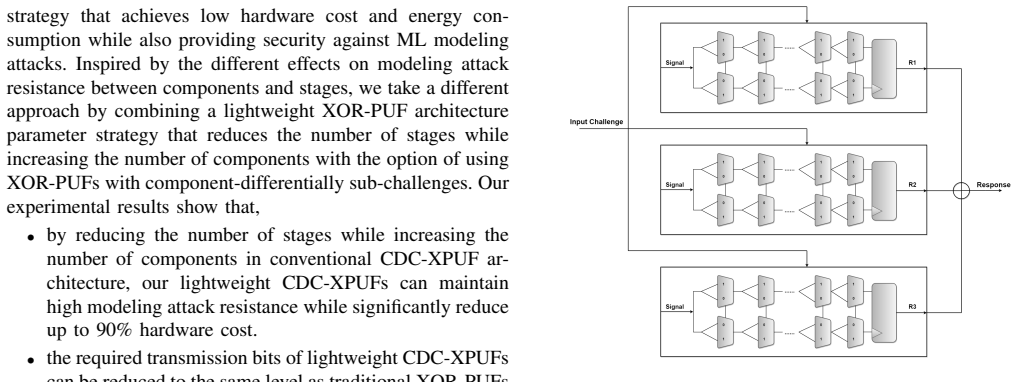
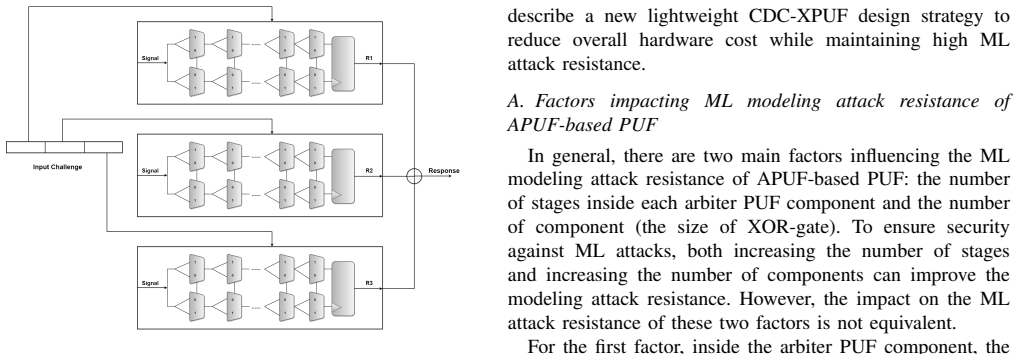
Component-differentially challenged XOR-PUF, where different challenges are applied to separate components to raise attack resistance without added hardware stages.
If this is right
- The designs require fewer hardware resources than XOR-PUFs that rely on larger numbers of stages or components.
- They transmit fewer challenge bits and therefore use less energy during operation.
- They achieve resistance to the strongest known machine learning attacks at the time of the experiments.
- Intra-device and inter-device metrics stay at excellent levels under the tested conditions.
- The parameter choices plus differential challenge method can guide fabrication of XOR-PUFs for low-resource IoT use.
Where Pith is reading between the lines
- The same differential-challenge idea could be tested on other delay-based PUF families to check if security gains appear at similar cost levels.
- Long-term field trials across temperature and voltage swings would be needed to confirm the performance numbers translate outside controlled experiments.
- Further tuning of XOR size and component count might reveal even smaller configurations that still block attacks.
Load-bearing premise
The machine learning attacks tested represent the strongest possible attacks and the reported intra- and inter-device performance metrics will hold under real fabrication variation and environmental conditions.
What would settle it
A new machine learning attack that models the proposed lightweight XOR-PUFs with high prediction accuracy using feasible training data, or fabricated devices that fail to meet the claimed intra-device reliability or inter-device uniqueness thresholds in varied conditions.
Figures
read the original abstract
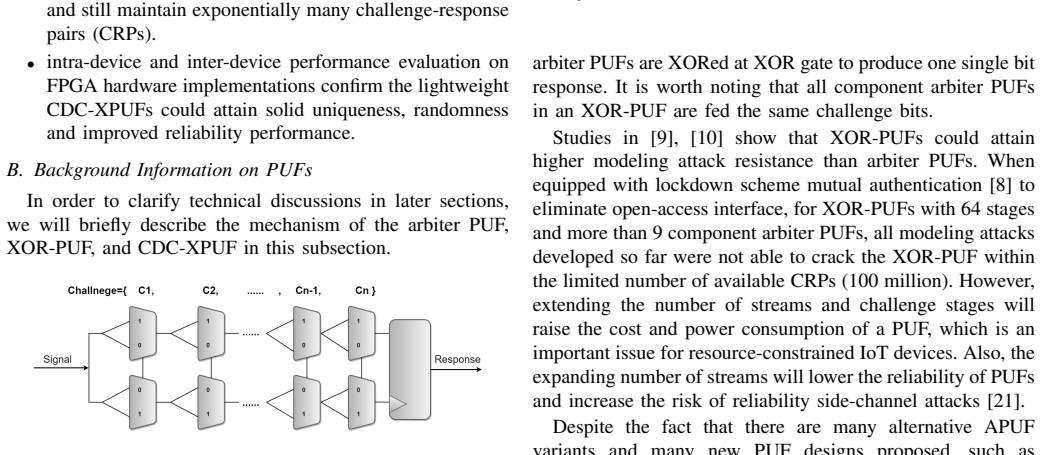
Physical Unclonable Functions (PUFs) are promising security primitives for resource-constrained IoT devices. And the XOR Arbiter PUF (XOR-PUF) is one of the most studied PUFs, out of an effort to improve the resistance against machine learning attacks of probably the most lightweight delay-based PUFs - the Arbiter PUFs. However, recent attack studies reveal that even XOR-PUFs with large XOR sizes are still not safe against machine learning attacks. Increasing PUF stages or components and using different challenges for different components are two ways to improve the security of APUF-based PUFs, but more stages or components lead to more hardware cost and higher operation power, and different challenges for different components require the transmission of more bits during operations, which also leads to higher power consumption. In this paper, we present a strategy that combines the choice of XOR Arbiter PUF (XOR-PUF) architecture parameters with the way XOR-PUFs are used to achieve lightweights in hardware cost and energy consumption as well as security against machine learning attacks. Experimental evaluations show that with the proposed strategy, highly lightweight component-differentially challenged XOR-PUFs can withstand the most powerful machine learning attacks developed so far and maintain excellent intra-device and inter-device performance, rendering this strategy a potential blueprint for the fabrication and use of XOR-PUFs for resource-constrained IoT applications.
Editorial analysis
A structured set of objections, weighed in public.
Referee Report
Summary. The manuscript proposes a strategy for XOR Arbiter PUFs that combines selection of architecture parameters (e.g., number of stages/components and XOR size) with component-differential challenging during use. The goal is to achieve low hardware cost and energy consumption while resisting machine-learning attacks, supported by experimental evaluations claiming resistance to current powerful attacks and strong intra-/inter-device metrics for IoT applications.
Significance. If the empirical results prove robust, the work supplies a concrete, low-overhead blueprint for deploying secure delay-based PUFs in resource-constrained settings, directly addressing the known ML vulnerability of Arbiter and XOR-PUFs without proportional increases in area or power. The experimental framing itself is a positive contribution when the tested attacks and conditions are accepted as representative.
major comments (1)
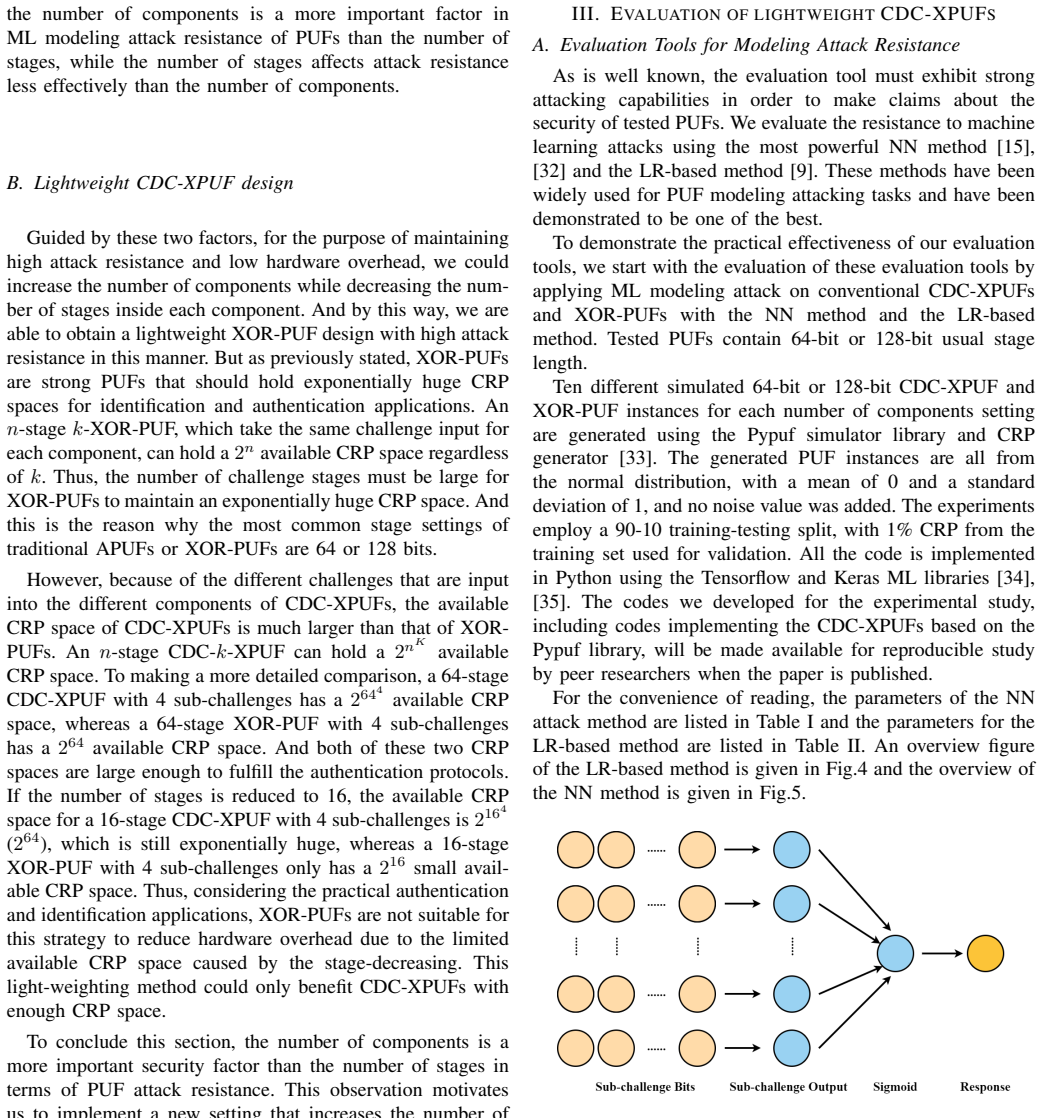
- [Experimental Evaluations] The central claim that the proposed component-differentially challenged XOR-PUFs 'withstand the most powerful machine learning attacks developed so far' is load-bearing and rests entirely on the experimental section. The manuscript evaluates only a finite set of published attacks; without explicit enumeration of the attack algorithms, training-set sizes, hyper-parameters, and a demonstration that no stronger or adaptive attacks succeed, the security conclusion cannot be fully assessed.
minor comments (2)
- [Abstract] The abstract contains several run-on sentences that reduce readability; splitting the description of the strategy and the performance claims would improve clarity.
- The title ends with the singular 'device' while the body consistently refers to plural IoT devices; a minor grammatical correction is needed.
Simulated Author's Rebuttal
We thank the referee for the constructive feedback. We address the major comment below, providing clarifications on our experimental evaluations while acknowledging inherent limitations of empirical security claims.
read point-by-point responses
-
Referee: The central claim that the proposed component-differentially challenged XOR-PUFs 'withstand the most powerful machine learning attacks developed so far' is load-bearing and rests entirely on the experimental section. The manuscript evaluates only a finite set of published attacks; without explicit enumeration of the attack algorithms, training-set sizes, hyper-parameters, and a demonstration that no stronger or adaptive attacks succeed, the security conclusion cannot be fully assessed.
Authors: We agree the experimental section is central and will revise to include an explicit enumeration (new Table or subsection) of all tested attacks (logistic regression, SVM, and neural network variants from the cited literature), training-set sizes (ranging from 10^4 to 10^6 challenges), hyper-parameters, and evaluation conditions. This addresses the request for transparency. However, as is standard for empirical PUF security papers, we cannot demonstrate that no stronger or adaptive attacks succeed; such a claim would require formal proofs or exhaustive future-proof testing, which is outside the paper's scope. Our security statement is limited to resistance against the most powerful published attacks at submission time, supported by the reported results. revision: partial
- Demonstrating that no stronger or adaptive machine learning attacks can succeed, which cannot be achieved through finite empirical evaluations alone.
Circularity Check
No significant circularity identified
full rationale
The paper advances an empirical strategy for lightweight XOR-PUFs and validates it solely through experimental evaluations against published ML attacks plus intra-/inter-device metrics. No equations, derivations, fitted parameters renamed as predictions, or load-bearing self-citations appear in the abstract or described content. The central claim is therefore not reducible to its own inputs by construction and remains self-contained against external benchmarks.
Axiom & Free-Parameter Ledger
Reference graph
Works this paper leans on
-
[1]
Controlled phys- ical random functions,
B. Gassend, D. Clarke, M. Van Dijk, and S. Devadas, “Controlled phys- ical random functions,” in 18th Annual Computer Security Applications Conference, 2002. Proceedings. IEEE, 2002, pp. 149–160
work page 2002
-
[2]
Silicon physical random functions,
B. Gassend, D. Clarke, M. V . Dijk, and S. Devadas, “Silicon physical random functions,” in Proceedings of the 9th ACM conference on Computer and communications security , 2002, pp. 148–160
work page 2002
-
[3]
J. W. Lee, D. Lim, B. Gassend, G. E. Suh, M. Van Dijk, and S. Devadas, “A technique to build a secret key in integrated circuits for identification and authentication applications,” in 2004 Symposium on VLSI Circuits. Digest of Technical Papers (IEEE Cat. No. 04CH37525) . IEEE, 2004, pp. 176–179
work page 2004
-
[4]
Physical unclonable functions for device authentication and secret key generation,
G. E. Suh and S. Devadas, “Physical unclonable functions for device authentication and secret key generation,” in 2007 44th ACM/IEEE Design Automation Conference . IEEE, 2007, pp. 9–14
work page 2007
-
[5]
Physical unclon- able functions and applications: A tutorial,
C. Herder, M.-D. Yu, F. Koushanfar, and S. Devadas, “Physical unclon- able functions and applications: A tutorial,” Proceedings of the IEEE , vol. 102, no. 8, pp. 1126–1141, 2014
work page 2014
-
[6]
On the pitfalls of using arbiter-pufs as building blocks,
G. T. Becker, “On the pitfalls of using arbiter-pufs as building blocks,” IEEE Transactions on Computer-Aided Design of Integrated Circuits and Systems, vol. 34, no. 8, pp. 1295–1307, 2015
work page 2015
-
[7]
Internet of things: Vision, applications and research challenges,
D. Miorandi, S. Sicari, F. De Pellegrini, and I. Chlamtac, “Internet of things: Vision, applications and research challenges,” Ad hoc networks , vol. 10, no. 7, pp. 1497–1516, 2012
work page 2012
-
[8]
A lockdown technique to prevent machine learning on pufs for lightweight authentication,
M.-D. Yu, M. Hiller, J. Delvaux, R. Sowell, S. Devadas, and I. Ver- bauwhede, “A lockdown technique to prevent machine learning on pufs for lightweight authentication,” IEEE Transactions on Multi-Scale Computing Systems, vol. 2, no. 3, pp. 146–159, 2016
work page 2016
-
[9]
Puf modeling attacks on simulated and silicon data,
U. R ¨uhrmair, J. S ¨olter, F. Sehnke, X. Xu, A. Mahmoud, V . Stoyanova, G. Dror, J. Schmidhuber, W. Burleson, and S. Devadas, “Puf modeling attacks on simulated and silicon data,” IEEE transactions on information forensics and security , vol. 8, no. 11, pp. 1876–1891, 2013
work page 2013
-
[10]
Modeling attacks on physical unclonable functions,
U. R ¨uhrmair, F. Sehnke, J. S¨olter, G. Dror, S. Devadas, and J. Schmidhu- ber, “Modeling attacks on physical unclonable functions,” in Proceed- ings of the 17th ACM conference on Computer and communications security, 2010, pp. 237–249
work page 2010
-
[11]
Why attackers win: on the learnability of xor arbiter pufs,
F. Ganji, S. Tajik, and J.-P. Seifert, “Why attackers win: on the learnability of xor arbiter pufs,” in International Conference on Trust and Trustworthy Computing . Springer, 2015, pp. 22–39
work page 2015
-
[12]
Towards fast and accurate machine learning attacks of feed-forward arbiter pufs,
M. S. Alkatheiri and Y . Zhuang, “Towards fast and accurate machine learning attacks of feed-forward arbiter pufs,” in 2017 IEEE Conference on Dependable and Secure Computing . IEEE, 2017, pp. 181–187
work page 2017
-
[13]
An experimental study of the state-of-the-art pufs implemented on fpgas,
M. S. Alkatheiri, Y . Zhuang, M. Korobkov, and A. R. Sangi, “An experimental study of the state-of-the-art pufs implemented on fpgas,” in 2017 IEEE Conference on Dependable and Secure Computing . IEEE, 2017, pp. 174–180
work page 2017
-
[14]
A. O. Aseeri, Y . Zhuang, and M. S. Alkatheiri, “A machine learning- based security vulnerability study on xor pufs for resource-constraint internet of things,” in 2018 IEEE International Congress on Internet of Things (ICIOT). IEEE, 2018, pp. 49–56
work page 2018
-
[15]
A fast deep learning method for security vulnerability study of xor pufs,
K. T. Mursi, B. Thapaliya, Y . Zhuang, A. O. Aseeri, and M. S. Alkatheiri, “A fast deep learning method for security vulnerability study of xor pufs,” Electronics, vol. 9, no. 10, p. 1715, 2020
work page 2020
-
[16]
Why attackers lose: Design and security analysis of arbi- trarily large xor arbiter pufs
N. Wisiol, C. Graebnitz, M. Margraf, M. Oswald, T. Soroceanu, and B. Zengin, “Why attackers lose: Design and security analysis of arbi- trarily large xor arbiter pufs.”
-
[17]
N. Wisiol, G. T. Becker, M. Margraf, T. A. Soroceanu, J. Tobisch, and B. Zengin, “Breaking the lightweight secure puf: Understanding the relation of input transformations and machine learning resistance,” in International Conference on Smart Card Research and Advanced Applications. Springer, 2019, pp. 40–54
work page 2019
-
[18]
A. O. Aseeri, Y . Zhuang, and M. S. Alkatheiri, “A subspace pre-learning approach to fast high-accuracy machine learning of large xor pufs with component-differential challenges,” in 2018 IEEE International Conference on Big Data (Big Data) . IEEE, 2018, pp. 1563–1568
work page 2018
-
[19]
Experimental examination of component- differentially-challenged xor puf circuits,
K. T. Mursi and Y . Zhuang, “Experimental examination of component- differentially-challenged xor puf circuits,” in Journal of Physics: Con- ference Series, vol. 1729, no. 1. IOP Publishing, 2021, p. 012006
work page 2021
-
[20]
Physical unclonable functions for device authentication and secret key generation,
G. E. Suh and S. Devadas, “Physical unclonable functions for device authentication and secret key generation,” in 2007 44th ACM/IEEE Design Automation Conference , 2007, pp. 9–14
work page 2007
-
[21]
The gap between promise and reality: On the insecurity of xor arbiter pufs,
G. T. Becker, “The gap between promise and reality: On the insecurity of xor arbiter pufs,” in International Workshop on Cryptographic Hardware and Embedded Systems . Springer, 2015, pp. 535–555
work page 2015
-
[22]
M. Majzoobi, F. Koushanfar, and M. Potkonjak, “Lightweight secure pufs,” in 2008 IEEE/ACM International Conference on Computer-Aided Design. IEEE, 2008, pp. 670–673
work page 2008
-
[23]
Iden- tification and authentication of integrated circuits,
B. Gassend, D. Lim, D. Clarke, M. Van Dijk, and S. Devadas, “Iden- tification and authentication of integrated circuits,” Concurrency and Computation: Practice and Experience , vol. 16, no. 11, pp. 1077–1098, 2004
work page 2004
-
[24]
Extracting secret keys from integrated circuits in master thesis,
D. Lim, “Extracting secret keys from integrated circuits in master thesis,” Massachusetts Institute of Technology , 2004
work page 2004
-
[25]
The interpose puf: Secure puf design against state-of- the-art machine learning attacks,
P. H. Nguyen, D. P. Sahoo, C. Jin, K. Mahmood, U. R ¨uhrmair, and M. van Dijk, “The interpose puf: Secure puf design against state-of- the-art machine learning attacks,” IACR Transactions on Cryptographic Hardware and Embedded Systems , pp. 243–290, 2019
work page 2019
-
[26]
On the scaling of machine learning attacks on pufs with application to noise bifurcation,
J. Tobisch and G. T. Becker, “On the scaling of machine learning attacks on pufs with application to noise bifurcation,” in International Workshop on Radio Frequency Identification: Security and Privacy Issues. Springer, 2015, pp. 17–31
work page 2015
-
[27]
Deep learning based model building attacks on arbiter puf compositions,
P. Santikellur, A. Bhattacharyay, and R. S. Chakraborty, “Deep learning based model building attacks on arbiter puf compositions,” Cryptology ePrint Archive, Report 2019/566. 2019. Available online: https . . . , Tech. Rep., 2019
work page 2019
-
[28]
K. T. Mursi and Y . Zhuang, “Experimental study of component- differentially-challenged xor pufs as security primitives for internet-of- things,” Journal of Communications , vol. 15, no. 10, 2020
work page 2020
-
[29]
Splitting the interpose puf: A novel modeling attack strategy,
N. Wisiol, C. M ¨uhl, N. Pirnay, P. H. Nguyen, M. Margraf, J.-P. Seifert, M. van Dijk, and U. R ¨uhrmair, “Splitting the interpose puf: A novel modeling attack strategy,” IACR Transactions on Cryptographic Hardware and Embedded Systems , pp. 97–120, 2020
work page 2020
-
[30]
B. Thapaliya, K. T. Mursi, and Y . Zhuang, “Machine learning-based vulnerability study of interpose pufs as security primitives for iot networks,” in 2021 IEEE International Conference on Networking, Architecture and Storage (NAS) . IEEE, 2021, pp. 1–7
work page 2021
-
[31]
Extracting secret keys from integrated circuits,
D. Lim, J. W. Lee, B. Gassend, G. E. Suh, M. Van Dijk, and S. Devadas, “Extracting secret keys from integrated circuits,” IEEE Transactions on Very Large Scale Integration (VLSI) Systems, vol. 13, no. 10, pp. 1200– 1205, 2005
work page 2005
-
[32]
Neural-network- based modeling attacks on xor arbiter pufs revisited
N. Wisiol, K. T. Mursi, J.-P. Seifert, and Y . Zhuang, “Neural-network- based modeling attacks on xor arbiter pufs revisited.” IACR Cryptol. ePrint Arch., vol. 2021, p. 555, 2021
work page 2021
-
[33]
pypuf: Cryptanalysis of Physically Unclonable Functions,
N. Wisiol, C. Gr ¨abnitz, C. M¨uhl, B. Zengin, T. Soroceanu, N. Pirnay, and K. T. Mursi, “pypuf: Cryptanalysis of Physically Unclonable Functions,”
-
[34]
Available: https://doi.org/10.5281/zenodo.3901410
[Online]. Available: https://doi.org/10.5281/zenodo.3901410
-
[35]
Tensorflow: A system for large- scale machine learning,
M. Abadi, P. Barham, J. Chen, Z. Chen, A. Davis, J. Dean, M. Devin, S. Ghemawat, G. Irving, M. Isard et al., “Tensorflow: A system for large- scale machine learning,” in 12th{USENIX} symposium on operating systems design and implementation ({OSDI} 16), 2016, pp. 265–283
work page 2016
-
[36]
A. Gulli and S. Pal, Deep learning with Keras . Packt Publishing Ltd, 2017
work page 2017
-
[37]
Y . Hori, T. Yoshida, T. Katashita, and A. Satoh, “Quantitative and sta- tistical performance evaluation of arbiter physical unclonable functions on fpgas,” in Reconfigurable Computing and FPGAs (ReConFig), 2010 International Conference on . IEEE, 2010, pp. 298–303
work page 2010
discussion (0)
Sign in with ORCID, Apple, or X to comment. Anyone can read and Pith papers without signing in.