REVIEW 3 major objections 4 minor 22 references
Querying a user about interventions can recover a personal causal model that yields valid, lower-cost recourse.
Reviewed by Pith at T0; open to challenge. T0 means a machine referee read the full paper against a public rubric. the ladder, T0–T4 →
T0 review · grok-4.5
2026-07-12 02:33 UTC pith:224P6GNV
load-bearing objection Clean proof-of-concept that personalizes causal recourse via HITL Bayesian ANM estimation; linear sims work, soft likelihood and known-topology assumptions keep it provisional. the 3 major comments →
Personalized Causal Recourse: A Human-In-The-Loop Approach
The pith
A machine-rendered reading of the paper's core claim, the machinery that carries it, and where it could break.
Core claim
A human-in-the-loop Bayesian procedure that estimates a user-specific linear additive-noise model from noisy soft-intervention responses produces personalized causal recourse whose validity and cost, measured on the ground-truth SCM, closely track the oracle and improve over a non-causal prior baseline for linear synthetic data.
What carries the argument
Personalized Causal Recourse (Definition 1): MCMC estimation of structural coefficients in a linear ANM surrogate from intervention–response pairs, followed by gradient-based robust optimization of the cheapest intervention that flips the classifier under the estimated model.
Load-bearing premise
The user's true causal process can be well approximated by a linear additive-noise model whose graph order is already known and whose noise is independent standard Gaussian.
What would settle it
Run the same query-and-estimate pipeline on real users whose feature dependencies are known to be non-linear or whose noise is non-Gaussian; if the resulting actions fail to flip the decision when applied in the real world at rates near the linear synthetic case, the central claim does not hold outside the assumed model class.
If this is right
- Recourse systems need not assume a single shared causal model; individual intervention queries can substitute for that knowledge.
- When the linear-ANM class matches the user, estimated recourse stays close to oracle validity and cost while beating non-causal baselines.
- Model mismatch (mixture noise, non-linear mechanisms) measurably degrades both estimation accuracy and recourse validity.
- Robustness constraints (epsilon-balls) reduce validity even under the true model, exposing a feasibility–robustness trade-off that must be managed.
Where Pith is reading between the lines
- If the topological order itself must also be elicited, the query budget and MCMC design would need to expand substantially beyond the current fixed-order setting.
- The same intervention-response protocol could be used to personalize cost models or preference structures rather than only structural equations.
- Real-user studies would immediately reveal whether the stylized mixture-noise response model underestimates structured human biases.
Editorial analysis
A structured set of objections, weighed in public.
Referee Report
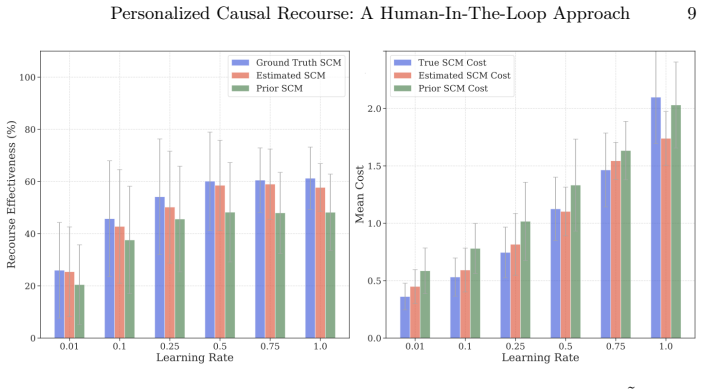
Summary. The paper formalizes personalized causal recourse (Definition 1) under uncertainty about a user's true SCM and proposes a HITL Bayesian pipeline that estimates a surrogate linear additive-noise model from T noisy intervention-response pairs via MCMC (soft likelihood in Section 4), then solves robust causal recourse (Eq. 2) on the estimated model. As a controlled proof-of-concept it evaluates the pipeline on three synthetic three-variable SCMs (linear M1, mixture-noise M2, non-linear M3) with simulated user responses under a Bernoulli mixture model (Eq. 4). For linear M1 the estimated SCM produces validity and cost that track the ground-truth oracle and improve over a non-causal prior baseline (Figs. 2-3); performance degrades under model mismatch while still often remaining cheaper than the prior; intervention patterns are partially recovered (Figs. 4-5). Code is released.
Significance. If the approach scales beyond the current restrictive assumptions, it would remove a central practical obstacle in causal algorithmic recourse—the requirement of a known global SCM—by eliciting user-specific causal mechanisms and thereby producing more plausible, lower-cost interventions. The formalization of the task, the honest reporting of degradation under mixture noise and non-linearity, and the public code release are genuine strengths. The contribution is a clean proof-of-concept for HITL causal personalization; its immediate significance is bounded by the three-variable linear-Gaussian setting and purely synthetic evaluation, but the direction is valuable for high-stakes XAI.
major comments (3)
- [Section 4, soft likelihood] The soft likelihood (Section 4) is defined as the indicator P(D|θ̃)=1{(1/N)∑1(Δk(θ̃)≤σ)≥1-β}. Any parameter vector whose soft-intervention predictions stay inside an ℓ2-ball of radius σ for a (1-β) fraction of the T=10 responses receives identical likelihood. Under the paper's own mixture response model (Eq. 4) many such vectors exist that are distant from θGT yet still satisfy the indicator. Consequently the MCMC posterior need not concentrate on models whose counterfactual map CF(·,a;M̃) coincides with the true map; the subsequent solver of Eq. (2) can therefore return actions that look good under M̃ but lose validity or cost once transferred to MGT. The linear experiments (Figs. 2-3) never isolate this gap because the same generative process supplies both the responses and the evaluation oracle. An ablation that injects held-out response noise or constructs alternative SCMs that match
- [Section 4, structural equations (3)] The surrogate (structural equations (3)) and the estimation procedure assume known topological order of the ground-truth SCM, independent standard-Gaussian exogenous noise, and no unobserved confounders. These assumptions are load-bearing: when they are violated (M2 mixture noise, M3 non-linear mechanisms) validity drops markedly while the prior baseline gap narrows. The central empirical claim of RQ1 therefore holds primarily inside the paper's own generative class rather than more generally. Either the surrogate class must be relaxed or additional experiments must delineate the regimes in which the linear-Gaussian approximation remains useful for recourse.
- [Section 5 / User response model] All feedback is generated by the stylized mixture model (Eq. 4); no real-user study is performed. While the manuscript correctly labels the work a proof-of-concept, the validity of the response model itself (Bernoulli mixture of true and adversarial parameters) is untested against actual human causal judgments, which frequently exhibit structured biases, anchoring, or coherent but incorrect beliefs. This leaves the practical utility of the HITL loop empirically unsupported beyond the synthetic regime.
minor comments (4)
- [Author list] Paolo Giudici's ORCID is given as 0000-0000-0000-0000, an obvious placeholder that should be corrected or removed.
- [Section 5.1] Section 5.1 describes qualitative recovery of θ but supplies no quantitative coefficient error (e.g., MSE or posterior credible intervals) or posterior visualizations; adding these would tighten the link between estimation quality and the recourse results of RQ1.
- [Throughout] Minor typographical issues: 'apriori' → 'a priori'; missing spaces after 'e.g.,' and 'i.e.,'; occasional run-on sentences in the discussion of M3.
- [Figures 2-5] Figures 2-5 report means ± std over five runs; adding the raw per-run values or a small table of numerical validity/cost would aid reproducibility checks.
Circularity Check
No load-bearing circularity: method is a standard simulation study whose validity/cost metrics are evaluated externally on held-out ground-truth SCMs, not by construction on the fitted surrogate.
full rationale
The paper proposes a HITL Bayesian procedure (soft likelihood + MCMC over linear-ANM coefficients) and evaluates it by (i) generating noisy intervention-response pairs from a known synthetic MGT, (ii) recovering a surrogate M̃, (iii) optimizing recourse under M̃, and (iv) measuring validity and cost after transferring the resulting actions onto the unobserved MGT (Section 5, 'We measure the recourse validity and cost by applying the found actions a∗ to the ground truth causal model MGT'). Because the final metrics are computed on an external object that is never seen by the estimator, the reported improvement over the non-causal prior is not forced by definition or by a fitted-input-as-prediction loop. The soft likelihood itself (Section 4) only constrains a (1-β)-fraction of responses to lie inside an ℓ2-ball of radius σ; it does not equate any parameter vector to the ground-truth coefficients, nor does the paper claim uniqueness or identification. Mild closed-world character of the synthetic protocol (same generative family supplies both queries and test labels) is ordinary for controlled simulation studies and does not reduce the central claim to its inputs. No self-definitional equations, no uniqueness theorems imported from overlapping authors, and no ansatz smuggled via self-citation appear in the derivation chain. Score 1 only for the generic simulation-setup observation; the derivation itself is self-contained against the external GT benchmark.
Axiom & Free-Parameter Ledger
free parameters (7)
- user error rate α
- tolerance σ
- outlier fraction β
- intervention budget T
- robustness radius ϵ
- SGD learning rate γ
- θ bounds [θmin, θmax]
axioms (4)
- domain assumption Each user is governed by an invertible SCM with no unobserved confounders and known topological order.
- ad hoc to paper Structural equations are linear additive-noise models with independent standard-Gaussian exogenous noise.
- ad hoc to paper User responses follow a Bernoulli mixture of the true SCM and a perturbed SCM.
- standard math Soft interventions and counterfactual abduction follow standard Pearl SCM semantics.
invented entities (2)
-
Personalized Causal Recourse task (Definition 1)
no independent evidence
-
Soft likelihood with tolerance σ and outlier fraction β
no independent evidence
read the original abstract
Algorithmic recourse addresses the challenge of providing tailored recommendations to users affected by unfavorable machine learning decisions, in potentially high-stakes scenarios. Traditional approaches to recourse often rely on the closest counterfactual explanations or assume a priori knowledge of a user's causal structure, resulting in interventions that overlook individual contexts and specific feature interactions. To overcome these limitations, we study a human-in-the-loop framework that iteratively approximates the user's structural causal model through interactive queries via Bayesian inference before producing recourse recommendations. This framework exploits humans' feedback to improve the identification of causal effects, allowing personalized recourse that is plausible, cost-effective, and aligned with the actual causal dependencies of each user. As a proof of concept, we evaluate this framework through simulated human responses. Our simulations across linear and non-linear causal models show promising results, though challenges remain in capturing complex, non-linear structures, emphasizing the importance of accurate approximations and robust noise distribution modeling.
Figures


Reference graph
Works this paper leans on
-
[1]
18–38 (07 2024)
Abrate, C., Siciliano, F., Bonchi, F., Sailvestri, F.: Human-in-the-Loop Personalized Counterfactual Recourse, pp. 18–38 (07 2024)
2024
-
[2]
IN- FORMS Journal on Optimization1(1), 2–34 (2019) 14 Tampieri et al
Bertsimas, D., Dunn, J., Pawlowski, C., Zhuo, Y.D.: Robust classification. IN- FORMS Journal on Optimization1(1), 2–34 (2019) 14 Tampieri et al
2019
-
[3]
In: Proceedings of the AAAI conference on human computation and crowdsourcing
Biswas, S., Corti, L., Buijsman, S., Yang, J.: Chime: Causal human-in-the-loop model explanations. In: Proceedings of the AAAI conference on human computation and crowdsourcing. vol. 10, pp. 27–39 (2022)
2022
-
[4]
De Toni, G., Teso, S., Lepri, B., Passerini, A.: Time can invalidate algorithmic recourse. In: Proceedings of the 2025 ACM Conference on Fairness, Accountability, and Transparency, FAccT 2025, Athens, Greece, June 23-26, 2025. pp. 89–107. ACM (2025). https://doi.org/10.1145/3715275.3732008, https://doi.org/10.1145/ 3715275.3732008
-
[5]
De Toni, G., Viappiani, P., Teso, S., Lepri, B., Passerini, A.: Personalized algorithmic recourse with preference elicitation. Trans. Mach. Learn. Res.2024(2024), https: //openreview.net/forum?id=8sg2I9zXgO
2024
-
[6]
In: International Conference on Machine Learning
Dominguez-Olmedo, R., Karimi, A.H., Schölkopf, B.: On the adversarial robustness of causal algorithmic recourse. In: International Conference on Machine Learning. pp. 5324–5342. PMLR (2022)
2022
-
[7]
Science advances4(1), eaao5580 (2018)
Dressel, J., Farid, H.: The accuracy, fairness, and limits of predicting recidivism. Science advances4(1), eaao5580 (2018)
2018
-
[8]
Philosophy of science 74(5), 981–995 (2007)
Eberhardt, F., Scheines, R.: Interventions and causal inference. Philosophy of science 74(5), 981–995 (2007)
2007
-
[9]
arXiv preprint arXiv:2106.05957 (2021)
Ellis, A., Thysen, H.C.: Subjective causality in choice. arXiv preprint arXiv:2106.05957 (2021)
Pith/arXiv arXiv 2021
-
[10]
In: Proceedings of the 32nd ACM Conference on User Modeling, Adaptation and Personalization
Esfahani, S., De Toni, G., Lepri, B., Passerini, A., Tentori, K., Zancanaro, M.: Preference elicitation in interactive and user-centered algorithmic recourse: an initial exploration. In: Proceedings of the 32nd ACM Conference on User Modeling, Adaptation and Personalization. p. 249–254. UMAP ’24, Association for Computing Machinery, New York, NY, USA (202...
-
[11]
Psychological medicine51(4), 563–578 (2021)
Hammerton, G., Munafò, M.R.: Causal inference with observational data: the need for triangulation of evidence. Psychological medicine51(4), 563–578 (2021)
2021
-
[12]
Scientific Journal of Artificial Intelligence and Blockchain Technologies2(3), 18–26 (2025)
Kalathoti, R.: Explainable ai in high-stakes decision making: Beyond accuracy. Scientific Journal of Artificial Intelligence and Blockchain Technologies2(3), 18–26 (2025)
2025
-
[13]
arXiv preprint arXiv: 2002.06212 (2020)
Karamanis, M., Beutler, F.: Ensemble slice sampling: Parallel, black-box and gradient-free inference for correlated & multimodal distributions. arXiv preprint arXiv: 2002.06212 (2020)
Pith/arXiv arXiv 2002
-
[14]
arXiv preprint arXiv:2105.03468 (2021)
Karamanis, M., Beutler, F., Peacock, J.A.: zeus: A python implementation of ensemble slice sampling for efficient bayesian parameter inference. arXiv preprint arXiv:2105.03468 (2021)
Pith/arXiv arXiv 2021
-
[15]
In: Proceedings of the 2021 ACM Conference on Fairness, Accountability, and Transparency
Karimi, A.H., Schölkopf, B., Valera, I.: Algorithmic recourse: from counterfactual explanations to interventions. In: Proceedings of the 2021 ACM Conference on Fairness, Accountability, and Transparency. pp. 353–362 (2021)
2021
-
[16]
Advances in Neural Information Processing Systems33, 265–277 (2020)
Karimi, A.H., Von Kügelgen, J., Schölkopf, B., Valera, I.: Algorithmic recourse under imperfect causal knowledge: a probabilistic approach. Advances in Neural Information Processing Systems33, 265–277 (2020)
2020
-
[17]
In: Proceedings of the 2024 ACM Conference on Fairness, Accountability, and Transparency
Majumdar, A., Valera, I.: Carma: A practical framework to generate recommen- dations for causal algorithmic recourse at scale. In: Proceedings of the 2024 ACM Conference on Fairness, Accountability, and Transparency. pp. 1745–1762 (2024)
2024
-
[18]
Cambridge university press (2009)
Pearl, J.: Causality. Cambridge university press (2009)
2009
-
[19]
In: Proceedings of the AAAI conference on artificial intelligence
Ribeiro, M.T., Singh, S., Guestrin, C.: Anchors: High-precision model-agnostic explanations. In: Proceedings of the AAAI conference on artificial intelligence. vol. 32 (2018) Personalized Causal Recourse: A Human-In-The-Loop Approach 15
2018
-
[20]
Annual review of psychology 66(1), 223–247 (2015)
Sloman, S.A., Lagnado, D.: Causality in thought. Annual review of psychology 66(1), 223–247 (2015)
2015
-
[21]
Wachter, S., Mittelstadt, B., Russell, C.: Counterfactual explanations without opening the black box: Automated decisions and the gdpr. Harv. JL & Tech.31, 841 (2017)
2017
-
[22]
NPJ digital medicine2(1), 1–9 (2019)
Yoo, T.K., Ryu, I.H., Lee, G., Kim, Y., Kim, J.K., Lee, I.S., Kim, J.S., Rim, T.H.: Adopting machine learning to automatically identify candidate patients for corneal refractive surgery. NPJ digital medicine2(1), 1–9 (2019)
2019
discussion (0)
Sign in with ORCID, Apple, or X to comment. Anyone can read and Pith papers without signing in.