REVIEW 4 major objections 6 minor 41 references
A unified keep-score for cached agent results—combining recomputation cost, DAG dependents, and agent frequency—beats LRU, LFU, and other eviction policies across three multi-agent benchmarks.
Reviewed by Pith at T0; open to challenge. T0 means a machine referee read the full paper against a public rubric. the ladder, T0–T4 →
T0 review · deepseek-v4-flash
2026-08-02 11:17 UTC pith:22CDALDD
load-bearing objection Useful systems paper with a credible core result; the accuracy-parity claim and the abstract's headline number do not survive contact with Table I. the 4 major comments →
Workload-Aware Caching for Multi-Agent Systems
The pith
A machine-rendered reading of the paper's core claim, the machinery that carries it, and where it could break.
Core claim
The central claim is that a workload-aware eviction policy for multi-agent caches should score each cached task result as score(t) = w_dep * D(t) + w_cost * τ(t) + w_freq * f(a(t)), where D is the count of downstream dependents in the task DAG, τ is the measured recomputation time, and f is the cumulative invocation frequency of the agent type. Evicting the minimum-score entry retains the most useful results under memory pressure. The paper reports that this approach outperforms LRU, LFU, FIFO, and ARC in hit rate and latency on SlideVQA, MP-DocVQA, and VideoMME while approaching infinite-cache performance, and that ablations removing any single signal degrade results, confirming the value o
What carries the argument
The unified scoring function score(t) = w_dep·D(t) + w_cost·τ(t) + w_freq·f(a(t)) is the load-bearing mechanism. Dependency count provides structural reuse potential, recomputation cost captures the penalty of eviction, and agent invocation frequency reflects workload-level reuse patterns; a min-heap keeps eviction at O(log n).
Load-bearing premise
The claim that caching leaves accuracy unchanged rests on the assumption that cache entries keyed by task description plus subject identifier are exact hits that return the exact same result as recomputation; Table I contradicts this, showing unexplained accuracy drops below the uncached baseline even for an infinite cache.
What would settle it
Re-run the SlideVQA and VideoMME experiments while logging, on every cache hit, whether the cached output exactly matches the output produced by recomputation. If the mismatch rate is nonzero, the accuracy drop is explained by nonexact keying and the main accuracy guarantee collapses; if mismatches are zero, then output nondeterminism is producing the gap and the reported accuracy numbers are not a valid comparison.
If this is right
- If the policy is correct, multi-agent serving systems can cut latency by over 60% on moderate-to-high reuse workloads while staying within a few percent of unbounded-cache latency.
- Eviction decisions should weight the cost of recomputation, not just access history, because evicting an expensive agent step is far more damaging than evicting a cheap one.
- DAG topology is a usable forward-looking reuse signal in agentic workloads, complementing or outperforming history-based policies.
- Workload-aware content caching is complementary to plan-level caching and parallel execution, as each targets a different bottleneck.
- Removing any of the three signals degrades performance, indicating that the signals are not redundant across diverse workloads.
Where Pith is reading between the lines
- The reported accuracy drops on SlideVQA (0.500 to 0.451) and VideoMME (35.4% to 33.2%) — even for an infinite cache — are not explained by the paper, and suggest that either cached hits can return results that differ from recomputation, or that the underlying LLM executions are nondeterministic; an editor would want error bars before accepting the accuracy claim.
- If cache keys are exact, the accuracy loss should be zero; the observed loss implies the keying assumption in Section III-A may be violated in practice. Testing whether keyed hits and recompute produce identical text would resolve this.
- The same scoring idea could be extended to semantic-cache settings where keys are approximate, but then the 'exact match avoids accuracy tradeoff' argument in the optimization study would need revisiting.
- A dynamic weight adaptation scheme (the paper's stated future work) could be validated by observing whether workload-dependent signal importance (e.g., execution cost dominating on SlideVQA, dependency count on VideoMME) leads to better latency when weights are learned online.
Editorial analysis
A structured set of objections, weighed in public.
Referee Report
Summary. The paper proposes a cache eviction policy for DAG-structured multi-agent workloads. Each cached node is assigned a keep score combining downstream dependency count, measured recomputation cost, and agent-type invocation frequency (Section III-B.4), and the minimum-score entry is evicted. The authors evaluate the policy on SlideVQA, MP-DocVQA, and VideoMME against LRU/LFU/FIFO/ARC and an unbounded cache, reporting higher hit rates and lower latency, near-unbounded-cache latency, and accuracy 'on par with or exceeding' all finite-capacity baselines. They also present an ablation of the three scoring signals, a cross-model replication with a different LLM backbone, and an agentic-optimization study combining the policy with plan-level caching and parallel execution.
Significance. If the empirical claims were fully supported, this would be a useful, modest contribution: a simple and interpretable scoring heuristic for agentic caches, with evidence that eviction quality matters beyond raw hit rate. The paper's strengths include a clear problem formulation, a cheap policy, a reasonable ablation (Table IV) showing each signal contributes, and a cross-model robustness check (Figure 6). The eviction-cost analysis (Table II, Figure 5) is a useful diagnostic. However, the accuracy-preservation claim is not internally consistent with the exact-match cache model, the headline 31.1% average latency reduction is not reproducible from Table I, and the claimed synergy with other optimizations is overstated by Table III. These issues are load-bearing and require correction before the central claims can be accepted.
major comments (4)
- [§III-A, Table I] The exact-match cache keying in Section III-A implies that a hit returns the same result as recomputation, so accuracy should be policy-invariant if the system is deterministic. Table I contradicts this: on SlideVQA, Uncached ANLS is 0.500 while Infinite Cache is 0.436 and Workload-Aware is 0.451; on VideoMME, Uncached is 35.4% while Infinite Cache is 31.5%. Moreover, Workload-Aware does not 'maintain accuracy on par with or exceeding all competing finite-capacity methods': on SlideVQA, LRU (0.466), ARC (0.461), and FIFO (0.480) all score higher. Either cache keys allow non-identical reuse, undermining the lossless claim, or the LLM agents are nondeterministic and the table reports single-run results without error bars. In either case, the accuracy-preservation claim is unsupported as stated. The paper needs run-level data, confidence intervals, and a corrected claim.
- [Abstract, §IV-B, Table I] The abstract's '31.1% average latency reduction over the next best finite-capacity baseline' cannot be reproduced from Table I. Using the lowest-latency finite baseline on each benchmark (LFU in all three), the reductions are: MP-DocVQA (17.19→13.00) = 24.4%, SlideVQA (21.27→14.59) = 31.4%, VideoMME (31.58→27.38) = 13.3%. The unweighted mean is 23.0%, not 31.1%. If the average is weighted by undisclosed query counts, the weighting must be reported; otherwise the number is an error and should be recomputed.
- [§III-B.4, §III-C Algorithm 1] The scoring function is described as using 'current workload state,' but Algorithm 1 computes a node's score only at insertion time and never updates the min-heap when agent invocation frequency f(a) or dependency count D(t_i) changes on later queries or hits. As written, the policy is a static-score policy, so the frequency and dependency signals do not affect eviction after the node is first cached. If scores are updated lazily or eagerly in the actual implementation, the algorithm and Section IV description must state this; if not, the policy is not the one claimed. The definition of D(t_i) across multiple queries also needs clarification: it is not clear whether dependent count is per-DAG, cumulative across DAGs, or updated over time.
- [§IV-C, Table III] The claim that workload-aware content caching, plan-level caching, and parallel execution are 'mutually reinforcing' / show 'clear synergy' is not supported by Table III. On SlideVQA, APC+Parallel+Workload-Aware is 30.12s (cold) and 21.54s (warm), both worse than Workload-Aware alone (14.59s). On VideoMME, the warm combination (27.42s) only matches the standalone policy (27.38s). No two-way combinations (Parallel+WA or APC+WA) are reported, so the individual contributions cannot be separated. This evidence is too weak for the paper's C4 contribution as stated; additional experiments or a substantially softened conclusion are needed.
minor comments (6)
- [§III-B.4] The formula score(t_i) = w_dep·D(t_i) + ... uses D(t_i) as a set but the score requires an integer; please write |D(t_i)| explicitly.
- [§IV-A.4, §V] The three weights are hand-set and the ablation only removes signals wholesale; it does not test weight sensitivity. The limitation is acknowledged, but a small weight-sweep table would substantially strengthen confidence in the fixed-weight claim.
- [Table I] No number of runs, standard deviations, confidence intervals, or reproducibility details are reported for hit rate, latency, or accuracy. Given the observed accuracy spread across policies, run-level statistics are essential.
- [Table II] The caption says 'execution time saved by cache hits as a percentage of the time saved by Workload-Aware caching'; the exact formula used to compute this percentage should be defined in the text.
- [Figure 5, Figure 6] Figure 5 has no units or error bars; Figure 6 reports relative latency reductions but no absolute latencies or standard errors. Please annotate the figures and include at least the underlying numbers in the text or appendix.
- [Table III] The table would be easier to interpret with the uncached baseline and the standalone Parallel and APC rows included in the same table; currently the reader must cross-reference Table I and the prose.
Circularity Check
No circularity: the scoring function is a hand-set heuristic evaluated on external benchmarks; the accuracy discrepancies are a correctness issue, not a circular reduction.
full rationale
The paper's central object is a stated heuristic scoring function score(t_i) = w_dep*D(t_i) + w_cost*tau(t_i) + w_freq*f(a(t_i)), with hand-set weights w_dep=1, w_cost=2, w_freq=0.01. These weights are not fitted to the reported latency, hit-rate, or accuracy numbers, and the policy is evaluated on three held-out benchmarks against external baselines, so the empirical claims are not equivalent to the scoring rule by construction. The latency metric is defined as tau(t_i) on a miss, and the policy directly scores tau(t_i); hence cost-aware eviction reducing miss cost is the intended design objective, not a circular prediction. There are no load-bearing self-citations: the cited baselines and prior methods (LRC, ARC, Plan-and-Act, Agentic Plan Caching, GPTCache, etc.) are external works, and no uniqueness theorem by the same authors is invoked to force the design. The ablation study is an internal consistency check rather than a derivation of the result from the result. The limitations section candidly acknowledges the fixed weights and proposes adaptive weight selection as future work. Non-circular concerns do exist and should be weighed as correctness/experimental-design issues: Table I contradicts the exact-match keying assumption in Section III-A (e.g., SlideVQA accuracy is 0.500 uncached, 0.436 infinite cache, and 0.451 Workload-Aware), and the capacity sweep selects the 50% point where policy differences are largest, but neither of these reduces the claimed result to its own inputs. Overall, no circularity is present.
Axiom & Free-Parameter Ledger
free parameters (4)
- w_dep =
1
- w_cost =
2
- w_freq =
0.01
- cache_capacity_fraction =
50% of working-set round (500MB for SlideVQA/MP-DocVQA, 5000MB for VideoMME)
axioms (4)
- domain assumption Dependent count D(ti) computed from the current query DAG predicts future cross-query reuse.
- domain assumption Cumulative agent invocation frequency f(a) predicts near-term likelihood of reuse.
- domain assumption Observed execution time tau(ti) is a stable estimate of recomputation cost on future misses.
- domain assumption Cache hits keyed by task description + subject identifier return outputs identical to recomputation, so accuracy should be preserved.
read the original abstract
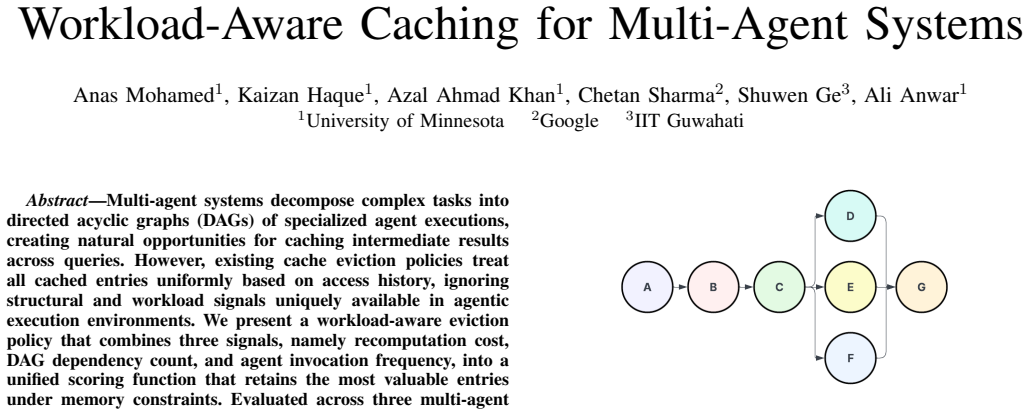
Multi-agent systems decompose complex tasks into directed acyclic graphs (DAGs) of specialized agent executions, creating natural opportunities for caching intermediate results across queries. However, existing cache eviction policies treat all cached entries uniformly based on access history, ignoring structural and workload signals uniquely available in agentic execution environments. We present a workload-aware eviction policy that combines three signals, namely recomputation cost, DAG dependency count, and agent invocation frequency, into a unified scoring function that retains the most valuable entries under memory constraints. Evaluated across three multi-agent benchmarks spanning diverse reuse regimes, our policy reduces latency by up to 64.7% relative to the uncached baseline and achieves on average a 31.1% latency reduction over the next best finite-capacity baseline, while approaching the performance of an unbounded cache and maintaining accuracy on par with or exceeding all competing finite-capacity methods. We further show that workload-aware content caching is complementary to other agentic system optimization methods, including plan-level caching and parallel agent execution, with each technique targeting a distinct efficiency bottleneck in multi-agent pipelines.
Figures


Reference graph
Works this paper leans on
-
[1]
SWE-bench: Can language models resolve real- world github issues?
C. E. Jimenez, J. Yang, A. Wettig, S. Yao, K. Pei, O. Press, and K. R. Narasimhan, “SWE-bench: Can language models resolve real- world github issues?” inThe Twelfth International Conference on Learning Representations, 2024. [Online]. Available: https: //openreview.net/forum?id=VTF8yNQM66
2024
-
[2]
Aiopslab: A holistic framework for evaluating ai agents for enabling autonomous cloud,
Y . Chen, M. Shetty, G. Somashekar, M. Ma, Y . Simmhan, J. Mace, C. Bansal, R. Wang, and S. Rajmohan, “Aiopslab: A holistic framework for evaluating ai agents for enabling autonomous cloud,” inMLSys ’25, May 2025
2025
-
[3]
The AI scientist: Towards fully automated open-ended scientific discovery,
C. Lu, C. Lu, R. T. Lange, J. Foerster, J. Clune, and D. Ha, “The AI scientist: Towards fully automated open-ended scientific discovery,” arXiv preprint arXiv:2408.06292, 2024
Pith/arXiv arXiv 2024
-
[4]
The AI scientist-v2: Workshop-level automated scientific discovery via agentic tree search,
Y . Yamada, R. T. Lange, C. Lu, S. Hu, C. Lu, J. Foerster, J. Clune, and D. Ha, “The AI scientist-v2: Workshop-level automated scientific discovery via agentic tree search,”arXiv preprint arXiv:2504.08066, 2025
Pith/arXiv arXiv 2025
-
[5]
React: Synergizing reasoning and acting in language models,
S. Yao, J. Zhao, D. Yu, N. Du, I. Shafran, K. R. Narasimhan, and Y . Cao, “React: Synergizing reasoning and acting in language models,” inThe Eleventh International Conference on Learning Representations, 2023
2023
-
[6]
A survey on large language model based autonomous agents,
L. Wang, C. Ma, X. Feng, Z. Zhang, H. ran Yang, J. Zhang, Z.-Y . Chen, J. Tang, X. Chen, Y . Lin, W. X. Zhao, Z. Wei, and J. rong Wen, “A survey on large language model based autonomous agents,” Frontiers of Computer Science, vol. 18, 2023. [Online]. Available: https://api.semanticscholar.org/CorpusID:261064713
2023
-
[7]
Efficient inference for large reasoning models: A survey,
Y . Liuet al., “Efficient inference for large reasoning models: A survey,” arXiv preprint arXiv:2503.23077, 2025
Pith/arXiv arXiv 2025
-
[8]
Attention is all you need,
A. Vaswani, N. Shazeer, N. Parmar, J. Uszkoreit, L. Jones, A. N. Gomez, L. Kaiser, and I. Polosukhin, “Attention is all you need,” inAdvances in Neural Information Processing Systems, 2017, pp. 5998–6008
2017
-
[9]
Efficient memory management for large language model serving with pagedattention,
W. Kwon, Z. Li, S. Zhuang, Y . Sheng, L. Zheng, C. H. Yu, J. E. Gonzalez, H. Zhang, and I. Stoica, “Efficient memory management for large language model serving with pagedattention,” inProceedings of the ACM SIGOPS 29th Symposium on Operating Systems Principles, 2023
2023
-
[10]
SGLang: Efficient execution of structured language model programs,
L. Zheng, L. Yin, Z. Xie, C. Sun, J. Huang, C. H. Yu, S. Cao, C. Kozyrakis, I. Stoica, J. E. Gonzalez, C. Barrett, and Y . Sheng, “SGLang: Efficient execution of structured language model programs,” inThe Thirty-eighth Annual Conference on Neural Information Processing Systems, 2024. [Online]. Available: https://openreview.net/forum?id=VqkAKQibpq
2024
-
[11]
Kvflow: Efficient prefix caching for accelerating llm-based multi-agent workflows,
Z. Pan, A. Patel, Z. Hu, Y . Shen, Y . Guan, W.-L. Li, L. Qin, Y . Wang, and Y . Ding, “Kvflow: Efficient prefix caching for accelerating llm-based multi-agent workflows,” 2025. [Online]. Available: https: //arxiv.org/abs/2507.07400
Pith/arXiv arXiv 2025
-
[12]
KVCOMM: Online cross-context KV-cache communication for efficient LLM-based multi-agent systems,
H. Ye, Z. Gao, M. Ma, Q. Wang, Y . Fu, M.-Y . Chung, Y . Lin, Z. Liu, J. Zhang, D. Zhuo, and Y . Chen, “KVCOMM: Online cross-context KV-cache communication for efficient LLM-based multi-agent systems,” inThe Thirty-ninth Annual Conference on Neural Information Processing Systems, 2025. [Online]. Available: https://openreview.net/forum?id=yGOytgjurF
2025
-
[13]
GPTCache: An open-source semantic cache for LLM applications enabling faster answers and cost savings,
F. Bang, “GPTCache: An open-source semantic cache for LLM applications enabling faster answers and cost savings,” inProceedings of the 3rd Workshop for Natural Language Processing Open Source Software (NLP-OSS 2023), L. Tan, D. Milajevs, G. Chauhan, J. Gwinnup, and E. Rippeth, Eds. Singapore: Association for Computational Linguistics, Dec. 2023, pp. 212–2...
2023
-
[14]
Billion-scale similarity search with GPUs,
J. Johnson, M. Douze, and H. J ´egou, “Billion-scale similarity search with GPUs,”IEEE Transactions on Big Data, vol. 7, no. 3, pp. 535– 547, 2019
2019
-
[15]
C. Ruan, C. Bi, K. Zheng, Z. Shi, X. Wan, and J. Li, “Cortex: Achieving low-latency, cost-efficient remote data access for llm via semantic-aware knowledge caching,” 2026. [Online]. Available: https://arxiv.org/abs/2509.17360
arXiv 2026
-
[16]
Agentic plan caching: Test- time memory for fast and cost-efficient LLM agents,
Q. Zhang, M. Wornow, and K. Olukotun, “Agentic plan caching: Test- time memory for fast and cost-efficient LLM agents,” inThe Thirty-ninth Annual Conference on Neural Information Processing Systems, 2025. [Online]. Available: https://openreview.net/forum?id=n4V3MSqK77
2025
-
[17]
Semanticalli: Caching reasoning, not just responses, in agentic systems,
V . Chillara, D. Kline, C. Alvares, E. Wooten, H. Yang, S. Khetan, C. Bauer, T. Guillory, T. Shah, Y . Dhariwal, V . Pavlov, and G. Popstefanov, “Semanticalli: Caching reasoning, not just responses, in agentic systems,” 2026. [Online]. Available: https://arxiv.org/abs/ 2601.16286
arXiv 2026
-
[18]
Lrc: Dependency-aware cache management for data analytics clusters,
Y . Yu, W. Wang, J. Zhang, and K. Ben Letaief, “Lrc: Dependency-aware cache management for data analytics clusters,” inIEEE INFOCOM 2017 - IEEE Conference on Computer Communications, 2017, pp. 1–9
2017
-
[19]
Resilient distributed datasets: A {fault-tolerant}abstraction for{in-memory}cluster computing,
M. Zaharia, M. Chowdhury, T. Das, A. Dave, J. Ma, M. McCauly, M. J. Franklin, S. Shenker, and I. Stoica, “Resilient distributed datasets: A {fault-tolerant}abstraction for{in-memory}cluster computing,” in9th USENIX symposium on networked systems design and implementation (NSDI 12), 2012, pp. 15–28
2012
-
[20]
Lerc: Coordinated cache management for data-parallel systems,
Y . Yu, W. Wang, J. Zhang, and K. B. Letaief, “Lerc: Coordinated cache management for data-parallel systems,” inGLOBECOM 2017 - 2017 IEEE Global Communications Conference, 2017, pp. 1–6
2017
-
[21]
S/c: Speeding up data materialization with bounded memory,
Z. Li, X. Pi, and Y . Park, “S/c: Speeding up data materialization with bounded memory,” in2023 IEEE 39th International Conference on Data Engineering (ICDE), 2023, pp. 1981–1994
2023
-
[22]
Real-time analytics by coordinating reuse and work sharing,
P. Sioulas, I. Mytilinis, and A. Ailamaki, “Real-time analytics by coordinating reuse and work sharing,” 2023. [Online]. Available: https://arxiv.org/abs/2307.08018
Pith/arXiv arXiv 2023
-
[23]
S-dag: A subject-based directed acyclic graph for multi-agent heterogeneous reasoning,
J. Dong, Z. Lin, W. Lin, and M. Zhang, “S-dag: A subject-based directed acyclic graph for multi-agent heterogeneous reasoning,” 2025. [Online]. Available: https://arxiv.org/abs/2511.06727
arXiv 2025
-
[24]
Agentnet: Decentralized evolutionary coordination for LLM-based multi-agent systems,
Y . Yang, H. Chai, S. Shao, Y . Song, S. Qi, R. Rui, and W. Zhang, “Agentnet: Decentralized evolutionary coordination for LLM-based multi-agent systems,” inThe Thirty-ninth Annual Conference on Neural Information Processing Systems, 2025. [Online]. Available: https://openreview.net/forum?id=tXqLxHlb8Z
2025
-
[25]
Benchmarking agentic workflow generation,
S. Qiao, R. Fang, Z. Qiu, X. Wang, N. Zhang, Y . Jiang, P. Xie, F. Huang, and H. Chen, “Benchmarking agentic workflow generation,” inThe Thirteenth International Conference on Learning Representations, 2025. [Online]. Available: https://openreview.net/forum?id=vunPXOFmoi
2025
-
[26]
Kairos: Low-latency multi-agent serving with shared llms and excessive loads in the public cloud,
J. Chen, J. Shi, Q. Chen, and M. Guo, “Kairos: Low-latency multi-agent serving with shared llms and excessive loads in the public cloud,”
-
[27]
Towards end-to-end optimization of llm-based applications with ayo,
X. Tan, Y . Jiang, Y . Yang, and H. Xu, “Towards end-to-end optimization of llm-based applications with ayo,” inProceedings of the 30th ACM International Conference on Architectural Support for Programming Languages and Operating Systems, Volume 2, 2025. [Online]. Available: https://doi.org/10.1145/3676641.3716278
arXiv 2025
-
[28]
AFlow: Automating agentic workflow generation,
J. Zhang, J. Xiang, Z. Yu, F. Teng, X.-H. Chen, J. Chen, M. Zhuge, X. Cheng, S. Hong, J. Wang, B. Zheng, B. Liu, Y . Luo, and C. Wu, “AFlow: Automating agentic workflow generation,” inThe Thirteenth International Conference on Learning Representations, 2025. [Online]. Available: https://openreview.net/forum?id=z5uV AKwmjf
2025
-
[29]
Automated design of agentic systems,
S. Hu, C. Lu, and J. Clune, “Automated design of agentic systems,” inThe Thirteenth International Conference on Learning Representations, 2025. [Online]. Available: https://openreview.net/ forum?id=t9U3LW7JVX
2025
-
[30]
Dynasaur: Large language agents beyond predefined actions,
D. Nguyen, V . D. Lai, S. Yoon, R. A. Rossi, H. Zhao, R. Zhang, P. Mathur, N. Lipka, Y . Wang, T. Bui, F. Dernoncourt, and T. Zhou, “Dynasaur: Large language agents beyond predefined actions,”arXiv preprint arXiv:2411.01747, 2024
Pith/arXiv arXiv 2024
-
[31]
Slidevqa: A dataset for document visual question answering on multiple images,
R. Tanaka, K. Nishida, K. Nishida, T. Hasegawa, I. Saito, and K. Saito, “Slidevqa: A dataset for document visual question answering on multiple images,” inAAAI, 2023
2023
-
[32]
Hierarchical multimodal transformers for multi-page docvqa,
R. Tito, D. Karatzas, and E. Valveny, “Hierarchical multimodal transformers for multi-page docvqa,” 2023. [Online]. Available: https://arxiv.org/abs/2212.05935
Pith/arXiv arXiv 2023
-
[33]
Video-mme: The first-ever comprehensive evaluation benchmark of multi-modal llms in video analysis,
C. Fu, Y . Dai, Y . Luo, L. Li, S. Ren, R. Zhang, Z. Wang, C. Zhou, Y . Shen, M. Zhanget al., “Video-mme: The first-ever comprehensive evaluation benchmark of multi-modal llms in video analysis,” inCVPR, 2025
2025
-
[34]
Plan-and-act: Improving planning of agents for long-horizon tasks,
L. E. Erdogan, H. Furuta, S. Kim, N. Lee, S. Moon, G. Anumanchipalli, K. Keutzer, and A. Gholami, “Plan-and-act: Improving planning of agents for long-horizon tasks,” inForty-second International Conference on Machine Learning, 2025. [Online]. Available: https: //openreview.net/forum?id=ybA4EcMmUZ
2025
-
[35]
ARC: A Self-Tuning, low overhead replacement cache,
N. Megiddo and D. S. Modha, “ARC: A Self-Tuning, low overhead replacement cache,” in2nd USENIX Conference on File and Storage Technologies (FAST 03). San Francisco, CA: USENIX Association, Mar. 2003. [Online]. Available: https://www.usenix.org/conference/ fast-03/arc-self-tuning-low-overhead-replacement-cache
2003
-
[36]
An llm compiler for parallel function calling,
S. Kim, S. Moon, R. Tabrizi, N. Lee, M. W. Mahoney, K. Keutzer, and A. Gholami, “An llm compiler for parallel function calling,” in Proceedings of the 41st International Conference on Machine Learning, ser. ICML’24. JMLR.org, 2024
2024
-
[37]
Q. Team, “Qwen2.5 technical report,”arXiv preprint arXiv:2412.15115, 2024
Pith/arXiv arXiv 2024
-
[38]
Ollama: Run AI models locally,
Ollama, “Ollama: Run AI models locally,” accessed: February 2025. [Online]. Available: https://ollama.com
2025
-
[39]
Can increasing the hit ratio hurt cache throughput? (long version),
Z. Qiu, J. Yang, and M. Harchol-Balter, “Can increasing the hit ratio hurt cache throughput? (long version),” 2024. [Online]. Available: https://arxiv.org/abs/2404.16219
Pith/arXiv arXiv 2024
-
[40]
Mistral Small 3.2,
Mistral AI, “Mistral Small 3.2,” https://huggingface.co/mistralai/ Mistral-Small-3.2-24B-Instruct-2506, 2025
2025
-
[2025]
Available: https://arxiv.org/abs/2508.06948
[Online]. Available: https://arxiv.org/abs/2508.06948
discussion (0)
Sign in with ORCID, Apple, or X to comment. Anyone can read and Pith papers without signing in.