REVIEW 5 major objections 5 minor 27 references
Two prompt modules reduce bias in pre-trained graph models
Reviewed by Pith at T0; open to challenge. T0 means a machine referee read the full paper against a public rubric. the ladder, T0–T4 →
T0 review · deepseek-v4-flash
2026-08-04 07:49 UTC pith:22D33TZG
load-bearing objection Promising empirical idea in fairness-aware graph prompting; the theoretical guarantees and the 'consistently outperforms' claim both overreach. the 5 major comments →
Towards Fair Graph Prompting: A Dual-Prompt Mechanism for Mitigating Attribute and Structural Bias
The pith
A machine-rendered reading of the paper's core claim, the machinery that carries it, and where it could break.
Core claim
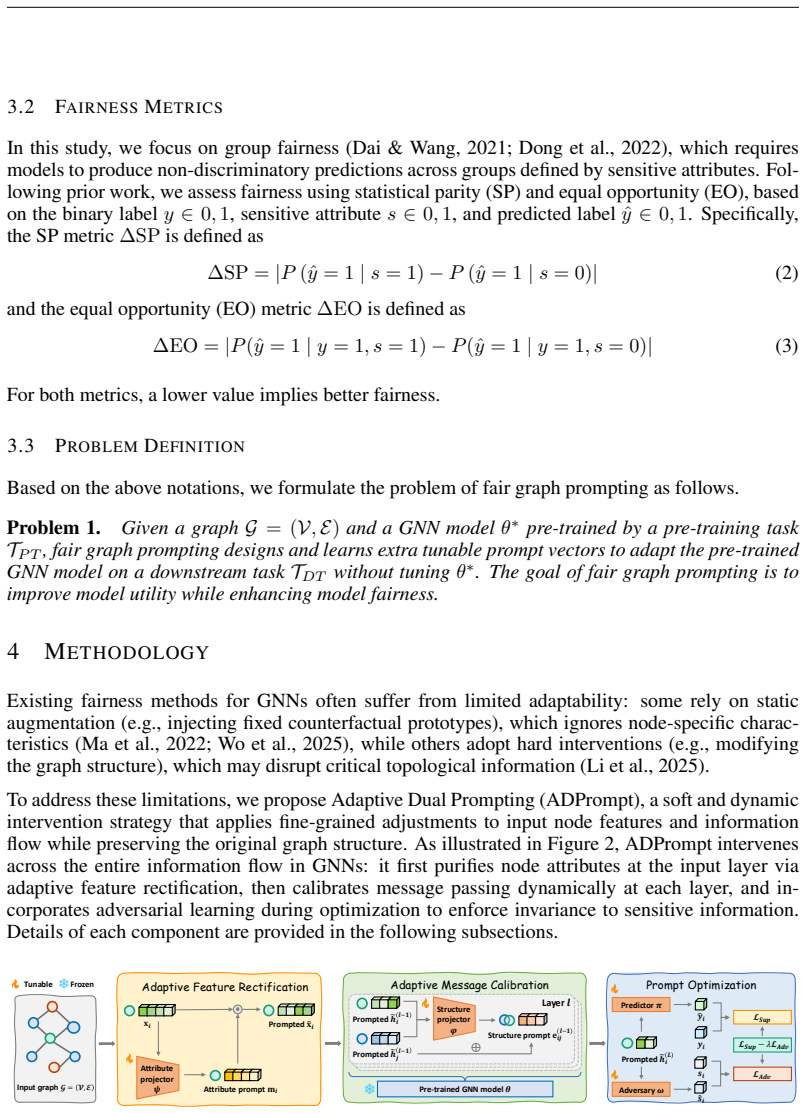
The central claim is that fairness can be injected into a frozen pre-trained GNN at adaptation time through hierarchical soft prompting. Adaptive Feature Rectification learns a per-node gating vector, computed by a sigmoid over a learned projection of the node's own attributes, and multiplies it element-wise into the input features to suppress sensitive dimensions. Adaptive Message Calibration generates edge- and layer-specific prompt vectors, computed by a LeakyReLU MLP over the concatenated source and target representations, and adds them to neighbor messages during aggregation. These prompts are trained jointly with a linear adversary that predicts the sensitive attribute from the final n
What carries the argument
The two prompting modules: AFR (a compact self-gating attribute projector with sigmoid activation, element-wise multiplied with node features) and AMC (an edge-specific message prompt computed by a LeakyReLU projector on concatenated node representations, added to neighbor messages). The joint minmax objective L_Sup − λ L_Adv, with a linear adversary, is the mechanism that drives the prompts to strip sensitive information. The theoretical analysis decomposes group disparity into an initial feature bias term and per-layer amplification and residual terms, which the prompts are claimed to reduce.
Load-bearing premise
The entire fairness guarantee rests on the unproved claim that the AMC structure prompts, after adversarial training, actually reduce both the per-layer amplification factor and the structural residual in the recursive disparity bound.
What would settle it
Measure the per-layer group disparity Δ^(l) of a pre-trained GCN with and without AMC on a real dataset; if AMC does not reduce the amplification factor and residual at each layer, Theorem 1's premise is false. A simpler test is to remove the adversarial loss and see whether the fairness improvement disappears.
If this is right
- Pre-trained GNNs can be adapted fairly without updating backbone parameters or modifying graph topology, making the approach lightweight and structure-preserving.
- The method is compatible with multiple self-supervised pre-training paradigms (InfoMax, GraphCL, GAE, BGRL), indicating the fairness prompts transfer across different learned representations.
- AFR's gating coefficients are shown to be lower on sensitive feature dimensions, confirming that source-level suppression is occurring.
- Applying AMC at every layer produces better fairness than restricting it to a single layer, suggesting that layer-wise calibration is important for controlling bias amplification.
Where Pith is reading between the lines
- The theoretical fairness guarantee depends on an unproved assertion that adversarial optimization of the AMC projector reduces the per-layer amplification and residual terms; if that holds only sometimes, the method's reliability is narrower than claimed.
- The adaptability theorem assumes edge-specific prompts can simulate any target graph, but prompts are only defined for edges that already exist in the original graph, so simulating entirely new edges would need an additional mechanism.
- A natural extension would be to test whether the same dual-prompt design reduces bias in link prediction or graph-level tasks, where the pre-training gap is different.
Editorial analysis
A structured set of objections, weighed in public.
Referee Report
Summary. The paper proposes ADPrompt, a fairness-aware graph prompting framework for adapting frozen pre-trained GNNs to downstream node classification. It consists of Adaptive Feature Rectification (AFR), which learns node-wise multiplicative attribute prompts to suppress sensitive feature dimensions, and Adaptive Message Calibration (AMC), which learns layer-wise edge-specific structure prompts to adjust messages during propagation. These are trained jointly with a supervised loss and an adversarial loss to encourage invariance to sensitive attributes. The paper claims theoretical guarantees for bias mitigation under a Generalized Statistical Parity bound and for universal adaptability, and reports experiments on four datasets under four pre-training strategies, claiming consistent superiority over seven baselines in accuracy and fairness. The central claims are that ADPrompt can make frozen pre-trained GNNs fairer without retraining or structural edits, and that it outperforms existing prompting and fairness-aware baselines.
Significance. If the theoretical and empirical claims were fully supported, ADPrompt would be a valuable contribution to the emerging area of fair graph prompting. The idea of combining input-level feature gating with layer-wise message calibration is intuitive and the experimental setup is broad (multiple datasets, pre-training strategies, backbones, and few-shot settings). The paper also includes ablations and sensitivity analyses that help validate the design choices. However, the theoretical analysis contains a load-bearing unproved step, the adaptability theorem overclaims what the proposed prompts can express, and the empirical claim of consistent superiority is contradicted by several rows of Table 1. The framework itself may still be sound and the experimental results suggestive, but the current manuscript needs substantial revision in the theory and more careful empirical claims.
major comments (5)
- [§5.2, Eq. (14)-(17) and Theorem 1] Theorem 1 is not proved. Eq. (14) states that the layer-wise disparity satisfies a recursion with γ^(l)>1, but no derivation is given. More importantly, Eq. (16) asserts that after AMC the same recursion holds with ̃γ^(l)≤γ^(l) and ̃ε^(l)≤ε^(l), and the proof of Theorem 1 simply substitutes this into Eq. (17). No argument links the specific LeakyReLU structure projector in Eq. (7) or the adversarial objective in Eq. (10) to these reductions. Without a derivation, the theorem's conclusion that ADPrompt 'formally shows' tighter bias bounds is an assumption restated as a theorem. I recommend either providing a rigorous proof of the reductions, or reframing the section as an analytical motivation rather than a formal guarantee.
- [Appendix A, Theorem 2 and Proof 2] Theorem 2 claims that AFR and AMC can simulate arbitrary target graphs G′ for any pre-trained GNN. This is not implementable for structural transformations. AMC computes e_{ij}^{(l−1)} only for existing edges (v_i, v_j)∈E, as in Algorithm 1 lines 10–12 and Eq. (7). For an edge present in G′ but absent in E, there is no e_{ij} at all, so the 'inject novel information' clause of Proof 2 cannot be realized by the proposed projector. The theorem should be restricted to edge-weight modifications and deletions, or a construction for absent edges must be given.
- [Table 1 and §6.2] The claim of 'consistently outperforming seven baselines' is not supported by Table 1. For example, under InfoMax on Pokec_n, GraphPrompt achieves ACC 73.94 vs. ADPrompt 69.89; under BGRL on Pokec_z, GraphPrompt achieves 70.68 vs. ADPrompt 66.12; under GAE on Pokec_n, GraphPrompt achieves 73.92 vs. ADPrompt 73.62. Several baselines also have better ∆EO or ∆SP in multiple cells. Additionally, no standard deviations are reported despite only three seeds, so the reported differences may not be statistically meaningful. The claim should be softened to 'competitive or better in most cases,' and variance or significance tests should be added.
- [Algorithm 1, line 24] The adversarial update appears to be incorrect with respect to Eq. (10). The objective is min_{ψ,φ,π} max_ω L_Sup − λL_Adv, so the adversary ω should be updated by gradient ascent on L_Adv. However, line 24 updates ω←ω−η∇_ω[λL_Adv], which is gradient descent and would minimize the adversary's loss, contradicting the minmax formulation. If this is a typo, it should be fixed; otherwise the method is not the claimed adversarial debiasing procedure.
- [§5.2 and §6.2, fairness metrics] The theoretical result bounds the Generalized Statistical Parity Δ_GSP of continuous predictions (Eq. 11), whereas the experiments report ΔEO and ΔSP computed on binary predicted labels (Eqs. 2–3). No formal connection is made between these quantities. A bound on the L2 difference of expected logits does not directly translate to a bound on equal opportunity or statistical parity of thresholded predictions. This gap should be addressed, either by adapting the analysis to the reported metrics or by explicitly stating the relationship.
minor comments (5)
- [General] The paper is generally well-written and organized, but the title in the header ('Adaptive Dual Prompting: Hierarchical Debiasing for Fairness-Aware Graph Neural Networks') differs from the arXiv title ('Towards Fair Graph Prompting: A Dual-Prompt Mechanism for Mitigating Attribute and Structural Bias'). The final version should use a consistent title.
- [Eq. (11)] The definition of Δ_GSP has unusual formatting with double norm bars and the expectation notation is ambiguous. It should be written as ∥E[ŷ|s=0] − E[ŷ|s=1]∥ or similar.
- [Figure 3] The figure reports average prompt coefficients for 'Sensitive' vs 'Non-Sensitive' dimensions, but no error bars or statistical tests are given, despite only three seeds. Adding error bars would strengthen the claim that AFR systematically suppresses sensitive dimensions.
- [§6.1, Implementation Details] The text cites 'Adam optimizer (Kipf & Welling, 2017)', but Adam is from Kingma and Ba (2015). The citation appears to be an error.
- [Algorithm 1] In lines 21–22, the gradient updates are written as minimizing L_Sup − λL_Adv with respect to ψ and φ, but the sign of the L_Adv term is the same in both lines. The text should clarify that this is a single gradient step on the combined objective, and the correct gradient with respect to ω as noted in the major comments.
Circularity Check
Theorem 1's fairness guarantee is the unproved Eq. (16) restated; the theoretical claim reduces to its own defining assumption.
specific steps
-
self definitional
[Section 5.2, Eq. (16) and Theorem 1]
"To counter this, AMC injects adaptive calibration vectors e^{(l−1)}_{ij} into messages via equation 7, optimized adversarially to offset sensitive components. This reduces both the amplification factor and the residual term: Δ^{(l)} ≤ γ̃^{(l)} Δ^{(l−1)} + ε̃^{(l)}. ... Theorem 1 ... where γ̃^{(l)} ≤ γ^{(l)} and ε̃^{(l)} ≤ ε^{(l)} denote the AMC-calibrated layer-wise amplification and residual terms respectively."
Theorem 1's bound (Eq. 17) is obtained by unrolling Eq. (16) over L layers; no construction or derivation connects the tilded constants to the LeakyReLU projector in Eq. (7) or to the adversarial objective in Eq. (10). The tilded constants are introduced precisely as the quantities that make Eq. (16) hold, so the theorem's conclusion is the defining property of its own terms. The claimed 'formal' fairness guarantee is therefore the same assertion as the unproved premise that AMC reduces γ^{(l)} and ε^{(l)}.
-
other
[Appendix A, Proof 2 (Theorem 2)]
"(3) inject novel information by designing e^{(l−1)}_{ij} independently of h̃^{(l−1)}_j, simulating the effect of virtual nodes or edges present in the target graph G′ but absent in the original graph."
This is the crux of Theorem 2's claim that AMC can simulate any target graph, but Eq. (7) defines e^{(l−1)}_{ij} = φ(h̃^{(l−1)}_i, h̃^{(l−1)}_j) only for v_j ∈ N(v_i) on existing edges. For an edge that is in G′ but not in E, there is no neighbor message to calibrate and no way to 'inject novel information' with the stated architecture. The proof assumes the exact universal-adaptation capability it is supposed to establish, so the theorem reduces to an assumption about AMC rather than a derivation from Eq. (7).
full rationale
The empirical comparison (Table 1) is against external baselines on public datasets, so the experimental claim 'ADPrompt outperforms seven baselines' is not circular. The circularity is confined to the theoretical support: Theorem 1 does not derive the fairness bound from the proposed modules; it defines the calibrated constants to satisfy Eq. (16) and then iterates that inequality, making the guarantee equivalent to its own premise. Theorem 2 similarly rests on an unproved expressiveness assertion that contradicts the edge-local definition of Eq. (7). Self-citations (Dong et al. 2022/2023; Ma et al. 2022) appear only as background and are not load-bearing. The result is partial circularity: the empirical content is independent, but the formal fairness/adaptability claims reduce by construction to assumptions.
Axiom & Free-Parameter Ledger
free parameters (2)
- lambda (adversarial trade-off) =
5-7
- projector hidden dimensions D_u and D_w =
not reported
axioms (5)
- domain assumption Activation functions of the GNN backbone and predictor are Lipschitz continuous (Assumption 1).
- ad hoc to paper The recursive disparity inequality Delta^(l) <= gamma^(l) Delta^(l-1) + epsilon^(l) with gamma^(l) > 1 holds for the GNN.
- ad hoc to paper AMC calibration yields gamma-tilde^(l) <= gamma^(l) and epsilon-tilde^(l) <= epsilon^(l).
- ad hoc to paper Adversarial loss with a linear adversary reduces mutual information I(X-tilde; S).
- ad hoc to paper For any target graph G', structure prompts e_ij can simulate arbitrary edge additions, deletions, and virtual nodes.
read the original abstract
Self-supervised pre-training on unlabeled graph data has become a common paradigm for Graph Neural Networks (GNNs). However, an objective gap often remains between pre-training objectives and downstream tasks. To bridge this gap, graph prompting methods adapt frozen pre-trained GNNs to specific downstream tasks through learnable prompts. Despite its effectiveness, most existing graph prompting methods primarily focus on improving model performance and largely overlook fairness concerns. As downstream graph data inherently contains biases in both node attributes and graph structures, pre-trained GNNs may produce representations that differ across demographic subgroups. To address this limitation, we propose Adaptive Dual Prompting (ADPrompt), a fairness-aware graph prompting framework for adapting pre-trained GNNs. ADPrompt incorporates two complementary components: Adaptive Feature Rectification, which learns personalized attribute prompts to suppress sensitive information at the input level, and Adaptive Message Calibration, which introduces layer-wise structure prompts to dynamically regulate information propagation from neighboring nodes. By jointly optimizing these two modules, ADPrompt adapts the pre-trained GNN while mitigating both attribute-level and structural bias. Experiments on four benchmark datasets with multiple pre-training strategies demonstrate that ADPrompt consistently outperforms seven competitive baselines in node classification tasks.
Figures



Reference graph
Works this paper leans on
-
[1]
This fine-grained gating mechanism is significantly more expressive than simple additive prompts or global transformations
Simulating Arbitrary Feature Transformations via AFR.The AFR module generates a personalized, dimension-wise attribute promptm i for each nodev i and applies it via element- wise multiplication: ˜xi =m i ⊙x i. This fine-grained gating mechanism is significantly more expressive than simple additive prompts or global transformations. By optimizing the modul...
2015
-
[2]
The Adaptive Message Calibration (AMC) module directly intervenes in this process by injecting a layer-wise, edge-specific structure prompt e(l−1) ij into each message
Simulating Arbitrary Structural Transformations via AMC.Modifications to the graph structure (i.e., fromEtoE ′) fundamentally alter the message-passing pathways within the GNN (Franceschi et al., 2019; Chen et al., 2020b). The Adaptive Message Calibration (AMC) module directly intervenes in this process by injecting a layer-wise, edge-specific structure p...
2019
-
[3]
Learning discrete structures for graph neural networks
Luca Franceschi, Mathias Niepert, Massimiliano Pontil, and Xiao He. Learning discrete structures for graph neural networks. InInternational conference on machine learning, pp. 1972–1982. PMLR,
1972
-
[4]
AMC serves as a layer-wise regularizer by generating edge-specific calibration vectors according to equation
Adaptive Message Calibration (AMC) as a Layer-wise Regularizer.Input purification alone cannot prevent bias amplification in message passing (Dai & Wang, 2021; Dong et al., 2022). AMC serves as a layer-wise regularizer by generating edge-specific calibration vectors according to equation
2021
-
[5]
Variational graph auto-encoders.arXiv preprint arXiv:1611.07308,
Thomas N Kipf and Max Welling. Variational graph auto-encoders.arXiv preprint arXiv:1611.07308,
-
[7]
These vectors act as corrective signals to suppress sensitive information propagated from neighbors, thereby reducing the mutual information: I( ˜H(l) i ;S N(i) )≤I( ˜H(l−1) i ;S N(i) ),(21) which prevents bias accumulation across layers and ensures fairness in deep GNNs (Tishby et al., 2000; Moyer et al., 2018; Oono & Suzuki, 2019). Together, AFR and AMC...
2000
-
[11]
Highway networks.arXiv preprint arXiv:1505.00387,
Rupesh Kumar Srivastava, Klaus Greff, and J¨urgen Schmidhuber. Highway networks.arXiv preprint arXiv:1505.00387,
-
[13]
Bootstrapped representation learning on graphs
Shantanu Thakoor, Corentin Tallec, Mohammad Gheshlaghi Azar, R ´emi Munos, Petar Veliˇckovi´c, and Michal Valko. Bootstrapped representation learning on graphs. InICLR 2021 workshop on geometrical and topological representation learning,
2021
-
[14]
The information bottleneck method.arXiv preprint physics/0004057,
Naftali Tishby, Fernando C Pereira, and William Bialek. The information bottleneck method.arXiv preprint physics/0004057,
-
[16]
Zengyi Wo, Chang Liu, Yumeng Wang, Minglai Shao, and Wenjun Wang. Improving fairness in graph neural networks via counterfactual debiasing.arXiv preprint arXiv:2508.14683,
-
[17]
How powerful are graph neural networks?arXiv preprint arXiv:1810.00826,
Keyulu Xu, Weihua Hu, Jure Leskovec, and Stefanie Jegelka. How powerful are graph neural networks?arXiv preprint arXiv:1810.00826,
-
[18]
Deep graph contrastive representation learning.arXiv preprint arXiv:2006.04131,
Yanqiao Zhu, Yichen Xu, Feng Yu, Qiang Liu, Shu Wu, and Liang Wang. Deep graph contrastive representation learning.arXiv preprint arXiv:2006.04131,
Pith/arXiv arXiv 2006
-
[19]
We demonstrate that ADPrompt can effectively adapt a fixed pre-trained GNNθ∗ to diverse downstream tasks through the learned adaptive dual prompts
13 A THEORETICALANALYSIS OFMODELADAPTABILITY In this section, we present a theoretical analysis of the adaptability of the ADPrompt framework. We demonstrate that ADPrompt can effectively adapt a fixed pre-trained GNNθ∗ to diverse downstream tasks through the learned adaptive dual prompts. The key to this adaptability lies in the universality of the promp...
2018
-
[22]
Raw node attributesXoften contain sen- sitive information correlated withS, forming the initial source of bias
Adaptive Feature Rectification (AFR) as an Input-Layer Bottleneck.AFR acts as a bottleneck at the feature input layer (Tishby et al., 2000). Raw node attributesXoften contain sen- sitive information correlated withS, forming the initial source of bias. By optimizing the projector ψadversarially, AFR generates a gating promptm i per node through equation
2000
-
[23]
This element-wise gating selectively suppresses sensitive dimensions inx i, ensuring I( ˜X;S)≤I(X;S),(20) and providing a purified feature foundation for fair downstream propagation (Jin et al., 2020). Proof
2020
-
[26]
working field
15 Algorithm 1ADPrompt 1:Input:pre-trained GNN modelθ; graphG= (V,E)with node attributesx i ∈R Dx and neighborsN(v i); hyperparameters: trade-offλ, learning rateη, total epochsE, current epoch e. 2:Output:attribute projectorψ, structure projectorφ, predictorπ, 3:fore= 1toEdo 4:forv i ∈ Vdo 5:Computem i =σ(ψ(x i))using equation 5 6:Compute˜x i using equati...
2021
-
[27]
It incorporates a fixed prompt to represent sensitive group em- beddings and a learnable prompt to bridge the gap between pre-training and downstream tasks
is a fairness-aware prompt tuning method that uses hybrid graph prompts to mitigate bias. It incorporates a fixed prompt to represent sensitive group em- beddings and a learnable prompt to bridge the gap between pre-training and downstream tasks. E MOREEXPERIMENTALRESULTS E.1 MODELCOMPARISON UNDER10-SHOTSETTING To assess the effectiveness of our model in ...
1961
-
[1998]
Temporal graph networks for deep learning on dynamic graphs.arXiv preprint arXiv:2006.10637,
Emanuele Rossi, Ben Chamberlain, Fabrizio Frasca, Davide Eynard, Federico Monti, and Michael Bronstein. Temporal graph networks for deep learning on dynamic graphs.arXiv preprint arXiv:2006.10637,
Pith/arXiv arXiv 2006
-
[2000]
Petar Veliˇckovi´c, Guillem Cucurull, Arantxa Casanova, Adriana Romero, Pietro Lio, and Yoshua Bengio. Graph attention networks. InInternational Conference on Learning Representations, 2018a. Petar Veliˇckovi´c, William Fedus, William L Hamilton, Pietro Li `o, Yoshua Bengio, and R Devon Hjelm. Deep graph infomax.arXiv preprint arXiv:1809.10341, 2018b. Pet...
-
[2017]
Yutai Duan, Jie Liu, Shaowei Chen, Liyi Chen, and Jianhua Wu
Accessed: [Insert date, e.g., 2023-10-27]. Yutai Duan, Jie Liu, Shaowei Chen, Liyi Chen, and Jianhua Wu. G-prompt: Graphon-based prompt tuning for graph classification.Information Processing & Management, 61(3):103639,
2023
-
[2018]
Kenta Oono and Taiji Suzuki. Graph neural networks exponentially lose expressive power for node classification.arXiv preprint arXiv:1905.10947,
Pith/arXiv arXiv 1905
-
[2020]
Auc-oriented graph neural network for fraud detection
Mengda Huang, Yang Liu, Xiang Ao, Kuan Li, Jianfeng Chi, Jinghua Feng, Hao Yang, and Qing He. Auc-oriented graph neural network for fraud detection. InProceedings of the ACM web conference 2022,
2022
-
[2021]
Fairness-aware prompt tuning for graph neural networks
Zhengpin Li, Minhua Lin, Jian Wang, and Suhang Wang. Fairness-aware prompt tuning for graph neural networks. InProceedings of the ACM on Web Conference 2025, pp. 3586–3597,
2025
-
[2022]
All in one: Multi-task prompting for graph neural networks
Xiangguo Sun, Hong Cheng, Jia Li, Bo Liu, and Jihong Guan. All in one: Multi-task prompting for graph neural networks. InProceedings of the 29th ACM SIGKDD Conference on Knowledge Discovery and Data Mining, 2023a. Xiangguo Sun, Jiawen Zhang, Xixi Wu, Hong Cheng, Yun Xiong, and Jia Li. Graph prompt learn- ing: A comprehensive survey and beyond.arXiv prepri...
-
[2023]
Edits: Modeling and mitigating data bias for graph neural networks
Yushun Dong, Ninghao Liu, Brian Jalaian, and Jundong Li. Edits: Modeling and mitigating data bias for graph neural networks. InProceedings of the ACM web conference 2022, pp. 1259–1269,
2022
-
[2024]
Prefix-tuning: Optimizing continuous prompts for generation.arXiv preprint arXiv:2101.00190,
Xiang Lisa Li and Percy Liang. Prefix-tuning: Optimizing continuous prompts for generation.arXiv preprint arXiv:2101.00190,
-
[2025]
Graphprompt: Unifying pre-training and downstream tasks for graph neural networks
Zemin Liu, Xingtong Yu, Yuan Fang, and Xinming Zhang. Graphprompt: Unifying pre-training and downstream tasks for graph neural networks. InProceedings of the ACM Web Conference 2023, 2023a. Zihan Liu, Yaqing Zhang, Kaize Ding, Dawei Wang, Yelong Shen, and Jundong Liu. A survey on prompt learning in natural language processing, computer vision, and graph l...
Pith/arXiv arXiv 2023
discussion (0)
Sign in with ORCID, Apple, or X to comment. Anyone can read and Pith papers without signing in.