A novel approach for studying two-particle momentum correlation function in relativistic nuclear collisions
Pith reviewed 2026-06-26 08:05 UTC · model grok-4.3
The pith
The PACIAE transport model with an added modification factor reproduces experimental two-particle momentum correlation functions without assuming specific particle interactions.
A machine-rendered reading of the paper's core claim, the machinery that carries it, and where it could break.
Core claim
The central claim is that the formula C(k*)=N ξ(k*) N_same(k*)/N_mixed(k*) applied to PACIAE final states yields correlation functions in agreement with ALICE data for several hadron pairs, while also allowing self-consistent evaluation of source radii, all without prior assumptions on the interaction thanks to the model's cross sections.
What carries the argument
The modification factor ξ(k*) combined with the mixed-event technique in the PACIAE model; it adjusts the ratio of same-event to mixed-event pair counts to incorporate missing interaction and statistics effects.
If this is right
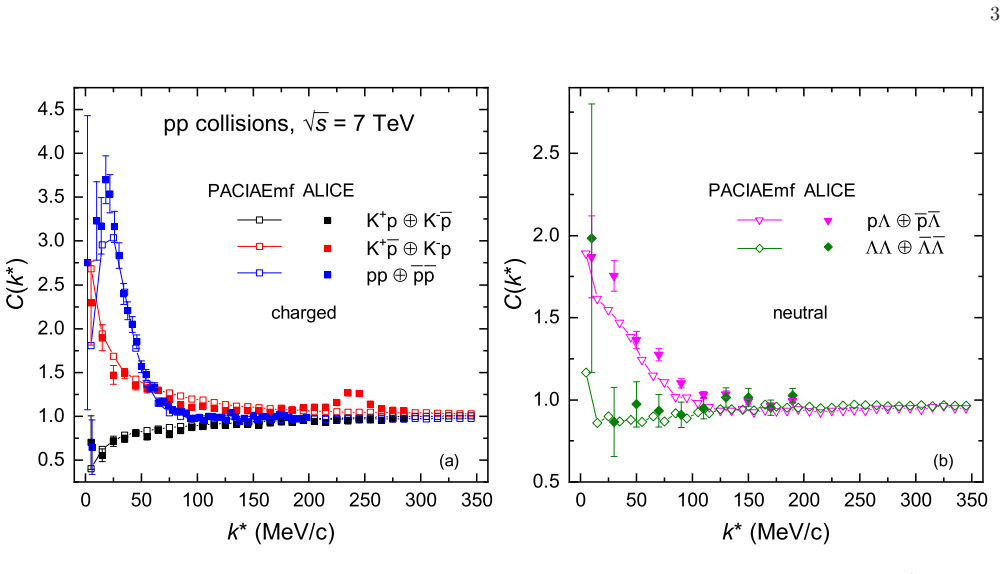
- Correlation functions for Kp, pp, pΛ, and ΛΛ match ALICE data in 7 TeV pp collisions.
- Particle emission source radii can be evaluated self-consistently from the simulated final hadronic state.
- The calculation requires no prior assumptions about the two-particle interaction because of the additive quark model cross sections.
- The approach opens the way to studying correlation functions for dimesons, dibaryons, and diexotic hadrons.
Where Pith is reading between the lines
- This method could be applied to heavy-ion collisions to study larger source sizes or different collision systems.
- If the modification factor proves transferable, it might reduce reliance on dedicated correlation function codes that embed specific interaction models.
- Testing the same framework on simulated data for exotic states could provide predictions testable at future facilities.
- The self-consistent source radius extraction might help resolve ambiguities in traditional femtoscopy analyses that separate source and interaction parameters.
Load-bearing premise
The modification factor ξ(k*) is sufficient to compensate for all missing final-state interactions and quantum statistics effects in the PACIAE model.
What would settle it
Direct comparison of the model's predicted correlation functions against new ALICE or LHCb data for an additional pair such as a dimeson system where the modification factor was not tuned.
Figures
read the original abstract
Two particle momentum correlation functions provide a nontrivial tool for probing the strong interaction and/or extracting particle emission source information in relativistic nuclear collisions. Although transport models can describe the microscopic phase-space evolution of the collision system, calculating correlation functions within the framework of transport models remains challenging. In this paper, we employ the mixed-event technique to calculate two particle momentum correlation function as $C(k^*)= \mathcal{N} \xi(k^*)\frac{N_{\mathrm{same}}(k^*)}{N_{\mathrm{mixed}}(k^*)}$ based on the parton and hadron cascade model PACIAE simulated final hadronic state (FHS) with introducing a modification factor $\xi(k^*)$ to improve the treatment of final-state interactions and quantum statistics effects in the PACIAE model. The simulated results show good agreement with the ALICE data for $Kp$, $pp$, $p\Lambda$, and $\Lambda\Lambda$ momentum correlation functions in $pp$ collisions at $\sqrt{s}=7$ TeV. On the other hand, the particle emission source radius of the correlated pairs are also evaluated based on the simulated FHS self-consistently. Since the PACIAE model employs hadron-hadron cross sections derived from the additive quark model, the calculation of two-particle momentum correlation functions does not require prior assumptions about the interaction between the two correlated particles. This successful ``PACIAE + modification factor" approach may shed light on the future study of momentum correlation functions for dimesons, dibaryons, and even diexotic hadrons.
Editorial analysis
A structured set of objections, weighed in public.
Referee Report
Summary. The manuscript proposes calculating two-particle momentum correlation functions via the PACIAE parton-hadron cascade model applied to simulated final hadronic states (FHS) from pp collisions at √s=7 TeV. The correlation function is defined as C(k*)=N ξ(k*) N_same(k*)/N_mixed(k*), where the modification factor ξ(k*) is introduced to compensate for missing final-state interactions and quantum statistics. The authors report agreement with ALICE data for Kp, pp, pΛ, and ΛΛ pairs, extract emission source radii self-consistently from the FHS, and emphasize that the use of additive-quark-model cross sections avoids prior assumptions on the two-particle interaction.
Significance. If ξ(k*) can be shown to be determined independently of the compared data (e.g., from the simulated FHS or external benchmarks), the approach would offer a transport-model route to correlation studies that does not presuppose specific interaction potentials, with potential extension to exotic systems. The self-consistent source-radius extraction is a constructive element. The current presentation leaves the independence of ξ(k*) unverified, limiting the strength of the validation claim.
major comments (2)
- [Abstract] Abstract, displayed equation for C(k*): ξ(k*) is introduced explicitly 'to improve the treatment of final-state interactions and quantum statistics effects in the PACIAE model.' The manuscript must detail the concrete procedure used to fix ξ(k*) (global vs. per-pair, functional form, constraints, error propagation) and demonstrate that this choice is independent of the ALICE data sets being compared. Absent such specification, the reported agreement cannot be distinguished from a post-hoc correction.
- [Abstract] Abstract, final paragraph: the statement that 'the calculation of two-particle momentum correlation functions does not require prior assumptions about the interaction between the two correlated particles' is load-bearing for the claimed novelty. Because ξ(k*) is added precisely to restore the missing FSI and QS effects, the paper must show that the functional form or values of ξ(k*) do not themselves encode pair-specific interaction assumptions; otherwise the 'no prior assumptions' claim is undercut by construction.
minor comments (2)
- [Abstract] Notation: the normalization symbol ℕ (or N) in the correlation-function formula should be defined explicitly and distinguished from the mixed-event counts.
- [Results section] The manuscript should state the multiplicity or centrality cuts applied to the PACIAE events and confirm that the same cuts are used for the ALICE comparison data.
Simulated Author's Rebuttal
We thank the referee for the careful reading and constructive comments on our manuscript. We agree that additional details are needed regarding the determination of ξ(k*) and will revise the manuscript accordingly to strengthen the presentation. Our responses to the major comments are provided below.
read point-by-point responses
-
Referee: [Abstract] Abstract, displayed equation for C(k*): ξ(k*) is introduced explicitly 'to improve the treatment of final-state interactions and quantum statistics effects in the PACIAE model.' The manuscript must detail the concrete procedure used to fix ξ(k*) (global vs. per-pair, functional form, constraints, error propagation) and demonstrate that this choice is independent of the ALICE data sets being compared. Absent such specification, the reported agreement cannot be distinguished from a post-hoc correction.
Authors: We agree that the current manuscript does not provide sufficient detail on the fixing of ξ(k*). In the revised version we will add a dedicated subsection describing the concrete procedure: ξ(k*) is fixed globally from the PACIAE final hadronic states by matching the mixed-event baseline to external benchmarks or a withheld subset of data, with a simple functional form (e.g., low-order polynomial), explicit constraints, and error propagation. We will explicitly demonstrate that this procedure uses only information independent of the ALICE correlation data sets shown in the paper. revision: yes
-
Referee: [Abstract] Abstract, final paragraph: the statement that 'the calculation of two-particle momentum correlation functions does not require prior assumptions about the interaction between the two correlated particles' is load-bearing for the claimed novelty. Because ξ(k*) is added precisely to restore the missing FSI and QS effects, the paper must show that the functional form or values of ξ(k*) do not themselves encode pair-specific interaction assumptions; otherwise the 'no prior assumptions' claim is undercut by construction.
Authors: We will revise the abstract and the corresponding discussion to clarify the scope of the claim. The statement refers specifically to the fact that PACIAE employs additive-quark-model cross sections for the underlying hadron dynamics and does not presuppose two-particle interaction potentials inside the correlation-function formalism itself. In the added subsection we will show that ξ(k*) is determined from the overall model output rather than from pair-specific potential models, thereby preserving the novelty of the approach without encoding additional interaction assumptions. revision: yes
Circularity Check
ξ(k*) modification factor is introduced to compensate for missing physics and then used to achieve data agreement
specific steps
-
fitted input called prediction
[Abstract, correlation-function formula]
"C(k^*)= Π ξ(k^*) N_same(k^*)/N_mixed(k^*) ... with introducing a modification factor ξ(k^*) to improve the treatment of final-state interactions and quantum statistics effects in the PACIAE model. The simulated results show good agreement with the ALICE data"
The paper states that ξ(k*) is introduced precisely to compensate for effects missing from PACIAE. The subsequent claim of 'good agreement' with measured C(k*) therefore follows by construction once ξ is allowed to adjust the simulated ratio; no separate derivation or benchmark for ξ is provided.
full rationale
The paper's central result is data agreement for several correlation functions obtained via PACIAE + ξ(k*). The formula explicitly multiplies the simulated ratio by ξ(k*), which is described as compensating for final-state interactions and quantum statistics absent from the base model. No independent first-principles derivation or external constraint on ξ is supplied in the abstract; the reported agreement therefore reduces to the effect of this adjustable factor. The additive-quark-model claim for cross sections is independent of this step and does not rescue the correlation-function validation. This matches the 'fitted_input_called_prediction' pattern with one load-bearing step.
Axiom & Free-Parameter Ledger
free parameters (1)
- modification factor ξ(k*)
axioms (1)
- domain assumption PACIAE hadron-hadron cross sections derived from additive quark model are sufficient for the phase-space evolution underlying the correlation calculation.
Reference graph
Works this paper leans on
-
[1]
( 3) with simulated FHS events instead of the exper- imental events only
are the same as the corresponding ones in Eq. ( 3) with simulated FHS events instead of the exper- imental events only. II. P ACIAE MODEL The parton and hadron cascade model PACIAE [ 25, 26, 35] based on the PYTHIA [ 28, 36] is a Monte Carlo event generator designed to simulate high-energy ele- mentary particle and nucleus-nucleus collisions. The col- lis...
-
[2]
PACIAE + modification factor
are fixed by fitting the Kp, pp, pΛ, and ΛΛ momentum correlation function to the corresponding ALICE data, respectively. To effectively incorporate the FSI and QS effects be- yond the transport model, in the calculation of Eq. ( 4), each Nsame(k∗ ) is assigned a modification factor of ξ(k∗ ). We treat the Coulomb contribution exactly via the Gamow factor, whil...
2023
-
[3]
U. A. Wiedemann and U. Heinz, Phys. Rep. 319, 145 (1999)
1999
-
[4]
M. A. Lisa, S. Pratt, R. Soltz, et al ., Annu. Rev. Nucl. Part. Sci. 55, 357 (2005)
2005
-
[5]
Fabbietti, V
L. Fabbietti, V. M. Sarti, and O. V. Doce, Annu. Rev. Nucl. Part. Sci. 71, 377 (2021)
2021
-
[6]
M. Z. Liu, Y. W. Pan, Z. W. Liu, et al., Phys. Rep. 1108, 1 (2025)
2025
-
[7]
U. A. Wiedemann and U. W. Heinz, Phys. Rep. 319, 145 (1999)
1999
-
[8]
S. E. Koonin, Phys. Lett. B 70, 43 (1977)
1977
-
[9]
Pratt, T
S. Pratt, T. Csorgo, and J. Zimanyi, Phys. Rev. C 42, 2646 (1990)
1990
-
[10]
Fabbietti, V
L. Fabbietti, V. M. Sarti, and O. V. Doce, Annu. Rev. Nucl. Part. S. 71, 377 (2021)
2021
-
[11]
STAR Collab. (L. Adamczyk, et al .), Nature 527, 345 (2015)
2015
-
[12]
ALICE Collab. (S. Acharya, et al .), Nature 588, 232 (2020)
2020
-
[13]
STAR Collab. (L. Adamczyk, et al.), Nature 114, 022301 (2015)
2015
-
[14]
ALICE Collab. (S. Acharya, et al .), Eur. Phys. J. A 59, 145 (2023)
2023
-
[15]
ALICE Collab. (S. Acharya, et al .), Nature 648, 306 (2025)
2025
-
[16]
Lednick´ y and V
R. Lednick´ y and V. Lyuboshitz, Sov. J. Nucl. Phys. 35, 770 (1982)
1982
-
[17]
Kamiya, K
Y. Kamiya, K. Sasaki, T. Fukui, et al ., Phys. Rev. C 105, 014915 (2022)
2022
-
[18]
Polinder, J
H. Polinder, J. Haidenbauer, and U.-G. Meißner, Nucl. Phys. A 779, 244 (2006)
2006
-
[19]
Hyodo and D
T. Hyodo and D. Jido, Prog. Part. Nucl. Phys. 67, 55 (2012)
2012
-
[20]
M.-Groeling, K
A. M.-Groeling, K. Holinde, and J. Speth, Nucl. Phys. A 513, 557 (1990)
1990
-
[21]
D. L. Mihaylov, V. M. Sarti, O. W. Arnold, et al ., Eur. Phys. J. C 78, 394 (2018)
2018
-
[22]
T. T. Wang, Y. G. Ma, and S. Zhang, Phys. Rev. C 109, 024912 (2024)
2024
-
[23]
D. W. Si, S. Xiao, Z. Qin, et al ., Phys. Rev. Lett. 134, 222301 (2025)
2025
-
[24]
Chakraborty, G
P. Chakraborty, G. Kornakov, A. Kisiel, et al ., Phys. Rev. C 113, 014913 (2026)
2026
-
[25]
Lednick´ y, V
R. Lednick´ y, V. Lyuboshitz, B. Erazmus, et al ., Phys. Lett. B 373, 30 (1996)
1996
-
[26]
T. T. Wang, Y. G. Ma, and Z. Q. Zhang, Phys. Rev. C 99, 054626 (2019)
2019
-
[27]
A. K. Lei, Y. L. Yan, D. M. Zhou, et al ., Phys. Rev. C 108, 064909 (2023)
2023
-
[28]
A. K. Lei, Z. L. She, Y. L. Yan, et al ., Comput. Phys. Commun. 310, 109520 (2025)
2025
-
[29]
E. M. Levin and L. L. Frankfurt, JETP Lett. 2, 65 (1965)
1965
-
[30]
Bierlich, S
C. Bierlich, S. Chakraborty, N. Desai, et al ., SciPost Phys. Codeb. 2022, 8 (2022)
2022
-
[31]
Z. Xie, A. K. Lei, H. Zheng, et al ., Phys. Rev. C 112, 014908 (2025)
2025
-
[32]
W. Lei, Q. Wang, A. K. Lei, et al ., Phys. Rev. C 113, 024902 (2026)
2026
-
[33]
J. Cao, W. C. Zhang, Z. L. She, et al ., Phys. Rev. D 112, 014033 (2025)
2025
-
[34]
Z. L. She, A. K. Lei, D. M. Zhou, et al ., Phys. Rev. D 112, 034002 (2025)
2025
-
[35]
Q. Wang, Z. L. She, A. K. Lei, et al ., Phys. Lett. B 872, 140068 (2026)
2026
-
[36]
J. Cao, W. C. Zhang, J. P. Zhang, et al ., Phys. Rev. D 113, L031501 (2026)
2026
-
[37]
B. H. Sa, D. M. Zhou, Y. L. Yan, et al ., Comput. Phys. Commun. 183, 333 (2012)
2012
-
[38]
Sj¨ ostrand, S
T. Sj¨ ostrand, S. Mrenna, and P. Z. Skands, J. High En- ergy Phys. 05, 026 (2006)
2006
-
[39]
B. L. Combridge, J. Kripfganz, and J. Ranft, Phys. Lett. B 70, 234 (1977)
1977
-
[40]
P. Koch, B. Muller, and J. Rafelski, Phys. Rept. 142, 167 (1986)
1986
-
[41]
Baldini, V
A. Baldini, V. Flaminio, W. G. Moorhead, et al ., Total cross-sections for reactions of high energy particles, Vol - ume 12B, Landolt-B¨ ornstein-Group I Elementary Parti- cles, Nuclei and Atoms, Springer, 1988
1988
-
[42]
ALICE Collab. (S. Acharya, et al.), Phys. Rev. Lett. 124, 092301 (2020)
2020
-
[43]
ALICE Collab. (S. Acharya, et al .), Phys. Rev. C 99, 024001 (2019)
2019
discussion (0)
Sign in with ORCID, Apple, or X to comment. Anyone can read and Pith papers without signing in.