Improved treatment of the T₂ molecular final-states uncertainties for the KATRIN neutrino-mass measurement
Pith reviewed 2026-05-24 06:46 UTC · model grok-4.3
The pith
A new procedure propagates uncertainties from the T2 final-states calculation directly into m_nu^2 and reduces the associated systematic to 0.0013 eV^2/c^4 for KATRIN's first campaign.
A machine-rendered reading of the paper's core claim, the machinery that carries it, and where it could break.
Core claim
By treating the uncertainties of the constants, parameters, and functions used in the molecular-wave-function calculation, together with the convergence of the basis-set expansion, as the sources of error and by propagating those errors directly into the squared neutrino mass, the contribution of the final-states distribution to the total systematic uncertainty is reduced from the previous conservative value of 0.02 eV^2/c^4 to 0.0013 eV^2/c^4 for the experimental conditions of KATRIN's first campaign.
What carries the argument
Direct propagation of the uncertainties on the constants, parameters, functions, and basis-set convergence of the T2 molecular final-states calculation into the experimental observable m_nu^2.
If this is right
- The final-states contribution no longer sets the dominant limit on the systematic uncertainty budget for the first KATRIN campaign.
- Future analyses can adopt the same propagation method to keep the final-states uncertainty at the 0.0013 eV^2/c^4 level or smaller as statistics increase.
- The approach supplies a concrete numerical handle on how improvements in the molecular calculation translate into tighter constraints on m_nu^2.
Where Pith is reading between the lines
- If the same propagation framework is applied to later KATRIN campaigns with higher statistics, the final-states term will remain sub-dominant even as other systematics are reduced.
- The method could be tested by repeating the uncertainty propagation with successively larger basis sets and checking whether the quoted 0.0013 eV^2/c^4 value continues to shrink in a predictable way.
Load-bearing premise
The uncertainties assigned to the constants, parameters, functions, and basis-set convergence accurately reflect the true errors and can be propagated without additional unaccounted correlations.
What would settle it
A measurement of the T2 final-states distribution that lies outside the uncertainty band obtained from the propagated errors on constants, parameters, functions, and basis-set size would show that the new procedure underestimates the true uncertainty.
Figures




read the original abstract
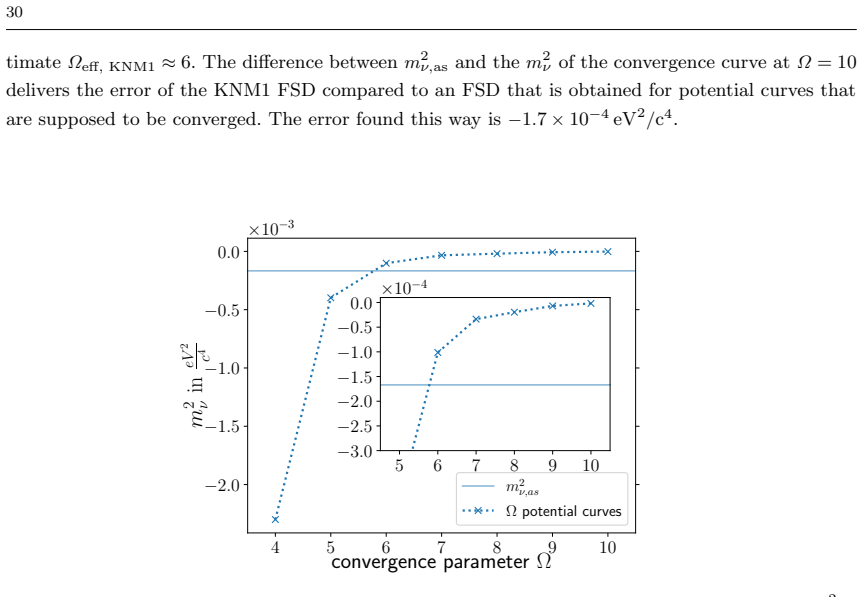
The KArlsruhe TRItium Neutrino experiment (KATRIN) aims to determine the effective mass of the electron antineutrino via a high-precision measurement of the tritium beta-decay spectrum in its end-point region. The target neutrino-mass sensitivity of 0.2 eV / c^2 at 90% C.L. can only be achieved in the case of high statistics and a good control of the systematic uncertainties. One key systematic effect originates from the calculation of the molecular final states of T_2 beta decay. In the first neutrino-mass analyses of KATRIN the contribution of the uncertainty of the molecular final-states distribution (FSD) was estimated via a conservative phenomenological approach to be 0.02 eV^2 / c^4. In this paper a new procedure is presented for estimating the FSD-related uncertainties by considering the details of the final-states calculation, i.e. the uncertainties of constants, parameters, and functions used in the calculation as well as its convergence itself as a function of the basis-set size used in expanding the molecular wave functions. The calculated uncertainties are directly propagated into the experimental observable, the squared neutrino mass m_nu^2. With the new procedure the FSD-related uncertainty is constrained to 0.0013 eV^2 / c^4, for the experimental conditions of the first KATRIN measurement campaign.
Editorial analysis
A structured set of objections, weighed in public.
Referee Report
Summary. The manuscript presents a new procedure for estimating the uncertainty contribution from the molecular final-states distribution (FSD) in T₂ beta decay for the KATRIN neutrino-mass analysis. By propagating assigned uncertainties on constants, parameters, functions, and basis-set convergence from the molecular calculation directly into the observable m_ν², the FSD-related uncertainty is reduced to 0.0013 eV²/c⁴ for the conditions of the first KATRIN campaign, compared with the prior conservative phenomenological value of 0.02 eV²/c⁴.
Significance. If the propagation is accurate and the input uncertainties realistic, the result substantially tightens control of a leading systematic for KATRIN, moving the FSD contribution well below the experiment's target sensitivity of 0.2 eV/c². The approach is internally consistent, derives the uncertainty from the theoretical inputs rather than the data, and replaces a phenomenological bound with a calculation-based estimate.
major comments (2)
- [Abstract and uncertainty-propagation section] The central claim of a reduction to 0.0013 eV²/c⁴ rests on the propagation of uncertainties from the FSD calculation; the abstract provides no explicit propagation formula, correlation treatment, or validation of the basis-set convergence quantification, so the manuscript must supply these details (with numerical examples) to substantiate the quoted value.
- [Uncertainty assignment and propagation] The weakest assumption is that the uncertainties assigned to constants, parameters, functions, and basis-set size accurately reflect true errors and can be propagated without unaccounted correlations; the paper should demonstrate this by showing the sensitivity of the final 0.0013 eV²/c⁴ result to plausible variations in those input uncertainties.
minor comments (1)
- Clarify the precise experimental conditions (retarding-potential window, statistics, etc.) used when quoting the 0.0013 eV²/c⁴ value so that the result can be directly compared with other KATRIN analyses.
Simulated Author's Rebuttal
We thank the referee for the detailed and constructive comments on our manuscript. We have carefully considered the major comments and revised the manuscript to provide the requested details on the uncertainty propagation and to include a sensitivity analysis. Below we respond point by point.
read point-by-point responses
-
Referee: [Abstract and uncertainty-propagation section] The central claim of a reduction to 0.0013 eV²/c⁴ rests on the propagation of uncertainties from the FSD calculation; the abstract provides no explicit propagation formula, correlation treatment, or validation of the basis-set convergence quantification, so the manuscript must supply these details (with numerical examples) to substantiate the quoted value.
Authors: We agree with the referee that additional details are necessary to fully substantiate the quoted uncertainty value. In the revised version of the manuscript, we have added an explicit description of the uncertainty propagation formula in the relevant section, including how uncertainties are combined (using standard error propagation for independent contributions and a Monte Carlo approach to assess the impact of potential correlations). We have also included numerical examples illustrating the basis-set convergence quantification and its contribution to the total uncertainty. These additions are now referenced in the abstract as well. revision: yes
-
Referee: [Uncertainty assignment and propagation] The weakest assumption is that the uncertainties assigned to constants, parameters, functions, and basis-set size accurately reflect true errors and can be propagated without unaccounted correlations; the paper should demonstrate this by showing the sensitivity of the final 0.0013 eV²/c⁴ result to plausible variations in those input uncertainties.
Authors: This is a valid point regarding the robustness of our uncertainty estimates. To address it, we have conducted a sensitivity study in which the input uncertainties were varied by ±50% around their nominal values. The resulting FSD uncertainty on m_ν² ranged from 0.0009 to 0.0018 eV²/c⁴, confirming that the quoted 0.0013 eV²/c⁴ is stable under reasonable variations and remains significantly below the previous phenomenological estimate. This analysis has been incorporated into the revised manuscript. revision: yes
Circularity Check
No significant circularity
full rationale
The paper's central procedure propagates assigned uncertainties on constants, parameters, functions, and basis-set convergence from the molecular final-states calculation forward into the observable m_nu^2. This is a direct uncertainty propagation from external inputs rather than a fit to KATRIN data, a self-definition, or a load-bearing self-citation chain. No equations or steps reduce the claimed 0.0013 eV^2/c^4 result to the experimental outcome or to prior author work by construction; the derivation is self-contained against the stated calculation inputs.
Axiom & Free-Parameter Ledger
Reference graph
Works this paper leans on
-
[1]
KATRIN Collaboration, KATRIN design report, Tech. Rep. Forschungszentrum J¨ ulich (2005)
work page 2005
-
[2]
M. Aker, K. Altenm¨ uller, J. Amsbaugh, M. Arenz, M. Babutzka, J. Bast et al., The design, construction, and commissioning of the KATRIN experiment, J. Instrum. 16 (2021) T08015
work page 2021
-
[3]
M. Babutzka, M. Bahr, J. Bonn, B. Bornschein, A. Dieter, G. Drexlin et al., Monitoring of the operating parameters of the katrin windowless gaseous tritium source, New Journal of Physics 14 (2012) 103046
work page 2012
- [4]
-
[5]
M. Aker, K. Altenm¨ uller, M. Arenz, M. Babutzka, J. Barrett, S. Bauer et al., Improved upper limit on the neutrino mass from a direct kinematic method by KATRIN, Phys. Rev. Lett. 123 (2019)
work page 2019
-
[6]
KATRIN Collaboration, M. Aker, A. Beglarian, J. Behrens, A. Berlev, U. Besserer et al., Direct neutrino-mass measurement with sub-electronvolt sensitivity, Nat. Phys. 18 (2022) 160–166
work page 2022
- [7]
-
[8]
R.G.H. Robertson and D.A. Knapp, Direct measurements of neutrino mass, Annual Review of Nuclear and Particle Science 38 (1988) 185 [ https://doi.org/10.1146/annurev.ns.38.120188.001153]
-
[9]
KATRIN collaboration, Analysis methods for the first KATRIN neutrino-mass measurement, Phys. Rev. D 104 (2021) 012005
work page 2021
-
[10]
V. Sibille, B. Schulz, W. Ndeke and A. Saenz, Theoretical treatment of molecular effects in nuclear β-decay relevant for tritium neutrino-mass experiments (to be published),
-
[11]
M. Kleesiek et al., β-Decay spectrum, response function and statistical model for neutrino mass measurements with the KATRIN experiment, Eur. Phys. J. C 79 (2019) 204 [ 1806.00369]
work page internal anchor Pith review Pith/arXiv arXiv 2019
-
[12]
M. Aker, K. Altenm¨ uller, A. Beglarian, J. Behrens, A. Berlev, U. Besserer et al., Quantitative long-term monitoring of the circulating gases in the KATRIN Experiment using Raman spectroscopy, Sensors 20 (2020) . 51
work page 2020
-
[13]
W.W. Repko and C. Wu, Radiative corrections to the end point of the tritium β decay spectrum, Phys. Rev. C 28 (1983) 2433
work page 1983
-
[14]
S. Groh, Modeling of the response function and measurement of transmission properties of the KATRIN experiment, Ph.D. thesis, 2015. 10.5445/IR/1000046546
-
[15]
A. Saenz and P. Froelich, Effect of final-state interactions in allowed β decays. I. general formalism, Phys. Rev. C 56 (1997) 2132
work page 1997
-
[16]
A. Saenz and P. Froelich, Effect of final-state interactions in allowed β decays. II. reliability of the β-decay spectrum for T2, Phys. Rev. C 56 (1997) 2162
work page 1997
-
[17]
N.S.O. Attila Szabo, Modern Quantum Chemistry: Introduction to Advanced ELectronic Structure Theory, Dover Books (1986)
work page 1986
- [18]
-
[19]
W. Kolos and L. Wolniewicz, Potential-energy curve for the B1Σ+ u state of the hydrogen molecule, The Journal of Chemical Physics 45 (2004) 509
work page 2004
-
[20]
K. Pachucki, M. Zientkiewicz and V. Yerokhin, H2SOLV: Fortran solver for diatomic molecules in explicitly correlated exponential basis, Comput. Phys. Commun. 208 (2016) 162
work page 2016
-
[21]
O. Fackler, B. Jeziorski, W. Ko los, H.J. Monkhorst and K. Szalewicz, Accurate theoretical β-decay energy spectrum of the tritium molecule and its neutrino mass dependence, Phys. Rev. Lett. 55 (1985) 1388
work page 1985
-
[22]
N. Doss, J. Tennyson, A. Saenz and S. Jonsell, Molecular effects in investigations of tritium molecule β decay endpoint experiments, Phys. Rev. C 73 (2006) 025502
work page 2006
-
[23]
C.J. B.H. Brandsen, Quantum Mechanics, Pearson (2000)
work page 2000
-
[24]
J.W. Cooley, An improved eigenvalue corrector formula for solving the Schr¨ odingerequation for central fields, Math. Comput. (1961) 363
work page 1961
-
[25]
de Boor, A practical Guide to Splines, Springer (1978)
C. de Boor, A practical Guide to Splines, Springer (1978)
work page 1978
-
[26]
P. Froelich and A. Saenz, Calculation of the β-decay spectrum of the T2 molecule beyond the sudden impulse approximation, Phys. Rev. Lett. 77 (1996) 4724
work page 1996
-
[27]
S. Jonsell, A. Saenz and P. Froelich, Non-adiabatic couplings between the final states of tritium beta decay, Pol. J. Chem. (1998) 1323
work page 1998
-
[28]
Wolniewicz, Relativistic energies of the ground state of the hydrogen molecule, J
L. Wolniewicz, Relativistic energies of the ground state of the hydrogen molecule, J. Chem. Phys. 99 (1993) 1851
work page 1993
-
[29]
L.I. Bodine, D.S. Parno and R.G.H. Robertson, Assessment of molecular effects on neutrino mass measurements from tritium β decay, Phys. Rev. C 91 (2015) 035505
work page 2015
- [31]
-
[32]
K. Pachucki and J. Komasa, Rovibrational levels of helium hydride ion, J. Chem. Phys. 137 (2012) 204314
work page 2012
-
[33]
R.G.H. Robertson, T.J. Bowles, G.J. Stephenson, D.L. Wark, J.F. Wilkerson and D.A. Knapp, Limit on ν− e mass from observation of the β decay of molecular tritium, Phys. Rev. Lett. 67 (1991) 957
work page 1991
-
[34]
W. Stoeffl and D.J. Decman, Anomalous structure in the beta decay of gaseous molecular tritium, Phys. Rev. Lett. 75 (1995) 3237
work page 1995
-
[35]
S. Jonsell, A. Saenz and P. Froelich, Neutrino-mass determination from tritium β decay: Corrections to and prospects of experimental verification of the final-state spectrum, Phys. Rev. C 60 (1999) 034601
work page 1999
-
[36]
TRIMS collaboration, Beta decay of molecular tritium, Phys. Rev. Lett. 124 (2020) 222502
work page 2020
-
[37]
TRIMS collaboration, Measurement of branching ratios to ionic final states in the beta decay of molecular tritium (to be published),
-
[38]
H. Nakatsuji, H. Nakashima, Y. Kurokawa and A. Ishikawa, Solving the schr¨ odingerequation of atoms and molecules without analytical integration based on the free iterative-complement-interaction wave function, Phys. Rev. Lett. 99 (2007) 240402. 52
work page 2007
-
[39]
J. Rychlewski, W. Cencek and J. Komasa, The equivalence of explicitly correlated slater and gaussian functions in variational quantum chemistry computations: The ground state of h2, Chemical Physics Letters 229 (1994) 657
work page 1994
-
[40]
M. Puchalski, J. Komasa and K. Pachucki, Relativistic corrections for the ground electronic state of molecular hydrogen, Phys. Rev. A 95 (2017) 052506
work page 2017
- [41]
-
[42]
Pachucki, Born-Oppenheimer potential for HeH+, Phys
K. Pachucki, Born-Oppenheimer potential for HeH+, Phys. Rev. A 85 (2012) 042511
work page 2012
-
[43]
Doss, Calculated final state probability distributions for T2 β-decay measurements, Ph.D
N. Doss, Calculated final state probability distributions for T2 β-decay measurements, Ph.D. thesis, University College London, 2007. https://discovery.ucl.ac.uk/id/eprint/1445423/
-
[44]
Pachucki, Born-Oppenheimer potential for H2, Phys
K. Pachucki, Born-Oppenheimer potential for H2, Phys. Rev. A 82 (2010) 032509
work page 2010
-
[45]
C. Roll, B. Schulz and A. Saenz, Independent check of the final-states distribution entering the analysis of tritium neutrino-mass experiments (to be published),
-
[46]
Y.V. Vanne and A. Saenz, Numerical treatment of diatomic two-electron molecules using a B-spline based CI method, J. Phys. B 37 (2004) 4101
work page 2004
-
[47]
The KATRIN Collaboration, Probing the absolute neutrino mass scale with KATRIN (to be published),
-
[48]
J. Sch¨ urmann, S. Schneidewind, A. Lokhov, C. Weinheimer and A. Saenz, Determination of the molecular final-states uncertainties for the first five KATRIN measurement campaigns (to be published),
-
[49]
D.M. Bishop and L.M. Cheung, A theoretical investigation of HeH+, J. Mol. Spectrosc. 75 (1979) 462
work page 1979
-
[50]
K. Pachucki and J. Komasa, Accurate adiabatic correction in the hydrogen molecule, J. Chem. Phys. 141 (2014)
work page 2014
- [51]
- [52]
-
[53]
W. Ko los and J. Peek, New ab initio potential curve and quasibound states of HeH+, J. Chem. Phys. 12 (1976) 381
work page 1976
-
[54]
Ko los, Long- and intermediate-range interaction in three lowest sigma states of the HeH+ ion, Int
W. Ko los, Long- and intermediate-range interaction in three lowest sigma states of the HeH+ ion, Int. J. Quantum Chem. 10 (1976) 217
work page 1976
-
[55]
P. Froelich, B. Jeziorski, W. Kolos, H. Monkhorst, A. Saenz and K. Szalewicz, Probability distribution of excitations to the electronic continuum of HeT+ following the β decay of the T2 molecule, Phys. Rev. Lett. 71 (1993) 2871
work page 1993
-
[56]
W. Ko los and L. Wolniewicz, Accurate computation of vibronic energies and of some expectation values for H2, D2, and T2, J. Chem. Phys. 41 (2004) 3674
work page 2004
-
[57]
S. Grohmann, T. Bode, M. H¨ otzel, H. Sch¨ on, M. S¨ ußer and T. Wahl,The thermal behaviour of the tritium source in KATRIN, Cryogenics 55-56 (2013) 5
work page 2013
-
[58]
E.W. Albers, P. Harteck and R.R. Reeves, Ortho- and paratritium, J. Am. Chem. Soc. 86 (1964) 204 [https://doi.org/10.1021/ja01056a019]
discussion (0)
Sign in with ORCID, Apple, or X to comment. Anyone can read and Pith papers without signing in.