Towards Adaptive, Learning-Based Security in Decentralized Applications
Pith reviewed 2026-05-24 06:12 UTC · model grok-4.3
The pith
Web3 security requires AI-powered smart certificates that continuously adapt using on-chain and off-chain signals.
A machine-rendered reading of the paper's core claim, the machinery that carries it, and where it could break.
Core claim
This position paper argues that securing Web3 requires a shift from static, tool-centric defenses to learning-driven security primitives capable of continuous reasoning, adaptation, and actuation. We introduce AI-powered smart certificates as a new security abstraction: programmable, continuously updated trust artifacts that integrate on-chain verifiability with off-chain machine learning signals derived from user behavior, transaction dynamics, and social context. Unlike traditional certificates or audits, these certificates maintain state, learn under distribution shift, and support automated policy enforcement and revocation in response to evolving threats.
What carries the argument
AI-powered smart certificates: programmable, state-maintaining trust artifacts that combine on-chain verifiability with off-chain machine learning signals to enable continuous adaptation and automated policy enforcement.
If this is right
- Smart certificates can coordinate heterogeneous security signals across layers in real time.
- They enable automated revocation and policy updates in response to detected evolving threats.
- Existing approaches such as formal verification and isolated anomaly detection are structurally limited for non-stationary Web3 attacks.
- Learning under partial observability and adversarial adaptation becomes a core requirement for decentralized security.
Where Pith is reading between the lines
- Certificate policies could incorporate community input through decentralized governance mechanisms.
- Trustworthy deployment may require new methods to verify the machine learning components themselves.
- The approach could generalize to adaptive trust mechanisms in other decentralized protocols such as peer-to-peer networks.
Load-bearing premise
Machine learning can perform continuous reasoning, adaptation, and actuation under distribution shift and partial observability when integrated with on-chain data in decentralized systems.
What would settle it
A controlled experiment in which integrated machine learning models fail to maintain accurate threat detection or policy enforcement when transaction patterns and user behavior undergo realistic distribution shifts in a live decentralized application.
Figures


read the original abstract
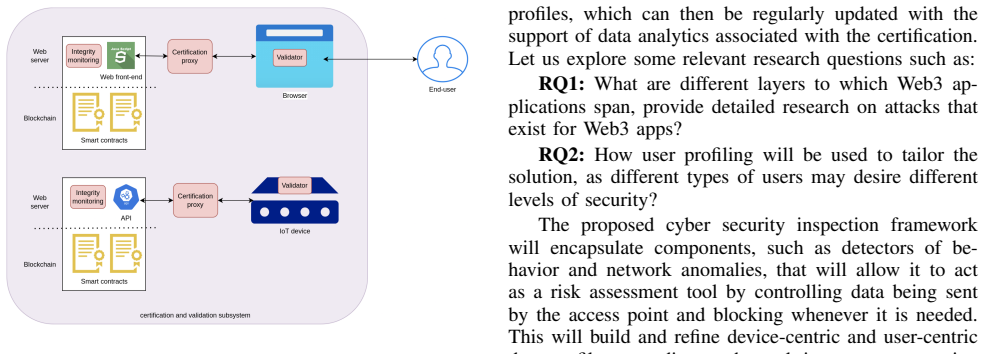
Web3 systems expose a fundamentally different security landscape from centralized platforms, characterized by composability, pseudonymous identities, decentralized governance, and rapidly evolving attack strategies that span social, application, and protocol layers. Existing security mechanisms, such as static smart contract analysis, blacklist-based phishing detection, and network-level mitigation, operate in isolation and assume fixed threat models, limiting their effectiveness against adaptive, cross-layer adversaries. This position paper argues that securing Web3 requires a shift from static, tool-centric defenses to learning-driven security primitives capable of continuous reasoning, adaptation, and actuation. We introduce AI-powered smart certificates as a new security abstraction: programmable, continuously updated trust artifacts that integrate on-chain verifiability with off-chain machine learning signals derived from user behavior, transaction dynamics, and social context. Unlike traditional certificates or audits, these certificates maintain state, learn under distribution shift, and support automated policy enforcement and revocation in response to evolving threats. We argue that existing paradigms, formal verification, threat modeling, and isolated anomaly detection, are structurally limited in capturing the non-stationary and socio-technical nature of Web3 attacks. We outline an architecture in which AI-powered smart certificates serve as cross-layer sentinels that coordinate heterogeneous security signals in real time, and position smart certificates as a research direction, raising questions around learning under partial observability, adversarial adaptation, and trustworthy ML deployment in decentralized systems.
Editorial analysis
A structured set of objections, weighed in public.
Referee Report
Summary. This position paper argues that Web3 systems require a shift from static security mechanisms (such as smart contract analysis, blacklist-based detection, and network-level mitigation) to learning-driven security primitives capable of continuous reasoning, adaptation, and actuation. It introduces AI-powered smart certificates as programmable, continuously updated trust artifacts integrating on-chain verifiability with off-chain ML signals from user behavior, transaction dynamics, and social context. The authors outline an architecture positioning these certificates as cross-layer sentinels and frame the work as raising open research questions on learning under partial observability, adversarial adaptation, and trustworthy ML deployment in decentralized systems.
Significance. If pursued, the proposed direction could advance the field by providing a unifying abstraction for adaptive, cross-layer security in decentralized applications that addresses the non-stationary and socio-technical nature of threats, which static paradigms struggle to capture. The paper's explicit framing as a research direction rather than a solved result, combined with its identification of structural limitations in existing approaches, may usefully stimulate work at the intersection of ML and blockchain security.
minor comments (2)
- [Abstract] Abstract: the description of the proposed architecture is high-level; adding a concrete (even schematic) example of how on-chain state and off-chain ML signals would interact for a specific threat scenario would improve clarity without altering the position-paper nature of the work.
- [Abstract] Abstract: the phrase 'learn under distribution shift' is used without elaboration on the specific learning setting (e.g., online, continual, or federated) or the partial-observability model assumed; a brief clarifying sentence would help readers assess the scope of the open questions raised.
Simulated Author's Rebuttal
We thank the referee for the positive assessment of our position paper, the recognition of its potential significance, and the recommendation for minor revision. The report does not list any specific major comments requiring response.
Circularity Check
No significant circularity
full rationale
The paper is a position piece proposing a research direction for AI-powered smart certificates in Web3 security. It contains no equations, derivations, fitted parameters, or load-bearing self-citations that reduce any claim to its own inputs by construction. All arguments are framed as open questions about non-stationary threats and learning under partial observability, with the central abstraction presented as a new conceptual primitive rather than a result derived from prior fitted quantities or author-specific uniqueness theorems. The text is self-contained as an advocacy document without any reduction steps.
Axiom & Free-Parameter Ledger
axioms (1)
- domain assumption Existing security mechanisms such as static smart contract analysis, blacklist-based phishing detection, and network-level mitigation operate in isolation and assume fixed threat models.
invented entities (1)
-
AI-powered smart certificates
no independent evidence
Reference graph
Works this paper leans on
-
[1]
CBInsights. 2023. State of Blockchain 2022 Report. https://www. cbinsights.com/research/report/blockchain-trends-2022/
work page 2023
-
[2]
Cryptocurrency market capitaliza- tions—Coinmarketcap
CoinMarketCap. 2019. “Cryptocurrency market capitaliza- tions—Coinmarketcap.” https://coinmarketcap.com/
work page 2019
-
[3]
Blockchain as a notarization service for data sharing with personal data store,
Chowdhury, M.J.M., Colman, A., Kabir, M.A., Han, J., Sarda, P. 2018. “Blockchain as a notarization service for data sharing with personal data store,” In: Trust-Com/BigDataSE IEEE, pp. 1330–1335
work page 2018
-
[4]
Berryhill, J. 2019. “New opsi guide to blockchain in the public sector—Observatory of public sector innovation ob- servatory of public sector innovation.” https://oecd-opsi.org/ new-opsi-guide-to-blockchain-in-the-public-sector
work page 2019
-
[5]
Maleh, Y ., Shojafar, M., Alazab M., and Romdhani, I. 2020. Blockchain for Cybersecurity and Privacy. First edition published by CRC Press
work page 2020
- [6]
-
[7]
Making smart contracts smarter,
Luu, L., Chu, D.H., Olickel, H., Saxena, P., Hobor, A. 2016. “Making smart contracts smarter,” In: Proceedings of the 2016 ACM SIGSAC Conference on Computer and Communications Security. CCS’16, pp. 254–269
work page 2016
-
[8]
A systematic literature review of blockchain cyber security,
Taylor, P.J., Dargahi, T., Dehghantanha, A., Parizi, R.M., Choo, K.K.R. 2019. “A systematic literature review of blockchain cyber security,” Digital Communications and Networks
work page 2019
-
[9]
Litecoin experiencing dust- ing attack
Omelchenko, D. 2019. “Litecoin experiencing dust- ing attack.” https://ihodl.com/topnews/2019-08-10/ litecoin-experiencing-dusting-attack
work page 2019
-
[10]
Chang, V ., Baudier, P., Zhang, H., Xu, Q., Zhang, J., and Arami, M. 2020. “How Blockchain can impact financial services–The overview, challenges and recommendations from expert intervie- wees,” Technol. Forecast. Soc. Change (158), 120166
work page 2020
-
[11]
Hameed, K., Barika, M., Garg, S., Amin, M.B., Kang, B. 2022. “A taxonomy study on securing Blockchain-based Industrial applica- tions: An overview, application perspectives, requirements, attacks, countermeasures, and open issues.”
work page 2022
-
[12]
Designing confidentiality- preserving blockchain-based transaction processing systems,
Wang, Y . and Kogan, A. 2018. “Designing confidentiality- preserving blockchain-based transaction processing systems,” Int. J. Account. Inf. Syst. (30), pp. 1–18
work page 2018
-
[13]
A secure versatile light payment system based on blockchain,
Zhong, L., Wu, Q, Xie, J., Li, J., and Qin, B. “A secure versatile light payment system based on blockchain,” Future Gener. Comput. Syst. (93), pp. 327–337
-
[14]
Behfar, S.K., ”Decentralized intelligence and bigdata analytics reciprocal relationship,” Proceeding of IEEE International Confer- ence on Blockchain Computing and Applications (BCCA Kuwait 2023)
work page 2023
-
[15]
Behfar, S.K., Th ´eodoloz, F., Schranz, C, and Hosseinpour, M., ”Blockchain-based data sharing platform customization with on/off-chain data balancing,” Proceeding of IEEE International Conference on Blockchain Computing and Applications (BCCA Kuwait 2023)
work page 2023
-
[16]
Su, L., Shen, X., Du, X., Liao, X., Wang, X., Xing, L., and Liu, B., ”Evil Under the Sun: Understanding and Discovering Attacks on Ethereum Decentralized Applications”, Published in USENIX Security Symposium 2021
work page 2021
-
[17]
Chen, J., Wang, Y ., Zhou. Y ., Ding, W., Tang, Y ., Wang, X., and Li, K., ”Understanding the Security Risks of Decentralized Exchanges by Uncovering Unfair Trades in the Wild”, IEEE European Sym- posium on Security and Privacy (EuroS&P) 2023
work page 2023
-
[18]
Dang, W.L. 2022. “Securing Web3”. https://www.unusual.vc/post/ securing-Web3
work page 2022
-
[19]
https://certificate.transparency.dev/ howctworks/
”Certificate Transparency”. https://certificate.transparency.dev/ howctworks/
discussion (0)
Sign in with ORCID, Apple, or X to comment. Anyone can read and Pith papers without signing in.