Joint Object Tracking and Intent Recognition
Pith reviewed 2026-05-25 08:15 UTC · model grok-4.3
The pith
A Bayesian framework augments target state with hidden intent and estimates both via particle filtering on virtual leader models.
A machine-rendered reading of the paper's core claim, the machinery that carries it, and where it could break.
Core claim
The paper claims that the posterior of an augmented state—kinematic variables plus latent intent—can be recursively estimated by embedding several intent models inside a virtual leader structure, applying suitable motion models for maneuvering targets, and running a Rao-Blackwellised sequential Monte Carlo sampler that treats the unknown intent as a dynamically evolving quantity that may take any value in the state space.
What carries the argument
Virtual leader formulation containing multiple latent intent models that encode the effect of the target's hidden goal on its instantaneous dynamics.
If this is right
- Intent can be inferred even when it changes during the observation window and can lie anywhere in the state space.
- The same sampler works with a range of motion models that cover highly maneuvering objects.
- Rao-Blackwellisation reduces variance in the kinematic-state estimates relative to a standard particle filter.
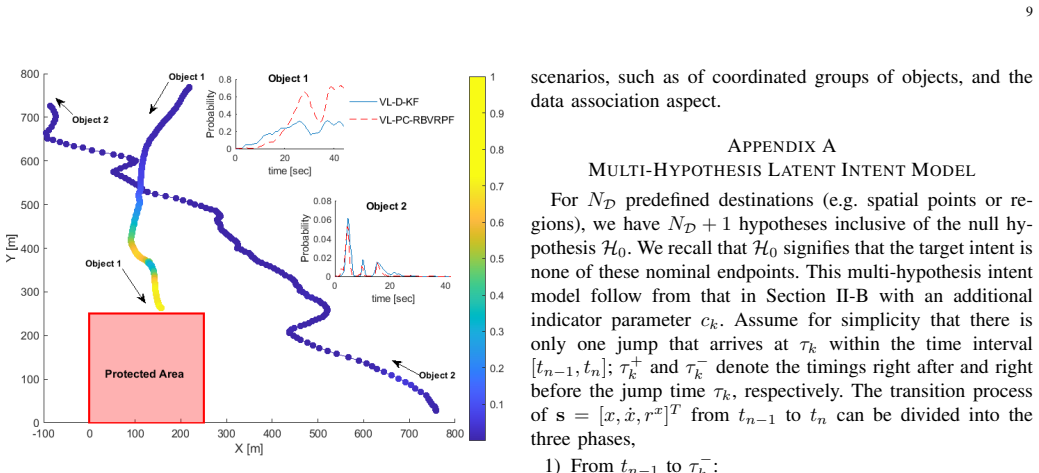
- The method produces usable results on both simulated data and recorded radar measurements.
Where Pith is reading between the lines
- Surveillance systems could use the inferred intent to trigger earlier alerts or resource allocation before a target reaches a sensitive area.
- The framework could be extended to multiple targets whose intents interact, provided the virtual-leader models are coupled.
- Real-time implementations would need to monitor particle degeneracy when intent switches rapidly.
Load-bearing premise
Latent intent models placed inside a virtual leader are adequate to represent how an unobserved goal shapes the target's current motion.
What would settle it
Run the filter on radar tracks whose final destination is known in advance and check whether the posterior mass on intent converges to the true destination region before the target arrives.
Figures


read the original abstract
This paper presents a Bayesian framework for inferring the posterior of the augmented state of a target, incorporating its underlying goal or intent, such as any intermediate waypoints and/or the final destination. Thus, it is for joint object tracking and intent recognition. Several latent intent models are proposed here within a virtual leader formulation. They capture the influence of the target's hidden goal on its instantaneous behaviour. In this context, various motion models, including for highly maneuvering objects, are also considered. The a priori unknown target intent (e.g. destination) can dynamically change over time and take any value within the state space (e.g. a location or spatial region). A sequential Monte Carlo (particle filtering) approach is introduced for the simultaneous estimation of the target's (kinematic) state and its intent. Rao-Blackwellisation is employed to enhance the statistical performance of the inference routine. Simulated data and real radar measurements are used to demonstrate the efficacy of the proposed techniques.
Editorial analysis
A structured set of objections, weighed in public.
Referee Report
Summary. The paper presents a Bayesian framework for joint object tracking and intent recognition. It augments the target state with a latent intent variable (waypoints or destination) modeled via several virtual-leader intent models that influence instantaneous motion. Various motion models (including for highly maneuvering targets) are considered. Inference uses sequential Monte Carlo (particle filtering) with Rao-Blackwellisation to estimate the joint posterior over kinematics and intent; the intent can change dynamically and take values anywhere in the state space. Efficacy is shown on simulated data and real radar measurements.
Significance. If the technical claims hold, the work supplies a direct, implementable extension of standard SMC methods to goal-aware tracking. The virtual-leader construction and Rao-Blackwellisation are standard tools applied to an augmented state; the main contribution is therefore the concrete formulation and the empirical demonstration on radar data rather than a new theoretical primitive. Reproducible code or machine-checked derivations are not mentioned.
minor comments (3)
- The abstract states that 'several latent intent models are proposed' but does not indicate how many models, their parametric forms, or the prior over model index; a dedicated subsection or table listing the models and their transition kernels would improve reproducibility.
- The description of Rao-Blackwellisation is brief; the paper should explicitly state which variables are marginalized analytically and which remain in the particle representation (e.g., § on inference algorithm).
- The real-radar experiment section should report the specific sensor characteristics, clutter model, and any preprocessing steps applied to the measurements.
Simulated Author's Rebuttal
We thank the referee for the constructive review and the recommendation of minor revision. The report provides a clear summary of the work but does not enumerate any specific major comments requiring point-by-point rebuttal. We therefore have no individual referee comments to address in the responses section below.
Circularity Check
No significant circularity detected
full rationale
The described framework is a direct application of existing sequential Monte Carlo and Rao-Blackwellised particle filtering techniques to an augmented state that includes a latent intent variable under virtual-leader motion models. No load-bearing step reduces by construction to a fitted parameter, self-definition, or self-citation chain; the derivation applies standard Bayesian inference tools to the joint tracking/intent problem without renaming known results or smuggling ansatzes via internal citations.
Axiom & Free-Parameter Ledger
axioms (1)
- domain assumption Latent intent models within a virtual leader formulation capture the influence of hidden goal on instantaneous behaviour.
invented entities (1)
-
Latent intent models in virtual leader formulation
no independent evidence
Reference graph
Works this paper leans on
-
[1]
Spatiotemporal trajectory models for metalevel target tracking,
M. Fanaswala and V . Krishnamurthy, “Spatiotemporal trajectory models for metalevel target tracking,” IEEE Aerospace and Electronic Systems Magazine, vol. 30, no. 1, pp. 16–31, 2015
work page 2015
-
[2]
Bayesian intent prediction in object tracking using bridging distributions,
B. I. Ahmad, J. K. Murphy, P. M. Langdon, and S. J. Godsill, “Bayesian intent prediction in object tracking using bridging distributions,” IEEE Transactions on Cybernetics , vol. 48, no. 1, pp. 215–227, 2018
work page 2018
-
[3]
E. d’Afflisio, P. Braca, and P. Willett, “Malicious AIS spoofing and abnormal stealth deviations: A comprehensive statistical framework for maritime anomaly detection,” IEEE Transactions on Aerospace and Electronic Systems, 2021
work page 2021
-
[4]
Detection of malicious intent in non-cooperative drone surveillance,
J. Liang, B. I. Ahmad, M. Jahangir, and S. Godsill, “Detection of malicious intent in non-cooperative drone surveillance,” in 2021 Sensor Signal Processing for Defence Conference (SSPD) , 2021
work page 2021
-
[5]
F. Carravetta and L. B. White, “Embedded stochastic syntactic processes: A class of stochastic grammars equivalent by embedding to a Markov process,” IEEE Transactions on Aerospace and Electronic Systems , vol. 57, no. 4, pp. 1996–2005, 2021
work page 1996
-
[6]
Sequential dynamic leadership inference using Bayesian Monte Carlo methods,
Q. Li, B. I. Ahmad, and S. J. Godsill, “Sequential dynamic leadership inference using Bayesian Monte Carlo methods,” IEEE Transactions on Aerospace and Electronic Systems , 2021
work page 2021
-
[7]
Joint stochastic prediction of vessel kinematics and destination based on a maritime traffic graph,
T. Tengesdal, L. M. Millefiori, P. Braca, and E. Brekke, “Joint stochastic prediction of vessel kinematics and destination based on a maritime traffic graph,” in2022 International Conference on Electrical, Computer, Communications and Mechatronics Engineering (ICECCME) . IEEE, 2022, pp. 1–8
work page 2022
-
[8]
R. W. Beard and T. W. McLain, Small unmanned aircraft: Theory and practice. Princeton university press, 2012
work page 2012
-
[9]
Stochastic linear hybrid systems: Modeling, estimation, and application in air traffic control,
C. E. Seah and I. Hwang, “Stochastic linear hybrid systems: Modeling, estimation, and application in air traffic control,” IEEE Transactions on Control Systems Technology, vol. 17, no. 3, pp. 563–575, 2009
work page 2009
-
[10]
Modeling vessel kinematics using a stochastic mean-reverting process for long-term prediction,
L. M. Millefiori, P. Braca, K. Bryan, and P. Willett, “Modeling vessel kinematics using a stochastic mean-reverting process for long-term prediction,” IEEE Transactions on Aerospace and Electronic Systems , vol. 52, no. 5, pp. 2313–2330, 2016
work page 2016
-
[11]
Conditionally Markov modeling and optimal estimation for trajectory with waypoints and destination,
R. Rezaie, X. R. Li, and V . P. Jilkov, “Conditionally Markov modeling and optimal estimation for trajectory with waypoints and destination,” IEEE Transactions on Aerospace and Electronic Systems, vol. 57, no. 4, pp. 2006–2020, 2021
work page 2006
-
[12]
Algorithms for the incorporation of predictive information in surveillance theory,
D. A. Castanon, B. C. Levy, and A. S. Willsky, “Algorithms for the incorporation of predictive information in surveillance theory,” Interna- tional Journal of Systems Science , vol. 16, no. 3, pp. 367–382, 1985
work page 1985
-
[13]
E. Baccarelli and R. Cusani, “Recursive filtering and smoothing for reciprocal Gaussian processes with Dirichlet boundary conditions,”IEEE Transactions on Signal Processing , vol. 46, no. 3, pp. 790–795, 1998
work page 1998
-
[14]
Modelling and estimation for finite state reciprocal processes,
F. Carravetta and L. B. White, “Modelling and estimation for finite state reciprocal processes,” IEEE Transactions on Automatic Control, vol. 57, no. 9, pp. 2190–2202, 2012
work page 2012
-
[15]
State space realisations and optimal smoothing for Gaussian generalised reciprocal processes,
L. B. White and F. Carravetta, “State space realisations and optimal smoothing for Gaussian generalised reciprocal processes,” IEEE Trans- actions on Automatic Control , 2020
work page 2020
-
[16]
M. Fanaswala and V . Krishnamurthy, “Detection of anomalous trajectory patterns in target tracking via stochastic context-free grammars and reciprocal process models,” IEEE Journal of Selected Topics in Signal Processing, vol. 7, no. 1, pp. 76–90, 2013
work page 2013
-
[17]
R. Rezaie and X. R. Li, “Gaussian conditionally Markov sequences: Dynamic models and representations of reciprocal and other classes,” IEEE Transactions on Signal Processing , vol. 68, pp. 155–169, 2019
work page 2019
-
[18]
V . Krishnamurthy and S. Gao, “Syntactic enhancement to vsimm for roadmap based anomalous trajectory detection: A natural language processing approach,” IEEE Transactions on Signal Processing, vol. 66, no. 20, pp. 5212–5227, Oct 2018
work page 2018
-
[19]
Target tracking problems subject to kinematic constraints,
M. Tahk and J. L. Speyer, “Target tracking problems subject to kinematic constraints,” IEEE transactions on automatic control , vol. 35, no. 3, pp. 324–326, 1990
work page 1990
-
[20]
On destination prediction based on Markov bridging distributions,
J. Liang, B. I. Ahmad, R. Gan, P. Langdon, R. Hardy, and S. Godsill, “On destination prediction based on Markov bridging distributions,” IEEE Signal Processing Letters , vol. 26, no. 11, pp. 1663–1667, Nov 2019. 11
work page 2019
-
[21]
State estima- tion with a destination constraint using pseudo-measurements,
G. Zhou, K. Li, X. Chen, L. Wu, and T. Kirubarajan, “State estima- tion with a destination constraint using pseudo-measurements,” Signal Processing, vol. 145, pp. 155–166, 2018
work page 2018
-
[22]
Constrained state estimation using noisy destination information,
G. Zhou, K. Li, and T. Kirubarajan, “Constrained state estimation using noisy destination information,” Signal Processing, vol. 166, p. 107226, 2020
work page 2020
-
[23]
Intent inference for hand pointing gesture-based interactions in vehicles,
B. I. Ahmad, J. K. Murphy, P. M. Langdon, S. J. Godsill, R. Hardy, and L. Skrypchuk, “Intent inference for hand pointing gesture-based interactions in vehicles,” IEEE Transactions on Cybernetics , vol. 46, no. 4, pp. 878–889, 2016
work page 2016
-
[24]
J. Liang, B. I. Ahmad, and S. Godsill, “Simultaneous intent prediction and state estimation using an intent-driven intrinsic coordinate model,” in 2020 IEEE 30th International Workshop on Machine Learning for Signal Processing (MLSP) , 2020, pp. 1–6
work page 2020
-
[25]
Modeling and state estimation of linear destination-constrained dynamic systems,
L. Xu, X. R. Li, Y . Liang, and Z. Duan, “Modeling and state estimation of linear destination-constrained dynamic systems,” IEEE Transactions on Signal Processing , 2022
work page 2022
-
[26]
R. P. S. Mahler, Statistical Multisource-Multitarget Information Fusion . USA: Artech House, Inc., 2007
work page 2007
-
[27]
Detection and tracking of coordinated groups,
S. K. Pang, J. Li, and S. J. Godsill, “Detection and tracking of coordinated groups,” IEEE Transactions on Aerospace and Electronic Systems, vol. 47, no. 1, pp. 472–502, January 2011
work page 2011
-
[28]
Group and extended object tracking,
D. J. Salmond and N. J. Gordon, “Group and extended object tracking,” in Signal and Data Processing of Small Targets 1999 , O. E. Drummond, Ed., vol. 3809, International Society for Optics and Photonics. SPIE, 1999, pp. 284 – 296. [Online]. Available: https://doi.org/10.1117/12.364028
-
[29]
A SMC sampler for joint tracking and destination estimation from noisy data,
L. Vladimirov and S. Maskell, “A SMC sampler for joint tracking and destination estimation from noisy data,” in2020 IEEE 23rd International Conference on Information Fusion (FUSION) , 2020, pp. 1–8
work page 2020
-
[30]
Intelligent interactive displays in vehicles with intent prediction: A Bayesian framework,
B. I. Ahmad, J. K. Murphy, S. Godsill, P. Langdon, and R. Hardy, “Intelligent interactive displays in vehicles with intent prediction: A Bayesian framework,” IEEE Signal Processing Magazine, vol. 34, no. 2, pp. 82–94, 2017
work page 2017
-
[31]
Bayesian intent prediction for fast maneuvering objects using variable rate particle filters,
R. Gan, J. Liang, B. Ahmad, and S. Godsill, “Bayesian intent prediction for fast maneuvering objects using variable rate particle filters,” in 2019 IEEE 29th International Workshop on Machine Learning for Signal Processing (MLSP), 2019
work page 2019
-
[32]
R. Gan, J. Liang, B. I. Ahmad, and S. Godsill, “Modeling intent and destination prediction within a Bayesian framework: Predictive touch as a usecase,” Data-Centric Engineering, vol. 1, p. e12, 2020
work page 2020
-
[33]
L ´evy state-space models for tracking and intent prediction of highly maneuverable objects,
R. Gan, B. I. Ahmad, and S. J. Godsill, “L ´evy state-space models for tracking and intent prediction of highly maneuverable objects,” IEEE Transactions on Aerospace and Electronic Systems, vol. 57, no. 4, 2021
work page 2021
-
[34]
Forecasting high- frequency futures returns using online Langevin dynamics,
H. L. Christensen, J. Murphy, and S. J. Godsill, “Forecasting high- frequency futures returns using online Langevin dynamics,” IEEE Jour- nal of Selected Topics in Signal Processing , vol. 6, no. 4, pp. 366–380, 2012
work page 2012
-
[35]
Models and algorithms for tracking of maneuvering objects using variable rate particle filters,
S. J. Godsill, J. Vermaak, W. Ng, and J. F. Li, “Models and algorithms for tracking of maneuvering objects using variable rate particle filters,” Proceedings of the IEEE , vol. 95, no. 5, pp. 925–952, 2007
work page 2007
-
[36]
Particle smoothing algorithms for variable rate models,
P. Bunch and S. Godsill, “Particle smoothing algorithms for variable rate models,” IEEE Transactions on Signal Processing , vol. 61, no. 7, pp. 1663–1675, 2013
work page 2013
-
[37]
Intent prediction of pedestrians via motion trajectories using stacked recurrent neural networks,
K. Saleh, M. Hossny, and S. Nahavandi, “Intent prediction of pedestrians via motion trajectories using stacked recurrent neural networks,” IEEE Transactions on Intelligent Vehicles, vol. 3, no. 4, pp. 414–424, 2018
work page 2018
-
[38]
Discriminatively learning inverse opti- mal control models for predicting human intentions,
S. Gaurav and B. D. Ziebart, “Discriminatively learning inverse opti- mal control models for predicting human intentions,” in International Conference on Autonomous Agents and Multiagent Systems , 2019
work page 2019
-
[39]
Multimodal interaction-aware motion prediction for autonomous street crossing,
N. Radwan, W. Burgard, and A. Valada, “Multimodal interaction-aware motion prediction for autonomous street crossing,” The International Journal of Robotics Research , vol. 39, no. 13, pp. 1567–1598, 2020
work page 2020
-
[40]
Human motion trajectory prediction: A survey,
A. Rudenko, L. Palmieri, M. Herman, K. M. Kitani, D. M. Gavrila, and K. O. Arras, “Human motion trajectory prediction: A survey,” The International Journal of Robotics Research, vol. 39, no. 8, pp. 895–935, 2020
work page 2020
-
[41]
Intention-aware motion modeling using GP priors with conditional kernels,
L. Xu, Z. Hou, M. Mallick, and Y . Fang, “Intention-aware motion modeling using GP priors with conditional kernels,” in 2022 25th International Conference on Information Fusion (FUSION) . IEEE, 2022, pp. 1–7
work page 2022
-
[42]
Øksendal, Stochastic differential equations: an introduction with applications
B. Øksendal, Stochastic differential equations: an introduction with applications. Springer-Verlag Berlin Heidelberg, 2003
work page 2003
-
[43]
S. S ¨arkk¨a and A. Solin, Applied Stochastic Differential Equations , ser. Institute of Mathematical Statistics Textbooks. Cambridge University Press, 2019
work page 2019
-
[44]
Piecewise-deterministic Markov processes: A general class of non-diffusion stochastic models,
M. H. A. Davis, “Piecewise-deterministic Markov processes: A general class of non-diffusion stochastic models,”Journal of the Royal Statistical Society. Series B (Methodological) , vol. 46, no. 3, pp. 353–388, 1984
work page 1984
-
[45]
Monte Carlo filtering of piecewise deterministic processes,
N. Whiteley, A. M. Johansen, and S. Godsill, “Monte Carlo filtering of piecewise deterministic processes,” Journal of Computational and Graphical Statistics, vol. 20, no. 1, pp. 119–139, 2011
work page 2011
-
[46]
Particle filters for continuous-time jump models in tracking applications,
S. Godsill, “Particle filters for continuous-time jump models in tracking applications,” in ESAIM: Proceedings, vol. 19. EDP Sciences, 2007, pp. 39–52
work page 2007
-
[47]
On sequential Monte Carlo sampling methods for Bayesian filtering,
A. Doucet, S. Godsill, and C. Andrieu, “On sequential Monte Carlo sampling methods for Bayesian filtering,” Statistics and computing , vol. 10, no. 3, pp. 197–208, 2000
work page 2000
-
[48]
Jacobsen, Point process theory and applications: marked point and piecewise deterministic processes
M. Jacobsen, Point process theory and applications: marked point and piecewise deterministic processes . Boston: Birkh ¨auser, MA, 2006
work page 2006
-
[49]
R. Chen and J. S. Liu, “Mixture kalman filters,” Journal of the Royal Statistical Society: Series B (Statistical Methodology) , vol. 62, no. 3, pp. 493–508, 2000
work page 2000
-
[50]
C. P. Robert and G. Casella, Monte Carlo statistical methods; 2nd ed. , ser. Springer texts in statistics. Berlin: Springer, 2005
work page 2005
-
[51]
Rao-blackwellised variable rate particle filters,
M. R. Morelande and N. Gordon, “Rao-blackwellised variable rate particle filters,” in 2009 12th International Conference on Information Fusion, 2009, pp. 1–8
work page 2009
-
[52]
Sequential Monte Carlo methods for dynamic systems,
J. S. Liu and R. Chen, “Sequential Monte Carlo methods for dynamic systems,” Journal of the American Statistical Association , vol. 93, no. 443, pp. 1032–1044, 1998
work page 1998
-
[53]
Marginalized particle filters for mixed linear/nonlinear state-space models,
T. Sch ¨on, F. Gustafsson, and P.-J. Nordlund, “Marginalized particle filters for mixed linear/nonlinear state-space models,”IEEE Transactions on Signal Processing , vol. 53, no. 7, pp. 2279–2289, 2005
work page 2005
-
[54]
Lookahead strategies for sequential Monte Carlo,
M. Lin, R. Chen, and J. S. Liu, “Lookahead strategies for sequential Monte Carlo,” Statistical Science, vol. 28, no. 1, pp. 69 – 94, 2013
work page 2013
-
[55]
B. Anderson and J. Moore, Optimal Filtering. Englewood Cliffs, NJ: Prentice-Hall, 1979
work page 1979
-
[56]
A. C. Harvey, Forecasting, structural time series models and the Kalman filter. Cambridge university press, 1990
work page 1990
-
[57]
Robust drone classification using two-stage decision trees and results from SESAR SAFIR trials,
M. Jahangir, B. I. Ahmad, and C. J. Baker, “Robust drone classification using two-stage decision trees and results from SESAR SAFIR trials,” in 2020 IEEE International Radar Conference (RADAR) . IEEE, 2020, pp. 636–641
work page 2020
-
[58]
J. Yun, D. Anderson, and F. Fioranelli, “Estimation of drone intention using trajectory frequency defined in radar’s measurement phase planes,” IET Radar, Sonar & Navigation , 2023
work page 2023
discussion (0)
Sign in with ORCID, Apple, or X to comment. Anyone can read and Pith papers without signing in.