Clothed particle representation in quantum field theory: Fermion mass renormalization due to vector boson exchange
Pith reviewed 2026-05-24 04:49 UTC · model grok-4.3
The pith
Unitary clothing transformations create a clothed particle representation that eliminates mass counterterms from the Hamiltonian in models with fermions and vector bosons.
A machine-rendered reading of the paper's core claim, the machinery that carries it, and where it could break.
Core claim
Within the clothed particle representation obtained via unitary clothing transformations, the second-order mass shifts due to vector boson exchange are derived as three-dimensional integrals whose integrands depend on covariant combinations of three-momenta. These results are particle-momentum independent and match those from Feynman techniques in both mesodynamics with nucleons and rho mesons and quantum electrodynamics with electrons and photons.
What carries the argument
Unitary clothing transformations that define the clothed particle representation, eliminating mass counterterms and ensuring cancellation of contact terms.
If this is right
- Mass counterterms are eliminated from the Hamiltonian and do not appear in the S-matrix.
- Contact terms cancel exactly in the models with vector bosons.
- The derived mass shifts are independent of the particle momentum.
- The results agree with those obtained using Feynman techniques.
Where Pith is reading between the lines
- This approach could be extended to higher-order calculations or other interaction types without introducing counterterms.
- The three-dimensional integral expressions may offer advantages for numerical computations in scattering or bound-state problems.
- The momentum independence suggests a more intrinsic definition of renormalized masses in the clothed basis.
Load-bearing premise
Unitary clothing transformations exist and can be applied to eliminate mass counterterms while making contact terms cancel exactly.
What would settle it
An explicit computation of the three-dimensional integrals that yields a momentum-dependent mass shift or a numerical mismatch with the corresponding Feynman diagram result.
Figures

read the original abstract
We consider the fermion mass renormalization due to the vector boson exchange within mesodynamics with nucleon and $\rho$ meson fields as well as quantum electrodynamics with electron and photon fields. The method of unitary clothing transformations is used to handle the so-called clothed particle representation that allows us to get rid of mass counterterms directly in the Hamiltonian. Thus, they can no longer appear in the S-matrix. Special attention is paid to the cancellation of the so-called contact terms that are inevitable in models with vector bosons. Within this formalism, the second-order mass shifts are derived. They are expressed through the corresponding three-dimensional integrals whose integrands depend on certain covariant combinations of the relevant three-momenta. Our results are proved to be particle-momentum independent and compared with ones obtained by Feynman techniques.
Editorial analysis
A structured set of objections, weighed in public.
Referee Report
Summary. The manuscript applies unitary clothing transformations to obtain the clothed particle representation in QFT, eliminating mass counterterms from the Hamiltonian for fermion mass renormalization due to vector boson exchange. It treats two models (nucleon-ρ mesodynamics and QED) and derives the second-order mass shifts as three-dimensional integrals over covariant combinations of three-momenta; these shifts are stated to be particle-momentum independent and are compared with results from standard Feynman techniques, with explicit attention to exact cancellation of contact terms.
Significance. If the derivations hold, the work supplies a Hamiltonian-based renormalization scheme that works directly with physical (clothed) particles and removes counterterms from the S-matrix by construction. The explicit reduction to momentum-independent integrals and the side-by-side comparison with Feynman results constitute a concrete strength, providing an external check on the second-order equivalence.
major comments (2)
- [Method / clothed-particle construction] The central claim rests on the construction of the unitary clothing operator such that mass counterterms are eliminated and contact terms cancel exactly (abstract, paragraph on method). The manuscript must exhibit the explicit form of this operator (or the algebraic conditions that guarantee cancellation) for the two models; without it the equivalence to the Feynman results cannot be verified independently.
- [Results on mass shifts] The proof that the three-dimensional integrals are independent of the external particle momentum is load-bearing for the claimed equivalence. The text should display the explicit integrands (or the symmetry argument that removes the momentum dependence) rather than merely asserting the result.
minor comments (1)
- [Results on mass shifts] The integrands are described as depending on 'certain covariant combinations of the relevant three-momenta'; writing these combinations explicitly (e.g., in terms of p·q, |p-q|, etc.) would improve reproducibility.
Simulated Author's Rebuttal
We thank the referee for the careful reading of the manuscript and the constructive comments. We respond to each major comment below.
read point-by-point responses
-
Referee: [Method / clothed-particle construction] The central claim rests on the construction of the unitary clothing operator such that mass counterterms are eliminated and contact terms cancel exactly (abstract, paragraph on method). The manuscript must exhibit the explicit form of this operator (or the algebraic conditions that guarantee cancellation) for the two models; without it the equivalence to the Feynman results cannot be verified independently.
Authors: We agree that the explicit form of the unitary clothing operator (or the defining algebraic conditions) is required for independent verification of the cancellation of mass counterterms and contact terms. In the revised manuscript we will supply the explicit operator expressions for both the nucleon-ρ and QED models together with the algebraic relations that guarantee the elimination of the counterterms from the clothed Hamiltonian. revision: yes
-
Referee: [Results on mass shifts] The proof that the three-dimensional integrals are independent of the external particle momentum is load-bearing for the claimed equivalence. The text should display the explicit integrands (or the symmetry argument that removes the momentum dependence) rather than merely asserting the result.
Authors: We accept that the demonstration of momentum independence must be made explicit. The revised text will present the explicit integrands for the second-order mass shifts in both models and will include the symmetry arguments showing that the integrands depend only on covariant combinations of three-momenta, thereby establishing independence from the external four-momentum. This addition will also strengthen the side-by-side comparison with the Feynman-technique results. revision: yes
Circularity Check
No significant circularity; derivation grounded by explicit comparison to Feynman results
full rationale
The paper derives second-order mass shifts via unitary clothing transformations, eliminates mass counterterms, cancels contact terms, and proves the resulting three-dimensional integrals are particle-momentum independent. These results are then directly compared to independent calculations obtained by standard Feynman techniques, providing external grounding. No load-bearing step reduces to a fitted parameter, self-definition, or self-citation chain; the central claims remain self-contained against the external benchmark. The method of clothing transformations is presented as a tool applied to the models, not as an ansatz whose validity is justified solely by prior self-work.
Axiom & Free-Parameter Ledger
Reference graph
Works this paper leans on
-
[1]
it can be written as K(α c) = HF +Mren +Vren +V (2) + 1 2 [R(1),V (1)] + [R(1),M ren] + 1 3 [R(1), [R(1),V (1)]] +... =HF (α c) +KI(α c). (15) Keeping in the r.h.s. of ( 15) only the contributions of the second order in coupling constants we get KI (α c) ≈ K (2) I (α c) = M (2) ren +V (2) + 1 2 [ R(1),V (1)] . (16) In other words, we neglect terms respons...
-
[2]
with contribution from Eq. ( 34)). After it the electron mass shift due to the one-photon exchange can be written as δm(2) ≡ δm(1ph-exc) e− (p) = e2 8(2π )3 ∫ dq Eqω p− q ¯u(pµ )γα × { q /+m Ep − ω p− q − Eq + q /− − m Ep +ω p− q +Eq } γ αu(pµ ) = e2 m(2π )3 ∫ dq 2Eqω p− q { 2m2 − pq Ep − ω p− q − Eq − 2m2 +pq− Ep +ω p− q +Eq } . (37) The last expression ...
-
[3]
and ( 33), i.e., I1, 2(p) = I1, 2(Λp). The latter simplifies the further calculations I1, 2(p) = I1, 2(m, 0, 0, 0) ∀p, reducing integrals ( 41), (42) to quadra- tures: I ′ 1(p) = I ′ 1(m, 0, 0, 0) =m e2 (2π )2 lim λ → 0 ∞∫ 0 dt t2 √ t2 + 1 2 − √ t2 + 1 1 − 1 2λ − √ t2 + 1 , (44) I ′ 2(p) = I ′ 2(m, 0, 0, 0) =m e2 (2π )2 lim λ → 0 ∞∫ 0 dt t2 √ t2 +λ 1 − √ t...
-
[4]
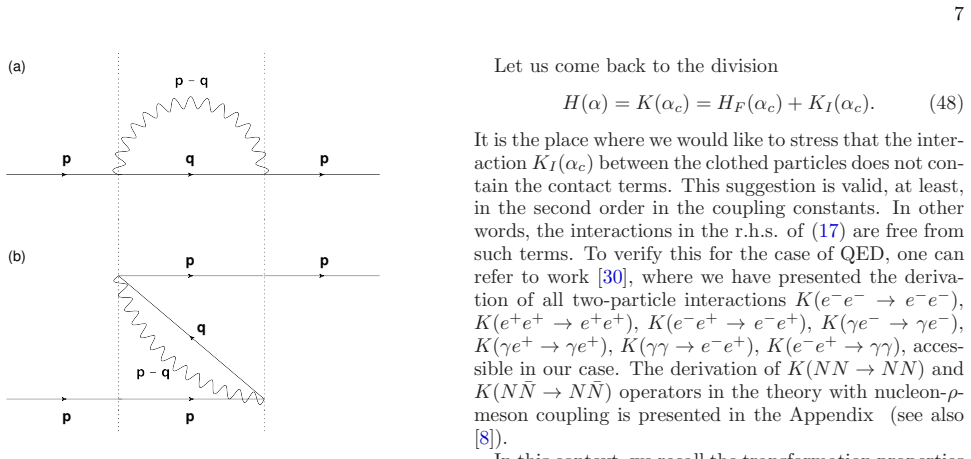
and (33) become equal, respectively, to ( 41) and ( 42) if we put g =e, f = 0, and mb =λ. Separate contributions in the curly brackets of ( 37) can be represented via the graphs (a) and (b) in Fig. 1. Such graphs are typical of the old-fashioned perturbation theory. In this context, the inverse energy denominators in the r.h.s. of Eq. (
-
[5]
have the form D− 1(E) = (E − Ei)− 1 with the appropriate values of the collision energy E and energy of all permissible intermediate states Ei. In other words, (Ep − ω p− q− Eq)− 1 and (Ep +ω p− q+Eq)− 1 are related to the propagators D− 1(E =Ep) = (E − ω p− q − Eq)− 1 and D− 1(E =Ep) = (E − Ep − ω p− q − Eq − Ep)− 1, (46) being associated with the two an...
-
[6]
are free from such terms. To verify this for the case of QED, one can refer to work [ 30], where we have presented the deriva- tion of all two-particle interactions K(e−e− → e−e− ), K(e+e+ → e+e+), K(e−e+ → e−e+), K(γe − → γe − ), K(γe + → γe +), K(γγ → e−e+), K(e−e+ → γγ ), acces- sible in our case. The derivation of K(NN → NN ) and K(N ¯N → N ¯N ) opera...
-
[7]
of the HI density to be the Lorentz scalar fulfills even in the BPR. But in the mod- els with vector bosons the operator HI (x) embodies the terms (V (2)(x) or VCoul(x)) that are not Lorentz scalars. These noncovariant contributions no longer present in the Hamiltonian. It is a distinctive feature of the CPR. Therefore, we choose the interaction K (2) I as...
-
[8]
Along the guide- line we replace the interaction Hamiltonian in the CPR (
we replace the structures ¯u(p1µ 1)Γu(p2µ 2), ¯u(p1µ 1)Γυ(p2µ 2), ¯υ(p1µ 1)Γu(p2µ 2), ¯υ(p1µ 1)Γυ(p2µ 2) (51) (Γ is some combination of the gamma matrices) with ones multiplied by the cutoff factors g11(p1,p 2), g12(p1,p 2), g21(p1,p 2), andg22(p1,p 2), respectively. Along the guide- line we replace the interaction Hamiltonian in the CPR (
-
[9]
by K nloc (2) I =K nloc(ff → ff ) +K nloc( ¯f ¯f → ¯f ¯f ) +K nloc(f ¯f → f ¯f ) +K nloc(bf → bf ) + · · · +K nloc (2) 1-body +M nloc (2) ren . (52) In order to fulfill the property ( 49) it is required (see details in the Appendix ) gε′ε(Λp1, Λp2) = gε′ε(p1,p 2) ( ε′,ε = 1, 2), (53) 8 i.e., these cutoff factors should be dependent on the Lorentz scalar p1p...
-
[10]
Here the coefficients mε′ε(p) may be momentum depen- dent
in the local field model we consider its nonlocal extension M nloc (2) ferm =m ∫ dp E2p F †(pµ 1)M nloc(pµ 1µ 2)F (pµ 2), (55) where one has to handle the matrix M nloc(pµ 1µ 2) = [ m(2) 11 (p)δµ 1µ 2 m(2) 12 (p)¯u(pµ 1)υ(p−µ 2) m(2) 21 (p)¯υ(p−µ 1)u(pµ 2) −m(2) 22 (p)δµ 1µ 2 ] . Here the coefficients mε′ε(p) may be momentum depen- dent. Of course, for simpl...
-
[11]
is to take on finite values. This prop- erty leads to the total cancellation of the finite terms K (2) 1-body b† b and M (2) ren b† b in the Hamiltonian ( 52). At the point one should realize that within our approach, the one-particle operators cannot appear in the new form K(α c) of the Hamiltonian. One should stress that the integral (
-
[12]
In other words, the two last terms in the decomposition ( 52) are cancelled
with properly selected cutoffs g11 , g21 takes on finite values for non- zero λ in ω p− q = √ λ 2 + (p − q)2. In other words, the two last terms in the decomposition ( 52) are cancelled. Thus, the pleasant feature of the CPR with λ ̸= 0 takes place as before. Otherwise, we will encounter the infrared singularity. Indeed, the parameter λ introduced in Eq. (
-
[13]
has to be put zero at the end of calculations, viz., when evaluat- ing some observables or matrix elements ⟨f |S|i⟩. But in the theory developed here quantities like m(2) 11 (p) orδm(2) are not considered as some corrections to the badly de- fined bare mass m0. Instead, they are introduced as free parameters that should be chosen to cancel the terms in H t...
-
[14]
bad” terms (at least, up to any given order in the cou- pling constants). Simultaneously, the
to be valid. So, the cancellation 1 Of course, in general, each coefficient m(2) ε′ε(p) is defined with an accuracy to adding a function fε′ε(p) such that∫ fε′ε(p)dp/E2 p = 0. 9 of the one-body terms happens in the Hamiltonian itself. Therefore, we do not encounter infrared singularities con- sidering the problem of fermion mass renormalization. There are no...
-
[15]
and ( 40), rely- ing upon the Dyson-Feynman series for the S operator, viz., S(α ) = 1 + SI +SII + · · ·= ∞∑ n=0 (−i)n n! × ∞∫ −∞ dt1 · · · ∞∫ −∞ dtnP [HI (t1) · · ·HI (tn)], (59) where HI (t) = eiHF tHIe− iHF t is an interaction in the D-picture. Unlike the superscripts in S(n) the Roman indices in SI , SII , etc., denote the order of their ap- pearance ...
-
[16]
only terms of the type b†b, a†a, and a†b†ab contribute to the matrix ele- ments ⟨f |S(2)(α c)|i⟩ = ⟨f | { − i ∫ ∞ −∞ dte iKF t( M (2) ren +V (2)) e− iKF t +S(2) SE +S(2)(bf → bf ) } |i⟩, (63) where S(2) SE = − 1 2 ∞∫ −∞ dt1 ∞∫ −∞ dt2P [V (1)(t1)V (1)(t2)]one-body =S(2) fSE +S(2) bSE (64) determines the so-called self-energy operator and S(2)(bf → bf ) ari...
-
[17]
corre- sponds to the self-energy Feynman diagram Fig. 2. Now by integrating over q0 in the r.h.s. of Eqs. ( 70)-(71) and taking into account the contributions from the simple poles Eq − iǫ and Ep +ω p− q − iǫ, we get δm(1ρ-exc) N = 1 m(2π )3 ∫ dq Eq 1 (p − q)2 − m2 b { g2(2m2 − pq) + 3gf (m2 − pq) + f 2 4m2 (m2 − pq)(5m2 − pq) } + 1 2m(2π )3 ∫ dk ω k 1 (p...
-
[18]
Rather than computing S matrix elements between usual states of the Fock space
(76) We see that the Dyson-Feynman formalism gives the same expressions for the mass shifts ( 31)-(33) and ( 40)- (42). So we have found another proof of the momentum independence of the integrals ( 32)-(33) and ( 41)-(42). But note that if we used the BPR and considered the ma- trix element ⟨a† · · ·Ω 0|S(α )|a† · · ·Ω 0⟩, we would arrive to the results ...
-
[19]
We have focused on deriving the mass shift in the sec- ond order in the coupling constants
(QED). We have focused on deriving the mass shift in the sec- ond order in the coupling constants. But in general, the total mass shift is given by the series δm = δm(2) + δm(4) + · · ·. To evaluate the subsequent contributions to it one needs to find the contributions from the more complicated commutators in the Campbell–Hausdorff ex- pansion that has been...
-
[20]
and ( 76) for the one-loop Feynman integrals that can be depicted by the fermion self-energy diagram. In this context, one of us (A.S.) re- minds of the comment by Walter Gl¨ ockle given during his visit to the Institut f¨ ur Theoretische Physik, Ruhr- Universit¨ at Bochum: “Alex, our proof of the momentum independence of the nucleon mass shift (cf., inte...
-
[21]
in the CPR we have an equivalent expansion S = ∞∑ n=0 (−i)n n! ∫ d4x1 · · · ∫ d4xnP [KI(x1) · · ·KI (xn)] (A.18) where KI(x) = eiKF tKI(x)e− iKF t is an interaction den- sity in the D-picture. In our case the corresponding den- sity can be written as KN N(x) = − m2 2(2π )6 ∫ d1′d2′d1d2e− ix·(p′ 1+p′ 2− p1− p2) × :N †(1, 1′)X(1′, 2′, 1, 2)N (2′, 2) : (A.19...
-
[22]
and ( A.7)). Thus, only explicitly co- variant terms will enter the S operator, that ensures UF (Λ)SU − 1 F (Λ) = S and the property ( 49). At last, in the case of the nonlocal interaction K nloc N N , the latter property requires gε′ε(Λp1, Λp2) = gε′ε(p1,p 2)
-
[23]
O. Greenberg and S. Schweber, Clothed particle op- erators in simple models of quantum field theory, Nuovo Cim. 8, 378 (1958)
work page 1958
- [24]
-
[25]
A. Shebeko and M. I. Shirokov, Relativistic quantum field theory (RQFT) treatment of few-body systems, Nucl. Phys. A 631, 564 (1998)
work page 1998
-
[26]
A. Shebeko and M. Shirokov, Clothing proce- dure in relativistic quantum field theory and its applications to description of electromag- netic interactions with nuclei (bound systems), Progr. Part. Nucl. Phys. 44, 75 (2000)
work page 2000
-
[27]
Unitary Transformations in Quantum Field Theory and Bound States
A. Shebeko and M. Shirokov, Unitary transformations in quantum field theory and bound states, Phys. Part. Nucl. 32, 15 (2001), arXiv:nucl-th/0102037
work page internal anchor Pith review Pith/arXiv arXiv 2001
-
[28]
V. Korda and A. Shebeko, Clothed particles represen- tation in quantum field theory: mass renormalization, Phys. Rev. D 70, 085011 (2004)
work page 2004
- [29]
-
[30]
I. Dubovyk and A. Shebeko, The method of unitary clothing transformations in the theory of nucleon-nucleon scattering, Few-Body Syst. 48, 109 (2010)
work page 2010
-
[31]
A. Shebeko and P. Frolov, A possible way for constructing generators of the Poincar´ e group in quantum field theory, Few-Body Syst. 52, 125 (2012)
work page 2012
-
[32]
Shebeko, Clothed particles in quantum elec- trodynamics and quantum chromodynamics, EPJ Web Conf
A. Shebeko, Clothed particles in quantum elec- trodynamics and quantum chromodynamics, EPJ Web Conf. 113, 03014 (2016)
work page 2016
-
[33]
Y. Kostylenko, A. Arslanaliev, and A. Shebeko, QED in the clothed-particle representation: a fresh look at positronium properties treatment, SciPost Phys. Proc. 3, 45 (2020)
work page 2020
-
[34]
A. Arslanaliev, P. Frolov, and J. Golak et al. , Possible extension of the three-body force by the unitary cloth- ing transformations method in the faddeev equations, Few-Body Systems 62, 71 (2021)
work page 2021
-
[35]
A. Arslanaliev, Y. Kostylenko, and A. Shebeko, in Quan- tum Field Theory and Applications , edited by N. Palerma (Nova Science Publishers, 2022) Chap. 1
work page 2022
-
[36]
Stefanovich, Quantum field theory without infinities, Ann
E. Stefanovich, Quantum field theory without infinities, Ann. Phys. 292, 139 (2001)
work page 2001
-
[37]
Weinberg, The Quantum Theory of Fields , Vol
S. Weinberg, The Quantum Theory of Fields , Vol. 1 (Cambridge University Press, 1995)
work page 1995
-
[38]
Schweber, An Introduction to Relativistic Quantum Field Theory (Row, Peterson & Co., New York, 1961)
S. Schweber, An Introduction to Relativistic Quantum Field Theory (Row, Peterson & Co., New York, 1961)
work page 1961
-
[39]
S. D. G/suppress lazek and K. G. Wilson, Renormalization of hamiltonians, Phys. Rev. D 48, 5863 (1993) . 16
work page 1993
-
[40]
Wegner, Flow-equations for hamiltonians, Ann
F. Wegner, Flow-equations for hamiltonians, Ann. Phys. 506, 77 (1994)
work page 1994
-
[41]
S. D. G/suppress lazek, Renormalization group procedure for effec- tive particles: Elementary example of an exact solution with finite mass corrections and no involvement of vac- uum, Phys. Rev. D 85, 125018 (2012)
work page 2012
-
[42]
S. D. G/suppress lazek, Fermion mass mixing and vacuum trivial- ity in the renormalization group procedure for effective particles, Phys. Rev. D 87, 125032 (2013)
work page 2013
-
[43]
E. Anderson, S. Bogner, R. Furnstahl, and R. Perry, Op- erator evolution via the similarity renormalization group : The deuteron, Phys. Rev. C 82, 054001 (2010)
work page 2010
-
[44]
A. Kr¨ uger and W. Gl¨ ockle, One-nucleon effective gener- ators of the Poincar´ e group derived from a field theory: Mass renormalization, Phys. Rev. C 60, 024004 (1999)
work page 1999
- [45]
-
[46]
Okubo, Diagonalization of Hamiltonian and Tamm- Dancoff equation, Prog
S. Okubo, Diagonalization of Hamiltonian and Tamm- Dancoff equation, Prog. Theor. Phys 12, 603 (1954)
work page 1954
-
[47]
E. Dubovyk and A. Shebeko, Low-energy parameters of the nucleon-nucleon scattering and deuteron proper- ties, electromagnetic interactions with bound systems, Few Body Syst. 54, 1513 (2013)
work page 2013
-
[48]
A. Shebeko, The method of unitary clothing transformations in relativistic quantum field the- ory: recent applications for the description of nucleon-nucleon scattering and deuteron properties, Few Body Syst. 54, 2271 (2013)
work page 2013
- [49]
-
[50]
A. Shebeko, Clothed particles in mesodynamics, quantum electrodynamics and other field models, PoS Baldin ISHEPP XXII 225, 027 (2015)
work page 2015
-
[51]
A. Arslanaliev, Y. Kostylenko, and A. She- beko, QED in the clothed-particle represen- tation, Recent Progress in Few-Body Physics , Springer Proc. in Phys. 238, 41 (2020)
work page 2020
-
[52]
A. Arslanaliev, Y. Kostylenko, and O. Shebeko, A new family of interactions between clothed particles in QED, Ukrainian Journal of Physics 66, 833 (2021)
work page 2021
-
[53]
M. Goldberger and K. Watson, Collision theory (John Wiley & Sons, Inc., New York, London, Sydney, 1967) p. 93
work page 1967
-
[54]
Y. R. Kwon and F. Tabakin, Hadronic atoms in momen- tum space, Phys. Rev. C 18, 932 (1978)
work page 1978
- [55]
-
[56]
Shebeko, The S-matrix in the method of unitary cloth- ing transformations, Nucl
A. Shebeko, The S-matrix in the method of unitary cloth- ing transformations, Nucl. Phys. A 737, 252 (2004)
work page 2004
-
[57]
D. A. Forde and A. Signer, Infrared-finite amplitudes for massless gauge theories, Nucl. Phys. B 684, 125 (2004)
work page 2004
-
[58]
S. Catani and M. Ciafaloni, Generalized coherent state for soft gluon emission, Nucl. Phys. B 249, 301 (1985)
work page 1985
discussion (0)
Sign in with ORCID, Apple, or X to comment. Anyone can read and Pith papers without signing in.