Closing the Loop: PID Feedback Control for Interpretable Activation Steering in Symbolic Music Generation
Pith reviewed 2026-06-26 19:50 UTC · model grok-4.3
The pith
Gram-Schmidt orthogonalization enables independent pitch and duration control via activation steering in music transformers
A machine-rendered reading of the paper's core claim, the machinery that carries it, and where it could break.
Core claim
Difference-in-means isolates usable directions for pitch and duration in the residual stream, validating the linear representation hypothesis. Gram-Schmidt orthogonalization in the dual steering framework then decouples these directions, which reduces conceptual interference and signal degradation relative to naive addition and permits independent deterministic control despite autoregressive conditioning.
What carries the argument
Dual Steering framework with Gram-Schmidt Orthogonalization, which geometrically decouples entangled steering vectors for different musical attributes.
Load-bearing premise
The Linear Representation Hypothesis holds in the MMT residual stream, allowing Difference-in-Means to isolate usable latent directions for Pitch and Duration.
What would settle it
Measuring the change in unintended attributes when steering an orthogonalized vector; if the interference remains as high as with naive addition, the benefit of the geometric decoupling would not hold.
Figures
read the original abstract
Transformer-based architectures have significantly advanced the generation of complex symbolic sequences, yet a significant gap remains in achieving fine-grained, interpretable control over discrete signal attributes. This paper investigates the mechanistic interpretability of the Multitrack Music Transformer (MMT) and proposes a framework for deterministic attribute modulation without retraining to bridge this gap via inference-time activation steering. Utilizing the Difference-in-Means (DiffMean) methodology, we isolate latent directions for signal attributes, specifically Pitch and Duration, within the residual stream. We validate the Linear Representation Hypothesis in this domain, achieving high correlation between steering magnitude and attribute shift. To address the inherent feature entanglement in multi-attribute steering, we introduce a Dual Steering framework utilizing Gram-Schmidt Orthogonalization. Experimental results demonstrate that this geometric decoupling reduces conceptual interference and signal degradation compared to naive vector addition, enabling independent deterministic control even against strong autoregressive conditioning.
Editorial analysis
A structured set of objections, weighed in public.
Referee Report
Summary. The manuscript investigates mechanistic interpretability of the Multitrack Music Transformer (MMT) for symbolic music generation. It applies Difference-in-Means to isolate latent directions for attributes such as Pitch and Duration in the residual stream, validates the Linear Representation Hypothesis via reported high correlation between steering magnitude and attribute shift, and introduces a Dual Steering framework with Gram-Schmidt orthogonalization to decouple entangled features. The approach claims to reduce conceptual interference and signal degradation relative to naive vector addition, enabling independent deterministic control under autoregressive conditioning; the title indicates incorporation of PID feedback control to achieve closed-loop modulation.
Significance. If the empirical claims hold with adequate validation, the work would demonstrate a training-free geometric method for fine-grained, interpretable attribute control in music transformers, extending activation steering techniques to a new domain while addressing multi-attribute entanglement.
major comments (2)
- [Abstract] Abstract: the central claims of 'high correlation between steering magnitude and attribute shift' and 'reduces conceptual interference and signal degradation compared to naive vector addition' are asserted without any quantitative metrics, error bars, dataset sizes, ablation results, or statistical tests, preventing assessment of whether the evidence supports the claims of usability and superiority.
- [Title, Abstract] Title vs. Abstract: the title highlights 'PID Feedback Control' as central to 'Closing the Loop,' yet the abstract describes only DiffMean extraction and Gram-Schmidt orthogonalization with no reference to PID, feedback, or closed-loop adjustment; this leaves unclear how (or whether) PID is used to modulate steering strength for deterministic targets.
minor comments (2)
- Provide explicit dataset details, model layer(s) used for direction extraction, and the precise definition of the correlation metric in the methods section.
- Clarify whether the orthogonalization is performed once or per generation step, and how the PID controller interfaces with the steering vectors (if present in the full text).
Simulated Author's Rebuttal
We thank the referee for the detailed and constructive report. We address each major comment below and will revise the manuscript to improve clarity and completeness.
read point-by-point responses
-
Referee: [Abstract] Abstract: the central claims of 'high correlation between steering magnitude and attribute shift' and 'reduces conceptual interference and signal degradation compared to naive vector addition' are asserted without any quantitative metrics, error bars, dataset sizes, ablation results, or statistical tests, preventing assessment of whether the evidence supports the claims of usability and superiority.
Authors: We acknowledge that the abstract states these claims at a high level without supporting numbers. The body of the manuscript reports the relevant quantitative results (Pearson correlations between steering magnitude and attribute shift, ablation comparisons of interference metrics, and dataset details). To address the concern, we will revise the abstract to include the key quantitative findings and dataset sizes so that the strength of evidence is evident from the abstract alone. revision: yes
-
Referee: [Title, Abstract] Title vs. Abstract: the title highlights 'PID Feedback Control' as central to 'Closing the Loop,' yet the abstract describes only DiffMean extraction and Gram-Schmidt orthogonalization with no reference to PID, feedback, or closed-loop adjustment; this leaves unclear how (or whether) PID is used to modulate steering strength for deterministic targets.
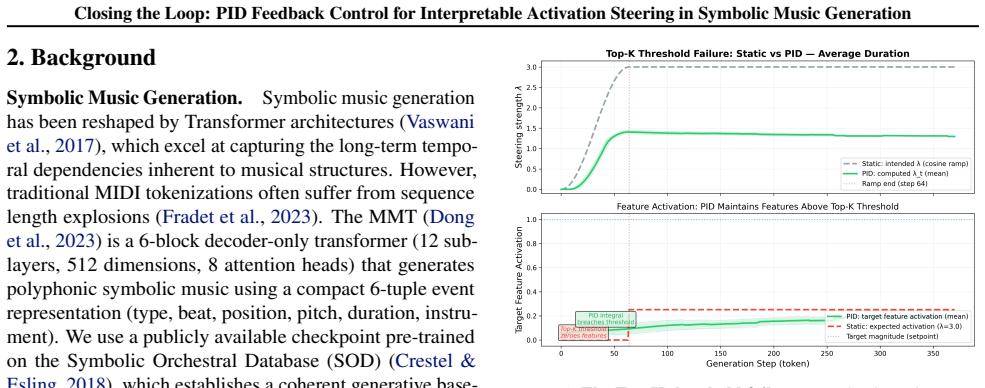
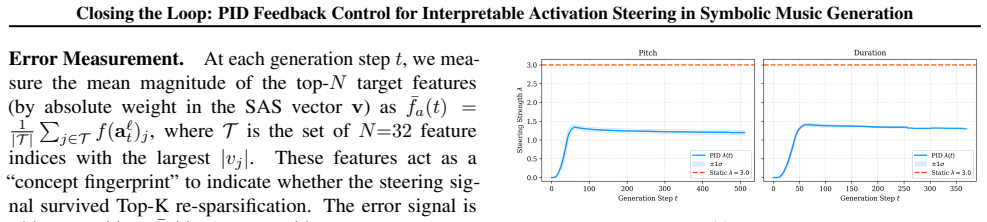
Authors: The referee correctly identifies an inconsistency. The title foregrounds the PID component, yet the current abstract omits any mention of it. The manuscript does employ PID feedback to close the loop: the proportional-integral-derivative controller continuously adjusts the steering coefficient based on the error between the observed attribute value and the user-specified target, enabling deterministic control under autoregressive generation. We will revise the abstract to explicitly note the use of PID feedback for closed-loop modulation of steering strength. revision: yes
Circularity Check
No significant circularity
full rationale
The described pipeline applies the standard Difference-in-Means procedure to extract directions under the Linear Representation Hypothesis, followed by Gram-Schmidt orthogonalization for decoupling. Both are pre-existing techniques from the mechanistic interpretability literature and are not derived from or fitted to the paper's own target results. Validation proceeds via direct empirical measurement of correlation between steering magnitude and observed attribute shift, which constitutes an independent test rather than a definitional identity. No self-citations, uniqueness theorems, or ansatzes imported from prior author work are invoked as load-bearing premises in the supplied text. The derivation chain therefore remains self-contained against external methodological benchmarks.
Axiom & Free-Parameter Ledger
axioms (1)
- domain assumption Linear Representation Hypothesis holds for Pitch and Duration attributes in the MMT residual stream
Reference graph
Works this paper leans on
-
[1]
Proceedings of the International Conference on Learning Representations (
Activation Steering with a Feedback Controller , author=. Proceedings of the International Conference on Learning Representations (
-
[2]
Proceedings of the
Multitrack Music Transformer , author=. Proceedings of the
-
[3]
Advances in Neural Information Processing Systems , year=
Activation Addition: Steering Language Models Without Optimization , author=. Advances in Neural Information Processing Systems , year=
-
[4]
Steering
Rimsky, Nina and Gabrieli, Nick and Schulz, Julian and Smith, Meg and Tong, Isabella and Hubinger, Evan , journal=. Steering
-
[5]
arXiv preprint arXiv:2406.11717 , year=
Refusal in Language Models Is Mediated by a Single Direction , author=. arXiv preprint arXiv:2406.11717 , year=
-
[6]
Proceedings of the International Conference on Learning Representations (
Mean Activation Transport for Activation Steering , author=. Proceedings of the International Conference on Learning Representations (
-
[7]
arXiv preprint arXiv:2501.15148 , year=
Sparse Autoencoders for Scalable Concept Steering in Large Language Models , author=. arXiv preprint arXiv:2501.15148 , year=
-
[8]
Transformer Circuits Thread , year=
Towards Monosemanticity: Decomposing Language Models With Dictionary Learning , author=. Transformer Circuits Thread , year=
-
[9]
arXiv preprint arXiv:2309.08600 , year=
Sparse Autoencoders Find Highly Interpretable Features in Language Models , author=. arXiv preprint arXiv:2309.08600 , year=
-
[10]
Transformer Circuits Thread , year=
Toy Models of Superposition , author=. Transformer Circuits Thread , year=
-
[11]
arXiv preprint arXiv:2311.03658 , year=
The Linear Representation Hypothesis and the Geometry of Large Language Models , author=. arXiv preprint arXiv:2311.03658 , year=
-
[12]
Scaling Monosemanticity: Extracting Interpretable Features from
Templeton, Adly and Conerly, Tom and Marcus, Jonathan and Lindsey, Jack and Bricken, Trenton and Chen, Brian and Pearce, Adam and Citro, Craig and Ameisen, Emmanuel and Jones, Andy and others , journal=. Scaling Monosemanticity: Extracting Interpretable Features from
-
[13]
Advances in Neural Information Processing Systems , year=
Inference-Time Intervention: Eliciting Truthful Answers from a Language Model , author=. Advances in Neural Information Processing Systems , year=
-
[14]
Proceedings of the International Society for Music Information Retrieval Conference (
A Database for Orchestration Research and Its Use for Timbre Interpolation , author=. Proceedings of the International Society for Music Information Retrieval Conference (
-
[15]
Dong, Hao-Wen and Chen, Ke and McAuley, Julian and Berg-Kirkpatrick, Taylor , booktitle=
-
[16]
Activation Patching for Controllable Generation in
Facchiano, Filippo and others , journal=. Activation Patching for Controllable Generation in
-
[17]
arXiv preprint , year=
Steering Music Generation with Activation Engineering , author=. arXiv preprint , year=
-
[18]
Wu, Yinghao Aaron and others , journal=. Fr\'
-
[19]
Wu, Shangda and others , booktitle=
-
[20]
Fradet, Nathan and Briot, Jean-Pierre and Chhel, Fabien and El Fallah Seghrouchni, Amal and Music, Sony Computer Science Laboratories , journal=
-
[21]
arXiv preprint arXiv:2510.13285 , year=
In-Distribution Steering: Balancing Control and Coherence in Language Model Generation , author=. arXiv preprint arXiv:2510.13285 , year=
-
[22]
Enhancing Instruction Following of
Kang, Minjae and Kim, Jaehyung , booktitle=. Enhancing Instruction Following of
-
[23]
arXiv preprint arXiv:2602.01654 , year=
Steering Vector Fields for Context-Aware Inference-Time Control in Large Language Models , author=. arXiv preprint arXiv:2602.01654 , year=
-
[24]
Proceedings of the Conference on Empirical Methods in Natural Language Processing (
Route Sparse Autoencoder to Interpret Large Language Models , author=. Proceedings of the Conference on Empirical Methods in Natural Language Processing (
-
[25]
Luo, Sarah and others , journal=
-
[26]
Wu, Yusong and others , journal=
-
[27]
Advances in Neural Information Processing Systems , year=
Attention Is All You Need , author=. Advances in Neural Information Processing Systems , year=
-
[28]
Jumping Ahead: Improving Reconstruction Fidelity with
Rajamanoharan, Senthooran and Conmy, Arthur and Smith, Lewis and Lieberum, Tom and Kramár, János and Nanda, Neel , journal=. Jumping Ahead: Improving Reconstruction Fidelity with
-
[29]
arXiv preprint arXiv:2506.18831 , year=
STU-PID: Steering Token Usage via PID Controller for Efficient Large Language Model Reasoning , author=. arXiv preprint arXiv:2506.18831 , year=
-
[30]
and Gamper, H
Gui, A. and Gamper, H. and Braun, S. and Emmanouilidou, D. , booktitle=. Adapting Fr
-
[31]
ICASSP 2025 - 2025 IEEE International Conference on Acoustics, Speech and Signal Processing (ICASSP) , year=
Benchmarking music generation models and metrics via human preference studies , author=. ICASSP 2025 - 2025 IEEE International Conference on Acoustics, Speech and Signal Processing (ICASSP) , year=
2025
-
[32]
ACM Computing Surveys , year=
Survey on the evaluation of generative models in music , author=. ACM Computing Surveys , year=
-
[33]
arXiv preprint arXiv:2506.10225 , year=
Genre controlled music generation via activation steering , author=. arXiv preprint arXiv:2506.10225 , year=
discussion (0)
Sign in with ORCID, Apple, or X to comment. Anyone can read and Pith papers without signing in.