Trust Dynamics in Cryptocurrency Markets: Centralized vs. Decentralized Exchanges
Pith reviewed 2026-05-24 02:25 UTC · model grok-4.3
The pith
The FTX collapse caused significant price declines on centralized exchanges and capital reallocation toward decentralized ones.
A machine-rendered reading of the paper's core claim, the machinery that carries it, and where it could break.
Core claim
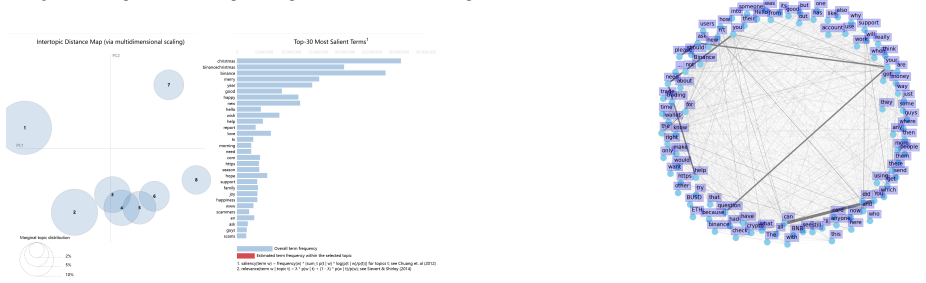
The FTX collapse produced significant price declines and capital reallocation from centralized to decentralized exchanges; sentiment metrics showed no sharp discontinuities, yet topic modeling and network analysis of Discord data revealed that seasonal holiday discourse had obscured underlying trust concerns in centralized exchange forums.
What carries the argument
The FTX collapse treated as a natural experiment, paired with causal inference on prices and flows plus topic modeling of community discourse to isolate trust dynamics.
If this is right
- Institutional trust in centralized exchanges proves fragile enough to trigger observable capital flight during crises.
- Decentralized exchanges receive measurable inflows when centralized platforms lose trust.
- Mixed quantitative and text-analytic methods can surface behavioral patterns that single-metric sentiment analysis misses.
- Exchange operators and regulators gain concrete signals for assessing platform-specific risk during systemic events.
Where Pith is reading between the lines
- The pattern implies decentralized architectures may serve as a partial hedge against failures in centralized crypto infrastructure.
- Similar trust-redistribution effects could be tested around other documented exchange failures or regulatory announcements.
- Market-design choices that separate custody from trading may alter how quickly capital responds to trust shocks.
Load-bearing premise
That the FTX collapse functions as a clean exogenous shock whose effects on prices, flows, and discourse can be isolated from concurrent market or seasonal factors.
What would settle it
Finding no statistically significant difference in price declines or net capital flows between centralized and decentralized exchanges after matching on concurrent market-wide events and seasonal controls.
Figures



read the original abstract
Trust mechanisms diverge between centralized and decentralized exchanges, representing distinct sociotechnical governance paradigms. However, quantifying trust dynamics and their redistribution between these architectures remains empirically challenging, limiting understanding of how institutional shocks affect market behavior. The FTX collapse offers a natural experiment to bridge this gap. Through an interdisciplinary approach combining causal inference and computational text analysis, we find significant price declines and capital reallocation from centralized to decentralized exchanges following the event. While sentiment metrics showed no sharp discontinuities, topic modeling and network analysis of Discord communities reveal that seasonal holiday discourse obscured underlying trust concerns in centralized exchange forums. These findings underscore the fragility of institutional trust architectures and demonstrate how mixed methods can illuminate behavioral patterns during systemic crises, offering insights for exchange risk management and regulatory assessment.
Editorial analysis
A structured set of objections, weighed in public.
Referee Report
Summary. The manuscript claims that the FTX collapse functions as a natural experiment to quantify trust dynamics between centralized (CEX) and decentralized (DEX) cryptocurrency exchanges. Combining causal inference on price and capital flow data with computational text analysis of Discord communities, it reports significant price declines and reallocation of capital from CEX to DEX after the event. Sentiment metrics show no sharp discontinuities, but topic modeling and network analysis indicate that seasonal holiday discourse obscured underlying trust concerns in CEX forums. The study concludes that institutional trust architectures are fragile and that mixed-methods approaches can illuminate behavioral responses during systemic crises.
Significance. If the identification strategy is valid and the text analysis reliably isolates latent trust concerns, the results would contribute to understanding how institutional shocks redistribute trust and capital across different exchange architectures. The mixed-methods design is a potential strength for illuminating behavioral patterns not captured by price data alone, with possible implications for risk management and regulation.
major comments (3)
- [Methods] The abstract and methods section provide no information on the identification strategy, control variables, statistical significance tests, or robustness checks for the claimed price declines and capital reallocation; without these the central causal claim cannot be evaluated.
- [Results (topic modeling)] No details are given on how holiday periods were handled in the topic model or how concurrent market factors were isolated from the FTX event, which is load-bearing for the claim that holiday discourse obscured trust concerns.
- [Identification and Data] The assumption that the FTX collapse is a clean exogenous shock whose effects on flows and discourse can be isolated is not supported by any discussion of identification or falsification tests in the provided text.
minor comments (1)
- [Abstract] The abstract could specify the exact time window, data sources for flows, and quantitative metrics (e.g., volume or TVL changes) used to measure reallocation.
Simulated Author's Rebuttal
We thank the referee for their constructive comments, which identify key areas for improving the clarity and rigor of our methods, results, and identification strategy. We address each major comment below and will incorporate the suggested details in a revised manuscript.
read point-by-point responses
-
Referee: [Methods] The abstract and methods section provide no information on the identification strategy, control variables, statistical significance tests, or robustness checks for the claimed price declines and capital reallocation; without these the central causal claim cannot be evaluated.
Authors: We agree that the current manuscript does not provide adequate detail on these elements in the abstract or methods section. In the revision, we will expand the methods section to describe the causal inference framework (including the specific econometric specification for price and flow analysis), list the control variables employed, report statistical significance tests with standard errors, and present robustness checks such as alternative event windows and placebo tests. The abstract will also be updated to reference the identification approach. revision: yes
-
Referee: [Results (topic modeling)] No details are given on how holiday periods were handled in the topic model or how concurrent market factors were isolated from the FTX event, which is load-bearing for the claim that holiday discourse obscured trust concerns.
Authors: The referee is correct that explicit details on these aspects are missing. We will revise the results section on topic modeling to specify how holiday periods were identified and controlled (e.g., via separate modeling or exclusion of December posts) and to describe steps for isolating the FTX event from concurrent factors, such as additional covariates or sensitivity analyses comparing holiday and non-holiday windows. revision: yes
-
Referee: [Identification and Data] The assumption that the FTX collapse is a clean exogenous shock whose effects on flows and discourse can be isolated is not supported by any discussion of identification or falsification tests in the provided text.
Authors: We acknowledge the lack of explicit discussion on this point. The revised manuscript will include a new subsection on the identification strategy that justifies treating the FTX collapse as exogenous (citing its idiosyncratic timing and firm-specific triggers) and reports falsification tests, including pre-trend checks and placebo event dates, to support isolation of effects on flows and discourse. revision: yes
Circularity Check
No significant circularity
full rationale
The paper presents an empirical mixed-methods study using the FTX collapse as an external dated event for causal inference on prices, flows, and Discord text data. No equations, fitted parameters, or derivation chains are described in the provided text; outcomes are tied to observable market data and external sources rather than being defined in terms of quantities constructed from the same fitted values. No self-citation load-bearing steps, ansatz smuggling, or renaming of known results appear. The central claims rest on identification from an exogenous shock and computational text analysis, which are independent of the reported patterns by construction.
Axiom & Free-Parameter Ledger
axioms (2)
- domain assumption The FTX collapse serves as an exogenous shock suitable for causal inference on trust dynamics.
- domain assumption Topic modeling and network analysis of Discord communities can surface underlying trust concerns even when aggregate sentiment metrics show no discontinuity.
Reference graph
Works this paper leans on
-
[1]
The design principle of blockchain: An initiative for the sok of soks,
S. Zhang, “The design principle of blockchain: An initiative for the sok of soks,” arXiv preprint arXiv:2301.00479 , 2023
-
[2]
Z. Ao, L. W. Cong, G. Horvath, and L. Zhang, “Is decentralized finance actually decentralized? a social network analysis of the aave protocol on the ethereum blockchain,” arXiv preprint arXiv:2206.08401 , 2022
-
[3]
Ai ethics on blockchain: Topic analysis on twitter data for blockchain security,
Y . Fu, Z. Zhuang, and L. Zhang, “Ai ethics on blockchain: Topic analysis on twitter data for blockchain security,” in Science and Information Conference. Springer, 2023, pp. 82–100
work page 2023
-
[4]
Sok: Blockchain decentralization,
L. Zhang, X. Ma, and Y . Liu, “Sok: Blockchain decentralization,” arXiv preprint arXiv:2205.04256, 2022
-
[5]
Blockchain network analysis: A comparative study of decentralized banks,
Y . Zhang, Z. Chen, Y . Sun, Y . Liu, and L. Zhang, “Blockchain network analysis: A comparative study of decentralized banks,” in Science and Information Conference. Springer, 2023, pp. 1022–1042
work page 2023
-
[6]
Leveraging social media sentiments and ethical signals for nft valuation,
L. Zhang, Y . Quan, J. Cao, K. Z. Zhou, and X. Tong, “Leveraging social media sentiments and ethical signals for nft valuation,” in 2024 IEEE 24th International Conference on Software Quality, Reliability, and Security Companion (QRS-C) , 2024, pp. 206–215
work page 2024
-
[7]
Decoding social sentiment in dao: A comparative analysis of blockchain governance communities,
Y . Quan, X. Wu, W. Deng, and L. Zhang, “Decoding social sentiment in dao: A comparative analysis of blockchain governance communities,” in 2024 IEEE 24th International Conference on Software Quality, Reliability, and Security Companion (QRS-C) . IEEE, 2024, pp. 216– 224
work page 2024
-
[8]
”centralized or decentralized?
Y . Xiao, B. Deng, S. Chen, K. Z. Zhou, R. LC, L. Zhang, and X. Tong, “”centralized or decentralized?”: Concerns and value judgments of stakeholders in the non-fungible tokens (nfts) market,” Proc. ACM Hum.-Comput. Interact. , vol. 8, no. CSCW1, Apr. 2024. [Online]. Available: https://doi.org/10.1145/3637305
-
[9]
The economics of blockchain governance: Evaluate liquid democracy on the internet computer,
Y . Liu and L. Zhang, “The economics of blockchain governance: Evaluate liquid democracy on the internet computer,” in 2024 IEEE 24th International Conference on Software Quality, Reliability, and Security Companion (QRS-C), 2024, pp. 225–231
work page 2024
-
[10]
Sok: Security and privacy of blockchain interoperability,
A. Augusto, R. Belchior, M. Correia, A. Vasconcelos, L. Zhang, and T. Hardjono, “Sok: Security and privacy of blockchain interoperability,” in 2024 IEEE Symposium on Security and Privacy (SP) . IEEE, 2024, pp. 3840–3865
work page 2024
-
[11]
Deciphering bitcoin blockchain data by cohort analysis,
Y . Liu, L. Zhang, and Y . Zhao, “Deciphering bitcoin blockchain data by cohort analysis,” Scientific Data, vol. 9, no. 1, p. 136, 2022
work page 2022
-
[12]
Uniswap daily transaction indices by network,
N. Chemaya, L. W. Cong, E. Jorgensen, D. Liu, and L. Zhang, “Uniswap daily transaction indices by network,” arXiv preprint arXiv:2312.02660, 2023
-
[13]
T. Yan, S. Li, B. Kraner, L. Zhang, and C. J. Tessone, “Analyzing reward dynamics and decentralization in ethereum 2.0: An advanced data engineering workflow and comprehensive datasets for proof-of- stake incentives,” arXiv preprint arXiv:2402.11170 , 2024
-
[14]
X. Tian, Z. Zhuang, and L. Zhang, “Redesign incentives in proof-of- stake ethereum: An interdisciplinary approach of reinforcement learning and mechanism design,” in 2024 6th International Conference on Data- driven Optimization of Complex Systems (DOCS) , 2024, pp. 16–24
work page 2024
-
[15]
Quan- tifying the blockchain trilemma: A comparative analysis of algorand, ethereum 2.0, and beyond,
Y . Fu, M. Jing, J. Zhou, P. Wu, Y . Wang, L. Zhang, and C. Hu, “Quan- tifying the blockchain trilemma: A comparative analysis of algorand, ethereum 2.0, and beyond,” in 2024 IEEE International Conference on Metaverse Computing, Networking, and Applications (MetaCom) . IEEE, 2024, pp. 97–104
work page 2024
-
[16]
The future of finance: Synthesizing cefi and defi for the benefit of all,
L. Zhang, “The future of finance: Synthesizing cefi and defi for the benefit of all,” in Financial Literacy in Today ´s Global Market , D. I. Miciuła, Ed. Rijeka: IntechOpen, 2023, ch. 0. [Online]. Available: https://doi.org/10.5772/intechopen.1003042
-
[17]
A. Park, J. Kietzmann, and L. Pitt, “The impact of trust building on transaction activity: A study of non-fungible token projects [award win- ning paper],” Socially Engaged Applied Doctoral Research in Canada: Approaches to Contemporary Social and Management Opportunities and Challenges, 2022
work page 2022
-
[18]
Trust in blockchain cryptocurrency ecosystem,
M. H. u. Rehman, K. Salah, E. Damiani, and D. Svetinovic, “Trust in blockchain cryptocurrency ecosystem,” IEEE Transactions on Engineer- ing Management, vol. 67, no. 4, p. 1–17, 2019
work page 2019
-
[19]
Do consumers really trust cryptocurrencies?
D. Arli, P. van Esch, M. Bakpayev, and A. Laurence, “Do consumers really trust cryptocurrencies?” Marketing Intelligence & Planning , vol. ahead-of-print, 2020
work page 2020
-
[20]
Understanding the creation of trust in cryptocurrencies: the case of bitcoin,
V . Marella, B. Upreti, J. Merikivi, and V . K. Tuunainen, “Understanding the creation of trust in cryptocurrencies: the case of bitcoin,” Electronic Markets, vol. 30, no. 2, 2020
work page 2020
-
[21]
Top 10 best crypto exchanges in 2023,
A. Numeris, “Top 10 best crypto exchanges in 2023,” crypto.ro, 2023. [Online]. Available: https://crypto.ro/en/education/ best-crypto-exchange/
work page 2023
-
[22]
Detecting and quantifying wash trading on decentralized cryptocurrency exchanges,
F. Victor and A. M. Weintraud, “Detecting and quantifying wash trading on decentralized cryptocurrency exchanges,” ArXiv, 2021. [Online]. Available: https://doi.org/10.1145/3442381.3449824
-
[23]
Automated market makers (amms) explained — chainlink,
Chainlink, “Automated market makers (amms) explained — chainlink,” 2023. [Online]. Available: https://chain.link/education-hub/ what-is-an-automated-market-maker-amm
work page 2023
-
[24]
J. Chen, Y . Wang, Y . Zhou, W. Ding, Y . Tang, X. Wang, and K. Li, “Understanding the security risks of decentralized exchanges by uncov- ering unfair trades in the wild,” in 2023 IEEE 8th European Symposium on Security and Privacy (EuroS&P) , 2023, pp. 332–351
work page 2023
-
[25]
Understand waiting time in transac- tion fee mechanism: An interdisciplinary perspective,
L. Zhang and F. Zhang, “Understand waiting time in transac- tion fee mechanism: An interdisciplinary perspective,” arXiv preprint arXiv:2305.02552, 2023
-
[26]
Trust and the nature of markets,
P. D. Starr and Others, “Trust and the nature of markets,” Journal of Economic Perspectives, vol. 25, no. 3, pp. 101–120, 2011
work page 2011
-
[27]
A survey of behavioral finance,
N. Barberis and R. Thaler, “A survey of behavioral finance,” Handbook of the Economics of Finance , vol. 1, pp. 1053–1128, 2018
work page 2018
-
[28]
The psychology of risk: A behavioral finance perspective,
V . Ricciardi and H. K. Simon, “The psychology of risk: A behavioral finance perspective,” Journal of Behavioral Finance , vol. 9, no. 2, pp. 84–102, 2008
work page 2008
-
[29]
Overconfidence in blockchain investment decisions,
S. R. Team, “Overconfidence in blockchain investment decisions,”
-
[30]
Available: https://www.status.im/research/2023/ overconfidence-blockchain-investments.html
[Online]. Available: https://www.status.im/research/2023/ overconfidence-blockchain-investments.html
work page 2023
-
[31]
User-weighted sentiment analysis for financial community on twitter,
A. B. Eliac ¸ik and N. Erdo ˘gan, “User-weighted sentiment analysis for financial community on twitter,” in 2015 11th International Conference on Innovations in Information Technology (IIT) , 2015, pp. 46–51
work page 2015
-
[32]
A sentiment analysis of blockchain technology in the financial,
M. Amirizaniani, “A sentiment analysis of blockchain technology in the financial,” 2021
work page 2021
-
[33]
Lender trust on the p2p lending: Analysis based on sentiment analysis of comment text,
B. Niu, J. Ren, A. Zhao, and X. Li, “Lender trust on the p2p lending: Analysis based on sentiment analysis of comment text,” Sustainability, vol. 12, no. 8, p. 3293, 2020. [Online]. Available: https://doi.org/10.3390/su12083293
-
[34]
Decoding social sentiment in dao: A comparative analysis of blockchain governance communities,
Y . Quan, X. Wu, W. Deng, and L. Zhang, “Decoding social sentiment in dao: A comparative analysis of blockchain governance communities,” in 2024 IEEE 24th International Conference on Software Quality, Reliability, and Security Companion (QRS-C) , 2024, pp. 216–224
work page 2024
-
[35]
L. Yuan, J. Bin, Y . Wei, Z. Hu, and P. Sun, “Transaction prediction in blockchain: A negative link prediction algorithm based on the sentiment analysis and balance theory,” Wireless Communications and Mobile Computing , vol. 2021, p. e8871150, 2021. [Online]. Available: https://doi.org/10.1155/2021/8871150
-
[36]
To implement blockchain based social media platform with sentiment anal- ysis using nlp,
V . Pandey, V . Tiwari, R. Sonavane, G. Jha, K. Mishra, and G. Lohar, “To implement blockchain based social media platform with sentiment anal- ysis using nlp,” in 2024 International Conference on Advances in Com- puting Research on Science Engineering and Technology (ACROSET) , 2024, pp. 1–7
work page 2024
-
[37]
Z. Shahbazi and Y .-C. Byun, “Blockchain-based event detection and trust verification using natural language processing and machine learning,” IEEE Access, vol. 10, pp. 5790–5800, 2022
work page 2022
-
[38]
Machine learning for blockchain: Literature review and open research questions,
L. Zhang, “Machine learning for blockchain: Literature review and open research questions,” in NeurIPS 2023 AI for Science Workshop , 2023
work page 2023
-
[39]
K. Venkatesan and S. B. Rahayu, “Blockchain security enhancement: An approach towards hybrid consensus algorithms and machine learning techniques,” Scientific Reports , vol. 14, no. 1149, 2024, accessed: 2024-12-14. [Online]. Available: https://www.nature.com/ articles/s41598-024-51578-7
work page 2024
-
[40]
T. Islam, F. H. Bappy, T. Shaila Zaman, M. S. Islam Sajid, and M. Mehedi Ahsan Pritom, “Mrl-pos: A multi-agent reinforcement learning based proof of stake consensus algorithm for blockchain,” in 2024 IEEE 14th Annual Computing and Communication Workshop and Conference (CCWC) . IEEE, Jan. 2024, p. 0409–0413. [Online]. Available: http://dx.doi.org/10.1109/C...
-
[41]
S. El Hessaini, R. Benaich, S. El Mendili, and Y . Gahi, “Enhancing blockchain consensus mechanisms with artificial intelligence: Potential improvements and applications,” in Information Systems and Technological Advances for Sustainable Development , ser. Lecture Notes in Information Systems and Organisation, M. Ben Ahmed, A. Boudhir, H. Abd Elhamid Atti...
-
[42]
Deep learning and blockchain- empowered security framework for intelligent 5g-enabled iot,
S. Rathore, J. H. Park, and H. Chang, “Deep learning and blockchain- empowered security framework for intelligent 5g-enabled iot,” IEEE Access, vol. 9, pp. 90 075–90 083, 2021
work page 2021
-
[43]
Finml-chain: A blockchain-integrated dataset for enhanced financial machine learning,
J. Chen, W. Deng, D. Chen, and L. Zhang, “Finml-chain: A blockchain-integrated dataset for enhanced financial machine learning,”
-
[44]
Available: https://arxiv.org/abs/2411.16277
[Online]. Available: https://arxiv.org/abs/2411.16277
-
[45]
Machine learning for blockchain and iot systems in smart cities: A survey,
E. Dritsas and M. Trigka, “Machine learning for blockchain and iot systems in smart cities: A survey,” Future Internet , vol. 16, no. 9, p. 324, 2024. [Online]. Available: https://doi.org/10.3390/fi16090324
-
[46]
Blockchain and deep reinforcement learning empowered intelligent 5g beyond,
Y . Dai, D. Xu, S. Maharjan, Z. Chen, Q. He, and Y . Zhang, “Blockchain and deep reinforcement learning empowered intelligent 5g beyond,” IEEE Network, vol. 33, no. 3, pp. 10–17, 2019
work page 2019
-
[47]
Chain fl: Decentralized federated machine learning via blockchain,
C. Korkmaz, H. E. Kocas, A. Uysal, A. Masry, O. Ozkasap, and B. Akgun, “Chain fl: Decentralized federated machine learning via blockchain,” in 2020 Second International Conference on Blockchain Computing and Applications (BCCA) , 2020, pp. 140–146
work page 2020
-
[48]
Blockchain and machine learning technologies for smart agriculture,
X. Yu, J. Geng, and Y . Zhang, “Blockchain and machine learning technologies for smart agriculture,” Soft Computing , vol. 26, pp. 1723–1737, 2022. [Online]. Available: https://link.springer.com/article/ 10.1007/s00500-021-06496-5
-
[49]
E. Goh, D.-Y . Kim, K. Lee, S. Oh, J.-E. Chae, and D.-Y . Kim, “Blockchain-enabled federated learning: A reference architecture design, implementation, and verification,” 2023. [Online]. Available: https://arxiv.org/abs/2306.10841
-
[50]
Machine learning in policy evaluation: New tools for causal inference,
N. Kreif and K. DiazOrdaz, “Machine learning in policy evaluation: New tools for causal inference,” Oxford Research Encyclopedia of Economics and Finance , July 29 2019, retrieved 14 Dec. 2024. [Online]. Available: https://oxfordre.com/economics/view/10.1093/ acrefore/9780190625979.001.0001/acrefore-9780190625979-e-256
-
[51]
Can Blockchain Technology Help Overcome Contractual Incompleteness? Evidence from State Laws,
M. A. Chen, S. S. Hu, J. Wang, and Q. Wu, “Can Blockchain Technology Help Overcome Contractual Incompleteness? Evidence from State Laws,” Management Science , vol. 69, no. 11, pp. 6540– 6567, November 2023. [Online]. Available: https://ideas.repec.org/a/ inm/ormnsc/v69y2023i11p6540-6567.html
work page 2023
-
[52]
X. Wang, R. Zhang, Z. Gong, and X. Chen, “Impact of blockchain on the green innovation performance of enterprises under the policy uncertainty,” Industrial Management & Data Systems , vol. 123, no. 10, pp. 2681–2703, 2023. [Online]. Available: https://www.emerald.com/ insight/content/doi/10.1108/imds-02-2023-0071/full/html
-
[53]
T. Kane and A. Lobosco, “Title of the article,” Science and Public Policy, vol. 48, no. 4, pp. 562–572, 2021. [Online]. Available: https://academic.oup.com/spp/article-abstract/48/4/562/6291644
work page 2021
-
[54]
Empirical analysis of eip-1559: Transaction fees, waiting times, and consensus security,
Y . Liu, Y . Lu, K. Nayak, F. Zhang, L. Zhang, and Y . Zhao, “Empirical analysis of eip-1559: Transaction fees, waiting times, and consensus security,” in Proceedings of the 2022 ACM SIGSAC Conference on Computer and Communications Security , ser. CCS ’22. New York, NY , USA: Association for Computing Machinery, 2022, p. 2099–2113. [Online]. Available: ht...
-
[55]
A. Kiayias and P. Lazos, “Sok: Blockchain governance,” in Proceedings of the 4th ACM Conference on Advances in Financial Technologies, ser. AFT ’22. New York, NY , USA: Association for Computing Machinery, 2023, p. 61–73. [Online]. Available: https://doi.org/10.1145/3558535.3559794
-
[56]
The collapse of ftx: The end of cryptocurrency’s age of innocence,
T. Conlon, S. Corbet, and Y . Hu, “The collapse of ftx: The end of cryptocurrency’s age of innocence,” Available at SSRN 4283333 , 2022
work page 2022
-
[57]
S. Fu, Q. Wang, J. Yu, and S. Chen, “Ftx collapse: a ponzi story,” in International Conference on Financial Cryptography and Data Security. Springer, 2023, pp. 208–215
work page 2023
-
[58]
The regression-discontinuity design,
W. M. Trochim, “The regression-discontinuity design,” Research methodology: Strengthening causal interpretations of nonexperimental data, pp. 119–139, 1990
work page 1990
-
[59]
Identification and estimation of treatment effects with a regression-discontinuity design,
J. Hahn, P. Todd, and W. Van der Klaauw, “Identification and estimation of treatment effects with a regression-discontinuity design,” Economet- rica, vol. 69, no. 1, pp. 201–209, 2001
work page 2001
-
[60]
Semiparametric difference-in-differences estimators,
A. Abadie, “Semiparametric difference-in-differences estimators,” The review of economic studies , vol. 72, no. 1, pp. 1–19, 2005
work page 2005
-
[61]
Difference-in-differences with multi- ple time periods,
B. Callaway and P. H. Sant’Anna, “Difference-in-differences with multi- ple time periods,” Journal of econometrics, vol. 225, no. 2, pp. 200–230, 2021
work page 2021
-
[62]
R. H. Baayen, Word frequency distributions . Springer Science & Business Media, 2012, vol. 18
work page 2012
-
[63]
D. M. Blei, A. Y . Ng, and M. I. Jordan, “Latent dirichlet allocation,” Journal of machine Learning research , vol. 3, no. Jan, pp. 993–1022, 2003
work page 2003
-
[64]
The evolution of 10-k textual disclosure: Evidence from latent dirichlet allocation,
T. Dyer, M. Lang, and L. Stice-Lawrence, “The evolution of 10-k textual disclosure: Evidence from latent dirichlet allocation,” Journal of Accounting and Economics , vol. 64, no. 2-3, pp. 221–245, 2017
work page 2017
-
[65]
Cytoscape stringapp: network analysis and visualization of proteomics data,
N. T. Doncheva, J. H. Morris, J. Gorodkin, and L. J. Jensen, “Cytoscape stringapp: network analysis and visualization of proteomics data,” Jour- nal of proteome research , vol. 18, no. 2, pp. 623–632, 2018
work page 2018
-
[66]
Investor sentiment and the holiday effect in the cryptocurrency market: evidence from china,
P. Zhang, K. Xu, J. Huang, and J. Qi, “Investor sentiment and the holiday effect in the cryptocurrency market: evidence from china,” Financial Innovation, vol. 10, no. 1, p. 113, 2024
work page 2024
-
[67]
Y . Chen, Y . Li, K. Z. Zhou, X. Fu, L. Liu, S. Bao, D. Sui, and L. Zhang, “Global public sentiment on decentralized finance: A spatiotemporal analysis of geo-tagged tweets from 150 countries,” arXiv preprint arXiv:2409.00843, 2024
-
[68]
D. Perera, J. Lim, S. Gunraku, and W. H. Lim, “Cryptocurrency analysis: Price prediction of cryptocurrency using user sentiments and quantitative data,” in International Conference on Agents and Artificial Intelligence
-
[69]
Scitepress, 2024, pp. 210–217
work page 2024
-
[70]
L. Zhang, “Next-generation behavioral economics: Blockchain as the web3 infrastructure for experimental studies,” in Blockchain - Pioneering the Web3 Infrastructure for an Intelligent Future , L. Zhang, M. Esposito, and T. Tse, Eds. Rijeka: IntechOpen, 2024, ch. 8. [Online]. Available: https://doi.org/10.5772/intechopen.1006740
-
[71]
Causalstock: Deep end-to-end causal discovery for news-driven stock movement prediction,
S. Li, Y . Sun, Y . Lin, X. Gao, S. Shang, and R. Yan, “Causalstock: Deep end-to-end causal discovery for news-driven stock movement prediction,” arXiv preprint arXiv:2411.06391 , 2024
discussion (0)
Sign in with ORCID, Apple, or X to comment. Anyone can read and Pith papers without signing in.