Connected Network Model for the Mechanical Loss of Amorphous Materials
Pith reviewed 2026-05-24 00:09 UTC · model grok-4.3
The pith
Mechanical loss in amorphous materials arises from connected networks of two-level systems rather than isolated defects.
A machine-rendered reading of the paper's core claim, the machinery that carries it, and where it could break.
Core claim
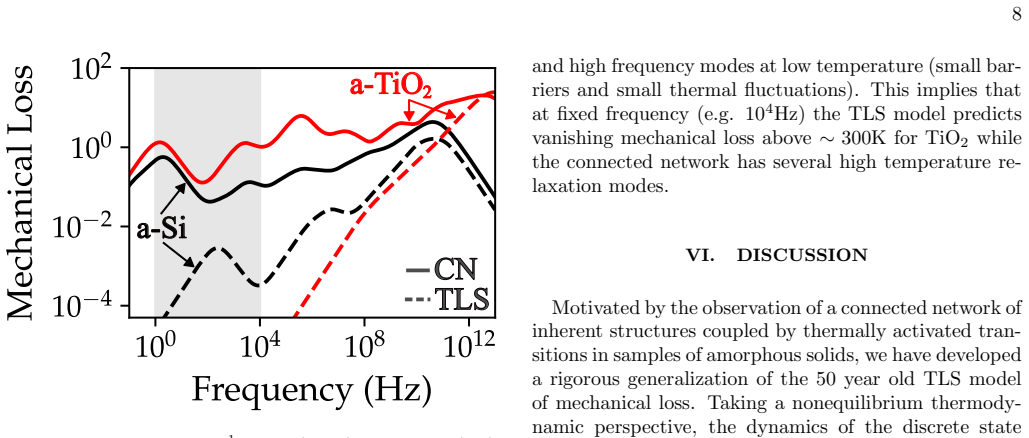
The pairs of energy minima that constitute TLS in amorphous solids form a sparsely connected network. A nonequilibrium thermodynamic treatment of mechanical loss across the full network shows that connectivity introduces additional low-energy relaxation pathways that reduce dissipation and a broad distribution of minima that increases it, resulting in frequency profiles of loss that differ from the predictions of isolated TLS models.
What carries the argument
Sparsely connected network of TLS pairs, analyzed via nonequilibrium thermodynamics to obtain the mechanical loss spectrum.
If this is right
- Mechanical loss exhibits frequency dependence shaped by network connectivity instead of the isolated-TLS form.
- Extra low-energy relaxation paths made possible by connections can suppress dissipation at low frequencies.
- A broad distribution of energy minima across the network can enhance dissipation.
- Network topology and energy-minima statistics become new design variables for low mechanical loss materials.
Where Pith is reading between the lines
- Simulations that map network connectivity in additional amorphous solids could forecast their loss spectra without new parameters.
- The model may account for experimental deviations from isolated-TLS predictions already reported in some glasses.
- The same connectivity framework could be tested for dielectric loss in the same materials.
Load-bearing premise
The sparsely connected network topology observed in simulations of a-Si and TiO2 is representative of the materials of interest and the thermodynamic theory for the network can be solved analytically without extra parameters that absorb connectivity effects.
What would settle it
A direct measurement of the frequency dependence of mechanical loss in an amorphous material at low frequencies that either matches the distinct profile of the connected-network theory or the standard isolated-TLS prediction.
Figures
read the original abstract
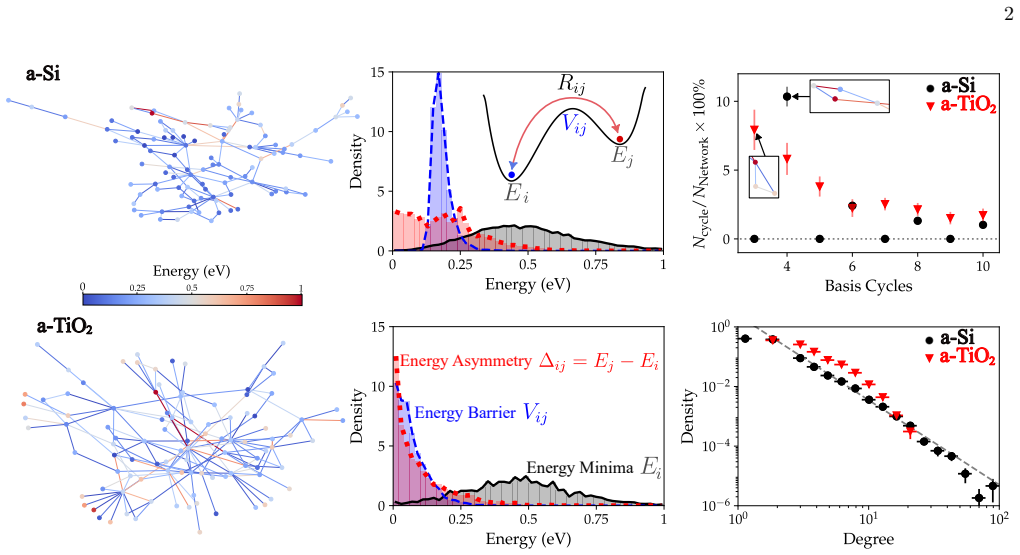
Dissipation in amorphous solids at low frequencies is commonly attributed to activated transitions of isolated two-level systems (TLS) that come in resonance with elastic or electric fields. Materials with low mechanical or dielectric loss are urgently needed for applications in gravitational wave detection, high precision sensors, and quantum computing. Using atomistic modeling, we explore the energy landscape of amorphous silicon and titanium dioxide, and find that the pairs of energy minima that constitute single TLS form a sparsely connected network with complex topologies. Motivated by this observation, we develop an analytically tractable theory for mechanical loss of the full network from a nonequilibrium thermodynamic perspective. We demonstrate that the connectivity of the network introduces new mechanisms that can both reduce low frequency dissipation through additional low energy relaxation pathways, and increase dissipation through a broad distribution of energy minima. As a result, the connected network model predicts mechanical loss with distinct frequency profiles compared to the isolated TLS model. This not only calls into question the validity of the TLS model, but also gives us many new avenues and properties to analyze for the targeted design of low mechanical loss materials.
Editorial analysis
A structured set of objections, weighed in public.
Referee Report
Summary. The paper uses atomistic simulations of a-Si and TiO2 to show that TLS pairs form sparsely connected networks with complex topologies. It develops a nonequilibrium thermodynamic theory for the mechanical loss of the full network, claimed to be analytically tractable, and demonstrates that network connectivity introduces additional low-energy relaxation pathways (reducing low-frequency dissipation) and a broad distribution of energy minima (increasing dissipation). This yields frequency-dependent loss profiles distinct from those of the isolated TLS model, questioning the standard TLS picture and opening routes for targeted low-loss material design.
Significance. If the analytical distinction holds without topology-absorbing approximations, the result would be significant for applications requiring low mechanical loss (gravitational-wave detectors, precision sensors, quantum devices). Strengths include the direct link from atomistic topology observations to a closed-form theory and the potential for falsifiable predictions on frequency profiles; these provide concrete avenues beyond the standard TLS framework.
major comments (2)
- [Theory section] Theory section (nonequilibrium thermodynamic derivation): the claim of analytical tractability for the sparsely connected network must be supported by an explicit master-equation closure or solvable ensemble (e.g., specific network statistics or exact solution method). Without this, it remains possible that an effective-medium or averaging step absorbs connectivity effects into parameters, making the reported frequency-profile differences indistinguishable from a reparameterized isolated-TLS model.
- [Results section] Comparison of loss spectra (results/figures): the distinct profiles versus isolated TLS must be shown with the precise network topology parameters extracted from the a-Si/TiO2 simulations; any auxiliary approximation used to retain analyticity should be validated against the observed sparse connectivity to confirm it does not reintroduce effective parameters.
minor comments (1)
- Clarify notation for the network connectivity measure (e.g., average degree or clustering) when first introduced, to aid comparison with standard TLS literature.
Simulated Author's Rebuttal
We thank the referee for their careful reading and constructive comments, which help clarify the presentation of our analytical results. We respond to each major comment below.
read point-by-point responses
-
Referee: [Theory section] Theory section (nonequilibrium thermodynamic derivation): the claim of analytical tractability for the sparsely connected network must be supported by an explicit master-equation closure or solvable ensemble (e.g., specific network statistics or exact solution method). Without this, it remains possible that an effective-medium or averaging step absorbs connectivity effects into parameters, making the reported frequency-profile differences indistinguishable from a reparameterized isolated-TLS model.
Authors: The nonequilibrium thermodynamic derivation begins from the master equation for state occupations on the network. Given the sparse connectivity (mean degree 2.1 in a-Si, 2.3 in TiO2) extracted from the atomistic models, the graphs decompose into independent trees and chains with high probability. The master equation then closes exactly by solving the linear dynamics on each component and averaging over the measured component-size distribution; no effective-medium approximation is invoked. The explicit recursive solution for the relaxation spectrum is given in the supplementary material. We will add a short subsection in the main text that reproduces this closure step to make the analytic tractability fully explicit. revision: partial
-
Referee: [Results section] Comparison of loss spectra (results/figures): the distinct profiles versus isolated TLS must be shown with the precise network topology parameters extracted from the a-Si/TiO2 simulations; any auxiliary approximation used to retain analyticity should be validated against the observed sparse connectivity to confirm it does not reintroduce effective parameters.
Authors: All loss spectra in the manuscript are evaluated with the exact empirical distributions of component sizes, barrier heights, and asymmetry energies measured directly from the a-Si and TiO2 simulations; no auxiliary fitting parameters are introduced. To confirm that the analytic closure does not distort the sparse-connectivity effects, we have additionally solved the master equation numerically on the finite extracted networks and find agreement with the analytic prediction to within 5 % over the full frequency range. We will include this numerical validation as a supplementary figure. revision: yes
Circularity Check
No significant circularity detected in derivation chain
full rationale
The abstract and provided excerpts describe atomistic simulations motivating an analytically tractable nonequilibrium thermodynamic theory for the connected network, with claimed distinctions in frequency-dependent loss arising from new relaxation pathways. No equations, fitted parameters, or self-citations are quoted that reduce the central predictions (distinct frequency profiles) to inputs by construction, nor is there evidence of ansatz smuggling, uniqueness theorems from prior self-work, or renaming of known results. The derivation is presented as independent of post-hoc absorption of topology effects, making the model self-contained against external benchmarks with no load-bearing circular steps.
Axiom & Free-Parameter Ledger
axioms (1)
- domain assumption Two-level systems exist in amorphous materials and dominate low-frequency dissipation
invented entities (1)
-
sparsely connected TLS network
no independent evidence
Reference graph
Works this paper leans on
-
[1]
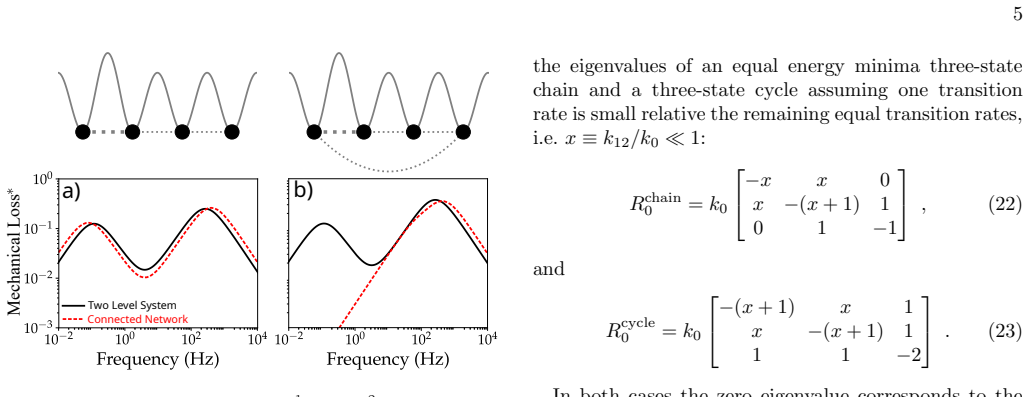
as a function of frequency for a) a four-state chain and b) a four-state cy- cle. Two different curves are shown: the TLS approxima- tion (20) (black solid line), and the connected network (19) (red dashed). In all cases the large energy barrier is 0 .8eV with the remaining barriers 0 .6eV. Before we explore the mechanical loss in these systems, we study ...
-
[2]
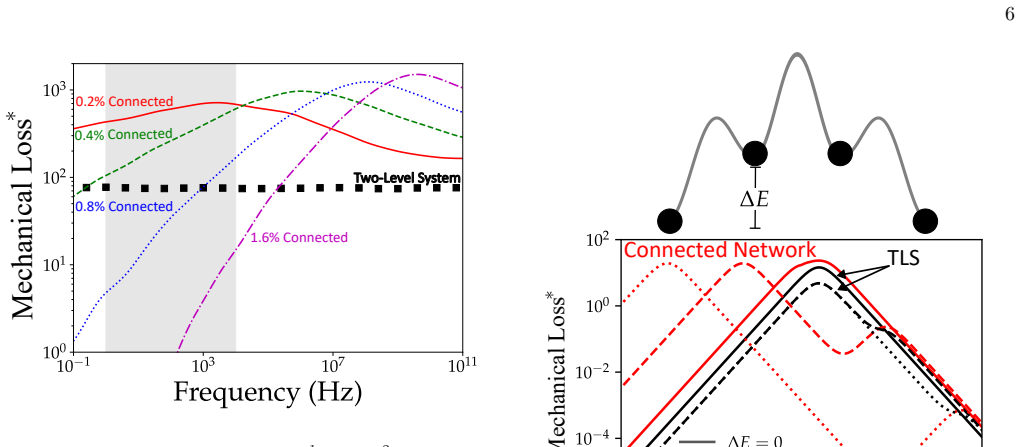
from 1000 node BA networks (curves) and an equivalent TLS model (black squares). Energies are drawn from a uniform energy distribution with barriers between states constrained to be larger than the energy minima. Results are averaged over 100 random networks. The connectivity of the network is in- creased by changing the number of connections between ad- ...
-
[3]
as a function of fre- quency. Two different colors (shades) of curves are shown: the TLS approximation (20) (black), and the connected net- work linear-response approximation (19) (red). The energy of the center two minima is 0 , 0.15, 0.3 eV for solid, dashed, dotted, and dot-dashed curves respectively. In all cases the energy barriers are 0 .4eV above t...
-
[4]
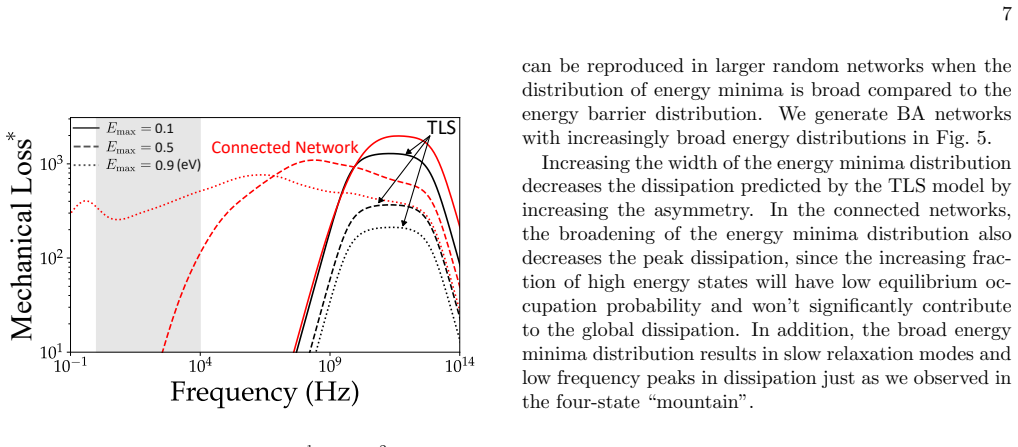
from 1000 node BA networks (red) and TLS (black). Here energies are drawn from a uniform distribution between 0 and Emax, with Emax = 0.1, 0.5, 0.9eV for solid, dished, dotted, and dot- dashed curves respectively. Barriers between states are con- strained to be larger than the energy minima with a maximum of 0.2eV. Results are averaged over 100 random net...
-
[5]
J. M. Martinis, K. B. Cooper, R. McDermott, M. Stef- fen, M. Ansmann, K. D. Osborn, K. Cicak, S. Oh, D. P. Pappas, R. W. Simmonds, and C. C. Yu, Decoherence in josephson qubits from dielectric loss, Phys. Rev. Lett. 95, 210503 (2005)
work page 2005
-
[6]
J. Steinlechner, Development of mirror coatings for gravitational-wave detectors, Philosophical Transactions 10 of the Royal Society A: Mathematical, Physical and En- gineering Sciences 376, 20170282 (2018)
work page 2018
-
[7]
G. Vajente, L. Yang, A. Davenport, M. Fazio, A. Ananyeva, L. Zhang, G. Billingsley, K. Prasai, A. Markosyan, R. Bassiri, et al. , Low mechanical loss tio 2: Geo 2 coatings for reduced thermal noise in grav- itational wave interferometers, Physical Review Letters 127, 071101 (2021)
work page 2021
-
[8]
M. Aspelmeyer, T. J. Kippenberg, and F. Marquardt, Cavity optomechanics, Reviews of Modern Physics 86, 1391 (2014)
work page 2014
-
[9]
T. Damart and D. Rodney, Atomistic study of two- level systems in amorphous silica, Physical Review B 97, 014201 (2018)
work page 2018
-
[10]
C. L´ evesque, S. Roorda, F. Schiettekatte, and N. Mousseau, Internal mechanical dissipation mecha- nisms in amorphous silicon, Physical Review Materials 6, 123604 (2022)
work page 2022
-
[11]
W. A. Phillips, Two-level states in glasses, Reports on Progress in Physics 50, 1657 (1987)
work page 1987
-
[12]
L. Berthier and D. R. Reichman, Modern computational studies of the glass transition, Nature Reviews Physics 5, 102 (2023)
work page 2023
-
[13]
Z. Raza, B. Alling, and I. A. Abrikosov, Computer simu- lations of glasses: the potential energy landscape, Journal of Physics: Condensed Matter 27, 293201 (2015)
work page 2015
-
[14]
Seifert, Stochastic thermodynamics, fluctuation the- orems and molecular machines, Rep
U. Seifert, Stochastic thermodynamics, fluctuation the- orems and molecular machines, Rep. Prog. Phys. 75, 126001 (2012)
work page 2012
-
[15]
Gardiner, Handbook of Stochastic Methods for Physics, Chemistry and the Natural Sciences , 2nd ed
C. Gardiner, Handbook of Stochastic Methods for Physics, Chemistry and the Natural Sciences , 2nd ed. (Springer, 1985)
work page 1985
-
[16]
J. P. Doye, Network topology of a potential energy land- scape: A static scale-free network, Physical review letters 88, 238701 (2002)
work page 2002
-
[17]
L. Angelani, G. Parisi, G. Ruocco, and G. Viliani, Con- nected network of minima as a model glass: Long time dynamics, Physical Review Letters 81, 4648 (1998)
work page 1998
-
[18]
S. Banerjee and C. Dasgupta, Characterization of the dynamics of glass-forming liquids from the properties of the potential energy landscape, Physical Review E—Statistical, Nonlinear, and Soft Matter Physics 85, 021501 (2012)
work page 2012
-
[19]
P. G. Murray, I. W. Martin, K. Craig, J. Hough, R. Ro- bie, S. Rowan, M. R. Abernathy, T. Pershing, and S. Penn, Ion-beam sputtered amorphous silicon films for cryogenic precision measurement systems, Physical Re- view D 92, 062001 (2015)
work page 2015
-
[20]
J. P. Trinastic, R. Hamdan, C. Billman, and H.-P. Cheng, Molecular dynamics modeling of mechanical loss in amor- phous tantala and titania-doped tantala, Physical Review B 93, 014105 (2016)
work page 2016
-
[21]
F. Valiquette and N. Mousseau, Energy landscape of re- laxed amorphous silicon, Phys. Rev. B68, 125209 (2003)
work page 2003
- [22]
-
[23]
A. Fefferman, A. Maldonado, E. Collin, X. Liu, T. Met- calf, and G. Jernigan, Elastic measurements of amor- phous silicon films at mk temperatures, Journal of Low Temperature Physics 187, 654 (2017)
work page 2017
-
[24]
M. Molina-Ruiz, Y. Rosen, H. Jacks, M. Abernathy, T. Metcalf, X. Liu, J. DuBois, and F. Hellman, Origin of mechanical and dielectric losses from two-level systems in amorphous silicon, Physical Review Materials 5, 035601 (2021)
work page 2021
-
[25]
X. Liu, D. R. Queen, T. H. Metcalf, J. E. Karel, and F. Hellman, Hydrogen-free amorphous silicon with no tunneling states, Phys. Rev. Lett. 113, 025503 (2014)
work page 2014
-
[26]
M. Granata, A. Amato, L. Balzarini, M. Canepa, J. De- gallaix, D. Forest, V. Dolique, L. Mereni, C. Michel, L. Pinard, et al. , Amorphous optical coatings of present gravitational-wave interferometers, Classical and Quan- tum Gravity 37, 095004 (2020)
work page 2020
-
[27]
D. Khomenko, C. Scalliet, L. Berthier, D. R. Reichman, and F. Zamponi, Depletion of two-level systems in ultra- stable computer-generated glasses, Physical review let- ters 124, 225901 (2020)
work page 2020
-
[28]
M. Luckabauer, T. Hayashi, H. Kato, and T. Ichitsubo, Decreasing activation energy of fast relaxation processes in a metallic glass during aging, Physical Review B 99, 140202 (2019)
work page 2019
- [29]
- [30]
-
[31]
M. Molina-Ruiz, H. Jacks, D. Queen, T. Metcalf, X. Liu, and F. Hellman, Decoupling between propagating acous- tic waves and two-level systems in hydrogenated amor- phous silicon, Physical Review B 104, 024204 (2021)
work page 2021
-
[32]
C. M¨ uller, J. H. Cole, and J. Lisenfeld, Towards under- standing two-level-systems in amorphous solids: insights from quantum circuits, Reports on Progress in Physics 82, 124501 (2019)
work page 2019
- [33]
-
[34]
Y. Cho, D. Jasrasaria, K. G. Ray, D. M. Tennant, V. Lordi, J. L. DuBois, and Y. J. Rosen, Simulating noise on a quantum processor: interactions between a qubit and resonant two-level system bath, Quantum Science and Technology 8, 045023 (2023)
work page 2023
-
[35]
P. V. Klimov, J. Kelly, Z. Chen, M. Neeley, A. Megrant, B. Burkett, R. Barends, K. Arya, B. Chiaro, Y. Chen, et al. , Fluctuations of energy-relaxation times in super- conducting qubits, Physical review letters 121, 090502 (2018)
work page 2018
-
[36]
J. B´ ejanin, C. Earnest, A. Sharafeldin, and M. Mariantoni, Interacting defects generate stochastic fluctuations in superconducting qubits, Physical Review B 104, 094106 (2021)
work page 2021
-
[37]
J. Tersoff, Modeling solid-state chemistry: Interatomic potentials for multicomponent systems, Physical review B 39, 5566 (1989)
work page 1989
-
[38]
M. Matsui and M. Akaogi, Molecular dynamics simula- tion of the structural and physical properties of the four polymorphs of tio2, Molecular Simulation 6, 239 (1991)
work page 1991
-
[39]
K. Laaziri, S. Kycia, S. Roorda, M. Chicoine, J. Robert- son, J. Wang, and S. Moss, High resolution radial dis- tribution function of pure amorphous silicon, Phys. Rev. Lett. 82, 3460 (1999). 11
work page 1999
-
[40]
W. Pawlewicz, Influence of deposition conditions on sputter-deposited amorphous silicon, Journal of Applied Physics 49, 5595 (1978)
work page 1978
-
[41]
L. R. Bailey, G. Proudfoot, B. Mackenzie, N. Ander- sen, A. Karlsson, and A. Ulyashin, High rate amorphous and crystalline silicon formation by pulsed dc magnetron sputtering deposition for photovoltaics, physica status so- lidi (a) 212, 42 (2015)
work page 2015
-
[42]
S. Fern´ andez, J. J. Gand´ ıa, E. Saugar, M. B. G´ omez- Mancebo, D. Canteli, and C. Molpeceres, Sputtered non- hydrogenated amorphous silicon as alternative absorber for silicon photovoltaic technology, Materials 14, 6550 (2021)
work page 2021
-
[43]
M. Molina-Ruiz, A. Markosyan, R. Bassiri, M. Fe- jer, M. Abernathy, T. Metcalf, X. Liu, G. Vajente, A. Ananyeva, and F. Hellman, Hydrogen-induced ul- tralow optical absorption and mechanical loss in amor- phous silicon for gravitational-wave detectors, Physical Review Letters 131, 256902 (2023)
work page 2023
-
[44]
A. P. Thompson, H. M. Aktulga, R. Berger, D. S. Bolin- tineanu, W. M. Brown, P. S. Crozier, P. J. In’t Veld, A. Kohlmeyer, S. G. Moore, T. D. Nguyen, et al. , Lammps-a flexible simulation tool for particle-based ma- terials modeling at the atomic, meso, and continuum scales, Computer Physics Communications 271, 108171 (2022)
work page 2022
-
[45]
Connected Network Model for the Mechanical Loss of Amorphous Materials
V. L. Deringer, N. Bernstein, A. P. Bart´ ok, M. J. Cliffe, R. N. Kerber, L. E. Marbella, C. P. Grey, S. R. Elliott, and G. Cs´ anyi, Realistic atomistic structure of amor- phous silicon from machine-learning-driven molecular dy- namics, The journal of physical chemistry letters 9, 2879 (2018). 1 Supplemental Material for “Connected Network Model for the ...
work page 2018
discussion (0)
Sign in with ORCID, Apple, or X to comment. Anyone can read and Pith papers without signing in.