INTENTAS -- An entanglement-enhanced atomic sensor for microgravity
Pith reviewed 2026-05-23 21:26 UTC · model grok-4.3
The pith
INTENTAS designs an atomic sensor that uses entangled Bose-Einstein condensates in microgravity to combine entanglement-enhanced sensitivity with longer interrogation times.
A machine-rendered reading of the paper's core claim, the machinery that carries it, and where it could break.
Core claim
The central claim is that a compact apparatus can be engineered to create and detect entangled BECs inside the low-noise, SWaP-constrained Einstein-Elevator environment through all-optical methods, thereby enabling entanglement-enhanced atomic sensing with extended interrogation times as a direct path to space-based operation.
What carries the argument
All-optical creation of Bose-Einstein condensates, which supplies the flexibility needed for varied configurations and rapid turnaround while fitting the platform constraints.
If this is right
- A successful Einstein-Elevator run will establish the technology readiness for space deployment.
- Microgravity will allow interrogation times long enough to exploit the full sensitivity gain from entanglement.
- The same all-optical architecture can support multiple sensor configurations without hardware redesign.
- Rapid turnaround times will enable repeated tests under varying conditions on the elevator platform.
Where Pith is reading between the lines
- The same low-SWaP entangled-BEC source could be adapted for ground-based portable sensors if vibration isolation improves.
- Success would motivate similar entanglement upgrades in other microgravity atom interferometers such as gravimeters or clocks.
- The flexible all-optical design might shorten development cycles for future space missions that require custom BEC geometries.
Load-bearing premise
The apparatus can deliver the low-noise conditions and successful all-optical production of entangled BECs inside the size, weight, and power envelope of the Einstein-Elevator.
What would settle it
Direct measurement during an Einstein-Elevator run showing either noise levels high enough to destroy observable entanglement or failure to produce and detect the condensates within the allotted power and time budget.
Figures




read the original abstract
The INTENTAS project aims to develop an atomic sensor utilizing entangled Bose-Einstein condensates (BECs) in a microgravity environment. This key achievement is necessary to advance the capability for measurements that benefit from both entanglement-enhanced sensitivities and extended interrogation times. The project addresses significant challenges related to size, weight, and power management (SWaP) specific to the experimental platform at the Einstein-Elevator in Hannover. The design ensures a low-noise environment essential for the creation and detection of entanglement. Additionally, the apparatus features an innovative approach to the all-optical creation of BECs, providing a flexible system for various configurations and meeting the requirements for rapid turnaround times. Successful demonstration of this technology in the Einstein-Elevator will pave the way for a future deployment in space, where its potential applications will unlock high-precision quantum sensing.
Editorial analysis
A structured set of objections, weighed in public.
Referee Report
Summary. The manuscript outlines the INTENTAS project, which aims to develop an atomic sensor utilizing entangled Bose-Einstein condensates (BECs) in microgravity. It focuses on addressing size, weight, and power (SWaP) constraints for the Einstein-Elevator platform in Hannover, ensuring a low-noise environment for entanglement creation and detection, and implementing an all-optical approach to BEC creation for flexibility and rapid turnaround. The paper states that successful demonstration will pave the way for space deployment and high-precision quantum sensing applications.
Significance. If the proposed design proves feasible and is successfully demonstrated, the work could contribute to advancing entanglement-enhanced quantum sensors by enabling longer interrogation times in microgravity. However, the manuscript provides no supporting data, simulations, or analysis, so any significance remains entirely prospective and conditional on future unverified engineering outcomes.
major comments (1)
- [Abstract] Abstract: The statements that the design 'ensures a low-noise environment essential for the creation and detection of entanglement' and meets 'requirements for rapid turnaround times' via all-optical BEC creation constitute the central engineering claims, yet they are presented without any quantitative estimates, noise budgets, SWaP calculations, or references to prior validation that would allow assessment of feasibility.
Simulated Author's Rebuttal
We thank the referee for their review. The manuscript is a design proposal for the INTENTAS sensor, and we address the concern about the abstract below.
read point-by-point responses
-
Referee: [Abstract] Abstract: The statements that the design 'ensures a low-noise environment essential for the creation and detection of entanglement' and meets 'requirements for rapid turnaround times' via all-optical BEC creation constitute the central engineering claims, yet they are presented without any quantitative estimates, noise budgets, SWaP calculations, or references to prior validation that would allow assessment of feasibility.
Authors: We agree this comment is valid. The abstract uses definitive phrasing for design goals that are elaborated conceptually in the manuscript body but without new quantitative analysis here. As this is a proposal paper, we will revise the abstract to use more precise language (e.g., 'is designed to ensure' and 'aims to meet') and add citations to prior literature on low-noise environments and all-optical BEC production. Detailed budgets remain outside the current scope. revision: yes
- The manuscript contains no supporting data, simulations, or quantitative analysis, which is inherent to its nature as a forward-looking design proposal rather than a completed experiment report.
Circularity Check
No significant circularity; descriptive project proposal
full rationale
The manuscript is a project proposal describing planned development and design features for an atomic sensor rather than reporting completed measurements, derivations, equations, or proofs. No load-bearing steps exist that reduce by the paper's own equations or self-citation to its inputs; the central claim is conditional on future successful demonstration and does not rest on any specific unverified technical assertion or hidden assumption within the text itself.
Axiom & Free-Parameter Ledger
Reference graph
Works this paper leans on
-
[1]
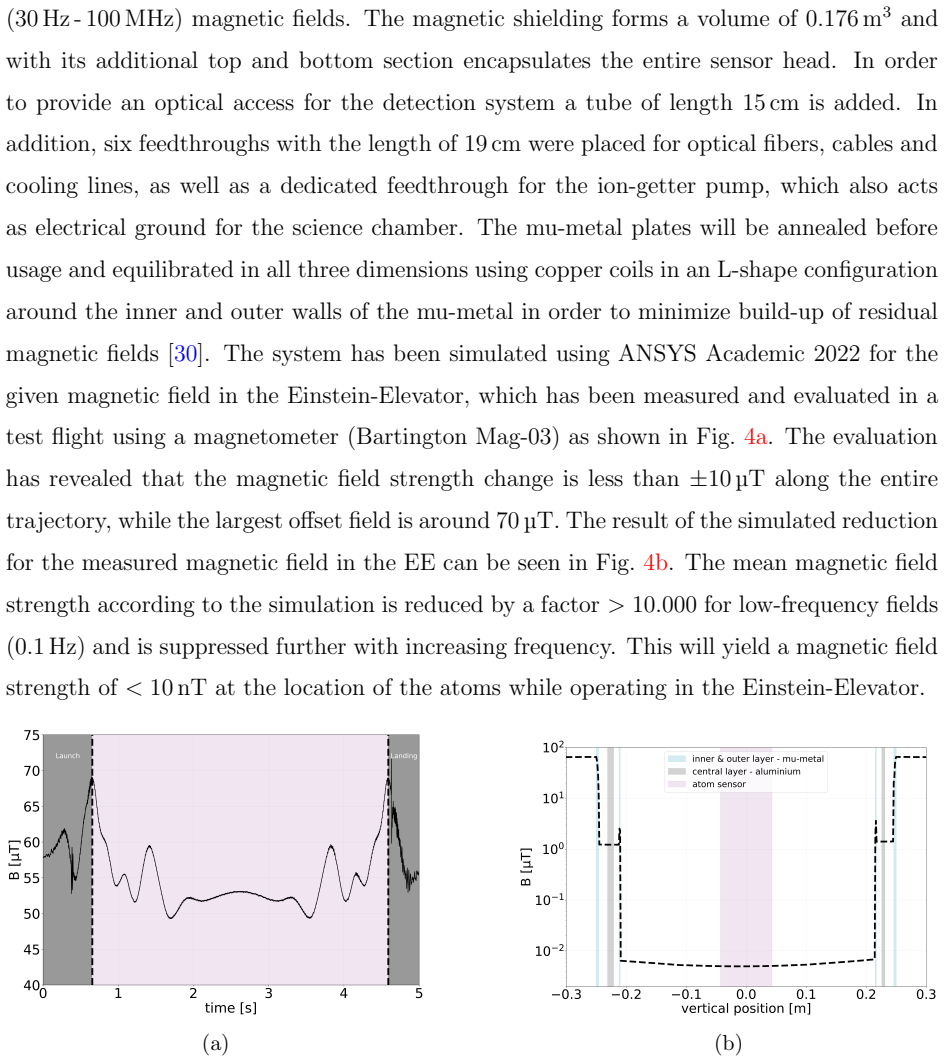
The source chamber consists of an atom oven providing the atoms for experimentation and, additionally, a two-dimensional magneto-optical trap including a directional laser beam able to transport pre-cooled atoms into the science chamber (2D +-MOT)
-
[2]
The chamber is equipped with a total of ten ports
The central chamber, which is referred to as the science chamber, is where the actual atom cooling, BEC creation, and state manipulation is performed. The chamber is equipped with a total of ten ports. Seven of the ten ports have an inner diameter of 20 mm and are equipped with windows that feature an anti-reflective (AR) coating for 780 nm light. Two of ...
-
[3]
It houses the vacuum pumps and vacuum gauges
The support chamber is connected to the second large port on the opposite side of the detection lens. It houses the vacuum pumps and vacuum gauges. Furthermore, it is also equipped with a viewport (b) to enable further optical access to the science chamber. 4 The different chambers are made of titanium in order to comply with the requirements on magnetic ...
work page 2022
-
[4]
This enables robust science laser modules (see Fig
Laser sources In order to cope with the requirements of the EE, the science lasers are implemented as fiber-coupled micro-integrated diode laser modules using a technology based on the one described in [31, 32]. This enables robust science laser modules (see Fig. 6) with a footprint of 139 mm × 80 mm and a mass of approximately 0.8 kg. FIG. 6: Photograph ...
-
[5]
Reference laser As reference for the science lasers, a micro-integrated frequency reference module is used. It consists of a distributed feedback laser (DFB) with a dedicated frequency modulation spectroscopy (FMS) unit based on the design in [35, 36]. The design has been adapted to the needs of the sensor by modifying the laser and spectroscopy units and...
-
[6]
The compartment housing this fiber network, is shown in Fig
Beat detection system The beat detection system is entirely fiber-based. The compartment housing this fiber network, is shown in Fig. 8b. The fiber-based approach, with higher losses but also less need for maintenance, is preferred for long continuous measurement campaigns due to its expected stability gain in comparison with free-space optics. In the sys...
-
[7]
Distribution System The major part of the output power of the science lasers is sent to the distribution module. To achieve the high efficiencies required to provide sufficient optical power to the sensor head, a free-space approach is chosen. A picture of the system can be found in Fig. 9. The design follows similar system designs, which already proved t...
-
[8]
Ground laser system In order to test capabilities on the ground another fiber-coupled laser system has been developed. While larger in footprint and not optimized for usage in the Einstein-Elevator, it offers more flexibility in terms of power and modifications for the initial testing on the ground. The laser system provides 485 mW of total power to the 2...
-
[9]
Self-built telescopes produce collimated beams with circular or linear polarization
Optical system The light from the laser system is guided to the science and source chamber by polar- ization maintaining fibers. Self-built telescopes produce collimated beams with circular or linear polarization. In the 2D +-MOT , the pusher beam is propagating towards the center of the differential pumping stage, pushing the atoms towards the 3D-MOT. Th...
-
[10]
The 2D +-MOT is surrounded by four coils
Magnetic field coils Next to the optical capabilities, there are several coils added to provide magneto-optical trapping and manipulation. The 2D +-MOT is surrounded by four coils. Those are rect- angular shaped, have a size of 47 mm × 83 mm, and are separated by 62 mm. Each coil comprises 64 windings of Kapton-insulated copper wire with a diameter of 0.7...
-
[11]
The resulting focal point has a diameter of 10.5 µm (1/e2) and a Rayleigh range of 320 µm
to the intersection point and cross under an angle of 30 °. The resulting focal point has a diameter of 10.5 µm (1/e2) and a Rayleigh range of 320 µm. With this system it is possible to bring up to 10 W per beam to the location of the atoms. To increase the trapping volume of the cODT, both beams can be spatially modulated in two directions. Given the cap...
-
[12]
I. Alonso et al., Cold atoms in space: community workshop summary and proposed road-map, EPJ Quantum Technology 9, 30 (2022)
work page 2022
-
[13]
S. Herrmann et al., Test of the Gravitational Redshift with Galileo Satellites in an Eccentric Orbit, Phys. Rev. Lett. 121, 231102 (2018)
work page 2018
-
[14]
S. Peil, S. Crane, J. L. Hanssen, T. B. Swanson, and C. R. Ekstrom, Tests of local position invariance using continuously running atomic clocks, Phys. Rev. A 87, 010102 (2013)
work page 2013
-
[15]
B. Battelier et al., Exploring the foundations of the physical universe with space tests of the equivalence principle, Experimental Astronomy 51, 1695 (2021)
work page 2021
-
[16]
S. Dimopoulos, P. W. Graham, J. M. Hogan, M. A. Kasevich, and S. Rajendran, Gravitational wave detection with atom interferometry, Phys. Lett. B 678, 37 (2009). 26
work page 2009
- [17]
- [18]
- [19]
-
[20]
T. L´ ev` equeet al. , Correlated atom accelerometers for mapping the Earth gravity field from Space, in International Conference on Space Optics , Vol. 11180 (SPIE, 2019) p. 344
work page 2019
-
[21]
Jekeli, Navigation Error Analysis of Atom Interferometer Inertial Sensor, NAVIGATION 52, 1 (2005)
C. Jekeli, Navigation Error Analysis of Atom Interferometer Inertial Sensor, NAVIGATION 52, 1 (2005)
work page 2005
-
[22]
B. Canuel et al. , Six-axis inertial sensor using cold-atom interferometry, Physical Review Letters 97, 010402 (2006)
work page 2006
-
[23]
P. Cheiney et al. , Navigation-Compatible Hybrid Quantum Accelerometer Using a Kalman Filter, Physical Review Applied 10, 034030 (2018)
work page 2018
-
[24]
B. Barrett, P. Cheiney, B. Battelier, F. Napolitano, and P. Bouyer, Multidimensional Atom Optics and Interferometry, Physical Review Letters 122, 043604 (2019)
work page 2019
-
[25]
M. Gersemann, M. Gebbe, S. Abend, C. Schubert, and E. M. Rasel, Differential interferometry using a Bose-Einstein condensate, The European Physical Journal D 74, 203 (2020)
work page 2020
-
[26]
S. Abend et al., Technology roadmap for cold-atoms based quantum inertial sensor in space, AVS Quantum Science 5, 019201 (2023)
work page 2023
-
[27]
H. M¨ untingaet al. , Interferometry with Bose-Einstein Condensates in Microgravity, Phys. Rev. Lett. 110, 093602 (2013)
work page 2013
-
[28]
D. Becker et al., Space-borne Bose–Einstein condensation for precision interferometry, Nature 562, 391–395 (2018)
work page 2018
-
[29]
Condon et al., All-optical bose-einstein condensates in microgravity, Phys
G. Condon et al., All-optical bose-einstein condensates in microgravity, Phys. Rev. Lett. 123, 240402 (2019)
work page 2019
-
[30]
C. Pelluet et al. , Atom interferometry in an Einstein Elevator 10.48550/arXiv.2407.07183 (2024). 27
-
[31]
P. Feldmann et al. , Optimal squeezing for high-precision atom interferometers 10.48550/arXiv.2311.10241 (2023)
-
[32]
R. Roy, A. Green, R. Bowler, and S. Gupta, Rapid cooling to quantum degeneracy in dynam- ically shaped atom traps, Phys. Rev. A 93, 043403 (2016)
work page 2016
-
[33]
B. L¨ uckeet al., Twin matter waves for interferometry beyond the classical Limit, Science 334, 773 (2011)
work page 2011
-
[34]
I. Kruse et al. , Improvement of an Atomic Clock using Squeezed Vacuum, Physical Review Letters 117, 143004 (2016)
work page 2016
-
[35]
C. Cassens, B. Meyer-Hoppe, E. Rasel, and C. Klempt, An entanglement-enhanced atomic gravimeter 10.48550/arXiv.2404.18668
-
[36]
All-optical production of Bose-Einstein condensates with 2 Hz repetition rate
M. Hetzel, M. Quensen, J. S. Haase, and C. Klempt, All-optical production of Bose-Einstein condensates with 2 Hz repetition rate 10.48550/arXiv.2406.16488 (2024)
work page internal anchor Pith review Pith/arXiv arXiv doi:10.48550/arxiv.2406.16488 2024
-
[37]
J. Rudolph et al. , A high-flux BEC source for mobile atom interferometers, New Journal of Physics 17, 065001 (2015)
work page 2015
-
[38]
C. Lotz, Untersuchungen zu Einflussfaktoren auf die Qualit¨ at von Experimenten unter Mikro- gravitation im Einstein-Elevator, Ph.D. thesis, Gottfried Wilhelm Leibniz Universit¨ at Han- nover (2022)
work page 2022
-
[39]
M. Raudonis et al., Microgravity facilities for cold atom experiments, Quantum Science and Technology 8, 044001 (2023)
work page 2023
-
[40]
S. T. Seidel, Eine Quelle f¨ ur die Interferometrie mit Bose-Einstein-Kondensaten auf Hoehen- forschungsraketen, Ph.D. thesis, Gottfried Wilhelm Leibniz Universit¨ at Hannover (2014)
work page 2014
-
[41]
I. Altarev et al. , Minimizing magnetic fields for precision experiments, Journal of Applied Physics 117, 233903 (2015)
work page 2015
-
[42]
C. K¨ urbiset al. , Extended cavity diode laser master-oscillator-power-amplifier for operation of an iodine frequency reference on a sounding rocket, Applied Optics 59, 253 (2020)
work page 2020
-
[43]
J. Hirsch et al. , Micro-integrated diode laser modules for operation in quantum technology applications, Proc. SPIE Int. Soc. Opt. Eng. 12912, 129120B (2024)
work page 2024
-
[44]
M. Schiemangk et al., Accurate frequency noise measurement of free-running lasers, Applied Optics 53, 7138 (2014)
work page 2014
-
[45]
G. Di Domenico, S. Schilt, and P. Thomann, Simple approach to the relation between laser frequency noise and laser line shape, Applied Optics 49, 4801 (2010). 28
work page 2010
-
[46]
A. Strangfeld et al. , Prototype of a compact rubidium-based optical frequency reference for operation on nanosatellites, J. Opt. Soc. Am. B 38, 1885 (2021)
work page 2021
-
[47]
A. Strangfeld, B. Wiegand, J. Kluge, M. Schoch, and M. Krutzik, Compact plug and play optical frequency reference device based on doppler-free spectroscopy of rubidium vapor, Opt. Express 30, 12039 (2022)
work page 2022
-
[48]
B. Wiegand, B. Leykauf, R. J¨ ordens, and M. Krutzik, Linien: A versatile, user-friendly, open- source FPGA-based tool for frequency stabilization and spectroscopy parameter optimization, Review of Scientific Instruments 93 (2022)
work page 2022
-
[49]
J. Pahl et al. , Compact and robust diode laser system technology for dual-species ultracold atom experiments with rubidium and potassium in microgravity, Appl. Opt. 58, 5456 (2019)
work page 2019
-
[50]
M. A. Popp, Compact, low-noise current drivers for quantum sensors with atom chips, Ph.D. thesis, Gottfried Wilhelm Leibniz Universit¨ at Hannover (2018)
work page 2018
-
[51]
A. Herbst et al. , High-flux source system for matter-wave interferometry exploiting tunable interactions, Physical Review Research 6 (2024)
work page 2024
-
[52]
H. Ammann and N. Christensen, Delta Kick Cooling: A New Method for Cooling Atoms, Phys. Rev. Lett. 78, 2088 (1997)
work page 2088
-
[53]
B. Meyer-Hoppe et al. , Dynamical low-noise microwave source for cold-atom experiments, Review of Scientific Instruments 94, 074705 (2023)
work page 2023
-
[54]
Bourdeauducq et al., Artiq: Advanced real-time infrastructure for quantum physics (2021)
S. Bourdeauducq et al., Artiq: Advanced real-time infrastructure for quantum physics (2021)
work page 2021
-
[55]
Sinara Hardware Project, Sinara: Open-Source Hardware for Quantum Physics (2024), ac- cessed: 2024-07-30
work page 2024
-
[56]
G. Kasprowicz et al. , Urukul – Open-source Frequency Synthesizer Module for Quantum Physics, International Journal of Electronics and Telecommunications 68, 123 (2022)
work page 2022
-
[57]
Grafana Labs, Grafana documentation (2018)
work page 2018
-
[58]
L. Pezz` e, A. Smerzi, M. K. Oberthaler, R. Schmied, and P. Treutlein, Quantum metrology with nonclassical states of atomic ensembles, Rev. Mod. Phys. 90, 035005 (2018)
work page 2018
-
[59]
C. D. Hamley, C. S. Gerving, T. M. Hoang, E. M. Bookjans, and M. S. Chapman, Spin-nematic squeezed vacuum in a quantum gas, Nature Physics 8, 305–308 (2012)
work page 2012
- [60]
-
[61]
P. Laurent et al., Qualification and frequency accuracy of the space-based primary frequency standard PHARAO, Metrologia 57, 055005 (2020)
work page 2020
-
[62]
F. Anders et al. , Momentum Entanglement for Atom Interferometry, Phys. Rev. Lett. 127, 140402 (2021). 30
work page 2021
discussion (0)
Sign in with ORCID, Apple, or X to comment. Anyone can read and Pith papers without signing in.