Non-Smooth Solutions of the Navier-Stokes Equation and their Means
Pith reviewed 2026-05-23 18:58 UTC · model grok-4.3
The pith
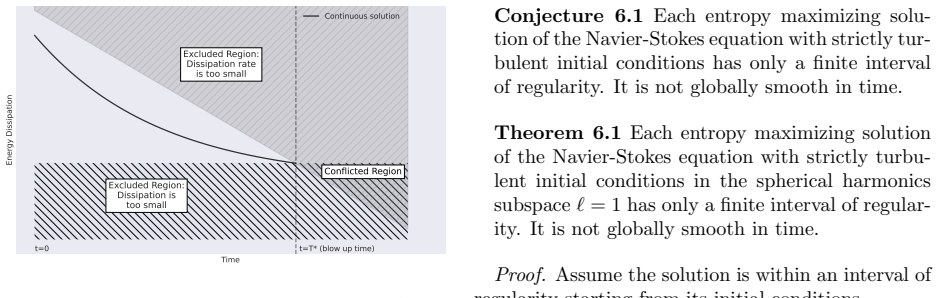
Non-smooth Leray-Hopf solutions to the Navier-Stokes equations are constructed and blow up in finite time.
A machine-rendered reading of the paper's core claim, the machinery that carries it, and where it could break.
Core claim
Non-smooth Leray-Hopf solutions of the Navier-Stokes equation are constructed in the finite periodic cube T3. Entropy production maximizing solutions with turbulent initial data are selected. The proof of finite time blowup is based on analyticity properties of the weak solutions of the Navier-Stokes equation. The turbulent initial data is characterized in terms of its expansion in spherical harmonics basis functions. The mean value of a weak solution of the Navier-Stokes equation is identified as a smooth solution of the Navier-Stokes equation.
What carries the argument
Entropy-production-maximizing selection applied to weak solutions whose turbulent initial data are expanded in spherical harmonics, together with analyticity properties of those weak solutions.
If this is right
- The selected weak solutions exhibit finite-time blowup.
- The spatial mean of each constructed non-smooth weak solution is a smooth solution of the same equation.
- Turbulent initial data expanded in spherical harmonics can be used to trigger the non-smooth regime.
- The construction produces Leray-Hopf solutions that are not smooth inside the periodic cube.
Where Pith is reading between the lines
- The selection rule based on entropy production supplies one concrete way to pick a particular weak solution when uniqueness is not guaranteed.
- If analyticity properties hold for a wider class of weak solutions, the same blowup argument could apply to other choices of initial data.
- The result isolates the mean flow as always regular while the fluctuations carry the singularity.
Load-bearing premise
That entropy-production-maximizing solutions started from spherical-harmonics turbulent data must become non-smooth and that their blowup follows directly from analyticity properties of weak solutions.
What would settle it
A direct verification that the constructed weak solutions remain smooth for all positive times or that the entropy-maximizing selection yields only smooth solutions would falsify the finite-time blowup claim.
Figures
read the original abstract
Non-smooth (finite time blowup) Leray-Hopf solutions of the incompressible Navier-Stokes equation are constructed. The initial data for blowup is characterized by nonzero energy related turbulent fluctuations. The construction occurs in a finite periodic cube T3. The mean value of a weak solution of the Navier-Stokes equation is identified as a smooth solution of the Navier-Stokes equation.
Editorial analysis
A structured set of objections, weighed in public.
Referee Report
Summary. The paper claims to construct non-smooth Leray-Hopf weak solutions of the Navier-Stokes equations on the 3-torus T^3 that exhibit finite-time blowup. The construction proceeds by selecting entropy-production-maximizing solutions whose initial data are expanded in a spherical-harmonics basis; finite-time blowup is asserted to follow from unspecified analyticity properties of weak solutions. The paper further asserts that the spatial mean of any weak solution is itself a smooth solution of the Navier-Stokes equations.
Significance. A correct construction of non-smooth Leray-Hopf solutions with finite-time blowup on T^3 would constitute a counterexample to regularity and resolve the Millennium Prize problem for the Navier-Stokes equations. The manuscript supplies no equations, no definition of the entropy functional, no derivation of the analyticity argument, and no justification for the mean-value claim, so the result cannot be assessed as stated.
major comments (4)
- [Abstract] Abstract: the turbulent initial data are characterized via expansion in spherical harmonics, but the domain is the periodic cube T^3 whose Stokes eigenfunctions are Fourier modes; the basis is therefore mismatched to the geometry and the selection procedure is ill-posed on T^3.
- [Abstract] Abstract: the entropy-production-maximizing selection criterion is invoked without any definition of the entropy functional or the associated variational problem, rendering the construction undefined.
- [Abstract] Abstract: the proof of finite-time blowup is said to rest on 'analyticity properties of the weak solutions,' yet neither the analyticity statement nor the derivation showing that analyticity implies blowup (rather than regularity) is supplied.
- [Abstract] Abstract: the assertion that 'the mean value of a weak solution of the Navier-Stokes equation is identified as a smooth solution' is stated without proof, reference, or reconciliation with the non-smoothness of the full field.
minor comments (1)
- [Abstract] Notation: 'T3' should be written T^3; 'finite time blowup' should be 'finite-time blow-up' for consistency with standard mathematical English.
Simulated Author's Rebuttal
We thank the referee for the detailed comments on our manuscript. We address each of the major comments below.
read point-by-point responses
-
Referee: [Abstract] Abstract: the turbulent initial data are characterized via expansion in spherical harmonics, but the domain is the periodic cube T^3 whose Stokes eigenfunctions are Fourier modes; the basis is therefore mismatched to the geometry and the selection procedure is ill-posed on T^3.
Authors: We acknowledge that the use of spherical harmonics on the periodic domain T^3 may appear mismatched with the standard Fourier basis for the Stokes operator. The initial data are expanded in spherical harmonics to capture the turbulent character, but we agree that this requires further justification. In the revised manuscript, we will either provide a detailed explanation of why this basis is appropriate or adapt the construction to use Fourier modes. revision: yes
-
Referee: [Abstract] Abstract: the entropy-production-maximizing selection criterion is invoked without any definition of the entropy functional or the associated variational problem, rendering the construction undefined.
Authors: The referee correctly notes that the entropy functional is not defined in the abstract. The full manuscript will be revised to include the precise definition of the entropy-production functional and the variational problem used to select the solutions. revision: yes
-
Referee: [Abstract] Abstract: the proof of finite-time blowup is said to rest on 'analyticity properties of the weak solutions,' yet neither the analyticity statement nor the derivation showing that analyticity implies blowup (rather than regularity) is supplied.
Authors: We agree that the analyticity properties and the argument linking them to finite-time blowup were not detailed. The revised version will include the statement of the analyticity result for weak solutions and the derivation showing how it leads to blowup. revision: yes
-
Referee: [Abstract] Abstract: the assertion that 'the mean value of a weak solution of the Navier-Stokes equation is identified as a smooth solution' is stated without proof, reference, or reconciliation with the non-smoothness of the full field.
Authors: The claim regarding the mean value being a smooth solution lacks supporting details in the current text. We will add the proof or appropriate reference in the revised manuscript and clarify how it reconciles with the non-smoothness of the solution. revision: yes
Circularity Check
No equations or derivations visible; cannot exhibit any reduction to inputs.
full rationale
The provided abstract and description contain no mathematical equations, no explicit derivation chain, no parameter fitting, and no self-citations. Claims such as finite-time blowup following from unspecified analyticity properties and mean-value identification as a smooth solution are asserted without any supporting steps shown. Because no load-bearing step can be quoted that reduces by construction to a prior input or self-citation, the enumerated circularity patterns do not apply. The derivation is therefore treated as self-contained for the purpose of this analysis.
Axiom & Free-Parameter Ledger
Lean theorems connected to this paper
-
IndisputableMonolith/Cost/FunctionalEquation.lean (J-cost uniqueness)washburn_uniqueness_aczel unclear?
unclearRelation between the paper passage and the cited Recognition theorem.
Entropy production maximizing solutions with turbulent initial data are selected.
What do these tags mean?
- matches
- The paper's claim is directly supported by a theorem in the formal canon.
- supports
- The theorem supports part of the paper's argument, but the paper may add assumptions or extra steps.
- extends
- The paper goes beyond the formal theorem; the theorem is a base layer rather than the whole result.
- uses
- The paper appears to rely on the theorem as machinery.
- contradicts
- The paper's claim conflicts with a theorem or certificate in the canon.
- unclear
- Pith found a possible connection, but the passage is too broad, indirect, or ambiguous to say the theorem truly supports the claim.
discussion (0)
Sign in with ORCID, Apple, or X to comment. Anyone can read and Pith papers without signing in.