Adaptive, symmetry-informed Bayesian metrology for precise quantum technology measurements
Pith reviewed 2026-05-23 18:41 UTC · model grok-4.3
The pith
Symmetry-informed Bayesian estimation reduces fractional variance in quantum parameter estimates by a factor of five.
A machine-rendered reading of the paper's core claim, the machinery that carries it, and where it could break.
Core claim
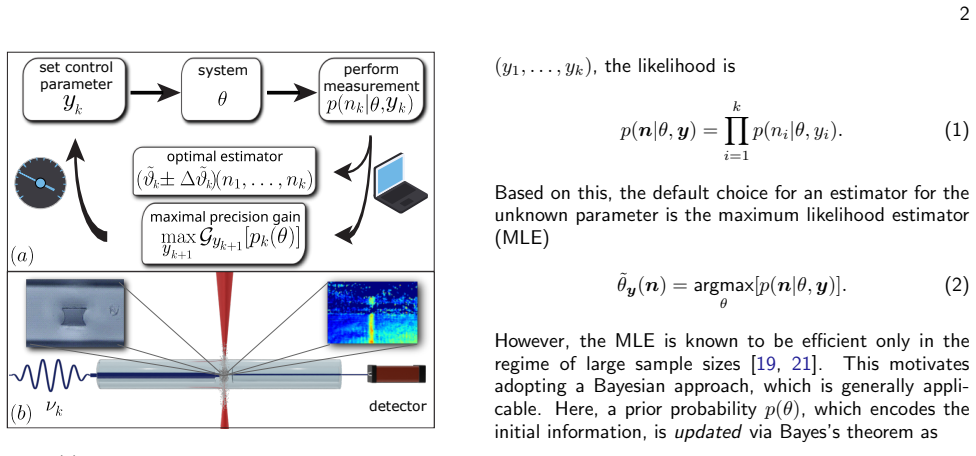
The authors introduce a systematic strategy for low-data parameter estimation that integrates experimental controls and natural symmetries under the guidance of a Bayesian precision-gain quantifier, enabling adaptive tailoring to each experiment. General expressions for optimal estimators are supplied for arbitrary parameters. In the caesium-atom micromachined-hole experiment the method yields a five-fold reduction in the fractional variance of the estimated parameter, equivalently achieving target precision with one-third the data points required by the standard procedure.
What carries the argument
The Bayesian quantifier of precision gain, which evaluates and guides adaptive choices of control parameters while folding in identified natural symmetries of the physical model.
If this is right
- Optimal estimators are available in closed form for any chosen parameter once the symmetry-informed Bayesian quantifier is applied.
- The same target precision is reached with one-third the measurements, directly accelerating data collection in quantum devices.
- The approach applies to any quantum technology setup in which symmetries can be identified beforehand.
- Enhanced device performance follows for applications in quantum computing, communication, and metrology.
Where Pith is reading between the lines
- If symmetry identification is uncertain, the reported gains may shrink unless a sensitivity analysis to mis-specification is performed.
- The strategy could be tested on other low-data quantum sensing platforms such as gravitational-wave detectors or nitrogen-vacancy centres to check transferability.
- Combining the method with model-selection tools would allow automatic discovery of which symmetries to include when the system is only partially understood.
Load-bearing premise
The method assumes that the relevant natural symmetries of the physical system can be correctly identified in advance and that the Bayesian precision-gain quantifier remains valid when the underlying model is only approximately known.
What would settle it
Repeat the caesium-atom experiment while deliberately using a mismatched set of assumed symmetries and check whether the five-fold variance reduction vanishes.
Figures


read the original abstract
High precision measurements are essential to solve major scientific and technological challenges, from gravitational wave detection to healthcare diagnostics. Quantum sensing delivers greater precision, but an in-depth optimisation of measurement procedures has been overlooked. Here we present a systematic strategy for parameter estimation in the low-data limit that integrates experimental control parameters and natural symmetries. The method is guided by a Bayesian quantifier of precision gain, enabling adaptive optimisation tailored to the experiment. We provide general expressions for optimal estimators for any parameter. The strategy's power is demonstrated in a quantum technology experiment, in which ultracold caesium atoms are confined in a micromachined hole in an optical fibre. We find a five-fold reduction in the fractional variance of the estimated parameter, compared to the standard measurement procedure. Equivalently, our strategy achieves a target precision with a third of the data points previously required. Such enhanced device performance and accelerated data collection will be essential for applications in quantum computing, communication, metrology, and the wider quantum technology sector.
Editorial analysis
A structured set of objections, weighed in public.
Referee Report
Summary. The paper presents a systematic adaptive Bayesian strategy for parameter estimation in quantum metrology that integrates experimental control parameters with natural symmetries of the physical system. It supplies general expressions for optimal estimators and demonstrates the method experimentally on ultracold caesium atoms confined in a micromachined optical-fibre hole, reporting a five-fold reduction in fractional variance (or equivalently a three-fold reduction in required data points) relative to a standard measurement procedure.
Significance. If the central experimental claim holds after the missing robustness checks, the work would offer a practical route to higher data efficiency in quantum sensing, directly relevant to applications in quantum computing, communication and metrology. The provision of general expressions for optimal estimators is a positive methodological contribution that could be reused beyond the specific demonstration.
major comments (2)
- [Experimental demonstration section] Experimental demonstration (section reporting the caesium-atom results): the five-fold fractional-variance reduction is stated without accompanying error bars, data-exclusion criteria, model-assumption validation or statistical tests; because this numerical improvement is the central empirical claim, the absence of these elements prevents assessment of whether the reported gain is statistically distinguishable from the standard procedure.
- [Method description section] Method description (section introducing the symmetry-informed Bayesian quantifier): the claimed precision gain rests on the premise that the relevant natural symmetries can be identified correctly a priori and that the quantifier remains valid under inevitable model mismatch; no sensitivity analysis to symmetry mis-specification or to deviations from the assumed Hamiltonian is supplied, yet this premise directly determines whether the reported variance reduction survives in a real experiment.
minor comments (2)
- Notation for the Bayesian precision-gain quantifier should be defined explicitly at first use and kept consistent with the general estimator expressions.
- Figure captions for the experimental data should state the number of independent runs and any fitting assumptions used to extract the reported variances.
Simulated Author's Rebuttal
We thank the referee for their constructive comments, which highlight important aspects for strengthening the presentation of our results. We respond to each major comment below and outline the revisions we will make.
read point-by-point responses
-
Referee: [Experimental demonstration section] Experimental demonstration (section reporting the caesium-atom results): the five-fold fractional-variance reduction is stated without accompanying error bars, data-exclusion criteria, model-assumption validation or statistical tests; because this numerical improvement is the central empirical claim, the absence of these elements prevents assessment of whether the reported gain is statistically distinguishable from the standard procedure.
Authors: We agree that the experimental results section requires additional statistical details to enable a full assessment of the reported improvement. In the revised manuscript we will add error bars to the fractional variance estimates (derived via bootstrap resampling of the experimental data), specify any data exclusion criteria applied, validate the key model assumptions against the measured data, and include statistical tests (such as a two-sample t-test or permutation test) to establish that the observed five-fold reduction is statistically distinguishable from the standard procedure. These elements will be incorporated into the main text and supplementary material. revision: yes
-
Referee: [Method description section] Method description (section introducing the symmetry-informed Bayesian quantifier): the claimed precision gain rests on the premise that the relevant natural symmetries can be identified correctly a priori and that the quantifier remains valid under inevitable model mismatch; no sensitivity analysis to symmetry mis-specification or to deviations from the assumed Hamiltonian is supplied, yet this premise directly determines whether the reported variance reduction survives in a real experiment.
Authors: The symmetries employed in the caesium experiment are directly determined from the well-established atomic physics of the system. Nevertheless, we acknowledge that a quantitative sensitivity analysis would strengthen the methodological contribution. In the revision we will add a dedicated subsection (and supporting simulations in the supplement) that examines the degradation of the precision gain under controlled mis-specification of the symmetry group and small deviations from the ideal Hamiltonian. Where possible we will also re-analyse subsets of the experimental data under perturbed models to illustrate robustness under realistic mismatch. revision: yes
Circularity Check
No circularity: Bayesian quantifier and experimental gain are independent of fitted outputs
full rationale
The derivation chain relies on a Bayesian precision-gain quantifier applied to an adaptive strategy that incorporates identified symmetries and control parameters. The reported five-fold variance reduction is obtained by direct comparison to a standard measurement procedure on the caesium-atom data; the quantifier is not defined in terms of the estimated parameter itself, nor is any prediction shown to be statistically forced by a fitted subset. No self-citation chain, ansatz smuggling, or renaming of known results appears in the abstract or described method. The central claim therefore retains independent content from the Bayesian framework and the external experimental benchmark.
Axiom & Free-Parameter Ledger
Reference graph
Works this paper leans on
-
[1]
J. M. Hogan and M. A. Kasevich, Atom-interferometric gravitational-wave detection using heterodyne laser links, Phys. Rev. A 94, 033632 (2016)
work page 2016
-
[2]
L. Badurina, E. Bentine, D. Blas, K. Bongs, D. Bortoletto, T. Bowcock, K. Bridges, W. Bowden, O. Buchmueller, C. Burrage, J. Coleman, G. Elertas, J. Ellis, C. Foot, V. Gibson, M. Haehnelt, T. Harte, S. Hedges, R. Hob- son, M. Holynski, T. Jones, M. Langlois, S. Lellouch, M. Lewicki, R. Maiolino, P. Majewski, S. Malik, J. March- Russell, C. McCabe, D. Newb...
work page 2020
- [3]
-
[4]
C. L. Degen, F. Reinhard, and P. Cappellaro, Quantum sensing, Rev. Mod. Phys. 89, 035002 (2017)
work page 2017
-
[5]
E. Boto, N. Holmes, J. Leggett, G. Roberts, V. Shah, S. S. Meyer, L. D. Mu˜ noz, K. J. Mullinger, T. M. Tier- ney, S. Bestmann, G. R. Barnes, R. Bowtell, and M. J. Brookes, Moving magnetoencephalography towards real- world applications with a wearable system., Nature 555, 657–66 (2018)
work page 2018
-
[6]
F. A. Narducci, A. T. Black, and J. H. Burke, Advances toward fieldable atom interferometers, Adv. Phys. X 7, 1946426 (2022)
work page 2022
-
[7]
J. Lee, R. Ding, J. Christensen, R. R. Rosenthal, A. Ison, D. P. Gillund, D. Bossert, K. H. Fuerschbach, W. Kindel, P. S. Finnegan, J. R. Wendt, M. Gehl, A. Kodigala, H. McGuinness, C. A. Walker, S. A. Kemme, A. Lentine, G. Biedermann, and P. D. D. Schwindt, A compact cold-atom interferometer with a high data-rate grating magneto-optical trap and a photon...
work page 2022
- [8]
-
[9]
T. M. Graham, Y. Song, J. Scott, C. Poole, L. Phutti- tarn, K. Jooya, P. Eichler, X. Jiang, A. Marra, B. Grinke- meyer, M. Kwon, M. Ebert, J. Cherek, M. T. Lichtman, M. Gillette, J. Gilbert, D. Bowman, T. Ballance, C. Camp- bell, E. D. Dahl, O. Crawford, N. S. Blunt, B. Rogers, T. Noel, and M. Saffman, Multi-qubit entanglement and algorithms on a neutral-...
work page 2022
-
[10]
Wintersperger, Karen, Dommert, Florian, Ehmer, Thomas, Hoursanov, Andrey, Klepsch, Johannes, Mauerer, Wolfgang, Reuber, Georg, Strohm, Thomas, Yin, Ming, and Luber, Sebastian, Neutral atom quantum computing hardware: performance and end-user perspec- tive, EPJ Quantum Technol. 10, 32 (2023). 7
work page 2023
-
[11]
X. Deng, S. Li, Z. Chen, Z. Ni, Y. Cai, J. Mai, L. Zhang, P. Zheng, H. Yu, C. Zou, S. Liu, F. Yan, Y. Xu, and D. Yu, Quantum-enhanced metrology with large fock states, Nat. Phys. 20, 1874–1880 (2024)
work page 2024
-
[12]
Y. Len, T. Gefen, A. Retzker, and J. Ko lody´ nski, Quan- tum metrology with imperfect measurements, Nat. Com- mun. 13, 6971 (2022)
work page 2022
-
[13]
P. Horodecki, L. Rudnicki, and K. ˙Zyczkowski, Five open problems in quantum information theory, PRX Quantum 3, 010101 (2022)
work page 2022
-
[14]
S. G. Turyshev, U. E. Israelsson, M. Shao, N. Yu, A. Kusenko, E. L. Wright, C. W. F. Everitt, M. Kase- vich, J. A. Lipa, J. C. Mester, R. D. Reasenberg, R. L. Walsworth, N. Ashby, H. Gould, and H. J. Paik, Space- based research in fundamental physics and quantum tech- nologies, Int. J. Mod. Phys. D 16, 1879 (2007)
work page 2007
-
[15]
R. Kaltenbaek, A. Acin, L. Bacsardi, P. Bianco, P. Bouyer, E. Diamanti, C. Marquardt, Y. Omar, V. Pruneri, E. Rasel, et al., Quantum technologies in space, Exp. As- tron. 51, 1677 (2021)
work page 2021
-
[16]
A. Belenchia, M. Carlesso, ¨Omer Bayraktar, D. De- qual, I. Derkach, G. Gasbarri, W. Herr, Y. L. Li, M. Rademacher, J. Sidhu, D. K. Oi, S. T. Seidel, R. Kaltenbaek, C. Marquardt, H. Ulbricht, V. C. Usenko, L. W¨ orner, A. Xuereb, M. Paternostro, and A. Bassi, Quantum physics in space, Phys. Rep. 951, 1 (2022)
work page 2022
- [17]
-
[18]
S. D. Bass and M. Doser, Quantum sensing for particle physics, Nat. Rev. Phys. 6, 329 (2024)
work page 2024
-
[19]
S. M. Kay, Fundamentals of Statistical Signal Processing: Estimation Theory (Prentice Hall, 1993)
work page 1993
-
[20]
M. G. Paris, Quantum estimation for quantum technology, Int. J. Quantum Inf. 7, 125 (2009)
work page 2009
-
[21]
R. Demkowicz-Dobrza´ nski, M. Jarzyna, and J. Ko lody´ nski, Quantum Limits in Optical Interfer- ometry, Prog. Opt. 60, 345 (2015)
work page 2015
-
[22]
V. Montenegro, C. Mukhopadhyay, R. Yousefjani, S. Sarkar, U. Mishra, M. G. A. Paris, and A. Bayat, Re- view: Quantum metrology and sensing with many-body systems, arXiv:2408.15323 (2024)
-
[23]
E. T. Jaynes, Probability Theory: The Logic of Science (Cambridge University Press, 2003)
work page 2003
-
[24]
J. Liu, H. Yuan, X.-M. Lu, and X. Wang, Quantum Fisher information matrix and multiparameter estimation, J. Phys. A: Math. Theor. 53, 023001 (2020)
work page 2020
-
[25]
Y. L. Len, T. Gefen, A. Retzker, and J. Ko lody´ nski, Quantum metrology with imperfect measurements, Na- ture Communications 13, 6971 (2022)
work page 2022
-
[26]
D. R. Arvidsson-Shukur, N. Yunger Halpern, H. V. Lep- age, A. A. Lasek, C. H. Barnes, and S. Lloyd, Quantum advantage in postselected metrology, Nature communica- tions 11, 3775 (2020)
work page 2020
-
[27]
J. Rubio and J. A. Dunningham, Quantum metrology in the presence of limited data, New J. Phys. 21, 043037 (2019)
work page 2019
- [28]
-
[29]
S. Morelli, A. Usui, E. Agudelo, and N. Friis, Bayesian parameter estimation using Gaussian states and measure- ments, Quantum Sci. Technol. 6, 025018 (2021)
work page 2021
- [30]
- [31]
- [32]
-
[33]
W. v. d. Linden, V. Dose, and U. v. Toussaint, Bayesian Probability Theory: Applications in the Physical Sciences (Cambridge University Press, 2014)
work page 2014
- [34]
-
[35]
S. Paesani, A. A. Gentile, R. Santagati, J. Wang, N. Wiebe, D. P. Tew, J. L. O’Brien, and M. G. Thomp- son, Experimental Bayesian Quantum Phase Estimation on a Silicon Photonic Chip, Phys. Rev. Lett. 118, 100503 (2017)
work page 2017
- [36]
-
[37]
R. Kaubruegger, D. V. Vasilyev, M. Schulte, K. Ham- merer, and P. Zoller, Quantum Variational Optimization of Ramsey Interferometry and Atomic Clocks, Phys. Rev. X 11, 041045 (2021)
work page 2021
-
[38]
I. Gianani, M. G. Genoni, and M. Barbieri, Assessing data postprocessing for quantum estimation, IEEE J. Sel. Top. Quantum Electron. 26, 1 (2020)
work page 2020
-
[39]
J. Glatthard, J. Rubio, R. Sawant, T. Hewitt, G. Baron- tini, and L. A. Correa, Optimal cold atom thermometry us- ing adaptive bayesian strategies, PRX Quantum 3, 040330 (2022)
work page 2022
-
[40]
L. Gerster, F. Mart ´ ınez-Garc ´ ıa, P. Hrmo, M. W. van Mourik, B. Wilhelm, D. Vodola, M. M¨ uller, R. Blatt, P. Schindler, and T. Monz, Experimental Bayesian Cal- ibration of Trapped-Ion Entangling Operations, PRX Quantum 3, 020350 (2022)
work page 2022
- [41]
-
[42]
A. Oliveira, J. Rubio, C. Noble, J. Anderson, J. Anders, and A. Mulholland, Fluctuation relations to calculate pro- tein redox potentials from molecular dynamics simula- tions, J. Chem. Theory Comput. 20, 385 (2023)
work page 2023
- [43]
-
[44]
F. Belliardo, V. Cimini, E. Polino, F. Hoch, B. Piccirillo, N. Spagnolo, V. Giovannetti, and F. Sciarrino, Optimiz- ing quantum-enhanced Bayesian multiparameter estima- tion of phase and noise in practical sensors, Phys. Rev. Res. 6, 023201 (2024)
work page 2024
- [45]
-
[46]
Z. Ma, C. Han, Z. Tan, H. He, S. Shi, X. Kang, J. Wu, J. Huang, B. Lu, and C. Lee, Adaptive cold-atom magne- tometry mitigating the trade-off between sensitivity and dynamic range, Science Advances 11, eadt3938 (2025)
work page 2025
-
[47]
C. W. Helstrom, Quantum Detection and Estimation The- 8 ory (Academic Press, New York, 1976)
work page 1976
-
[48]
G. D’Agostini, Bayesian inference in processing experi- mental data: principles and basic applications, Rep. Prog. Phys. 66, 1383 (2003)
work page 2003
-
[49]
K. Macieszczak, M. Fraas, and R. Demkowicz-Dobrza´ nski, Bayesian quantum frequency estimation in presence of col- lective dephasing, New J. Phys. 16, 113002 (2014)
work page 2014
-
[50]
R. Demkowicz-Dobrza´ nski, W. G´ orecki, and M. Gut ¸˘ a, Multi-parameter estimation beyond quantum Fisher in- formation, J. Phys. A: Math. Theor. 53, 363001 (2020)
work page 2020
-
[51]
J. Bavaresco, P. Lipka-Bartosik, P. Sekatski, and M. Mehboudi, Designing optimal protocols in Bayesian quantum parameter estimation with higher-order opera- tions, Phys. Rev. Res. 6, 023305 (2024)
work page 2024
-
[52]
Rubio, First-principles construction of symmetry- informed quantum metrologies, Phys
J. Rubio, First-principles construction of symmetry- informed quantum metrologies, Phys. Rev. A 110, L030401 (2024)
work page 2024
-
[53]
L. Su, A. Douglas, M. Szurek, A. H. H´ ebert, A. Krahn, R. Groth, G. A. Phelps, O. Markovi´ c, and M. Greiner, Fast single atom imaging for optical lattice arrays., Nat. Commun. 16, 1017 (2025)
work page 2025
- [54]
-
[55]
Rubio, Quantum scale estimation, Quantum Sci
J. Rubio, Quantum scale estimation, Quantum Sci. Tech- nol. 8, 015009 (2022)
work page 2022
-
[56]
E. D. Ros, N. Cooper, J. Nute, and L. Hackermueller, Cold atoms in micromachined waveguides: A new platform for atom-photon interactions, Phys. Rev. Research 2, 033098 (2020)
work page 2020
- [57]
-
[58]
B. Schrinski, P. Haslinger, J. Schmiedmayer, K. Horn- berger, and S. Nimmrichter, Testing collapse models with bose-einstein-condensate interferometry, Phys. Rev. A 107, 043320 (2023)
work page 2023
-
[59]
K. Clements, B. Elder, L. Hackermueller, M. Fromhold, and C. Burrage, Detecting dark domain walls through their impact on particle trajectories in tailored ultrahigh vacuum environments, Phys. Rev. D 109, 123023 (2024)
work page 2024
- [60]
-
[61]
M. Mehboudi, M. R. Jørgensen, S. Seah, J. B. Brask, J. Ko lody´ nski, and M. Perarnau-Llobet, Fundamental Limits in Bayesian Thermometry and Attainability via Adaptive Strategies, Phys. Rev. Lett. 128, 130502 (2022)
work page 2022
-
[62]
S. Kurdzia lek, W. G´ orecki, F. Albarelli, and R. Demkowicz-Dobrza´ nski, Using adaptiveness and causal superpositions against noise in quantum metrol- ogy, Phys. Rev. Lett. 131, 090801 (2023)
work page 2023
-
[63]
J. G. Smith, C. H. W. Barnes, and D. R. M. Arvidsson- Shukur, Adaptive Bayesian quantum algorithm for phase estimation, Phys. Rev. A 109, 042412 (2024)
work page 2024
-
[64]
B. MacLellan, P. Roztocki, S. Czischek, and R. G. Melko, End-to-end variational quantum sensing, arXiv:2403.02394 (2024)
-
[65]
Demkowicz-Dobrza´ nski, Optimal phase estimation with arbitrary a priori knowledge, Phys
R. Demkowicz-Dobrza´ nski, Optimal phase estimation with arbitrary a priori knowledge, Phys. Rev. A 83, 061802 (2011)
work page 2011
-
[66]
R. E. Kass and L. Wasserman, The Selection of Prior Distributions by Formal Rules, J Am Stat Assoc 91, 1343 (1996)
work page 1996
-
[67]
S.-I. Amari, Information Geometry and Its Applications , 1st ed., Applied mathematical sciences (Springer, Tokyo, Japan, 2016)
work page 2016
-
[68]
W. Bogaerts, D. P´ erez, J. Capmany, D. A. B. Miller, J. Poon, D. Englund, F. Morichetti, and A. Melloni, Pro- grammable photonic circuits, Nature 586, 207 (2020)
work page 2020
- [69]
-
[70]
N. V. Corzo, J. Raskop, A. Chandra, A. S. Sheremet, B. Gouraud, and J. Laurat, Waveguide-coupled single collective excitation of atomic arrays, Nature 566, 359 (2019)
work page 2019
-
[71]
C. Troullinou, V. G. Lucivero, and M. W. Mitchell, Quantum-enhanced magnetometry at optimal number density, Phys. Rev. Lett. 131, 133602 (2023)
work page 2023
- [72]
-
[73]
V. Naniyil, Y. Zhou, G. Simmonds, N. Cooper, W. Li, and L. Hackermueller, Observation of collectivity enhanced magnetoassociation of 6Li in the quantum degenerate regime, New Journal of Physics 24, 113005 (2022)
work page 2022
-
[74]
D. A. Steck, Cesium D line data, revision 2.3.3, http: //steck.us/alkalidata (2024), accessed: 2024-09-10
work page 2024
-
[75]
Tsang, Generalized conditional expectations for quan- tum retrodiction and smoothing, Phys
M. Tsang, Generalized conditional expectations for quan- tum retrodiction and smoothing, Phys. Rev. A 105, 042213 (2022)
work page 2022
-
[76]
I. S. M. Schuld and F. Petruccione, An introduction to quantum machine learning, Contemp. Phys. 56, 172 (2015)
work page 2015
-
[77]
L. J. Fiderer, J. Schuff, and D. Braun, Neural-Network Heuristics for Adaptive Bayesian Quantum Estimation, PRX Quantum 2, 020303 (2021)
work page 2021
-
[78]
D. Koutn´ y, L. Motka, Z. c. v. Hradil, J. ˇReh´ aˇ cek, and L. L. S´ anchez-Soto, Neural-network quantum state to- mography, Phys. Rev. A 106, 012409 (2022)
work page 2022
-
[79]
V. Gebhart, R. Santagati, A. A. Gentile, E. M. Gauger, D. Craig, N. Ares, L. Banchi, F. Marquardt, L. Pezz` e, and C. Bonato, Learning quantum systems, Nat. Rev. Phys. 5, 141 (2023)
work page 2023
-
[80]
E. Rinaldi, M. G. Lastre, S. G. Herreros, S. Ahmed, M. Khanahmadi, F. Nori, and C. S. Mu˜ noz, Parameter es- timation from quantum-jump data using neural networks, Quantum Sci. Technol. 9, 035018 (2024)
work page 2024
discussion (0)
Sign in with ORCID, Apple, or X to comment. Anyone can read and Pith papers without signing in.