Aligned Vector Quantization for Edge-Cloud Collabrative Vision-Language Models
Pith reviewed 2026-05-23 17:06 UTC · model grok-4.3
The pith
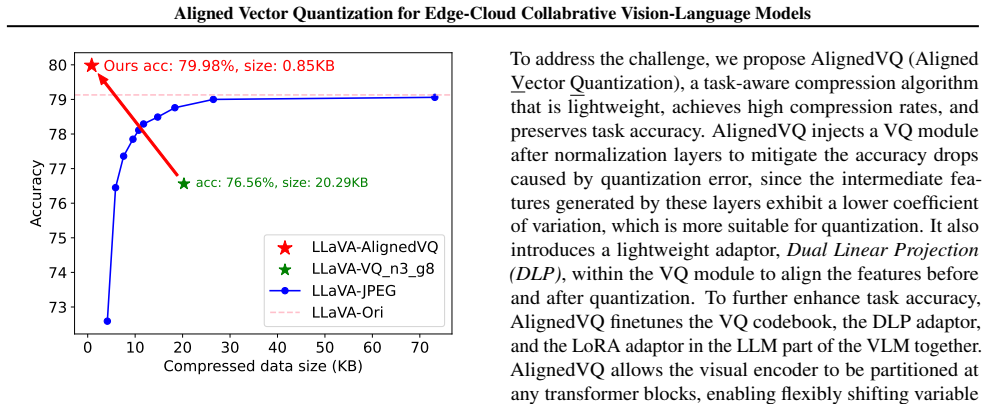
The AlignedVQ algorithm compresses intermediate features in vision-language models by 1365 times, enabling edge-cloud collaboration that cuts transmission overhead by 96.8% and speeds up inference 2-15 times with accuracy within 2% of the原版
A machine-rendered reading of the paper's core claim, the machinery that carries it, and where it could break.
Core claim
The paper claims that the Aligned Vector Quantization algorithm can be inserted into an existing LLaVA model to support partitioned execution, achieving an approximately 1365x compression rate on intermediate features. This reduces data transmission overhead by 96.8% compared with sending JPEG90-compressed images, delivers an inference speedup of 2-15x, and keeps accuracy within -2.23% to +1.6% of the original model across eight VQA datasets, all without requiring model retraining or further architectural changes.
What carries the argument
Aligned Vector Quantization (AlignedVQ), a quantization step placed after early layers that aligns codebook entries to preserve semantic content of intermediate activations for the cloud-side layers.
If this is right
- Early layers run on the edge device and only quantized features travel to the cloud.
- Transmission volume falls below even heavily compressed raw images.
- End-to-end inference time decreases by a factor of 2 to 15.
- Accuracy on visual question answering remains comparable to the cloud-only baseline.
- The change requires no retraining and works on existing model weights.
Where Pith is reading between the lines
- The same quantization step could be tested on other vision-language architectures beyond LLaVA.
- Lower transmission might allow collaborative inference on slower or metered networks.
- Energy use on the edge device could drop if early layers are lighter than full forward passes.
- Combining AlignedVQ with existing model pruning might produce further size reductions.
Load-bearing premise
The quantized intermediate features still contain enough semantic information for the remaining model layers to answer visual questions correctly.
What would settle it
Running LLaVA-AlignedVQ on the eight VQA datasets and observing accuracy drops larger than 2.23% relative to the unmodified LLaVA model would falsify the central accuracy claim.
Figures


read the original abstract
Vision Language Models (VLMs) are central to Visual Question Answering (VQA) systems and are typically deployed in the cloud due to their high computational demands. However, this cloud-only approach underutilizes edge computational resources and requires significant bandwidth for transmitting raw images. In this paper, we introduce an edge-cloud collaborative VQA system, called LLaVA-AlignedVQ, which features a novel Aligned Vector Quantization algorithm (AlignedVQ) that efficiently compress intermediate features without compromising accuracy to support partitioned execution. Our experiments demonstrate that LLaVA-AlignedVQ achieves approximately 1365x compression rate of intermediate features, reducing data transmission overhead by 96.8% compared to transmitting JPEG90-compressed images to the cloud. LLaVA-AlignedVQ achieves an inference speedup of 2-15x while maintaining high accuracy, remaining within -2.23% to +1.6% of the original model's accuracy performance across eight VQA datasets, compared to the cloud-only solution.
Editorial analysis
A structured set of objections, weighed in public.
Referee Report
Summary. The paper introduces LLaVA-AlignedVQ, an edge-cloud collaborative VQA system that inserts a novel post-hoc Aligned Vector Quantization (AlignedVQ) step after the vision encoder on the edge device. Quantized intermediate features are transmitted to the cloud for the language-model stage of LLaVA. Experiments on eight VQA datasets report ~1365× feature compression, 96.8% lower transmission cost versus JPEG90 images, 2–15× inference speedup, and accuracy within −2.23% to +1.6% of the unmodified model.
Significance. If reproducible, the work supplies a concrete, training-free mechanism for partitioning large VLMs across edge and cloud while preserving downstream task performance. The multi-dataset accuracy evaluation directly tests semantic fidelity of the compressed features and, together with the measured bandwidth and latency gains, constitutes a practical contribution to efficient VLM deployment.
major comments (2)
- [Abstract and §3] Abstract and §3 (method): the central claim that AlignedVQ can be inserted post-hoc into a frozen LLaVA model without retraining or architectural changes rests on an empirical demonstration, yet the manuscript supplies neither pseudocode, the precise alignment objective, nor the training procedure used to learn the codebook. These omissions are load-bearing for verifying the reported compression ratios and accuracy band.
- [§4] §4 (experiments): accuracy is stated to remain within −2.23% to +1.6% across eight datasets, but no standard deviations, number of runs, or statistical tests are reported. Without these, it is impossible to determine whether the observed deviations are within the variability of the original model or constitute a genuine degradation.
minor comments (1)
- [Figures 3–5] Figure captions and axis labels use inconsistent terminology for “feature size” versus “bit rate”; clarify whether reported compression is measured in bytes or bits.
Simulated Author's Rebuttal
We thank the referee for the constructive feedback on our manuscript. We address the major comments below and will make revisions to improve the clarity and completeness of the method description and experimental reporting.
read point-by-point responses
-
Referee: [Abstract and §3] Abstract and §3 (method): the central claim that AlignedVQ can be inserted post-hoc into a frozen LLaVA model without retraining or architectural changes rests on an empirical demonstration, yet the manuscript supplies neither pseudocode, the precise alignment objective, nor the training procedure used to learn the codebook. These omissions are load-bearing for verifying the reported compression ratios and accuracy band.
Authors: We agree that providing these details will enhance the reproducibility of our work. Although the method is presented as post-hoc without retraining the LLaVA model, the codebook learning involves a separate procedure. In the revised manuscript, we will add pseudocode for AlignedVQ, explicitly define the alignment objective, and describe the training procedure for the codebook in Section 3. revision: yes
-
Referee: [§4] §4 (experiments): accuracy is stated to remain within −2.23% to +1.6% across eight datasets, but no standard deviations, number of runs, or statistical tests are reported. Without these, it is impossible to determine whether the observed deviations are within the variability of the original model or constitute a genuine degradation.
Authors: We recognize the value of statistical analysis for validating the accuracy claims. Our current experiments consist of single runs for each dataset due to the substantial computational resources required for VLM evaluation. We will update Section 4 to report the number of runs and include a discussion on the observed accuracy variations across the eight datasets, which remain small and consistent. We are unable to provide standard deviations or statistical tests without conducting additional runs. revision: partial
Circularity Check
No significant circularity detected
full rationale
The paper presents an empirical method (AlignedVQ) for feature compression in partitioned LLaVA execution and reports measured outcomes: 1365x compression, 96.8% transmission reduction vs JPEG90, 2-15x speedup, and accuracy within -2.23% to +1.6% across eight VQA datasets. These are direct experimental results on fixed models, not derivations, fitted-parameter predictions, or self-citation chains. No equations or load-bearing steps reduce by construction to inputs; the central claim is an external benchmark test of semantic preservation under quantization. The derivation chain is self-contained against the reported datasets and baselines.
Axiom & Free-Parameter Ledger
invented entities (1)
-
AlignedVQ
no independent evidence
Reference graph
Works this paper leans on
-
[1]
Abdi, H. Coefficient of variation. Encyclopedia of research design, 1 0 (5): 0 169--171, 2010
work page 2010
-
[2]
Achiam, J., Adler, S., Agarwal, S., Ahmad, L., Akkaya, I., Aleman, F. L., Almeida, D., Altenschmidt, J., Altman, S., Anadkat, S., et al. Gpt-4 technical report. arXiv preprint arXiv:2303.08774, 2023
work page internal anchor Pith review Pith/arXiv arXiv 2023
-
[3]
Flamingo: a visual language model for few-shot learning
Alayrac, J.-B., Donahue, J., Luc, P., Miech, A., Barr, I., Hasson, Y., Lenc, K., Mensch, A., Millican, K., Reynolds, M., et al. Flamingo: a visual language model for few-shot learning. Advances in neural information processing systems, 35: 0 23716--23736, 2022
work page 2022
-
[4]
Berahmand, K., Daneshfar, F., Salehi, E. S., Li, Y., and Xu, Y. Autoencoders and their applications in machine learning: a survey. Artificial Intelligence Review, 57 0 (2): 0 28, 2024
work page 2024
- [5]
-
[6]
Choi, H. and Baji \'c , I. V. Deep feature compression for collaborative object detection. In 2018 25th IEEE International Conference on Image Processing (ICIP), pp.\ 3743--3747. IEEE, 2018
work page 2018
-
[7]
Chung, H. W., Hou, L., Longpre, S., Zoph, B., Tay, Y., Fedus, W., Li, Y., Wang, X., Dehghani, M., Brahma, S., et al. Scaling instruction-finetuned language models. Journal of Machine Learning Research, 25 0 (70): 0 1--53, 2024
work page 2024
-
[8]
A., Choi, H., and Baji \'c , I
Cohen, R. A., Choi, H., and Baji \'c , I. V. Lightweight compression of neural network feature tensors for collaborative intelligence. In 2020 IEEE International Conference on Multimedia and Expo (ICME), pp.\ 1--6. IEEE, 2020
work page 2020
-
[9]
Vq4dit: Efficient post-training vector quantization for diffusion transformers
Deng, J., Li, S., Wang, Z., Gu, H., Xu, K., and Huang, K. Vq4dit: Efficient post-training vector quantization for diffusion transformers. arXiv preprint arXiv:2408.17131, 2024
-
[10]
Taming transformers for high-resolution image synthesis
Esser, P., Rombach, R., and Ommer, B. Taming transformers for high-resolution image synthesis. In Proceedings of the IEEE/CVF conference on computer vision and pattern recognition, pp.\ 12873--12883, 2021
work page 2021
-
[11]
Gersho, A. and Gray, R. M. Vector quantization and signal compression, volume 159. Springer Science & Business Media, 2012
work page 2012
-
[12]
Making the v in vqa matter: Elevating the role of image understanding in visual question answering
Goyal, Y., Khot, T., Summers-Stay, D., Batra, D., and Parikh, D. Making the v in vqa matter: Elevating the role of image understanding in visual question answering. In Proceedings of the IEEE conference on computer vision and pattern recognition, pp.\ 6904--6913, 2017
work page 2017
-
[13]
J., Guo, A., Lin, C., Grauman, K., Luo, J., and Bigham, J
Gurari, D., Li, Q., Stangl, A. J., Guo, A., Lin, C., Grauman, K., Luo, J., and Bigham, J. P. Vizwiz grand challenge: Answering visual questions from blind people. In Proceedings of the IEEE conference on computer vision and pattern recognition, pp.\ 3608--3617, 2018
work page 2018
-
[14]
Clio: Enabling automatic compilation of deep learning pipelines across iot and cloud
Huang, J., Samplawski, C., Ganesan, D., Marlin, B., and Kwon, H. Clio: Enabling automatic compilation of deep learning pipelines across iot and cloud. In Proceedings of the 26th Annual International Conference on Mobile Computing and Networking, pp.\ 1--12, 2020
work page 2020
-
[15]
Hudson, D. A. and Manning, C. D. Gqa: A new dataset for real-world visual reasoning and compositional question answering. In Proceedings of the IEEE/CVF conference on computer vision and pattern recognition, pp.\ 6700--6709, 2019
work page 2019
-
[16]
Packet-loss-tolerant split inference for delay-sensitive deep learning in lossy wireless networks
Itahara, S., Nishio, T., and Yamamoto, K. Packet-loss-tolerant split inference for delay-sensitive deep learning in lossy wireless networks. arXiv preprint arXiv:2104.13629, 2021
-
[17]
Neurosurgeon: Collaborative intelligence between the cloud and mobile edge
Kang, Y., Hauswald, J., Gao, C., Rovinski, A., Mudge, T., Mars, J., and Tang, L. Neurosurgeon: Collaborative intelligence between the cloud and mobile edge. In ACM SIGARCH Computer Architecture News, volume 45, pp.\ 615--629. ACM, 2017
work page 2017
-
[18]
Kingma, D. P. Adam: A method for stochastic optimization. arXiv preprint arXiv:1412.6980, 2014
work page internal anchor Pith review Pith/arXiv arXiv 2014
-
[19]
Li, J., Li, D., Savarese, S., and Hoi, S. Blip-2: Bootstrapping language-image pre-training with frozen image encoders and large language models. In International conference on machine learning, pp.\ 19730--19742. PMLR, 2023 a
work page 2023
-
[20]
Evaluating Object Hallucination in Large Vision-Language Models
Li, Y., Du, Y., Zhou, K., Wang, J., Zhao, W. X., and Wen, J.-R. Evaluating object hallucination in large vision-language models. arXiv preprint arXiv:2305.10355, 2023 b
work page internal anchor Pith review Pith/arXiv arXiv 2023
-
[21]
Lin, H., Bai, H., Liu, Z., Hou, L., Sun, M., Song, L., Wei, Y., and Sun, Z. Mope-clip: Structured pruning for efficient vision-language models with module-wise pruning error metric. In Proceedings of the IEEE/CVF Conference on Computer Vision and Pattern Recognition, pp.\ 27370--27380, 2024
work page 2024
-
[22]
Lin, T.-Y., Maire, M., Belongie, S., Hays, J., Perona, P., Ramanan, D., Doll \'a r, P., and Zitnick, C. L. Microsoft coco: Common objects in context. In Computer Vision--ECCV 2014: 13th European Conference, Zurich, Switzerland, September 6-12, 2014, Proceedings, Part V 13, pp.\ 740--755. Springer, 2014
work page 2014
-
[23]
Liu, H., Li, C., Wu, Q., and Lee, Y. J. Visual instruction tuning. Advances in neural information processing systems, 36, 2023
work page 2023
-
[24]
Liu, H., Li, C., Li, Y., and Lee, Y. J. Improved baselines with visual instruction tuning. In Proceedings of the IEEE/CVF Conference on Computer Vision and Pattern Recognition, pp.\ 26296--26306, 2024 a
work page 2024
-
[25]
Liu, H., Li, C., Li, Y., Li, B., Zhang, Y., Shen, S., and Lee, Y. J. Llava-next: Improved reasoning, ocr, and world knowledge, January 2024 b . URL https://llava-vl.github.io/blog/2024-01-30-llava-next/
work page 2024
-
[26]
L., Cao, T., Li, C., and Yang, M
Liu, Y., Wen, J., Wang, Y., Ye, S., Zhang, L. L., Cao, T., Li, C., and Yang, M. Vptq: Extreme low-bit vector post-training quantization for large language models. arXiv preprint arXiv:2409.17066, 2024 c
-
[27]
Liu, Y., Duan, H., Zhang, Y., Li, B., Zhang, S., Zhao, W., Yuan, Y., Wang, J., He, C., Liu, Z., et al. Mmbench: Is your multi-modal model an all-around player? In European Conference on Computer Vision, pp.\ 216--233. Springer, 2025
work page 2025
-
[28]
Radford, A., Kim, J. W., Hallacy, C., Ramesh, A., Goh, G., Agarwal, S., Sastry, G., Askell, A., Mishkin, P., Clark, J., et al. Learning transferable visual models from natural language supervision. In International conference on machine learning, pp.\ 8748--8763. PMLR, 2021
work page 2021
-
[29]
Towards vqa models that can read
Singh, A., Natarajan, V., Shah, M., Jiang, Y., Chen, X., Batra, D., Parikh, D., and Rohrbach, M. Towards vqa models that can read. In Proceedings of the IEEE/CVF conference on computer vision and pattern recognition, pp.\ 8317--8326, 2019
work page 2019
-
[30]
J., Bathla, G., Mehta, M., Chhabra, G., and Singh, P
Singh, H. J., Bathla, G., Mehta, M., Chhabra, G., and Singh, P. Visual questions answering developments, applications, datasets and opportunities: A state-of-the-art survey. In 2023 International Conference on Sustainable Computing and Data Communication Systems (ICSCDS), pp.\ 778--785. IEEE, 2023
work page 2023
-
[31]
And the bit goes down: Revisiting the quantization of neural networks
Stock, P., Joulin, A., Gribonval, R., Graham, B., and J \'e gou, H. And the bit goes down: Revisiting the quantization of neural networks. In ICLR 2020-Eighth International Conference on Learning Representations, pp.\ 1--11, 2020
work page 2020
-
[32]
Distributed deep neural networks over the cloud, the edge and end devices
Teerapittayanon, S., McDanel, B., and Kung, H.-T. Distributed deep neural networks over the cloud, the edge and end devices. In 2017 IEEE 37th International Conference on Distributed Computing Systems (ICDCS), pp.\ 328--339. IEEE, 2017
work page 2017
-
[33]
Neural discrete representation learning
Van Den Oord, A., Vinyals, O., et al. Neural discrete representation learning. Advances in neural information processing systems, 30, 2017
work page 2017
-
[34]
Hifi-codec: Group-residual vector quantization for high fidelity audio codec
Yang, D., Liu, S., Huang, R., Tian, J., Weng, C., and Zou, Y. Hifi-codec: Group-residual vector quantization for high fidelity audio codec. 2023
work page 2023
-
[35]
MM-Vet: Evaluating Large Multimodal Models for Integrated Capabilities
Yu, W., Yang, Z., Li, L., Wang, J., Lin, K., Liu, Z., Wang, X., and Wang, L. Mm-vet: Evaluating large multimodal models for integrated capabilities. arXiv preprint arXiv:2308.02490, 2023
work page internal anchor Pith review Pith/arXiv arXiv 2023
-
[36]
Soundstream: An end-to-end neural audio codec, 2021
Zeghidour, N., Luebs, A., Omran, A., Skoglund, J., and Tagliasacchi, M. Soundstream: An end-to-end neural audio codec, 2021
work page 2021
-
[37]
" write newline "" before.all 'output.state := FUNCTION n.dashify 't := "" t empty not t #1 #1 substring "-" = t #1 #2 substring "--" = not "--" * t #2 global.max substring 't := t #1 #1 substring "-" = "-" * t #2 global.max substring 't := while if t #1 #1 substring * t #2 global.max substring 't := if while FUNCTION format.date year duplicate empty "emp...
discussion (0)
Sign in with ORCID, Apple, or X to comment. Anyone can read and Pith papers without signing in.