REVIEW 4 major objections 4 minor 36 references
MambaXCTrack: Mamba-based Tracker with SSM Cross-correlation and Motion Prompt for Ultrasound Needle Tracking
T0 review · 4 major / 4 minor · reviewed 2026-08-12 · deepseek-v4-flash
Pith's one-line read MambaXCTrack claims that a Mamba-based tracker with SSM cross-correlation and an implicit motion prompt tracks ultrasound needle tips more accurately than eight prior CNN and transformer trackers, with a mean error of 0.34 mm across…
desk verdict A plausible Mamba-based US needle tracker with strong reported numbers, but the unsourced test-time motion descriptor makes the central claim unverifiable and possibly inflated. read the letter →
The pith
A machine-rendered reading of the paper's core claim, the machinery that carries it, and where it could break.
The reading
What carries the argument
The load-bearing object is the SSMX-Corr operation: SSM cross-correlation, which rewrites the standard convolutional cross-correlation $z * x$ as a convolution $y = \bar{K} * u$ between the interleaved scan of template, search submap, and motion descriptor and the input-dependent SSM kernel $\bar{K} = (C\bar{A}^j\bar{B})_{j \in [L]}$. This formulation gives global search over the whole map while retaining the convolution-like form of X-Corr. Two supporting mechanisms feed it: the cross-map interleaved scan (CIS), which alternates template and search pixels along four directions so local pixel-wise interaction and positional inductive bias survive SSM scanning, and the implicit low-level motion descriptor $m_t = (\Delta cx_t, \Delta cy_t)$, a queue of raw tip displacements that acts as a non-visual prompt during invisibility.
What would settle it
Recompute the v4-versus-baseline ablation under two motion-queue conditions during testing: one fed with ground-truth bounding boxes and one fed with the tracker's own predicted boxes. If the AUC gap between v4 and the baseline narrows to near zero when using self-generated boxes, the motion-prompt gain is explained by label leakage rather than by robust tracking.
Extended reading notes
Core claim
On its own terms, the paper's central claim is that cross-correlation for visual tracking can be implemented with structured state space models instead of convolution, and that this combined with an implicit motion prompt solves the ultrasound needle tracking problem. SSMX-Corr treats the interleaved template, search, and motion sequence as input to a selective SSM, whose closed form is a convolution with an input-dependent kernel; because the kernel is sequence-wide, the operation searches globally rather than in a local window. The motion descriptor is just the pixel displacement between consecutive historical bounding boxes, stored in a queue and concatenated into the scan. The paper reports that this design yields a mean tracking error below the needle radius in most frames, and that each component contributes in ablation.
Load-bearing premise
During evaluation, the historical bounding boxes that feed the motion descriptor are assumed to be the tracker's own previous outputs; if instead ground-truth boxes are used, the motion prompt could leak future label information and the reported ablation gain would be inflated.
Editorial extensions
If this is right
- If the reported numbers are right, SSMX-Corr gives an end-to-end tracker with a long-range search range that convolutional X-Corr lacks, so similar state space cross-correlation could improve other tracking tasks with degraded local features.
- An implicit low-level motion prompt can keep a target tracked when it disappears for up to the queue duration (T = 60 frames, about 2 seconds), without an explicit motion predictor.
- The method runs at 34.9 FPS on a single GPU, so it meets real-time clinical rates, but only with a high-end GPU; the authors state this limits deployment on low-end hardware.
- The ablation in Table III reports that replacing SSMX-Corr with ConvX-Corr lowers mean AUC by 4.7 points, removing CIS lowers it by 1.1 points, and removing the motion descriptor lowers it by 5.1 points, supporting each component's contribution.
Reading between the lines
- Beyond the paper: the evaluation protocol does not state whether the historical bounding boxes feeding the motion queue are the tracker's own previous outputs or ground-truth boxes; if ground truth is used at test time, the motion prompt can leak future tip positions and the ablation gain would not transfer to real deployment.
- Beyond the paper: the EM ground truth has a reported RMSE of 0.76 mm, yet the phantom tracking error is 0.22 mm, so the sub-0.76 mm accuracy figures should be interpreted with that measurement floor in mind.
- Beyond the paper: SSMX-Corr is architecture-agnostic enough that a direct test would replace ConvX-Corr in an existing Siamese tracker with SSMX-Corr and compare on natural-image benchmarks to see whether the global-search benefit generalizes beyond ultrasound.
Signed reviews
Editorial analysis
A structured set of objections, weighed in public.
Referee Report
Summary. The paper presents MambaXCTrack, a tracking architecture for ultrasound needle tip localization built on Mamba/SSM blocks. The key components are SSMX-Corr, which replaces convolutional cross-correlation with an SSM-based operation intended to perform global long-range matching between template and search features; CIS, a four-directional interleaved scan that keeps template and search pixels locally adjacent; and an implicit motion descriptor computed from historical bounding-box displacements and injected as a prompt. The authors collect a motorized-insertion dataset (57 phantom and 51 tissue videos) with EM ground truth, retrain eight existing trackers under a common protocol, and report that MambaXCTrack achieves the best mean AUC, precision, normalized precision, and millimeter error in phantom, tissue, and pooled results, with ablations v1-v7 supporting each component.
Significance. The contribution is potentially significant for the medical robotics and ultrasound tracking community: it is the first Mamba-based needle tracker, the proposed SSMX-Corr and CIS are architecturally novel, and the dataset with video-level splits is a useful test bed. The paper also provides a systematic ablation and compares against eight trackers, including recent transformer and motion-prompt baselines. If the evaluation protocol is clean, the reported margins over MixFormerV2 and SwinTrack would be a credible advance. However, the central empirical claim currently rests on an underspecified test-time motion queue, and the theoretical description of SSM cross-correlation contains a formal imprecision; these points must be resolved before the results can be taken at face value. No code is provided, and no repeated-seed statistics are reported, so independent confirmation is not yet possible.
major comments (4)
- [Section II-D and Section III-A] The paper does not state whether the historical bounding boxes B used to form m_t are the tracker's own previous outputs or ground-truth boxes at inference. Training uses ground-truth boxes with added Gaussian noise (Section III-A), but the evaluation protocol is not described. If ground-truth boxes populate the motion queue at test time, the tracker receives current-frame displacement information unavailable to the eight baselines, inflating both the headline gains and the v4 ablation. Please specify the inference-time protocol; if ground-truth boxes are used, rerun the experiments with self-generated boxes and re-report Table II and the v4 row of Table III.
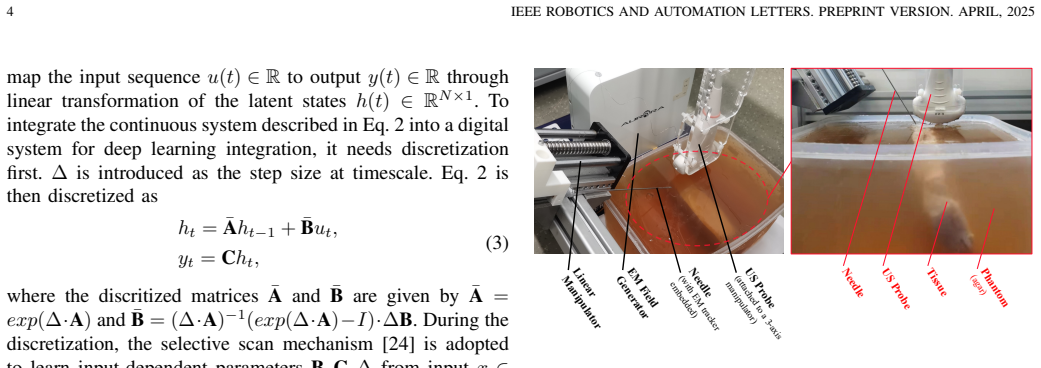
- [Section III-A and Table II] The phantom tracking error 0.22 +/- 0.14 mm and tissue error 0.49 +/- 1.01 mm are lower than the stated EM ground-truth RMSE of 0.76 mm. This is not impossible if the EM error is predominantly a constant bias, but the manuscript does not explain the discrepancy. The authors should report how the EM RMSE was measured, whether it is systematic or random, and how the millimeter error was computed relative to the EM time series; otherwise the sub-millimeter claims cannot be interpreted.
- [Section II-C, Eq. (5)] Eq. (5) uses the convolution equivalence y = K_bar * u for a selective SSM in which A_bar, B_bar, C, and Delta are functions of the input. For a time-varying or selective system, the unrolled recurrence is not a convolution with a fixed kernel, and K_bar is not constant across the input. The sentence 'Note that K_bar comes from the parameterization of input...' does not restore the equality. Please replace the convolution claim with the actual selective-scan recurrence, or explicitly label Eq. (5) as an LTI idealization used only for motivation.
- [Tables I-III] All comparisons and ablations are reported as single point estimates with no repeated-initialization variance, confidence intervals, or significance tests. Some of the key differences are small, such as the v1 versus baseline comparison in Table III and several tissue-environment entries in Table I. Please report mean +/- standard deviation over at least three seeds, or a paired significance test, for the main comparisons and for the v4 ablation that isolates the motion descriptor.
minor comments (4)
- [Section II-D] The definition beta_t = (w_t, h_t, cx_t, cy_t) calls (cx_t, cy_t) the 'top-left corner' but uses those coordinates for displacement as if they represent a consistent reference point; please clarify the coordinate convention of the bounding-box tuple.
- [Figure 1 and Figure 2] The path of the motion descriptor m into each Mamba head is described in the text but is not clearly visible in the overview figure; adding an explicit annotation or legend for m would improve readability.
- [Table I] The caption says the best and second-best results are noted in red and cyan, but these colors are not visible in monochrome print; please use bold or superscript markers as well.
- [Section III-B] The authors motivate SSMX-Corr by comparing with segmentation-based needle trackers [17], [18] but do not include any segmentation-based method in the experiments; a short sentence explaining why these methods are excluded from the comparison would help the reader judge the baseline coverage.
Circularity Check
The motion descriptor is defined using the current frame's bounding box, so the predicted tip position is an input unless a test-time protocol using only prior predictions is specified; the paper does not provide one.
-
self definitional
[Section II-D, 'Implicit Low-level Motion Descriptor' (definition of m_t)]
"Given a set of historical bounding boxes B = {β1, β2, ..., βt} (t is the time index), where βt = ( wt, ht, cxt, cyt) is the bounding box defined by its width wt, height ht, and coordinate of the top-left corner (cxt, cyt), the low-level motion descriptor mt is constructed using the local displacement, given by mt = ( cxt − cxt−1, cyt − cyt−1) = (∆ cxt, ∆cyt)."
This descriptor is fed into SSMX-Corr as the motion prompt, and the tracker's output is the current frame's bounding box. The definition includes βt itself, the very box the tracker is supposed to output at time t, so the displacement ∆cx_t, ∆cy_t is derived from the target position. If B is the ground-truth sequence, the current tip position is an input to the predictor and the reported 'tracking error' is not an independent prediction. The paper never states that, at inference, B contains only the tracker's own previous outputs; it also reports phantom error 0.22 ± 0.14 mm below the stated 0.76 mm EM ground-truth RMSE, consistent with label-derived motion input. The v4 ablation crediting the motion descriptor is likewise not self-contained under this reading.
full rationale
Most of the architecture is methodologically independent: SSMX-Corr and CIS are tested against convolutional X-Corr in ablations v2/v3, and the SSM-convolution equivalence in Eq. (5) is a standard mathematical identity rather than a circular step. The central circularity is the implicit motion descriptor: as written in Section II-D, m_t is computed from β_t, the current frame's bounding box, which is the tracker's output. Unless the test-time motion queue is explicitly populated only with previous predictions, the predicted tip position is available as an input, making the headline SOTA result and the v4 ablation partially reduce by construction. The reported error below the EM ground-truth RMSE (0.22 vs. 0.76 mm) is a coherence check that supports this concern. No load-bearing self-citation or imported uniqueness theorem appears; the paper's novelty claims and the non-motion components are not circular, but the motion-prompt contribution is not self-contained as specified.
Assumptions & free parameters
free parameters (3)
- Motion queue length T =
60 frames (2 s at 30 FPS)
- Submap unfolding stride =
(H_z/2, W_z/2)
- Number of Mamba heads =
4
assumptions (4)
- ad hoc to paper Selective SSM output can be written as a convolution with a fixed kernel K despite input-dependent B, C, Delta.
- domain assumption EM tracking provides accurate ground truth for needle tip position.
- domain assumption The test-time motion queue is populated by the tracker's own history, not by ground-truth boxes.
- domain assumption Agar phantom and ex-vivo pork tissue with motorized constant-velocity insertion represent clinically relevant ultrasound needle tracking.
Cite this review
Pith. "Pith review of MambaXCTrack: Mamba-based Tracker with SSM Cross-correlation and Motion Prompt for Ultrasound Needle Tracking." pith.science (2026). https://pith.science/paper/CYNXG2ZQ
@misc{pith2026241108395,
  author       = {Pith},
  title        = {Pith review of: MambaXCTrack: Mamba-based Tracker with SSM Cross-correlation and Motion Prompt for Ultrasound Needle Tracking},
  year         = {2026},
  howpublished = {\url{https://pith.science/paper/CYNXG2ZQ}},
  note         = {Machine review of arXiv:2411.08395}
}
read the original abstract
Ultrasound (US)-guided needle insertion is widely employed in percutaneous interventions. However, providing feedback on the needle tip position via US imaging presents challenges due to noise, artifacts, and the thin imaging plane of US, which degrades needle features and leads to intermittent tip visibility. In this paper, a Mamba-based US needle tracker MambaXCTrack utilizing structured state space models cross-correlation (SSMX-Corr) and implicit motion prompt is proposed, which is the first application of Mamba in US needle tracking. The SSMX-Corr enhances cross-correlation by long-range modeling and global searching of distant semantic features between template and search maps, benefiting the tracking under noise and artifacts by implicitly learning potential distant semantic cues. By combining with cross-map interleaved scan (CIS), local pixel-wise interaction with positional inductive bias can also be introduced to SSMX-Corr. The implicit low-level motion descriptor is proposed as a non-visual prompt to enhance tracking robustness, addressing the intermittent tip visibility problem. Extensive experiments on a dataset with motorized needle insertion in both phantom and tissue samples demonstrate that the proposed tracker outperforms other state-of-the-art trackers while ablation studies further highlight the effectiveness of each proposed tracking module.
Figures


Figures from the paper (1 more)

Reference graph
Works this paper leans on
-
[1]
Deep learning in medical ultrasound analysis: a review,
S. Liu et al., “Deep learning in medical ultrasound analysis: a review,” Engineering, vol. 5, no. 2, pp. 261–275, 2019
work page 2019
-
[2]
Imaging modalities: Ad- vantages and disadvantages,
R. R. Richardson, MD and R. R. Richardson, “Imaging modalities: Ad- vantages and disadvantages,” Atlas of Acquired Cardiovascular Disease Imaging in Children , pp. 1–4, 2017
work page 2017
-
[3]
Robust real-time needle tracking in 2-d ultrasound images using statistical filtering,
K. Mathiassen et al., “Robust real-time needle tracking in 2-d ultrasound images using statistical filtering,” IEEE Transactions on Control Systems Technology, vol. 25, no. 3, pp. 966–978, 2016
work page 2016
-
[4]
Real-time needle tip localization in 2d ultrasound images for robotic biopsies,
M. Kaya et al. , “Real-time needle tip localization in 2d ultrasound images for robotic biopsies,” in 2015 International Conference on Advanced Robotics (ICAR) , pp. 47–52, IEEE, 2015
work page 2015
-
[5]
C. Shen et al. , “Discriminative correlation filter network for robust landmark tracking in ultrasound guided intervention,” in Medical Image Computing and Computer Assisted Intervention–MICCAI 2019: 22nd International Conference, Shenzhen, China, October 13–17, 2019, Pro- ceedings, Part V 22 , pp. 646–654, Springer, 2019
work page 2019
-
[6]
Learning-based needle tip tracking in 2d ultrasound by fusing visual tracking and motion prediction,
W. Yan et al., “Learning-based needle tip tracking in 2d ultrasound by fusing visual tracking and motion prediction,” Medical Image Analysis , vol. 88, p. 102847, 2023
work page 2023
-
[7]
H. Che et al., “Improving needle tip tracking and detection in ultrasound- based navigation system using deep learning-enabled approach,” IEEE Journal of Biomedical and Health Informatics , 2024
work page 2024
-
[8]
Attention is all you need,
A. Vaswani, “Attention is all you need,” Advances in Neural Information Processing Systems, 2017
2017
Show all 36 references
-
[9]
A unified framework for microscopy defocus deblur with multi-pyramid transformer and contrastive learning,
Y . Zhang et al. , “A unified framework for microscopy defocus deblur with multi-pyramid transformer and contrastive learning,” in Proceed- ings of the IEEE/CVF Conference on Computer Vision and Pattern Recognition, pp. 11125–11136, 2024
2024
-
[10]
Siamrpn++: Evolution of siamese visual tracking with very deep networks,
B. Li et al. , “Siamrpn++: Evolution of siamese visual tracking with very deep networks,” in Proceedings of the IEEE/CVF conference on computer vision and pattern recognition , pp. 4282–4291, 2019
2019
-
[11]
Mixformerv2: Efficient fully transformer tracking,
Y . Cui et al. , “Mixformerv2: Efficient fully transformer tracking,” Advances in Neural Information Processing Systems , vol. 36, 2024
2024
-
[12]
Motion-guided dual-camera tracker for endoscope tracking and motion analysis in a mechanical gastric simulator,
Y . Zhang et al. , “Motion-guided dual-camera tracker for endoscope tracking and motion analysis in a mechanical gastric simulator,” arXiv preprint arXiv:2403.05146, 2024
2024 arXiv
-
[13]
Visual tracking of needle tip in 2d ultrasound based on global features in a siamese architecture,
W. Yan et al., “Visual tracking of needle tip in 2d ultrasound based on global features in a siamese architecture,” in 2023 IEEE International Conference on Robotics and Automation (ICRA) , pp. 4782–4788, IEEE, 2023
2023
-
[14]
Task-oriented network design for visual tracking and motion filtering of needle tip under 2d ultrasound,
W. Yan et al. , “Task-oriented network design for visual tracking and motion filtering of needle tip under 2d ultrasound,” IEEE Transactions on Medical Imaging , 2024
2024
-
[15]
Convolution neural networks for real-time needle detection and localization in 2d ultrasound,
C. Mwikirize et al., “Convolution neural networks for real-time needle detection and localization in 2d ultrasound,” International journal of computer assisted radiology and surgery , vol. 13, pp. 647–657, 2018
2018
-
[16]
Learning needle tip localization from digital subtraction in 2d ultrasound,
C. Mwikirize, J. L. Nosher, and I. Hacihaliloglu, “Learning needle tip localization from digital subtraction in 2d ultrasound,” International journal of computer assisted radiology and surgery , vol. 14, pp. 1017– 1026, 2019
2019
-
[17]
A needle in a (medical) haystack: Detecting a biopsy needle in ultrasound images using vision transformers,
A. M. Wijata, B. Pyci ´nski, and J. Nalepa, “A needle in a (medical) haystack: Detecting a biopsy needle in ultrasound images using vision transformers,” in 2024 IEEE International Conference on Image Pro- cessing (ICIP), pp. 3017–3023, IEEE, 2024
2024
-
[18]
Ultrasound-guided needle tracking with deep learning: A novel approach with photoacoustic ground truth,
X. Hui et al. , “Ultrasound-guided needle tracking with deep learning: A novel approach with photoacoustic ground truth,” Photoacoustics, vol. 34, p. 100575, 2023
2023
-
[19]
Siamban: Target-aware tracking with siamese box adaptive network,
Z. Chen et al. , “Siamban: Target-aware tracking with siamese box adaptive network,” IEEE Transactions on Pattern Analysis and Machine Intelligence, vol. 45, no. 4, pp. 5158–5173, 2022
2022
-
[20]
Siamcar: Siamese fully convolutional classification and regression for visual tracking,
D. Guo et al. , “Siamcar: Siamese fully convolutional classification and regression for visual tracking,” in Proceedings of the IEEE/CVF conference on computer vision and pattern recognition , pp. 6269–6277, 2020
2020
-
[21]
Deformable siamese attention networks for visual object tracking,
Y . Yu et al., “Deformable siamese attention networks for visual object tracking,” in Proceedings of the IEEE/CVF conference on computer vision and pattern recognition , pp. 6728–6737, 2020
2020
-
[22]
Advancements in needle visualization enhancement and localization methods in ultrasound: a literature review,
A. Kimbowa et al., “Advancements in needle visualization enhancement and localization methods in ultrasound: a literature review,” Artificial Intelligence Surgery, vol. 4, no. 3, pp. 149–169, 2024
2024
-
[23]
Single shot needle tip localization in 2d ultrasound,
C. Mwikirize, J. L. Nosher, and I. Hacihaliloglu, “Single shot needle tip localization in 2d ultrasound,” in International Conference on Medical Image Computing and Computer-Assisted Intervention , pp. 637–645, Springer, 2019
2019
-
[24]
Mamba: Linear-time sequence modeling with selective state spaces,
A. Gu and T. Dao, “Mamba: Linear-time sequence modeling with selective state spaces,” arXiv preprint arXiv:2312.00752 , 2023
2023 arXiv
-
[25]
Trackingmamba: Visual state space model for object tracking,
Q. Wang et al. , “Trackingmamba: Visual state space model for object tracking,” IEEE Journal of Selected Topics in Applied Earth Observa- tions and Remote Sensing , 2024
2024
-
[26]
Mambavt: Spatio-temporal contextual modeling for robust rgb-t tracking,
S. Lai et al., “Mambavt: Spatio-temporal contextual modeling for robust rgb-t tracking,” IEEE Transactions on Circuits and Systems for Video Technology, 2025
2025
-
[27]
A survey on visual mamba,
H. Zhang et al., “A survey on visual mamba,” Applied Sciences, vol. 14, no. 13, p. 5683, 2024
2024
-
[28]
A new approach to linear filtering and prediction problems,
R. E. Kalman, “A new approach to linear filtering and prediction problems,” 1960
1960
-
[29]
Fully-convolutional siamese networks for object tracking,
L. Bertinetto et al. , “Fully-convolutional siamese networks for object tracking,” in Computer Vision–ECCV 2016 Workshops: Amsterdam, The Netherlands, October 8-10 and 15-16, 2016, Proceedings, Part II 14 , pp. 850–865, Springer, 2016
2016
-
[30]
Deep residual learning for image recognition,
K. He et al., “Deep residual learning for image recognition,” in Proceed- ings of the IEEE conference on computer vision and pattern recognition, pp. 770–778, 2016
2016
-
[31]
Sigmoid-weighted linear units for neural network function approximation in reinforcement learning,
S. Elfwing, E. Uchibe, and K. Doya, “Sigmoid-weighted linear units for neural network function approximation in reinforcement learning,” Neural networks, vol. 107, pp. 3–11, 2018
2018
-
[32]
Combining recurrent, convolutional, and continuous-time models with linear state space layers,
A. Gu et al., “Combining recurrent, convolutional, and continuous-time models with linear state space layers,” Advances in neural information processing systems, vol. 34, pp. 572–585, 2021
2021
-
[33]
Stmtrack: Template-free visual tracking with space-time memory networks,
Z. Fu et al. , “Stmtrack: Template-free visual tracking with space-time memory networks,” in Proceedings of the IEEE/CVF conference on computer vision and pattern recognition , pp. 13774–13783, 2021
2021
-
[34]
Swintrack: A simple and strong baseline for transformer tracking,
L. Lin et al., “Swintrack: A simple and strong baseline for transformer tracking,” Advances in Neural Information Processing Systems , vol. 35, pp. 16743–16754, 2022
2022
-
[35]
Online object tracking: A benchmark,
Y . Wu, J. Lim, and M.-H. Yang, “Online object tracking: A benchmark,” in Proceedings of the IEEE conference on computer vision and pattern recognition, pp. 2411–2418, 2013
2013
-
[36]
Trackingnet: A large-scale dataset and benchmark for object tracking in the wild,
M. Muller et al., “Trackingnet: A large-scale dataset and benchmark for object tracking in the wild,” in Proceedings of the European conference on computer vision (ECCV) , pp. 300–317, 2018
2018
Reviewed August 12, 2026 · model on record in the stance chip above.
Discussion (0). Continue with ORCID to comment.