REVIEW 2 major objections 7 minor 63 references
From noisy cell size control to population growth: when variability can be beneficial
T0 review · 2 major / 7 minor · reviewed 2026-08-12 · deepseek-v4-flash
Pith's one-line read Noise in single-cell growth rates can increase a population's growth rate when slow-growing cells divide at smaller sizes.
desk verdict A careful small-noise Euler-Lotka extension that finally couples growth-rate noise to size-control and partitioning noise; the math holds up, but the headline beneficial-variability regime rests on an uncorrelated-growth-rate kernel that the author explicitly flags. read the letter →
The pith
A machine-rendered reading of the paper's core claim, the machinery that carries it, and where it could break.
The reading
What carries the argument
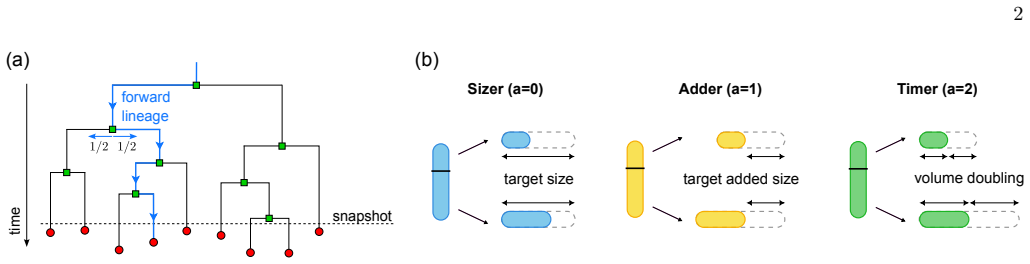
The engine of the paper is the generalized Euler–Lotka equation (eq. 6), the population analogue of the renewal equation that relates the distribution of birth, division, and growth-rate states in the population tree to the population growth rate $\lambda$. The inheritance law entering it is assumed to factorize as $K(s_d,s_b,\alpha|s'_d,s'_b,\alpha') = \psi(s_d|s_b,\alpha)\,\nu(\alpha)\,\kappa(s_b|s'_d)$, with $\psi$ generated by the noisy linear map $s_d = a s_b + b + \eta$ (eq. 11). Factorization implies that, in the forward-lineage statistics, birth size and growth rate are independent and that the forward birth-size distribution obeys a self-consistent equation; the author expands both sides of the Euler–Lotka equation in powers of the coefficients of variation and matches coefficients to get explicit formulas such as eqs. (17), (22), and (30). The parameter $a$ indexes the size-control strategy—0 is a sizer, 1 is an adder, 2 would be a timer—and appears explicitly in every coefficient, which is how the paper compares mechanisms.
What would settle it
Measure, in a mother-machine experiment, the joint distribution of mother and daughter single-cell growth rates: if the child growth rate is not independent of the mother's growth rate and birth size, the factorized kernel fails and eq. (30) is not the correct leading-order prediction. A second direct check is to measure $S_a$ and $S_b$ from linear fits of division size versus birth size in growth-rate bins, then compare population growth rates across conditions with different $\text{CV}_\alpha$; if $\lambda$ does not rise once $\bar{a}S_a + (2-\bar{a})S_b$ exceeds $2\ln 2 - (\ln 2)^2$, the claimed beneficial effect is absent.
Extended reading notes
Core claim
On its own terms, the paper establishes that the population growth rate $\lambda$ is, to leading order in the coefficients of variation, a sum of squares of single-cell noise: growth-rate noise $\text{CV}_\alpha^2$, size-control noise $\text{CV}_\phi^2$, volume-partitioning noise $\text{CV}_p^2$, and, in the $\alpha$-dependent case, the sensitivities $S_a$ and $S_b$ of the slope and intercept of the noisy linear map $s_d = a s_b + b + \eta$. For exponentially growing cells the central formula is $\lambda/\langle\alpha\rangle \approx 1 - \bigl(1 - \tfrac{\ln 2}{2} - \tfrac{\bar{a}S_a + (2-\bar{a})S_b}{2\ln 2}\bigr)\,\text{CV}_\alpha^2$ (eq. 30). When $\bar{a}S_a + (2-\bar{a})S_b$ is large enough, the correction is positive and fluctuations in single-cell growth rates increase population growth; the author argues this is the regime where slow-growing cells divide at smaller sizes than fast-growing cells. For the previously studied case where size control does not depend on growth rate, the paper recovers the known detrimental effect and adds new cross-terms: noise in size control is always beneficial, while noise in volume partitioning is beneficial only below $a \approx 0.97$, so the sizer is faster than the adder for fixed noise levels. The same Euler–Lotka machinery, applied to linear growth, yields first-order positive corrections from size-control and partitioning noise even when growth rates are identical across cells.
Load-bearing premise
The whole calculation rests on the assumption that a newborn cell's growth rate is drawn independently of its mother's growth rate and of the size it was born with, encoded in the factorized inheritance kernel of eq. (8); if mother–daughter growth-rate correlations are present, the predicted size and sign of the growth-rate effect would need to change.
Editorial extensions
If this is right
- For exponentially growing cells with $\alpha$-independent size control, the population growth penalty from growth-rate noise is reduced by size-control noise; at fixed $\text{CV}_\phi$, $\text{CV}_p$, and $\text{CV}_\alpha$, the sizer yields a larger $\lambda$ than the adder or timer-like mechanisms.
- Noise in division-size control is never harmful at leading order for exponential growth, while noise in volume partitioning helps only for $a \lesssim 0.97$ and is essentially neutral for the adder.
- For linearly growing cells, noise in size control and partitioning raise $\lambda$ even when all cells share the same growth rate, with the adder being the slowest strategy.
- When $a(\alpha)$ and $b(\alpha)$ are extracted from single-cell data, the model predicts that growth-rate variability can push $\lambda$ above the value for a uniform population, and the bound $\lambda \le \langle\alpha\rangle$ can fail while $\lambda \ge \ln 2/\langle\tau_d\rangle_{\mathrm{fw}}$ survives.
- Mother-machine estimates of $\text{CV}_\alpha$, $\text{CV}_\phi$, and $\text{CV}_p$ are directly usable in these expansions to predict population-level fitness from lineage data.
Reading between the lines
- A natural next test is to measure the joint distribution of mother and daughter growth rates in the same experiments; the factorized-kernel assumption (eq. 8) is the main place where real cells could depart from the model, and the paper itself notes that mother–daughter correlations can already make fluctuations beneficial.
- If eq. (30) survives data, it reframes the evolution of cell size control: variability in growth rate would not be a nuisance to be suppressed but a trait that can be selected for, provided slow growers divide small—an argument the author does not develop into an evolutionary claim.
- The linear-growth result suggests that for organisms with linear single-cell growth, measurement of size-control noise $\text{CV}_\phi$ alone is enough to predict a fitness advantage of noisy division, without requiring growth-rate noise; this is a sharper, testable prediction than the exponential case.
- The same expansion method could be applied to growth laws with more than two phases or to time-varying growth rates; the supplementary treatment of bi-linear fission yeast growth indicates the machinery extends, but the paper leaves those extensions for future work.
Signed reviews
Editorial analysis
A structured set of objections, weighed in public.
Referee Report
Summary. This paper develops a unified framework, based on a generalized Euler-Lotka equation (Eq. 6), to compute the steady-state population growth rate λ and the mean birth size in the tree statistics for cell populations with stochastic single-cell growth rates, noisy size control (noisy linear map, Eq. 11), and noisy volume partitioning (Eq. 9). The authors derive small-noise expansions for exponentially growing cells (Eqs. 16-17) and linearly growing cells (Eqs. 21-22), and they extend the model in Section III.C to allow the slope and intercept of the size-control map to depend on the growth rate (Eqs. 23-24). The central result is Eq. (30): λ/⟨α⟩ ≈ 1 − (1 − ln2/2 − (āSa + (2−ā)Sb)/(2 ln2)) CVα², so that growth-rate fluctuations can increase λ when slow-growing cells tend to divide at smaller sizes. The theoretical predictions are compared with agent-based simulations and show good agreement. An analysis of E. coli mother-machine data indicates that the size-control parameters do depend on growth rate, motivating the α-dependent model.
Significance. The paper provides a systematic and careful treatment of how different sources of single-cell noise affect population growth, extending earlier work by Lin and Amir and by Thomas. The result that size-control noise always increases λ for exponential growers, and that partitioning noise can be beneficial or detrimental depending on the control strategy, is new. The α-dependent size-control mechanism offers a distinct route for beneficial variability, separate from mother-daughter growth-rate correlations. The simulations are extensive and the expansions are tested beyond leading order; the recovery of known results as special cases (e.g., the asymmetric-division result of Barber et al.) lends confidence. The framework is general enough to cover linear and bi-linear growth laws, which broadens its applicability to organisms such as M. tuberculosis and S. pombe. If the identified limitations are addressed, the paper should be a useful contribution to quantitative cell biology.
major comments (2)
- [Section III.C, Eqs. (23)-(24), Fig. 5] The α-dependent parameterization a = ā(1 + Sa x) and b = b̄(1 + Sb x) is introduced without restricting the range of x. In the original linear map (11), the constraints b ≥ 0 and 0 ≤ a ≤ 2 are assumed. For the parameter values used to illustrate the beneficial effect in Fig. 5 (e.g., Sb = 3 with CVα up to 0.3), the added size b becomes negative for slow-growing cells (those with x < −1/Sb). A negative b implies sd < sb for the adder, so the generation time τd = ln(sd/sb)/α is not well-defined and the Euler-Lotka equation (6) no longer describes a meaningful cell cycle. The simulation results in Fig. 5 may therefore lie outside the model's domain of validity. The authors should either restrict the sensitivities so that b(α) > 0 and a(α) ∈ [0, 2) for all α in the support of ν (for example, use Sb values below the positivity bound 1/(2CVα) and choose Sb = 1.5 rather than Sb = 3 in the figure), or explicitly discuss the interpretation and consequences of negative b. This is directly relevant to the central claim because the beneficial regime is realized only for large positive S, where constraint violations are most likely.
- [Section II.A, Eq. (8), and Section III.C, Eq. (30)] The factorized inheritance kernel K = ψ(sd|sb,α)ν(α)κ(sb|s'd) is the central structural assumption. It makes the tree distribution of growth rates equal to ν(α) and underlies the derivation of Eq. (30). The paper correctly notes in the Introduction that mother-daughter correlations in α are neglected and that such correlations can by themselves make fluctuations beneficial (ref. [14]). However, because real mother-machine data, including the E. coli data analyzed in Section C, exhibit such correlations, the quantitative threshold S > 2 ln2 − (ln2)² for beneficial fluctuations is not directly transferable to those data. I recommend that the authors (i) state this limitation explicitly in the abstract and conclusion, and (ii) ideally provide a short analysis or simulation for a correlated kernel ν(α|α′) to indicate how the coefficient cα changes. At minimum, the discussion should make clear that Eq. (30) applies to populations with uncorrelated single-cell growth rates.
minor comments (7)
- [Abstract and Discussion] The phrase 'fluctuations in single-cell growth rates can be beneficial' in the abstract should be qualified with 'within our model, which neglects mother-daughter growth-rate correlations' to avoid overstatement, since the discussion already notes this limitation.
- [Section III.A] There is a typo: 'mircro-organisms' should be 'micro-organisms'.
- [Section III.A] The sentence 'on can also consider the situation' should read 'one can also consider the situation'.
- [Section III.B] The phrase 'allows use to identify' should be 'allows us to identify'.
- [Supplementary Material, Section III] In the text introducing the derivation, 'sensitivies' is a typo for 'sensitivities'.
- [Section III.C] The sentence 'This analysis also shows that the bounds on the population growth rate, ⟨α⁻¹⟩⁻¹ ≤ λ ≤ ⟨α⟩, derived in [10] when ψ(sd|sb,α)=ψ(sd|sb) are no longer valid in this case' could be clarified by adding 'in general' and explicitly noting that the lower bound ln2/⟨τd⟩fw still holds, which the paper does later.
- [Figure 5] For panels (a) and (b), the authors should state the order of the truncation used for the theoretical curves (first order in CVα²) and indicate which parameter combinations keep b(α) > 0 for all α in the plotted range.
Circularity Check
No material circularity: the Euler-Lotka expansions are derived from the model equations, and the E. coli sensitivities enter only as fitted inputs, not as fits to lambda.
full rationale
The derivation chain is self-contained. The generalized Euler-Lotka equation (eq. 6) follows from the population balance, and the small-noise coefficients in eqs. (16), (17), (21), (22), (29) and (30) are obtained by expanding that equation, not by fitting the population growth rate. The forward-lineage relation (eq. 13) fixes the birth-size distribution independently of the growth-rate distribution, so the expansion coefficients are analytic functions of the model parameters and noise levels. In Section C, the sensitivities S_a and S_b are fitted to sd-vs-sb mother-machine regressions from external data [7] and then enter as inputs into the derived formula for lambda; no fitted quantity is renamed as a prediction. The factorized kernel (eq. 8) and the restriction to uncorrelated growth rates are explicit modeling assumptions, and the paper itself states in Section II.A that correlated kernels nu(alpha|alpha') can make fluctuations beneficial [14], which is an honest limitation rather than a circular step. The self-citations [39,40] are used only in the Supplementary Material as a cross-check that the lower bound ln2/<tau_d>_fw holds, and the main results do not depend on them. Known limits (eq. 7 and the checks against [10,12,15]) are reproduced, supporting the independence of the calculation. No step was found in which an Eq. X reduces to Eq. Y by construction, and no prediction is statistically forced by a fit to the target quantity.
Assumptions & free parameters
free parameters (4)
- a_bar (mean size-control slope) =
0.90 +/- 0.01 (glucose)
- Sa (slope sensitivity) =
-1.12 +/- 0.25 (glucose)
- b_bar (mean intercept) =
2.42 +/- 0.03 um (glucose)
- Sb (intercept sensitivity) =
0.89 +/- 0.20 (glucose)
assumptions (6)
- domain assumption The single-cell growth rate alpha of a newborn is drawn independently from a fixed distribution nu(alpha), with no mother-daughter correlations and no correlation with birth size.
- domain assumption Cell division follows the noisy linear map sd = a sb + b + eta with 0 <= a < 2, b > 0, <eta>=0, and eta independent of alpha.
- domain assumption Fluctuations are small, allowing truncation of the Euler-Lotka expansion at second order in the CVs.
- ad hoc to paper In Section C, the slope and intercept of the linear map depend linearly on the standardized growth rate: a = a_bar(1 + Sa x), b = b_bar(1 + Sb x).
- standard math Volume is conserved at division, with daughter fraction p having mean 1/2.
- domain assumption Each cell grows at a constant rate alpha during its cycle, under exponential, linear, or bi-linear growth laws.
Cite this review
Pith. "Pith review of From noisy cell size control to population growth: when variability can be beneficial." pith.science (2026). https://pith.science/paper/OT4DKEOT
@misc{pith2026241108512,
  author       = {Pith},
  title        = {Pith review of: From noisy cell size control to population growth: when variability can be beneficial},
  year         = {2026},
  howpublished = {\url{https://pith.science/paper/OT4DKEOT}},
  note         = {Machine review of arXiv:2411.08512}
}
abstract
Single-cell experiments revealed substantial variability in generation times, growth rates but also in birth and division sizes between genetically identical cells. Understanding how these fluctuations determine the fitness of the population, i.e. its growth rate, is necessary in any quantitative theory of evolution. Here, we develop a biologically-relevant model which accounts for the stochasticity in single-cell growth rates, birth sizes and division sizes. We derive expressions for the population growth rate and for the mean birth size in the population in terms of the single-cell fluctuations. Allowing division sizes to fluctuate reveals how the mechanism of cell size control (timer, sizer, adder) influences population growth. Surprisingly, we find that fluctuations in single-cell growth rates can be beneficial for population growth when slow-growing cells tend to divide at smaller sizes than fast-growing cells. Our framework is not limited to exponentially-growing cells like $\textit{Escherichia coli}$, and we derive similar expressions for cells with linear and bi-linear growth laws, such as $\textit{Mycobacterium tuberculosis}$ and fission yeast $\textit{Schizosaccharomyces pombe}$, respectively.
Figures


Figures from the paper (2 more)


Reference graph
Works this paper leans on
-
[1]
1949 The Growth of Bacterial Cultures
Monod J. 1949 The Growth of Bacterial Cultures. Annu. Rev. Microbiol. 3, 371–394. (10.1146/an- nurev.mi.03.100149.002103)
arXiv 1949
-
[2]
Schaechter M, MaalØe O, Kjeldgaard NO. 1958 Dependency on Medium and Temperature of Cell Size and Chemical Composition during Balanced Growth of Salmonella typhimurium. J . gen. Microbial. 19, 592–606. (10.1099/00221287-19- 3-592)
-
[3]
1982 Relationship between temperature and growth rate of bacterial cultures
Ratkowsky DA, Olley J, McMeekin TA, Ball A. 1982 Relationship between temperature and growth rate of bacterial cultures. J. Bacteriol. 149, 1–5. (10.1128/jb.149.1.1-5.1982)
-
[4]
2010 Robust Growth of Escherichia coli
Wang P, Robert L, Pelletier J, Dang WL, Taddei F, Wright A, Jun S. 2010 Robust Growth of Escherichia coli. Curr. Biol. 20, 1099–1103. (10.1016/j.cub.2010.04.045)
-
[5]
2014 Concerted control of Escherichia coli cell division
Osella M, Nugent E, Cosentino Lagomarsino M. 2014 Concerted control of Escherichia coli cell division. Proc. Natl. Acad. Sci. U.S.A. 111, 3431–3435. (10.1073/pnas.1313715111)
-
[6]
2014 A Constant Size Extension Drives Bacterial Cell Size Homeostasis
Campos M, Surovtsev I, Kato S, Paintdakhi A, Beltran B, Ebmeier S, Jacobs-Wagner C. 2014 A Constant Size Extension Drives Bacterial Cell Size Homeostasis. Cell 159, 1433–1446. (10.1016/j.cell.2014.11.022)
-
[7]
2015 Cell-Size Control and Home- ostasis in Bacteria
Taheri-Araghi S, Bradde S, Sauls J, Hill N, Levin P, Paulsson J, Vergassola M, Jun S. 2015 Cell-Size Control and Home- ostasis in Bacteria. Curr. Biol. 25, 385–391. (10.1016/j.cub.2014.12.009)
-
[8]
2015 A noisy linear map underlies oscillations in cell size and gene expression in bacteria
Tanouchi Y, Pai A, Park H, Huang S, Stamatov R, Buchler NE, You L. 2015 A noisy linear map underlies oscillations in cell size and gene expression in bacteria. Nature 523, 357–360. (10.1038/nature14562)
Show all 63 references
-
[9]
2016 Noise-driven growth rate gain in clonal cellular populations
Hashimoto M, Nozoe T, Nakaoka H, Okura R, Akiyoshi S, Kaneko K, Kussell E, Wakamoto Y. 2016 Noise-driven growth rate gain in clonal cellular populations. Proc. Natl. Acad. Sci. U.S.A. 113, 3251–3256. (10.1073/pnas.1519412113)
2016 doi
-
[11]
2017 How does variability in cell aging and growth rates influence the Malthus parameter?
Olivier A. 2017 How does variability in cell aging and growth rates influence the Malthus parameter?. Kinet. Relat. Models 10, 481–512. (10.3934/krm.2017019)
2017 doi
-
[12]
2017 The Effects of Stochasticity at the Single-Cell Level and Cell Size Control on the Population Growth
Lin J, Amir A. 2017 The Effects of Stochasticity at the Single-Cell Level and Cell Size Control on the Population Growth. Cell Syst. 5, 358–367.e4. (10.1016/j.cels.2017.08.015)
2017 doi
-
[13]
2019 Optimal Segregation of Proteins: Phase Transitions and Symmetry Breaking
Lin J, Min J, Amir A. 2019 Optimal Segregation of Proteins: Phase Transitions and Symmetry Breaking. Phys. Rev. Lett. 122, 068101. (10.1103/PhysRevLett.122.068101) 13
2019 doi
-
[15]
2021 Modeling the impact of single-cell stochasticity and size control on the population growth rate in asymmetrically dividing cells
Barber F, Min J, Murray AW, Amir A. 2021 Modeling the impact of single-cell stochasticity and size control on the population growth rate in asymmetrically dividing cells. PLoS Comput. Biol. 17, e1009080. (10.1371/journal.pcbi.1009080)
2021 doi
-
[16]
1956 Growth Rate and Generation Time of Bacteria, with Special Reference to Continuous Culture
Powell EO. 1956 Growth Rate and Generation Time of Bacteria, with Special Reference to Continuous Culture. J. Gen. Microbiol. 15, 492–511. (10.1099/00221287-15-3-492)
1956 doi
-
[17]
2018 Fundamental principles in bacterial physiology—history, recent progress, and the future with focus on cell size control: a review
Jun S, Si F, Pugatch R, Scott M. 2018 Fundamental principles in bacterial physiology—history, recent progress, and the future with focus on cell size control: a review. Rep. Prog. Phys. 81, 056601. (10.1088/1361-6633/aaa628)
2018 doi
-
[18]
1968 Cell Growth and Division: III
Bell GI. 1968 Cell Growth and Division: III. Conditions for Balanced Exponential Growth in a Mathematical Model. Biophys. J. 8, 431–444. (10.1016/S0006-3495(68)86498-7)
1968 doi
-
[19]
1970 A note on the dispersionless growth law for single cells
Trucco E, Bell GI. 1970 A note on the dispersionless growth law for single cells. Bull. Math. Biophys. 32, 475–483. (10.1007/BF02476766)
1970 doi
-
[20]
2016 Single-Cell Analysis of Growth in Budding Yeast and Bacteria Reveals a Common Size Regulation Strategy
Soifer I, Robert L, Amir A. 2016 Single-Cell Analysis of Growth in Budding Yeast and Bacteria Reveals a Common Size Regulation Strategy. Curr. Biol. 26, 356–361. (10.1016/j.cub.2015.11.067)
2016 doi
-
[21]
2017 Mycobacteria Modify Their Cell Size Control under Sub- Optimal Carbon Sources
Priestman M, Thomas P, Robertson BD, Shahrezaei V. 2017 Mycobacteria Modify Their Cell Size Control under Sub- Optimal Carbon Sources. Front. Cell Dev. Biol. 5, 64. (10.3389/fcell.2017.00064)
2017
-
[22]
2017 Archaeal cells share common size control with bacteria despite noisier growth and division
Eun YJ, Ho PY, Kim M, LaRussa S, Robert L, Renner LD, Schmid A, Garner E, Amir A. 2017 Archaeal cells share common size control with bacteria despite noisier growth and division. Nat. Microbiol. 3, 148–154. (10.1038/s41564-017-0082-6)
2017 doi
-
[23]
2018 Size control in mammalian cells involves modulation of both growth rate and cell cycle duration
Cadart C, Monnier S, Grilli J, S´ aez PJ, Srivastava N, Attia R, Terriac E, Baum B, Cosentino-Lagomarsino M, Piel M. 2018 Size control in mammalian cells involves modulation of both growth rate and cell cycle duration. Nat. Commun. 9,
2018
-
[24]
2014 Long-Term Single Cell Analysis of S
Nobs JB, Maerkl SJ. 2014 Long-Term Single Cell Analysis of S. pombe on a Microfluidic Microchemostat Array. PLoS ONE 9, e93466. (10.1371/journal.pone.0093466)
2014 doi
-
[25]
2023 Mycobacterium tuberculosis grows linearly at the single-cell level with larger variability than model organisms
Chung ES, Kar P, Kamkaew M, Amir A, Aldridge BB. 2023 Mycobacterium tuberculosis grows linearly at the single-cell level with larger variability than model organisms. BiorXiv. (10.1101/2023.05.17.541183)
2023 doi
-
[26]
2016 Cell length growth patterns in fission yeast reveal a novel size control mechanism operating in late G2 phase
Horv´ ath A, R´ acz-M´ onus A, Buchwald P, Sveiczer A. 2016 Cell length growth patterns in fission yeast reveal a novel size control mechanism operating in late G2 phase. Biol. Cell 108, 259–277. (10.1111/boc.201500066)
2016 doi
-
[27]
2021 Non-genetic variability in microbial populations: survival strategy or nuisance?
Levien E, Min J, Kondev J, Amir A. 2021 Non-genetic variability in microbial populations: survival strategy or nuisance?. Rep. Prog. Phys. 84, 116601. (10.1088/1361-6633/ac2c92)
2021 doi
-
[28]
2022 Analytical cell size distribution: lineage-population bias and parameter inference
Genthon A. 2022 Analytical cell size distribution: lineage-population bias and parameter inference. J. R. Soc. Interface. 19, 20220405. (10.1098/rsif.2022.0405)
2022
-
[29]
2024 Asymptotic decoupling of population growth rate and cell size distribution
Hein Y, Jafarpour F. 2024 Asymptotic decoupling of population growth rate and cell size distribution. Phys. Rev. Research 6, 043006. (10.1103/PhysRevResearch.6.043006)
2024 doi
-
[30]
2017 Inferring fitness landscapes and selection on phenotypic states from single-cell genealogical data
Nozoe T, Kussell E, Wakamoto Y. 2017 Inferring fitness landscapes and selection on phenotypic states from single-cell genealogical data. PLoS Genet. 13, e1006653. (10.1371/journal.pgen.1006653)
2017 doi
-
[31]
2015 Cell-size maintenance: universal strategy revealed
Jun S, Taheri-Araghi S. 2015 Cell-size maintenance: universal strategy revealed. Trends Microbiol. 23, 4–6. (10.1016/j.tim.2014.12.001)
2015 doi
-
[32]
2014 Division in Escherichia coli is triggered by a size-sensing rather than a timing mechanism
Robert L, Hoffmann M, Krell N, Aymerich S, Robert J, Doumic M. 2014 Division in Escherichia coli is triggered by a size-sensing rather than a timing mechanism. BMC Biol. 12, 17. (10.1186/1741-7007-12-17)
2014 doi
-
[33]
2018 Analysis of Cell Size Homeostasis at the Single-Cell and Population Level
Thomas P. 2018 Analysis of Cell Size Homeostasis at the Single-Cell and Population Level. Front. Phys. 6, 64. (10.3389/fphy.2018.00064)
2018
-
[34]
2021 Distinguishing different modes of growth using single-cell data
Kar P, Tiruvadi-Krishnan S, M¨ annik J, M¨ annik J, Amir A. 2021 Distinguishing different modes of growth using single-cell data. eLife 10, e72565. (10.7554/eLife.72565)
2021 doi
-
[35]
2023 Super-exponential growth and stochastic size dynamics in rod-like bacteria
Cylke A, Banerjee S. 2023 Super-exponential growth and stochastic size dynamics in rod-like bacteria. Biophys. J. 122, 1254–1267. (10.1016/j.bpj.2023.02.015)
2023 doi
-
[36]
2021 Single-cell growth inference of Corynebacterium glutamicum reveals asymptotically linear growth
Messelink JJ, Meyer F, Bramkamp M, Broedersz CP. 2021 Single-cell growth inference of Corynebacterium glutamicum reveals asymptotically linear growth. eLife 10, e70106. (10.7554/eLife.70106)
2021 doi
-
[37]
2017 Analysis of Noise Mechanisms in Cell-Size Control
Modi S, Vargas-Garcia CA, Ghusinga KR, Singh A. 2017 Analysis of Noise Mechanisms in Cell-Size Control. Biophys. J. 112, 2408–2418. (10.1016/j.bpj.2017.04.050)
2017 doi
-
[38]
2018 The Empirical Fluctuation Pattern of E
Grilli J, Cadart C, Micali G, Osella M, Cosentino Lagomarsino M. 2018 The Empirical Fluctuation Pattern of E. coli Division Control. Front. Microbiol. 9, 1541. (10.3389/fmicb.2018.01541)
2018
-
[39]
2020 Fluctuation relations and fitness landscapes of growing cell populations
Genthon A, Lacoste D. 2020 Fluctuation relations and fitness landscapes of growing cell populations. Sci. Rep. 10, 11889. (10.1038/s41598-020-68444-x)
2020 doi
-
[40]
2022 Fluctuations in cell lineages and population trees: a thermodynamic perspective
Genthon A. 2022 Fluctuations in cell lineages and population trees: a thermodynamic perspective . PhD thesis Universit´ e Paris sciences et lettres
2022
-
[41]
2024 Spread of parasites affecting death and division rates in a cell population
Marguet A, Smadi C. 2024 Spread of parasites affecting death and division rates in a cell population. Stoch. Process. Their Appl. 168, 104262. (10.1016/j.spa.2023.104262)
2024
-
[42]
2016 High-throughput measurement of single-cell growth rates using serial microfluidic mass sensor arrays
Cermak N, Olcum S, Delgado FF, Wasserman SC, Payer KR, A Murakami M, Knudsen SM, Kimmerling RJ, Stevens MM, Kikuchi Y, et al.. 2016 High-throughput measurement of single-cell growth rates using serial microfluidic mass sensor arrays. Nat. Biotechnol. 34, 1052–1059. (10.1038/nbt.3666)
2016 doi
-
[43]
2020 Mass measurements during lymphocytic leukemia cell polyploidization decouple cell cycle- and cell size-dependent growth
Mu L, Kang JH, Olcum S, Payer KR, Calistri NL, Kimmerling RJ, Manalis SR, Miettinen TP. 2020 Mass measurements during lymphocytic leukemia cell polyploidization decouple cell cycle- and cell size-dependent growth. Proc. Natl. Acad. Sci. U.S.A. 117, 15659–15665. (10.1073/pnas.1...
2020 doi
-
[44]
2024 A size-dependent division strategy accounts for leukemia cell size heterogeneity
Miotto M, Scalise S, Leonetti M, Ruocco G, Peruzzi G, Gosti G. 2024 A size-dependent division strategy accounts for leukemia cell size heterogeneity. Commun. Phys. 7, 248. (10.1038/s42005-024-01743-1)
2024 doi
-
[45]
2020 Large Deviation Principle Linking Lineage Statistics to Fitness in Microbial Popu- lations
Levien E, GrandPre T, Amir A. 2020 Large Deviation Principle Linking Lineage Statistics to Fitness in Microbial Popu- lations. Phys. Rev. Lett. 125, 048102. (10.1103/PhysRevLett.125.048102)
2020 doi
-
[46]
2021 Generalized Euler-Lotka equation for correlated cell divisions
Pigolotti S. 2021 Generalized Euler-Lotka equation for correlated cell divisions. Phys. Rev. E 103, L060402. (10.1103/Phys- RevE.103.L060402)
2021 doi
- [47]
-
[48]
2022 Evolution of cell size control is canalized towards adders or sizers by cell cycle structure and selective pressures
Proulx-Giraldeau F, Skotheim JM, Fran¸ cois P. 2022 Evolution of cell size control is canalized towards adders or sizers by cell cycle structure and selective pressures. eLife 11, e79919. (10.7554/eLife.79919)
2022 doi
-
[49]
2024 Effects of Molecular Noise on Cell Size Control
ElGamel M, Mugler A. 2024 Effects of Molecular Noise on Cell Size Control. Phys. Rev. Lett. 132, 098403. (10.1103/Phys- RevLett.132.098403) Supplementary Material for ‘From noisy cell size control to population growth: when variability can be beneficial’ Arthur Genthon Max Pla...
2024 arXiv
-
[51]
(S17) Canceling the terms proportional to CV 2 αCV2 φ and CV2 αCV2 tree[sb] implies relations between the other coefficients: 8 ( (2−a) ˆDφ,α− 2 ˆCα,φ ln 2 ) + (2− ln 2)(2−a)2 = 0 (S18) 8 ( (2−a) ˆDsb,α− 2 ˆCα,sb ln 2 ) + (2− ln 2)(2−a)2 = 0. (S19) To fully determine these las...
-
[52]
To illustrate the effect of growth laws with piecewise patterns on our results, we describe the growth of S
and bi-linear [7, 8] elongations are popular candidates. To illustrate the effect of growth laws with piecewise patterns on our results, we describe the growth of S. pombe with a bi-linear pattern characterized by two portions of linear 5 growth with rates α1 and α2 > α1, sepa...
-
[53]
Robert, M
L. Robert, M. Hoffmann, N. Krell, S. Aymerich, J. Robert, and M. Doumic, Division in Escherichia coli is triggered by a size-sensing rather than a timing mechanism, BMC Biology 12, 17 (2014)
2014
-
[54]
Osella, E
M. Osella, E. Nugent, and M. Cosentino Lagomarsino, Concerted control of Escherichia coli cell division, Proceedings of the National Academy of Sciences 111, 3431 (2014)
2014
-
[55]
Taheri-Araghi, S
S. Taheri-Araghi, S. Bradde, J. Sauls, N. Hill, P. Levin, J. Paulsson, M. Vergassola, and S. Jun, Cell-Size Control and Homeostasis in Bacteria, Current Biology 25, 385 (2015)
2015
-
[56]
Thomas, Single-cell histories in growing populations: relating physiological variability to population growth, BiorXiv 10.1101/100495 (2017)
P. Thomas, Single-cell histories in growing populations: relating physiological variability to population growth, BiorXiv 10.1101/100495 (2017)
2017 doi
-
[57]
Genthon, Analytical cell size distribution: lineage-population bias and parameter inference, Journal of The Royal Society Interface 19, 20220405 (2022)
A. Genthon, Analytical cell size distribution: lineage-population bias and parameter inference, Journal of The Royal Society Interface 19, 20220405 (2022)
2022
-
[58]
Cooper, Schizosaccharomyces pombe grows exponentially during the division cycle with no rate change points, FEMS Yeast Research 13, 650 (2013)
S. Cooper, Schizosaccharomyces pombe grows exponentially during the division cycle with no rate change points, FEMS Yeast Research 13, 650 (2013)
2013
-
[59]
Baumg¨ artner and I
S. Baumg¨ artner and I. M. Toli´ c-Nørrelykke, Growth Pattern of Single Fission Yeast Cells Is Bilinear and Depends on Temperature and DNA Synthesis, Biophysical Journal 96, 4336 (2009)
2009
-
[60]
Horv´ ath, A
A. Horv´ ath, A. R´ acz-M´ onus, P. Buchwald, and A. Sveiczer, Cell length growth patterns in fission yeast reveal a novel size control mechanism operating in late G2 phase, Biology of the Cell 108, 259 (2016)
2016
-
[61]
Chang and K
F. Chang and K. C. Huang, How and why cells grow as rods, BMC Biology 12, 54 (2014)
2014
-
[62]
C. Jia, A. Singh, and R. Grima, Characterizing non-exponential growth and bimodal cell size distributions in fission yeast: An analytical approach, PLoS Computational Biology 18, e1009793 (2022)
2022
-
[63]
Genthon and D
A. Genthon and D. Lacoste, Fluctuation relations and fitness landscapes of growing cell populations, Scientific Reports 10, 11889 (2020)
2020
-
[64]
Genthon, Fluctuations in cell lineages and population trees: a thermodynamic perspective , PhD thesis, Universit´ e Paris sciences et lettres (2022)
A. Genthon, Fluctuations in cell lineages and population trees: a thermodynamic perspective , PhD thesis, Universit´ e Paris sciences et lettres (2022)
2022
-
[65]
Barber, J
F. Barber, J. Min, A. W. Murray, and A. Amir, Modeling the impact of single-cell stochasticity and size control on the population growth rate in asymmetrically dividing cells, PLoS Computational Biology 17, e1009080 (2021)
2021
-
[3275]
(10.1038/s41467-018-05393-0)
Reviewed August 12, 2026 · model on record in the stance chip above.
Discussion (0). Continue with ORCID to comment.