REVIEW 3 major objections 6 minor 40 references
Zero-shot Cross-lingual Transfer Learning with Multiple Source and Target Languages for Information Extraction: Language Selection and Adversarial Training
T0 review · 3 major / 6 minor · reviewed 2026-08-12 · deepseek-v4-flash
Pith's one-line read A weighted combination of three typological language distances predicts zero-shot cross-lingual transfer above 0.6 for information extraction, and the same metric guides source-language selection and adversarial training in many-to-many…
desk verdict A useful empirical study of multi-source zero-shot transfer for IE, but its headline metric is fitted in-sample and the load-bearing pairwise-to-multi-transfer assumption is never tested. read the letter →
The pith
A machine-rendered reading of the paper's core claim, the machinery that carries it, and where it could break.
The reading
What carries the argument
The load-bearing object is the combined linguistic distance $d_{\text{comb}}$, a convex combination of three pairwise distances computed from binary typological feature vectors: Anderberg distance over syntax features, inner-product distance over phonology features, and Anderberg distance over inventory features, weighted $0.4$, $0.2$, $0.4$. It is fit by maximizing the Pearson correlation between pairwise distance and single-source transfer score, then reused as the similarity for $k$-medoids language clustering and as the edge structure for graph-relational adversarial training. The graph allows language-pair-specific alignment instead of forcing all languages into one uniform representation, while the medoids are the cluster centers that serve as the recommended source languages.
What would settle it
Run a held-out study on a larger language set: compute the correlation between pairwise single-transfer scores and multi-source multi-target scores for all source triples, and compare $k$-medoid source sets chosen by $d_{\text{comb}}$ against random source sets of the same size; if the correlation is low or medoid sets fail to beat random sets, the central claim is falsified.
Extended reading notes
Core claim
The central claim is that one fixed weighted combination of three typological distances approximates zero-shot cross-lingual transfer performance for information extraction across tasks and model sizes, and that the same distance can be reused for source-language selection and adversarial alignment in many-to-many transfer. The paper defines $d_{\text{comb}}$ as a convex combination of Anderberg distance on syntax, inner-product distance on phonology, and Anderberg distance on inventory, with weights $0.4$, $0.2$, and $0.4$, fit by maximizing the Pearson correlation between pairwise distance and single-transfer score. The reported correlation is above $0.6$ in every tested setting, and the metric reduces variability across tasks and model scales compared with individual distances. On this basis, languages clustered by $d_{\text{comb}}$ and selected through $k$-medoids outperform random source sets for multi-transfer, and relational adversarial training over the cluster graph improves transfer further.
Load-bearing premise
The load-bearing premise is that pairwise single-transfer performance is highly correlated with multi-source multi-target transfer performance, an assumption the paper states in Section 6.1 but never measures.
Editorial extensions
If this is right
- Source-language selection for zero-shot IE can be done before any model training, using only linguistic features, so annotation effort can be spent on languages that transfer best.
- Medoid-based source sets improve many-to-many transfer over random sets in every tested configuration, with larger gains on the dataset with more target languages.
- Relational adversarial training with unlabeled data improves over the multi-transfer baseline in almost all settings, while the uniform-alignment DANN baseline consistently hurts, especially on small models.
- The combined metric lowers variability across tasks and model scales, making it a candidate task-independent proxy for transfer difficulty.
- Multi-transfer with guided source selection is a stronger and more realistic baseline than single-transfer for multilingual information extraction.
Reading between the lines
- Editorial inference: if $d_{\text{comb}}$ is a genuine general proxy, the clustering-and-medoid pipeline should extend to other multilingual tasks such as question answering or summarization, but the weights would likely need refitting per task family.
- Editorial inference: the paper never measures the correlation between pairwise transfer and multi-source transfer; an explicit test on held-out language triples would decide whether medoid selection survives at larger scale.
- Editorial inference: the failure of DANN and success of graph-relational alignment suggest the key ingredient is language-pair-specific alignment rather than uniform invariance, which could be tested by replacing the graph with a learned similarity.
- Editorial inference: the paper's own limitation notes that the largest tested models have hundreds of millions of parameters, so the stability of the $0.4/0.2/0.4$ weights for billion-scale or instruction-tuned models remains an open question.
Signed reviews
Editorial analysis
A structured set of objections, weighed in public.
Referee Report
Summary. The paper studies zero-shot cross-lingual transfer for information extraction in three settings: single source-target pairs (ZSCL-S), multiple sources and targets (ZSCL-M), and relational transfer with unlabeled data (ZSCL-R), using the MINION and SMiLER datasets at three model scales. It proposes a combined linguistic distance dcomb = 0.4 * syntax + 0.2 * phonology + 0.4 * inventory (all Anderberg-based), claims this metric correlates with single-transfer performance above 0.6 in every setting, uses k-medoids clustering over dcomb to select source languages for multi-transfer, and applies graph-relational adversarial training with a language graph to improve multi-transfer. The central empirical claims are that dcomb is a general transfer predictor, medoid-based selection improves ZSCL-M over random selection, and ZSCL-R improves over both ZSCL-M and DANN-style adversarial training.
Significance. If the claims held, the paper would provide practical tools for cross-lingual IE: estimating transfer performance without training, guiding low-cost source-language data collection, and using unlabeled data through linguistically informed adversarial training. The work is also one of the few to study many-to-many zero-shot transfer for IE, and it covers a broad experimental grid: two tasks, three model scales, 17 languages, and 14 linguistic distance metrics, with detailed results in the appendix. The ZSCL-R extension is a reasonable and nontrivial application of graph-relational domain adaptation. However, the generality of the combined metric is not established because its weights are selected on the same data used to report the correlation, and the key assumption connecting single-transfer correlation to multi-transfer selection is stated but never tested. These issues are load-bearing for the paper's main conclusions, so the contribution is currently conditional rather than demonstrated.
major comments (3)
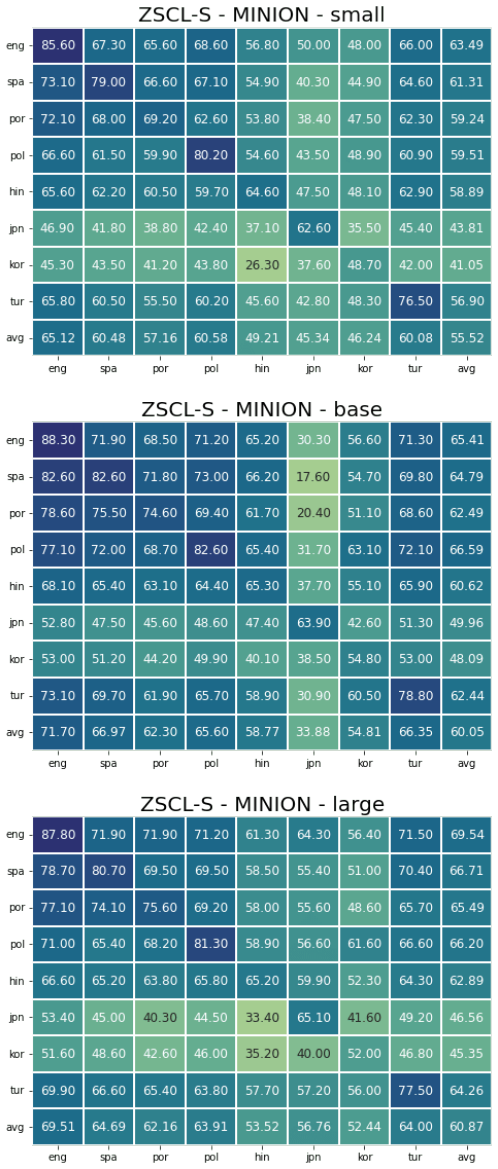
- [5.1] The claim that dcomb is a general metric for predicting zero-shot transfer is an in-sample statement. The weights 0.4/0.2/0.4 are proposed after examining the per-task, per-scale optimal weights from the constrained correlation maximization shown in Figure 2, and the reported correlations 'above 0.6 for every setting' are then computed on the same ZSCL-S data used to motivate those weights. A weighted combination of three distance metrics fitted to maximize correlation on a dataset will naturally outperform the individual metrics on that dataset, so the comparison in Figure 3 does not by itself support the 'potential to be a general metric' conclusion. The Limitations section also concedes that the metric is 'heuristically defined based on the transfer-distance correlation scores' and calls for further analysis. To support the generality claim, the authors should fix the weights using only a subset of tasks/model scales and evaluate on held-out tasks, languages, or model scales, or use leave-one-task-out or nested cross-validation, and report the correlation on data not used for weight selection.
- [6.1] The language-selection proposal rests on the assumption stated in Section 6.1: 'Assuming pair-wise transfer is highly correlated with multi-transfer, these configurations can be identified by clustering languages based on the combined linguistic distance dcomb.' This assumption is never tested. The paper does not report the correlation between the ZSCL-S scores (the quantity to which dcomb was calibrated) and the observed ZSCL-M scores across configurations. Without that measurement, the medoid-vs-random differences in Table 2 could be attributed to confounds such as the number of source languages, the specific languages inside each cluster, or target-set composition. A direct test is feasible with the data already collected: for each configuration, compute either the average single-transfer score of its source languages to its targets or the relevant dcomb distances, and correlate that quantity with the observed ZSCL-M F1; report the correlation, a scatter plot, and the number of configurations. Until such a test is provided, the conclusion that dcomb 'provides useful directions for language clustering and selection' remains unsupported.
- [6.3, Table 2] Tables 2 and 3 report only point estimates without variance, number of runs, or significance tests. The inter-cluster configuration has exactly one option per task; intra-cluster and random configurations are described only as averages of 'sampled transfer runs', with no sample size, random seeds, or sampling distribution specified. Several reported differences are on the order of 0.7-1.0 F1 points (e.g., Table 2, MINION small medoids*: 1.8; SMALL tur*: 2.7), which is typically within run-to-run noise for multilingual fine-tuning. The statements that dcomb-based selection gives a 'considerable boost' and 'significant improvements' are therefore not established. The authors should report standard deviations or confidence intervals over multiple random seeds, the full list of sampled configurations, and paired significance tests (e.g., bootstrap or permutation) for the medoid vs. random comparisons, and similarly for the adversarial-training comparisons in Table 3.
minor comments (6)
- [6.1] The text contains a typo: 'multi-transferm' should be 'multi-transfer'.
- [5.1] The formula 'dinner-phonology' is inconsistent with the Anderberg naming used elsewhere; it should presumably be 'dander-phonology'.
- [3] The sentence 'also referred to as he event trigger' should read 'the event trigger'; there is also an unrelated typo 'Engish' in Section 2.
- [Table 1] The dataset name is spelled inconsistently as SMILER, SMiLER, and SMilER across the text and captions; please standardize.
- [Tables 2 and 3] The column header 'MODEL_A VG' appears to be a typo for 'MODEL AVG' and should be defined in the caption.
- [6.3] The description of Random configurations ('sampled from the set of configurations that are not part of the above two configurations') should state how many configurations were sampled, whether the number of source languages was matched to the medoid configurations, and how the random sampling was stratified.
Circularity Check
dcomb's 'highest correlation' is an in-sample fit to the same ZSCL-S transfer scores, so the general-metric claim is partly circular; the ZSCL-M and ZSCL-R experiments are independent runs but inherit an untested pairwise-to-multi-transfer assumption.
-
fitted input called prediction
[Section 5.1, 'Combined Metric' paragraph and Figure 3; also acknowledged in Limitations, first paragraph.]
"For each task, the optimal weights are the solution of a simple constrained correlation linear maximization (the weights are constrained to be non-negative and sum to 1). ... From these observations, we propose a joint combined metric that involves all three of the typological features as follows: dcomb = 0.4 ∗ dander-syntax + 0.2∗dinner-phonology+0.4∗dander-inventory. ... Not only dcomb achieves the highest correlation with transfer performances overall (above 0.6 for every setting) ..."
The weights of dcomb are chosen by maximizing correlation with the very ZSCL-S transfer scores that are then used to report that dcomb 'achieves the highest correlation ... above 0.6 for every setting'. The reported correlation is therefore a property of the fitting objective (or a rounding of it), not an out-of-sample prediction. No held-out task, model-scale, or language split is described to validate the metric. The paper's own Limitations concedes: 'our combined metric is heuristically defined based on the transfer-distance correlation scores'. The subsequent ZSCL-M and ZSCL-R experiments use dcomb as an input, so they do not independently validate the correlation claim.
full rationale
The central circularity is limited to the dcomb correlation claim: Section 5.1 fits dcomb's weights to maximize correlation with ZSCL-S transfer scores and then presents the same in-sample correlations as evidence that dcomb is a general pre-training predictor. This is a fitted input being called a prediction, matching the reader's concern and the paper's own limitation note. The ZSCL-M and ZSCL-R experiments are genuinely new transfer runs evaluated on held-out configurations, so they are not circular in themselves; however, their interpretation depends on the untested Section 6.1 assumption that 'pair-wise transfer is highly correlated with multi-transfer', which is an external-validity gap rather than a circularity. Table 2 also rests on a small number of configurations with no variance or significance testing, but that is a statistical weakness, not a circular reduction. No load-bearing self-citation chain or imported uniqueness theorem appears. Overall, the headline general-metric claim partially reduces to the data used to construct it, giving a score of 6 rather than a higher score, because the multi-transfer and relational-transfer evaluations are independent empirical contributions.
Assumptions & free parameters
free parameters (3)
- dcomb feature weights =
0.4 Anderberg-syntax, 0.2 Inner-product-phonology, 0.4 Anderberg-inventory
- Per-task optimal correlation weights =
not reported numerically (one set per task and model scale)
- Number of source languages and clusters k =
MINION: k=2 with Ns=2; SMiLER: k=3 with Ns=3
assumptions (4)
- domain assumption URIEL binary feature vectors adequately represent the linguistic relations relevant to cross-lingual transfer.
- domain assumption Pairwise zero-shot transfer performance is highly correlated with multi-transfer performance.
- ad hoc to paper The joint dcomb weights fitted to two tasks and three model scales generalize to other tasks, languages, and model families.
- standard math Pearson correlation is an appropriate measure of association between distances and transfer scores.
Cite this review
Pith. "Pith review of Zero-shot Cross-lingual Transfer Learning with Multiple Source and Target Languages for Information Extraction: Language Selection and Adversarial Training." pith.science (2026). https://pith.science/paper/Z2Y4CDC2
@misc{pith2026241108785,
  author       = {Pith},
  title        = {Pith review of: Zero-shot Cross-lingual Transfer Learning with Multiple Source and Target Languages for Information Extraction: Language Selection and Adversarial Training},
  year         = {2026},
  howpublished = {\url{https://pith.science/paper/Z2Y4CDC2}},
  note         = {Machine review of arXiv:2411.08785}
}
read the original abstract
The majority of previous researches addressing multi-lingual IE are limited to zero-shot cross-lingual single-transfer (one-to-one) setting, with high-resource languages predominantly as source training data. As a result, these works provide little understanding and benefit for the realistic goal of developing a multi-lingual IE system that can generalize to as many languages as possible. Our study aims to fill this gap by providing a detailed analysis on Cross-Lingual Multi-Transferability (many-to-many transfer learning), for the recent IE corpora that cover a diverse set of languages. Specifically, we first determine the correlation between single-transfer performance and a wide range of linguistic-based distances. From the obtained insights, a combined language distance metric can be developed that is not only highly correlated but also robust across different tasks and model scales. Next, we investigate the more general zero-shot multi-lingual transfer settings where multiple languages are involved in the training and evaluation processes. Language clustering based on the newly defined distance can provide directions for achieving the optimal cost-performance trade-off in data (languages) selection problem. Finally, a relational-transfer setting is proposed to further incorporate multi-lingual unlabeled data based on adversarial training using the relation induced from the above linguistic distance.
Figures


Figures from the paper (12 more)




Reference graph
Works this paper leans on
-
[1]
URL: " 'urlintro :=
ENTRY address author booktitle chapter edition editor howpublished institution journal key month note number organization pages publisher school series title type volume year eprint doi pubmed url lastchecked label extra.label sort.label short.list INTEGERS output.state before.all mid.sentence after.sentence after.block STRINGS urlintro eprinturl eprintpr...
-
[2]
write newline
" write newline "" before.all 'output.state := FUNCTION n.dashify 't := "" t empty not t #1 #1 substring "-" = t #1 #2 substring "--" = not "--" * t #2 global.max substring 't := t #1 #1 substring "-" = "-" * t #2 global.max substring 't := while if t #1 #1 substring * t #2 global.max substring 't := if while FUNCTION word.in bbl.in capitalize " " * FUNCT...
-
[3]
Waleed Ammar, George Mulcaire, Miguel Ballesteros, Chris Dyer, and Noah A. Smith. 2016. https://doi.org/10.1162/tacl_a_00109 Many languages, one parser . Transactions of the Association for Computational Linguistics, 4:431--444
-
[4]
Guanzheng Chen, Fangyu Liu, Zaiqiao Meng, and Shangsong Liang. 2022. https://aclanthology.org/2022.emnlp-main.168 Revisiting parameter-efficient tuning: Are we really there yet? In Proceedings of the 2022 Conference on Empirical Methods in Natural Language Processing, pages 2612--2626, Abu Dhabi, United Arab Emirates. Association for Computational Linguistics
work page 2022
-
[5]
Xilun Chen, Yu Sun, Ben Athiwaratkun, Claire Cardie, and Kilian Weinberger. 2018. https://doi.org/10.1162/tacl_a_00039 Adversarial deep averaging networks for cross-lingual sentiment classification . Transactions of the Association for Computational Linguistics, 6:557--570
-
[6]
Zewen Chi, Li Dong, Furu Wei, Nan Yang, Saksham Singhal, Wenhui Wang, Xia Song, Xian-Ling Mao, Heyan Huang, and Ming Zhou. 2021. https://doi.org/10.18653/v1/2021.naacl-main.280 InfoXLM : An information-theoretic framework for cross-lingual language model pre-training . In Proceedings of the 2021 Conference of the North American Chapter of the Association ...
-
[7]
SHC Choi, Sung-Hyuk Cha, and Charles Tappert. 2009. A survey of binary similarity and distance measures. J. Syst. Cybern. Inf., 8
work page 2009
-
[8]
Alexis Conneau, Kartikay Khandelwal, Naman Goyal, Vishrav Chaudhary, Guillaume Wenzek, Francisco Guzm \'a n, Edouard Grave, Myle Ott, Luke Zettlemoyer, and Veselin Stoyanov. 2020. https://doi.org/10.18653/v1/2020.acl-main.747 Unsupervised cross-lingual representation learning at scale . In Proceedings of the 58th Annual Meeting of the Association for Comp...
Show all 40 references
-
[9]
Błażej Dolicki and Gerasimos Spanakis. 2021. http://arxiv.org/abs/2105.05975 Analysing the impact of linguistic features on cross-lingual transfer
2021 arXiv
-
[10]
Dryer and Martin Haspelmath, editors
Matthew S. Dryer and Martin Haspelmath, editors. 2013. https://doi.org/10.5281/zenodo.7385533 WALS Online (v2020.3) . Zenodo
2013 doi
-
[11]
Yuwei Fang, Shuohang Wang, Zhe Gan, Siqi Sun, and Jingjing Liu. 2021. https://doi.org/10.1609/aaai.v35i14.17512 FILTER : An enhanced fusion method for cross-lingual language understanding . Proceedings of the AAAI Conference on Artificial Intelligence , 35(14):12776--12784
2021 doi
-
[12]
Yaroslav Ganin, Evgeniya Ustinova, Hana Ajakan, Pascal Germain, Hugo Larochelle, Fran c ois Laviolette, Mario March, and Victor Lempitsky. 2016. http://jmlr.org/papers/v17/15-239.html Domain-adversarial training of neural networks . Journal of Machine Learning Research, 17(59):1--35
2016
-
[13]
Naman Goyal, Jingfei Du, Myle Ott, Giri Anantharaman, and Alexis Conneau. 2021. https://doi.org/10.18653/v1/2021.repl4nlp-1.4 Larger-scale transformers for multilingual masked language modeling . In Proceedings of the 6th Workshop on Representation Learning for NLP ( RepL 4NLP...
2021 doi
-
[14]
Harald Hammarström, Robert Forkel, Martin Haspelmath, and Sebastian Bank. 2022. https://doi.org/10.5281/zenodo.7398962 glottolog/glottolog: Glottolog database 4.7
2022 doi
-
[15]
Lifu Huang, Heng Ji, and Jonathan May. 2019. https://doi.org/10.18653/v1/N19-1383 Cross-lingual multi-level adversarial transfer to enhance low-resource name tagging . In Proceedings of the 2019 Conference of the North A merican Chapter of the Association for Computational Lin...
2019 doi
-
[16]
Phillip Keung, Yichao Lu, Julian Salazar, and Vikas Bhardwaj. 2020. https://doi.org/10.18653/v1/2020.emnlp-main.40 Don ' t use E nglish dev: On the zero-shot cross-lingual evaluation of contextual embeddings . In Proceedings of the 2020 Conference on Empirical Methods in Natur...
2020 doi
-
[17]
Anne Lauscher, Vinit Ravishankar, Ivan Vuli \'c , and Goran Glava s . 2020. https://doi.org/10.18653/v1/2020.emnlp-main.363 From zero to hero: O n the limitations of zero-shot language transfer with multilingual T ransformers . In Proceedings of the 2020 Conference on Empirica...
2020 doi
-
[18]
Paul Lewis, editor
M. Paul Lewis, editor. 2009. Ethnologue: Languages of the World, sixteenth edition. SIL International, Dallas, TX, USA
2009
-
[19]
Yaobo Liang, Nan Duan, Yeyun Gong, Ning Wu, Fenfei Guo, Weizhen Qi, Ming Gong, Linjun Shou, Daxin Jiang, Guihong Cao, Xiaodong Fan, Ruofei Zhang, Rahul Agrawal, Edward Cui, Sining Wei, Taroon Bharti, Ying Qiao, Jiun-Hung Chen, Winnie Wu, Shuguang Liu, Fan Yang, Daniel Campos, ...
2020 doi
-
[20]
Tomasz Limisiewicz, David Mare c ek, and Rudolf Rosa. 2020. https://doi.org/10.18653/v1/2020.findings-emnlp.245 U niversal D ependencies A ccording to BERT : B oth M ore S pecific and M ore G eneral . In Findings of the Association for Computational Linguistics: EMNLP 2020, pa...
2020 doi
-
[21]
Yu-Hsiang Lin, Chian-Yu Chen, Jean Lee, Zirui Li, Yuyan Zhang, Mengzhou Xia, Shruti Rijhwani, Junxian He, Zhisong Zhang, Xuezhe Ma, Antonios Anastasopoulos, Patrick Littell, and Graham Neubig. 2019. https://doi.org/10.18653/v1/P19-1301 Choosing transfer languages for cross-lin...
2019 doi
-
[22]
Mortensen, Ke Lin, Katherine Kairis, Carlisle Turner, and Lori Levin
Patrick Littell, David R. Mortensen, Ke Lin, Katherine Kairis, Carlisle Turner, and Lori Levin. 2017. https://aclanthology.org/E17-2002 URIEL and lang2vec: Representing languages as typological, geographical, and phylogenetic vectors . In Proceedings of the 15th Conference of ...
2017
-
[23]
S. Lloyd. 1982. https://doi.org/10.1109/TIT.1982.1056489 Least squares quantization in pcm . IEEE Transactions on Information Theory, 28(2):129--137
1982
-
[24]
Dan Malkin, Tomasz Limisiewicz, and Gabriel Stanovsky. 2022. https://doi.org/10.18653/v1/2022.naacl-main.361 A balanced data approach for evaluating cross-lingual transfer: Mapping the linguistic blood bank . In Proceedings of the 2022 Conference of the North American Chapter ...
2022 doi
-
[25]
Steven Moran, Daniel McCloy, and Richard Wright, editors. 2014. http://phoible.org/ PHOIBLE Online . Max Planck Institute for Evolutionary Anthropology, Leipzig
2014
-
[26]
Nghia Ngo Trung, Duy Phung, and Thien Huu Nguyen. 2021. https://doi.org/10.18653/v1/2021.findings-acl.351 Unsupervised domain adaptation for event detection using domain-specific adapters . In Findings of the Association for Computational Linguistics: ACL-IJCNLP 2021, pages 40...
2021 doi
-
[27]
Minh Van Nguyen, Tuan Ngo Nguyen, Bonan Min, and Thien Huu Nguyen. 2021. https://doi.org/10.18653/v1/2021.emnlp-main.440 Crosslingual transfer learning for relation and event extraction via word category and class alignments . In Proceedings of the 2021 Conference on Empirical...
2021 doi
-
[28]
Jason Phang, Iacer Calixto, Phu Mon Htut, Yada Pruksachatkun, Haokun Liu, Clara Vania, Katharina Kann, and Samuel R. Bowman. 2020. https://aclanthology.org/2020.aacl-main.56 E nglish intermediate-task training improves zero-shot cross-lingual transfer too . In Proceedings of t...
2020
-
[29]
Telmo Pires, Eva Schlinger, and Dan Garrette. 2019. https://doi.org/10.18653/v1/P19-1493 How multilingual is multilingual BERT ? In Proceedings of the 57th Annual Meeting of the Association for Computational Linguistics, pages 4996--5001, Florence, Italy. Association for Compu...
2019 doi
-
[30]
Edoardo Maria Ponti, Roi Reichart, Anna Korhonen, and Ivan Vuli \'c . 2018. https://doi.org/10.18653/v1/P18-1142 Isomorphic transfer of syntactic structures in cross-lingual NLP . In Proceedings of the 56th Annual Meeting of the Association for Computational Linguistics (Volum...
2018 doi
-
[31]
Amir Pouran Ben Veyseh, Minh Van Nguyen, Franck Dernoncourt, and Thien Nguyen. 2022. https://doi.org/10.18653/v1/2022.naacl-main.166 MINION : a large-scale and diverse dataset for multilingual event detection . In Proceedings of the 2022 Conference of the North American Chapte...
2022 doi
-
[32]
Sebastian Ruder, Noah Constant, Jan Botha, Aditya Siddhant, Orhan Firat, Jinlan Fu, Pengfei Liu, Junjie Hu, Dan Garrette, Graham Neubig, and Melvin Johnson. 2021. https://doi.org/10.18653/v1/2021.emnlp-main.802 Xtreme-r: Towards more challenging and nuanced multilingual evalua...
2021 doi
-
[33]
Alessandro Seganti, Klaudia Firl a g, Helena Skowronska, Micha Sat awa, and Piotr Andruszkiewicz. 2021. https://doi.org/10.18653/v1/2021.eacl-main.166 Multilingual entity and relation extraction dataset and model . In Proceedings of the 16th Conference of the European Chapter ...
2021 doi
-
[34]
Anirudh Srinivasan, Gauri Kholkar, Rahul Kejriwal, Tanuja Ganu, Sandipan Dandapat, Sunayana Sitaram, Balakrishnan Santhanam, Somak Aditya, Kalika Bali, and Monojit Choudhury. 2022. https://www.microsoft.com/en-us/research/publication/litmus-predictor-an-ai-assistant-for-buildi...
2022
-
[35]
Anirudh Srinivasan, Sunayana Sitaram, Tanuja Ganu, Sandipan Dandapat, Kalika Bali, and Monojit Choudhury. 2021. Predicting the performance of multilingual nlp models. ArXiv, abs/2110.08875
2021 arXiv
-
[36]
Iulia Turc, Kenton Lee, Jacob Eisenstein, Ming-Wei Chang, and Kristina Toutanova. 2021. http://arxiv.org/abs/2106.16171 Revisiting the primacy of english in zero-shot cross-lingual transfer
2021 arXiv
-
[37]
Wenhui Wang, Furu Wei, Li Dong, Hangbo Bao, Nan Yang, and Ming Zhou. 2020. Minilm: Deep self-attention distillation for task-agnostic compression of pre-trained transformers. In Proceedings of the 34th International Conference on Neural Information Processing Systems, NIPS'20,...
2020
-
[38]
Dai, and Quoc V Le
Jason Wei, Maarten Bosma, Vincent Zhao, Kelvin Guu, Adams Wei Yu, Brian Lester, Nan Du, Andrew M. Dai, and Quoc V Le. 2022. https://openreview.net/forum?id=gEZrGCozdqR Finetuned language models are zero-shot learners . In International Conference on Learning Representations
2022
-
[39]
Ningyu Xu, Tao Gui, Ruotian Ma, Qi Zhang, Jingting Ye, Menghan Zhang, and Xuanjing Huang. 2022 a . https://aclanthology.org/2022.emnlp-main.552 Cross-linguistic syntactic difference in multilingual BERT : How good is it and how does it affect transfer? In Proceedings of the 20...
2022
-
[40]
Zihao Xu, Hao He, Guang-He Lee, Bernie Wang, and Hao Wang. 2022 b . https://openreview.net/forum?id=kcwyXtt7yDJ Graph-relational domain adaptation . In International Conference on Learning Representations
2022
Reviewed August 12, 2026 · model on record in the stance chip above.
Discussion (0). Continue with ORCID to comment.