REVIEW 2 major objections 5 minor 1 cited by
Nuclear correlation functions using first-principle calculations of lattice quantum chromodynamics
T0 review · 2 major / 5 minor · reviewed 2026-08-12 · deepseek-v4-flash
Pith's one-line read This paper claims that nuclear two-point correlation functions in lattice QCD can be computed much faster by first finding a propagator-independent minimal set of determinant contractions, and that an extremely small fraction of…
desk verdict Genuinely useful randomized redundancy elimination for lattice QCD contractions, but the truncation-based speedup claim needs controlled systematics before it can be believed. read the letter →
The pith
A machine-rendered reading of the paper's core claim, the machinery that carries it, and where it could break.
The reading
What carries the argument
The load-bearing object is the determinant form of the Wick sum, $G(t)=\sum \Theta \det M^u \det M^d \det M^s$, in which the quark permutation sum is replaced by determinants of flavor-separated propagator matrices. The preprocessing that carries the speedup is randomized identity testing: by evaluating the determinants once with a random integer propagator, equivalent index tuples are detected with an error probability bounded by $d/|C|$ per trial, yielding a minimal, propagator-independent index set. The third mechanism is the empirically observed extreme distribution of the terms, which the paper uses to argue that a tiny top fraction of determinants or blocks reconstructs the correlator and which is conjectured to reflect an unidentified spin-color symmetry.
What would settle it
Take the $^{4}$He point-sink correlator at a light quark mass on a large lattice, compute the full minimal determinant sum, and compare the effective-mass plateau with the plateau obtained from the top $0.05\%$ of terms selected on a small $24^3\times64$ lattice. If the two plateaus disagree beyond statistical error, or if another interpolating operator requires a materially different dominant set, the truncation claim fails.
Extended reading notes
Core claim
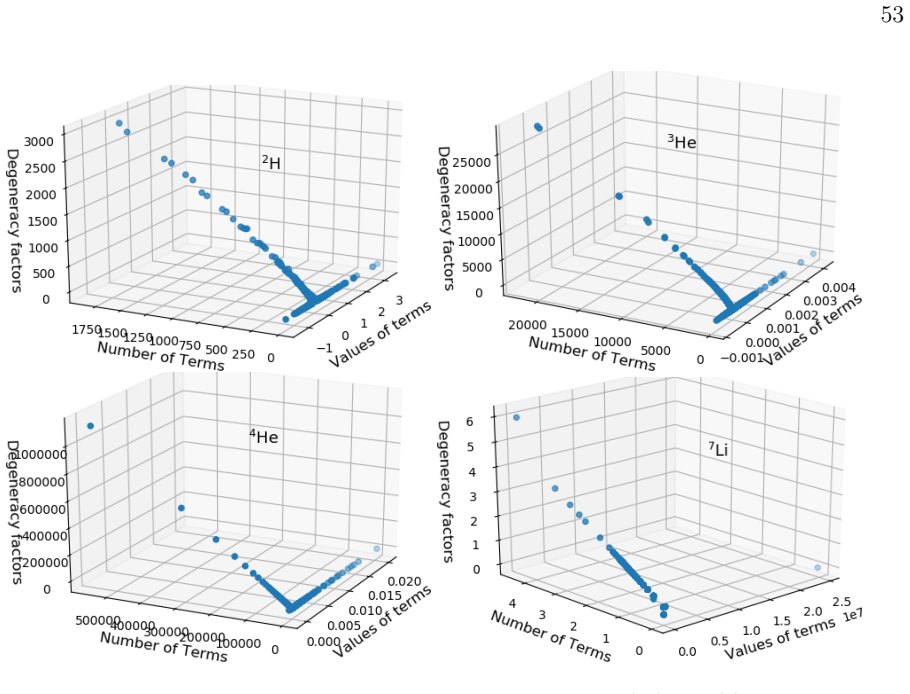
The central discovery is that the determinant representation of Wick contractions carries more symmetry than previous analyses used. Writing the two-point function as a weighted sum of products $\det M^u \det M^d \det M^s$, one finds that many of these determinants are identical up to permutation signs, either because their index tuples are related by quark permutations or because different full index choices share the same flavor sub-tuples. The paper's preprocessing step replaces the quark propagator with random integer entries, evaluates all candidate determinants once in exact integer arithmetic on a small lattice, and uses randomized polynomial identity testing to collect the unique determinant polynomials. This minimal set of index tuples is independent of the Dirac propagator, the gauge configuration, the time slice, and the lattice volume, so it is computed once per interpolating operator and then reused. The result is that the cost of Eq. (15) scales as $N N'(O(n_u^3+n_d^3))$ instead of $O(n_u^3 n_d^3)$, with measured internal reductions of 4.35, 7.30, 27.89, and 24.72 for $^{2}$H, $^{3}$He, $^{4}$He, and $^{7}$Li, and an order-of-magnitude advantage over the block algorithm in the point-sink setup. The correlator computations also reveal that the retained terms follow an extreme, sharply peaked long-tailed distribution, so that only a small fraction of them is needed to reproduce the effective mass.
Load-bearing premise
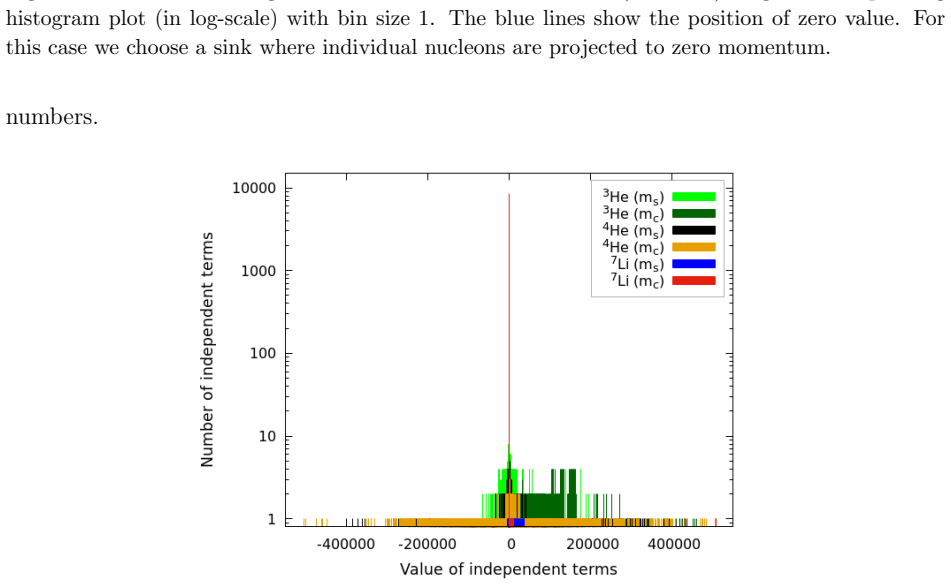
The load-bearing premise is that the small fixed fraction of the largest determinant or block terms, identified once on a small lattice at one quark mass, continues to reproduce the full correlation function at other quark masses, lattice volumes, and interpolating operators; the paper explicitly says the associated systematic uncertainties are not yet fully understood.
Editorial extensions
If this is right
- Lattice QCD calculations of light nuclei up to $A\sim12$, including $^{12}$C, become computationally feasible for point and smeared sinks once the minimal set is precomputed.
- GEVP correlation matrices with many interpolating operators share determinant sub-expressions, so the preprocessing can be applied across matrix entries and accelerate excited-state spectroscopy.
- Three-point functions for electromagnetic and axial structure of light nuclei can be generated and GPU-accelerated through the same tensor-based code-generation pipeline.
- Retaining only the dominant spin-color terms can cut correlator cost by a further order of magnitude, reducing the resources needed for multi-volume, multi-mass extrapolations.
- The observed universal dominance pattern, if confirmed as a symmetry, could guide the construction of interpolating operators with better signal-to-noise for heavier nuclei.
Reading between the lines
- The paper's heat maps show stripes where a dominant source spin-color row stays dominant across sink choices, which suggests the weight tensor $\Theta$ is nearly factorized; estimating its numerical rank across quark masses could turn the truncation from an empirical shortcut into a controlled approximation.
- The same randomized preprocessing should transfer to three- and four-point functions and to form-factor matrix elements, where the contraction sums share the same determinant structure; even without truncation, the minimal set would cut those costs substantially.
- If the tail statistics follow a universal extreme-value law, the fraction of terms needed for fixed accuracy may scale predictably with $A$ and quark mass, letting practitioners budget computations for nuclei beyond $A=12$ without running the full sum.
Editorial analysis
A structured set of objections, weighed in public.
Referee Report
Summary. The paper reports two methods for evaluating nuclear two-point correlation functions in lattice QCD. The first is an optimized determinant algorithm: the correlator is written as a sum of products of per-flavor determinants [Eq. (15)], and a randomized preprocessing step based on Schwartz-Zippel identity testing identifies, once per interpolating operator, a 'minimal set' of determinant index tuples that is claimed to be independent of the propagator and of the lattice volume. The second method uses TensorFlow/opt_einsum to generate and automatically optimize tensor contractions of the block algorithm and to execute them on GPUs. The authors apply the methods to 2H, 3He, 4He, and 7Li point-sink and plane-wave-sink correlators at several lattice volumes, report wall-clock timings for serial-C, OpenMP, CUDA, and TensorFlow implementations, and extract effective masses and finite-volume energy shifts at two unphysical quark masses. They also observe that the terms contributing to the sums follow an extreme distribution, such that a small top fraction (0.05%-20%) reportedly reproduces the full effective masses, and conjecture a spin-color symmetry.
Significance. The core algorithmic contribution is sound and likely useful: the flavor factorization leading to O(nu^3+nd^3+ns^3) determinant evaluation is clean, and the randomized preprocessing has a rigorous probabilistic error bound (Appendix C) and is genuinely a one-time cost for a given operator. The GPU/TensorFlow implementation is a practical engineering contribution that will be of interest to the lattice community. The observed dominance of a small fraction of terms is intriguing and, if quantitatively controlled, could enable substantial additional savings. However, the paper's headline 'order of magnitude' claim is overstated for the light nuclei, and the truncation-based speedup and symmetry conjecture are not yet backed by a quantitative systematic analysis. Overall, the work is a solid incremental algorithmic advance with real but uneven speedups, not yet a demonstrated order-of-magnitude improvement across the entire range claimed.
major comments (2)
- [Abstract; Sec. VI A; Tables II-IV; Fig. 1] The headline claim of 'at least an order of magnitude improvement over existing algorithms' conflates algorithmic improvement with hardware acceleration and is not met for the lighter nuclei. In the algorithmic comparison of Fig. 1 (same point-sink setup), the determinant algorithm is only about two times faster than the block algorithm for 2H and 3He; Table II shows the optimized-determinant speedup over the vanilla determinant is 4.35x for 2H and 7.30x for 3He. The large ratios in Tables III and IV, such as SERIAL C versus CUDA (~200x), are dominated by GPU-versus-CPU differences and do not quantify an algorithmic improvement. The stated level of speedup is therefore valid only for 4He (27.89x) and 7Li (24.72x); the claims should be qualified accordingly.
- [Sec. VI C; Table VI; Appendix D] The claim that keeping only the top 0.05%-20% of terms reproduces the full correlator is based on visual agreement of effective masses in plateau regions, with no quantitative error budget; the manuscript itself states in Sec. VI C that 'systematic uncertainties associated with dropping any terms need to be fully understood.' Moreover, the required fraction varies with quark mass and nucleus (Table VI; Figs. 7-8), and no test establishes that a top-term index set identified on one small lattice or ensemble remains sufficient on an independent ensemble at another mass, volume, or operator. Because the additional 'order of magnitude' speedup and the spin-color symmetry conjecture in Sec. VI C depend on this truncation, a quantitative validation or an explicit demarcation of the claim as a preliminary observation is needed.
minor comments (5)
- [Sec. VI C, Fig. 7 caption] The caption says 'Distribution plots for 2He' but the text and context refer to the deuteron, so this should read '2H'.
- [Sec. IV] The sentence 'We provide the snippet of the one nucleon code in the Appendix C' appears to be a wrong cross-reference; the TensorFlow code snippet is shown in the main text and the code-generation details are in Appendix B, while Appendix C is about identity testing.
- [Table II] The entry '2 × 1026a' is ambiguous in print; the footnote says '1026 terms', so please format the table to avoid the reader interpreting '1026' as 10^26.
- [Fig. 1] Because the block-algorithm comparison is a central quantitative claim, please add the numerical timing values or label the bars explicitly; the log-scale plot alone does not allow the reader to verify the stated factors of ~2 and ~10^3.
- [Sec. III B] The claim that the minimal set is independent of the propagator and lattice volume is argued for generic point operators; for smeared or extended operators, which are needed for the A~12 outlook, the χ indices include spatial positions, so the claim that the precomputation can be performed on 'one set of space-time points' needs a precise definition of the smearing region and a justification that the resulting set is independent of lattice size.
Circularity Check
No significant circularity: the determinant/minimal-set derivation is self-contained, and the top-term truncation caveat is an acknowledged limitation rather than a circular reduction.
full rationale
The paper's core derivation chain is self-contained. The determinant algorithm begins from Wick's theorem (Eq. 11), factorizes the flavor permutation sums (Eq. 12), and expresses the two-point function as sums of products of determinants (Eq. 15); the claimed time complexity N N' × O(n_u^3 + n_d^3 + n_s^3) is a direct consequence of evaluating the small flavor determinants separately, not an input of the calculation. The minimal determinant set is obtained by randomized identity testing (Appendix C): determinants are viewed as polynomials in the propagator entries, and equality on random integer instantiations implies polynomial identity with the bounded Schwartz-Zippel error probability, so the resulting index set is genuinely propagator-independent. This step is backed by an external, parameter-free mathematical theorem, not by a self-citation. The self-citations in the paper (e.g., Refs. [56,59,60]) are background lattice-QCD results and are not load-bearing for the algorithmic claims. The only potentially questionable step is the 'top few percent terms' truncation (Sec. VI C, Table VI, Appendix D), where required fractions are selected after comparing truncated and full effective masses on the same ensembles and then proposed as a cheap precomputable set. However, the paper explicitly discloses that this is not yet a controlled systematic statement: 'The improvement observed is, so far, numerical and systematic uncertainties associated with dropping any terms need to be fully understood.' That is an acknowledged limitation and a transferability risk, not a constructively circular reduction of the kind where an output equals an input by definition. No equation is used as both premise and conclusion, and no fitted parameter is renamed as a prediction. Accordingly, no circularity step is identified and the score is 0.
Assumptions & free parameters
free parameters (1)
- per-case term-fraction threshold =
0.05%, 0.3%, 1%, 5%, 10%, 20% depending on nucleus, quark mass, and sink type
assumptions (6)
- standard math Wick's theorem and Grassmann anti-commutation of quark fields
- standard math The flavor-separated permutation sums factorize into determinants
- standard math Schwartz-Zippel identity testing over random integer matrices detects determinant polynomial equality
- domain assumption The minimal set of determinant index tuples is independent of lattice volume, gauge configuration, and time slice
- ad hoc to paper Truncating the sum to largest absolute terms is a controlled approximation
- domain assumption MILC HISQ ensembles with m_u=m_d=m_s or m_c and overlap valence propagators are a valid testbed for algorithmic benchmarking
invented entities (1)
-
As-yet-unidentified spin-color symmetry
Cite this review
Pith. "Pith review of Nuclear correlation functions using first-principle calculations of lattice quantum chromodynamics." pith.science (2026). https://pith.science/paper/FA5ZDSOI
@misc{pith2026241108962,
  author       = {Pith},
  title        = {Pith review of: Nuclear correlation functions using first-principle calculations of lattice quantum chromodynamics},
  year         = {2026},
  howpublished = {\url{https://pith.science/paper/FA5ZDSOI}},
  note         = {Machine review of arXiv:2411.08962}
}
read the original abstract
Exploring nuclear physics through the fundamental constituents of the strong force -- quarks and gluons -- is a formidable challenge. While numerical calculations using lattice quantum chromodynamics offer the most promising approach for this pursuit, practical implementation is arduous, especially due to the uncontrollable growth of quark-combinatorics, the so-called Wick-contraction problem of nuclei. We present here two novel methods providing a state-of-the-art solution to this problem. In the first, we exploit randomized algorithms inspired from computational number theory to detect and eliminate redundancies that arise in Wick contraction computations. Our second method explores facilities for automation of tensor computations -- in terms of efficient utilization of specialized hardware, algorithmic optimizations, as well as ease of programming and the potential for automatic code generation -- that are offered by new programming models inspired by applications in machine learning (e.g., TensorFlow). We demonstrate the efficacy of our methods by computing two-point correlation functions for Deuteron, Helium-3, Helium-4 and Lithium-7, achieving at least an order of magnitude improvement over existing algorithms with efficient implementation on GPU-accelerators. Additionally, we discover an intriguing characteristic shared by all the nuclei we study: specific spin-color combinations dominate the correlation functions, hinting at a potential connection to an as-yet-unidentified symmetry in nuclei. Moreover finding them beforehand can reduce the computing time further and substantially. Our results, with the efficiency that we achieved, suggest the possibility of extending the applicability of our methods for calculating properties of light nuclei, potentially up to A ~12 and beyond.
Figures


Figures from the paper (20 more)






Forward citations
Cited by 1 Pith paper
-
Estimating energy levels from lattice QCD correlation functions using a transfer matrix formalism
A generalized eigenvalue formulation of the transfer matrix, equivalent to the oblique Lanczos method, with a KDE-based filtering scheme for spurious eigenvalues, extracts stable ground and excited state energies from...
Reference graph
Works this paper leans on
-
[1]
1 + \ 2 oe
(B1) Here the subscript “0” refers to the indices of the source point. 1 + \ 2 oe . contract ( eps , [ ’ i_0 ’ , ’ j_0 ’ , ’ k_0 ’] , C , [ ’ beta_0 ’ , ’ gamma_0 ’] , eps , [ ’ i_ 0_ pr i me ’ , ’ j _0 _p ri me ’ , ’ k _0 _p ri me ’] , C , [ ’ b e t a _ 0 _ p r i m e ’ , ’ g a m m a _ 0 _ p r i m e ’] , S , [ ’ x_0 ’ , ’ i_0 ’ , ’ alpha_0 ’ , ’ i _0 _p r...
-
[2]
Thus, for greater accuracy and simplicity, it is better to take the set C from which evaluation points are drawn to be a set of integers, say from 1 to |C|
Note that the coefficients of the determinants above are integers (even though the matrix entries in S may be arbitrary complex numbers). Thus, for greater accuracy and simplicity, it is better to take the set C from which evaluation points are drawn to be a set of integers, say from 1 to |C|. This ensures that all the arithmetic performed in the tests is...
-
[3]
In particular, if one uses machine integers, one may suspect that some of the test results above may be spurious
However, since we would typically like |C| to be about ten times nf , a potential problem with large nf (roughly when nf ≥ 7) may be the possibility of integer overflow (if machine integer types are used) or slow speed and large memory use (if exact rational arithmetic is used). In particular, if one uses machine integers, one may suspect that some of the...
-
[4]
M. G. Mayer, On Closed Shells in Nuclei, Phys. Rev. 74, 235 (1948)
1948
-
[5]
M. G. Mayer, On closed shells in nuclei. ii, Phys. Rev. 75, 1969 (1949)
1949
-
[6]
M. A. Preston and R. K. Bhaduri, Structure of the Nucleus (Addison-Wesley, 1975)
1975
-
[7]
R. B. Wiringa, V. G. J. Stoks, and R. Schiavilla, An Accurate nucleon-nucleon potential with charge independence breaking, Phys. Rev. C 51, 38 (1995), arXiv:nucl-th/9408016
arXiv 1995
-
[8]
B. S. Pudliner, V. R. Pandharipande, J. Carlson, and R. B. Wiringa, Quantum monte carlo calculations of A ≤ 6 nuclei, Phys. Rev. Lett. 74, 4396 (1995)
1995
Show all 114 references
-
[9]
Navr´ atil, J
P. Navr´ atil, J. P. Vary, and B. R. Barrett, Properties of 12c in the ab initio nuclear shell model, Phys. Rev. Lett. 84, 5728 (2000)
2000
-
[10]
Machleidt, The High precision, charge dependent Bonn nucleon-nucleon potential (CD- Bonn), Phys
R. Machleidt, The High precision, charge dependent Bonn nucleon-nucleon potential (CD- Bonn), Phys. Rev. C 63, 024001 (2001), arXiv:nucl-th/0006014
2001 arXiv
-
[11]
Hohenberg and W
P. Hohenberg and W. Kohn, Inhomogeneous electron gas, Phys. Rev. 136, B864 (1964)
1964
-
[12]
Kohn and L
W. Kohn and L. J. Sham, Self-consistent equations including exchange and correlation effects, Phys. Rev. 140, A1133 (1965)
1965
-
[13]
I. Z. Petkov and M. V. Stoitsov, Nuclear Density Functional Theory (Clarendon Press, 1991)
1991
-
[14]
Lomnitz-Adler, V
J. Lomnitz-Adler, V. Pandharipande, and R. Smith, Monte carlo calculations of triton and 4he nuclei with the reid potential, Nuclear Physics A 361, 399 (1981)
1981
-
[15]
Carlson, Green’s function monte carlo study of light nuclei, Phys
J. Carlson, Green’s function monte carlo study of light nuclei, Phys. Rev. C 36, 2026 (1987)
1987
-
[16]
Schmidt and S
K. Schmidt and S. Fantoni, A quantum monte carlo method for nucleon systems, Physics Letters B 446, 99 (1999)
1999
-
[17]
P. F. Bedaque and U. van Kolck, Effective field theory for few-nucleon systems, Annual Review of Nuclear and Particle Science 52, 339 (2002), https://doi.org/10.1146/annurev.nucl.52.050102.090637
2002
-
[18]
B. R. Barrett, P. Navratil, and J. P. Vary, Ab initio no core shell model, Prog. Part. Nucl. Phys. 69, 131 (2013)
2013
-
[19]
Hagen, T
G. Hagen, T. Papenbrock, M. Hjorth-Jensen, and D. J. Dean, Coupled-cluster computations of atomic nuclei, Reports on Progress in Physics 77, 096302 (2014)
2014
-
[20]
Carlson, S
J. Carlson, S. Gandolfi, F. Pederiva, S. C. Pieper, R. Schiavilla, K. E. Schmidt, and R. B. Wiringa, Quantum Monte Carlo methods for nuclear physics, Rev. Mod. Phys. 87, 1067 61 (2015), arXiv:1412.3081 [nucl-th]
2015 arXiv
-
[21]
Weinberg, Nuclear forces from chiral lagrangians, Physics Letters B 251, 288 (1990)
S. Weinberg, Nuclear forces from chiral lagrangians, Physics Letters B 251, 288 (1990)
1990
-
[22]
Weinberg, Effective chiral lagrangians for nucleon-pion interactions and nuclear forces, Nuclear Physics B 363, 3 (1991)
S. Weinberg, Effective chiral lagrangians for nucleon-pion interactions and nuclear forces, Nuclear Physics B 363, 3 (1991)
1991
-
[23]
Weinberg, Three-body interactions among nucleons and pions, Physics Letters B 295, 114 (1992)
S. Weinberg, Three-body interactions among nucleons and pions, Physics Letters B 295, 114 (1992)
1992
-
[24]
Epelbaum, H.-W
E. Epelbaum, H.-W. Hammer, and U.-G. Meißner, Modern theory of nuclear forces, Rev. Mod. Phys. 81, 1773 (2009)
2009
-
[25]
Epelbaum, W
E. Epelbaum, W. Gl¨ ockle, and U.-G. Meißner, The two-nucleon system at next-to-next-to- next-to-leading order, Nuclear Physics A 747, 362 (2005)
2005
-
[26]
T. A. L. L¨ ahde and U.-G. Meisner, Nuclear Lattice Effective Field Theory: An Introduction (Lecture Notes in Physics Book 957) (Springer, 2019)
2019
-
[27]
Epelbaum, H
E. Epelbaum, H. Krebs, D. Lee, and U.-G. Meißner, Ab initio calculation of the hoyle state, Phys. Rev. Lett. 106, 192501 (2011)
2011
-
[28]
S. R. Beane, W. Detmold, K. Orginos, and M. J. Savage, Nuclear Physics from Lattice QCD, Prog. Part. Nucl. Phys. 66, 1 (2011), arXiv:1004.2935 [hep-lat]
2011 arXiv
-
[29]
S. R. Beane et al. (NPLQCD), Evidence for a Bound H-dibaryon from Lattice QCD, Phys. Rev. Lett. 106, 162001 (2011), arXiv:1012.3812 [hep-lat]
2011 arXiv
-
[30]
S. R. Beane, E. Chang, S. D. Cohen, W. Detmold, H. W. Lin, T. C. Luu, K. Orginos, A. Parreno, M. J. Savage, and A. Walker-Loud (NPLQCD), Light Nuclei and Hypernuclei from Quantum Chromodynamics in the Limit of SU(3) Flavor Symmetry, Phys. Rev. D 87, 034506 (2013), arXiv:1206.5...
2013 arXiv
-
[31]
S. R. Beane, E. Chang, S. D. Cohen, W. Detmold, H. W. Lin, T. C. Luu, K. Orginos, A. Par- reno, M. J. Savage, and A. Walker-Loud, Hyperon-Nucleon Interactions and the Composition of Dense Nuclear Matter from Quantum Chromodynamics, Phys. Rev. Lett. 109, 172001 (2012), arXiv:12...
2012 arXiv
-
[32]
S. R. Beane, E. Chang, S. Cohen, W. Detmold, H. W. Lin, K. Orginos, A. Parreno, M. J. Savage, and B. C. Tiburzi, Magnetic moments of light nuclei from lattice quantum chromo- dynamics, Phys. Rev. Lett. 113, 252001 (2014), arXiv:1409.3556 [hep-lat]
2014 arXiv
-
[33]
S. R. Beane, E. Chang, W. Detmold, K. Orginos, A. Parre˜ no, M. J. Savage, and B. C. Tiburzi (NPLQCD), Ab initio Calculation of the np→dγ Radiative Capture Process, Phys. Rev. Lett. 62 115, 132001 (2015), arXiv:1505.02422 [hep-lat]
2015 arXiv
-
[34]
S. R. Beane, E. Chang, S. D. Cohen, W. Detmold, H. W. Lin, T. C. Luu, K. Orginos, A. Parre˜ no, M. J. Savage, and A. Walker-Loud (NPLQCD Collaboration), Light nuclei and hypernuclei from quantum chromodynamics in the limit of su(3) flavor symmetry, Phys. Rev. D 87, 034506 (2013)
2013
-
[35]
Orginos, A
K. Orginos, A. Parreno, M. J. Savage, S. R. Beane, E. Chang, and W. Detmold, Two nucleon systems at mπ ∼ 450 MeV from lattice QCD, Phys. Rev. D 92, 114512 (2015), [Erratum: Phys.Rev.D 102, 039903 (2020)], arXiv:1508.07583 [hep-lat]
2015 arXiv
-
[36]
Berkowitz, T
E. Berkowitz, T. Kurth, A. Nicholson, B. Joo, E. Rinaldi, M. Strother, P. M. Vranas, and A. Walker-Loud, Two-Nucleon Higher Partial-Wave Scattering from Lattice QCD, Phys. Lett. B 765, 285 (2017), arXiv:1508.00886 [hep-lat]
2017 arXiv
-
[37]
Detmold, K
W. Detmold, K. Orginos, A. Parreno, M. J. Savage, B. C. Tiburzi, S. R. Beane, and E. Chang, Unitary Limit of Two-Nucleon Interactions in Strong Magnetic Fields, Phys. Rev. Lett. 116, 112301 (2016), arXiv:1508.05884 [hep-lat]
2016 arXiv
-
[38]
Detmold and K
W. Detmold and K. Orginos, Nuclear correlation functions in lattice qcd, Phys. Rev. D 87, 114512 (2013)
2013
-
[39]
M. J. Savage, P. E. Shanahan, B. C. Tiburzi, M. L. Wagman, F. Winter, S. R. Beane, E. Chang, Z. Davoudi, W. Detmold, and K. Orginos, Proton-Proton Fusion and Tritium β Decay from Lattice Quantum Chromodynamics, Phys. Rev. Lett. 119, 062002 (2017), arXiv:1610.04545 [hep-lat]
2017 arXiv
-
[40]
B. C. Tiburzi, M. L. Wagman, F. Winter, E. Chang, Z. Davoudi, W. Detmold, K. Orginos, M. J. Savage, and P. E. Shanahan, Double- β Decay Matrix Elements from Lattice Quantum Chromodynamics, Phys. Rev. D 96, 054505 (2017), arXiv:1702.02929 [hep-lat]
2017 arXiv
-
[41]
M. L. Wagman, F. Winter, E. Chang, Z. Davoudi, W. Detmold, K. Orginos, M. J. Savage, and P. E. Shanahan, Baryon-Baryon Interactions and Spin-Flavor Symmetry from Lattice Quantum Chromodynamics, Phys. Rev. D 96, 114510 (2017), arXiv:1706.06550 [hep-lat]
2017 arXiv
-
[42]
Detmold, R
W. Detmold, R. G. Edwards, J. J. Dudek, M. Engelhardt, H.-W. Lin, S. Meinel, K. Orginos, and P. Shanahan (USQCD), Hadrons and Nuclei, Eur. Phys. J. A 55, 193 (2019), arXiv:1904.09512 [hep-lat]
2019 arXiv
-
[43]
Davoudi, W
Z. Davoudi, W. Detmold, K. Orginos, A. Parre˜ no, M. J. Savage, P. Shanahan, and M. L. Wagman, Nuclear matrix elements from lattice QCD for electroweak and beyond-Standard- 63 Model processes, Phys. Rept. 900, 1 (2021), arXiv:2008.11160 [hep-lat]
2021 arXiv
-
[44]
Detmold, M
W. Detmold, M. Illa, D. J. Murphy, P. Oare, K. Orginos, P. E. Shanahan, M. L. Wagman, and F. Winter (NPLQCD), Lattice QCD Constraints on the Parton Distribution Functions of 3He, Phys. Rev. Lett. 126, 202001 (2021), arXiv:2009.05522 [hep-lat]
2021 arXiv
-
[45]
Parre˜ no, P
A. Parre˜ no, P. E. Shanahan, M. L. Wagman, F. Winter, E. Chang, W. Detmold, and M. Illa (NPLQCD), Axial charge of the triton from lattice QCD, Phys. Rev. D 103, 074511 (2021), arXiv:2102.03805 [hep-lat]
2021 arXiv
-
[46]
Amarasinghe, R
S. Amarasinghe, R. Baghdadi, Z. Davoudi, W. Detmold, M. Illa, A. Parre˜ no, A. V. Pochinsky, P. E. Shanahan, and M. L. Wagman, Variational study of two-nucleon systems with lattice QCD, Physical Review D 107, 094508 (2023)
2023
-
[47]
Davoudi, W
Z. Davoudi, W. Detmold, Z. Fu, A. V. Grebe, W. Jay, D. Murphy, P. Oare, P. E. Shana- han, and M. L. Wagman (NPLQCD), Long-distance nuclear matrix elements for neutrinoless double-beta decay from lattice QCD, Phys. Rev. D 109, 114514 (2024), arXiv:2402.09362 [hep-lat]
2024 arXiv
-
[48]
Ishii, S
N. Ishii, S. Aoki, and T. Hatsuda, The Nuclear Force from Lattice QCD, Phys. Rev. Lett. 99, 022001 (2007), arXiv:nucl-th/0611096
2007 arXiv
-
[49]
Yamazaki, Y
T. Yamazaki, Y. Kuramashi, and A. Ukawa (PACS-CS), Helium Nuclei in Quenched Lattice QCD, Phys. Rev. D 81, 111504 (2010), arXiv:0912.1383 [hep-lat]
2010 arXiv
-
[50]
Nemura, N
H. Nemura, N. Ishii, S. Aoki, and T. Hatsuda, Hyperon-nucleon force from lattice QCD, Phys. Lett. B 673, 136 (2009), arXiv:0806.1094 [nucl-th]
2009 arXiv
-
[51]
Yamazaki, Y
T. Yamazaki, Y. Kuramashi, and A. Ukawa, Helium nuclei in quenched lattice QCD, Physical Review D 81, 10.1103/physrevd.81.111504 (2010)
2010 doi
-
[52]
S. Aoki, T. Hatsuda, and N. Ishii, Theoretical Foundation of the Nuclear Force in QCD and its applications to Central and Tensor Forces in Quenched Lattice QCD Simulations, Prog. Theor. Phys. 123, 89 (2010), arXiv:0909.5585 [hep-lat]
2010 arXiv
-
[53]
Inoue, N
T. Inoue, N. Ishii, S. Aoki, T. Doi, T. Hatsuda, Y. Ikeda, K. Murano, H. Nemura, and K. Sasaki (HAL QCD), Bound H-dibaryon in Flavor SU(3) Limit of Lattice QCD, Phys. Rev. Lett. 106, 162002 (2011), arXiv:1012.5928 [hep-lat]
2011 arXiv
-
[54]
T. Doi, S. Aoki, T. Hatsuda, Y. Ikeda, T. Inoue, N. Ishii, K. Murano, H. Nemura, and K. Sasaki (HAL QCD), Exploring Three-Nucleon Forces in Lattice QCD, Prog. Theor. Phys. 127, 723 (2012), arXiv:1106.2276 [hep-lat]. 64
2012 arXiv
-
[55]
S. Aoki, T. Doi, T. Hatsuda, Y. Ikeda, T. Inoue, N. Ishii, K. Murano, H. Nemura, and K. Sasaki (HAL QCD), Lattice QCD approach to Nuclear Physics, PTEP 2012, 01A105 (2012), arXiv:1206.5088 [hep-lat]
2012 arXiv
-
[56]
Gongyo et al
S. Gongyo et al. , Most Strange Dibaryon from Lattice QCD, Phys. Rev. Lett. 120, 212001 (2018), arXiv:1709.00654 [hep-lat]
2018 arXiv
-
[57]
Francis, J
A. Francis, J. R. Green, P. M. Junnarkar, C. Miao, T. D. Rae, and H. Wittig, Lattice QCD study of the H dibaryon using hexaquark and two-baryon interpolators, Phys. Rev. D 99, 074505 (2019), arXiv:1805.03966 [hep-lat]
2019 arXiv
-
[58]
Drischler, W
C. Drischler, W. Haxton, K. McElvain, E. Mereghetti, A. Nicholson, P. Vranas, and A. Walker- Loud, Towards grounding nuclear physics in QCD, Prog. Part. Nucl. Phys.121, 103888 (2021), arXiv:1910.07961 [nucl-th]
2021 arXiv
-
[59]
Junnarkar and N
P. Junnarkar and N. Mathur, Deuteronlike Heavy Dibaryons from Lattice Quantum Chromo- dynamics, Phys. Rev. Lett. 123, 162003 (2019), arXiv:1906.06054 [hep-lat]
2019 arXiv
-
[60]
J. R. Green, A. D. Hanlon, P. M. Junnarkar, and H. Wittig, Weakly Bound H Dibaryon from SU(3)-Flavor-Symmetric QCD, Physical Review Letters 127, 242003 (2021)
2021
-
[61]
H¨ orz, D
B. H¨ orz, D. Howarth, E. Rinaldi, A. Hanlon, C. C. Chang, C. K¨ orber, E. Berkowitz, J. Bulava, M. A. Clark, W. T. Lee, C. Morningstar, A. Nicholson, P. Vranas, and A. Walker-Loud, Two- nucleon S-wave interactions at the SU (3) flavor-symmetric point with mud ≈ mphys s : A fi...
2021
-
[62]
P. M. Junnarkar and N. Mathur, Study of three-flavored heavy dibaryons using lattice QCD, Phys. Rev. D 106, 054511 (2022), arXiv:2206.02942 [hep-lat]
2022 arXiv
-
[63]
Mathur, M
N. Mathur, M. Padmanath, and D. Chakraborty, Strongly Bound Dibaryon with Maximal Beauty Flavor from Lattice QCD, Phys. Rev. Lett. 130, 111901 (2023), arXiv:2205.02862 [hep-lat]
2023 arXiv
-
[64]
K. G. Wilson, Confinement of quarks, Phys. Rev. D 10, 2445 (1974)
1974
-
[65]
A. S. Kronfeld et al. (USQCD), Lattice QCD and Particle Physics (2022), arXiv:2207.07641 [hep-lat]
2022 arXiv
-
[66]
Davoudi et al
Z. Davoudi et al. , Report of the Snowmass 2021 Topical Group on Lattice Gauge Theory, in Snowmass 2021 (2022) arXiv:2209.10758 [hep-lat]
2022 arXiv
-
[67]
R. L. Workman and Others (Particle Data Group), Review of Particle Physics, PTEP 2022, 65 083C01 (2022)
2022
-
[68]
Gattringer and C
C. Gattringer and C. Lang, Quantum Chromodynamics on the Lattice: An Introductory Pre- sentation (Springer Science & Business Media, 2009)
2009
-
[69]
Parisi, The strategy for computing the hadronic mass spectrum, Physics Reports 103, 203 (1984)
G. Parisi, The strategy for computing the hadronic mass spectrum, Physics Reports 103, 203 (1984)
1984
-
[70]
G. P. Lepage, The Analysis of Algorithms for Lattice Field Theory, in Theoretical Advanced Study Institute in Elementary Particle Physics (1989)
1989
-
[71]
Detmold and M
W. Detmold and M. G. Endres, Signal/noise enhancement strategies for stochastically esti- mated correlation functions, Phys. Rev. D 90, 034503 (2014)
2014
-
[72]
M. C` e, L. Giusti, and S. Schaefer, Domain decomposition, multilevel integration, and expo- nential noise reduction in lattice qcd, Phys. Rev. D 93, 094507 (2016)
2016
-
[73]
B. Yoon, T. Bhattacharya, and R. Gupta, Machine learning estimators for lattice qcd observ- ables, Phys. Rev. D 100, 014504 (2019)
2019
-
[74]
Detmold, G
W. Detmold, G. Kanwar, M. L. Wagman, and N. C. Warrington, Path integral contour deformations for noisy observables, Phys. Rev. D 102, 014514 (2020)
2020
-
[75]
Yamazaki, K.-i
T. Yamazaki, K.-i. Ishikawa, N. Ishizuka, Y. Kuramashi, Y. Namekawa, Y. Taniguchi, N. Ukita, and T. Yoshi´ e (PACS), |Vus| from kaon semileptonic form factor in Nf = 2 + 1 QCD at the physical point on (10 fm) 4, in 40th International Symposium on Lattice Field Theory (2023) ar...
2023 arXiv
-
[76]
Aoyama, T
T. Aoyama, T. M. Doi, T. Doi, E. Itou, Y. Lyu, K. Murakami, and T. Sugiura, Scale setting and hadronic properties in light quark sector with (2+1)-flavor Wilson fermions at the physical point, arXiv e-prints , arXiv:2406.16665 (2024), arXiv:2406.16665 [hep-lat]
2024
-
[77]
Doi and M
T. Doi and M. G. Endres, Unified contraction algorithm for multi-baryon correlators on the lattice, Computer Physics Communications 184, 117 (2013)
2013
-
[78]
Ishii, S
N. Ishii, S. Aoki, and T. Hatsuda, Nuclear force from lattice QCD, Physical Review Letters 99, 10.1103/physrevlett.99.022001 (2007)
2007 doi
-
[79]
Vachaspati and W
P. Vachaspati and W. Detmold, Fast Evaluation of Multi-Hadron Correlation Functions, PoS LA TTICE2014, 041 (2014), arXiv:1411.3691 [hep-lat]
2014 arXiv
-
[80]
Detmold, D
W. Detmold, D. Murphy, A. Pochinsky, M. Savage, P. Shanahan, and M. Wagman, Spars- ening algorithm for multihadron lattice QCD correlation functions, Physical Review D 104, 10.1103/physrevd.104.034502 (2021). 66
2021 doi
-
[81]
Humphrey, W
N. Humphrey, W. Detmold, R. D. Young, and J. M. Zanotti, Novel algorithms for computing correlation functions of nuclei (2022)
2022
-
[82]
Abadi et al., TensorFlow: Large-scale machine learning on heterogeneous systems (2015), software available from tensorflow.org
M. Abadi et al., TensorFlow: Large-scale machine learning on heterogeneous systems (2015), software available from tensorflow.org
2015
-
[83]
Developers, TensorFlow (Zenodo, 2023) See the full list of authors on GitHub
T. Developers, TensorFlow (Zenodo, 2023) See the full list of authors on GitHub
2023
-
[84]
C. A. Tracy and H. Widom, Level-spacing distributions and the airy kernel, Physics Letters B 305, 115 (1993)
1993
-
[85]
G¨ unther, B
J. G¨ unther, B. C. T´ oth, and L. Varnhorst, Recursive approach to determine correlation func- tions in multibaryon systems, Phys. Rev. D 87, 094513 (2013)
2013
-
[86]
G. C. Wick, The evaluation of the collision matrix, Phys. Rev. 80, 268 (1950)
1950
-
[87]
M. E. Peskin and D. V. Schroeder, An Introduction to quantum field theory (Addison-Wesley, Reading, USA, 1995)
1995
-
[88]
Yamazaki, Y
PACS-CS Collaboration, T. Yamazaki, Y. Kuramashi, and A. Ukawa, Helium nuclei in quenched lattice QCD, Physical Review D 81, 111504 (2010), publisher: American Physi- cal Society
2010
-
[89]
H¨ orz and A
B. H¨ orz and A. Hanlon, Two- and Three-Pion Finite-Volume Spectra at Maximal Isospin from Lattice QCD, Physical Review Letters 123, 142002 (2019)
2019
-
[90]
R. G. Edwards and B. Jo´ o, The Chroma software system for lattice QCD, Nuclear Physics B - Proceedings Supplements 140, 832 (2005)
2005
-
[91]
Djukanovic, Quark contraction tool — QCT, Computer Physics Communications 247, 106950 (2020)
D. Djukanovic, Quark contraction tool — QCT, Computer Physics Communications 247, 106950 (2020)
2020
-
[92]
Michael, Adjoint sources in lattice gauge theory, Nuclear Physics B 259, 58 (1985)
C. Michael, Adjoint sources in lattice gauge theory, Nuclear Physics B 259, 58 (1985)
1985
-
[93]
Luscher and U
M. Luscher and U. Wolff, How to Calculate the Elastic Scattering Matrix in Two-dimensional Quantum Field Theories by Numerical Simulation, Nucl. Phys. B339, 222 (1990)
1990
-
[94]
C. C. Chang et al., A per-cent-level determination of the nucleon axial coupling from quantum chromodynamics, Nature 558, 91 (2018), arXiv:1805.12130 [hep-lat]
2018 arXiv
-
[95]
Gonz´ alez-Alonso, O
M. Gonz´ alez-Alonso, O. Naviliat-Cuncic, and N. Severijns, New physics searches in nuclear and neutron β decay, Prog. Part. Nucl. Phys. 104, 165 (2019), arXiv:1803.08732 [hep-ph]
2019 arXiv
-
[96]
Engel and J
J. Engel and J. Men´ endez, Status and Future of Nuclear Matrix Elements for Neutrinoless Double-Beta Decay: A Review, Rept. Prog. Phys. 80, 046301 (2017), arXiv:1610.06548 [nucl- th]. 67
2017 arXiv
-
[97]
Bazavov et al
A. Bazavov et al. (MILC), Lattice QCD Ensembles with Four Flavors of Highly Improved Staggered Quarks, Phys. Rev. D 87, 054505 (2013), arXiv:1212.4768 [hep-lat]
2013 arXiv
-
[98]
Neuberger, Exactly massless quarks on the lattice, Phys
H. Neuberger, Exactly massless quarks on the lattice, Phys. Lett. B417, 141 (1998), arXiv:hep-lat/9707022 [hep-lat]
1998 arXiv
-
[99]
Neuberger, Exactly massless quarks on the lattice, Physics Letters B 417, 141 (1998)
H. Neuberger, Exactly massless quarks on the lattice, Physics Letters B 417, 141 (1998)
1998
-
[100]
Luscher, Two particle states on a torus and their relation to the scattering matrix, Nucl
M. Luscher, Two particle states on a torus and their relation to the scattering matrix, Nucl. Phys. B 354, 531 (1991)
1991
-
[101]
Rummukainen and S
K. Rummukainen and S. Gottlieb, Resonance scattering phase shifts on a non-rest-frame lattice, Nuclear Physics B 450, 397 (1995)
1995
-
[102]
M. T. Hansen and S. R. Sharpe, Relativistic, model-independent, three-particle quantization condition, Phys. Rev. D 90, 116003 (2014), arXiv:1408.5933 [hep-lat]
2014 arXiv
-
[103]
R. A. Briceno, J. J. Dudek, and R. D. Young, Scattering processes and resonances from lattice QCD, Rev. Mod. Phys. 90, 025001 (2018), arXiv:1706.06223 [hep-lat]
2018 arXiv
-
[104]
M. T. Hansen and S. R. Sharpe, Lattice QCD and Three-particle Decays of Resonances, Ann. Rev. Nucl. Part. Sci. 69, 65 (2019), arXiv:1901.00483 [hep-lat]
2019 arXiv
-
[105]
A. S. Kronfeld, D. G. Richards, W. Detmold, R. Gupta, H.-W. Lin, K.-F. Liu, A. S. Meyer, R. Sufian, and S. Syritsyn (USQCD), Lattice QCD and Neutrino-Nucleus Scattering, Eur. Phys. J. A 55, 196 (2019), arXiv:1904.09931 [hep-lat]
2019 arXiv
-
[106]
J. T. Schwartz, Fast Probabilistic Algorithms for Verification of Polynomial Identities, Journal of the ACM 27, 701 (1980)
1980
-
[107]
Zippel, Probabilistic algorithms for sparse polynomials, in Symbolic and Algebraic Com- putation, Vol
R. Zippel, Probabilistic algorithms for sparse polynomials, in Symbolic and Algebraic Com- putation, Vol. 72, edited by G. Goos, J. Hartmanis, P. Brinch Hansen, D. Gries, C. Moler, G. Seegm¨ uller, J. Stoer, N. Wirth, and E. W. Ng (Springer Berlin Heidelberg, Berlin, Heidel- b...
1979
-
[108]
R. A. Demillo and R. J. Lipton, A probabilistic remark on algebraic program testing, Infor- mation Processing Letters 7, 193 (1978)
1978
-
[109]
D. E. Erickson, Counting zeros of polynomials over fintite fields , Ph.D. thesis, California Institute of Technology, Pasadena, California, USA (1974)
1974
-
[110]
Ore, ¨Uber h¨ ohere kongruenzen, Norsk Mat
Ø. Ore, ¨Uber h¨ ohere kongruenzen, Norsk Mat. Fornings Skrifter1 (1922)
1922
-
[111]
G. L. Miller, Riemann’s hypothesis and tests for primality, Journal of Computer and System Sciences 13, 300 (1976). 68
1976
-
[112]
M. O. Rabin, Probabilistic algorithm for testing primality, Journal of Number Theory 12, 128 (1980)
1980
-
[113]
Agrawal and S
M. Agrawal and S. Biswas, Primality and identity testing via Chinese remaindering, Journal of the ACM 50, 429 (2003)
2003
-
[114]
Agrawal, N
M. Agrawal, N. Kayal, and N. Saxena, PRIMES is in P, Annals of Mathematics 160, 781 (2004)
2004
Reviewed August 12, 2026 · model on record in the stance chip above.
Discussion (0). Continue with ORCID to comment.