REVIEW 3 major objections 4 minor 36 references
Chemical bonding in three-membered ring systems
T0 review · 3 major / 4 minor · reviewed 2026-08-12 · deepseek-v4-flash
Pith's one-line read In high symmetry, three-membered rings open and close along two different energy paths with no saddle-point barrier; only when symmetry is lowered do the paths merge.
desk verdict Solid OVB/CASSCF study of three-membered ring additions and eliminations; the C2v 'no saddle point' claim outruns the constrained-scan evidence. read the letter →
The pith
A machine-rendered reading of the paper's core claim, the machinery that carries it, and where it could break.
The reading
What carries the argument
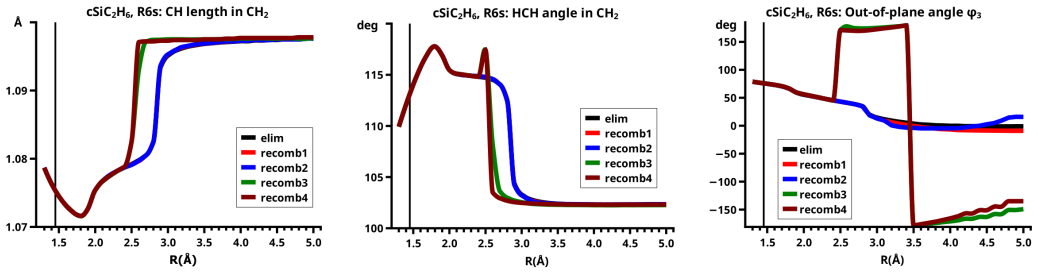
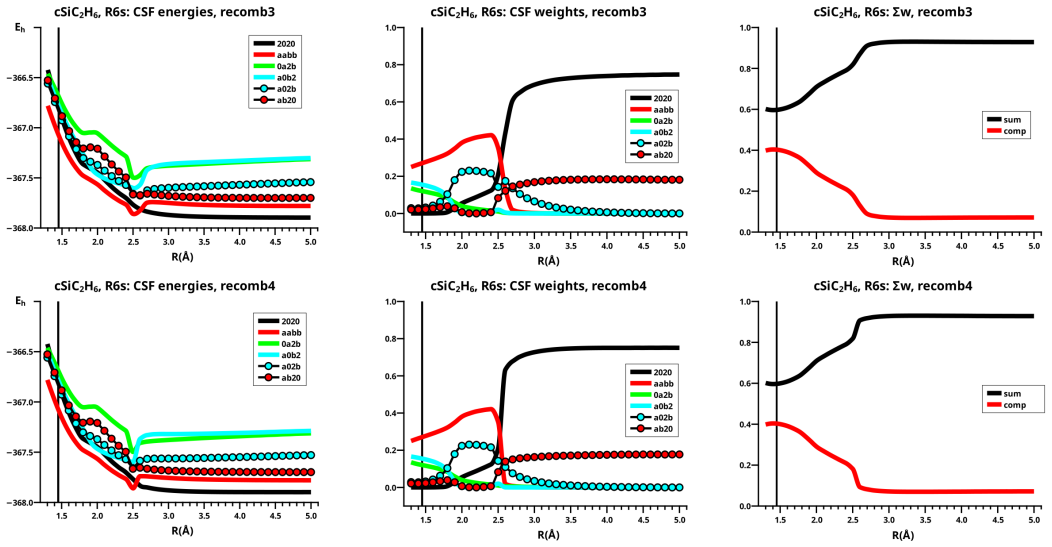
The central object is the orthogonal valence bond (OVB) analysis of CAS(4,4) wave functions: delocalized CASSCF molecular orbitals are localized onto fragment molecular orbitals (FMOs) by a Procrustes transformation, and the wave function is expanded in configuration state functions (CSFs) with definite local charge and spin distributions, such as the no-bond CSF, the local-triplet CSF, and ionic charge-transfer CSFs. Tracking CSF weights and energies along the approximate reaction coordinate R reveals which fragment states dominate in the bonded and dissociated regions and shows that the two reaction valleys keep distinct electronic characteristics, the signature of diabatic behavior. The CSF labels provide the diagnostic: in C2v only twelve of the twenty CSFs are totally symmetric, so the single-excitation and charge-shift CSFs that could mix the valleys are absent; in Cs all twenty CSFs enter and the states combine adiabatically.
What would settle it
Run an unconstrained transition-state search for one of the C2v reactions, such as methylene elimination from cyclopropane at the CAS(4,4) level, starting from the crossing-point geometry; if an intrinsic reaction coordinate connects the ring to the separated fragments through a first-order saddle point, the central claim fails.
Extended reading notes
Core claim
Using CAS(4,4) wave functions and an orthogonal valence bond (OVB) analysis of the four ring systems cyclopropane, silirane, disilirane, and cyclotrisilane, the paper finds that in C2v symmetry the forward addition and reverse elimination reactions are diabatic reactions: they follow different minimum energy paths whose potential energy curves cross at a point where the system jumps from one electronic state to the other. There is no saddle point and no conventional reaction barrier on the adiabatic ground-state surface; the energy simply rises along one diabatic curve, then falls after the jump. In Cs symmetry the two diabatic states combine into a single adiabatic ground state and the reaction follows one smooth minimum energy path without a barrier. The authors conclude that the kinetic stability of substituted cyclotrisilanes and related three-membered rings is therefore a symmetry effect: substituents that prevent deformation away from C2v force the elimination reaction to climb the diabatic curve, while unhindered systems relax through Cs and react easily.
Load-bearing premise
The central claim rests on the assumption that constraining the fragment-fragment distance R and optimizing all other coordinates is enough to trace the true minimum energy path; if the real path bends through asymmetric distortions that the C2v scan freezes out, a saddle point could still exist.
Editorial extensions
If this is right
- With large substituents that freeze the ring into C2v geometry, methylene or silylene elimination has to climb the diabatic curve; the paper's crossing-point estimates (up to 492 kJ/mol for cyclopropane and 311 kJ/mol for cyclotrisilane) explain why such three-membered rings can be isolated.
- When the system can relax to Cs, the diabatic states mix into a single adiabatic ground state, so unhindered rings open and close along one smooth path without a saddle-point barrier.
- The well-known stability of substituted cyclotrisilanes is kinetic rather than thermodynamic: cyclotrisilane is not intrinsically unstable toward elimination, and the long-standing difficulty in making it came from kinetic protection, not from an unfavorable reaction energy.
- In C2v symmetry, addition of a carbene analog to a double bond requires both fragments to change from low-spin to high-spin character, often with an umbrella inversion of the pyramidal fragment; these electronic rearrangements, not a conventional barrier, govern the reaction cost.
- All C2v reactions studied are orbital-symmetry forbidden in the Woodward-Hoffmann sense, while the Cs versions are allowed; the paper's diabatic picture gives a local, spin-resolved account of what the symmetry rules summarize globally.
Reading between the lines
- If the paper's picture transfers to other cheletropic additions, constrained symmetric scans that show cusps should be reinterpreted as diabatic crossings, and transition-state searches should be run in the lower-symmetry group before concluding that a barrier exists.
- The mechanism predicts a substituent test: rigid bridges that enforce C2v should raise elimination barriers toward the computed crossing-point energies, while floppy substituents that permit Cs folding should erase them; this could be checked by comparing tethered, bulky, and flexible substituents on known cyclotrisilanes.
- The paper's closing suggestion that jumps between troughs need an electron-phonon description points to a concrete dynamical follow-up: compute nonadiabatic couplings or surface-hopping rates between the two diabatic states in the crossing region to see whether the C2v reaction actually crosses or tunnels.
- The OVB weight analysis implies a falsifiable electronic-structure marker: spin-sensitive measurements should see the fragments acquire triplet-like geometry at the same fragment separation where the C2v potential energy curve jumps, rather than gradually.
Editorial analysis
A structured set of objections, weighed in public.
Referee Report
Summary. The manuscript reports CAS(4,4) calculations with orthogonal valence bond (OVB) analysis for the formation and cleavage of four three-membered rings, c-(CH2)3-k(SiH2)k, by addition/elimination of methylene or silylene to ethene, disilene, or silaethene. The central claim is that in C2v symmetry the addition and elimination reactions follow different minimum energy paths and are diabatic: the energy rises monotonically along one branch until the system switches to the other branch, so that there are no saddle-point barriers on the potential energy surface. In Cs symmetry, by contrast, the diabatic states combine into a single adiabatic path. The authors use this to explain the kinetic stability of substituted cyclotrisilanes and related rings, and they provide PECs, geometry curves, CSF weights and energies, corrected reaction energies, and comparisons across the four ring systems.
Significance. If the no-saddle-point claim is correct, the paper offers a physically concrete explanation for the kinetic stability of substituted cyclotrisilanes, with a local charge/spin interpretation that goes beyond a Woodward-Hoffmann symmetry label. The calculations are carried out at a consistent CAS(4,4) level, with CAS(6,6) checks for two of the reactions, and the OVB transformation is well defined and yields interpretable CSF weights and energies. The paper is also candid about the limitations of its reaction-coordinate picture, explicitly noting that the true reaction coordinate is replaced by an approximate coordinate R and that continuous curve representations hide discontinuous MEP switching. These strengths are real; the main weakness is that the headline topological conclusion is inferred from constrained one-dimensional scans rather than from a full or sampled potential energy surface.
major comments (3)
- [VII; IV A] The central claim that C2v reactions have "no energy barriers corresponding to saddle points" is based entirely on constrained scans along the approximate reaction coordinate R (Section VII: "all other geometry parameters were optimized"; Section IV A: "the true reaction coordinate lambda is mostly replaced by an approximate reaction coordinate R"). The scan protocol deliberately conserves the electronic structure along R, and the C2v constraint freezes out asymmetric distortions. Such a one-dimensional scan cannot rule out first-order saddle points whose transition vector involves a combination of coordinates other than R, nor saddle points that connect the two apparent MEPs through symmetry-broken geometries. Section VI states that "the energy at the crossing point is not an adiabatic reaction barrier," but that statement is interpretive and does not replace a transition-state search. I therefore do not regard the no-saddle-point assertion as established; the authors should either perform unconstrained transition-state searches and/or IRC calculations in the relevant regions, or explicitly restrict the claim to "no barrier along the constrained R coordinate."
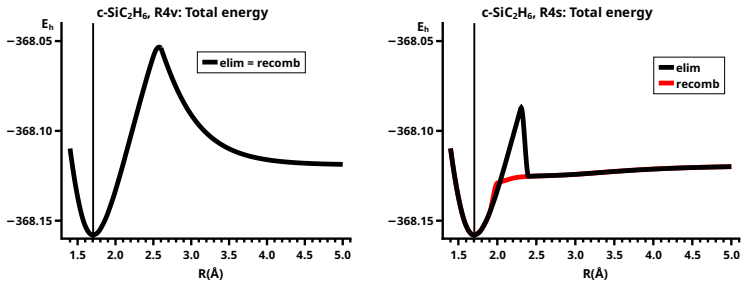
- [IV B; VI] The paper mixes adiabatic and diabatic levels of description in a way that matters for the conclusion. Section IV B says that the PECs in the two-trough case "are indeed adiabatic PECs because the energies are the lowest eigenvalues of the Hamiltonian," yet the reactions are then called diabatic. The physically important question, whether the two C2v valleys are disjoint on the adiabatic ground-state PES, requires knowledge of the ridge between them. No ridge height, second-order saddle point, or minimum-energy crossing seam is reported. Please provide such a characterization, or frame the conclusion as "no barrier along the constrained R scan" rather than "no saddle point on the PES." This is not a semantic quibble, because Section VI and Table S7 use the crossing-point energies as estimates of kinetic barriers for substituted rings.
- [V; Supporting Information B] CAS(4,4) is validated against CAS(6,6) only for R1v and R2v, i.e., cyclopropane and cyclotrisilane. The heteronuclear systems R3-R6 involve polarized pi bonds and charge-asymmetric fragments, and the unusual result for c-CSi2H6, that methylene elimination remains diabatic and yields triplet fragments without a jump, is not covered by those checks. A CAS(6,6) test for at least one heteronuclear reaction would materially strengthen the claim that the reported PES topology is not an artifact of the smaller active space.
minor comments (4)
- [Throughout] There are several typographical errors, e.g., "0f" in Section F, "ist" in Section VI, and "Reuter et al.some" in Section VI; these should be corrected.
- [Figure 2] The caption says that CSFs labelled in red contribute only in Cs symmetry, but the figure appears in grayscale; please ensure the color coding is visible or use another marker such as boldface or an asterisk.
- [IV B; Figures] The continuous representation of discontinuous PECs is acknowledged in Section IV B and in the Supporting Information, but the main-text figures are still drawn as continuous curves; a consistent notation such as dashed segments or vertical jump markers would help readers distinguish the two MEP branches.
- [Supporting Information] The SI lists fragment energies and selected energy differences, but not the full set of optimized geometries and total energies along the R scans; providing these data would make the PECs reproducible and would also allow readers to check the claimed cusps and jumps.
Circularity Check
No significant circularity: the central energies and geometries are ab initio outputs, not fitted inputs; the main weakness is an under-supported no-saddle-point inference, not a reduction of results to assumptions.
full rationale
The derivation chain starts from CAS(4,4) and CAS(6,6) electronic structure calculations. Total energies, optimized geometries, and CSF weights are computed outputs, not parameters fitted to the OVB concepts. The OVB analysis is a post-processing transformation of the same CASSCF wave functions, and the paper states that diagonalizing the CI matrix built from OVB CSFs reproduces the CASSCF energy exactly ('the lowest eigenvalue of the CI matrix must be identical with the CAS(4,4) energy obtained with delocalized MOs'), so the interpretive layer does not generate the energetics. The diabatic/different-MEP classification is an interpretation of computed PECs and CSF weights, and the self-citations (refs. 7, 13, 19, 20) describe the OVB methodology and prior applications rather than supplying an unverified uniqueness theorem. The weakest claim — that C2v reactions have no saddle-point barriers — is not circular but under-supported: it rests on constrained scans along one approximate coordinate R with serial MO seeding ('With this strategy, the electron structure along the approximate reaction coordinate was conserved'), and the paper itself concedes the ridge between valleys is unknown ('As long as one does not study the potential energy surface in detail, one can only assume that the two skew troughs are separated by a ridge of unknown height'). That is a completeness/validation concern about missing transition-state searches or full PES sampling, not a case where a prediction reduces to a fitted parameter or to a self-citation by construction. The mild self-referential method basis justifies a low nonzero score, but no circular step meeting the quoted-evidence standard was found.
Assumptions & free parameters
assumptions (5)
- standard math Born-Oppenheimer approximation is valid for the studied reactions.
- domain assumption CAS(4,4) active space is sufficient to describe the reactions, including the spin rearrangements.
- domain assumption Constrained scans along the approximate reaction coordinate R, with all other coordinates optimized, capture the true minimum energy paths and any existing saddle points.
- domain assumption The orthogonal Procrustes localization yields fragment MOs that preserve the essential electronic structure for interpretation.
- domain assumption The configurational uniformity criterion identifies diabatic states and supports the interpretation of separate MEPs as diabatic reactions.
Cite this review
Pith. "Pith review of Chemical bonding in three-membered ring systems." pith.science (2026). https://pith.science/paper/AXYHERXX
@misc{pith2026241109399,
  author       = {Pith},
  title        = {Pith review of: Chemical bonding in three-membered ring systems},
  year         = {2026},
  howpublished = {\url{https://pith.science/paper/AXYHERXX}},
  note         = {Machine review of arXiv:2411.09399}
}
abstract
The formation of the four three-ring systems \ce{c-(CH2)_{3-k}(SiH2)_{k}}, ($k=0$: cyclopropane, $k=1$: silirane, $k=2$: disilirane, $k=3$: cyclotrisilane) by addition of methylene and silylene to the double bond in ethene, disilene, and silaethene, as well as the elimination of the carbene analogs from the three-rings, was studied with CAS(4,4) wave functions in both $C_{2v}$ and $C_s$ symmetry. To reveal charge and spin redistribution during these reactions the CAS(4,4) wave functions were analyzed using the orthogonal valence bond method (OVB). The potential energy curves, different internal coordinates, and the results of the OVB analysis show, that frequently the addition and elimination reactions follow different minimum energy paths, because they are indeed diabatic reactions. In these cases, there are no energy barriers corresponding to saddle points on the potential energy surfaces but the energy increases during one diabatic reaction until, at a certain point, the system jumps to the other diabatic state and, in the following, the energy decreases. This happens for reactions in $C_{2v}$ symmetry; as soon as the system can change to the lower symmetry, the diabatic states combine to an adiabatic one and the reaction follows a single minimum energy path.
Figures


Figures from the paper (43 more)











Reference graph
Works this paper leans on
-
[1]
author author R. West , author M. J. \ Fink ,\ and\ author J. Michl ,\ title title Tetramesityldisilene, a Stable Compound Containing a Silicon-Silicon Double Bond , \ @noop journal journal Science \ volume 214 ,\ pages 1343--1344 ( year 1981 ) NoStop
work page 1981
-
[2]
author author S. Masamune , author S. Murakami , author J. F. \ Blount ,\ and\ author T. Bally ,\ title title Cyclotrisilane (R _2 Si) _3 and Disilene (R _2 Si=SiR _2 ) Systems: Synthesis and Characterization , \ https://doi.org/10.1021/ja00368a065 journal journal Journal of the American Chemical Society \ volume 104 ,\ pages 1150--1153 ( year 1982 ) NoStop
-
[3]
author author S. Masamune , author H. Tobita ,\ and\ author S. Murakami ,\ title title Hexaalkylcyclotrisilanes (R _2 Si) _3 : Hexakis(1-ethylpropy1) and Hexaisopropyl Derivatives , \ https://doi.org/10.1021/ja00359a046 journal journal Journal of the American Chemical Society \ volume 105 ,\ pages 6524--6525 ( year 1983 ) NoStop
-
[4]
Dasent ,\ @noop title Nonexistent Compounds: Compounds of Low Stability
author author W. Dasent ,\ @noop title Nonexistent Compounds: Compounds of Low Stability. \ ( publisher Marcel Dekker ,\ address New York ,\ year 1965 ) NoStop
work page 1965
-
[5]
If a subset of the system has all properties a system has, it constitutes a subsystem of the system
@noop note In science, a system is defined by a scientists by stating of what it is composed and which properties it has. If a subset of the system has all properties a system has, it constitutes a subsystem of the system. A set of educts in a chemical reaction can be considered as a set of non-interacting subsystems of a molecular system; if the reaction...
-
[6]
author author H.-W. \ Preuss ,\ @noop title Quantentheoretische Chemie I \ ( publisher Bibliographisches Institut ,\ address Mannheim, Z\"urich ,\ year 1963 ) NoStop
work page 1963
-
[7]
author author A. F. \ Sax ,\ title title Chemical Bonding: The Orthogonal Valence-Bond View , \ @noop journal journal International Journal of Molecular Sciences \ volume 16 ,\ pages 8896--8933 ( year 2015 ) NoStop
work page 2015
-
[8]
Weinbaum ,\ title title The Normal State of the Hydrogen Molecule , \ @noop journal journal J
author author S. Weinbaum ,\ title title The Normal State of the Hydrogen Molecule , \ @noop journal journal J. Chem.Phys. \ volume 1 ,\ pages 593--596 ( year 1933 ) NoStop
work page 1933
Show all 36 references
-
[9]
Kollmar \ and\ author V
author author H. Kollmar \ and\ author V. Staemmler ,\ title title Ab Initio Calculations of the Potential Energy Surface of the Reaction of Singlet Methylene with the Hydrogen Molecule. \ @noop journal journal Theoret. Chim. Acta \ volume 54 ,\ pages 207--217 ( year 1979 ) NoStop
1979
-
[10]
author author M. S. \ Gordon \ and\ author D. R. \ Gano ,\ title title Ab initio study of the insertions of methylene and silylene into methane, silane, and hydrogen , \ @noop journal journal Journal of the American Chemical Society \ volume 106 ,\ pages 5421--5425 ( year 1984...
1984
-
[11]
Sosa \ and\ author H
author author C. Sosa \ and\ author H. B. \ Schlegel ,\ title title Carbene and silylene insertion reactions. ab initio calculations on the effects of fluorine substitution , \ @noop journal journal Journal of the American Chemical Society \ volume 106 ,\ pages 5847--5852 ( ye...
1984
-
[12]
Sax \ and\ author G
author author A. Sax \ and\ author G. Olbrich ,\ title title Ab Initio Study of the Insertion Reaction SiH_2(^1A_1)+H_2 SiH_4 , \ @noop journal journal J. Am. Chem. Soc. \ volume 107 ,\ pages 4868--4874 ( year 1985 ) NoStop
1985
-
[13]
author author A. F. \ Sax ,\ title title OVB analysis of symmetry allowed and symmetry forbidden chemical reactions , \ https://doi.org/10.1016/j.comptc.2017.02.009 journal journal Computational and Theoretical Chemistry \ volume 1116 ,\ pages 117--133 ( year 2017 ) NoStop
2017 doi
-
[14]
author author A. F. \ Sax ,\ @noop title Chemical bonding in many electron molecules , \ ( year 2022 ),\ https://arxiv.org/abs/2205.01078 arXiv:2205.01078 [physics.chem-ph] NoStop
2022 arXiv
-
[15]
@noop note Given a state composed of N quantum particles, which can be in individual states i , such as position states _i , spin states _i , energy states _i , or tensor products of them, e.g., . Any state of the N -particle state can be represented by the quantum amplitude (...
-
[16]
Physical Chemistry, A molecular approach
@noop note See any good textbook on Physical Chemistry, for example "Physical Chemistry, A molecular approach", McQuarrie, D. A. and Simon, J. D., University Science Books, 1997 NoStop
1997
-
[17]
Cohen-Tannoudji , author B
author author C. Cohen-Tannoudji , author B. Diu ,\ and\ author F. Lalo\"e ,\ @noop title Quantum Mechanics, vol. 1 \ ( publisher Hermann, John Wiley ,\ address Paris, France, New York, USA ,\ year 1977 ) NoStop
1977
-
[18]
Pauncz ,\ @noop title Spin Eigenfunctions \ ( publisher Plenum Press ,\ address New York, USA ,\ year 1979 ) NoStop
author author R. Pauncz ,\ @noop title Spin Eigenfunctions \ ( publisher Plenum Press ,\ address New York, USA ,\ year 1979 ) NoStop
1979
-
[19]
author author A. F. \ Sax ,\ title title Localization of molecular orbitals on fragments , \ @noop journal journal J. Comp. Chem. \ volume 33 ,\ pages 495--1510 ( year 2012 ) NoStop
2012
-
[20]
author author A. F. \ Sax ,\ title title Chemical Bonding in the C _2 Molecule , \ @noop journal journal Inorganics \ volume 11 ,\ pages 245 ( year 2023 ) NoStop
2023
-
[21]
author author B. T. \ Sutcliffe \ and\ author R. G. \ Woolley ,\ title title On the quantum theory of molecules , \ https://doi.org/10.1063/1.4755287 journal journal Journal of Chemical Physics \ volume 137 ( year 2012 ),\ 10.1063/1.4755287 ,\ https://arxiv.org/abs/1206.4239 a...
2012 arXiv
-
[22]
Ruedenberg \ and\ author G
author author K. Ruedenberg \ and\ author G. J. \ Atchity ,\ title title A quantum chemical determination of diabatic states , \ https://doi.org/10.1063/1.466125 journal journal The Journal of Chemical Physics \ volume 99 ,\ pages 3799--3803 ( year 1993 ) NoStop
-
[23]
Atchity \ and\ author K
author author G. Atchity \ and\ author K. Ruedenberg ,\ title title Determination of diabatic states through enforcement of configurational uniformity , \ @noop journal journal Theor. Chem. Acc. \ volume 97 ,\ pages 47--58 ( year 1997 ) NoStop
1997
-
[24]
Shu , author Z
author author Y. Shu , author Z. Varga , author S. Kanchanakungwankul , author L. Zhang ,\ and\ author D. G. \ Truhlar ,\ title title Diabatic States of Molecules , \ https://doi.org/10.1021/acs.jpca.1c10583 journal journal Journal of Physical Chemistry A \ volume 126 ,\ pages...
-
[25]
Nakamura \ and\ author D
author author H. Nakamura \ and\ author D. G. \ Truhlar ,\ title title The direct calculation of diabatic states based on configurational uniformity. \ @noop journal journal Journal of Chemical Physics \ volume 115 ,\ pages 10353 ( year 2001 ) NoStop
2001
-
[26]
Ruedenberg \ and\ author M
author author K. Ruedenberg \ and\ author M. W. \ Schmidt ,\ title title Why does electron sharing lead to covalent bonding? A variational analysis , \ @noop journal journal J. Comp. Chem. \ volume 28 ,\ pages 391 ( year 2007 ) NoStop
2007
-
[27]
Bitter , author K
author author T. Bitter , author K. Ruedenberg ,\ and\ author W. H. E. \ Schwarz ,\ title title Towards a physical understanding of electron-sharing two-center bonds. I. General aspects , \ @noop journal journal J. Comp. Chem. \ volume 28 ,\ pages 411 ( year 2007 ) NoStop
2007
-
[28]
Ruedenberg \ and\ author M
author author K. Ruedenberg \ and\ author M. W. \ Schmidt ,\ title title Physical Understanding through Variational Reasoning: Electron Sharing and Covalent Bonding , \ @noop journal journal J. Phys. Chem. A \ volume 113 ,\ pages 1954 ( year 2009 ) NoStop
1954
-
[29]
Bitter , author S
author author T. Bitter , author S. G. \ Wang , author K. Ruedenberg ,\ and\ author W. H. E. \ Schwarz ,\ title title Towards a physical understanding of electron-sharing two-center bonds. II. Pseudo-potential based analysis of diatomic molecules , \ @noop journal journal Theo...
2010
-
[30]
author author M. W. \ Schmidt , author J. Ivanic ,\ and\ author K. Ruedenberg ,\ title title Covalent bonds are created by the drive of electron waves to lower their kinetic energy through expansion , \ @noop journal journal J. Chem. Phys. \ volume 140 ,\ pages 1204104 ( year ...
2014
-
[31]
Lennard-Jones ,\ title title New Ideas in Chemistry , \ @noop journal journal Adv
author author J. Lennard-Jones ,\ title title New Ideas in Chemistry , \ @noop journal journal Adv. Sci. \ volume 11 ,\ pages 136--148 ( year 1954 ) NoStop
1954
-
[32]
\ L\'evy-Leblond \ and\ author F
author author J.-M. \ L\'evy-Leblond \ and\ author F. Balibar ,\ @noop title Quantics, Rudiments of Quantum Physics \ ( publisher North Holland, Elsevier Science Publishers B.V. ,\ address Amsterdam, The Netherlands ,\ year 1990 ) NoStop
1990
-
[33]
Daudel , author G
author author R. Daudel , author G. Leroy , author D. Peeters ,\ and\ author M. Sana ,\ @noop title Quantum Chemistry \ ( publisher John Wiley Sons ,\ address Chichester, New York, Brisbane, Toronto, Singapore ,\ year 1984 ) NoStop
1984
-
[34]
Piela ,\ @noop title Ideas of Quantum Chemistry \ ( publisher Elsevier ,\ year 2014 ) NoStop
author author L. Piela ,\ @noop title Ideas of Quantum Chemistry \ ( publisher Elsevier ,\ year 2014 ) NoStop
2014
-
[35]
Reuter , author B
author author W. Reuter , author B. Engels ,\ and\ author S. D. \ Peyerimhoff ,\ title title Reactlon of Slnglet and Triplet Methylene wlth Ethane. A Multlreference Conflguratlon I nteractlon Study , \ @noop journal journal J. Phys. Chem. \ volume 96 ,\ pages 6221--6232 ( year...
1991
-
[36]
author author M. W. \ Schmidt , author K. K. \ Baldridge , author J. A. \ Boatz , author S. T. \ Elbert , author M. S. \ Gordon , author J. H. \ Jensen , author S. Koseki , author N. Matsunaga , author K. A. \ Nguyen , author S. J. \ Su , author T. L. \ Windus , author M. Dupu...
1993
Reviewed August 12, 2026 · model on record in the stance chip above.
Discussion (0). Continue with ORCID to comment.